

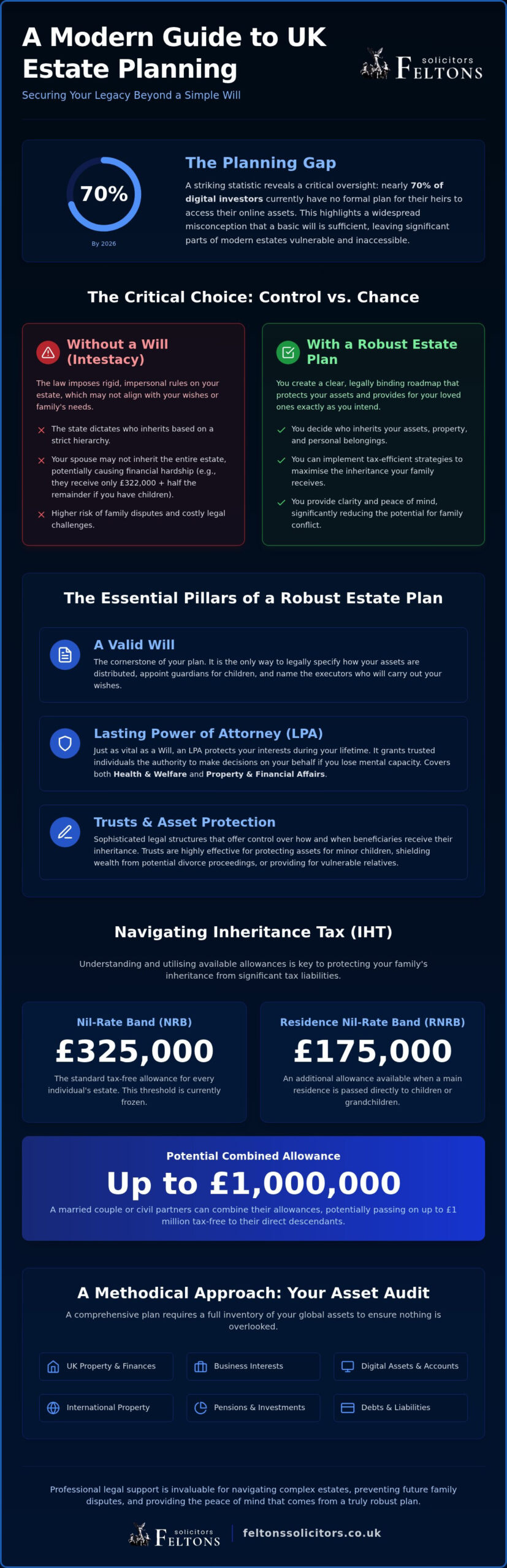
Did you know that in 2026, nearly 70% of digital investors still have no formal plan for their heirs to access their online assets? It is a striking figure that highlights a broader, more unsettling truth; many people mistakenly believe a simple will is enough to protect their life’s work. You likely feel a deep sense of responsibility to ensure your hard-earned assets reach the right hands. However, the fear of the state claiming a significant portion through Inheritance Tax remains a heavy burden. It’s natural to feel anxious about potential family disputes or confused by the technical gap between a basic will and a comprehensive estate planning strategy.
We believe your legacy is about more than just numbers. It is about the people you love and the values you have built. This guide provides a sophisticated roadmap to securing your assets and ensuring your family’s future remains legally protected. We will explore how to minimise tax liabilities under current thresholds, such as the frozen £325,000 nil-rate band, and provide clarity on protecting vulnerable beneficiaries. From the intricacies of the Residence Nil-Rate Band to the upcoming 2027 changes to pension taxation, we’ll help you find the peace of mind that comes from a truly robust plan.
Key Takeaways
- Understand why estate planning is a comprehensive legal strategy that goes far beyond a simple will to include lifetime gifts and protective powers of attorney.
- Identify the essential pillars of a robust plan, focusing on how a valid Will and a Lasting Power of Attorney work together to safeguard your interests.
- Learn how to navigate the complexities of Inheritance Tax by utilising the Nil-Rate Band and the Residence Nil-Rate Band to protect your family’s inheritance.
- Discover a methodical approach to auditing your global assets, including digital accounts and international property, to ensure nothing is overlooked.
- Recognise the value of a boutique legal partner in managing complex estates and preventing future family disputes or costly litigation.
Defining Estate Planning in the Modern UK Context
Estate planning is a holistic legal and financial strategy designed to manage your assets during your lifetime and ensure their orderly distribution after your death. It is far more than just drafting a document; it is a methodical process that aligns your personal values with the practicalities of the law. By creating a comprehensive overview of estate planning, you establish a clear roadmap that protects your legacy from unnecessary tax burdens and legal ambiguity. Most importantly, it serves as a vital safeguard against the rigid, impersonal rules of intestacy, which apply when no valid plan is in place.
Beyond the Will: A Holistic Legal Strategy
Whilst a Will is the cornerstone of any legacy, it often isn’t enough to address the complexities of modern life. If you own a business, hold international assets, or have a blended family structure, a standard Will might leave significant gaps. Effective estate planning incorporates wider tools such as lifetime gifting, trusts, and the registration of Lasting Powers of Attorney. These mechanisms do more than just distribute wealth; they protect it. A well-structured plan can help shield assets from being depleted by care home costs or becoming entangled in divorce proceedings within the family. Because legislation evolves, having a dedicated solicitor ensures your strategy remains compliant with current tax laws and legal precedents.
The Risks of Inaction: Intestacy and Legal Uncertainty
Dying “intestate” means the state determines who inherits your estate based on a fixed hierarchy, regardless of your personal relationships or intentions. Under current rules in England and Wales, if you die without a Will and have a spouse and children, your partner is entitled to personal belongings and a statutory legacy of £322,000. They only receive half of the remaining estate, with the other half going to your children. This often creates unintended financial hardship and emotional distress. Without professional guidance, the risk of contentious probate disputes increases significantly. A clear, legally binding plan reduces this burden on grieving relatives, providing them with the certainty and peace of mind they need during a difficult time. It prevents the state from becoming the default architect of your family’s future.
The Essential Pillars of a Robust Estate Plan
A successful approach to estate planning relies on several interconnected legal instruments. Relying on a single document is like building a house without a roof; it might look complete, but it won’t withstand the elements. Beyond the Will, which acts as your primary instruction manual, you must consider tools that protect you whilst you’re still alive and others that manage your wealth long after you’ve gone. These pillars provide a framework that ensures your wishes are followed precisely, regardless of what the future holds.
The foundation is a valid Will. It is the only way to ensure your assets are distributed exactly as you intend. Without it, your estate is subject to the rigid rules of intestacy. To support this, many people also include a Letter of Wishes. This is a non-binding document that provides your executors with personal guidance on matters such as funeral arrangements or the specific distribution of sentimental items. It adds a human touch to the clinical precision of a legal Will.
Lasting Power of Attorney: Protecting Your Interests During Life
An LPA is arguably as vital as a Will. It grants a person you trust the authority to make decisions on your behalf if you lose mental capacity. There are two distinct types: Health and Welfare, and Property and Financial Affairs. Many younger professionals and business owners overlook this, assuming it’s a concern for the distant future. However, if an accident or illness leaves you unable to manage your business interests or personal bank accounts, your family could face a costly application to the Court of Protection. The legal process of registering an LPA with the Office of the Public Guardian takes time, so it’s a step that should be taken whilst you are fit and healthy. If you’re unsure where to start, you can organise your estate planning with the help of a specialist to ensure every base is covered.
Trusts and Asset Protection: Sophisticated Legacy Management
Trusts are sophisticated legal vehicles that allow you to dictate how and when beneficiaries receive their inheritance. They are particularly effective for protecting minor children or vulnerable relatives who might struggle to manage a large lump sum. For those with complex property portfolios, trusts can help manage the transition of ownership across generations whilst potentially offering protection from third-party claims. If your estate includes international property, you must also be aware of the overseas entity beneficial owner registration requirements to ensure your holdings are compliant with current UK law. Whilst your executors will eventually follow official probate guidance to settle your affairs, having these structures in place now reduces the administrative and emotional burden they will face later.
Navigating Inheritance Tax (IHT) and Exemptions
Inheritance Tax is often the most significant concern for those embarking on estate planning. It can feel like a silent partner in your financial life, waiting to claim a portion of what you have worked to build. Currently, the standard Nil-Rate Band remains frozen at £325,000 until April 2031. However, many homeowners can also benefit from the Residence Nil-Rate Band (RNRB), which provides an additional £175,000 allowance when passing a main residence to direct descendants. Understanding these Inheritance Tax thresholds and rules is the first step toward mitigation. For married couples or civil partners, these allowances are transferable, potentially creating a combined tax-free threshold of £1 million.
Reliefs and exemptions play a critical role in sophisticated planning. Transfers between spouses are generally tax-free, and leaving at least 10% of your net estate to charity can reduce your overall IHT rate from 40% to 36%. For business owners, Business Property Relief (BPR) is an essential tool. As of April 6, 2026, 100% relief for business and agricultural assets is capped at a combined £2.5 million per individual. Above this threshold, relief is reduced to 50%, making precise valuation and early advice vital for those with significant commercial interests. For estates valued at more than £2 million, the RNRB is also tapered, reducing by £1 for every £2 that the estate exceeds the threshold.
Strategic Gifting and the Seven-Year Rule
Gifting assets during your lifetime is an effective way to reduce the taxable value of your estate. Most significant gifts are considered Potentially Exempt Transfers (PETs), which only become entirely tax-free if you survive for seven years after making the gift. You must be cautious of the ‘Gift with Reservation of Benefit’ rule. You cannot, for example, gift your family home to your children whilst continuing to live there rent-free, as HMRC will still view it as part of your estate. You can, however, utilise your annual £3,000 gift allowance or make small gifts of up to £250 per person each tax year without any IHT implications.
Life Insurance and Pensions in Estate Planning
Pensions have traditionally been one of the most tax-efficient ways to pass on wealth, as they usually sit outside your estate for IHT purposes. However, from April 6, 2027, most unused defined-contribution pension pots will become subject to Inheritance Tax, a change that will affect thousands of families. Life insurance policies should also be managed with care; by writing a policy in trust, the payout goes directly to your beneficiaries rather than forming part of your legal estate. If your circumstances involve complex family dynamics or former partners, consulting a divorce and financial arrangements lawyer ensures your tax strategy doesn’t conflict with existing legal obligations.
The Estate Planning Process: A Methodical Approach
Transitioning from understanding legal tools to implementing them requires a disciplined, step-by-step methodology. Effective estate planning begins with a comprehensive audit of your entire financial landscape. This isn’t limited to your bank balance; it includes international property holdings, business interests, and outstanding liabilities. You must also identify your primary objectives. Are you prioritising maximum tax efficiency, the protection of a vulnerable relative, or the smooth continuity of a family business? Clear goals determine which legal structures will serve you best and provide the necessary certainty for your executors.
Assessing Your Global Assets and Liabilities
We recommend creating what many call an “Estate Bible”. This is a secure, centralised record for your executors that lists every account, insurance policy, and property you own. For those with significant real estate interests, working with a residential property law firm ensures that complex title issues or leasehold extensions are resolved before they become probate problems. Don’t forget your digital legacy. With 85.6% of digital investors failing to include online assets in their Wills as of 2026, ensuring access to cryptocurrency, social media, and cloud-stored photos is a critical modern requirement that prevents your digital life from being locked away forever.
Preventing Contentious Probate and Family Disputes
The human cost of a poorly drafted plan often manifests in painful family conflict. Contentious probate is on the rise, but professional oversight can significantly reduce the likelihood of a successful challenge. Precise drafting and the inclusion of objective explanations for your decisions help manage expectations and discourage legal disputes amongst beneficiaries. We often use “no-contest” clauses or detailed solicitor’s file notes as vital evidence of your mental capacity and intentions at the time of signing. This level of detail provides a robust shield for your executors, ensuring your wishes are followed whilst protecting your loved ones from the trauma of litigation.
Once your documents are executed, your plan shouldn’t sit in a drawer gathering dust. Review your affairs at least every five years or following major life events such as marriage, divorce, or the birth of grandchildren. Legislation and personal circumstances change, and your strategy must evolve alongside them to remain effective. To begin your own methodical review and ensure your affairs are in order, you can contact our estate planning team for a discreet, professional consultation.
Professional Legal Support: The Feltons Solicitors Approach
Feltons Solicitors LLP understands that legal documents are only as effective as the strategy behind them. Since our establishment in 2010 by Paula Felton, we’ve prioritised a boutique level of care that high-volume firms often struggle to replicate. We combine traditional professional integrity with modern efficiency to ensure your affairs are handled with the discretion they deserve. Our people-first philosophy means we never lose sight of the human impact of our work. Whether we’re drafting a simple Will or managing complex international litigation, our focus remains on providing a calm, steady presence. We act as a sophisticated guide, navigating you through the nuances of the law whilst ensuring your personal connection to the firm remains at the heart of our service.
A Discreet, Boutique Service for Complex Estates
High-net-worth individuals often face unique challenges that require more than a template-driven approach. We specialise in providing tailored solutions for those with intricate family structures or diverse asset portfolios across multiple jurisdictions. Having a single point of contact who understands your entire history is invaluable; it ensures that your estate planning remains cohesive and aligned with your long-term vision. For those seeking deeper insights into legacy protection, our complete guide to estate planning offers further details on how we safeguard complex holdings. We handle everything from residential conveyancing to the registration of overseas entities, ensuring no part of your global footprint is left exposed to unnecessary risk or tax liability.
Securing Your Future with Pragmatic Legal Advice
Choosing the right solicitor is the most important decision you’ll make in this process. We’re committed to providing pragmatic advice in plain English, avoiding the dense, archaic legalese that often leads to confusion. Our professional fees are transparent and fair, ensuring you feel in control of the process from the very first meeting. The initial consultation is designed to be a thorough yet reassuring experience where we listen to your concerns and map out a bespoke strategy. We believe that estate planning shouldn’t be a source of anxiety; it should be a source of confidence. Our firm is deeply rooted in the community yet possesses the worldly experience necessary to handle international-scale matters with ease. Take the first step towards securing your family’s future and achieving true peace of mind today.
Secure Your Legacy with Certainty and Care
Effective estate planning is about more than just wealth; it’s about providing your family with a clear, conflict-free future. By addressing the essential pillars, from robust Wills to Lasting Powers of Attorney, and navigating the frozen £325,000 Nil-Rate Band, you ensure your assets remain in the right hands. A methodical audit of your global and digital holdings prevents the state from becoming the default architect of your family’s inheritance and ensures your wishes are followed precisely.
Established in 2010 by Paula Felton, Feltons Solicitors LLP specialises in complex property and private client law. We provide pragmatic, people-first legal advice tailored to your unique circumstances. Whether you’re managing a domestic estate or intricate international interests, we act as your trusted advisor to ensure every legal detail is meticulously handled. Take the first step towards true peace of mind and contact Feltons Solicitors LLP for a discreet estate planning consultation. You’ve worked hard to build your legacy; now, let us help you protect it for the generations to come.
Frequently Asked Questions
What is the difference between a will and estate planning?
A Will is a specific legal document that dictates how your assets are distributed after death, whilst estate planning is a comprehensive strategy for managing your affairs during your lifetime and beyond. It encompasses a wider range of tools, including Lasting Powers of Attorney, trusts, and tax mitigation tactics. Whilst a Will is the foundation, a full plan ensures that your financial, legal, and personal interests are protected against unforeseen circumstances like incapacity or excessive tax liabilities.
How much can I leave to my children before they pay Inheritance Tax?
Under current 2026 rules, an individual can typically leave up to £500,000 to their children tax-free by combining the £325,000 Nil-Rate Band with the £175,000 Residence Nil-Rate Band. For married couples or civil partners, these allowances are transferable, allowing for a combined threshold of up to £1 million. Anything above these limits is generally taxed at 40%, unless specific exemptions or charitable reliefs apply to the remainder of the estate.
Do I need a solicitor for estate planning, or can I do it myself?
Whilst you can legally draft your own documents, professional legal oversight is strongly recommended for anyone with complex assets, business interests, or international property. A solicitor ensures that your documents are technically valid and structured to minimise tax liabilities effectively. Professional guidance also provides vital evidence of mental capacity and intent, which significantly reduces the likelihood of your wishes being challenged through contentious probate litigation later.
What happens to my estate if I do not have a will?
If you die without a Will, your estate is distributed according to the rigid rules of intestacy rather than your personal wishes. In England and Wales, a surviving spouse is entitled to all personal belongings, a statutory legacy of £322,000, and half of the remaining estate. The other half is divided amongst your children. This often creates financial uncertainty and may leave unmarried partners with no automatic inheritance rights at all.
Can estate planning protect my home from being sold for care home fees?
Certain legal structures, such as life interest trusts or severing a joint tenancy, can help protect a portion of your home’s value for your beneficiaries. However, you must be cautious of ‘deprivation of assets’ rules, where the local authority may challenge transfers made specifically to avoid care costs. Because this area of law is highly nuanced, it requires a bespoke approach to ensure your plan is both effective and legally compliant.
How often should I review my estate plan and will?
We recommend reviewing your estate plan and Will at least every five years to ensure they still reflect your wishes and current legislation. You should also update your documents immediately following major life events, such as marriage, divorce, or the birth of a child. Significant changes in your financial situation, such as purchasing international property or starting a business, also necessitate a professional review to maintain the plan’s effectiveness.
What is a Lasting Power of Attorney and why is it part of estate planning?
A Lasting Power of Attorney (LPA) is a legal document that appoints trusted individuals to make decisions on your behalf if you lose mental capacity. It is a vital part of estate planning because it protects your interests whilst you are still alive. Without an LPA, your family might have to undergo a costly and lengthy application to the Court of Protection to manage your bank accounts, business affairs, or health care needs.
Can I include my digital assets, like social media and cryptocurrency, in my estate plan?
Yes, you should absolutely include digital assets like cryptocurrency, social media accounts, and online photo libraries in your plan. As of 2026, a significant majority of people still haven’t made provisions for their digital legacy, which can lead to these assets being lost forever. Including a specific digital asset clause and providing your executors with clear instructions on how to access these platforms is now an essential part of modern legacy protection.