
What if the future of your family’s financial security depended entirely on which country’s court received your paperwork first? For families with global connections, the “race to issue” is a high-stakes reality that can dictate the outcome of a divorce for years to come. When your life spans multiple borders, the complexity of conflicting legal systems often leads to profound anxiety and confusion. Working with experienced international family law solicitors ensures that you aren’t just reacting to events, but proactively managing them. It’s natural to feel overwhelmed by the prospect of competing jurisdictions or the fear of a less favourable legal landscape.
We understand that your primary concern is securing a clear, pragmatic strategy for your financial settlements and, most importantly, the welfare of your children. This guide provides expert insight into navigating international divorce proceedings, child relocation challenges, and the nuances of cross-border asset protection. You’ll learn how to establish the most advantageous jurisdiction whilst maintaining the discreet, professional approach your private matters require. Feltons Solicitors LLP will examine the essential steps to safeguard your family’s interests across international lines and provide a steady hand through these complex legal transitions.
Key Takeaways
- Understand the critical roles of ‘habitual residence’ and ‘domicile’ in determining which court has the authority to oversee your family law matters.
- Identify the most effective strategies for protecting complex global assets and navigating the nuances of international financial settlements.
- Partnering with expert international family law solicitors london ensures that the welfare of your children remains the primary focus during cross-border relocation disputes.
- Learn how to draft international nuptial agreements that offer robust protection and remain enforceable across various legal jurisdictions.
- Discover the benefits of a boutique legal service that prioritises personal discretion and provides specialised expertise in the Registration of Overseas Entities.
What is International Family Law and Why Jurisdiction Matters
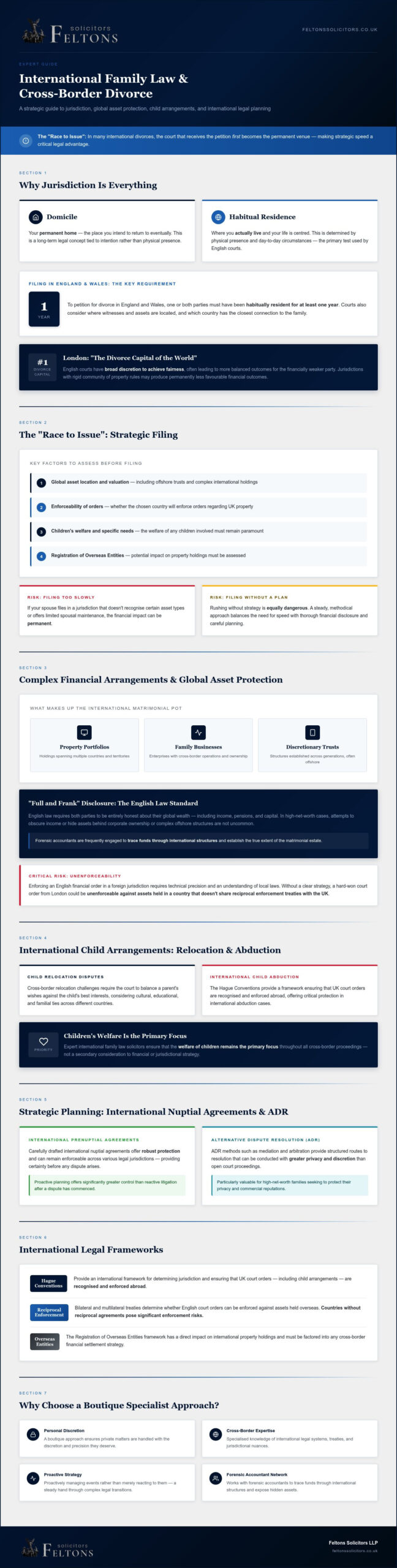
International family law governs legal matters where a family has connections to more than one country. This might involve a couple of different nationalities, a family living abroad, or assets located in multiple territories. At the heart of these cases are two legal anchors: habitual residence and domicile. Domicile is your permanent home, the place you intend to return to eventually. Habitual residence is where you actually live and your life is centred. Identifying these correctly is the first task for international family law solicitors london, as they dictate which country’s laws will govern your future.
Choosing the right forum isn’t just a technicality; it’s a decision that shapes your financial settlement and your children’s arrangements. London is often referred to as the “divorce capital of the world” because English courts have a broad discretion to achieve fairness, often leading to more balanced outcomes for the financially weaker party. If you lose the “race to issue” and the case proceeds in a jurisdiction with rigid community of property rules, the financial impact can be permanent. A boutique approach ensures these nuances are handled with the discretion and precision they deserve.
Determining Which Country Has Jurisdiction
To file for divorce in England and Wales, you must establish a legal connection to the jurisdiction. Usually, this means one or both parties have been habitually resident here for at least a year. If two countries could potentially handle the divorce, the court must decide which is the most appropriate place for the trial. This decision involves looking at where the witnesses are, where the assets are located, and which country has the closest connection to the family. International treaties, such as the Hague Conventions, provide a framework for these decisions, ensuring that UK court orders are recognised and enforced abroad.
The ‘Race to Issue’: Strategic Filing
In many international cases, the court that issues the petition first becomes the permanent venue for the divorce. This makes speed a vital component of your legal strategy. If your spouse files in a jurisdiction that doesn’t recognise certain types of assets or has limited spousal maintenance, you could be at a significant disadvantage. Experienced international family law solicitors london will prioritise securing the most favourable jurisdiction whilst protecting your privacy. However, rushing without a plan is equally dangerous. You must consider several factors before filing:
- The location and valuation of global assets, including offshore trusts.
- Whether the chosen country will enforce orders regarding UK property.
- The specific needs and welfare of any children involved.
- The potential for the Registration of Overseas Entities to impact property holdings.
Balancing the need for speed with thorough financial disclosure is essential. A steady, methodical approach allows for detailed planning, ensuring that your filing is both swift and strategically sound.
Complex Financial Arrangements and Global Asset Protection
Families with global connections often hold wealth in intricate structures that span multiple continents. This isn’t just about shared bank accounts; it’s about property portfolios, family businesses, and discretionary trusts that may have been established generations ago. Identifying the true extent of the matrimonial pot is the first major hurdle in any cross-border case. Professional international family law solicitors london work to ensure these assets are correctly identified, categorised, and valued according to current market conditions. Enforcing an English financial order in a foreign jurisdiction requires technical precision and an understanding of local laws. Without a clear strategy, a hard-won court order from London could be unenforceable against assets held in a country that doesn’t share reciprocal enforcement treaties with the UK.
Disclosure and Transparency in Cross-Border Cases
English law demands “full and frank” disclosure. This means both parties must be entirely honest about their global wealth, including income, pensions, and capital. In high-net-worth cases, it’s not unusual to see attempts to obscure income or hide assets behind layers of corporate ownership or complex offshore structures. We often work with forensic accountants to trace funds through international banking systems. A methodical approach ensures that the final settlement reflects the family’s actual financial reality rather than just what’s visible on the surface. Transparency is the only way to achieve a fair outcome for both parties.
Protecting UK Property Interests
For many international families, UK real estate is a central and highly valuable asset. The overseas entity beneficial owner registration has introduced a new level of transparency that directly impacts family law. Foreign companies owning UK land must now disclose their beneficial owners, making it much harder to shield property from matrimonial claims. Seeking advice from international family law solicitors london allows you to address these property concerns alongside the broader divorce strategy. Developing a clear strategy for protecting your assets during a divorce settlement is vital for your long-term security. If you’re managing cross-border assets, it’s helpful to partner with a firm like Feltons Solicitors LLP that offers specialised expertise in both family law and the registration of overseas entities.
International Child Arrangements: Relocation and Abduction
Whilst financial settlements are technically complex, the most sensitive challenges in cross-border cases involve the future of your children. In the UK, the court’s primary consideration is the “welfare principle.” This means any decision made must be in the child’s best interests, above all other factors. When families have ties to multiple countries, disputes often arise regarding where a child should live or how they will maintain a relationship with a parent residing abroad. Working with specialist international family law solicitors london provides the necessary clarity to manage these delicate situations whilst ensuring your child’s emotional and physical security remains the priority.
Preventative measures are often essential for families with significant global mobility. If there’s a risk that a child might be removed from the jurisdiction without consent, a Prohibited Steps Order can be sought to prevent travel. In some instances, the court may order the surrender of passports to the Tipstaff or another neutral party. These steps are not about creating conflict; they are about establishing a steady and secure framework that protects the child’s stability during a period of transition.
Seeking Permission to Relocate
Moving a child abroad permanently, known as “leave to remove,” requires either the written consent of every person with parental responsibility or a court order. The court examines a relocation proposal with extreme care. You must provide a detailed plan that covers housing, schooling, healthcare, and, crucially, how the child will maintain a meaningful relationship with the parent remaining in the UK. Opposing a relocation application requires showing that the move would be detrimental to the child’s welfare rather than simply inconvenient for the parent. It’s a rigorous process where the quality of your evidence and the viability of your future plans are under constant scrutiny.
Responding to International Child Abduction
If a child is removed from the UK without consent, or kept abroad beyond an agreed holiday, it’s considered international child abduction. This is a legal emergency that requires immediate action. For countries that are signatories to the Hague Convention, there’s a clear legal framework designed to return children to their country of habitual residence as quickly as possible. We work closely with the Central Authority to initiate these proceedings. In cases involving non-signatory countries, the process is more complex and often involves wardship proceedings in the High Court. Whatever the destination, acting within the first 24 to 48 hours is often critical to a successful return. Expert international family law solicitors london can guide you through these high-pressure moments with the quiet confidence and technical skill required to secure your child’s safe return.
Strategic Planning: International Prenups and ADR
Forward-thinking families often choose to manage potential legal complexities long before a dispute arises. For those with international assets or diverse nationalities, a well-drafted nuptial agreement is a vital tool for financial security. Whether it’s a prenuptial agreement before marriage or a postnuptial agreement during the relationship, these documents provide a clear framework for asset division. Working with international family law solicitors london allows you to address the specific requirements of the English legal system whilst considering the laws of other relevant countries. This proactive approach reduces uncertainty and protects your family’s future.
International Nuptial Agreements
In England and Wales, the landmark ruling of Radmacher v Granatino significantly changed how courts view prenups. Whilst they aren’t strictly binding in the same way as a commercial contract, the court will usually uphold them if they were entered into freely and both parties understood the implications. For international families, the document must be enforceable in every country where you hold significant assets. This requires independent legal advice from qualified solicitors in each relevant jurisdiction. We ensure that your agreement includes specific clauses addressing global property, offshore interests, and choice of law provisions to prevent future jurisdictional battles.
Dispute Resolution Outside the Courtroom
Litigation isn’t the only path, and for many high-profile families, the public nature of the Family Court is a significant concern. Alternative Dispute Resolution (ADR) offers a discreet, private, and often more cost-effective way to settle cross-border matters. Mediation allows couples to reach a bespoke agreement through facilitated discussion, which is particularly helpful when managing complex child arrangements across borders. Arbitration provides a faster alternative, where a private judge makes a binding decision in a confidential setting. This level of privacy is a hallmark of the boutique service we provide.
Collaborative law is another effective strategy. In this process, both parties and their lawyers commit to reaching a settlement without going to court. It fosters a more cooperative environment, which is invaluable for preserving long-term family relationships. If you’re looking to protect your interests through a tailored legal strategy, you can contact our international family law solicitors london to discuss your options. Choosing the right method of resolution can save significant time and emotional energy whilst securing a result that respects your family’s unique global circumstances.
Why Choose Feltons for International Family Law?
Choosing the right legal partner is a decision that impacts your privacy, your finances, and your family’s future stability. Feltons Solicitors LLP provides a boutique level of care that prioritises personal connection over high-volume processing. As international family law solicitors london, we offer a calm, steady presence in the face of complex cross-border challenges. Established in 2010 by Paula Felton, our firm combines traditional professional integrity with modern efficiency to deliver a service that feels both grounded and current. We act as a discreet partner for high-net-worth individuals who require pragmatic, plain-English advice that cuts through the noise of international legal systems.
Discreet and Tailored Legal Support
We manage high-stakes cases with a quiet confidence that reassures our clients during stressful transitions. You won’t be passed between departments; instead, you’ll work with a dedicated solicitor who understands the full context of your global life. This continuity is essential for maintaining the high standards of reliability our clients expect. Our commitment to a “people-first” philosophy ensures that whilst the technical legal work is paramount, the human impact is never forgotten. We value the personal rapport that comes with a boutique firm, providing a tailored experience that larger, more impersonal practices often struggle to match.
A Multidisciplinary Perspective
Our strength lies in the seamless integration of family law, property law, and estate planning. For international families, these areas are often inseparable. We uniquely offer specialised expertise in the Registration of Overseas Entities, a critical service for those with UK property interests held through foreign structures. This multidisciplinary approach allows us to handle complex financial disputes whilst simultaneously protecting your broader legacy. Our worldly experience is balanced with a community-conscious ethos, making us a trusted advisor for families navigating the complexities of modern life.
- Pragmatic advice that focuses on realistic, achievable outcomes.
- Discreet management of sensitive private client matters.
- Worldly experience applied to local and international litigation.
- Clear, transparent communication without dense legalese.
If you’re ready to discuss your circumstances, our team is here to provide the steady guidance you need. We invite you to begin your consultation with our international family law solicitors london to develop a strategy that secures your interests across every border.
Securing Your Family’s Global Future
Managing a life that spans multiple borders requires more than just technical legal knowledge; it demands a strategy that respects the human impact of every decision. We’ve explored how establishing the correct jurisdiction and identifying global assets are vital steps in protecting your financial security. Whether you’re navigating the complexities of international child relocation or drafting a nuptial agreement that stands up in multiple courts, having a steady hand to guide you makes all the difference. Our boutique approach ensures that your privacy is maintained whilst we apply our specialised expertise in matters like the registration of overseas entities to your unique situation.
Expert international family law solicitors london provide the clarity needed to turn confusion into a coordinated plan of action. At Feltons Solicitors, our pragmatic, client-first philosophy means we cut through international complexity with plain-English advice and quiet confidence. You don’t have to face these cross-border challenges alone. We invite you to contact Feltons Solicitors for a discreet consultation on your international family matter. With the right support, you can move forward with certainty and protect the things that matter most to your family.
Frequently Asked Questions
How do I know if the UK court has jurisdiction over my international divorce?
You can file for divorce in England and Wales if you or your spouse meet specific criteria regarding habitual residence or domicile. Usually, this requires one party to have lived here for at least 12 months. Identifying these legal anchors is a primary task for international family law solicitors london. The court will assess where your life is centred and where you intend to remain permanently before confirming it has the authority to proceed with your case.
Can I stop my ex-partner from moving our child abroad?
If you believe your child is at risk of being moved abroad without your consent, you can apply to the court for a Prohibited Steps Order. This legal safeguard prevents a parent from removing a child from the jurisdiction. UK courts prioritise the child’s welfare above all else. In urgent situations, your solicitor can seek an emergency order or request the surrender of passports to ensure the child remains secure whilst arrangements are finalised.
What happens to our overseas property during a UK divorce settlement?
English courts have the power to include global assets, including foreign real estate and offshore trusts, within the matrimonial pot for division. Whilst the court can make orders regarding these assets, enforcing those orders in a foreign territory depends on reciprocal treaties. We often utilise our expertise in the Registration of Overseas Entities to ensure transparency regarding property ownership, helping to secure a fair and pragmatic financial settlement for our clients during these complex negotiations.
Are international prenuptial agreements legally binding in England?
Prenuptial agreements are not automatically binding in England and Wales, but they carry significant weight following the Radmacher v Granatino ruling. For an international agreement to be upheld, it must be entered into freely by both parties with a full understanding of its implications. It’s essential that each person receives independent legal advice in both relevant countries. This ensures the document is robust enough to be considered fair and enforceable by the court when assets are divided.
What is the ‘race to issue’ and why is it important in family law?
The ‘race to issue’ refers to the strategic advantage gained by being the first to file a divorce petition in a favourable jurisdiction. In many international cases, the court that receives the paperwork first will retain the case. This is vital because financial outcomes vary significantly between countries. Acting quickly with the support of international family law solicitors london ensures you don’t lose the opportunity to have your case heard in the most appropriate and beneficial forum.
How long does an international divorce usually take compared to a domestic one?
International divorces typically take longer than domestic cases due to the additional layers of complexity involved. Delays often arise from the need to serve legal documents across borders, value assets in multiple currencies, or resolve disputes over which country has jurisdiction. Whilst a standard UK divorce might take six to nine months, a cross-border case involving complex financial arrangements or child relocation can extend significantly beyond this timeframe as essential international evidence is gathered and verified.
Can I enforce a UK child maintenance order if my ex-partner lives abroad?
You can often enforce a UK maintenance order through the Reciprocal Enforcement of Maintenance Orders (REMO) system. This international agreement allows UK orders to be recognised and enforced in many other countries. If your ex-partner lives in a REMO signatory nation, the court in that jurisdiction can take steps to collect payments on your behalf. Our team provides pragmatic advice on how to navigate these international frameworks to ensure your family’s financial interests are protected effectively.
Do I need a solicitor in both countries for an international family law case?
It is often necessary to engage legal representation in both jurisdictions to ensure your interests are fully protected. Whilst your UK solicitor manages the proceedings in England and Wales, a local lawyer in the other country can advise on local property laws or the enforcement of financial orders. We frequently coordinate with international legal professionals to provide a seamless strategy, ensuring every aspect of your cross-border case is handled with professional authority and discretion.