

Could the financial and emotional cost of challenging a will eventually eclipse the value of the estate itself? It is a question that haunts many families facing inheritance disputes, especially as the probate application fee in England and Wales rose to £526 in July 2026. When you’re already dealing with the weight of grief, the added pressure of legal uncertainty can feel overwhelming. Finding the right contested probate lawyers uk is about more than just legal representation. It is about securing a steady, expert hand to guide you through a sensitive period with clarity and poise.
We understand that your primary goal is a fair resolution that respects the deceased’s wishes whilst protecting your own interests. This guide provides the pragmatic legal advice you need to navigate complex claims, from questioning testamentary capacity to addressing the removal of a problematic executor. You’ll discover how specialist mediation and a people-first approach can resolve even the most fractious disputes without the necessity of a high-cost court trial. We will explore the essential steps to take, the strict six-month time limits for certain claims, and how to achieve a distribution of assets that is both just and final.
Key Takeaways
- Understand the critical distinction between challenging the validity of a Will and disputing the administration of an estate to determine the correct legal path.
- Learn how “Lack of Testamentary Capacity” is assessed using the Banks v Goodfellow test to evaluate the strength of your potential claim.
- Discover how to use a Caveat to pause the probate process, allowing specialist contested probate lawyers uk to investigate concerns before assets are distributed.
- Identify the specific legal duties of executors and the available remedies for resolving disagreements or removing a problematic administrator from their role.
- Explore pragmatic dispute resolution methods, such as mediation, that aim to protect the estate’s value and avoid the emotional strain of a full court trial.
Understanding Contested Probate in the UK
Contentious probate is a broad term describing legal disagreements regarding a deceased person’s estate. These disputes are inherently sensitive; they often occur at a time when emotions are high and family dynamics are already strained. Understanding Contested Probate in the UK requires a clear view of the legal frameworks that govern how assets are distributed and how a person’s final wishes are honoured. When these processes falter, seeking guidance from specialist contested probate lawyers uk becomes essential to ensure the estate is protected from depletion or mismanagement.
Triggers for these disputes vary significantly amongst different families. They might involve a sudden, unexpected change to a Will shortly before death, or perhaps an executor who fails to communicate with beneficiaries. Regardless of the specific cause, the primary objective remains the same: a fair and lawful resolution that reflects the true intentions of the deceased whilst preserving the value of the inheritance for those entitled to it.
Contesting a Will vs. Contested Probate
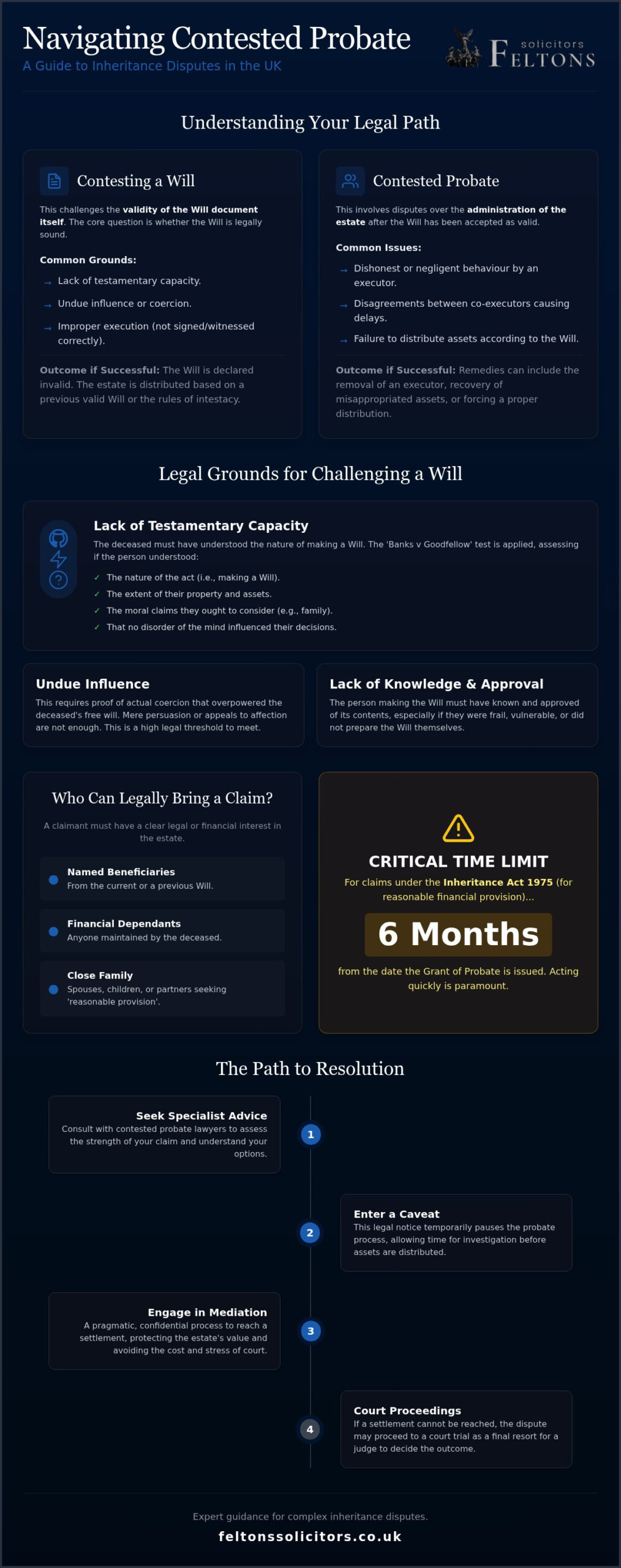
It is a common misconception that contesting a Will and contesting probate are identical. They are distinct legal challenges that require different strategies. Contesting a Will focuses specifically on the validity of the document itself. Grounds for this might include a lack of testamentary capacity, improper execution, or undue influence. If a Will is found invalid, the estate is usually distributed according to a previous, valid Will or the rules of intestacy.
In contrast, contested probate involves disputes that arise during the administration process. This typically happens after the Grant of Probate has been issued. You might find yourself in this position if an executor is behaving dishonestly, or if there is a disagreement amongst co-executors that brings the entire process to a standstill. Understanding this distinction is vital; it dictates whether you are challenging the “what” (the document) or the “how” (the administration).
Who Can Legally Bring a Claim?
The law is specific about who has the standing to bring a claim against an estate. It is not open to anyone. There must be a clear legal or financial interest involved. Generally, the following parties may have grounds to act:
- Named Beneficiaries: Individuals mentioned in the current Will or a previous version who stand to lose out due to recent changes or administration errors.
- Financial Dependants: Those who were being maintained, either wholly or partly, by the deceased immediately before their death.
- Close Family: Spouses, civil partners, or children who feel the Will fails to make “reasonable financial provision” for them under the Inheritance Act 1975.
Acting quickly is paramount. Whilst some claims have no statutory time limit, others, such as those brought under the Inheritance Act, must be issued within six months of the Grant of Probate. Professional contested probate lawyers uk can help you identify your standing and the relevant deadlines before the estate’s assets are distributed beyond reach.
Legal Grounds for Challenging a Will or Estate
English law prioritises testamentary freedom, the principle that an individual should be free to leave their assets to whomever they choose. However, this freedom is not absolute. To successfully challenge a Will, a claimant must meet a high legal threshold that goes beyond simple disappointment or a sense of unfairness. The Legal Grounds for Challenging a Will or Estate are specific and require robust evidence to overturn a document that appears, on its face, to be validly executed.
Lack of testamentary capacity is one of the most frequent grounds for dispute. Courts apply the gold-standard Banks v Goodfellow test to determine if the deceased understood the nature of the act, the extent of their property, and the moral claims they were expected to consider. It isn’t enough to show that the deceased suffered from general frailty or a degree of confusion. The incapacity must have directly affected the specific provisions of the Will at the time it was drafted or signed.
Proving undue influence is significantly more challenging. It requires evidence of actual coercion, showing that the deceased’s “free will” was effectively overborne by another party. Mere persuasion, or what the courts call “appeals to affection,” is usually insufficient to invalidate a Will. This is where the discreet expertise of contested probate lawyers uk becomes invaluable. We help families piece together the subtle, circumstantial evidence required to demonstrate that a document does not reflect the testator’s true wishes.
Other technical grounds include a lack of valid execution, such as a Will not being signed in the presence of two witnesses, or proprietary estoppel. Estoppel applies when a person was promised an inheritance and relied on that promise to their significant financial or personal detriment. These cases are complex and require a methodical approach to gather the necessary witness statements and historical evidence.
The Inheritance (Provision for Family and Dependants) Act 1975
Even if a Will is technically valid, certain individuals can claim for “reasonable financial provision” under the Inheritance Act 1975. This typically applies to spouses, children, or those who were financially dependent on the deceased. The court weighs the claimant’s current and future financial needs against the deceased’s wishes and the interests of other beneficiaries. Specialist contested probate lawyers uk must act quickly in these matters, as there is a strict statutory time limit of six months from the date of the Grant of Probate to issue a claim.
Fraud, Forgery, and Lack of Knowledge and Approval
In rarer cases, a Will may be challenged on the basis of fraud or forgery. This involves proving that the document was altered or that the signature was not made by the deceased. Lack of knowledge and approval is a related ground, where it is argued that although the deceased signed the Will, they didn’t fully understand its contents. Building such a case often requires the involvement of handwriting experts and a meticulous review of medical records to establish the deceased’s state of mind and the circumstances surrounding the Will’s creation.
Disputes Regarding Executors and Estate Administration
An executor’s role is one of immense trust and legal responsibility. They are fiduciaries, meaning they must act in the best interests of the estate and its beneficiaries, setting aside personal preferences. However, when an executor is also a family member or a beneficiary, the lines between duty and emotion often blur. This friction is a common catalyst for litigation, requiring the intervention of contested probate lawyers uk to restore order and transparency. Without professional oversight, a simple administrative task can quickly spiral into a costly and protracted dispute.
Beneficiaries have a legal right to be kept informed throughout the process. This includes the right to request an “account” of the estate, which is a formal record of all assets, debts, and distributions. If an executor refuses to provide this information or is evasive about the estate’s value, it’s often the first red flag that the administration has gone off course. Transparency is the bedrock of estate management; when it’s withheld, trust evaporates.
Deadlock is another frequent issue, particularly amongst co-executors who cannot agree on key decisions. If two people are appointed to manage an estate but disagree on the sale price of a property or the valuation of sentimental items, the entire probate process can grind to a halt. This stalemate doesn’t just delay the distribution. It can actively diminish the estate’s value through mounting interest on unpaid Inheritance Tax or ongoing property maintenance costs. Specialist contested probate lawyers uk can provide the objective, pragmatic advice needed to break these deadlocks and move the administration forward.
Identifying Executor Misconduct
Misconduct isn’t always a deliberate act of theft. It often manifests as “passive” negligence or a lack of urgency. You might notice unreasonable delays in applying for probate or a persistent failure to respond to basic enquiries. More serious breaches include selling estate property at a significant undervalue to a favoured party or “borrowing” funds for personal use. Such actions constitute a clear breach of fiduciary duty. Executors must remember they are personally liable for any financial loss the estate suffers due to their negligence or dishonesty.
Removing or Replacing an Executor
If the relationship between beneficiaries and executors has broken down irretrievably, the court has the power to remove an executor. This is not a decision the court takes lightly. You must demonstrate that the executor is unfit for the role or that their continued presence is preventing the proper administration of the estate. A “Lack of Progress” is a valid ground, especially if it’s clear the executor is unable or unwilling to act. In many complex cases, appointing an independent professional executor is the most pragmatic way to resolve a stalemate, allowing family members to step back from the conflict.
The Legal Process: Timelines, Costs, and Resolution
Resolving an inheritance dispute is a methodical process. It requires a balance of tactical speed and patient negotiation. The first step often involves entering a caveat at the Probate Registry. This simple but effective action prevents the Grant of Probate from being issued for six months, effectively pausing the administration. It provides contested probate lawyers uk with the necessary time to investigate the merits of a claim without the risk of assets being distributed prematurely. Since the probate application fee rose to £526 in July 2026, pausing the process early can also prevent unnecessary administrative costs on a contested estate.
Once a caveat is in place, the next stage involves issuing a formal Letter of Claim. This document outlines the legal basis for the challenge and invites the other parties to respond. During this phase, we often request a “Larke v Nugus” statement. This is a detailed account from the solicitor who drafted the Will, providing crucial evidence regarding the deceased’s capacity and the circumstances surrounding the document’s creation. Gathering this information early is essential for building a robust case or, conversely, identifying when a claim may lack the necessary weight to proceed.
Most disputes don’t reach a courtroom. The legal system encourages parties to engage in negotiation and disclosure to find a middle ground. If you are facing an uncertain inheritance situation, seeking a consultation with specialist contested probate lawyers uk can help you establish a clear roadmap for resolution that protects both the estate’s value and your personal interests.
Statutory Time Limits for Probate Claims
Timing is critical in estate litigation. For claims brought under the Inheritance (Provision for Family and Dependants) Act 1975, there is a strict six-month window from the date the Grant of Probate is issued. If you miss this deadline, you may lose the right to claim altogether. Whilst challenges to a Will’s validity don’t have the same statutory limit, delaying can be fatal to a case. Assets may be sold, spent, or moved, making recovery difficult even if you eventually win your claim.
Mediation and Alternative Dispute Resolution (ADR)
Court proceedings should always be a final resort. Litigation is expensive and often depletes the very inheritance you’re trying to protect. Mediation offers a pragmatic alternative. It allows families to discuss grievances in a controlled, confidential environment led by an independent professional. Our contested probate lawyers uk prioritise these methods because they offer a faster resolution and are far more effective at preserving fragile family relationships than the adversarial nature of a trial. The courts now expect parties to have attempted ADR before seeking a hearing, often penalising those who refuse to mediate without a valid reason.
Expert Legal Representation for Complex Inheritance Disputes
Feltons Solicitors LLP provides a refined alternative to the impersonal, high-volume models often found in larger legal practices. Established in 2010, our firm has built a reputation for handling complex litigation with a blend of modern efficiency and traditional professional integrity. We understand that inheritance disputes are rarely just about the law; they’re deeply personal matters that require a calm, steady presence. As specialist contested probate lawyers uk, we act as a discreet partner, prioritising personal rapport and a “people-first” philosophy. This ensures that while the technical legal work is paramount, the human impact is never forgotten.
Pragmatic Advice for Beneficiaries and Executors
Our approach is built on providing pragmatic advice that avoids unnecessary court battles whenever possible. We don’t believe in litigation for the sake of it. Instead, we develop tailored strategies for both beneficiaries and executors, ensuring that every action taken is in the best interest of the estate’s long-term health. For executors, this often means defending against malicious or unfounded claims that threaten to drain the estate’s resources. We provide the robust support needed to uphold your fiduciary duties with confidence. To prevent such disputes from arising in the first place, we often advise clients on the importance of robust Estate Planning. It’s a proactive step that safeguards your legacy and ensures your wishes are articulated with absolute clarity, leaving no room for future ambiguity.
National Legal Support with a Boutique Approach
Although we maintain a boutique, approachable feel, our team possesses the worldly experience required to manage high-value and international-scale matters. We offer national legal support, representing clients across the UK who seek a higher standard of individualised care. By avoiding the factory feel of larger firms, we ensure that you’ll have direct access to senior expertise throughout your case. Our goal is always to reach a favourable settlement out of court, leveraging our litigation expertise to negotiate from a position of authority. This methodical and orderly mindset provides our clients with a sense of security during otherwise turbulent times. If you require a trusted advisor to resolve an estate dispute, we invite you to contact our expert probate solicitors for a confidential consultation. Our team of contested probate lawyers uk is ready to provide the clarity and support you need to move forward with confidence.
Securing a Fair Resolution for Your Future
Navigating an inheritance dispute requires a delicate balance of legal precision and emotional resilience. Success often depends on early intervention; this might involve entering a caveat to pause the process or identifying the specific legal grounds for a challenge before assets are distributed. By prioritising mediation and pragmatic dispute resolution, you can protect the estate’s value and avoid the long-term strain of adversarial court proceedings. Our team of contested probate lawyers uk is dedicated to providing the steady, expert guidance needed to resolve even the most complex matters with poise.
We offer a boutique service that ensures you receive direct, senior-level attention throughout your case. Whether you are dealing with a national dispute or a complex international estate, our litigation experience allows us to provide pragmatic advice tailored to your unique circumstances. Taking the first step toward clarity is often the most important. We invite you to discuss your case with our specialist contested probate lawyers to begin the process of reaching a just and final resolution. You don’t have to face these challenges alone; the right support can make all the difference in protecting your legacy.
Frequently Asked Questions
How long do I have to contest a probate in the UK?
Time limits vary depending on the nature of your claim. For challenges under the Inheritance (Provision for Family and Dependants) Act 1975, you must issue your claim within six months of the date the Grant of Probate was issued. Whilst there is no statutory time limit for challenging a Will’s validity on grounds of capacity or fraud, acting quickly is vital to prevent the estate from being fully distributed.
Can a Will be contested after probate has been granted?
Yes, you can contest a Will after probate is granted, though it is often more complex. Once the Grant of Probate is issued, executors are legally permitted to distribute assets. If you wait until after this stage, you may find that the inheritance has already been spent or moved, making recovery difficult even with the help of contested probate lawyers uk.
What are the most common grounds for contesting a Will?
Common legal grounds include lack of testamentary capacity, where the deceased did not understand their actions, and undue influence, where they were coerced. Other grounds include lack of knowledge and approval or improper execution of the document. These cases often rely on the Banks v Goodfellow test to determine if the testator was of sound mind at the time of signing.
How much does it cost to contest a probate or a Will?
The cost depends on the complexity of the dispute and the stage at which it is resolved. You will need to account for the probate application fee, which increased to £526 on 13 July 2026, alongside professional legal fees and potential court costs. Resolving a matter through mediation is almost always more cost-effective than proceeding to a full High Court trial.
Do I have to go to court to resolve an inheritance dispute?
No, court is generally considered a final resort for unresolved disputes. Most inheritance disagreements are settled through negotiation or Alternative Dispute Resolution (ADR), such as mediation. Courts now actively encourage parties to mediate, and failing to engage in this process can sometimes result in cost penalties, even for the winning party.
Can I remove an executor if they are taking too long?
You can apply to the court to remove an executor if they are failing in their duties or causing unreasonable delays. Whilst executors are generally given a “year and a day” to administer an estate, a total lack of progress or communication can be grounds for replacement. Appointing a professional administrator is often the most pragmatic way to break a stalemate between family members.
Who pays the legal fees in a contested probate case?
The general rule in litigation is that the “loser pays” the winner’s costs, but the court has wide discretion. In some instances, if the dispute arose due to the deceased’s own actions or an ambiguous Will, the court may order that legal fees are paid from the estate’s assets. Specialist contested probate lawyers uk can advise you on the likely cost risks of your specific case.
Can I contest a Will if I was not named in it?
Yes, you can contest a Will even if you were excluded from it entirely. If you are a spouse, child, or someone who was financially dependent on the deceased, you may be able to claim “reasonable financial provision” under the Inheritance Act 1975. Alternatively, you might challenge the Will’s validity to revert to an earlier version where you were named as a beneficiary.