
Complex Probate Solicitors: Navigating Intricate Estate Administration in 2026

Complex Probate Solicitors: Navigating Intricate Estate Administration in 2026

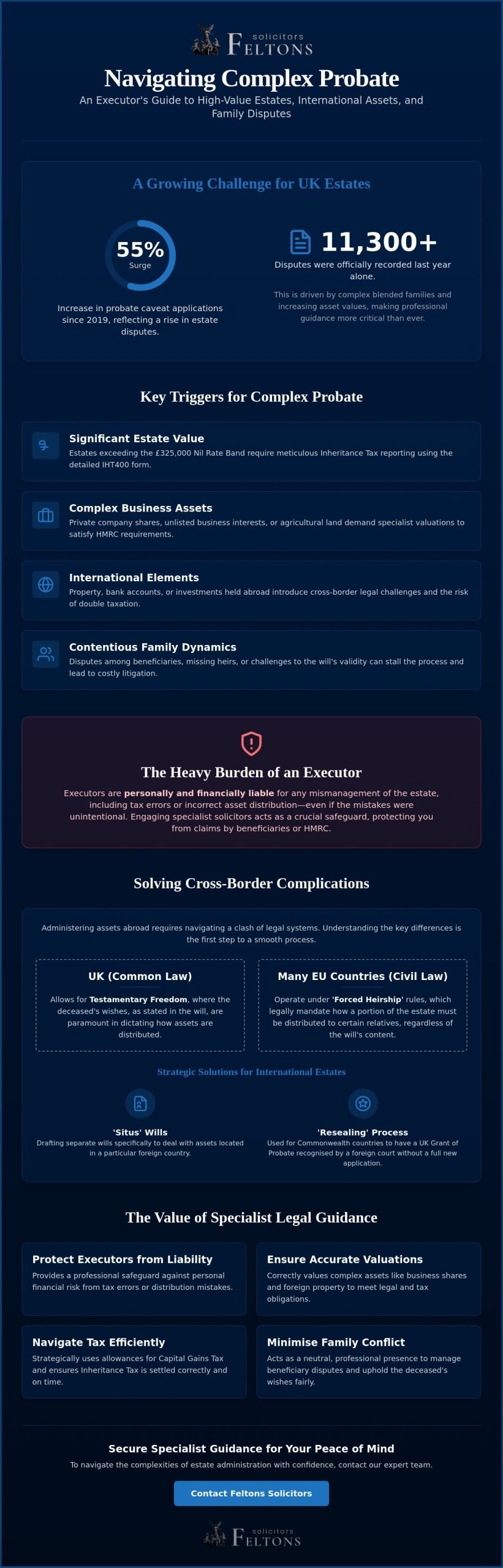
Did you know that probate caveat applications have surged by 55% since 2019, with over 11,300 disputes recorded last year? This sharp rise reflects a modern landscape where blended families and rising asset values make estate administration increasingly contentious. When you’re managing an estate that spans international borders or involves significant business interests, the margin for error is slim and the pressure is immense.

It’s natural to feel concerned about the personal liability that comes with potential tax errors or the emotional strain of family disagreements. You want to ensure that every asset is accounted for and every beneficiary is treated fairly, yet the technical hurdles can feel insurmountable. Specialist complex probate solicitors act as a steady, professional presence, taking the weight of these intricate responsibilities off your shoulders whilst providing much-needed clarity.

In this article, you’ll discover how expert legal guidance manages high-value assets and foreign jurisdictions to ensure a seamless probate process. We’ll outline the steps taken to protect you from liability, facilitate efficient asset distribution, and maintain clear communication during what can often be a long and challenging journey.

Key Takeaways

  • Identify the specific triggers that move an estate from standard administration into a complex legal landscape, including technical financial intricacies and multi-jurisdictional assets.
  • Explore the specialised processes required for valuing private business shares and managing the legalities of property held in foreign jurisdictions.
  • Understand how to handle modern family dynamics and potential disputes amongst beneficiaries, ensuring the deceased’s wishes are upheld whilst minimising conflict.
  • Master the financial nuances of the administration period, including the strategic use of Capital Gains Tax allowances and the timely settlement of Inheritance Tax.
  • Discover why engaging complex probate solicitors provides the discreet, high-standard guidance necessary to protect executors from personal liability and ensure a smooth distribution.

Probate is often viewed as a procedural necessity. For many families, however, the Probate process in the UK evolves into a multi-layered legal undertaking. Complexity isn’t merely about the volume of paperwork; it arises when the estate’s composition involves technical, financial, or legal intricacies that exceed the scope of a standard Grant of Representation. Whilst administrative difficulty refers to the time taken to gather assets, complex probate involves navigating conflicting laws, high-stakes valuations, and nuanced tax obligations.

Engaging complex probate solicitors is often the difference between a stalled application and a successful distribution. Standard DIY approaches frequently falter when executors encounter HMRC ‘long-form’ accounts, known as the IHT400. These forms require a level of forensic detail that goes far beyond simple bank balances. They demand precise reporting of lifetime gifts, trust interests, and foreign holdings. Without specialist oversight, the risk of professional negligence or significant tax penalties increases.

Common Triggers for Complex Estate Administration

Several factors can elevate a case into the complex category. Estates exceeding the Nil Rate Band threshold of £325,000, which is currently frozen until April 2031, require meticulous Inheritance Tax reporting. Complexity also spikes when the deceased held unlisted business interests, agricultural land, or private company shares. These assets require specialist valuations to satisfy HMRC requirements. Additionally, the presence of multiple beneficiaries spread across different countries or missing heirs adds a layer of cross-border legal coordination that few executors are equipped to handle alone.

The Legal Responsibility of the Executor

Executors carry a heavy burden. They are personally and financially liable for any mismanagement of the estate, including tax errors or incorrect distributions. This liability remains even if the mistake was unintentional. Professional guidance from complex probate solicitors acts as a safeguard. It protects you from potential claims brought by disgruntled beneficiaries or HMRC. Securing a Grant of Probate is the key to unlocking sophisticated asset classes, yet doing so correctly requires a methodical approach that prioritises legal integrity over speed. Proactive estate planning, including working with a lasting power of attorney solicitor London residents trust, can help reduce the administrative burden placed on executors before probate even begins.

While many associate estate disputes with family disagreements, technical complexity often stems from the nature of the assets themselves. High-value estates frequently involve intricate financial structures, such as Lloyd’s of London memberships or sophisticated trust arrangements, that require a methodical legal approach. Managing these requires more than just administrative diligence; it demands a deep understanding of how different asset classes interact with current Inheritance Tax rules. Expert complex probate solicitors provide the necessary oversight to ensure that valuations are accurate and that all available reliefs are fully utilised.

International Assets and Cross-Border Probate

Modern estates are rarely confined to a single country. When a deceased person held property, bank accounts, or investments abroad, the administration process must account for the clash between different legal systems. Common Law jurisdictions, like the UK, generally allow for testamentary freedom, whereas many Civil Law countries in Europe operate under ‘forced heirship’ rules. These rules can dictate exactly how assets must be distributed, regardless of what the will says.

Coordinating this requires a strategy involving ‘Situs’ wills, which are documents drafted specifically to deal with assets in a particular jurisdiction. For assets held within the Commonwealth, we often use the ‘resealing’ process, which allows a UK Grant of Probate to be recognised by a foreign court without a full new application. Working alongside international legal counsel is vital to avoid the pitfalls of double taxation and to ensure that foreign grants of probate are obtained efficiently. If you are managing a portfolio with multi-jurisdictional reach, our team offers the specialised probate and estate planning support required to navigate these global requirements.

Business Interests and Agricultural Property Relief

For business owners and landowners, the stakes are particularly high. The valuation of private company shares, intellectual property rights, and agricultural land is a forensic exercise that HMRC scrutinises closely. A significant change occurring in 2026 is the new cap on Business Property Relief (BPR) and Agricultural Property Relief (APR). From 6 April 2026, the 100% relief is capped at a combined £2.5 million per person; any value above this threshold will only attract 50% relief. This makes the role of complex probate solicitors even more critical in ensuring business continuity whilst the estate is being settled.

Business Property Relief can potentially reduce Inheritance Tax by 50% or 100% depending on the asset type. Identifying which assets qualify and ensuring they meet the strict ‘trading’ criteria is essential for protecting the estate’s value. We focus on providing pragmatic advice that keeps the business operational, preventing the forced sale of assets to cover tax liabilities that could have been mitigated through careful administration.

Addressing Contentious Probate and Modern Family Dynamics

Estate administration is rarely just a matter of calculating figures and filing forms. The human element often presents the greatest challenge. Modern family structures, including cohabitees, step-children, and multiple marriages, frequently result in competing claims that a standard probate process cannot resolve. Under the Inheritance (Provision for Family and Dependants) Act 1975, certain individuals can claim they haven’t been left reasonable financial provision. Managing these sensitivities requires complex probate solicitors who act as both technical experts and calm, steady mediators.

Our approach prioritises pragmatism. We understand that behind every legal dispute is a family seeking closure and fairness. By addressing potential conflicts early, we help executors navigate the emotional weight of their role whilst ensuring the estate remains protected from the high costs of prolonged litigation.

Contesting the Validity of a Will

Challenges to a will’s validity usually arise from three specific areas: lack of testamentary capacity, undue influence, or improper execution. Proving or defending these claims requires forensic evidence gathering, including medical records and witness statements. A critical first step in this process is finding a will that represents the deceased’s final, uncoerced intentions. Complex probate solicitors provide a sophisticated guide through this evidence, ensuring that the deceased’s true wishes are upheld and that the estate is not depleted by meritless challenges.

Resolving Conflict Amongst Executors and Beneficiaries

Friction isn’t always between beneficiaries; it often occurs amongst the executors themselves. If an executor fails in their duties or acts in their own interest, the law provides a path for their removal through a court application. However, we believe that transparency is the most effective defence against suspicion. By providing meticulous estate accounts and clear communication, executors can demonstrate they are acting fairly and in accordance with their legal obligations.

When disputes delay the sale of assets, such as a family home, the financial implications can be significant. Delays can impact the eventual Capital Gains Tax on inherited property, as the market value may shift between the date of death and the date of sale. We utilise mediation as a discreet tool for family reconciliation, aiming to reach a settlement that avoids the public nature and stress of a full court hearing. This methodical flow ensures that the distribution of assets remains as efficient and harmonious as possible.

Complex Probate Solicitors: Navigating Intricate Estate Administration in 2026

Managing the Financial Burden: Inheritance Tax and Capital Gains

The financial aspects of estate administration often present the most significant pressure for executors. One of the most challenging requirements is the necessity to pay at least a portion of the Inheritance Tax (IHT) bill before the Grant of Probate is even issued. This creates a liquidity challenge, as many assets remain frozen until the grant is secured. Expert complex probate solicitors play a vital role here, helping executors identify sources of funding, such as the Direct Payment Scheme, to settle tax liabilities without personal financial strain.

HMRC maintains rigorous compliance checks for high-value estates, often scrutinising valuations and lifetime gifting history. Accuracy is paramount. During the period of administration, executors must also manage Capital Gains Tax (CGT) on any assets that increase in value between the date of death and the date of sale. Utilising the estate’s specific CGT allowance requires a methodical approach to timing and asset disposal to ensure the maximum value remains for the beneficiaries.

Inheritance Tax (IHT) Efficiency Strategies

Strategic tax planning doesn’t necessarily end when a person passes away. We focus on applying for all available reliefs, including transferable Nil Rate Bands and Residence Nil Rate Bands, which can collectively shield up to £1 million for a married couple. Lifetime gifts made within seven years of death must be meticulously accounted for, as they can significantly impact the tax threshold through ‘taper relief’. A Deed of Variation can be used post-death to improve tax efficiency for beneficiaries by effectively rewriting the will to redirect assets in a more tax-advantageous manner. These sophisticated tools require precise legal drafting to satisfy HMRC’s strict criteria.

Trust Administration and Asset Protection

The role of family trusts is central to many complex estates. Often, these structures ‘crystallise’ upon the death of the settlor, requiring immediate and expert management to protect the legacy for future generations. There is a profound interaction between long-term estate planning and the eventual probate outcome; a well-structured trust can simplify the process, but only if the trustees understand their ongoing legal obligations.

We often see a clear distinction between the effectiveness of professional trustees versus lay trustees. Whilst a family member may have the best intentions, they may lack the technical knowledge to manage complex long-term obligations, such as tax filings and investment oversight. Complex probate solicitors provide the steady guidance needed to ensure trusts remain compliant and continue to serve their intended purpose. If you are concerned about the tax implications or trust management of a high-value estate, our team provides the professional tax and probate support necessary to safeguard your interests.

Why Choose Feltons Solicitors for Complex Probate?

Choosing the right legal partner for an intricate estate is a decision that impacts both the financial outcome and your personal peace of mind. Unlike high-volume firms where cases are often processed as mere numbers, our boutique approach ensures that your matter receives the focused attention of senior legal experts. We believe that professional authority and empathetic reassurance are not mutually exclusive. As complex probate solicitors, we provide a sophisticated level of care that prioritises your specific needs whilst maintaining the highest standards of technical precision. Our ‘people-first’ philosophy means we never lose sight of the human impact behind the legal administration, offering a steady hand when family dynamics or financial pressures feel overwhelming.

We pride ourselves on delivering pragmatic, plain-English advice. In a world of dense legalese, we choose clarity. This commitment to transparent communication allows us to handle both national and international matters with discreet professional integrity, ensuring that executors feel empowered rather than confused. Whether you’re managing multi-jurisdictional assets or navigating the new 2026 tax caps, our team provides the worldly experience necessary to protect your interests.

A Tailored Approach to Estate Administration

Every estate we manage is unique, requiring a strategy that is as individualised as the legacy it represents. We organise a bespoke plan for each client, ensuring that the nuances of business assets, agricultural land, or foreign property are handled with sound judgment. During high-stress legal periods, we act as a calm, steady presence. Our focus isn’t solely on the technicalities; we remain mindful of the human impact of our work, ensuring that every beneficiary feels supported and informed throughout the process. By acting as your complex probate solicitors, we bridge the gap between established heritage and forward-thinking methodology.

Moving Forward with Confidence

The first step in resolving a complex administration is a comprehensive estate review. During an initial consultation, we’ll discuss the technical hurdles you’re facing and provide a clear outline of the necessary steps. You can expect transparent communication regarding timelines and the frequency of updates, ensuring you’re never left in the dark. We understand that executors often feel the weight of personal liability, which is why our methodical flow is designed to provide security and comprehensive care. Contact us today for a discreet discussion about your probate needs and discover how our expertise can provide the protection and efficiency you require.

Securing Your Legacy with Professional Integrity

Managing an intricate estate involves more than just administrative diligence; it requires a sophisticated understanding of cross-border laws and evolving tax thresholds. You’ve seen how technical hurdles, such as valuing private business shares or resolving modern family disputes, can quickly complicate the probate process. By addressing these challenges with a methodical and proactive strategy, you can protect the estate’s value and ensure a harmonious distribution for all beneficiaries.

Since 2010, Feltons Solicitors has provided the discreet, senior-level attention that high-value estates demand. Our boutique approach means you’ll always have direct access to experienced advisors who prioritise personal connection over volume. As complex probate solicitors, we’re dedicated to delivering pragmatic, plain-English advice that simplifies the most daunting legal landscapes. We invite you to speak with our complex probate experts at Feltons Solicitors for a tailored review of your circumstances. You don’t have to carry the burden of executor liability alone. With the right guidance, even the most intricate administration can be managed with quiet confidence and success.

Frequently Asked Questions

How long does complex probate usually take in the UK?

Complex probate typically takes between 12 and 18 months to conclude. Whilst a standard estate might be settled much sooner, the presence of foreign property or unlisted business interests requires additional time for forensic valuations and international tax clearances. Each jurisdiction involved adds its own procedural layer, and if the estate is particularly intricate, the process can extend beyond two years to ensure every asset is correctly accounted for.

Can an executor be held personally liable for mistakes in a complex estate?

Executors carry full personal financial liability for any mismanagement of the estate. This liability remains even if the error was unintentional, such as a miscalculation of Inheritance Tax or an overlooked beneficiary. Engaging complex probate solicitors provides a layer of protection, as professional oversight ensures that all legal and fiscal obligations are met, significantly reducing the risk of personal claims being brought against you.

What makes a probate case ‘contentious’ rather than just ‘complex’?

A case is defined as ‘complex’ when it involves technical or financial hurdles, whereas ‘contentious’ probate refers to active legal disputes amongst parties. Complexity often stems from multi-jurisdictional assets or sophisticated tax structures that require specialist handling. Contentiousness arises when the validity of a will is challenged or when beneficiaries disagree on the distribution. It’s common for high-value estates to be both complex and contentious simultaneously.

How much do complex probate solicitors charge for their services?

The fees for administering an intricate estate are determined by the specific nature of the assets and the time required to resolve technical hurdles. Most complex probate solicitors provide a tailored estimate following an initial review of the estate’s composition. This ensures that the fee reflects the level of specialist expertise required, whether that involves negotiating with foreign tax authorities or managing private company valuations during the administration period.

What happens if there are assets located in multiple countries?

Assets located in multiple countries usually require a coordinated approach across several legal systems. For property held in Commonwealth countries, the UK Grant of Probate can often be ‘resealed’ by the local court to gain recognition. In other jurisdictions, you may need to obtain a separate grant of probate entirely. We coordinate with local legal counsel to manage these requirements and prevent the estate from being taxed twice on the same assets.

Can I change solicitors if my current probate process is stalled or becoming too difficult?

You have the legal right to transfer your file to a different firm at any stage of the probate process. If you feel that your current solicitors lack the specialist knowledge required for intricate financial matters, or if communication has become infrequent, you can request a transfer. A fresh perspective from a boutique firm often provides the necessary momentum to resolve long-standing technical issues and bring the administration to a close.

What is a Deed of Variation and when should it be used in complex probate?

A Deed of Variation is a legal instrument used to alter the distribution of an estate after someone has died. It must be executed within two years of the death and requires the consent of all affected beneficiaries. This tool is frequently utilised in complex administration to improve tax efficiency or to move assets into a trust, ensuring the long-term protection of the family legacy for future generations.

How do business assets affect the timeline for receiving a Grant of Probate?

Business assets often extend the timeline for securing a Grant of Probate because they require forensic valuation to satisfy HMRC. Specialist valuers must assess the company’s worth and determine eligibility for Business Property Relief (BPR) before the tax accounts are submitted. This detailed valuation process can add several months to the initial stages of administration, particularly if the business structure is sophisticated or involves intellectual property rights. Ensuring that legal arrangements such as a lasting power of attorney solicitor London professionals recommend are in place before death can help streamline the handover of business management responsibilities during this period.

Contentious Probate Solicitors: Resolving Complex Estate Disputes

Contentious Probate Solicitors: Resolving Complex Estate Disputes

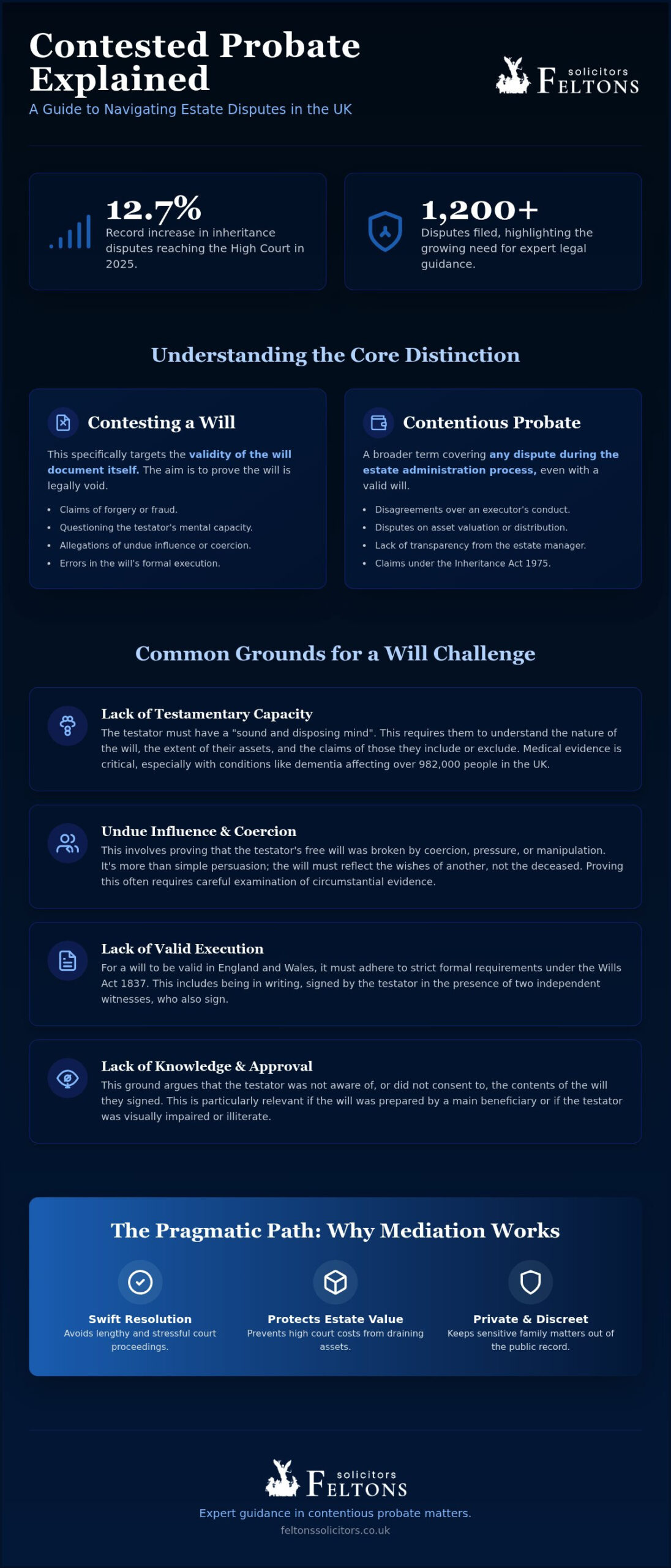
What if the legacy your loved one worked a lifetime to build becomes the very thing that tears your family apart? When a will is contested or an executor fails in their duty, the emotional burden is often as heavy as the financial risk. It’s entirely natural to fear that spiralling costs might swallow the estate or that complex terminology will leave you feeling sidelined. Engaging experienced contentious probate solicitors provides a calm, steady hand to manage these disputes, ensuring your interests are protected with both discretion and professional integrity.

We recognise that you’re likely seeking a fair distribution of assets whilst trying to manage the exhaustion of family conflict. This guide provides a comprehensive roadmap for navigating inheritance disputes with a focus on pragmatic, clear-headed advice. You’ll gain a better understanding of your legal standing, the strict six-month deadlines for Inheritance Act claims, and the steps required to remove an incompetent or dishonest executor. Our aim is to help you reach a resolution that respects the deceased’s wishes and preserves what matters most, providing the clarity you need during a difficult time.

Key Takeaways

  • Understand the strict legal criteria required to challenge a Will, ensuring your case is built on specific evidence rather than simple unfairness.
  • Identify common forms of executor misconduct and learn how contentious probate solicitors can intervene to protect the best interests of beneficiaries.
  • Recognise the importance of the six-month time limit for Inheritance Act claims to avoid losing your right to a fair distribution of the estate.
  • Explore discreet and pragmatic strategies for resolving complex estate disputes whilst minimising both financial costs and emotional strain.
  • Discover how a tailored legal approach can help you navigate complex probate terminology and protect your loved one’s legacy.

What is Contentious Probate and When Does a Dispute Arise?

Contentious probate is a term that encompasses any legal disagreement regarding the administration of a deceased person’s estate. It serves as a vital legal mechanism for ensuring a fair and legal legacy, protecting the true intentions of the deceased whilst safeguarding the rights of those left behind. While the majority of estates are settled through a standard Probate process, complexity often arises in cases involving high-value assets or modern blended families where interests may naturally diverge. When these disagreements escalate, the guidance of experienced contentious probate solicitors becomes essential to provide a calm, objective perspective on the legal standing of all parties involved.

At its core, contentious probate is the legal framework used to resolve disputes over an estate to ensure the deceased’s true wishes are honoured and a fair, lawful legacy is established. It doesn’t always mean a full-scale court battle; often, it’s about finding a pragmatic resolution to a complex situation that has become emotionally charged.

Common Triggers for Inheritance Disputes

Disputes rarely emerge from a single event; they are usually the result of long-standing tensions or sudden, unexpected discoveries. One of the most frequent triggers is the exclusion of a family member from a Will or a significant, unexplained change in a final version. In other instances, family members may harbour suspicions regarding the deceased’s mental capacity at the time the document was signed. There are also tragic cases where undue influence is suspected, perhaps where a specific beneficiary or a carer has exerted pressure on a vulnerable individual. These situations require a methodical approach to gather evidence and establish the facts of the case.

The Distinction Between Contesting a Will and Contentious Probate

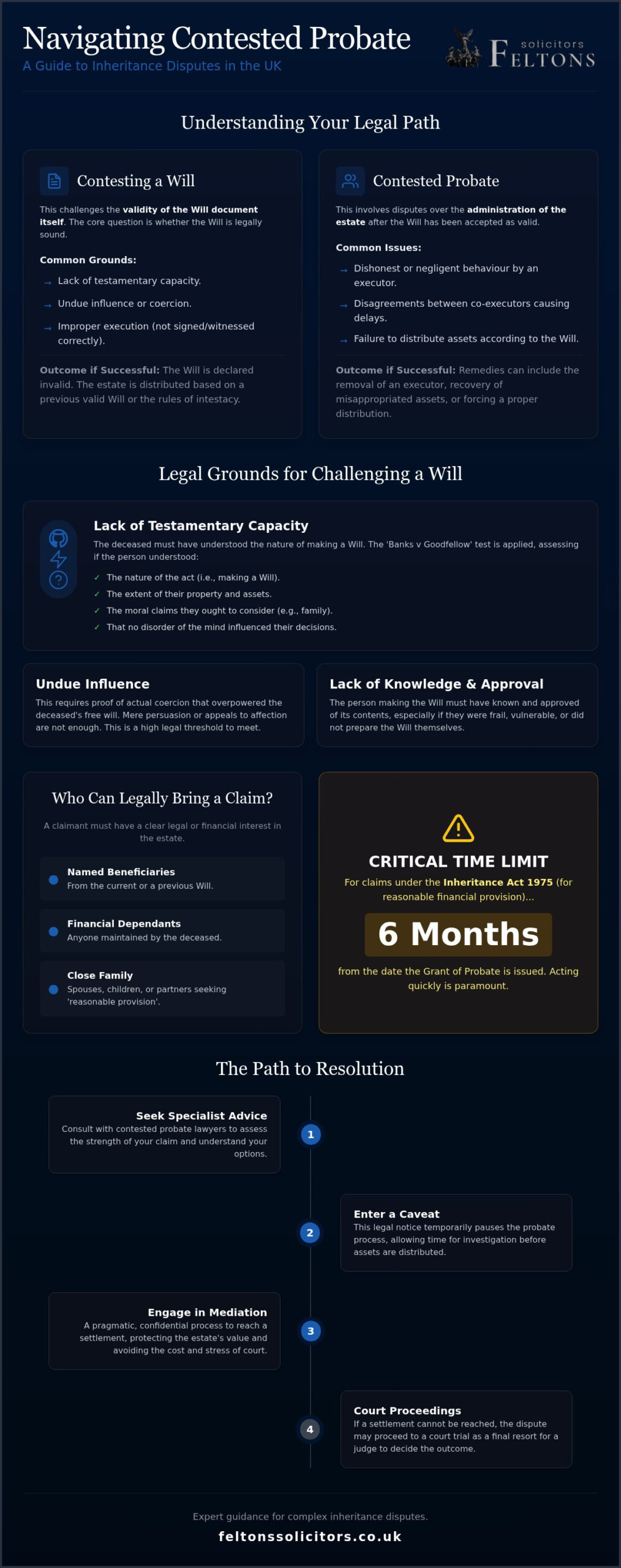
It’s helpful to clarify that contesting a Will is actually a specific subset of contentious probate. While contesting a Will focuses strictly on the validity of the document itself, contentious probate covers a much broader range of issues. This includes estates where no Will exists, known as intestacy, where disputes may arise over who is entitled to inherit under the law. It also encompasses disagreements regarding the behaviour of executors. If an executor is failing to account for assets or is causing unreasonable delays, these matters fall under the remit of contentious probate solicitors. Understanding this distinction helps you identify exactly which legal path is most appropriate for your specific circumstances.

Successfully challenging an estate in the UK requires meeting strict legal criteria. It’s a common misconception that a Will can be overturned simply because the distribution feels “unfair” or doesn’t align with family expectations. Courts are generally reluctant to interfere with a person’s right to choose their beneficiaries unless there is clear, admissible evidence of a legal flaw. Legal systems internationally, including the Probate and Family Court, maintain specific jurisdictions for estate matters, but in the UK, your claim must meet one of several established legal thresholds. Additionally, the principle of “Laches” means that an unreasonable delay in bringing a claim can bar you from seeking a remedy, even if your grounds are technically sound.

One of the most powerful tools for those left without adequate support is the Inheritance (Provision for Family and Dependants) Act 1975. This allows certain individuals, such as spouses or children, to claim that the Will fails to make “reasonable financial provision” for them. If you are concerned that a document does not reflect the true wishes of the deceased, consulting with experienced contentious probate solicitors can provide the clarity needed to determine your next steps.

Lack of Testamentary Capacity

The “Banks v Goodfellow” test remains the definitive standard for determining mental capacity. To be valid, the deceased must have understood the nature of the act, the extent of their property, and the claims of those they might be expected to benefit. We often look to medical records and contemporaneous notes from the drafting solicitor to build a picture of the deceased’s mind at the time. Dementia or other cognitive impairments don’t automatically invalidate a Will, but they do place a higher burden on proving that the individual truly understood their actions.

Undue Influence and Lack of Knowledge

Undue influence occurs when coercion overpowers the deceased’s own volition. It’s more than mere persuasion; it’s a level of pressure that results in a Will they wouldn’t have otherwise made. Similarly, a Will can be challenged for “lack of knowledge and approval” if the deceased didn’t fully grasp its contents. Common red flags include:

  • The Will being drafted or organised by a significant beneficiary.
  • A sudden, radical departure from previous versions of the Will.
  • The deceased being physically or emotionally dependent on a single individual.
  • Isolation of the deceased from other family members during the Will-writing process.

Fraud and Forgery

Allegations of forged signatures or fraudulent Wills carry a high burden of proof. These cases often require the input of handwriting experts and meticulous witness testimony. If you suspect a Will has been tampered with, it’s vital to secure the original document and any previous versions immediately. Our contentious probate solicitors work closely with forensic specialists to scrutinise the authenticity of documents and protect the integrity of the estate.

Addressing Executor Misconduct and Fiduciary Duties

Being named as an executor is often viewed as a mark of trust, yet it carries a heavy legal burden known as a fiduciary duty. This isn’t merely a moral obligation; it’s a strict requirement to act with the utmost good faith in the best interests of the beneficiaries. When an executor fails to meet this standard, the resulting friction can stall the administration process and cause significant distress. Our contentious probate solicitors specialise in identifying when these duties are being breached and taking the necessary steps to protect the estate’s value.

Misconduct often manifests in ways that are subtle but damaging. Common examples include:

  • Failing to provide a clear and transparent account of the estate’s assets.
  • Unreasonable delays in applying for probate or distributing legacies.
  • Selling estate property at an undervalue to friends or associates.
  • Using estate funds for personal expenses, even if they intend to pay it back.

Executors must understand that they face personal liability for their actions. If their negligence or dishonesty causes a financial loss to the estate, they can be ordered to reimburse the beneficiaries from their own personal assets. Feltons Solicitors LLP provides pragmatic advice to both executors who need guidance on their duties and beneficiaries who suspect the estate is being mismanaged. We prioritise a “people-first” approach, recognising that these disputes often occur during a period of intense grief.

Identifying Incompetence vs. Malice

It’s vital to distinguish between an executor who is simply overwhelmed by the complexity of the task and one who is acting with malice. An executor who is out of their depth may benefit from professional support to get the administration back on track. However, if an executor is being deliberately obstructive, we can help you request a formal “Account and Enquiry” through the court. This forces a detailed disclosure of all financial dealings. In cases where multiple executors are deadlocked, we often suggest the appointment of a “Neutral Executor”, a professional third party who can resolve the impasse and ensure the deceased’s wishes are finally met.

The Process of Removing an Executor

Removing an executor is a significant legal step that the Court does not take lightly. You must demonstrate that the executor’s continued presence is detrimental to the estate. The Court’s primary consideration is the “welfare of the beneficiaries” and whether the estate is being administered properly. This usually requires specialist litigation support to build a robust case. Whether the issue is a total breakdown in communication or a clear conflict of interest, we focus on finding a solution that restores order to the process whilst minimising further conflict and protecting the deceased’s legacy.

Contentious Probate Solicitors: Resolving Complex Estate Disputes

Time is often the most critical factor in resolving estate disputes. In the UK, the legal clock starts ticking from the moment the Grant of Probate is issued, rather than the date of death. For claims brought under the Inheritance (Provision for Family and Dependants) Act 1975, you have a strict six-month window to file your claim. Missing this deadline usually requires the Court’s permission to proceed, which is only granted in exceptional circumstances. Whilst other types of disputes, such as challenging the validity of a Will, do not have a fixed statutory limit, the Court retains discretion to refuse claims that have been delayed unreasonably. Early legal intervention is vital to ensure that evidence is preserved and that assets are not distributed before your claim is even heard.

If you suspect that an estate is being administered incorrectly or that a Will is invalid, you can use the “Caveat” system. Entering a Caveat at the Probate Registry temporarily stops the Grant of Probate from being issued for six months. This provides a necessary pause, allowing contentious probate solicitors to investigate the circumstances of the Will without the risk of the estate’s assets being sold or moved. If you are concerned about the current direction of an estate administration, contacting expert contentious probate solicitors as soon as possible can help you secure the estate whilst you determine your legal standing.

Alternative Dispute Resolution (ADR) and Mediation

We recognise that a public Court battle is often the last thing a grieving family wants. Mediation offers a sophisticated, private, and cost-effective alternative that prioritises pragmatic settlements over prolonged conflict. During mediation, a neutral third party helps all sides reach a voluntary agreement, which can often preserve family relationships that might otherwise be destroyed by litigation. The Court now expects parties to actively engage in ADR before proceeding to a full trial; failing to do so without a valid reason can lead to significant cost penalties, even for the winning party. Feltons utilises ADR to achieve discreet resolutions that reflect the best interests of our clients whilst minimising the emotional toll of the dispute.

What to Expect in a Contentious Probate Trial

Should a dispute proceed to litigation, the process follows several structured stages. It begins with a formal Letter of Claim, followed by the “Disclosure” phase where both parties must share relevant documents, such as medical records or solicitor files. The final stage is the Trial itself, where a judge will make a binding decision. It’s important to understand the “loser pays” principle in UK law; typically, the unsuccessful party is ordered to pay a significant portion of the winner’s legal costs. This principle makes a clear settlement strategy essential from the outset. Throughout this journey, our role is to provide a calm, steady presence, ensuring you are fully informed and supported at every turn.

Choosing Feltons Solicitors for Discreet and Pragmatic Representation

Selecting the right legal partner is the most consequential decision you’ll make when facing an inheritance dispute. Feltons Solicitors LLP operates as a boutique firm, deliberately choosing a path that combines modern efficiency with traditional professional integrity. Unlike high-volume practices that prioritise turnover, we focus on a “people-first” philosophy. This ensures that every client receives the individualised attention necessary for complex, high-value disputes. Our contentious probate solicitors act as discreet partners, valuing your privacy and personal rapport whilst working tirelessly to protect your interests and the deceased’s legacy.

Our firm possesses the worldly experience required to handle international-scale matters, yet we remain deeply rooted in our community values. We provide expert representation across the UK, offering a national reach with a personal touch. We understand that these matters are rarely just about the law; they’re about people, relationships, and the legacies they leave behind. Where an estate dispute intersects with broader business or commercial interests, it is worth understanding how commercial litigation firms UK are evolving in 2026 to deliver greater strategic precision and cost-certainty for clients facing complex disputes.

For clients who maintain property or family ties in the United States, particularly in Florida, it is beneficial to consult with local specialists to ensure cross-border compliance; you may wish to discover Flex Legal, PLLC for their expertise in West Palm Beach estate law.

Likewise, if your legal needs extend to Texas, you can explore Estate Planning with Massingill Attorneys & Counselors at Law to protect your Texas-based assets and family legacy effectively.

A Tailored Approach to Estate Litigation

We avoid the “one-size-fits-all” mentality often found in larger organisations. Instead, we provide a tailored approach to estate litigation that considers the unique nuances of your family dynamic and financial situation. Because property is often the most significant asset in a dispute, we integrate our specialised expertise in residential and commercial conveyancing into our litigation strategy. This holistic view allows us to anticipate challenges that other firms might overlook. We invite you to a confidential consultation to assess the merits of your case and provide the clear, calm guidance you need to move forward.

The Feltons Difference: Professional Authority and Empathy

The firm was founded by Paula Felton with a commitment to traditional professional values and a forward-thinking methodology. This foundation allows us to serve as a steady, reassuring presence during what is often an emotionally exhausting period of family conflict. We don’t just process files; we support individuals through some of life’s most stressful challenges with quiet confidence and poised reliability. If you require a legal partner who prioritises your well-being alongside technical excellence, we are here to help.

Contact Feltons Solicitors today for a discreet discussion regarding your probate dispute.

Resolving an inheritance dispute is rarely just a matter of law; it’s a delicate balancing act between protecting your financial interests and preserving family relationships. By understanding the strict six-month window for Inheritance Act claims and the specific legal grounds required to challenge a Will, you can approach the situation with clarity. Whether you are addressing executor misconduct or seeking a fair distribution of assets, early intervention is essential to prevent the estate’s value from being depleted by unnecessary conflict.

We pride ourselves on offering a boutique service with individualised attention, ensuring that traditional professional integrity remains at the heart of our modern delivery. Our expertise in complex litigation and dispute resolution allows us to act as your sophisticated guide through these sensitive matters. You don’t have to face this emotional exhaustion alone; we are here to provide the steady, expert hand you need.

Speak to our specialist contentious probate solicitors for a confidential consultation and take the first step towards a pragmatic resolution. We are committed to helping you manage these complexities with the calm, steady presence your family deserves.

Frequently Asked Questions

How long do I have to contest a Will in the UK?

The time limit depends entirely on the type of claim you are making. For claims brought under the Inheritance (Provision for Family and Dependants) Act 1975, you must file your application within six months of the date the Grant of Probate is issued. Whilst there is no fixed statutory deadline for challenging a Will’s validity on grounds like lack of capacity, waiting too long can lead the Court to refuse your claim under the principle of Laches.

Can I challenge a Will if I was left out of it entirely?

You can challenge a Will if you are a spouse, civil partner, child, or someone who was financially dependent on the deceased. Under the Inheritance Act 1975, these individuals can claim that the Will fails to make reasonable financial provision for them. You might also challenge the Will if you have evidence that the document is invalid due to undue influence or a lack of testamentary capacity at the time it was signed.

How much does a contentious probate claim typically cost?

Costs for estate litigation vary based on the complexity of the evidence and whether the matter reaches a full Court trial. It’s important to understand the “loser pays” principle, where the unsuccessful party is usually ordered to pay a significant portion of the winner’s legal fees. Engaging contentious probate solicitors early can often help you reach a settlement through mediation, which is significantly more cost-effective than a public trial.

What happens if there is no Will and I disagree with the distribution?

When someone dies without a Will, the Rules of Intestacy dictate how the estate is distributed amongst surviving relatives. If these strict legal rules fail to provide for you, and you were a spouse or dependant, you can still bring a claim for reasonable financial provision under the Inheritance Act 1975. This process allows the Court to look at your specific needs and adjust the distribution to ensure a fair outcome.

Can an executor be removed if they are taking too long to distribute the estate?

You can apply to the Court to remove or replace an executor if their unreasonable delays are damaging the estate or the welfare of the beneficiaries. Executors have a fiduciary duty to progress the administration with due diligence. If they are being deliberately obstructive, failing to account for assets, or simply lack the competence to handle the task, our contentious probate solicitors can help you seek a Court order for their removal.

Is it possible to resolve a probate dispute without going to Court?

Most probate disputes are resolved through Alternative Dispute Resolution (ADR), specifically mediation, rather than a full trial. This is a private, less adversarial process where a neutral mediator helps all parties reach a voluntary settlement. Courts now actively encourage ADR and may impose cost penalties on parties who refuse to attempt mediation without a valid reason, making it a pragmatic choice for preserving both assets and family relationships.

What is a Caveat and how does it help in a probate dispute?

A Caveat is a legal notice filed at the Probate Registry that prevents a Grant of Probate from being issued for six months. This creates a vital “pause” in the administration, giving you time to investigate potential grounds for a claim without the risk of assets being distributed. It is an effective, low-cost tool that provides the necessary breathing room to gather evidence or seek professional legal advice regarding the Will’s validity.

Will the legal fees for a probate dispute be paid out of the estate?

There is no automatic right for legal fees to be paid from the estate’s funds. Whilst the Court has the discretion to order that costs be covered by the estate, the general rule in litigation is that the unsuccessful party pays the successful party’s costs. This makes it crucial to assess the merits of your case carefully with a solicitor before proceeding, ensuring that your strategy prioritises a resolution that doesn’t swallow the estate’s value.