
Silicosis Litigation Process UK: A Comprehensive Guide to Compensation in 2026

Silicosis Litigation Process UK: A Comprehensive Guide to Compensation in 2026

Did you know that engineered stone can contain up to 95% crystalline silica, making it one of the most significant workplace hazards in the modern construction industry? If you are facing a diagnosis, the fear of deteriorating health and the anxiety of providing for your family can feel like an overwhelming burden. You might be confused about the “date of knowledge” or worried that the three-year legal time limit has already passed. Understanding the silicosis litigation process uk is the first step toward regaining control and ensuring your future is financially protected.

We recognise that behind every legal case is a person seeking reassurance and professional clarity. You deserve to know how to hold a negligent employer accountable while navigating a system that often feels designed to exclude you. This guide provides a clear roadmap for securing compensation in 2026, offering the expert legal guidance you need to protect your family’s interests. We will explore the recent 8.2% uplift in Judicial College Guidelines, explain how Industrial Injuries Disablement Benefit rates have changed, and provide a step-by-step preview of the litigation journey so you can move forward with confidence.

Key Takeaways

  • Understand the specific risks of Respirable Crystalline Silica (RCS) and identify if your career in high-risk British industries has left you vulnerable to respiratory disease.
  • Learn how to navigate the silicosis litigation process uk by gathering the medical and employment records required to prove workplace exposure.
  • Gain insights into employer duties under COSHH Regulations and the “Hierarchy of Control” used to hold companies accountable for safety failures.
  • Discover how to bypass the “Smoker’s Defence” misdiagnosis trap so your symptoms are correctly linked to silica dust.
  • Find out how securing interim payments can provide immediate access to private medical rehabilitation whilst your claim progresses toward a final settlement.

Understanding Silica Dust Exposure and the Risks in British Workplaces

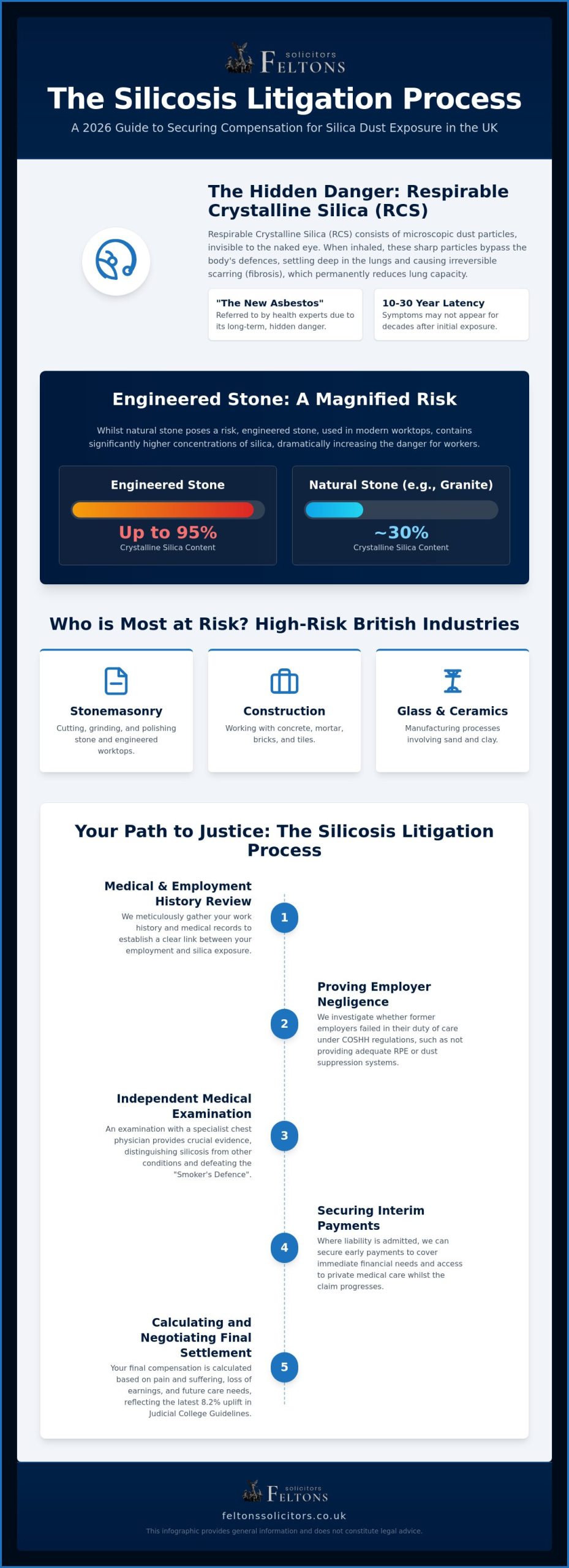
Silica is a natural substance found in stone, rock, and sand, but it’s the invisible dust created during industrial processes that causes lasting harm. Respirable Crystalline Silica (RCS) consists of particles so small they cannot be seen by the naked eye. These microscopic shards are easily inhaled, bypassing the body’s natural defences to settle deep within the alveolar sacs of the lungs. If you are researching What is Silicosis?, you’ll find that these particles trigger permanent scarring and inflammation that reduces lung capacity over time.

Several British industries carry a heightened risk for employees. Workers in stone masonry, glass manufacturing, and construction are frequently exposed to high levels of RCS. The danger is often hidden because of the long latency period; it can take ten to thirty years for symptoms to manifest. This delay is why many health and safety experts now refer to silica as the “New Asbestos.” By the time a worker notices breathlessness or a persistent cough, the damage is often irreversible. This complex timeline is a critical factor in the silicosis litigation process uk, as legal experts must trace exposure back through decades of employment history to hold former employers accountable.

The Distinction Between Natural and Engineered Stone

Engineered stone, commonly used for high-end kitchen worktops, presents a far greater risk than natural granite or marble. Whilst natural stone might contain 30% silica, engineered variants often contain upwards of 90% to 95% crystalline silica. The 2026 regulatory environment has tightened significantly around the cutting and fabrication of these materials, reflecting a growing awareness of their toxicity. Even if you aren’t the one cutting the stone, fine dust can linger in workshop air for hours, affecting everyone in the building. This pervasive nature of the hazard means that employer liability often extends beyond the primary fabricator.

The Scale of the Crisis in 2026

Recent data from the Health and Safety Executive (HSE) underscores a growing concern, with an average of 12 deaths per year attributed directly to silicosis over the last decade. In 2023, the HSE reported 35 new cases assessed for Industrial Injuries Disablement Benefit, yet the actual prevalence is suspected to be higher due to misdiagnosis. Settled dust remains a persistent hazard; it can be disturbed by simple activities like sweeping or foot traffic, creating a secondary exposure risk for tradespeople working in adjacent areas. This systemic failure to control dust is a primary driver in the silicosis litigation process uk today, as more individuals seek justice for preventable lung damage. Masons and fabricators in particular are increasingly pursuing stone masonry silicosis claims to hold negligent employers accountable for decades of inadequate dust control.

The Health Impact of Silicosis: Recognising Symptoms and the Misdiagnosis Trap

Silicosis is a progressive condition that manifests in three distinct forms depending on the intensity and duration of dust inhalation. Chronic silicosis is the most common, often appearing ten to thirty years after exposure. Accelerated silicosis develops much faster, usually within five to ten years of heavy exposure, whilst acute silicosis can occur within weeks or months of inhaling massive quantities of silica dust. Unlike a temporary respiratory infection, the physiological process involves fibrosis, where the lungs develop permanent, inelastic scar tissue in response to the sharp silica shards. For early and accurate detection, medical professionals recommend High-Resolution Computed Tomography (HRCT) scans, as standard X-rays frequently fail to capture the fine, granular scarring typical of early-stage disease.

One of the most significant hurdles in the silicosis litigation process uk is the “Smoker’s Defence.” Employers and their insurers often attempt to attribute breathlessness or lung damage to a claimant’s history of tobacco use. However, expert solicitors work with specialist chest physicians to distinguish between the damage caused by smoking and the specific nodular patterns of silica-induced fibrosis. By providing clear medical evidence of occupational scarring, we ensure that your right to compensation isn’t undermined by unrelated lifestyle factors.

Why Silicosis is Often Mistaken for COPD or Asthma

The “Misdiagnosis Trap” occurs when GPs overlook a patient’s occupational history, leading them to diagnose more common ailments like asthma or Chronic Obstructive Pulmonary Disease (COPD). Because the symptoms of a persistent cough and chest tightness are so similar, many workers suffer for years without the correct diagnosis. This delay is critical because it can complicate the legal “date of knowledge,” which is the point at which the three-year limitation period for a claim begins. If you suspect your symptoms are work-related, it’s vital to request a specialist occupational lung disease review. Speaking with specialist silicosis solicitors can help you understand how a formal diagnosis impacts your legal standing.

Beyond the Lungs: Autoimmune and Kidney Risks

Modern medical research has revealed that the impact of silica exposure extends far beyond respiratory health. There is a proven link between inhaled silica and nephrotoxicity, which can lead to chronic kidney disease. Additionally, sufferers face an increased risk of developing debilitating autoimmune conditions, amongst them scleroderma, rheumatoid arthritis, and lupus. When navigating the silicosis litigation process uk, it’s essential that these secondary conditions are factored into the claim. A comprehensive legal strategy ensures that the full scale of your health complications is recognised, providing a settlement that covers long-term care for all related illnesses. For more information on the clinical progression of the disease, you can review the official NHS guidance on Silicosis Symptoms and Diagnosis.

Employer Liability and the Duty of Care Under COSHH Regulations

British employers operate under a strict legal framework designed to protect workers from invisible killers like silica dust. The Control of Substances Hazardous to Health (COSHH) Regulations 2002 remain the primary legislation governing these risks in 2026. Under these rules, a company has a non-delegable duty to prevent or, where prevention isn’t possible, adequately control exposure to Respirable Crystalline Silica (RCS). This isn’t merely a set of suggestions; it’s a statutory requirement. According to the HSE guidance on silica risks, any failure to implement these protections can form the basis of a significant legal claim.

The law mandates a “Hierarchy of Control” that every employer must follow. They cannot simply hand out masks and consider the job done. The process should follow these steps:

  • Elimination: Removing the risk entirely by changing the work process.
  • Substitution: Using materials with lower silica content where possible.
  • Engineering Controls: Implementing local exhaust ventilation (LEV) or water-suppression systems to stop dust from entering the air.

Respiratory Protective Equipment (RPE) should only be used as a final line of defence. When RPE is necessary, it must be matched to the individual through mandatory face-fit testing. Furthermore, employers are required to provide regular health surveillance for at-risk staff. This involves lung function tests and health checks designed to identify early-stage damage whilst intervention is still possible. If your employer failed to provide these checks, it significantly strengthens your position within the silicosis litigation process uk.

Breach of Statutory Duty: Common Failures

In many cases, employers attempt to argue that they followed “industry standards.” However, the courts have been clear: if the industry standard was insufficient to protect the worker, the employer remains liable. We frequently see claims arising from dry cutting stone when wet cutting was a viable alternative, or LEV systems that were never properly maintained or tested. Training is another common area of failure. If you weren’t told about the specific dangers of silica or taught how to use safety equipment correctly, your employer has likely breached their duty of care.

Specialist Claims for Engineered Stone Workers

A “new wave” of silicosis is currently affecting younger tradespeople, particularly kitchen fitters and fabricators working with engineered quartz. These modern materials are far more hazardous than natural stone, yet safety standards in smaller workshops often lag behind the risks. Our complex personal injury claims solicitors specialise in these high-stakes cases. We don’t just look at employer negligence; we also investigate product liability claims against manufacturers who may have failed to provide sufficient warnings about their products. Navigating the silicosis litigation process uk for engineered stone requires specific technical evidence, including air quality reports and detailed employment histories, to ensure the full scale of the negligence is exposed.

Silicosis Litigation Process UK: A Comprehensive Guide to Compensation in 2026

The Silicosis Litigation Process: A Step-by-Step Guide to Claiming

Understanding the silicosis litigation process uk is essential for anyone facing a life-altering diagnosis. It’s a methodical journey that transforms medical evidence into legal accountability. We guide you through five core stages to ensure your claim is robust and your future is secure. This structured approach provides the clarity needed to handle what is often a stressful time for you and your family.

  • Step 1: Initial Consultation. We begin by establishing a detailed history of your workplace exposure. This involves identifying specific employers, the materials you handled, and the safety measures (or lack thereof) that were in place.
  • Step 2: Gathering Evidence. We obtain your full medical records and your HMRC employment history. These documents are vital for identifying the correct defendants, especially if you worked for multiple companies over several decades.
  • Step 3: Independent Medical Expert. We instruct a specialist chest physician to conduct a thorough assessment. Their report provides the definitive link between your silica exposure and your current health, which is the foundation of any successful claim.
  • Step 4: Letter of Claim. Once the evidence is compiled, we issue a formal Letter of Claim to the employer and their insurers. This document sets out the legal basis of the claim and the specific breaches of duty.
  • Step 5: Negotiation or Court. Most claims are settled through negotiation, but we are prepared to issue court proceedings if the insurers refuse to offer a fair settlement. Our goal is to secure a sum that covers your pain, suffering, and long-term care needs.

If you’re ready to start this journey, our silicosis litigation experts are here to provide a discreet, professional consultation to discuss your options.

Time Limits and the “Date of Knowledge”

The Limitation Act 1980 sets a standard three-year window for personal injury claims. However, because silicosis has such a long latency period, the clock doesn’t usually start ticking until your “date of knowledge.” This is the point at which you were diagnosed and could reasonably have known your condition was work-related. You can review our guide on silicosis claim time limits uk for a deeper look at these nuances and the rare exceptions that may apply to your case.

Claiming Against Former or Defunct Employers

It’s a common concern that a claim might be impossible if a former employer has ceased trading. Fortunately, we can often trace the insurers who provided cover at the time of your exposure using the Employers’ Liability Tracing Office (ELTO). This allows us to pursue compensation even from businesses that no longer exist. In the saddest of circumstances, we also support families in pursuing a silicosis claim after death, ensuring that dependents are financially protected even after a loved one has passed away.

Securing Your Future: How Feltons Solicitors LLP Manages Silicosis Claims

At Feltons Solicitors LLP, we understand that a silicosis diagnosis is a deeply personal and life-altering event. We reject the high-volume, “factory” approach common in larger firms, opting instead for a boutique service that prioritises your individual needs. Our role in the silicosis litigation process uk is to act as your sophisticated guide, providing a calm and steady presence whilst we navigate the technical complexities of your case. We focus on building a personal connection, ensuring you feel heard and supported throughout the legal journey. We don’t just process claims; we protect futures.

Recognising the immediate financial and physical strain of respiratory disease, we are committed to securing interim payments whenever possible. These early funds can be vital for accessing private medical treatment, pulmonary rehabilitation, or specialised equipment before the final settlement is reached. We manage the psychological impact of the disease with empathetic, people-first communication, acknowledging that your peace of mind is just as important as the financial outcome. Our service is inherently discreet, valuing your privacy and professional integrity at every stage of the litigation. It’s about more than just a settlement; it’s about restoring a sense of security.

A Sophisticated Approach to High-Value Litigation

Silicosis cases are scientifically complex, requiring a bespoke strategy that goes beyond standard personal injury protocols. We coordinate with a hand-picked network of top-tier medical experts and specialist barristers to ensure every aspect of your condition is documented. This level of preparation allows us to build an unshakeable case, whether the negligence occurred in a local workshop or involves international corporate entities. Our worldly experience ensures that even the most intricate legal hurdles are handled with quiet confidence and precision. We provide the tailored attention that high-value claims demand.

What Your Compensation Covers

A successful claim provides financial security through two primary categories of damages. Under the 18th edition of the Judicial College Guidelines, published in April 2026, “General Damages” for pain, suffering, and loss of amenity have seen an 8.2% to 8.3% uplift to account for inflation. This ensures your award reflects the true impact of your condition in today’s economy. In addition to this, we pursue “Special Damages” to cover quantifiable losses, including:

  • Lost Earnings: Compensation for past and future income if you are no longer able to work.
  • Future Care Costs: Funding for professional nursing or help with daily tasks.
  • Home Adaptations: Costs for installing stairlifts, ramps, or specialised ventilation systems.
  • Medical Expenses: Coverage for private prescriptions, travel to appointments, and ongoing therapy.

If you are ready to discuss how we can help you secure your financial future, we invite you to begin your journey with a confidential consultation. We will listen to your specific circumstances and provide the expert clarity you need to move forward with the silicosis litigation process uk.

Securing Your Health and Financial Legacy

Facing a silicosis diagnosis is undeniably challenging, but you don’t have to navigate the legal path alone. We’ve explored how identifying specific workplace failures and bypassing the misdiagnosis trap are essential steps for a successful claim. By understanding your rights under COSHH regulations and the updated 2026 compensation brackets, you can take meaningful steps toward protecting your family’s future. Navigating the silicosis litigation process uk requires a partner who understands both the technical legal requirements and the human impact of respiratory disease.

Feltons Solicitors provides a boutique, people-first service tailored to your individual needs. Our specialist expertise in complex industrial disease litigation, combined with a proven track record in securing high-value settlements, ensures your case is in capable hands. We pride ourselves on being a steady, discreet presence during what is often a stressful time. If you’re ready to explore your options, we invite you to contact Feltons Solicitors for a discreet, expert consultation on your silica dust claim. You deserve the security and care that comes with professional legal support. We’re here to help you move forward with confidence.

Frequently Asked Questions

Can I still make a silica dust compensation claim if I used to smoke?

Yes, you can still pursue a claim if you have a history of smoking. Whilst employers may attempt to blame tobacco use for respiratory issues, we instruct specialist medical experts who can distinguish between smoking-related damage and the specific scarring caused by silica dust. Your compensation may be adjusted, but it isn’t barred by your lifestyle history.

What is the “date of knowledge” in a silicosis claim?

The “date of knowledge” is the point at which you first realised, or could reasonably have been expected to know, that your illness was linked to your employment. This is often the date of a formal medical diagnosis. This specific date is vital because it marks the start of the three-year period allowed to begin the silicosis litigation process uk.

How much compensation can I expect for a silicosis diagnosis?

Compensation amounts vary based on the severity of your condition and its impact on your quality of life. Under the April 2026 Judicial College Guidelines, brackets for general damages have increased by over 8% to account for inflation. Your final settlement will also include special damages to cover lost income and the costs of any necessary home adaptations or private medical care.

What happens if my former employer has gone out of business?

You can still claim compensation even if your former employer is no longer trading. We use the Employers’ Liability Tracing Office (ELTO) to identify the insurance company that provided cover at the time of your exposure. Since the insurer is responsible for the payout, the company’s current status doesn’t prevent you from receiving the funds you deserve.

Is there a time limit for making a silicosis claim in the UK?

The standard time limit is three years from the date of your diagnosis or your date of knowledge. Because silicosis has a long latency period, the law doesn’t expect you to claim until you’re aware of the damage. It’s best to seek legal guidance as soon as you suspect a link between your symptoms and your past work to protect your rights.

Will I lose my job if I make a claim against my current employer?

You are legally protected from being sacked or treated unfairly for making a personal injury claim. UK law regards such actions as unfair dismissal. Most employers recognise that compensation is handled by their insurance provider, meaning the claim doesn’t directly threaten the company’s daily finances or your ongoing position.

How long does the silicosis litigation process typically take?

The silicosis litigation process uk usually takes between 12 and 24 months to resolve, depending on the complexity of the evidence. Cases involving multiple past employers or contested medical reports can take longer. We focus on securing interim payments early in the process to provide you with immediate financial relief for treatment and living costs.

Can I claim compensation on behalf of a family member who has passed away?

Yes, the law allows the estate and dependents of a deceased individual to pursue a claim for compensation. This can cover the suffering endured by your loved one and provide essential financial security for the family they left behind. We handle these claims with the highest level of professional discretion and empathy during such a difficult time.

Commercial Litigation Firms UK: 2026 Trend Analysis and Selection Guide

Commercial Litigation Firms UK: 2026 Trend Analysis and Selection Guide

In 2026, the traditional “big firm” model for commercial disputes is increasingly becoming a liability for businesses seeking agility and cost-certainty. As the UK legal market surpasses a £40 billion valuation, the criteria for selecting commercial litigation firms UK have shifted from sheer size to strategic precision. You likely feel the pressure of escalating costs and the potential for conflicts of interest within multi-service giants, especially as the new Practice Direction 51ZH pilot mandates greater transparency for court documents by default.

We understand that facing a complex dispute is inherently stressful, particularly when the landscape is shifting under your feet with new AI regulations and the updated Arbitration Act 2025. This guide provides an expert analysis of the current litigation environment to help you secure a partner who prioritises your commercial interests over billable hours. We will explore why boutique, partner-led firms are often better equipped to handle modern challenges, from navigating the nuances of third-party funding to meeting the latest Civil Justice Council requirements for AI disclosure in the Business and Property Courts.

Key Takeaways

  • Understand how emerging trends like ESG claims and AI-driven e-disclosure are reshaping the strategies of commercial litigation firms UK wide.
  • Learn why boutique firms often provide a more agile, conflict-free alternative to global giants for complex shareholder and corporate disputes.
  • Discover how proactive contract drafting and strategic risk management can prevent costly courtroom battles before they begin.
  • Identify the essential criteria for selecting a legal partner who prioritises partner-led service and pragmatic, commercial outcomes.
  • Gain insight into the latest 2026 regulatory shifts, including the Practice Direction 51ZH pilot, and how they impact your litigation strategy.

The Evolving Landscape of Commercial Litigation in the UK (2026)

Commercial litigation is the engine of the corporate legal system. It encompasses high-stakes disputes that threaten the stability of a business, typically involving complex contracts, shareholder disagreements, or failures in corporate governance. In 2026, the United Kingdom maintains its position as the pre-eminent global centre for dispute resolution. Whilst Brexit introduced significant regulatory shifts, the fundamental reliability of UK company law continues to attract international litigants. Recent data indicates that the UK legal market is growing at a rate of approximately 5% annually, valued at over £40 billion, proving that the jurisdiction’s authority remains unshaken amongst global competitors.

The approach taken by leading commercial litigation firms UK wide has transitioned from traditional, aggressive courtroom posturing toward a philosophy of pragmatic resolution. This shift reflects a growing demand for legal partners who prioritise commercial outcomes over procedural wins. Today, the sectors driving the most significant volume of litigation include Technology, where intellectual property and deepfake authenticity disputes are rife; Finance, dealing with the fallout of bank and credit account fraud which saw a 19% increase recently; and Energy, as the transition to renewables creates friction in legacy agreements.

Key Drivers of Commercial Disputes in 2026

Current disputes are often born from the fragility of global supply chains. Contractual instability has led to a surge in breach-of-contract claims as businesses struggle with unpredictable logistics and rising costs. Additionally, shareholder activism has reached new heights. Investors are increasingly using corporate governance challenges to hold boards accountable for their strategic decisions. These disputes are further shaped by recent regulatory updates that have tightened the requirements of the pre-action phase. Evidence gathering is now a digital-first endeavour, and businesses must be prepared for the scrutiny of their internal communications much earlier in the process than in previous years.

The Increasing Role of Alternative Dispute Resolution (ADR)

The High Court no longer views mediation as an optional extra; it’s now a procedural expectation. Arbitration and mediation are actively encouraged before a trial date is even considered. From a cost-benefit perspective, ADR often proves superior to traditional litigation. It avoids the exorbitant expenses of a full trial whilst offering a faster path to closure. Strategic agility is the hallmark of a modern resolution. For many of our clients, the most compelling advantage is confidentiality. Settling a sensitive commercial matter behind closed doors protects a brand’s reputation in a way a public courtroom never can. By opting for ADR, companies can craft settlements that include non-monetary components, such as revised service agreements, which a judge simply cannot award in court.

The 2026 litigation outlook suggests that Environmental, Social, and Governance (ESG) factors are no longer just corporate talking points; they’ve become high-stakes legal battlegrounds. For commercial litigation firms UK wide, the focus has shifted toward defending or pursuing claims related to “greenwashing” and supply chain ethics. Regulators like the Competition and Markets Authority (CMA) now wield significant enforcement powers under the Digital Markets, Competition and Consumers Act 2024. This allows them to take a much tougher stance on misleading environmental claims, often leading to reputational damage that far outweighs the immediate financial penalty.

Third-party litigation funding continues to evolve as well. Following the government’s commitment to reverse the impact of the Supreme Court’s PACCAR decision, the funding market has regained a sense of stability. This provides businesses with more options to pursue legitimate claims without straining their own balance sheets. If you’re currently facing a dispute that requires this level of strategic foresight, seeking pragmatic dispute resolution can help you manage these emerging risks effectively.

ESG: Moving Beyond Compliance to Litigation

Boards of directors are finding themselves personally scrutinised. In 2026, it’s increasingly common for leadership teams to be held accountable for ESG misstatements that mislead investors. Group action claims are also on the rise, particularly against multinational corporations regarding the actions of their overseas subsidiaries. When choosing a legal partner, it’s vital to identify a firm that understands these specific regulatory nuances and can offer a steady hand during high-profile scrutiny. The focus is no longer just on avoiding fines, it’s about protecting the long-term integrity of the brand.

AI and the Future of Evidence Management

The AI revolution is fundamentally altering e-disclosure. The Civil Justice Council’s consultation, which concluded in April 2026, has already influenced how AI is used to generate or review witness statements in the Business and Property Courts. Predictive coding now allows for the management of massive data sets with a level of precision that human review simply cannot match. This technological leap is also dismantling traditional fee structures. Many commercial litigation firms UK are moving away from purely hourly billing for document review, opting instead for fixed-price models that reflect the efficiency of AI-led discovery. Whilst this reduces costs, it also demands rigorous data security to protect sensitive commercial information amidst digital disclosure processes.

Evaluating Litigation Firms: Boutique Specialism vs. Global Giants

Choosing between a global powerhouse and a specialized boutique is one of the most critical decisions a business leader faces when a dispute arises. Whilst the “Magic Circle” and large international firms possess an undeniable depth of resources, they are frequently hamstrung by the “Conflict of Interest” problem. These multi-service giants often represent major financial institutions or multinational conglomerates on the advisory side. Consequently, they are often legally or commercially prohibited from acting against those same entities in a dispute. For a business seeking to challenge a major bank or a dominant market player, this lack of independence can be a significant hurdle.

Specialist commercial litigation firms UK wide have gained prominence by offering a “conflict-free” model. By focusing exclusively on litigation and dispute resolution, these firms maintain the independence required to pursue robust claims against any adversary, regardless of their size. Whilst global firms are essential for “mega-litigation” requiring hundreds of lawyers for massive document reviews, boutique firms provide the strategic agility and senior-level focus that complex commercial matters often demand. They operate without the heavy corporate overheads of their larger counterparts, allowing for a more direct alignment with the client’s commercial goals.

The Value of Partner-Led Instruction

In high-volume firms, cases are frequently delegated to junior associates or trainees to maximize leverage. This can lead to a disconnect between the initial strategy and the daily execution of the case. Boutique firms offer a distinct advantage: direct and consistent access to senior partners. Your matter isn’t just another file in a processing system; it’s a priority handled by an expert with decades of experience. This personal rapport ensures that the solicitor understands the human impact of the dispute, leading to more nuanced and effective representation. A partner-led approach means that tactical decisions are made with the benefit of seasoned judgment, rather than through a checklist of procedural steps.

Fee Structures and Value for Money

Transparency in billing is a hallmark of a modern, client-focused firm. Whilst traditional hourly rates still exist, many commercial litigation firms UK are embracing more flexible arrangements. These include fixed-fee stages, capped fees, or contingent structures that share the risk of the outcome. Evaluating the ROI of legal advice isn’t just about the final bill; it’s about the value secured in the settlement. High-end advice that secures a pragmatic resolution early in the process often proves far more cost-effective than a cheaper, protracted battle that ends in an uncertain trial. When reviewing potential partners, look for a firm that provides clear, “plain English” breakdowns of costs and focuses on achieving a result that protects your bottom line.

Commercial Litigation Firms UK: 2026 Trend Analysis and Selection Guide

Strategic Risk Management: Avoiding the Courtroom

The most effective litigation strategy often ensures that a trial never takes place. Whilst courtrooms provide finality, they also introduce significant costs and public scrutiny. Leading commercial litigation firms UK now prioritise “dispute avoidance” through proactive contract drafting. By embedding clear “dispute clauses” into your agreements, you define the path of resolution before a conflict even exists. This might include mandatory cooling-off periods or specific escalations to senior management, preventing minor disagreements from spiralling into expensive legal battles.

Early Neutral Evaluation (ENE) has become a vital component of this preventative approach. In an ENE, an independent third party, often a retired judge or senior barrister, provides a non-binding assessment of the case’s merits. This provides a “reality check” that can be incredibly persuasive during negotiations. It also helps manage reputational risk. As discussed in our analysis of the 2026 pilot scheme for public access to court documents, once a claim is filed, your sensitive commercial data may enter the public domain. Resolving a matter privately through litigation and dispute resolution expertise ensures your brand remains protected from unnecessary exposure.

The Pre-Action Protocol: A Strategic Opportunity

The pre-action phase is not just a procedural hurdle; it is a strategic opportunity. A well-crafted “Letter of Claim” does more than state your case. It sets a tone of quiet confidence and professional authority. By presenting a robust, evidence-backed position early, you can often force a favourable settlement before the High Court even becomes involved. Failing to engage meaningfully at this stage is a common pitfall. The courts are increasingly willing to impose cost penalties on parties that bypass these protocols, regardless of the eventual outcome of the case. Detailed engagement here demonstrates that you are prepared for a battle but prefer a pragmatic resolution.

Mediation as a Commercial Tool

2026 has seen a surge in “mandatory” mediation considerations within the UK justice system. Preparing for mediation requires a different mindset than preparing for trial. It is a commercial negotiation, not a legal argument. To ensure a win, you must identify your “Best Alternative to a Negotiated Agreement” (BATNA) and understand the other party’s commercial pressures. However, a sophisticated guide also knows when to walk away. If the other side is not acting in good faith or offers a resolution that compromises your core interests, litigation remains the necessary path to protect your business. Successful mediation is about finding a solution that allows both parties to return to their core operations without the shadow of a pending trial; many firms find that the structured approach of Echelon Facilitation is invaluable for ensuring these negotiations remain aligned with their ultimate business objectives.

Feltons Solicitors: Pragmatic Dispute Resolution for 2026

Feltons Solicitors LLP occupies a unique space within the legal market. Whilst many commercial litigation firms UK wide prioritise volume and high-speed processing, we focus on depth, discretion, and individualized attention. We combine modern, efficient delivery with the traditional professional integrity that high-stakes disputes demand. Our commitment to “Plain English” advice ensures that you’re never lost in a sea of dense, archaic legalese. Instead, we focus on the practical, commercial outcomes that matter most to your business’s survival and growth.

A dispute is often a source of significant stress for any business owner. Our role is to act as a calm, steady presence in the face of these challenges. We don’t believe in aggressive posturing for its own sake. We develop customised strategies that align legal action with your broader business goals. Whether it’s a contract breach, a shareholder disagreement, or a complex international matter, we bring the same level of quiet confidence and methodical precision to every case. Our “people-first” philosophy means we never forget the human impact of the technical legal work we perform.

Our Litigation Philosophy

We understand the evolving landscape of 2026. This includes the rise of ESG-related claims and the complexities introduced by AI-driven disclosure. We help you navigate the new Practice Direction 51ZH pilot with a focus on protecting your privacy whilst meeting the court’s transparency requirements. By choosing Feltons Solicitors LLP, you aren’t just hiring a solicitor; you’re securing a discreet partner who values personal rapport over high-volume turnover. Our expertise extends across various industry sectors, from technology to finance. We provide the worldly experience necessary to handle complex matters with the strategic agility of a boutique firm. This ensures that tactical decisions are made with seasoned judgment and a focus on long-term brand integrity.

Seamless Integration of Expertise

A commercial dispute rarely exists in a vacuum. It often involves property rights, asset protection, or private client considerations. At Feltons Solicitors LLP, our litigation team works alongside our experts in residential and commercial conveyancing, leasehold enfranchisement, and estate planning. This integration allows us to anticipate risks that a single-discipline firm might overlook. For example, a dispute involving the registration of overseas entities requires a nuanced understanding of both litigation and property law, and clients with UK property assets should also be aware of the distinct challenges involved in leasehold extension for overseas landlords, particularly given the compliance requirements of the Register of Overseas Entities. We also maintain a robust network of specialist barristers and expert witnesses, ensuring you have access to the finest minds in the UK legal system. Our goal is to provide a high-standard service that handles complex matters with the personal care of a trusted advisor.

Discuss your dispute with a senior partner at Feltons Solicitors LLP.

Securing Strategic Clarity for Your Commercial Disputes

The legal environment in 2026 demands more than just technical proficiency; it requires a partner who can navigate the complexities of AI-driven disclosure and the rising tide of ESG claims with quiet confidence. Choosing amongst commercial litigation firms UK wide often involves a balance between the vast resources of global giants and the strategic agility of a boutique specialist. A partner-led approach ensures that your case is never delegated to junior staff, whilst a conflict-free model protects your ability to pursue robust resolutions against any adversary.

Established in 2010, Feltons Solicitors LLP provides the high-end reliability and worldly experience required for both domestic and complex international litigation. Our “people-first” philosophy ensures that whilst we handle the technical intricacies of the law, we never lose sight of the commercial impact on your business. We prioritise pragmatic, “Plain English” advice designed to protect your interests and secure a resolution that allows you to move forward. You don’t have to navigate these stressful situations alone. Contact Feltons Solicitors LLP for a discreet consultation regarding your commercial dispute and take the first step toward a steady, professional resolution.

Frequently Asked Questions

What are the primary costs involved in UK commercial litigation?

The primary costs include court filing fees, solicitor and barrister fees, expert witness disbursements, and the technical expenses associated with AI-driven e-disclosure. You should also account for potential adverse costs, which are the legal fees of the opposing party that you may be ordered to pay if your claim is unsuccessful. Modern firms often provide staged cost estimates to help you manage your budget throughout the proceedings.

How long does a typical commercial dispute take to reach trial in 2026?

A typical commercial dispute usually takes between 12 and 24 months to reach a full trial in the High Court. This timeframe accounts for the mandatory pre-action protocols, the exchange of evidence, and the extensive digital disclosure phase. Whilst this is the standard duration for complex matters, cases involving urgent injunctions or summary judgments can often be resolved much faster depending on the court’s availability.

Can I use third-party funding for my commercial litigation case?

You can use third-party funding to cover your legal expenses in exchange for the funder receiving a portion of the settlement or damages awarded. Following the government’s commitment to reverse the impact of the PACCAR decision, the market for litigation funding remains a stable and viable option for UK businesses. It’s a strategic tool that allows you to pursue high-value claims without putting your company’s immediate cash flow at risk.

What is the difference between mediation and arbitration in the UK?

Mediation is a confidential, non-binding negotiation facilitated by a neutral third party to help both sides reach a voluntary settlement. In contrast, arbitration is a private, formal process where an arbitrator makes a legally binding decision that is final and enforceable. Whilst mediation focuses on finding a pragmatic compromise, arbitration is governed by the Arbitration Act 2025 and serves as a private alternative to a public court trial.

How do I switch commercial litigation firms if I am unhappy with my current representation?

You have the right to switch commercial litigation firms UK wide at any stage of your proceedings if you feel your current representation isn’t aligned with your goals. The process involves formally instructing a new firm and providing written authority to your existing solicitors to transfer your files. It’s important to review your current engagement letter first to understand any obligations regarding outstanding fees before the file transfer occurs.

What happens if we win the case? Can we recover all our legal costs?

Winning a case doesn’t automatically mean you will recover every penny spent on legal fees. In the UK, the “loser pays” principle typically allows the successful party to recover approximately 60% to 70% of their reasonable costs when assessed on a “standard basis.” The court has broad discretion and will consider the behaviour of both parties, including whether you meaningfully engaged in mediation or other forms of dispute resolution.

Is my commercial dispute confidential if it goes to the UK High Court?

Most proceedings in the UK High Court are public, meaning that hearings are open and court documents can often be accessed by third parties. Under the Practice Direction 51ZH pilot, which runs until December 2027, transparency has increased with many documents being publicly accessible by default through the CE-File system. If confidentiality is a primary concern for your business, you should explore arbitration or private settlement options before a claim is issued.

What is the role of an expert witness in commercial litigation?

An expert witness provides independent, technical evidence to assist the court on specialised matters that fall outside the judge’s expertise, such as forensic accounting or climate attribution science. Their overriding duty is to the court rather than the party paying their fees. Experienced commercial litigation firms UK will select experts who can provide clear, “plain English” explanations of complex data whilst remaining resilient under cross-examination.