

A worker’s death does not necessarily rule out a claim. Families may pursue fatal industrial disease compensation claims if workplace exposure, including coal dust, contributed to the illness that caused the death. For a claim made on behalf of someone who has died, the stated three-year time limit runs from the date of death or the date post-mortem results were received.
It can be hard to know what to do while grieving, particularly if the illness developed years after exposure or the employer has since closed. The key questions are whether the disease was work-related, who may bring a claim, and what evidence could establish responsibility and the family’s losses.
This guide explains how these claims work in the UK, including claims involving coal-dust-related lung disease. It covers who may claim, the time limit, the evidence and steps involved, and what families can expect as a claim progresses.
Key Takeaways
- Learn who may bring a claim after a loved one’s death and when the stated three-year period begins.
- See how workplace exposure, including coal dust, may be connected to a fatal lung disease.
- Find out which records and evidence can help build a clearer picture of the illness and its work-related cause.
- Understand how a compensation claim differs from Industrial Injuries Disablement Benefit, including the disability assessment threshold.
Industrial Disease Compensation Claims – How do they Work?
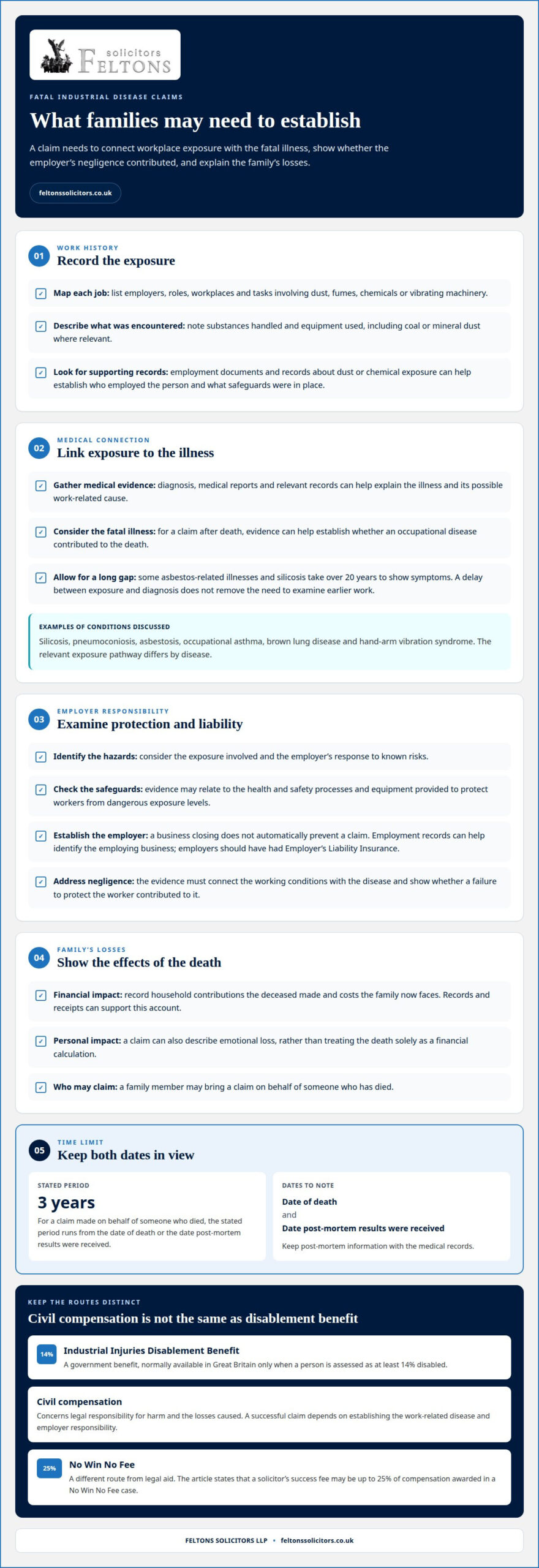
An industrial disease claim considers whether workplace exposure caused an illness and whether employer negligence contributed to it. Evidence must connect the working conditions with the disease and the resulting loss.
Employer health and safety responsibilities
The Health and Safety at Work Act 1974 requires UK employers to protect employees’ health at work. This includes appropriate health and safety processes and equipment to protect workers from dangerous exposure levels. Families can look at the hazards involved, the protection provided and the employer’s response to known risks. For example, records about dust or chemical exposure may help explain what safeguards were in place.
Claims against former or insolvent employers
A former employer’s closure does not automatically prevent an industrial disease claim. Employers should have had Employer’s Liability Insurance, so a claim may still be possible after a business ceases trading. If the employer is insolvent, start by identifying the employing business and gathering records of the deceased person’s work. Employment documents and medical records can help establish who employed them and what exposure they experienced.
Claims based on employer negligence
In the United Kingdom, an industrial disease claim requires evidence that the condition resulted from the employer’s negligence. This may include medical reports and information about the employer’s actions or failures. A specialist can assess how workplace exposure relates to the illness and whether suitable processes and equipment were in place. The central question is liability: whether a failure to protect the worker contributed to the disease.
Civil compensation and disablement benefit
Industrial Injuries Disablement Benefit is a government benefit, separate from civil compensation. In Great Britain, it is normally available only when a person is assessed as at least 14% disabled, according to the Department for Work and Pensions. Civil compensation instead concerns legal responsibility for harm and the losses caused. Legal aid and No Win No Fee are different routes; families can explore a No Win No Fee arrangement for solicitor help. According to the Ministry of Justice, a solicitor’s success fee may be up to 25% of compensation awarded in a No Win No Fee case.
Occupational lung disease and fatal workplace exposure
Occupational diseases can develop gradually, meaning exposure may have ended before symptoms appeared. The diagnosis and work history help link an illness to substances encountered at work.
Workplace diseases and exposures
Workplace lung diseases include silicosis, pneumoconiosis and asbestosis, all associated with underground tunnel work. Exposure to dust, fumes or chemicals can also cause respiratory conditions, skin disease or cancer. In metalworking, chrome oxide dust and Kemet fumes can cause occupational asthma. Cotton dust can cause brown lung disease through lung scarring. Vibration white finger, also known as hand-arm vibration syndrome, may be relevant if vibrating machinery was used without appropriate anti-vibration protectors. The equipment, substances and tasks involved help establish the exposure history.
Evidence of historical exposure
Build a clear work history by listing each employer, job role, workplace and task involving dust, fumes, chemicals or vibrating machinery. Note the substances handled and the equipment used, then compare those details with medical reports describing the illness. This can help show how exposure occurred, even if the worker is no longer employed there. Some asbestos-related illnesses and silicosis take over 20 years to show symptoms, so a long gap between work and diagnosis does not erase the need to examine earlier exposure.
Diseases that may qualify for compensation
Potentially relevant conditions include silicosis, pneumoconiosis, asbestosis, occupational asthma, brown lung disease and hand-arm vibration syndrome. The specific diagnosis matters: a claim needs evidence linking the illness to workplace exposure and the employer’s conduct. For a fatal claim, medical records and exposure history can help establish whether an occupational disease contributed to the death. As each disease has a different exposure pathway, distinguish, for example, coal or mineral dust from chemical fumes and machinery vibration.
Where a family is tracing a past exposure, legal guidance on occupational disease claims can help explain how the evidence fits together.
Compensation claims following coal-dust-related death
Families may consider a civil claim if coal dust or another occupational exposure contributed to a loved one’s fatal illness. Evidence must link the exposure to the disease and resulting losses.
Who can make a claim after a death
A family member may bring a claim on behalf of someone who has died. A fatal workplace claim can set out the bereaved family’s financial and emotional losses. For example, a widow whose husband had died five years earlier asked about a claim connected to coal-dust exposure and industrial lung disease. This illustrates why families may seek advice even after time has passed, while still keeping the legal time limit in mind.
Financial and emotional losses
A claim can describe the practical and personal effects of the death. Financial evidence may include the household contributions the deceased made and costs the family now faces. Records and receipts can help explain these losses. The claim can also describe emotional loss, rather than treating the death solely as a financial calculation. A successful claim depends on establishing the work-related disease and the employer’s responsibility.
Time limits for claims after death
For a claim made on behalf of someone who died, the stated period is three years from the date of death or the date post-mortem results were received. Note both dates and keep post-mortem information with medical records. If the connection between coal dust and lung disease was recognised late, reconstructing the timeline may be harder. Record when the diagnosis and cause became known.
Civil compensation for a work-related death
Yes. Families can pursue civil compensation for a death caused by a work-related disease where evidence supports a link between occupational exposure and the fatal illness, alongside employer negligence. This differs from Industrial Injuries Disablement Benefit, which concerns assessment of disablement rather than the family’s civil claim. Dependants should distinguish an enquiry about that benefit from a civil compensation claim, which addresses liability and the losses caused by the death.
Steps in an industrial disease compensation claim
For families pursuing fatal industrial disease compensation claims, the first step is to preserve records and create a clear account of the worker’s history. Note the suspected occupational illness, workplaces, roles and substances involved. Keep medical and post-mortem papers together, and record when each document was received. This provides a useful starting point for investigating the cause of death and identifying the potentially responsible employer.
- Build a work history. List each employer, job role, workplace, task and known exposure. Include details such as coal dust, asbestos, chemical fumes or vibrating machinery where relevant. Add approximate employment periods if available, and note former colleagues who could describe the conditions. This chronology helps distinguish separate jobs and possible sources of exposure.
- Gather supporting evidence. Collect medical reports, diagnosis records, employment documents and post-mortem information. Witness accounts, photographs, messages and workplace records may clarify the conditions. Look for evidence that links the illness to specific duties, rather than relying on a diagnosis alone. Keep copies and note who supplied each item.
- Assess causation and responsibility. A specialist considers whether the evidence connects workplace exposure to the illness and whether employer negligence contributed. This can be difficult when symptoms appeared long after exposure or the business has closed. Records from different jobs can help identify the relevant workplace and clarify which employer’s actions need examination.
- Set out the family’s losses. Gather documents showing how the death affected household finances, including contributions the worker made and costs the family incurred. Describe the personal impact as well. In fatal industrial disease compensation claims, this information helps present the family’s losses alongside the evidence about illness and responsibility.
A dated file makes it easier to follow events and identify missing details. Discuss an industrial disease claim with a solicitor to consider how the available evidence may support the next steps.
Feltons Solicitors LLP: Divorce and Financial Arrangements
Feltons Solicitors LLP handles personal injury and silicosis claims where workplace exposure may have caused illness. If a loved one has died, the family can discuss the available evidence, suspected occupational disease and losses connected with the death. The firm also provides wills, probate and estate planning, which may be relevant to managing a deceased person’s estate. These are separate legal matters, so explain whether you need advice about a compensation claim, estate administration or both.
Before discussing the matter, gather any medical reports, employment records and post-mortem information. These give the solicitor a clearer starting point for understanding the work history and the family’s concerns.
Contact Feltons Solicitors LLP to discuss your circumstances, or visit feltonssolicitors.co.uk.
Choose a clear next step for your family
Legal advice can help your family decide what to do with the evidence and which questions to address first. For families considering fatal industrial disease compensation claims, the next step is a focused discussion of the work history, medical information and losses caused by the death. You can also raise any related legal matters that need attention as your family makes plans.
Feltons Solicitors LLP handles personal injury and silicosis claims, as well as wills, probate and estate planning. The firm also provides divorce and financial arrangements, and residential and commercial conveyancing. These are distinct matters, but a family may need advice on more than one as circumstances change.
Contact Feltons Solicitors LLP to discuss your circumstances and consider a practical way forward. A careful first conversation can help you approach the next steps with greater clarity.
Frequently Asked Questions
How much compensation will I receive?
There is no single set amount for an industrial disease claim. The assessment considers the effects of the illness and the losses supported by evidence, including how the death changed the family’s financial position. Useful records may include earnings information, household expense documents and receipts for costs linked to the illness. A solicitor can review these details and explain what losses may be included.
The employer that caused my illness has gone out of business, can I still claim?
Yes. A business closing does not automatically prevent a claim. Start by establishing the employer’s exact name and the period your relative worked there. Old payslips, contracts, pension papers and correspondence can help identify the business, even if its premises have closed. An insurer may still be relevant, so keep records that identify the employer to help trace the route for a claim.
Will I have to go to court?
Not every claim reaches a hearing. The parties may resolve a claim through settlement discussions, but court proceedings may be necessary if responsibility or the value of losses remains disputed. Before then, the evidence is gathered and the claim is presented to the party considered responsible. Keep copies of relevant records and give a clear account of the work history so the case can be assessed properly.
Am I likely to have a case to claim compensation for my occupational illness?
You may have grounds to claim if medical evidence supports an occupational illness and other evidence links it to an employer’s failure. A diagnosis alone does not establish liability. For example, a worker’s medical history can be considered alongside job records describing their duties and exposure. A solicitor can assess whether the available information supports causation, negligence and a claim for losses arising from the illness.
Can I be fired or dismissed for seeking damages against my employer for my industrial disease?
If you are concerned about how your employer may respond to a claim, keep a clear record of related communications. Employees concerned about how a claim could affect their work may wish to keep written communications about the claim or employment, including messages and letters. Keep any written communications about the claim or employment, including messages and letters, to maintain a clear record of what was said and when.
How can I be sure my illness was caused by my work?
To establish a work-related cause, compare the medical evidence with the person’s work history and exposures. Create a timeline of jobs, tasks, substances encountered, and when symptoms or diagnoses arose. Medical reports can explain the illness, while employment records, workplace documents and witness accounts may clarify the conditions. Together, this evidence can help assess whether workplace exposure caused or contributed to the disease.