
Fatal industrial disease compensation claims for families

Fatal industrial disease compensation claims for families

A worker’s death does not necessarily rule out a claim. Families may pursue fatal industrial disease compensation claims if workplace exposure, including coal dust, contributed to the illness that caused the death. For a claim made on behalf of someone who has died, the stated three-year time limit runs from the date of death or the date post-mortem results were received.

It can be hard to know what to do while grieving, particularly if the illness developed years after exposure or the employer has since closed. The key questions are whether the disease was work-related, who may bring a claim, and what evidence could establish responsibility and the family’s losses.

This guide explains how these claims work in the UK, including claims involving coal-dust-related lung disease. It covers who may claim, the time limit, the evidence and steps involved, and what families can expect as a claim progresses.

Key Takeaways

  • Learn who may bring a claim after a loved one’s death and when the stated three-year period begins.
  • See how workplace exposure, including coal dust, may be connected to a fatal lung disease.
  • Find out which records and evidence can help build a clearer picture of the illness and its work-related cause.
  • Understand how a compensation claim differs from Industrial Injuries Disablement Benefit, including the disability assessment threshold.

Industrial Disease Compensation Claims – How do they Work?

An industrial disease claim considers whether workplace exposure caused an illness and whether employer negligence contributed to it. Evidence must connect the working conditions with the disease and the resulting loss.

Employer health and safety responsibilities

The Health and Safety at Work Act 1974 requires UK employers to protect employees’ health at work. This includes appropriate health and safety processes and equipment to protect workers from dangerous exposure levels. Families can look at the hazards involved, the protection provided and the employer’s response to known risks. For example, records about dust or chemical exposure may help explain what safeguards were in place.

Claims against former or insolvent employers

A former employer’s closure does not automatically prevent an industrial disease claim. Employers should have had Employer’s Liability Insurance, so a claim may still be possible after a business ceases trading. If the employer is insolvent, start by identifying the employing business and gathering records of the deceased person’s work. Employment documents and medical records can help establish who employed them and what exposure they experienced.

Claims based on employer negligence

In the United Kingdom, an industrial disease claim requires evidence that the condition resulted from the employer’s negligence. This may include medical reports and information about the employer’s actions or failures. A specialist can assess how workplace exposure relates to the illness and whether suitable processes and equipment were in place. The central question is liability: whether a failure to protect the worker contributed to the disease.

Civil compensation and disablement benefit

Industrial Injuries Disablement Benefit is a government benefit, separate from civil compensation. In Great Britain, it is normally available only when a person is assessed as at least 14% disabled, according to the Department for Work and Pensions. Civil compensation instead concerns legal responsibility for harm and the losses caused. Legal aid and No Win No Fee are different routes; families can explore a No Win No Fee arrangement for solicitor help. According to the Ministry of Justice, a solicitor’s success fee may be up to 25% of compensation awarded in a No Win No Fee case.

Occupational lung disease and fatal workplace exposure

Occupational diseases can develop gradually, meaning exposure may have ended before symptoms appeared. The diagnosis and work history help link an illness to substances encountered at work.

Workplace diseases and exposures

Workplace lung diseases include silicosis, pneumoconiosis and asbestosis, all associated with underground tunnel work. Exposure to dust, fumes or chemicals can also cause respiratory conditions, skin disease or cancer. In metalworking, chrome oxide dust and Kemet fumes can cause occupational asthma. Cotton dust can cause brown lung disease through lung scarring. Vibration white finger, also known as hand-arm vibration syndrome, may be relevant if vibrating machinery was used without appropriate anti-vibration protectors. The equipment, substances and tasks involved help establish the exposure history.

Evidence of historical exposure

Build a clear work history by listing each employer, job role, workplace and task involving dust, fumes, chemicals or vibrating machinery. Note the substances handled and the equipment used, then compare those details with medical reports describing the illness. This can help show how exposure occurred, even if the worker is no longer employed there. Some asbestos-related illnesses and silicosis take over 20 years to show symptoms, so a long gap between work and diagnosis does not erase the need to examine earlier exposure.

Diseases that may qualify for compensation

Potentially relevant conditions include silicosis, pneumoconiosis, asbestosis, occupational asthma, brown lung disease and hand-arm vibration syndrome. The specific diagnosis matters: a claim needs evidence linking the illness to workplace exposure and the employer’s conduct. For a fatal claim, medical records and exposure history can help establish whether an occupational disease contributed to the death. As each disease has a different exposure pathway, distinguish, for example, coal or mineral dust from chemical fumes and machinery vibration.

Where a family is tracing a past exposure, legal guidance on occupational disease claims can help explain how the evidence fits together.
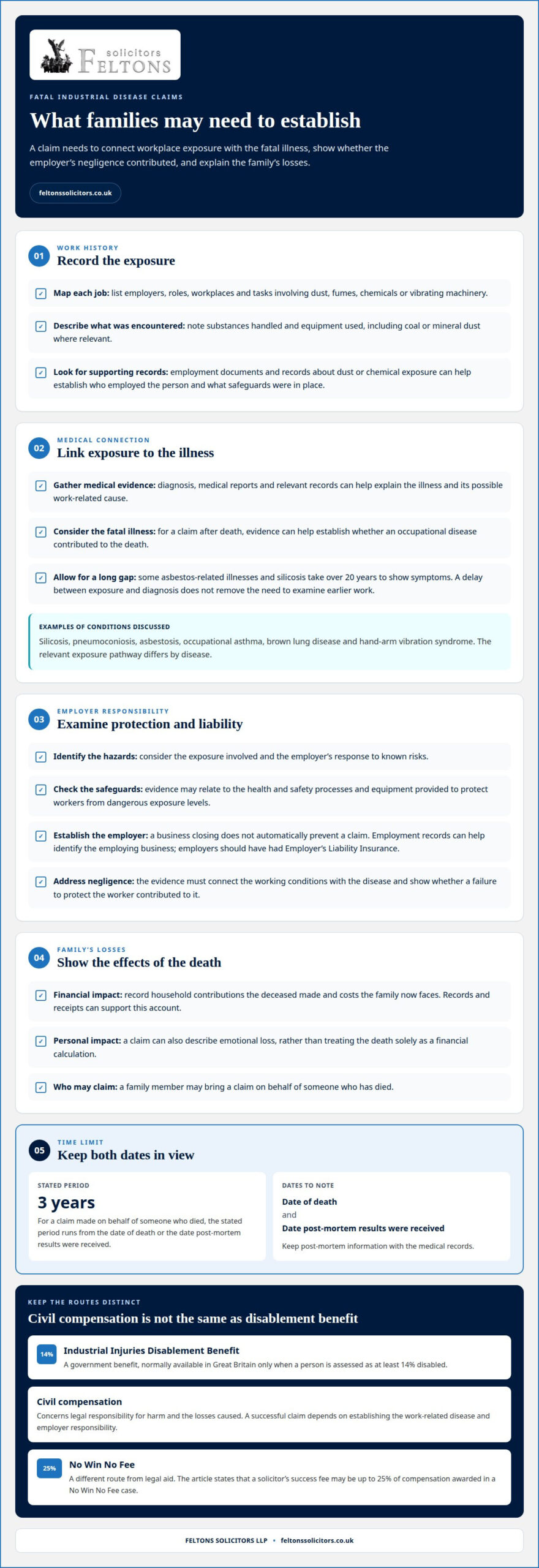
Fatal industrial disease compensation claims for families

Families may consider a civil claim if coal dust or another occupational exposure contributed to a loved one’s fatal illness. Evidence must link the exposure to the disease and resulting losses.

Who can make a claim after a death

A family member may bring a claim on behalf of someone who has died. A fatal workplace claim can set out the bereaved family’s financial and emotional losses. For example, a widow whose husband had died five years earlier asked about a claim connected to coal-dust exposure and industrial lung disease. This illustrates why families may seek advice even after time has passed, while still keeping the legal time limit in mind.

Financial and emotional losses

A claim can describe the practical and personal effects of the death. Financial evidence may include the household contributions the deceased made and costs the family now faces. Records and receipts can help explain these losses. The claim can also describe emotional loss, rather than treating the death solely as a financial calculation. A successful claim depends on establishing the work-related disease and the employer’s responsibility.

Time limits for claims after death

For a claim made on behalf of someone who died, the stated period is three years from the date of death or the date post-mortem results were received. Note both dates and keep post-mortem information with medical records. If the connection between coal dust and lung disease was recognised late, reconstructing the timeline may be harder. Record when the diagnosis and cause became known.

Civil compensation for a work-related death

Yes. Families can pursue civil compensation for a death caused by a work-related disease where evidence supports a link between occupational exposure and the fatal illness, alongside employer negligence. This differs from Industrial Injuries Disablement Benefit, which concerns assessment of disablement rather than the family’s civil claim. Dependants should distinguish an enquiry about that benefit from a civil compensation claim, which addresses liability and the losses caused by the death.

Steps in an industrial disease compensation claim

For families pursuing fatal industrial disease compensation claims, the first step is to preserve records and create a clear account of the worker’s history. Note the suspected occupational illness, workplaces, roles and substances involved. Keep medical and post-mortem papers together, and record when each document was received. This provides a useful starting point for investigating the cause of death and identifying the potentially responsible employer.

  1. Build a work history. List each employer, job role, workplace, task and known exposure. Include details such as coal dust, asbestos, chemical fumes or vibrating machinery where relevant. Add approximate employment periods if available, and note former colleagues who could describe the conditions. This chronology helps distinguish separate jobs and possible sources of exposure.
  2. Gather supporting evidence. Collect medical reports, diagnosis records, employment documents and post-mortem information. Witness accounts, photographs, messages and workplace records may clarify the conditions. Look for evidence that links the illness to specific duties, rather than relying on a diagnosis alone. Keep copies and note who supplied each item.
  3. Assess causation and responsibility. A specialist considers whether the evidence connects workplace exposure to the illness and whether employer negligence contributed. This can be difficult when symptoms appeared long after exposure or the business has closed. Records from different jobs can help identify the relevant workplace and clarify which employer’s actions need examination.
  4. Set out the family’s losses. Gather documents showing how the death affected household finances, including contributions the worker made and costs the family incurred. Describe the personal impact as well. In fatal industrial disease compensation claims, this information helps present the family’s losses alongside the evidence about illness and responsibility.

A dated file makes it easier to follow events and identify missing details. Discuss an industrial disease claim with a solicitor to consider how the available evidence may support the next steps.

Feltons Solicitors LLP: Divorce and Financial Arrangements

Feltons Solicitors LLP handles personal injury and silicosis claims where workplace exposure may have caused illness. If a loved one has died, the family can discuss the available evidence, suspected occupational disease and losses connected with the death. The firm also provides wills, probate and estate planning, which may be relevant to managing a deceased person’s estate. These are separate legal matters, so explain whether you need advice about a compensation claim, estate administration or both.

Before discussing the matter, gather any medical reports, employment records and post-mortem information. These give the solicitor a clearer starting point for understanding the work history and the family’s concerns.

Contact Feltons Solicitors LLP to discuss your circumstances, or visit feltonssolicitors.co.uk.

Choose a clear next step for your family

Legal advice can help your family decide what to do with the evidence and which questions to address first. For families considering fatal industrial disease compensation claims, the next step is a focused discussion of the work history, medical information and losses caused by the death. You can also raise any related legal matters that need attention as your family makes plans.

Feltons Solicitors LLP handles personal injury and silicosis claims, as well as wills, probate and estate planning. The firm also provides divorce and financial arrangements, and residential and commercial conveyancing. These are distinct matters, but a family may need advice on more than one as circumstances change.

Contact Feltons Solicitors LLP to discuss your circumstances and consider a practical way forward. A careful first conversation can help you approach the next steps with greater clarity.

Frequently Asked Questions

How much compensation will I receive?

There is no single set amount for an industrial disease claim. The assessment considers the effects of the illness and the losses supported by evidence, including how the death changed the family’s financial position. Useful records may include earnings information, household expense documents and receipts for costs linked to the illness. A solicitor can review these details and explain what losses may be included.

The employer that caused my illness has gone out of business, can I still claim?

Yes. A business closing does not automatically prevent a claim. Start by establishing the employer’s exact name and the period your relative worked there. Old payslips, contracts, pension papers and correspondence can help identify the business, even if its premises have closed. An insurer may still be relevant, so keep records that identify the employer to help trace the route for a claim.

Will I have to go to court?

Not every claim reaches a hearing. The parties may resolve a claim through settlement discussions, but court proceedings may be necessary if responsibility or the value of losses remains disputed. Before then, the evidence is gathered and the claim is presented to the party considered responsible. Keep copies of relevant records and give a clear account of the work history so the case can be assessed properly.

Am I likely to have a case to claim compensation for my occupational illness?

You may have grounds to claim if medical evidence supports an occupational illness and other evidence links it to an employer’s failure. A diagnosis alone does not establish liability. For example, a worker’s medical history can be considered alongside job records describing their duties and exposure. A solicitor can assess whether the available information supports causation, negligence and a claim for losses arising from the illness.

Can I be fired or dismissed for seeking damages against my employer for my industrial disease?

If you are concerned about how your employer may respond to a claim, keep a clear record of related communications. Employees concerned about how a claim could affect their work may wish to keep written communications about the claim or employment, including messages and letters. Keep any written communications about the claim or employment, including messages and letters, to maintain a clear record of what was said and when.

How can I be sure my illness was caused by my work?

To establish a work-related cause, compare the medical evidence with the person’s work history and exposures. Create a timeline of jobs, tasks, substances encountered, and when symptoms or diagnoses arose. Medical reports can explain the illness, while employment records, workplace documents and witness accounts may clarify the conditions. Together, this evidence can help assess whether workplace exposure caused or contributed to the disease.

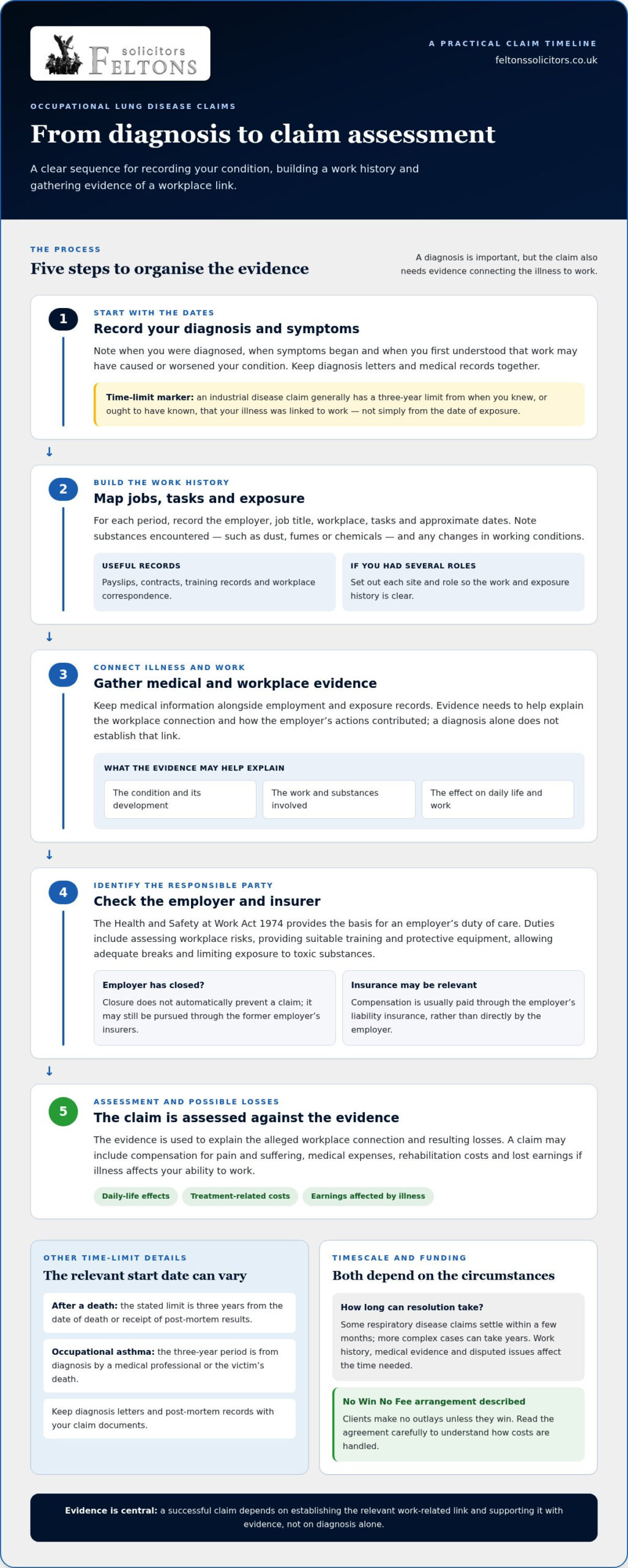
Occupational lung disease solicitors in the UK and claim costs

Occupational lung disease solicitors in the UK and claim costs

Whether you pay upfront for an occupational lung disease claim depends on its funding arrangement. Overall costs depend on the case and the evidence. If you are considering occupational lung disease solicitors in the UK, understand how legal fees and case expenses are handled before deciding how to proceed.

It is understandable to be concerned about costs while dealing with a serious health condition. The time limit matters too: an industrial disease claim generally must be brought within three years of when you knew, or ought to have known, that your illness was linked to work.

This guide explains what can affect claim costs, what compensation may cover, and how medical evidence and work history can help establish a link to workplace exposure. It also outlines the time limit and the key information to gather, so you can make an informed decision about your next steps.

Key Takeaways

  • Understand how the funding arrangement and case expenses can affect what you pay during a claim.
  • Gather details of your past roles, tasks and workplace exposures to help build a clear employment history.
  • Identify which financial losses and health-related costs may form part of a compensation claim.
  • Learn how medical reports can connect a lung condition with workplace exposure, and when specialist personal injury or silicosis claims support may help.

Is there a time limit on industrial disease claims?

Yes. According to the UK legislation register, an industrial disease claim generally has a three-year time limit from when the claimant discovered the illness was linked to work. To start a claim, establish the diagnosis, record relevant work and exposure history, then gather evidence connecting the illness to work; resolution can take a few months or, in complex cases, years.

Time limits for disease claims

The three-year period is generally linked to when you became aware of the connection with work, rather than simply the date exposure occurred. Symptoms of industrial respiratory disease can take years to develop, so note when you were diagnosed and when you first understood that work may have caused or worsened your condition. These dates help clarify which events matter when assessing the time limit.

For a claim after someone has died, the stated time limit is three years from the date of death or receipt of post-mortem results. Occupational asthma claims also have a three-year period from diagnosis by a medical professional or the victim’s death. As the relevant start date can depend on the circumstances, keep diagnosis letters and post-mortem records with your claim documents.

Claims after an employer closes

An employer closing or ceasing to trade does not automatically prevent an industrial disease claim. A claim may still be pursued against the former employer’s insurers, so the employer’s status is not the only detail to investigate. Identify the business involved during each relevant period of work, and record the dates, job roles and substances encountered.

For example, someone diagnosed with obstructive pulmonary disease after years of workplace exposure can set out where they worked, what tasks they performed and which substances they handled. These details can help identify the relevant employer and insurer, even if the business has since closed. Keep employment records, payslips and correspondence that help establish your work history.

Steps and timescales for making a claim

Start by documenting your respiratory condition, diagnosis dates and symptoms, then create a timeline of jobs and possible exposures. Next, gather medical information and employment records that may help link the disease to work. The claim can then be assessed against the relevant employer or insurer, using the evidence to explain the alleged workplace connection and resulting losses.

Some respiratory disease claims settle within a few months, while more complex cases can take years to resolve. The time needed depends on the work history, medical evidence and whether the parties can resolve disputed issues. A successful claim depends on establishing the relevant link and supporting it with evidence, not on the diagnosis alone.

Do I pay to claim respiratory disease compensation?

Whether you pay upfront depends on the claim’s funding arrangement. Under the No Win No Fee arrangement described for these claims, clients make no outlays unless they win. Read the agreement carefully to understand how costs are handled.

You may qualify to claim if workplace exposure caused a respiratory illness and your employer was negligent and legally at fault. A diagnosis alone does not establish that link: evidence must connect your condition to work and show how the employer’s actions contributed.

Start by building a practical employment timeline. Record each employer, job title, workplace, task and substance encountered, including dust, fumes or chemicals. Add approximate dates and note any changes in working conditions. Payslips, contracts, training records and workplace correspondence can support your account, particularly if you worked across several sites or roles.

The Health and Safety at Work Act 1974 provides the basis for an employer’s duty of care to protect workers from harm. Employers should assess workplace risks, provide suitable training and protective equipment, allow adequate breaks and limit exposure to toxic substances. For example, records showing that harmful dust was present can help explain the conditions in which an illness developed.

Insurance may be relevant when pursuing a work-related claim. If a former employer has closed, a claim may still be pursued through its insurers. Lawyers can use your employment history, business details and exposure records to help trace the relevant insurer. Compensation is usually paid through the employer’s liability insurance, rather than directly by the employer.

Keep medical records alongside workplace evidence, and note how symptoms affected your ability to work. A specialist can assess whether the available evidence supports a compensation claim and explain the funding terms before you proceed. For claims involving workplace exposure, personal injury and silicosis claims are relevant to the legal issues involved.

Occupational lung disease solicitors in the UK and claim costs

Compensation for pain, suffering and financial losses

Industrial disease compensation can address both the effects of illness and the practical costs it creates. Evidence should show how respiratory disease has affected your daily life, treatment needs and ability to work.

Compensation for pain and suffering

Compensation may reflect pain, suffering and the effect of a lung condition on everyday activities. Describe specific changes, such as difficulty walking, sleeping or completing household tasks, and explain when they began. Medical records can show how the condition has affected you over time, while your account adds detail about its impact beyond the diagnosis.

Thousands of workers die from work-related lung disease each year in the UK, but each claim turns on its own evidence. A respiratory disease compensation lawyer can assess how medical information and personal evidence support the claim, and explain the issues that may affect its value.

Compensation for financial losses

A claim may include medical expenses, rehabilitation costs and lost earnings if illness affects your ability to work. Keep receipts, invoices and wage records, organised by date and purpose. For example, treatment costs alongside payslips may help show how illness has affected both your spending and income.

State benefits may continue while you receive industrial disease compensation. If your income has fallen before a claim concludes, ask whether an interim payment can be sought. This is an advance against potential compensation, not a separate award. The available evidence and circumstances of the case matter.

Occupational asthma compensation

An occupational asthma claim requires evidence connecting asthma to workplace exposure. Set out the roles and tasks involved, the substances encountered, and when symptoms arose or worsened. Medical reports can explain the diagnosis and its relationship to work, while employment records may support your exposure history.

When considering legal support, look for a specialist who can assess medical evidence, earnings records and treatment costs together. Ask how these factors will be presented in the compensation claim, including any losses that may continue as the illness develops. Clear records help lawyers distinguish documented financial effects from estimates.

Medical reports can help explain whether a lung condition relates to workplace exposure. The diagnosis, work history and substances encountered all contribute to the assessment.

Asbestos-related lung conditions

Mesothelioma, asbestos-related lung cancer and asbestosis can be connected to past workplace asbestos exposure. Around 5,000 people die each year in the UK from asbestos-related diseases, with clear links to previous work with asbestos. Note the relevant sites, roles and tasks, including work involving insulation, maintenance or materials that may have contained asbestos.

A medical expert can assess whether the diagnosis and reported exposure are consistent with the condition. For example, records describing asbestos-related tasks can add context to medical findings. An occupational lung disease solicitor in the UK can help organise these records and explain how they may support the alleged link between exposure and illness.

Work-related breathing problems

Work-related breathing problems include chronic obstructive pulmonary disease and asthma. An estimated 12,000 deaths each year are due to work-related respiratory disease. In 2018/19, an estimated 18,000 new cases of breathing or lung problems developed or were aggravated by work in the UK.

Record each relevant job, task and substance, then compare that history with medical reports. Examples include dust from concrete, brick, stone or cement, and fumes from welding, cutting or grinding metals. Occupational lung disease solicitors can assess this evidence alongside medical reports to consider how workplace exposure may have contributed to a condition. Exposure may be long-term or brief but intense enough to cause illness.

Medical evidence can explain the diagnosis, symptoms and possible relationship to exposure. Employment records and a clear account of workplace conditions add context, helping show whether an injury was work-related. If you need legal support with evidence of workplace exposure, discuss your personal injury claim.

Feltons Solicitors LLP: Divorce and Financial Arrangements

Feltons Solicitors LLP handles personal injury and silicosis claims, including cases where a lung condition may be linked to workplace exposure. If your diagnosis involves silicosis, or you are considering a personal injury claim, discuss how your medical records, work history and exposure evidence relate to your circumstances.

A clear timeline of jobs, tasks and substances encountered can help explain your work history. Medical reports and records of how the illness has affected you can also inform the legal assessment. These details matter when considering the connection between work and disease, and the losses involved.

For a claim involving workplace lung disease, contact Feltons Solicitors LLP to discuss your circumstances and possible next steps.

Take the next step with a clear picture of your case

Before taking action, bring your key information together. A short timeline of your work, diagnosis and the effect on daily life can help frame the issues to address. Include questions about evidence, funding and the losses you want considered. This gives a solicitor a practical starting point for understanding your circumstances.

Choosing occupational lung disease solicitors in the UK is a personal decision, particularly when illness has disrupted work and home life. Look for clear explanations of the legal process and funding terms, and make sure you understand what information will help assess your position. You can work through the discussion one step at a time.

Feltons Solicitors LLP can discuss a potential personal injury or silicosis claim and the information relevant to your circumstances. Contact Feltons Solicitors LLP to start a considered conversation about your next steps.

Frequently Asked Questions

How should my employer have protected me against industrial disease?

Your employer should have taken practical steps to reduce workplace health risks, including assessing hazards, providing suitable training and protective equipment, allowing adequate breaks, and limiting exposure to toxic substances. If your role involved dust or fumes, consider what controls were in place and whether you received relevant training. Records of safety procedures, equipment and workplace instructions may help show what protection was provided.

Can I lose my job if I make a claim against my employers?

Making an industrial disease compensation claim should not, by itself, mean you lose your job. Legal safeguards protect employees against unfair dismissal or discrimination for making a claim. Keep a record of any changes to your duties, treatment at work or employment decisions after raising the issue. Dates, written messages and meeting notes can help document events if you are concerned about how you are being treated.

How do I prove that my lung disease was caused by workplace exposure?

Bring your medical diagnosis together with details of the work you did and substances you encountered. A medical report can explain whether workplace exposure is consistent with your condition, while job records and a detailed account can identify where and how exposure occurred. Note tasks involving dust, welding fumes or asbestos, and connect them to the relevant employers and periods of work.

How much will it cost to fund my claim?

The funding arrangement determines what you may need to pay during a claim. Under the No Win No Fee arrangement described for these cases, clients make no outlays unless they win. Before agreeing to proceed, read the funding terms carefully and ask how legal costs and case expenses are treated, including what happens if the claim does not succeed. Do not assume every agreement has the same terms.

My employer has gone out of business, can I still claim?

Yes, a former employer ceasing to trade does not automatically prevent a claim. Industrial disease claims may be pursued against the employer’s insurers, so identifying the business and relevant insurer can still matter. Gather old contracts, payslips, work records or correspondence that identify the employer and your role. A timeline of workplaces and employment periods can help explain where exposure occurred.

What occupational lung diseases can be the basis of a UK compensation claim?

Conditions linked to workplace exposure can include occupational asthma, chronic obstructive pulmonary disease, asbestosis, mesothelioma, asbestos-related lung cancer and berylliosis. The key question is whether evidence connects the diagnosed illness to exposure at work and supports a claim against an employer. For example, records of beryllium dust or fumes may be relevant alongside medical evidence of berylliosis. Each condition requires evidence specific to its circumstances.

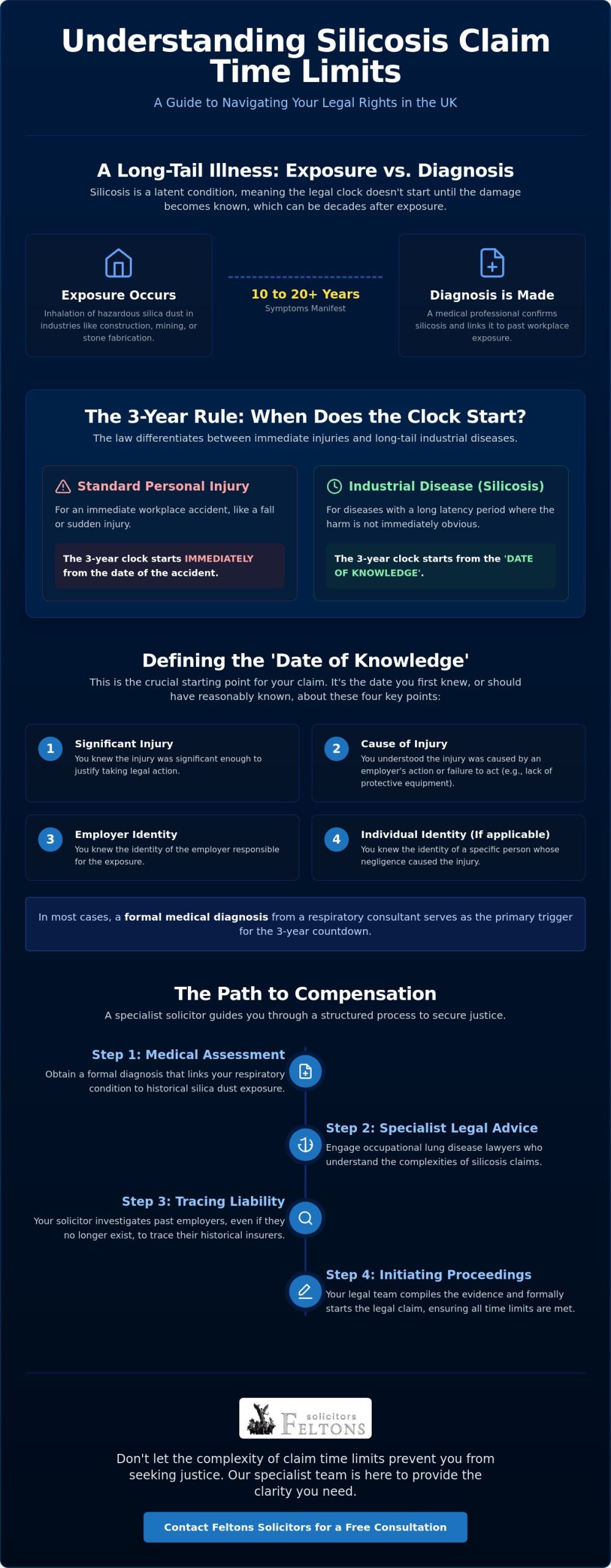
Silicosis Claim Time Limits UK: A Guide to Occupational Lung Disease Compensation in 2026

Silicosis Claim Time Limits UK: A Guide to Occupational Lung Disease Compensation in 2026

The legal clock for industrial disease doesn’t necessarily start ticking the moment you’re exposed to hazardous silica dust; it starts when you first realise the damage it’s caused. If you’ve recently received a diagnosis, understanding the strict silicosis claim time limits uk courts enforce is the most vital step toward protecting your family’s future. It’s natural to feel anxious that you might be too late to seek justice, especially when your health is a primary concern and the companies you once worked for may no longer exist.

This article provides the clarity you need by explaining how the ‘date of knowledge’ rule creates a fair opportunity for compensation, regardless of when your exposure occurred. We’ll outline the three year limitation period, explain the process of tracing historical insurers, and provide a methodical overview of the current 2026 claim requirements. By the end of this guide, you’ll have a clear, professional path toward the financial support and peace of mind you deserve.

Key Takeaways

  • Understand the standard three-year limitation period and how the ‘date of knowledge’ rule provides a fair starting point for legal action.
  • Learn how silicosis claim time limits uk regulations apply even if your exposure occurred decades ago in industries like mining or construction.
  • Discover how specialist solicitors can trace historical insurers and hold former employers accountable, even if the original company is no longer trading.
  • Identify your legal rights regarding modern silica risks, such as those found in engineered stone fabrication and quartz worktop manufacturing.
  • Explore the benefits of a tailored, boutique legal approach that manages the complexities of litigation whilst you focus on your health and recovery.

Understanding Silicosis Claim Time Limits in the UK

Silicosis is a progressive, irreversible lung condition caused by the inhalation of respirable crystalline silica (RCS) dust. For those seeking a comprehensive overview of silicosis, it’s defined by the scarring of lung tissue which leads to persistent breathing difficulties and a reduced quality of life. Unlike a trip or fall where the injury is immediate and obvious, silicosis often remains latent for decades. This delay creates a unique challenge when navigating silicosis claim time limits uk, as the gap between breathing in the dust and receiving a medical diagnosis can span an entire career.

The Limitation Act 1980 sets the standard legal framework for personal injury in England and Wales. Generally, a claimant has three years to initiate legal proceedings. However, because respiratory diseases are “long-tail” illnesses, the law treats them differently from a sudden workplace accident. In a traumatic injury case, the clock starts immediately. With silicosis, the law recognises that the damage is internal and invisible for years. Therefore, a critical distinction is made between the date of exposure and the date of injury. You aren’t expected to claim for an injury you don’t yet know exists. Instead, the legal focus shifts to when you first became aware that your health had been compromised by your working conditions.

The 3-Year Rule: When Does the Clock Actually Start?

The statutory period for industrial disease doesn’t usually begin on your last day of work. It starts on your “date of knowledge.” This is the point at which a reasonable person would have realised they had a significant injury caused by their employer’s negligence. With the 2026 HSE updated guidelines placing a heavier emphasis on silica exposure reporting in sectors like engineered stone fabrication, the courts are increasingly precise about when this “knowledge” is established. If you’ve been diagnosed with silicosis, the three-year countdown likely began on the day of that medical confirmation.

Why Silicosis Claims Require Specialist Occupational Lung Disease Lawyers

Proving a link between current breathlessness and dust inhaled decades ago is a complex undertaking. Experienced occupational lung disease lawyers are essential for identifying the point of legal liability, especially when multiple employers are involved. They understand the nuances of the Control of Substances Hazardous to Health (COSHH) Regulations 2002 and how these duties applied during your employment. These specialists handle the intricate task of tracing defunct companies and their insurers, ensuring silicosis claim time limits uk are met whilst you focus on your health. This methodical approach transforms a daunting legal hurdle into a structured path toward recovery.

The ‘Date of Knowledge’ Exception for Respiratory Claims

The standard three-year window for personal injury can feel incredibly restrictive for those suffering from industrial diseases. Because symptoms of silica exposure often take 10 to 20 years to manifest, the law provides a vital exception known as the “date of knowledge.” This principle ensures that silicosis claim time limits uk courts apply don’t expire before a claimant even knows they’re unwell. If you’re experiencing persistent coughing or shortness of breath, reviewing NHS information on silicosis symptoms is often the first step toward a formal medical assessment.

For the three-year clock to begin, the law requires that a claimant has “knowledge” of four specific pillars. First, you must know the injury is significant enough to justify legal proceedings. Second, you must understand that the injury was caused by an act or omission, such as a lack of protective equipment at work. Third, you must know the identity of the employer responsible. Finally, if the claim involves a specific individual’s negligence, you must know their identity. Until these factors align, the limitation period typically remains paused.

The ‘date of knowledge’ is the moment a reasonable person would suspect their illness was caused by work.

In most modern cases, a formal medical diagnosis from a respiratory consultant serves as the primary trigger for the countdown. Once a doctor confirms that your lung scarring is directly linked to historical dust exposure, the legal expectation is that you’ll take action. If you’re unsure when your own clock started, speaking with a specialist at Feltons Solicitors LLP can provide the clarity needed to move forward.

What if You Suspected the Link Years Ago?

The courts also consider “constructive knowledge,” which refers to information you should’ve reasonably discovered. If your medical records show you discussed work-related dust with a GP five years ago but didn’t investigate further, an insurer might argue you’re out of time. A specialist solicitor’s role is to argue against an early date of knowledge by proving that your suspicions didn’t constitute definitive legal “knowledge” at that time.

Section 33: The Court’s Power to Overlook the Deadline

Even if the three-year limit has passed, Section 33 of the Limitation Act 1980 grants judges the discretion to allow “out of time” claims. The court weighs the length of your delay against the potential prejudice to the employer. If the evidence is still available and the delay was understandable, this section acts as a vital lifeline for silicosis sufferers who may have missed the initial deadline due to health or personal circumstances.

Identifying Liability in Modern and Historical Exposure

Establishing who’s legally responsible for your illness is as critical as navigating the silicosis claim time limits uk courts require. Under the Control of Substances Hazardous to Health (COSHH) Regulations 2002, employers have a non-negotiable duty to protect their workforce from respirable crystalline silica. This isn’t just about providing a simple dust mask; it’s about a comprehensive hierarchy of control. Negligence often stems from a failure to organise a safe working environment, particularly amongst stone masons and construction workers where the risks are highest. To understand more about structural safety and maintenance in these sectors, visit Composites Construction UK.

The UK is currently facing a rising crisis linked to engineered stone (quartz) worktop fabrication. These materials can contain up to 90% silica, compared to much lower levels in natural stone. If an employer failed to provide “on-tool” water suppression to catch dust at the source or neglected to supply high-grade, face-fitted Respiratory Protective Equipment (RPE), they’ve breached their statutory duty. For those seeking medical context, NHS information on silicosis outlines how this exposure leads to life-altering damage, reinforcing why legal accountability is so vital. If you worked as a mason or fabricator and have received a diagnosis, our dedicated guide to stone masonry silicosis claims explains how to seek legal redress and secure the compensation you’re entitled to.

Tracing Insurers for Companies That No Longer Exist

Many silicosis sufferers worry that they can’t claim because their former employer went bust years ago. This isn’t the case. We use the Employers’ Liability Tracing Office (ELTO) to locate historical insurance policies that were active at the time of your exposure. Even if a business is dissolved, we can often restore the company to the Register of Companies specifically to pursue litigation. The insurer, not the defunct business, pays the compensation, ensuring that silicosis claim time limits uk rules don’t prevent you from accessing the funds you need for care.

Multiple Employers: Who is Responsible for Your Silicosis?

It’s common for workers to have been exposed to dust across several different jobs over a long career. In these instances, liability is usually apportioned between the various employers based on the length and intensity of the exposure at each site. The “material contribution” test is often applied, where we prove that each employer’s negligence contributed significantly to the overall risk of you developing the disease. Handling these multi-defendant cases requires a methodical approach, often involving complex personal injury claims solicitors to ensure every responsible party is held to account. This level of detail is essential for securing a settlement that reflects the true impact on your health and future.

Silicosis Claim Time Limits UK: A Guide to Occupational Lung Disease Compensation in 2026

The Step-by-Step Process of a Silicosis Claim

Initiating a legal challenge for an industrial disease requires a methodical approach and early intervention. Because evidence such as site logs, dust monitoring records, and maintenance files can be lost over time, starting the process whilst information is still accessible is paramount. Reconstructing a work history from several decades ago is a specialist task. By acting promptly, you ensure that the silicosis claim time limits uk courts strictly enforce are not breached, protecting your ability to secure essential financial support. For a detailed breakdown of each stage, our guide to the silicosis litigation process UK provides a comprehensive roadmap for securing compensation in 2026.

Our role involves more than just filing paperwork. We work closely with medical experts to quantify the exact level of your lung impairment and its likely progression. This detailed assessment allows us to negotiate settlements that don’t just cover past losses, but also account for future care requirements and potential loss of earnings. This forward-thinking strategy is designed to provide you and your family with long-term security and peace of mind.

Step 1: The Initial Consultation and Merit Assessment

The journey begins with a detailed review of your employment history and medical diagnosis letters. We carefully assess your “date of knowledge” to ensure your case falls within the necessary silicosis claim time limits uk. At Feltons Solicitors LLP, we offer pragmatic, plain-English advice during this stage. We focus on being a calm, steady presence, helping you understand the strengths of your case without the distraction of dense legalese.

Step 2: Evidence Gathering and Expert Reports

Once we’ve established the merits of your claim, we move into the intensive evidence-gathering phase. This involves instructing a consultant respiratory physician to provide a comprehensive causation report. We also use Subject Access Requests (SARs) to obtain personnel files and seek witness statements from former colleagues who can testify to the dust levels and lack of protective equipment at your former workplace. This robust body of evidence is the foundation of a successful recovery.

Step 3: Letter of Claim and Pre-Action Protocols

We formally notify the defendant or their insurer of the legal action through a Letter of Claim. Under pre-action protocols, they have a specific timeline to investigate and provide a formal response regarding liability. Whilst we prepare every case with the diligence required for a court trial, most claims are settled through professional negotiation. If you’re concerned about your health and want to explore your options, contact Feltons Solicitors LLP for a discreet consultation on your silicosis claim.

Why Specialist Representation Matters for Silicosis Claims

Choosing the right legal partner is as significant as understanding the silicosis claim time limits uk courts mandate. Industrial disease litigation is rarely straightforward, often involving decades of employment history and complex medical pathology. Unlike high-volume firms that may treat these cases as mere statistics, a boutique approach prioritises personal connection and tailored care. We understand that behind every file is a person facing a challenging health journey, which is why our focus remains firmly on providing a supportive, high-standard service through Feltons Solicitors LLP.

Our team manages the heavy lifting of your litigation, allowing you to focus on your medical treatment and well-being. We take responsibility for the exhaustive research required to trace former employers and their insurers, even when businesses have long since closed. This professional oversight ensures that your claim is built on a robust foundation, protecting your family’s future through meticulous preparation. In cases where a condition progresses rapidly, we provide the necessary continuity to ensure a silicosis claim after death can be pursued by bereaved families, honouring the original intent of the legal action.

The Feltons Solicitors LLP Professional Standards

We pride ourselves on a sophisticated blend of traditional professional integrity and modern delivery. Our solicitors act as a calm, steady presence during what can be a stressful and uncertain period. Whilst we maintain a boutique level of care, our reach is national. We represent clients across the UK, ensuring that regardless of where you were exposed to silica dust, you have access to high-end reliability and worldly legal experience. This methodical approach ensures that no detail is overlooked in the pursuit of justice.

Securing Your Financial Future

A successful claim is about more than just a settlement figure; it’s about providing the resources needed for a dignified life. We work methodically to calculate damages for pain, suffering, and loss of amenity (PSLA), ensuring the physical and emotional impact of your condition is fully recognised. Our goal is to recover costs that cover private medical treatment, specialised equipment, and necessary home adaptations. For those who may require professional property modifications, it can be helpful to explore Project-based Installation and Landscaping Fees from Wolverhampton Driveways Ltd to assist with financial planning. If you’re ready to explore your options and ensure you remain within the silicosis claim time limits uk, we invite you to take the first step with a confidential, professional consultation with Feltons Solicitors LLP to discuss your path forward.

Securing Your Path to Justice and Recovery

Navigating a respiratory diagnosis is a significant challenge, but the legal framework exists to ensure you aren’t left without support. We’ve examined how the “date of knowledge” principle provides a vital extension to the standard silicosis claim time limits uk regulations, allowing for claims even decades after initial exposure. By tracing historical insurers and identifying modern liability, you can secure the financial resources necessary for private care and long-term security.

Since 2010, Feltons Solicitors LLP has maintained a national reputation for delivering pragmatic legal advice through a boutique, people-first approach. We provide a calm, steady presence during complex litigation, prioritising the personal connection that high-volume firms often overlook. Our specialist expertise in industrial disease ensures that your family’s future is protected with the highest standards of professional integrity. Speak with our specialist occupational lung disease lawyers today to begin your confidential consultation. You don’t have to face this journey alone; we’re here to provide the sophisticated guidance you deserve.

Frequently Asked Questions

How long do I have to make a silicosis claim in the UK?

The standard limitation period is three years from the date of your diagnosis or the date you first suspected your illness was linked to your work. This is legally referred to as the “date of knowledge.” Because symptoms can take decades to appear, the silicosis claim time limits uk courts apply are designed to ensure that the clock only starts once the injury is actually discovered.

Can I claim if my diagnosis was more than three years ago?

In most circumstances, the three-year deadline is strictly enforced. However, the court has discretionary power under Section 33 of the Limitation Act 1980 to allow a claim to proceed “out of time.” A judge will weigh the reasons for your delay against the availability of evidence. It’s always advisable to have your case reviewed by a specialist to see if an exception might apply to your situation.

What happens if the company I worked for is now insolvent?

You can still seek compensation even if the business you worked for has closed down. Claims are made against the employers’ liability insurance policy that was active at the time of your exposure. We use specialist tracing services to locate these historical insurers, ensuring that a former employer’s insolvency doesn’t prevent you from receiving the financial support you’re entitled to.

Do I need to have a formal diagnosis before I contact a solicitor?

You don’t need a final medical report to begin an initial consultation. If you’re experiencing respiratory symptoms and have a history of working with silica dust, early legal advice is beneficial. We can help you navigate the process of obtaining a formal diagnosis and ensure that the right medical experts are instructed to assess the link between your health and your previous employment.

How much compensation can I expect for a silicosis claim in 2026?

Compensation is calculated based on the severity of your condition and the financial impact on your life. Awards are divided into “general damages” for pain and suffering and “special damages” for financial losses, such as lost earnings and the cost of private care. Every case is unique, and a specialist will provide a methodical valuation based on your specific medical evidence and care requirements.

Can I claim for silicosis if I was a smoker?

Yes, having a history of smoking doesn’t prevent you from pursuing a claim. The legal test is whether silica dust exposure caused or materially contributed to your lung condition. Medical experts are highly skilled at apportioning the cause of respiratory damage, and if it can be proven that workplace dust played a significant role, you’re still eligible to seek compensation for that contribution.

Is there a time limit for a silicosis claim after death?

The limitation period for a claim brought by a bereaved family is usually three years from the date of death. Alternatively, the clock may start from the date the cause of death was confirmed, such as through a post-mortem report. This ensures that families can still seek justice even if the link to silica dust wasn’t fully understood during the sufferer’s lifetime.

Will I have to pay legal fees upfront for an occupational lung disease claim?

Most claims are handled under a “No Win, No Fee” agreement, meaning there are no upfront costs to pay. If your claim is successful, the solicitor’s success fee is legally capped at 25% of the compensation awarded for pain, suffering, and past financial losses. This arrangement ensures that you can access high-quality legal representation without facing financial risk whilst your case is ongoing.