

Trust creation and asset protection solicitors for property

Trust creation and asset protection solicitors for property

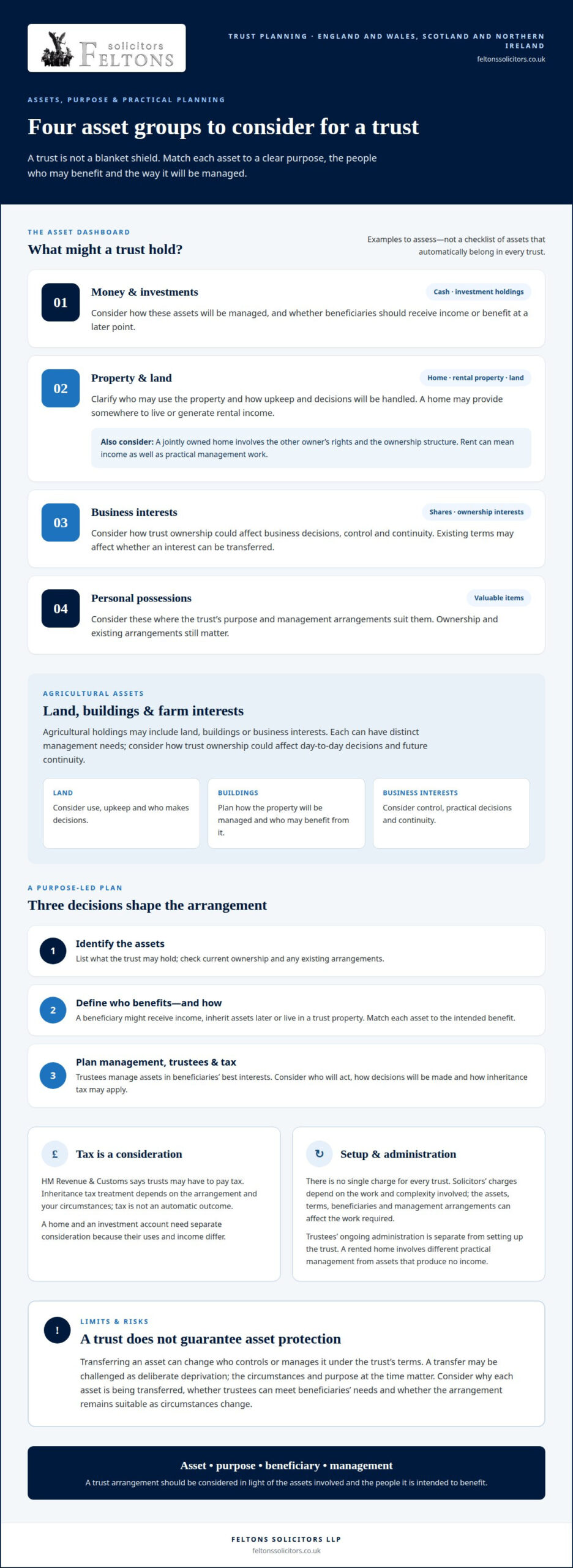
A trust is not a blanket shield for every asset. Trust creation and asset protection solicitors can explain how a trust may hold property, business interests or agricultural assets, and the practical and tax considerations involved. The right structure depends on what you own, who should benefit and how much control you want to retain.

It is understandable to want to protect assets while planning clearly for the people who may inherit or benefit from them. A trust can organise how assets are managed and passed on, but it needs careful consideration rather than being treated as a one-size-fits-all solution.

This article explains which assets may be placed in a trust, how trusts can relate to property, business and agricultural holdings, and what to consider about inheritance tax. It also outlines common trust arrangements and trustees’ roles, helping you approach the decisions with a clearer understanding of what may suit your circumstances.

Key Takeaways

  • Start by matching the assets you want to place in trust with the people who should benefit and the way they should benefit.
  • Factor in trustee responsibilities and the possibility of tax, including inheritance tax considerations, before settling on an arrangement.
  • Consider how property, business interests and agricultural assets are managed, and whether they may generate income within the trust.
  • Compare the purpose of discretionary, income-entitlement, Will, lifetime and disability trusts when considering which structure may fit your plans.

Trusts and inheritance tax considerations

Trust planning involves identifying assets, intended beneficiaries and tax considerations. Inheritance tax treatment depends on the arrangement and your circumstances.

Inheritance tax considerations

HM Revenue & Customs says trusts may have to pay tax. Tax is therefore a planning consideration, not an automatic outcome. Consider which assets would enter the trust, who could benefit and how trustees would manage them. For example, a home and an investment account need separate consideration because their uses and income differ.

Trustees manage trust assets in beneficiaries’ best interests. Before creating a trust, define its purpose and intended beneficiaries, then consider how its terms will affect asset management and future benefits. A beneficiary might receive income, inherit assets later or live in a trust property. These decisions help shape questions about inheritance tax.

Trust set-up and administration costs

There is no single charge that applies to every trust. Solicitors’ charges depend on the work and complexity involved, with a fee provided after a quote request. The trust’s assets, terms, beneficiaries and management arrangements can all affect the work required to prepare its documentation.

Administration is separate from setting up a trust. Trustees must manage its assets and act in beneficiaries’ best interests. A trust holding a rented home, for example, involves different practical management from one holding assets that produce no income. Consider the set-up and ongoing work separately.

Start by reviewing the assets and purpose. List what the trust may hold, who should benefit, and whether they need income, a future inheritance or use of a property. Then consider who will act as trustee and how decisions will be managed. The person establishing a trust may appoint themselves as trustee, while naming a successor can clarify who takes over if they die.

Finally, review the trust document against the intended arrangements. It records how a lifetime trust is to be managed. Clarifying responsibilities, beneficiaries’ needs and tax considerations before creation gives the arrangement a defined purpose. This helps frame a practical discussion about whether a trust suits your estate planning.

Trusts for property, business and agricultural assets

A trust can hold different assets, but each requires practical planning. Consider how ownership, management and beneficiaries’ needs fit together.

To compare solicitors near you, look for clear advice on the assets involved, trustee duties and trust terms. Ask how the proposed arrangement would address your aims, including ongoing management and tax considerations.

For property, consider who can use it and how it will be managed. A home held in trust might provide a place for a beneficiary to live or generate rental income. A business interest may require decisions about control and continuity. Agricultural assets may include land, buildings or business interests, each with distinct management needs.

Challenges to asset transfers

Yes, transferring assets into a trust can be challenged as deliberate deprivation. The circumstances and purpose of the transfer matter, including what was intended at the time. A trust should not be treated as a guaranteed way to prevent assets being considered in other decisions. Consider the reason for transferring each asset and record how the arrangement supports your wider plans.

Limits and risks of asset protection trusts

A trust does not remove every risk or guarantee that assets will be protected. Transferring an asset can also change who controls or manages it under the trust’s terms. Consider whether trustees can meet beneficiaries’ needs, how property or business interests will be handled, and whether the arrangement remains suitable as circumstances change.

According to the UK Government, assets held in a trust can generate income, such as rent from a home. That income and the practical work of managing the property should form part of the planning. For a business or farm, consider how trust ownership could affect day-to-day decisions and future continuity.

For property-related planning, Wills, Probate, and Estate Planning can help shape decisions about assets and beneficiaries.
Trust creation and asset protection solicitors for property

Assets that can be placed in a trust

A trust can hold money or other assets for beneficiaries. Suitable assets depend on ownership, intended use and the trust’s terms. Trust creation and asset protection solicitors can help assess how each proposed asset fits your aims. Start by identifying what the trust may hold and what benefit it should provide. A cash fund, investment holding and family home each raise different management questions.

Examples of assets to consider include:

  • Money and investments: cash or investment holdings can form part of a trust. Consider how they will be managed and whether beneficiaries should receive income or benefit later.
  • Property and land: a home, rental property or land may be considered. Clarify who can use it and how decisions about its upkeep will be handled.
  • Business interests: shares or an ownership interest may be relevant. Consider how trust arrangements fit with business decisions and continuity.
  • Personal possessions: valuable items can be considered where the trust’s purpose and management arrangements suit them.

These examples are not a checklist of assets that automatically belong in every trust. Current ownership and existing arrangements matter. For a jointly owned home, for example, the other owner’s rights and the ownership structure need consideration. Business interests may also have existing terms that affect how they can be transferred.

Next, match each asset to a clear purpose. Decide whether the trust should provide income, preserve an asset for a future inheritance or allow a beneficiary to use it. Then consider who will manage it and what decisions they may need to make. This helps distinguish assets that support the trust’s purpose from those that complicate administration.

Set out the proposed assets and beneficiaries together. A home intended for a beneficiary’s use needs different management planning from cash intended to provide income. A business interest may require attention to decision-making, while land may need ongoing oversight. Trust creation and asset protection solicitors can help clarify how the proposed terms should reflect these practical responsibilities.

Finally, consider how each proposed transfer affects your wider estate plan. Reviewing an asset, its ownership and its intended role together gives you a clearer basis for deciding what to include.

What types of trusts are available in England and Wales, Scotland and Northern Ireland?

Trust options include discretionary, income-entitlement, Will, lifetime and disability trusts. For plans involving England and Wales, Scotland or Northern Ireland, establish the relevant jurisdiction before settling on a structure.

A discretionary trust gives trustees discretion over how beneficiaries benefit. This can suit plans where trustees need to consider beneficiaries’ differing needs over time. The trust document should clearly set out its purpose and management arrangements.

A trust with income entitlements gives a beneficiary an entitlement to income from trust assets. Consider who receives that income and how the underlying assets are managed. For example, both rental income and the property generating it need clear oversight.

A Will trust is created through a will and takes effect as part of estate planning. A lifetime trust is established during the settlor’s lifetime, using a trust document that records how it should be managed. Their timing and purpose distinguish these options. Consider whether the arrangement should form part of a will or begin during your lifetime.

A trust for a person with disabilities is designed around the beneficiary’s circumstances. Consider the person’s needs, the assets intended to support them and how trustees will manage those assets. The terms should connect the trust’s purpose with the support it is intended to provide.

Compare options by asking what beneficiaries need, who should make decisions and when benefits should be available. Then consider the assets involved and how trustees will manage them. A property intended for someone’s use may need different terms from investments intended to provide income. The structure should reflect the practical purpose, not rely on a trust label alone.

Since England and Wales, Scotland and Northern Ireland each form part of the UK’s trust-planning context, identify where the relevant assets and people are based. That helps frame advice on the appropriate structure and its terms. To discuss how trust choices fit your estate plans, arrange a conversation about your estate planning.

Feltons Solicitors LLP

Feltons Solicitors LLP can help you consider trust decisions within your wider estate and property plans. If you’re weighing how assets should benefit family members, its Wills, Probate, and Estate Planning service can support related planning discussions. Where property ownership forms part of your plans, Residential and Commercial Conveyancing may also be relevant.

Bring together the assets you are considering, your intended beneficiaries and the outcome you hope to achieve. This provides a clearer starting point for discussing how trust planning connects with your will, estate and property arrangements. A focused conversation about your circumstances and priorities is a practical next step.

Contact Feltons Solicitors LLP to discuss your estate planning questions.

Make your next planning decision with clarity

Before taking action, set out what you want the trust to achieve and how it fits your wider plans. Consider who should benefit, what role you want trustees to have, and whether your property or family circumstances may change. A clear outline of these priorities can make your next discussion more focused.

Trust creation and asset protection solicitors can help you consider how these decisions connect with your estate and property arrangements. Feltons Solicitors LLP’s work in Wills, Probate, and Estate Planning, Residential and Commercial Conveyancing, and Divorce and Financial Arrangements may be relevant where those matters intersect.

Bring your questions and the decisions you are weighing to a conversation. You can contact Feltons Solicitors LLP about trusts to discuss a practical next step. Thoughtful planning can help you move forward with greater confidence.

Frequently Asked Questions

Need help with a Trust?

Yes, a solicitor can help assess whether a trust fits your aims and circumstances. Prepare a brief outline of the assets involved, who you want to benefit and what you want them to receive. For example, a family home intended for a child’s future use raises different practical questions from investments intended to support someone now.

How do I set up a lifetime trust?

Begin by defining the trust’s purpose, intended beneficiaries and assets. Decide who should act as trustees, then establish how they should manage the trust and make decisions. A lifetime trust is created using a trust document that records its management arrangements. Consider how the terms will work in practice, including how trustees should respond if beneficiaries’ needs change.

What are settlors, trustees, and beneficiaries?

The settlor is the person who creates the trust and places assets into it. Trustees manage those assets under the trust’s terms, while beneficiaries receive the intended benefit. For example, a parent could establish a trust for a child, appoint trustees to manage its assets and set out how the child may benefit.

What can a family trust and asset protection solicitor do?

A solicitor can help a family understand trust options, clarify what the arrangement should achieve and consider how it fits with estate planning. They can also identify practical questions about beneficiaries, trustee roles and asset management. For instance, a family planning for a relative’s future support may need to consider who makes decisions and how those decisions are guided.

What does a trust and asset protection solicitor do in the UK?

A solicitor can explain trust structures, help consider suitable terms and discuss how a proposed arrangement fits your wider plans. This may involve considering asset ownership, beneficiaries, trustee responsibilities and tax implications. Feltons Solicitors LLP offers Wills, Probate, Trusts and Estate Planning, which can be relevant when considering how trust questions connect with your estate arrangements.

How can trusts protect assets from care fees, creditors or divorce in the UK?

A trust does not automatically protect assets from care-fee assessments, creditors or divorce-related claims. The purpose and timing of a transfer, the settlor’s control and the trust’s terms may all matter. Treat a trust as an estate-planning arrangement, not a guaranteed shield. Get advice on your circumstances before transferring assets or relying on a trust for protection.

International Probate Solicitors UK: Navigating Cross-Border Estates in 2026

International Probate Solicitors UK: Navigating Cross-Border Estates in 2026

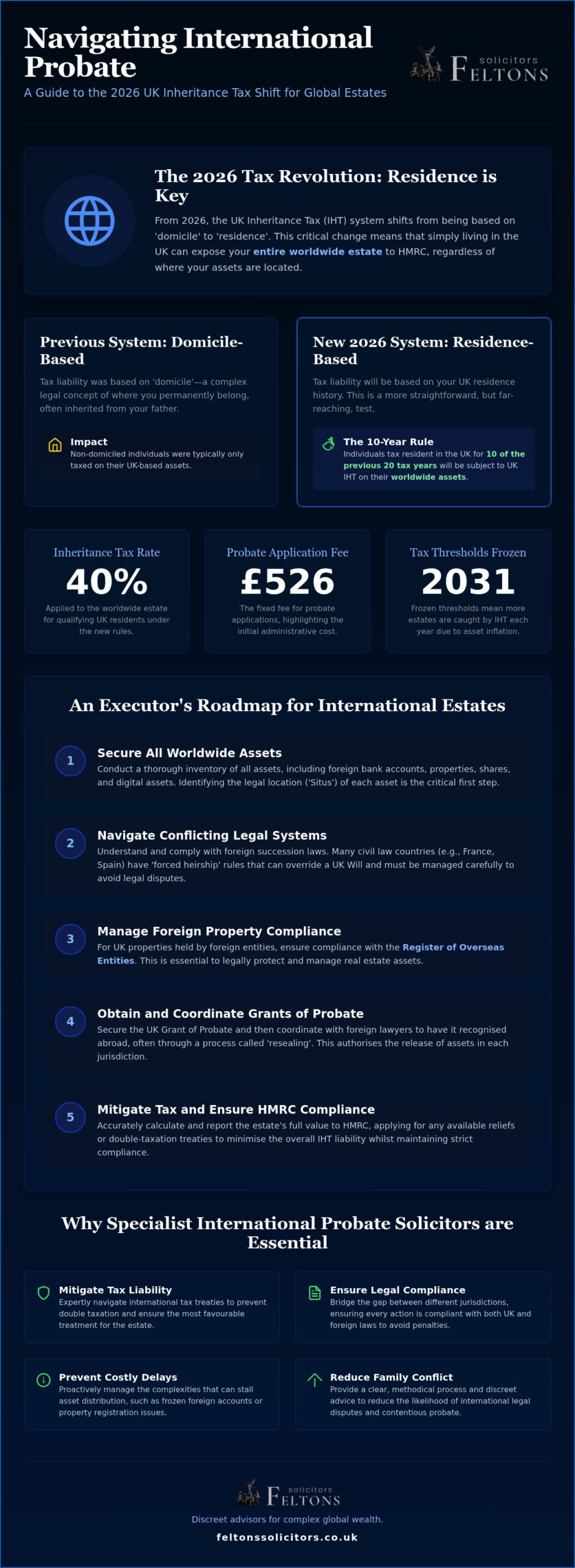
Could your global legacy be dismantled by the very borders you crossed to build it? In 2026, the transition to a residence-based Inheritance Tax system means that simply living in the UK can now expose your worldwide assets to HMRC, regardless of where they’re physically located. Managing these complexities requires the steady hand of experienced international probate solicitors uk. The intersection of foreign succession laws and British tax requirements has never been more intricate, making professional oversight essential for protecting family wealth and ensuring your intentions are honoured.

It’s natural to feel overwhelmed by the conflicting demands of different legal systems or the fear that significant delays will stall the distribution of assets to your beneficiaries. With probate application fees now at £526 and tax thresholds frozen until 2031, the margin for error has vanished. This guide provides a clear, comprehensive roadmap for managing complex cross-border estates, ensuring every foreign asset is legally secured whilst maintaining strict compliance with current 2026 regulations. We’ll examine how to navigate the new residence-based tax landscape, mitigate your total tax liability through expert planning, and streamline the probate process across multiple jurisdictions to provide your family with much-needed stability.

Key Takeaways

  • Grasp how the 2026 shift to a residence-based tax system impacts your global estate and the specific reporting obligations now required by HMRC.
  • Navigate the complexities of foreign property ownership, including the essential steps for the Registration of Overseas Entities to protect your real estate assets.
  • Benefit from the bespoke guidance of international probate solicitors uk to manage the nuances of cross-border administration and ensure seamless asset distribution.
  • Utilise a methodical executor roadmap to accurately secure worldwide assets while identifying the most favourable tax treatments available under current laws.
  • Reduce the likelihood of international legal disputes and contentious probate through discreet, forward-thinking estate management strategies.

What is International Probate? Understanding Cross-Border Estate Administration

International probate is the legal procedure required to manage and distribute an estate when the deceased held assets in more than one country. Unlike a standard domestic probate, which follows a single set of rules, cross-border administration involves a complex conflict of laws between different legal systems. This often occurs in two primary scenarios: a UK resident dies leaving property or bank accounts abroad, or a foreign national passes away leaving assets within the UK. In either case, the process requires international probate solicitors uk to act as a central coordinator, managing various legal threads to ensure a cohesive distribution of the estate.

The role of the UK solicitor is to bridge the gap between jurisdictions. They don’t just handle the UK side; they liaise with foreign legal professionals to ensure that the grant of probate is recognised and that assets are released without unnecessary friction. This coordination is what prevents a cross-border estate from becoming a decades-long administrative burden for the family.

The Legal Complexity of Multiple Jurisdictions

The primary challenge in these cases is the concept of “Situs,” which refers to the legal location of an asset. For example, immovable property like a holiday home is governed by the laws of the country where it stands, whilst movable assets like shares or cash might follow the laws of the deceased’s last residence. Identifying every jurisdiction early is vital. Failing to account for a single foreign bank account can stall the entire process. Experienced international probate solicitors uk must navigate different definitions of “ownership” and “validity” across borders, which significantly increases the administrative burden compared to a UK-only estate.

Why Specialist Expertise is Essential for Cross-Border Estates

Many civil law countries, such as France or Spain, operate under “forced heirship” rules. These regulations dictate that a specific portion of an estate must go to certain relatives, potentially overriding the instructions in a UK Will. Without specialist guidance, executors risk foreign assets being frozen or facing unexpected legal challenges from disgruntled heirs abroad. A dedicated solicitor ensures that the estate remains compliant with international treaties and local requirements, preventing costly delays. At Feltons Solicitors LLP, we provide that boutique level of care, acting as a discreet, trusted advisor to navigate these global complexities whilst protecting the integrity of the deceased’s final wishes.

The distinction between domicile and residence is often the most significant hurdle in cross-border estate administration. Whilst residence describes where you live, domicile is a deeper legal concept reflecting where you truly belong or intend to remain permanently. Since April 2025, the UK has moved to a residence-based system for Inheritance Tax. This means individuals who’ve been UK tax residents for at least 10 out of the previous 20 tax years are now subject to UK IHT on their worldwide assets. For executors, this shift makes the guidance of international probate solicitors uk essential to avoid double taxation or compliance failures with HMRC.

Determining Domicile and Its Impact on Probate

HMRC’s assessment of domicile remains the foundation of any international probate strategy. You typically have a domicile of origin, which is usually the country of your father’s domicile at your birth. However, you can acquire a domicile of choice by moving to a new country with the clear intention of living there permanently. Even if you’ve lived abroad for years, HMRC may still consider you “deemed domiciled” in the UK for tax purposes if you haven’t sufficiently severed those legal ties. This determination dictates whether the 40% Inheritance Tax rate applies only to your UK assets or your entire global estate. Our team at Feltons Solicitors LLP acts as a discreet advisor for complex wealth, ensuring these technical legal frameworks are navigated with precision.

Resealing a Grant vs. Applying for a New Grant

A common point of confusion for foreign executors is whether they need to start the probate process from scratch in the UK. If the deceased was from a country covered by the Colonial Probates Act 1892, the existing foreign grant can often be “resealed”. This process is available for several jurisdictions, including Australia, Canada, New Zealand, and Hong Kong. Resealing is a streamlined administrative procedure where the UK court places its own seal on the foreign document, giving it full legal force here. It’s significantly faster and more cost-effective than a fresh application.

However, for countries not covered by this Act, such as the USA or most of mainland Europe, a full UK Grant of Representation is required. This involves a more rigorous application process, including a detailed account of UK-based assets and liabilities. Experienced international probate solicitors uk can determine which path is necessary, preventing the freezing of assets and reducing distribution delays. Whether your situation requires a simple reseal or a complex new application, a methodical approach ensures that the estate is administered whilst maintaining strict compliance with international treaties.

Managing Foreign Property and the Register of Overseas Entities

Real estate often forms the cornerstone of a cross-border estate, yet it presents unique challenges that differ from liquid assets like cash or shares. When a property is involved, executors must navigate the specific Residential Property Law of the country where the land is situated. This is particularly complex when UK land is held by a foreign company or trust. In such cases, the mandatory Registration of Overseas Entities becomes a critical compliance hurdle. If the deceased was a beneficial owner of an overseas entity that owns UK property, the executor has a legal duty to update the register at Companies House. Failure to do so can freeze the property’s title, preventing any sale or transfer to beneficiaries.

Compliance with the Economic Crime Act

Under the Economic Crime (Transparency and Enforcement) Act 2022, any foreign entity owning UK land must identify its beneficial owners. Probate acts as a trigger for these requirements. Executors must verify the identity of the new beneficial owners or confirm that the deceased’s interest has ceased. This isn’t a task for the layperson. It requires a UK-regulated verification agent to submit the data to Companies House. Professional international probate solicitors uk provide this essential service, ensuring that the estate doesn’t face daily fines or criminal prosecution for non-compliance. These regulations are designed to prevent money laundering, but for an executor, they represent a significant administrative trap that can stall asset distribution for months.

Valuing and Transferring Foreign Real Estate

Securing an accurate valuation of foreign property is the first step in determining the estate’s total value for HMRC. You can’t simply rely on local estate agent estimates. HMRC requires professional valuations that meet their specific criteria, which often means coordinating with surveyors in the country where the property is located. Beyond the valuation, executors must account for local transfer taxes and potential Capital Gains Tax. Each jurisdiction has its own rules for how property passes to heirs. Some countries require a local notary to oversee the transfer, whilst others may have specific “exit taxes” for non-resident beneficiaries. By engaging international probate solicitors uk, you gain a partner who can manage these local professionals, ensuring that the property is either sold or transferred efficiently whilst minimising the tax impact on the final inheritance.

International Probate Solicitors UK: Navigating Cross-Border Estates in 2026

An Executor Roadmap: Steps for Handling International Assets

Managing an estate with global reach requires a disciplined, step-by-step approach to avoid administrative gridlock. While the legal process is complex, the journey often begins with the support of dedicated funeral services like Ashley Edwards to help families through the immediate practicalities of loss. Once these initial arrangements are settled, the first priority for the estate is to conduct a thorough search for all worldwide assets and liabilities. This isn’t always straightforward, as digital accounts, offshore holdings, and foreign life policies can be easily overlooked. Once the inventory is complete, you must determine the deceased’s domicile and the applicable tax regime. This step is critical; it dictates whether HMRC expects a slice of the global pie or just the UK-based assets. Working with international probate solicitors uk ensures this assessment is accurate, preventing costly overpayments or future investigations.

The paperwork for cross-border estates is significantly more demanding than domestic probate. You’ll often need multiple copies of the death certificate, each verified with an Apostille to prove its authenticity to foreign banks and land registries. If the deceased left a Will in a foreign language, it must be translated by a certified professional before the UK Probate Registry will accept it. Organising a comprehensive inventory of global shareholdings is equally vital. Each jurisdiction has its own requirements for transferring securities; missing a single document can stall the distribution process for months. A methodical approach to documentation is the only way to maintain the momentum of the estate administration.

Navigating International Inheritance Tax

Tax is often the greatest source of anxiety for executors. Fortunately, the UK has established Double Taxation Treaties with many countries to ensure you don’t pay tax twice on the same asset. However, claiming this relief isn’t automatic. You must report all foreign assets on the IHT400 form and provide evidence of any tax already paid abroad. This is where professional Estate Planning advice becomes invaluable. It helps you understand the nuances of these treaties and ensures the estate remains compliant whilst protecting the maximum amount of wealth for the beneficiaries. If you’re struggling to manage the complexities of a multi-jurisdictional estate, our team of international probate solicitors uk can provide the steady, expert guidance you need. For tailored support with your cross-border legal matters, contact Feltons Solicitors LLP today.

Why Specialist International Probate Solicitors are Essential

Cross-border estates aren’t just legal puzzles; they’re human stories spanning continents. Managing these requires more than a standard probate application. By engaging international probate solicitors uk, you secure a single point of contact who understands the friction between different legal systems. This central coordination is vital for preventing the misunderstandings that lead to Contentious Probate. When beneficiaries are spread across jurisdictions, the risk of disputes over asset valuation or distribution increases. A specialist firm mitigates this by providing clear, authoritative guidance that respects the laws of every country involved.

Feltons Solicitors LLP brings a unique advantage to this process. We specialise in both Private Client and Property Law, a combination that’s essential when an estate includes high-value UK real estate or complex overseas entities. Many firms treat probate and property as separate silos. We integrate them, ensuring that the registration of overseas entities or the transfer of leasehold property happens alongside the probate application. This prevents the administrative gaps that often cause significant delays for executors.

Discreet Handling of High-Value Estates

Privacy is paramount when dealing with high-value international wealth. Our boutique approach prioritises personal connection over high-volume processing. We understand the sensitive family dynamics that arise when assets are distributed amongst relatives in different tax regimes. By acting as a discreet, trusted advisor, we protect the privacy of your beneficiaries. We ensure that the technical legal work remains invisible to the family, allowing them to focus on their own transition whilst we handle the global complexities with quiet confidence.

Pragmatic Advice for Global Clients

Efficiency is the hallmark of our service. We focus on pragmatic outcomes that avoid protracted legal battles. During what is often a stressful period, we provide a calm, steady presence, guiding you through every HMRC requirement and foreign legal hurdle. Our goal is to secure your assets and distribute them with minimal tax liability. If you’re ready to secure your global legacy, you can instruct us for a comprehensive Probate and Estate Planning review. This ensures your current estate is handled correctly whilst preparing your own affairs for the future. As experienced international probate solicitors uk, we’re here to provide the sophisticated oversight your estate deserves.

Securing Your Global Legacy with Confidence

Managing a cross-border estate in 2026 requires a meticulous balance of legal precision and strategic foresight. As the UK moves towards a residence-based tax system, the importance of accurately determining domicile whilst ensuring compliance with the Registration of Overseas Entities cannot be overstated. These complexities often feel overwhelming. They don’t have to be. By understanding the intersection of private client law and international property requirements, you can protect family wealth and ensure a seamless transition of assets across jurisdictions.

The guidance of international probate solicitors uk provides the steady, professional oversight needed to navigate these global challenges. Feltons Solicitors LLP offers a sophisticated boutique service tailored to the needs of complex global wealth. Our expertise in multi-jurisdictional property and probate ensures that every detail, from foreign tax clearances to beneficial owner registrations, is handled with the utmost discretion and care. We’re here to act as your trusted advisor, providing pragmatic solutions that respect both the law and your family’s privacy. Contact Feltons Solicitors LLP for expert international probate advice today and take the first step towards securing your legacy with peace of mind.

Frequently Asked Questions

Do I need a UK solicitor if the deceased lived abroad but had UK assets?

Yes, if the deceased owned UK property, bank accounts, or shares, you’ll generally need a UK Grant of Probate to release them. UK financial institutions won’t accept foreign grants without a local seal or a fresh application. Engaging international probate solicitors uk ensures that these assets are identified and secured whilst maintaining compliance with local inheritance tax requirements. It’s the most efficient way to prevent assets from being frozen indefinitely.

How long does international probate typically take to complete?

International probate usually takes between 6 and 18 months, depending on the complexity of the jurisdictions involved. Whilst a domestic estate might be settled faster, cross-border cases require coordination with foreign legal professionals and tax authorities. Delays often occur during the valuation of foreign property or when waiting for tax clearances from multiple countries. A methodical approach and early documentation gathering help to keep the process within a predictable and manageable timeframe for the family.

Can I reseal a Grant of Probate from any country in the UK?

No, you can only reseal a Grant of Probate if it was issued in a country covered by the Colonial Probates Act 1892. This includes many Commonwealth jurisdictions such as Australia, New Zealand, Canada, and South Africa. If the deceased lived in a country outside this list, such as the USA or France, you must apply for a fresh UK Grant of Representation. For those managing estates with a US connection, you might check out Coastal Legacy Law to learn more about Florida trusts and elder law. This technical distinction is vital for planning your administrative timeline and overall estate budget.

Having multiple wills is a common strategy to handle assets in different jurisdictions, provided they’re drafted correctly. The primary challenge is ensuring that a newer will doesn’t accidentally revoke an older one in another country. Solicitors must carefully review the revocation clauses in each document. If conflicts arise, legal experts must determine which law takes precedence, often based on the deceased’s domicile or the location of the specific assets being distributed amongst the heirs.

Will I have to pay inheritance tax in both the UK and the foreign country?

You might be liable for tax in both countries, but Double Taxation Treaties usually prevent you from paying twice on the same asset. These treaties allow you to offset tax paid in one jurisdiction against the liability in another. Since the UK moved to a residence-based system in 2025, your worldwide assets may be subject to HMRC’s 40% rate if the deceased met the 10-out-of-20-year residency rule. Professional planning is essential to manage these complex liabilities.

What is an Apostille and why is it needed for international probate?

An Apostille is a certificate that authenticates the signature or seal on a public document, such as a death certificate or a power of attorney. It’s a requirement under the Hague Convention to ensure that documents from one country are legally recognised in another. Without this verification, foreign banks and land registries often won’t accept your UK legal papers. This causes significant administrative hurdles and can indefinitely stall the distribution of the estate to its beneficiaries.

How does the Register of Overseas Entities affect inheriting UK property?

If you’re inheriting UK property held through a foreign company, you must comply with the Register of Overseas Entities. Executors are required to update Companies House regarding any changes in beneficial ownership. Failure to maintain this registration can result in daily fines and prevent the property from being sold or transferred. Specialist international probate solicitors uk can act as verification agents to ensure the estate remains compliant with the Economic Crime Act whilst protecting the property’s legal title.

Can an executor be held personally liable for international tax errors?

Yes, executors carry a heavy burden of personal liability for the accuracy of tax returns submitted to HMRC and foreign authorities. If you fail to report worldwide assets or miscalculate the tax due, you could be held responsible for penalties or unpaid interest out of your own pocket. This financial risk is why many executors seek professional guidance from a boutique firm like Feltons Solicitors LLP to ensure every valuation and tax claim is precise and fully compliant.

Inheritance Tax Planning Solicitors: Protecting Your Family Legacy in 2026

Inheritance Tax Planning Solicitors: Protecting Your Family Legacy in 2026

What if the most expensive bill your family ever receives is the one that arrives after you’re gone? With the Treasury projected to collect over £9 billion in inheritance tax by the 2026/27 tax year, the “death tax” is no longer a concern reserved solely for the ultra-wealthy. Frozen thresholds and recent reforms to business reliefs mean that many more family homes and hard-earned savings are now falling into the 40% tax net. Partnering with experienced inheritance tax planning solicitors is no longer just a financial precaution; it’s a vital step in ensuring your life’s work isn’t dismantled by HMRC.

It’s natural to feel a sense of unease when faced with complex HMRC rules and the fear of losing a legacy you’ve spent decades building. We believe that your estate should benefit those you love most, rather than being unnecessarily eroded by tax liabilities. This article explores how expert planning can safeguard your assets, providing a clear strategy to minimise tax and protect the family home. We will preview the latest 2026 legislative changes, from business property relief caps to upcoming shifts in pension treatment, giving you the peace of mind that your family legacy remains secure and intact.

Key Takeaways

  • Understand how frozen thresholds and rising property values are placing more family homes within the 40% tax bracket than in previous decades.
  • Learn to navigate the specific rules surrounding the Nil Rate Band and Residence Nil Rate Band to protect up to £1 million of your joint estate.
  • Discover the strategic benefits of the “Seven-Year Rule” and trusts to gift assets whilst ensuring your beneficiaries receive the maximum possible benefit.
  • Identify why engaging expert inheritance tax planning solicitors is essential for conducting a comprehensive audit of your property, pensions, and global interests.
  • Explore how a boutique, people-first approach to estate planning provides the discreet and tailored guidance necessary to secure a complex family legacy.

Understanding Inheritance Tax: The “Silent” Threat to Your Estate

Inheritance tax is often described as a voluntary levy because, with the right guidance from inheritance tax planning solicitors, its impact can be significantly mitigated. At its core, Inheritance Tax in the United Kingdom is a 40% charge on the portion of an estate that exceeds specific thresholds. While it was once perceived as a tax for the wealthy, rising property values combined with frozen tax-free bands have created a “fiscal drag” that pulls many more families into the net. This isn’t just a financial burden; it’s a source of profound emotional stress. Without a clear plan, beneficiaries may face difficult decisions or even disputes amongst themselves during an already painful time. The Nil Rate Band is the foundational tax-free allowance in the UK, providing a baseline of £325,000 that can be passed on without triggering a tax charge.

The 40% Factor: Why Doing Nothing is Costly

The 40% rate is one of the highest tax figures in the UK, yet it only applies to the value above your available allowances. For many, the most significant allowance is the Residence Nil Rate Band (RNRB), which provides an additional £175,000 when a main residence is left to direct descendants. However, if your estate’s value exceeds these combined limits, the tax bill can be staggering. We often see families forced into a “fire sale” of the family home or cherished assets simply to satisfy HMRC within the required six-month window. This pressure is entirely avoidable with proactive organisation. It’s about protecting the liquidity of your estate so your loved ones aren’t left with a debt they can’t afford to pay.

Common Misconceptions About Estate Planning

A frequent mistake is the belief that inheritance tax only affects the super-rich. With the average UK house price rising, many modest estates now exceed the thresholds. Another misconception is that a basic Will is enough. While a Will is vital for stating who gets what, it rarely addresses the complex tax structures needed to preserve wealth over generations. Finally, many assume that gifting assets is a simple, immediate solution. In reality, gifts are subject to strict rules and can lead to unexpected tax charges if not handled with professional care. Engaging inheritance tax planning solicitors ensures these nuances are managed, protecting your legacy from avoidable erosion whilst giving you the confidence that your affairs are in order.

Key Thresholds and Reliefs: The Framework of UK Tax Planning

Effective tax planning begins with a clear understanding of the allowances available to you. Every individual in the UK currently benefits from a Nil Rate Band (NRB) of £325,000. This is the amount you can pass on to your beneficiaries entirely tax-free amongst other potential exemptions. When a main residence is involved, the Residence Nil Rate Band (RNRB) provides an additional £175,000 allowance, provided the property is left to direct descendants like children or grandchildren. For married couples and civil partners, these allowances are even more powerful. Any unused portion of a deceased partner’s NRB or RNRB can be transferred to the survivor, effectively doubling the tax-free threshold. You can find the most recent updates on these figures in the official government IHT guidance.

Accurate valuation is the cornerstone of a robust estate plan. This is particularly true for complex assets such as property with leasehold interests. The value of a leasehold property can fluctuate significantly based on the remaining term of the lease, making it essential to obtain professional valuations that HMRC will accept. Our inheritance tax planning solicitors work closely with property experts to ensure every asset is accounted for at its true market value, preventing overpayment or future disputes with the tax office whilst ensuring full compliance.

The Role of the Family Home in Your Estate

The family home is often a person’s most valuable asset. By combining both the NRB and the RNRB, a couple can potentially pass on up to £1 million without triggering an inheritance tax bill. It’s vital to be aware of the tapering rules; for estates valued at more than £2 million, the RNRB is reduced by £1 for every £2 the estate’s value exceeds this threshold. If your estate includes significant property holdings, you might find our residential property law guide helpful for understanding how ownership structures impact your tax position.

Specialist Reliefs for Business and Agricultural Assets

For business owners and farmers, the landscape changed significantly in April 2026. Business Property Relief (BPR) and Agricultural Property Relief (APR) can provide up to 100% relief on qualifying assets, but this is now capped at a combined £2.5 million per person. Value exceeding this cap generally receives 50% relief. To qualify, assets must meet strict criteria, such as being a trading business rather than an investment company. Meticulous documentation is required to satisfy HMRC that these reliefs apply. If you’re concerned about how these caps affect your commercial interests, it’s wise to review your estate planning with a specialist who understands both the legal and commercial nuances.

Bespoke Strategies: Gifts, Trusts, and Lifetime Planning

Lifetime planning is about taking proactive steps today to ensure your family’s future is unburdened by tax liabilities. One of the most effective tools used by inheritance tax planning solicitors is the Potentially Exempt Transfer (PET). This allows you to gift assets of any value, which then become exempt from tax if you survive for seven years from the date of the transfer. Beyond simple gifts, you might consider leaving at least 10% of your net estate to a qualifying charity. This altruistic choice reduces the standard 40% inheritance tax rate to 36% across your entire taxable estate, potentially saving your family a significant sum whilst supporting a cause you value. For many, life insurance remains a cornerstone of a robust strategy. When a policy is written into a Trust, the payout doesn’t form part of your taxable estate; instead, it provides immediate liquidity for your beneficiaries to settle any IHT bill without the need to sell the family home.

Utilising Trusts to Protect Assets and Control Distribution

Trusts offer a sophisticated way to remove assets from your estate whilst maintaining a level of influence over how and when they are distributed. A Discretionary Trust allows you to appoint trustees who decide which beneficiaries receive funds, providing flexibility for changing family circumstances. Alternatively, a Life Interest Trust can protect a spouse’s right to live in a property whilst ensuring the capital eventually passes to children. You can find more detail on these structures in our guide to estate planning. These arrangements require precise legal drafting to ensure they remain compliant with HMRC’s evolving rules and provide the protection your family needs.

The Nuances of Gifting and Taper Relief

Not all gifts are subject to the seven-year rule. Every individual has an annual exemption of £3,000, which can be carried forward for one year if unused. Small gifts of up to £250 to any number of people and specific wedding gifts are also immediately exempt. When larger gifts are made, Taper Relief applies if you survive between three and seven years. This relief reduces the tax rate on the gift itself on a sliding scale, though it’s a common misconception that it reduces the value of the gift for the purposes of the nil-rate band. The UK government’s guide to Inheritance Tax provides the specific percentage breakdowns for these periods. It’s vital to avoid a “Gift with Reservation of Benefit” (GROB). This occurs if you give an asset away, such as your home, but continue to use it without paying a full market rent. HMRC will treat such assets as if they never left your estate, potentially negating your entire planning strategy. Our inheritance tax planning solicitors ensure your gifts are structured correctly to avoid these common pitfalls.

Inheritance Tax Planning Solicitors: Protecting Your Family Legacy in 2026

The Planning Process: How Inheritance Tax Solicitors Organise Your Affairs

Organising a complex estate requires a methodical approach that balances technical legal requirements with your personal family values. Expert inheritance tax planning solicitors act as a sophisticated guide, leading you through a structured process designed to provide clarity and security. This journey begins with a comprehensive audit of your global estate. We examine everything from residential and commercial property holdings to pension funds and interests in overseas entities. By understanding the full scope of your assets, we can identify potential tax exposures that a more superficial review might miss, which is why the involvement of inheritance tax planning solicitors is so vital.

Once the audit is complete, the focus shifts to your specific family goals. This people-first philosophy ensures the resulting strategy reflects your priorities, whether that’s protecting a business for the next generation or ensuring a spouse is provided for. The planning then moves through three critical implementation phases:

  • Drafting and Updating: We refine your Will to incorporate tax-efficient structures, such as the trusts discussed in previous sections.
  • Active Implementation: This involves setting up lifetime gift programmes or establishing trusts to remove assets from the taxable estate whilst retaining necessary control.
  • Continual Oversight: A legacy is not static. We schedule regular reviews to ensure your plan remains effective as tax laws evolve or your personal circumstances change.

Collaborating with Financial Advisors

We believe the best results are achieved through professional synergy. Whilst our role focuses on legal asset protection and the drafting of complex documents, financial advisors provide the investment strategy and product selection. We frequently collaborate with a client’s existing professional network to ensure the legal framework and financial investments work in perfect harmony. This holistic approach ensures that no aspect of your wealth is left vulnerable to avoidable tax “bites.” If you’re ready to begin this process, you can contact our specialist team today for a discreet consultation.

Reviewing Your Plan: Adapting to Change

Life rarely follows a linear path. Major milestones such as marriage, the birth of grandchildren, or a change in business ownership necessitate an immediate review of your IHT strategy. Significant life events like separation also require careful handling to protect assets from being unnecessarily depleted. In such cases, consulting a divorce and financial arrangements lawyer ensures that your estate plan remains robust even during periods of personal transition. Regular reviews also safeguard your legacy against shifts in government policy, ensuring that your tax-mitigation strategies remain fully compliant with the latest HMRC rules.

Why Choose Feltons Solicitors for Your IHT Planning?

Choosing the right inheritance tax planning solicitors is a decision that impacts generations. Since our establishment in 2010, Feltons Solicitors LLP has positioned itself as a sophisticated guide for families seeking to protect their wealth. We offer a boutique service level that prioritises personal connection over high-volume processing. This means you aren’t just another file; you’re a partner whose legacy we are committed to safeguarding. Our national service handles complex, international-scale matters with the same quiet confidence we bring to every consultation. We take pride in our “plain English” approach. We believe that professional authority shouldn’t be inaccessible. By stripping away unnecessary legalese, we ensure you feel informed and in control of your financial future.

A unique advantage of our firm is the synergy between our private client work and our deep expertise in residential and commercial property law. Most inheritance tax liabilities are tied to property value. Our background in conveyancing and leasehold matters allows us to provide pragmatic, high-standard advice that other firms might overlook. We understand the nuances of valuation and the legal structures required to protect property assets effectively. This dual expertise ensures that your most valuable assets are managed with precision and care.

A People-First Philosophy to Legal Care

Legal work is essentially about human impact. We adopt a people-first philosophy, recognising that estate planning can be a sensitive or stressful process. Our team acts as a calm, steady presence, guiding you through the technicalities with empathetic reassurance. We value traditional professional integrity, yet we embrace modern efficiency to deliver results that are both thorough and timely. Building a personal rapport is central to our method. It allows us to understand the specific goals of your family, ensuring the strategy we build is truly bespoke. You deserve a solicitor who listens as much as they advise.

A Discreet Partner for High-Net-Worth Individuals

For high-net-worth individuals, privacy is paramount. We act as a discreet partner, handling high-value estates with the utmost confidentiality. Our experience extends to complex matters such as overseas entity beneficial owner registration, ensuring that international property interests are fully compliant and tax-efficient. We handle the intricacies of global assets so you don’t have to. Protecting your legacy is a serious responsibility. We invite you to begin this journey with a confidential consultation, where we can discuss your priorities in a secure and professional environment. Your peace of mind is our primary objective.

Securing Your Legacy for the Generations to Come

Protecting your hard-earned assets from the 40% inheritance tax levy requires more than just a simple Will; it demands a proactive and highly organised strategy. We’ve explored how frozen thresholds and rising property values have made expert planning essential for modern families. By utilising bespoke tools such as lifetime gifting and carefully structured trusts, you can ensure your beneficiaries receive the maximum benefit from your estate whilst maintaining your family’s financial harmony.

As a firm established in 2010, Feltons Solicitors LLP provides a boutique service that combines national expertise with a deeply personal touch. We specialise in property-linked estate planning, ensuring that the unique complexities of your home and commercial interests are fully addressed. Choosing the right inheritance tax planning solicitors is the first step towards achieving lasting peace of mind. Our team is here to act as your sophisticated guide, providing the discreet and pragmatic advice you need to navigate HMRC’s evolving rules.

Secure your family’s future—contact Feltons Solicitors LLP today for bespoke inheritance tax advice. You’ve spent a lifetime building your legacy; let us help you ensure it is protected for those who matter most.

Frequently Asked Questions

Is inheritance tax planning legal and compliant with HMRC?

Yes, inheritance tax planning is entirely legal and compliant with HMRC when it focuses on legitimate tax mitigation. This involves utilising statutory reliefs and exemptions, such as the nil-rate bands or business property relief, to reduce the tax burden on your estate. It’s fundamentally different from tax evasion, which is illegal. Our inheritance tax planning solicitors ensure that every strategy implemented is transparent, professionally documented, and adheres strictly to the latest UK legislation.

Can I avoid inheritance tax by giving my house to my children now?

Gifting your home to your children whilst you continue to live there is usually ineffective for tax purposes. HMRC views this as a “Gift with Reservation of Benefit.” Unless you pay a full market rent to your children, the property remains part of your estate for tax calculations. This rule prevents individuals from artificially reducing their estate’s value whilst still enjoying the benefits of the asset. Proper planning requires more sophisticated legal structures.

What is the seven-year rule for inheritance tax?

The seven-year rule applies to Potentially Exempt Transfers, which are lifetime gifts that fall outside your estate if you survive for seven years. If you die within this period, the gift is added back into your estate’s value. Taper relief may reduce the tax rate on the gift if you survive at least three years, but it doesn’t reduce the value of the gift itself. It’s a complex sliding scale that requires meticulous record-keeping.

How much can I leave to my children tax-free in 2026?

In 2026, an individual can typically pass on up to £500,000 tax-free, provided their estate includes a main residence left to direct descendants. This total includes the £325,000 Nil Rate Band and the £175,000 Residence Nil Rate Band. For married couples or civil partners, these allowances can be combined to allow up to £1 million to be passed on without triggering a tax charge. However, these thresholds are subject to tapering for larger estates.

Do I need a solicitor for inheritance tax planning or can I do it myself?

Whilst it’s possible to attempt estate planning yourself, the risks of costly errors are exceptionally high. HMRC’s rules are intricate, and a single mistake in a trust deed or gift record can negate your entire strategy. Engaging inheritance tax planning solicitors provides the security of professional indemnity and ensures your plan is bespoke to your family’s needs. We provide the sophisticated guidance necessary to navigate these complex legal frameworks whilst prioritising your family’s harmony.

What happens if I die without a Will or an inheritance tax plan?

Dying without a Will or plan means your estate is distributed according to the laws of intestacy. This often results in assets passing to people you didn’t intend to benefit and can lead to a much higher tax bill. Without professional organisation, your family may lose out on valuable reliefs like the Residence Nil Rate Band, potentially forcing the sale of the family home to pay HMRC. It leaves your legacy to chance.

Can business owners claim relief on their company assets?

Yes, business owners can claim Business Property Relief on qualifying trading assets. However, as of April 2026, 100% relief is capped at a combined £2.5 million per person for business and agricultural property. Any value exceeding this threshold only receives 50% relief. This change makes it essential for business owners to review their succession plans to ensure their commercial interests remain protected under the new rules. Proactive restructuring may be necessary to preserve value.

How does the Residence Nil Rate Band work if I sell my home to move into care?

If you sell your home to move into care or a smaller property, you may still be eligible for “downsizing additions” to the Residence Nil Rate Band. This relief ensures you aren’t penalised for moving to a less valuable home later in life. Provided the original property was your main residence and you leave assets of equivalent value to your direct descendants, you can often still claim the full allowance. It provides vital flexibility for elderly homeowners.