

While a no-fault divorce might simplify the initial paperwork, does it actually protect your pension, your property, or your peace of mind? Many people assume that because the legal process has become more accessible, the need for an expert divorce solicitor has diminished. You’re likely feeling the weight of this transition; perhaps you’re worrying about how a simple filing might leave your financial future vulnerable or impact your children’s stability. It’s a natural concern when the stakes involve everything you’ve worked to build.
This guide provides a clear, professional roadmap through the legal landscape of England and Wales in 2026. You’ll learn how to secure a fair financial settlement and protect your emotional well-being throughout the process. We will explore the nuances of the current system, the critical importance of a legally binding clean break, and how specialist legal oversight can transform a stressful confrontation into a structured, dignified transition. By focusing on pragmatic solutions and tailored advice, you can move forward with the confidence that your interests are fully protected.
Key Takeaways
- Discover why the no-fault divorce system simplifies the legal procedure but does not automatically protect your assets without professional oversight.
- Learn the essential steps of the divorce process in England and Wales, ensuring you meet every requirement from the initial application to the final order.
- Understand how an expert divorce solicitor helps you achieve a legally binding clean break, preventing your former partner from making future financial claims.
- Gain insight into the importance of full and frank financial disclosure to secure a settlement that prioritises fairness and long-term stability.
- Explore how a boutique, people-first legal strategy can minimise conflict and protect your emotional well-being during a difficult transition.
The Role of a Divorce Solicitor in the No-Fault Era
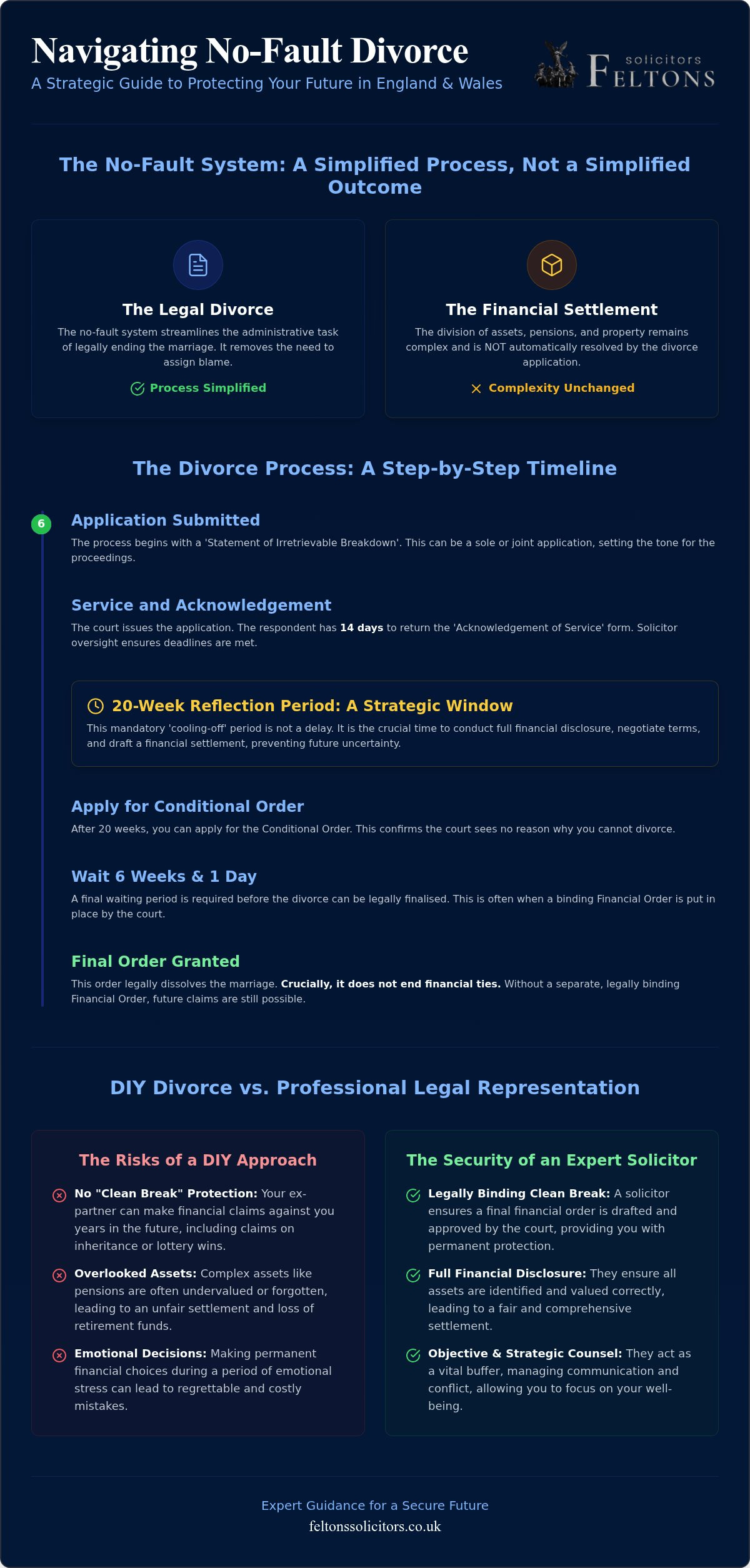
The introduction of no-fault divorce in 2022 changed the procedural nature of separation, but it didn’t remove the complexities of uncoupling a shared life. Many believe that because they no longer need to prove “unreasonable behaviour” or “adultery,” the process is now a simple administrative task. This is a common misconception. A divorce solicitor does far more than file paperwork; they provide the strategic oversight necessary to protect your long-term interests. While the online portal allows you to end the marriage legally, it does nothing to resolve the division of assets or ensure your financial independence.
Separating the legal dissolution of a marriage from the financial settlement is crucial. One ends the contract of marriage, whilst the other secures your future. In high-conflict situations, your solicitor acts as a vital buffer. They manage communications with your former partner, allowing you the space to focus on your emotional recovery and your children’s needs without the stress of direct legal confrontation.
The Strategic Advantage of Professional Counsel
Professional counsel provides a level of scrutiny that automated systems cannot match. We often see complex cases where one party may have “forgotten” certain assets or where pension structures are not immediately transparent. A skilled divorce solicitor identifies these discrepancies early. They ensure every legal document is drafted with precision to prevent future claims, providing you with a definitive clean break. This balance of objective legal strategy and empathetic support ensures you aren’t making permanent decisions based on temporary emotional states.
Navigating the 20-Week Reflection Period
The reflection period is a statutory requirement introduced in 2022. It serves as a mandatory “cooling off” window between the initial application and the Conditional Order. Rather than viewing this as a delay, it’s a period that should be used effectively for full and frank financial disclosure. By initiating the exchange of financial information during these twenty weeks, you can often reach an agreement on asset division by the time the divorce is ready to proceed to the final stage. This proactive approach minimises uncertainty and helps you transition into your new life with a clear plan.
Step-by-Step: The Divorce Process in England and Wales
The legal journey to end a marriage is now defined by a clear, chronological sequence. It begins with the initial application, where you or your spouse provide a “Statement of Irretrievable Breakdown” to the court. This statement is the foundation of the modern no-fault system; it removes the need for blame and focuses instead on the reality that the relationship has ended. Once the court issues the application, the “Service of Papers” occurs, and the respondent has 14 days to return the “Acknowledgement of Service” form. Engaging a divorce solicitor at this early stage ensures these deadlines are met and that the initial filing doesn’t inadvertently complicate future financial claims.
Following the initial application, the 20-week reflection period begins. Once this period concludes, you can apply for the Conditional Order. This document confirms the court sees no reason why you cannot divorce. The final stage is obtaining the Final Order, which can be applied for six weeks and one day after the Conditional Order is granted. This final decree legally dissolves the marriage, but it is rarely the end of the legal work required.
The Dual Track: Marriage vs. Finances
A common pitfall is assuming the Final Order provides total closure. It doesn’t. Whilst it ends your status as a married person, it does not automatically terminate your financial ties or obligations to your former spouse. This is why we recommend running financial negotiations alongside the divorce proceedings. Achieving a legally binding financial order ensures that your assets, including property and pension rights, are protected from future claims. Timing the application for the Final Order is particularly sensitive; doing so before a financial order is in place can sometimes jeopardise your rights to a spouse’s pension if they were to pass away unexpectedly.
Joint vs. Sole Applications
You now have the choice to apply for divorce individually or as a joint couple. A sole application follows the traditional route where one party initiates the process. Conversely, a joint application can set a more collaborative tone from the outset, potentially reducing friction and legal costs. At Feltons, we help organise joint applications for clients who wish to maintain a constructive relationship throughout the transition. Whether you choose a sole or joint path, an experienced divorce solicitor ensures that your specific circumstances are accounted for, preventing procedural errors that could lead to delays or additional court fees.
DIY Divorce vs. Professional Legal Representation
The rise of online portals and “quick-fix” DIY kits has created a perception that ending a marriage is a simple administrative task. While these kits offer a lower upfront cost, they often represent a false economy. A DIY approach typically only addresses the legal dissolution of the marriage, leaving complex financial issues entirely unresolved. Without the oversight of a qualified divorce solicitor, you may inadvertently leave the door open for your former spouse to make significant financial claims against your future earnings, inheritances, or business interests years after the marriage has ended.
The necessity for precise administrative filing is a constant across borders; for instance, individuals navigating family law or name change requirements in the United States may seek assistance from Nevada State Forms & Filing Services to ensure their documents are prepared to a professional standard.
Professional representation adds value by identifying the nuances that standard forms overlook. In cases involving shared property or business ownership, a solicitor ensures that valuations are accurate and that the division of assets is legally binding. This isn’t just about filling in boxes; it’s about strategic foresight. The question isn’t whether you can afford the legal fee, but whether you can afford the risk of an insecure financial future.
When DIY is a High-Risk Strategy
Certain circumstances demand a more sophisticated level of legal scrutiny. If your marriage involves international assets, overseas entities, or a significant disparity in income, a DIY approach is inherently high-risk. These factors require expert interpretation to ensure fairness and compliance with UK regulations. Separation is also a critical time to review your broader financial legacy. Integrating estate planning into your separation strategy ensures that your assets are protected and your wishes are clear, preventing your former partner from benefitting from your estate in the event of your death before the final order is granted.
The Feltons Approach to Cost-Effectiveness
Our philosophy is rooted in pragmatism and people-first service. We understand that legal fees are a concern, which is why we focus our resources on high-impact financial negotiations rather than unnecessary litigation. By providing clear, transparent communication regarding our fees, we ensure you remain in control of your costs. An experienced divorce solicitor from our team acts as your trusted advisor, seeking the most direct path to a fair settlement. This methodical approach avoids the frantic energy of high-pressure legal battles, opting instead for a steady, deliberate flow that prioritises your long-term security and emotional well-being.
Securing Your Future: Financial Arrangements and Asset Protection
While the Final Order legally dissolves a marriage, it is the financial settlement that dictates your quality of life thereafter. In England and Wales, the court operates under the Matrimonial Causes Act 1973, which prioritises the principle of “fairness.” This doesn’t always mean a 50/50 split. Instead, judges consider various factors, including the welfare of any children, the duration of the marriage, and the future needs of both parties. Achieving a just outcome requires a methodical approach to asset division, ensuring that your contributions, both financial and non-financial, are recognised.
Transparency is the cornerstone of any successful negotiation. Both parties are legally required to provide “full and frank” disclosure of their assets through a document known as Form E. This comprehensive process covers everything from property and bank accounts to complex investments and business interests. A divorce solicitor plays a pivotal role here, scrutinising these disclosures to ensure no assets are undervalued or omitted. Once the financial landscape is clear, several types of orders can be sought, including lump sum payments, property transfers, and pension sharing. For most, the ultimate goal is a Clean Break Order, which provides the security of knowing that neither party can make future financial claims against the other.
Protecting High Net Worth and Business Assets
Cases involving significant wealth or private businesses require a more nuanced strategy. Valuing a professional practice or a family-run company is rarely straightforward; it involves assessing liquidity, future earnings, and tax implications. Our expertise in protecting assets during divorce allows us to navigate these complexities with precision. Whether you are seeking to ring-fence pre-marital wealth or ensure a business remains viable post-separation, a divorce and financial arrangements lawyer provides the objective counsel needed to reach a pragmatic resolution without unnecessary risk.
Spousal Maintenance vs. Capital Settlements
The court distinguishes between “needs” and “sharing” when determining financial awards. Spousal maintenance is a periodic payment for a former partner’s living costs. Whilst some settlements involve an ongoing payment, there is a growing trend towards “term orders” that provide support for a fixed period to encourage financial independence. If you are unsure how these principles apply to your specific circumstances, you should speak with a specialist solicitor to discuss your options. We focus on balancing immediate capital needs with long-term income requirements, ensuring your settlement is both fair and sustainable.
Why Choose Feltons Solicitors for Your Divorce?
Selecting a divorce solicitor is a deeply personal choice that extends far beyond technical competence. At Feltons Solicitors LLP, we recognise that you aren’t just looking for a legal representative; you’re seeking a trusted advisor to guide you through one of life’s most challenging transitions. Established in 2010 by Paula Felton, our firm provides a bespoke alternative to high-volume legal practices. We combine traditional professional integrity with a modern, efficient delivery that respects both your time and your privacy. Our “people-first” philosophy ensures that whilst we’re technically rigorous in our legal application, we never lose sight of the human impact of our work.
Our expertise spans both domestic separations and complex international matters, allowing us to handle high-value asset protection with the same care we apply to sensitive family dynamics. We pride ourselves on being a steady, dependable presence, projecting quiet confidence even in the most high-pressure situations. By choosing a boutique service, you benefit from a level of personal rapport and tailored strategy that larger firms often struggle to replicate.
A Discreet Partner in Stressful Times
Privacy is a cornerstone of our service, particularly for clients involved in high-profile or sensitive cases. We act as a discreet partner, ensuring your personal matters remain confidential whilst we work towards a pragmatic resolution. Our approach prioritises constructive negotiation and dispute resolution to avoid the unnecessary trauma and expense of court proceedings wherever possible. We understand that every family dynamic is unique, and our advice is always tailored to respect your specific circumstances and long-term goals. This methodical, reassuring pace helps you feel supported and in capable hands throughout the entire process.
Taking the First Step Towards Your New Chapter
Preparing for your first meeting with a divorce solicitor can feel daunting, but it’s the first step towards your new chapter. To make this initial consultation as productive as possible, we suggest gathering basic information such as your marriage certificate and a general overview of your joint and individual assets. This allows us to provide more specific, actionable insights from the very beginning. Whether you require support with complex financial arrangements or a straightforward clean break order, our specialist team is available to provide national legal support. We invite you to arrange a consultation to discuss how we can protect your interests and help you move forward with confidence.
Securing Your Financial Future and Personal Peace of Mind
Divorce in 2026 is less about assigning blame and more about strategic preparation for your new life. While the legal dissolution of a marriage has become more streamlined, the underlying financial complexities remain as significant as ever. Ensuring a fair division of assets and obtaining a legally binding clean break order are the most critical steps you can take to protect your independence. An expert divorce solicitor acts as your sophisticated guide, navigating the nuances of pension sharing, property transfers, and business valuations with precision.
Feltons Solicitors LLP has been a steady presence for clients since 2010, specialising in high-net-worth financial arrangements with a discreet, boutique approach. We combine national reach with the personal service that complex family matters deserve. By prioritising pragmatic dispute resolution over unnecessary conflict, we help you transition with dignity and security. You deserve a partner who values your privacy as much as your legal outcome.
If you are ready to move forward, contact Feltons Solicitors for a discreet consultation on your divorce and financial arrangements. You don’t have to face this transition alone; expert support is available to help you build a stable foundation for the years ahead.
Frequently Asked Questions
How much does a divorce solicitor cost in the UK?
Legal costs vary depending on the complexity of your assets and whether the separation is contested. You must pay a mandatory court fee of £628 to file the application, which is a standard charge in England and Wales. Professional fees are then structured based on the time required to negotiate financial settlements and draft the necessary orders. High-net-worth cases involving complex pensions or business interests naturally require a more significant investment in specialist expertise.
Can I get a divorce without a solicitor if we agree on everything?
You can technically file for divorce yourself, but this is often a high-risk strategy for your financial future. Agreeing on the end of the marriage is not the same as securing a legally binding financial settlement. Without a professional divorce solicitor to draft and file a Consent Order, your former spouse could still make financial claims against you many years later. Professional oversight ensures your agreement is permanent and provides a definitive clean break.
How long does the divorce process take in 2026?
A standard divorce typically takes between six and eight months to complete. This timeline is dictated by mandatory statutory periods, including a 20-week reflection period between the initial application and the Conditional Order. Following this, there is a further six-week and one-day wait before you can apply for the Final Order. Whilst the procedural steps are fixed, complex financial negotiations can sometimes extend the overall timeframe beyond these minimums.
What is a Financial Remedy Order and do I need one?
A Financial Remedy Order is a legally binding document approved by the court that outlines how assets, income, and pensions are divided. You need this order to ensure that any agreement you reach with your spouse is enforceable and final. Without it, the “financial door” remains open, meaning either party could apply to the court for money or property long after the Final Order has dissolved the marriage itself.
Will I have to go to court for my divorce?
Most people never have to attend court during their divorce proceedings. The process is now largely administrative, with judges reviewing paperwork submitted through the online portal. If you can reach an agreement on financial matters and child arrangements through solicitor-led negotiation or mediation, the court will simply approve the orders by post. Court hearings are generally a last resort reserved for cases where parties cannot reach a pragmatic compromise.
Can my ex-spouse claim money after the divorce is finalised?
Yes, an ex-spouse can potentially make a claim against your assets years after the divorce unless you have a Clean Break Order. The Final Order ends the marriage, but it doesn’t automatically end the financial relationship. An experienced divorce solicitor ensures that a court-approved Consent Order is in place, which formally dismisses future claims and protects your future earnings, business growth, and any inheritances you might receive later in life.
What happens to the family home in a divorce settlement?
The family home is treated as a priority asset, with the court focusing on the housing needs of both parties and any children. The outcome depends on your specific circumstances; the property might be sold and the proceeds split, or one person may buy out the other’s share. In some cases, a “Mesher Order” is used to defer the sale until a child reaches a certain age, ensuring stability for the family during their minority.
Is a no-fault divorce quicker than the old system?
No-fault divorce was not designed to be faster, but rather to be less confrontational. The introduction of the 20-week reflection period ensures that the process is deliberate and provides couples with time to consider the implications of their separation. Whilst the statutory waiting periods mean the process takes a similar amount of time as the old system, the reduction in conflict often makes it easier to reach financial agreements more efficiently.