

A grant of probate issued in England and Wales is not automatically recognised abroad. Probate administration in the UK involving overseas assets must therefore be coordinated with the rules and procedures in each country where an asset is held. A local process or resealing of the UK grant may be required. Executors should also obtain date-of-death valuations for overseas assets as soon as possible.
It is understandable to expect one probate process to cover an entire estate, but cross-border administration can involve different legal systems, tax rules and practical steps. Understanding how these fit together can clarify what may affect access to assets and the timing of distributions.
This article explains how UK and overseas administration can be coordinated, when another country may require a separate process or recognise a UK grant, and how foreign assets are valued. It also explains why valuations and tax considerations matter before an estate is distributed.
Key Takeaways
- Identify which country’s succession rules may apply, especially where foreign property or forced heirship could affect who inherits.
- Plan for UK and overseas tax obligations before distributing the estate, as tax may be due in more than one country.
- Find out whether the country holding each asset accepts a UK grant, requires it to be resealed or needs a separate local probate process.
- Obtain date-of-death valuations for overseas assets early; these help inform tax declarations and the administration of the estate.
How does probate work when there are foreign assets to consider?
In England and Wales, probate confirms an executor’s authority to administer an estate. Forced heirship rules, local wills and conflicting succession laws can affect who inherits foreign assets.
Foreign succession and forced heirship
Foreign succession law determines how an estate passes under another country’s rules. Forced heirship reserves a fixed share for children or other relatives, limiting what a will can leave to others. France, Spain and Italy have rules protecting certain heirs. A local will may conflict with a UK will if its wording revokes the other document. Before distribution, executors need to establish which law applies and whether both wills remain effective.
Applying UK probate to foreign assets
UK probate confirms an executor’s authority to deal with assets in England and Wales, but a UK grant does not automatically unlock foreign accounts or property. The country where each asset is held determines whether to accept the grant, require resealing or demand local probate. A foreign will may also be admitted to UK probate, although the process is more complex than a standard application. Requirements depend on the asset, its value and the deceased’s circumstances. Without a will, the process in England and Wales is an application for letters of administration.
Moveable and immoveable assets abroad
Moveable assets include bank accounts and investments; immoveable assets include land and buildings. In many countries, the deceased’s domicile may determine the law governing moveable assets, while the law of the country where land is situated may govern that property. This distinction can divide an estate between legal systems. For example, executors may need a UK grant for UK administration, while foreign land requires a separate local process. The asset’s location and type therefore affect the steps required.
Advice from UK and foreign lawyers
Early advice from UK and foreign lawyers can help align estate administration. A lawyer in the country where assets are held can explain local succession rules and grant requirements, while UK advice can address the will’s effect on administration here. Together, this analysis can identify whether separate wills conflict, which documents remain effective and whether executors must report foreign tax. It can also flag possible double taxation before distributions. This is especially relevant when an estate includes French property, a Spanish account or wills drafted in different jurisdictions.
Co-ordinating UK and overseas estate administration
UK executors should identify overseas assets, establish the requirements in each country, then coordinate tax and administration before distributing the estate. For a UK-domiciled individual’s estate, UK inheritance tax is 40% above the nil-rate band of £325,000, according to HM Revenue & Customs.
Identifying and securing overseas assets
Identifying and securing overseas assets involves locating them, notifying asset holders and establishing how they can be accessed. This gives executors a clearer basis for dealing with accounts, property and other estate assets across borders. Contacting a foreign bank can notify it of the death and provide a valuation and details of its process. Executors should also gather information about assets in each country and coordinate with lawyers abroad where local procedures apply.
Before distribution, executors need to consider UK inheritance tax alongside any foreign tax due. The country where an asset is held may impose inheritance or estate tax, creating a risk of double taxation. The UK has treaties with certain countries that may allow tax paid abroad to be credited against UK tax. Executors should consider the tax burden and who is liable before paying beneficiaries.
Executors and administration timescales
Choosing executors for a cross-border estate means considering who can coordinate information and decisions across jurisdictions. Executors may need to liaise with foreign asset holders, lawyers and beneficiaries while handling UK administration. Complex international estates may take 18 months to 3 years; estates involving foreign property, multiple jurisdictions or complex tax issues may take 2-4 years to administer fully. Timely updates can help beneficiaries understand delays.
Distribution also requires care if a beneficiary is bankrupt. Personal representatives may become personally liable for a bankrupt beneficiary’s creditors if they distribute funds to that beneficiary instead of complying with the bankruptcy laws where the beneficiary resides. Bankruptcy searches before distribution can help executors identify this risk and pause payment while the position is addressed.
For support with UK probate and estate administration involving overseas assets, consider probate and estate planning advice.
Recognition of UK grants abroad
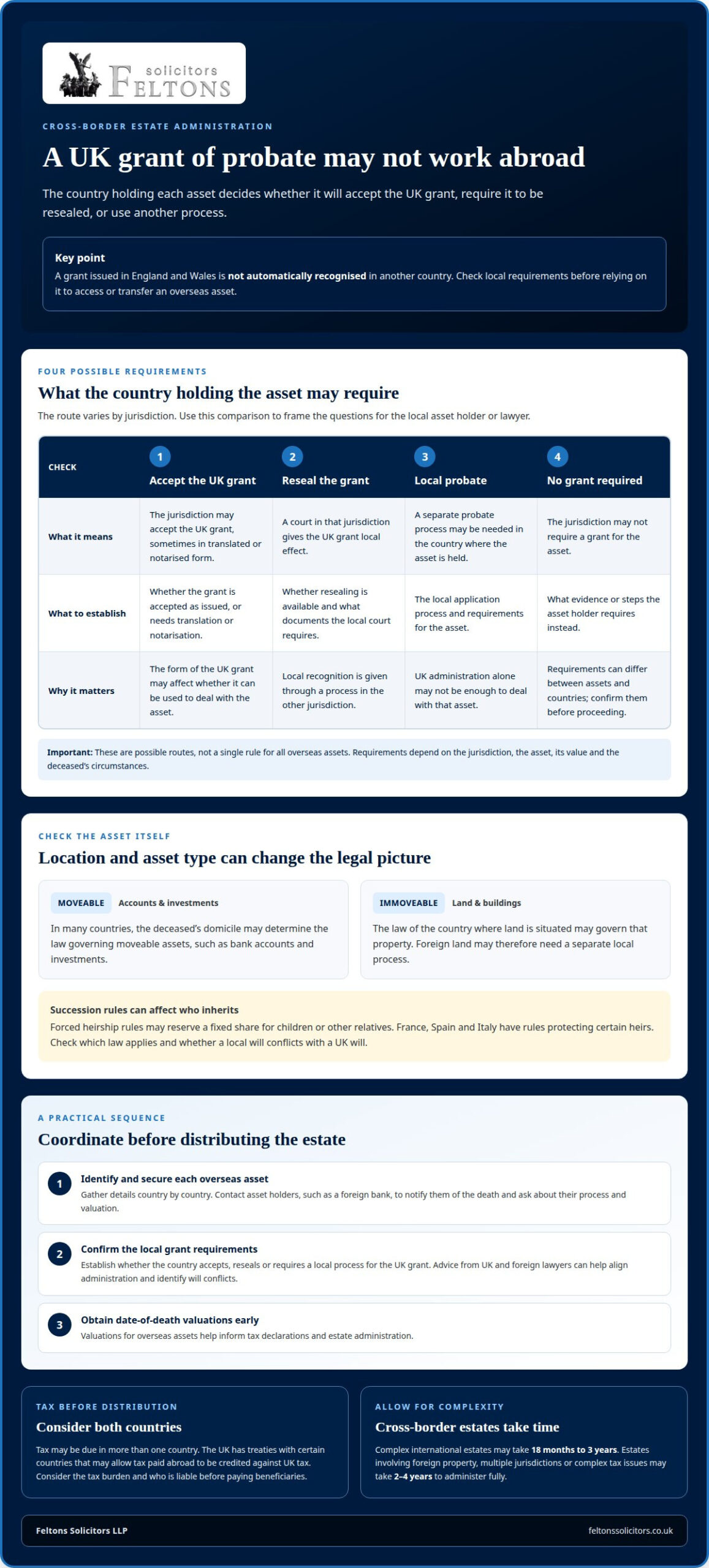
A grant of probate issued in England and Wales is not automatically recognised in another country. The required documents depend on the jurisdiction: a country may accept a translated, notarised or resealed UK grant, require local probate, or not require a grant.
When a grant of probate is required
A grant may be needed when the country holding an asset requires formal proof of the deceased’s representative’s authority. Whether one is required depends on the country, asset value and the deceased’s circumstances. For example, a foreign bank may require a grant before releasing an account, while another jurisdiction may use a different process. Executors should establish local requirements before relying on an England and Wales grant to access or transfer an asset.
Resealing UK grants overseas
Resealing is a process through which a court in another jurisdiction gives a UK grant local effect. Some Commonwealth countries, including Australia, Canada and New Zealand, may offer a simplified route if their conditions are met. Ireland may also reseal UK grants. The Colonial Probates Act 1892 is relevant to resealing in certain countries, including South Africa, Australia, New Zealand and some Caribbean nations. Requirements vary, so a grant that works in one country may not work in another.
Country-specific probate documents
Country-specific probate documents are the evidence and applications required by the jurisdiction holding each asset. Some authorities may accept the UK grant after translation, notarisation or resealing; others require a separate local probate application. France, Spain and Germany generally require a separate legal process to access assets rather than treating UK probate as sufficient. Executors should establish the required documents for each country, including whether the original grant or a translated version is needed. These requirements shape how estate administration proceeds across jurisdictions.
Overseas asset valuations and administration
Executors should obtain a date-of-death valuation for each overseas asset as soon as possible. In probate administration in the UK, overseas asset values provide a consistent starting point for estate administration and tax reporting. The evidence needed depends on whether the asset is a bank account, investment or property, and on the records available in the country where it is located. Keep each valuation with its supporting documents.
For an overseas account, notify the bank of the death and request its valuation and details of the process for dealing with the funds. For foreign property, obtain a valuation reflecting its value at the date of death, rather than relying on an old purchase price. An investment statement may provide relevant account information, while a property may require a separate valuation. These records help executors explain how each estate value was reached.
Overseas assets may also require tax declarations in more than one country. Executors should record each asset’s location, date-of-death value, ownership details and any foreign tax paid. This information helps lawyers assess reporting and distribution obligations. The deceased’s domicile can affect the tax position, while the country holding an asset may impose its own tax. Consider potential double taxation before beneficiaries receive funds.
Valuation and access are linked: foreign assets usually require local probate or an equivalent process before they can be transferred. A bank in one country may need different documents from a property authority elsewhere. In France, foreign succession rules may affect who inherits, so a valuation alone cannot settle entitlement. Probate administration in the UK involving overseas assets must account for local requirements, asset records and the will before distribution.
For help with overseas valuations and related probate administration, contact Feltons Solicitors LLP about probate support.
Feltons Solicitors LLP: Wills, Probate, and Estate Planning
Feltons Solicitors LLP provides Wills, Probate, and Estate Planning services for people managing estates with assets in the UK and abroad. Probate support can help executors understand the UK administration involved, organise estate information and consider how overseas assets affect the process. It may be useful when a will covers property or accounts in another country, several wills need to be considered, or beneficiaries are awaiting an update on distribution.
For future planning, tailored advice can help people with overseas interests consider how their wills and estate arrangements fit together. Each jurisdiction’s rules still matter, particularly where foreign property or succession requirements affect administration. A clear understanding of the estate’s UK and international elements can inform decisions ahead.
Contact Feltons Solicitors LLP to discuss probate and estate planning support.
Make a considered start on the next steps
Cross-border estate administration is easier to approach when decisions are made in a clear order. Start by identifying what still needs to be resolved, such as a foreign institution’s requirements, a valuation or the status of a local application. This gives executors a practical basis for coordinating the remaining work and keeping beneficiaries informed.
For overseas assets, probate administration in the UK may involve decisions that connect legal, tax and practical issues. A considered review can clarify which matters need attention first and what information is needed to move forward. It can also help executors avoid treating each asset as an isolated task when one decision may affect another.
Feltons Solicitors LLP offers Wills, Probate, and Estate Planning, alongside Divorce and Financial Arrangements and Residential and Commercial Conveyancing. If you would like to discuss the estate’s UK probate administration, contact Feltons Solicitors LLP. A clear conversation can help you identify a constructive next step.
Frequently Asked Questions
What Happens When an Estate Includes Foreign Assets?
An estate with foreign assets usually needs coordinated UK and local administration, rather than one process covering every asset. For example, a foreign bank may require evidence of the executor’s authority before releasing an account, while UK probate continues separately. Executors can record each institution’s requirements, valuations and foreign tax, then consider these alongside the will before agreeing distributions to beneficiaries.
What is a cross-border estate?
A cross-border estate contains assets in England and/or Wales and assets in another country outside British jurisdiction. Someone with a home in England and an investment account abroad is one example; overseas land creates another jurisdictional link. The term describes where the assets are held, not the deceased’s nationality. This matters because different assets can involve separate succession rules, tax systems and document requirements.
Which country’s laws apply to foreign assets?
The applicable law can depend on the asset’s location and the deceased’s domicile, so one estate may involve several succession systems. French heirship rules may apply to a person’s worldwide assets if they lived in France at death. If they lived and were domiciled in the UK, those rules may apply only to immovable assets in France. A Brussels IV declaration directing English law may not prevent French heirship rules applying to assets in France.
How are overseas assets treated in UK probate and estate administration?
Overseas holdings form part of the estate’s wider valuation and distribution picture, but UK probate does not itself transfer title abroad. In England and Wales, personal representatives value the estate, pay debts and taxes, then distribute assets under the will or intestacy rules. For foreign holdings, they must also account for local transfer requirements and foreign tax reporting, so beneficiaries may receive different assets at different stages.
Does UK probate cover foreign property, bank accounts and investments?
No. A UK grant does not automatically provide access to foreign property, bank accounts or investments. Acceptance depends on the country and the asset. A bank may require proof of authority, while foreign land may need local probate or an equivalent process. The asset’s value and the deceased’s circumstances can also affect whether a grant is needed, so requirements must be assessed for each holding.
How do UK domicile and residence affect inheritance tax on overseas assets?
Domicile and residence are distinct: a person has one domicile at a time, which may differ from their residence or nationality. For a UK-domiciled individual, UK inheritance tax applies to worldwide assets; for someone not UK-domiciled, HMRC usually limits claims to assets physically in the UK. The Long Term UK Residence test has applied since 6 April 2025, adding a further factor when assessing the tax position.