

International Asset Tracing Divorce Lawyers: A UK Guide to Overseas Assets

International Asset Tracing Divorce Lawyers: A UK Guide to Overseas Assets

What if a spouse’s disclosed finances don’t explain their known lifestyle or apparent resources overseas? If you’re looking for international asset tracing divorce lawyers, an overseas property, company, account or investment may raise legitimate questions. But uncertainty alone isn’t proof of concealed assets. The next step is to establish what the available information shows and how it may matter to divorce proceedings.

It’s important to distinguish investigating assets from obtaining legal advice on evidence and financial arrangements. A solicitor can help you identify disclosure questions, assess how available information may support negotiations or court proceedings, and consider whether specialist input is appropriate. Cross-border issues may also affect how an order can be enforced, depending on the country involved.

This guide explains what may justify further enquiries, which records to preserve and how evidence about overseas assets may inform your legal strategy. It also covers how to approach concerns discreetly, protect privacy and avoid unsupported allegations. The aim is a measured way forward based on the evidence and your circumstances.

Key Takeaways

  • An asset’s overseas location alone doesn’t establish who owns it or whether it should affect divorce finances.
  • Build a clearer picture by reviewing financial disclosure, identifying specific gaps and preserving relevant records before considering next steps.
  • Unexplained transfers or changes in company ownership may warrant questions, but assess them alongside other evidence rather than treating them as proof.
  • Prepare for a legal discussion by organising known asset details, dates, existing disclosure and relevant communications. Don’t confront anyone or access information without permission.
  • Choose international asset tracing divorce lawyers who connect cross-border evidence to financial proceedings, explain proportionate options and avoid promising a particular outcome.

What international asset tracing means in divorce financial proceedings

International asset tracing in divorce involves identifying potential overseas assets, gathering evidence about them and assessing whether they are relevant to the parties’ financial arrangements. It doesn’t establish that an asset has been hidden, belongs to one spouse or must be shared. For example, property registered abroad may be held for someone else or be subject to another person’s rights.

Financial disclosure is the starting point. If information is missing, unclear or inconsistent, focused enquiries may help establish what further evidence is relevant. That is different from assuming wrongdoing or investigating without proper authority. International asset tracing divorce lawyers can help connect available evidence to the legal issues in financial proceedings. Legal advice is distinct from forensic investigation, and no particular outcome can be presumed.

Which overseas assets may need to be considered?

Relevant assets may include overseas property, bank accounts, investments, company interests, trusts and valuable personal possessions. The key questions are not just where an asset is located, but what the evidence shows about its ownership, value and connection to the parties’ finances.

Legal title and beneficial ownership can differ. A company may be the registered owner of a property, for instance, while the rights of shareholders or other beneficiaries depend on the structure and evidence. Control alone doesn’t establish beneficial ownership, and an asset associated with a spouse shouldn’t automatically be treated as theirs.

Why jurisdiction matters to the divorce case

The applicable process depends on where the financial proceedings take place. In England and Wales, financial remedy proceedings sit within a framework that includes the Matrimonial Causes Act 1973. Scotland and Northern Ireland have distinct legal frameworks and procedures, so rules and terminology shouldn’t be assumed to apply uniformly across the UK.

The country where an asset is held may also affect what evidence is available and how an order can be enforced. Identifying an overseas asset and establishing what a UK court can do about it are separate questions. For wider context on financial arrangements and settlement considerations, read the divorce and financial arrangements guide.

How international asset tracing builds an evidence-led picture of wealth

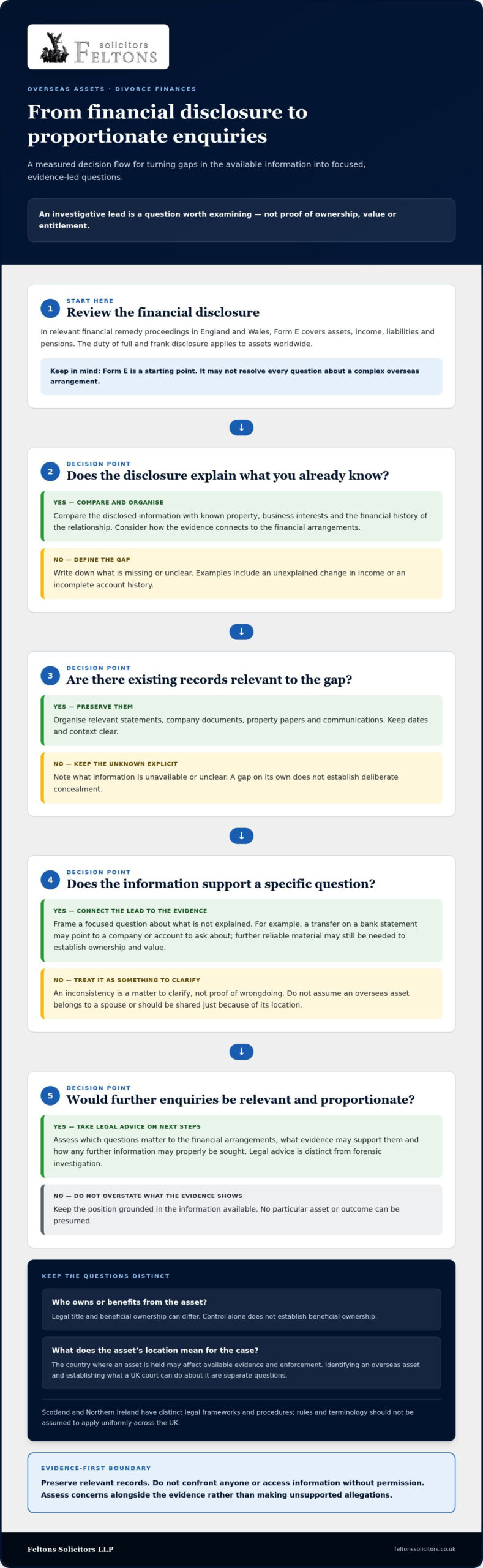
A careful approach moves from what has been disclosed to specific, answerable questions. In relevant financial remedy proceedings in England and Wales, Form E is used for financial disclosure, including information about assets, income, liabilities and pensions. The duty of full and frank disclosure applies to assets worldwide. Form E is a starting point, not a guarantee that every question about a complex overseas arrangement will be resolved.

A proportionate sequence can help keep the focus on evidence:

  • Review disclosure: compare the information provided with what is already known about property, business interests and financial history.
  • Identify gaps: note what is missing or unclear, such as an unexplained change in income or an incomplete account history.
  • Preserve existing records: organise statements, company documents, property papers and relevant communications, keeping dates and context clear.
  • Take legal advice: assess which questions matter to the financial arrangements and what steps may be appropriate.
  • Consider proportionate enquiries: decide whether further information is justified and how it may properly be sought.

An investigative lead points to a question worth examining. It isn’t proof of ownership, value or entitlement. For example, a transfer shown on a bank statement may identify a company or account to ask about, but further reliable material may be needed to establish who owns an interest and what it is worth. A lawyer can connect the evidence and any proposed legal steps to the financial proceedings, but can’t promise that an asset will be found or included in a settlement.

From financial disclosure to specific questions

Compare disclosed information with known business interests, property records and the financial history of the relationship. A company name in correspondence, for instance, may help frame a question about an interest that isn’t clearly explained in the disclosure. Treat inconsistencies as matters to clarify, not proof of deliberate concealment. The Law Commission’s review of financial remedy laws provides further context on the framework governing financial outcomes.

Following company and property ownership across borders

Corporate structures can separate the person with legal title from those with beneficial interests, so company filings alone may not establish who owns or benefits from an asset. For overseas entities that own UK land or property, the Companies House Register of Overseas Entities may provide relevant information about registrable beneficial owners. It doesn’t establish ownership of every overseas asset. The overseas entity beneficial owner registration guide explains this UK property context.

International asset tracing divorce lawyers can help assess how cross-border information relates to financial arrangements. If records raise questions, tailored advice on divorce and financial arrangements can help you consider a measured next step.

When suspected hidden overseas assets justify further enquiries

Unusual finances can justify careful questions, but they don’t establish that a spouse has concealed assets. The issue is whether reliable information points to a specific gap in the financial picture and whether clarifying it could matter to the financial arrangements. An evidence-led approach helps avoid turning uncertainty into an unsupported allegation.

Patterns that may warrant a closer look

Consider the context and any available records. Potential discrepancies include:

  • A sustained mismatch between declared income and apparent spending or lifestyle.
  • Transfers to overseas accounts or entities that aren’t explained in the financial information provided.
  • Newly disclosed liabilities or sudden changes in company interests that affect the reported position.
  • Overseas property or income that appears in relevant records but not in the financial disclosure.

One item may have a straightforward explanation. Several changes around the same period may make it reasonable to seek clarification, particularly if they can’t readily be reconciled with business records, statements or the known financial history. Record what prompted the concern and when. Avoid presenting an inference as an established fact.

What a warning sign cannot prove

An inconsistency may result from an error, a change in circumstances, a legitimate business arrangement or incomplete information. Test it against reliable records and the other explanations available. A transfer may point to an account or company worth asking about, but it doesn’t by itself establish who owns the funds or why they moved.

Consider these as separate questions: does the asset exist, who owns it legally or beneficially, what is its present value, who controls it, and is it relevant to the financial outcome? Evidence of a property, for example, may not establish its current value or the extent of a spouse’s beneficial interest. Nor does identifying an asset prove it can be recovered or readily dealt with under an order.

Access only information you’re entitled to use. Don’t log into another person’s account, obtain private records without authority or confront them in a way that could compromise evidence or escalate matters. Share concerns and records already lawfully available with your solicitor so possible next steps can be considered proportionately. International asset tracing divorce lawyers can help assess how a concern relates to financial proceedings without treating suspicion as proof.

In England and Wales, section 37 of the Matrimonial Causes Act 1973 provides court powers concerning certain dispositions intended to defeat financial relief and applications to restrain a disposition. Such measures are court decisions, not automatic consequences of a concern. The legal test and evidence matter. Procedures differ across the UK, and overseas enforcement can raise separate jurisdictional questions.
International Asset Tracing Divorce Lawyers: A UK Guide to Overseas Assets

How to prepare for an international asset tracing discussion with a divorce lawyer

A clear, organised account of what you know can make legal advice more focused. You don’t need to prove that an overseas asset has been concealed before raising a concern. The aim is to help your solicitor understand the available information, distinguish fact from assumption and consider whether a next step is justified.

Information to organise before taking advice

Prepare a simple timeline and gather records you already hold or are authorised to access. Keep copies in their original form where possible, and note where each item came from. Useful material may include:

  • A dated outline of known overseas assets, business links and significant financial changes, such as a transfer or change in company interests.
  • Existing financial disclosure and relevant bank statements, company records, property documents or correspondence.
  • Relevant communications that help explain an asset, transaction or financial change, with dates and context.
  • A note of what you know and what you don’t. Separate direct knowledge from assumptions, information reported by someone else and unanswered questions.

Keep the material factual and concise. Don’t try to access another person’s accounts or private records without authority, and avoid confronting your spouse based on an unverified suspicion. Your solicitor can help assess how the information may be used and what further material, if any, is appropriate to seek.

Questions a case-specific legal assessment should address

Useful questions include: What does the evidence currently establish? What remains uncertain about ownership, value or control? Which country’s procedures may be relevant, and could information be obtained or an order enforced there? These questions help distinguish a promising lead from a step that may be costly, intrusive or unlikely to clarify the financial position.

Advice should also consider the quality of the evidence, privacy, proportionality and the options available in your proceedings. Depending on the circumstances, a sensible next step might involve seeking clarification through disclosure, exploring a negotiated resolution or considering a court application. None is automatic. International asset tracing divorce lawyers should link any proposed step to the evidence and the financial issues it may help resolve, rather than promise a particular result.

If you’re concerned about overseas assets, Feltons Solicitors LLP can discuss your circumstances discreetly and provide tailored advice on divorce and financial arrangements. Discuss your divorce and financial arrangements with Feltons Solicitors LLP.

A sound legal strategy connects available evidence to the financial questions in your divorce. It doesn’t promise that an asset will be found, recovered or included in a settlement. Instead, it assesses what the information establishes, what remains uncertain and whether further steps are justified in your circumstances.

When considering international asset tracing divorce lawyers, focus on how the advice will support your financial proceedings, not simply on the language used to describe tracing.

Decision criterion What useful advice should address
Family-law relevance How the available information relates to financial disclosure, negotiations or the court’s consideration of financial arrangements.
Cross-border reasoning Which country’s laws or procedures may matter, and whether advice from another jurisdiction could be relevant.
Proportionality The legal basis, evidence, likely practical value and potential consequences of each proposed step.
Clear communication A plain-English explanation of options, uncertainties and what each route may involve, without overstating likely outcomes.

What a well-framed legal strategy should consider

A proposed step should have a clear purpose. For example, if an overseas company appears in financial records, legal advice can assess whether the documents support a relevant question about ownership or value, and whether seeking further disclosure is proportionate. The strategy should also account for privacy, the strength of the evidence and practical limits on obtaining information or enforcing an order abroad.

Different jurisdictions have different legal systems and procedures. A process available in England and Wales may not operate in the same way elsewhere, so advice should identify when foreign law or input from another jurisdiction may be needed. Understand the possible routes and their uncertainties before deciding how to proceed.

How Feltons can support divorce financial arrangements

Feltons advises on divorce and financial arrangements, connecting cross-border financial issues with the questions that matter to your case. The firm also handles complex litigation and dispute resolution for international clients. This experience supports a considered approach that recognises both the legal complexity and the personal impact of financial uncertainty.

A discussion can focus on the facts you have, your objectives and proportionate options, without assuming that a concern proves concealment or guarantees a particular result. Speak to Feltons about your financial arrangements.

Take a measured next step with confidence

Overseas assets call for careful assessment, not assumptions. A lead may justify a question, but it doesn’t establish ownership, value or entitlement. Organising the information you already have can clarify what remains uncertain and whether further steps are proportionate to your financial case.

Choosing international asset tracing divorce lawyers means finding legal advice that connects cross-border evidence to divorce financial arrangements, explains the options clearly and recognises the limits of what the evidence can prove. The right approach should reflect your circumstances and objectives without promising a particular outcome.

Feltons advises on divorce and financial arrangements and handles complex litigation and dispute resolution for international clients. Established in 2010, the firm combines modern delivery with traditional values, offering a considered perspective on complex financial issues and their personal impact.

For a discreet discussion of the facts, your priorities and possible next steps, speak to Feltons about your divorce and financial arrangements. A clear, tailored conversation can help you approach what comes next with greater confidence.

Frequently Asked Questions

What is international asset tracing in divorce?

International asset tracing in divorce means identifying potential assets connected with another country, examining available evidence and assessing how those assets may relate to financial arrangements. It may concern overseas property, bank accounts, investments or business interests. A record or lead doesn’t automatically prove that an asset is concealed, beneficially owned by a spouse or recoverable. The legal steps available depend on where proceedings are taking place and which jurisdictions are involved.

Can a divorce lawyer trace assets held overseas?

A divorce lawyer can advise on financial disclosure, assess apparent inconsistencies and consider appropriate legal steps concerning overseas assets. This is legal advice, not necessarily a forensic investigation. Information may need to be considered across more than one jurisdiction, and other professional input may be relevant in some cases. The existence of an asset, who owns it and what it is worth are separate questions. No lawyer can guarantee that every asset will be identified.

What are the signs of hidden assets during a divorce?

Possible warning signs include unexplained transfers, inconsistent financial records, sudden changes in company ownership or a lifestyle that seems difficult to reconcile with disclosed income. For example, a transfer to an unfamiliar overseas company may raise a question about its purpose. These signs aren’t proof of deliberate concealment. Review the documents and wider context before making allegations or pursuing further steps, as there may be an innocent explanation for an apparent discrepancy.

Can overseas property be included in a divorce financial settlement?

Overseas property may be relevant to divorce financial arrangements, but its treatment depends on the facts, ownership evidence, applicable law and the court’s jurisdiction. A company or other structure may hold the legal title, so the title alone might not show who benefits from the property. Its value and whether an order can be enforced in the country where it is located may also matter. Foreign location doesn’t automatically exclude property from consideration.

What evidence helps identify overseas assets in divorce?

Potentially useful records include financial disclosure, bank statements, company documents, property papers, tax records and relevant communications that you’re lawfully entitled to access. A dated note of known transactions or changes in ownership can help organise the information. Assess each record for reliability and context. For example, a statement may point to a payment or account, but it may not prove beneficial ownership, current value or deliberate non-disclosure.

Can a court freeze overseas assets during divorce proceedings?

A court may have powers to make protective orders in appropriate circumstances, but suspicion alone doesn’t make an order automatic. The legal test, evidence, procedure and practical effect depend on the proceedings and jurisdiction. An order made in one country may not have the same effect elsewhere, and enforcement can raise separate issues. A solicitor can advise whether a court application may be available and proportionate based on the evidence and circumstances.

How do I choose international asset tracing divorce lawyers?

Look for family-law advice that links cross-border asset questions to the financial proceedings and explains what the evidence does and doesn’t establish. International asset tracing divorce lawyers should consider jurisdiction, privacy, proportionality and the practical consequences of proposed steps. Clear communication matters: you should understand what is known, what remains uncertain and why a particular route may be appropriate. Be cautious of promises that assets will be found, recovered or included in a settlement.

International Probate Solicitors London: A Guide to Managing Cross-Border Estates (2026)

International Probate Solicitors London: A Guide to Managing Cross-Border Estates (2026)

What if the legacy you’ve spent a lifetime building becomes a source of legal deadlock for your heirs simply because an asset sits across a border? Losing a loved one is difficult enough without the added weight of conflicting inheritance laws, frozen foreign bank accounts, and the looming threat of double taxation. You likely feel that a clear Will should be the end of the matter, yet cross-border estates often require a more sophisticated level of coordination to ensure assets are protected and distributed correctly.

Securing the right international probate solicitors is the first step towards transforming a complex global puzzle into a manageable process. At Feltons Solicitors LLP, we understand that you need more than just technical filing; you require a trusted advisor who prioritises personal rapport and discreet, high-standard service. This guide provides a clear roadmap for handling international estate administration, from resealing grants of probate to the registration of overseas entities. You’ll discover how to minimise tax liabilities across jurisdictions and establish the legal security necessary to prevent inheritance disputes before they arise.

Key Takeaways

  • Understand the fundamental differences between domestic and international probate to navigate conflicting legal jurisdictions effectively.
  • Discover how international probate solicitors london streamline the process of resealing grants of probate or obtaining fresh grants for foreign-held assets.
  • Learn why establishing your domicile status is critical for managing UK inheritance tax and preventing the burden of double taxation.
  • Gain clarity on the mandatory legal requirements for the registration of overseas entities when managing UK property within a cross-border estate.
  • Explore the benefits of a boutique, strategic approach to estate administration that ensures both legal security and personal peace of mind.

Understanding International Probate and Cross-Border Estate Administration

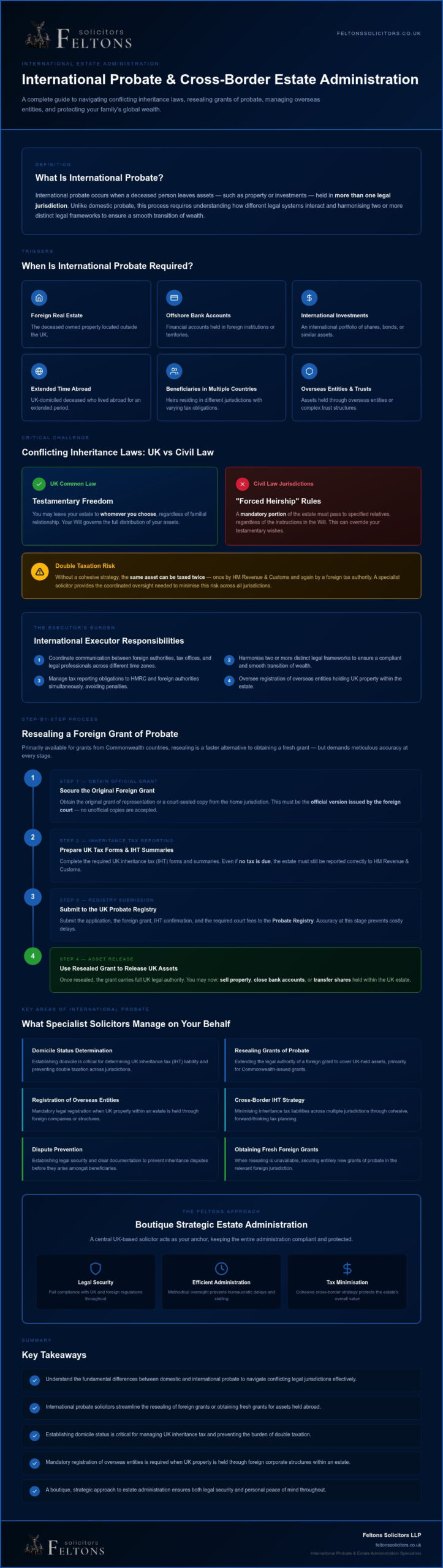
International probate occurs when a deceased person leaves behind assets, such as property or investments, held in more than one legal jurisdiction. Unlike domestic probate, which follows a single set of rules, this process requires a deep understanding of how different legal systems interact. It’s rarely a straightforward path. Cross-border succession is the legal transition of assets across national boundaries.

The executor’s role becomes significantly more demanding in these scenarios. They must act as a central coordinator, managing communication between foreign authorities, tax offices, and legal professionals across different time zones. It’s a strategic burden that requires calm, methodical oversight to prevent the estate from becoming stalled in bureaucratic red tape. You aren’t just filing paperwork; you’re harmonising two or more distinct legal frameworks to ensure a smooth transition of wealth.

When is International Probate Required?

You’ll typically encounter this requirement if the deceased owned foreign real estate, held offshore bank accounts, or maintained an international investment portfolio. It also applies in more nuanced situations, such as:

  • The deceased was domiciled in the UK but lived abroad for an extended period before they passed away.
  • Beneficiaries reside in different jurisdictions, which complicates the distribution of funds and specific tax reporting requirements.
  • Estate assets are held through overseas entities or complex trust structures that require specialist verification; for those researching the financial side of these arrangements, Northeast Legal Team provides a transparent guide to the costs of setting up a trust.

The Challenges of Conflicting Inheritance Laws

One of the most significant hurdles is the conflict between different legal philosophies. In the UK, we value testamentary freedom, which is the right to leave your estate to whomever you choose. However, many civil law jurisdictions enforce “forced heirship” rules. These mandate that a specific portion of the estate must go to certain relatives, regardless of the instructions in a Will. This can lead to significant disputes if not managed with professional authority and poise.

Tax regimes also vary wildly, and the threat of double taxation is a constant concern for families with global interests. Without a cohesive strategy, the same asset could be taxed by both HM Revenue & Customs and a foreign tax authority. Engaging international probate solicitors london provides the expert oversight needed to navigate these clashing rules. A central UK-based solicitor acts as your anchor, ensuring that the administration remains compliant with both local and foreign regulations whilst protecting the overall value of the inheritance. This methodical approach doesn’t just save money; it provides the legal security your family needs during a complex transition.

When an estate includes UK assets but probate was originally granted in another country, you often need to “reseal” that document to gain local legal authority. This process is a streamlined path primarily available for grants issued in Commonwealth countries and certain territories. It allows the UK court to place its own seal on the existing foreign grant, effectively giving it the same power as a UK-issued document. It’s a faster alternative to a full application, but it still demands meticulous attention to detail. Engaging international probate solicitors london ensures that these technical hurdles don’t delay the distribution of a loved one’s estate.

Steps to Reseal a Foreign Grant in the UK

The process follows a logical, methodical sequence to satisfy the UK Probate Registry. Accuracy at each stage is vital to avoid unnecessary delays.

  • Step 1: Obtain the original grant of representation or a court-sealed copy from the home jurisdiction. This document must be the official version issued by the foreign court.
  • Step 2: Prepare the necessary UK tax forms and inheritance tax (IHT) summaries. Even if no tax is due, the estate must be reported correctly to HM Revenue & Customs.
  • Step 3: Submit the application to the Probate Registry along with the required court fees. This submission includes the foreign grant and the IHT confirmation.
  • Step 4: Once the document is resealed, you can use it to release UK-based assets. This includes selling property, closing bank accounts, or transferring shares.

Managing Assets in Non-Commonwealth Jurisdictions

If the assets are located in a non-Commonwealth country, such as the USA, France, or Spain, the resealing process is generally not available. In these cases, you’ll likely need a “Grant de Novo,” which is essentially a fresh application for probate in that specific country. This often requires an “Affidavit of Foreign Law.” This legal document, prepared by a qualified practitioner, explains the deceased’s domicile and the validity of their Will to the foreign court. Feltons Solicitors LLP coordinates closely with local counsel in these jurisdictions to ensure the transition remains smooth and discreet.

Precision is equally important when dealing with non-English documents. The UK Probate Registry requires certified translations and, in many cases, an apostille to verify the document’s authenticity. Our team provides the methodical oversight required to handle these cross-border applications. If you’re managing a global estate, seeking advice from Feltons Solicitors LLP can simplify the path forward. We act as your trusted advisor, providing the quiet confidence needed to resolve complex international matters whilst respecting the human impact of the work.

Domicile is the legal concept that determines how much of your global estate is subject to UK inheritance tax. While you might live in several countries throughout your life, you can only have one domicile at any given time. It acts as the anchor for tax liability. HMRC distinguishes between domicile of origin, which is acquired at birth; domicile of dependence, which applies to children under 16; and domicile of choice. A domicile of choice is established when an individual voluntarily moves to another country with the clear intention of making it their permanent home.

In 2026, the nuances of long-term residence rules have become even more critical for estate planning. Under current UK regulations, if you’ve been a resident in the UK for at least 15 of the last 20 tax years, you’re deemed domiciled for inheritance tax purposes. This means your worldwide assets, not just those located in the UK, fall within the scope of the 40% tax rate. Properly documenting a change in domicile requires more than just moving house; it involves severing significant ties with your previous home and establishing new ones, such as updating your Will and voter registration. This methodical approach is essential for protecting the estate from unexpected tax liabilities.

Domicile vs. Residence: Key Differences

Residence is a factual status based on the number of days you spend in a country during a tax year. Domicile, however, is about your ultimate home. You can be a resident in Spain whilst remaining domiciled in the UK. This distinction is vital because it dictates whether HMRC taxes only your UK assets or your entire global wealth. When managing these intricacies, international probate solicitors london provide the clarity needed to avoid costly assumptions. They help executors identify the deceased’s true status, ensuring the estate doesn’t overpay tax based on a misunderstanding of residency rules.

Mitigating Cross-Border Inheritance Tax

Double Taxation Treaties are the primary tool used to protect an estate from paying tax twice on the same asset. The UK has agreements with many nations to ensure that tax paid in one jurisdiction is credited against the liability in another. Strategic estate planning is the most effective way to reduce this global tax burden before it becomes a problem for your heirs. For executors, the challenge lies in claiming these credits accurately. You must provide evidence of foreign death duties paid to satisfy HMRC’s requirements. Our role as a trusted advisor is to guide you through these filings with a methodical, people-first approach that ensures the legacy is preserved for the next generation. This level of care ensures that whilst the technical legal work is paramount, the human impact is never forgotten.

International Probate Solicitors London: A Guide to Managing Cross-Border Estates (2026)

Managing International Property and the Registration of Overseas Entities

Managing real estate within a cross-border estate introduces layers of complexity that go far beyond standard conveyancing. In London particularly, many high-value properties are held through foreign companies or trust structures. Whilst these arrangements can offer privacy, they also trigger strict disclosure requirements upon the death of a beneficial owner. If you’re an executor, you aren’t just dealing with a physical building; you’re managing a corporate entity that must remain compliant with UK law to avoid significant legal blocks.

The introduction of the Economic Crime (Transparency and Enforcement) Act has fundamentally changed how foreign-owned land is handled. A central requirement is the overseas entity beneficial owner registration with Companies House. Non-compliance isn’t a minor administrative oversight. It can result in criminal penalties, daily fines, and a complete freeze on the property’s title at the Land Registry, making it impossible to sell or transfer the asset until the records are corrected.

The Register of Overseas Entities (ROE) Requirements

Any foreign company or partnership that owns UK land must be listed on the ROE. This involves identifying and verifying the “registrable beneficial owners” behind the entity. For executors, probate is a critical trigger point. When a shareholder or owner passes away, the entity’s beneficial ownership changes, necessitating an update to the register. This update must be handled by a UK-regulated verification agent who can confirm the accuracy of the information provided. Maintaining this register is an annual obligation, and missing the deadline can stall the entire probate process.

To ensure your global assets are managed with precision, you can visit Sheikh Najam TEP for specialised support in cross-border tax and trust administration.

Practical Steps for Foreign Real Estate

When the estate includes property abroad, such as a holiday home in the EU or commercial assets in Asia, the coordination efforts double. You’ll need to work amongst different legal systems, often involving local notaries who operate under civil law rather than common law. It’s a common mistake to assume a UK Will covers everything. Without a local Will in the foreign jurisdiction, the property might be subject to that country’s intestacy or forced heirship rules, which could contradict the deceased’s wishes. Our team acts as a sophisticated guide in these matters, coordinating with local counsel to ensure that property transfers are handled with poise and precision.

Deciding whether to sell or transfer foreign real estate is a strategic choice that affects the estate’s liquidity and tax position. As international probate solicitors london, we help you evaluate these options whilst ensuring all ROE filings are up to date. If you’re navigating the complexities of a foreign-owned UK property, contact Feltons Solicitors LLP for discreet, expert advice that protects the estate’s value and your legal standing.

Strategic Estate Administration with Feltons Solicitors

Managing a cross-border estate requires more than a standard legal checklist; it demands a strategic partner who can handle global complexities with professional authority. Choosing the right international probate solicitors london is about finding a firm that manages the technical burden whilst respecting the emotional weight of your situation. At Feltons Solicitors LLP, we act as a steady, calm presence for families facing the challenges of international succession. Our boutique approach ensures you aren’t just another file in a high-volume system. We provide a tailored experience that prioritises personal connection and discreet, high-standard service.

A Centralised Approach to Global Assets

Executors often feel overwhelmed by the need to coordinate various foreign legal advisors across multiple time zones and languages. We act as your single point of contact, streamlining the communication flow and bringing every international element into a cohesive UK probate strategy. This methodical approach ensures that assets are identified, protected, and distributed with precision. By centralising the administration, we reduce the risk of conflicting advice and ensure the estate complies with both UK and foreign requirements. We bridge the gap between established heritage and forward-thinking methodology, providing the worldly experience necessary to handle complex, international-scale matters with quiet confidence.

Discreet Support for High-Net-Worth Families

Privacy is a cornerstone of our service, particularly for families whose interests span multiple jurisdictions. Our commitment to protecting family reputations and maintaining confidentiality is unwavering throughout the probate process. We offer pragmatic, discreet advice designed to prevent inheritance disputes before they have the chance to escalate. If conflicts do arise, our extensive experience in litigation and dispute resolution allows us to handle complex matters amongst beneficiaries residing in different countries. This combination of high-end reliability and approachable care makes us the preferred choice for those seeking international probate solicitors london who value both modern efficiency and traditional professional integrity. We maintain a people-first philosophy. We know that while the technical legal work is paramount, the human impact of these transitions is never forgotten. You can trust us to handle your global legacy with the poise and dedication it deserves.

Securing Your Global Legacy with Professional Poise

Managing a cross-border estate is a delicate balancing act that requires both legal precision and a deep understanding of the human impact involved. You’ve seen how navigating the intricacies of domicile and ensuring compliance with the registration of overseas entities are vital steps. These actions protect assets against the risks of double taxation and inheritance disputes, ensuring a smoother transition for your heirs. Every detail matters when wealth spans multiple jurisdictions, and a methodical approach is the only way to ensure nothing is overlooked.

As international probate solicitors london, we provide the steady, expert guidance needed to harmonise these global complexities. Our dedicated private client team offers pragmatic and discreet legal advice tailored to high-net-worth individuals, ensuring your family’s reputation remains secure. With our specialist expertise in the registration of overseas entities and complex litigation, we act as a calm, steady presence in stressful situations. Contact Feltons Solicitors for expert international probate guidance to begin your journey with a trusted advisor. You don’t have to face these international hurdles alone; we’re here to provide the clarity and security your legacy deserves.

Frequently Asked Questions

What is the difference between domestic and international probate?

International probate involves the administration of an estate with assets located in more than one legal jurisdiction. Unlike domestic probate, which follows a single set of UK rules, the international process requires coordinating between different legal systems and tax regimes. This often involves specific procedures like resealing foreign grants or obtaining new ones in non-Commonwealth countries. Expert international probate solicitors london ensure these complex interactions don’t stall the distribution of assets to beneficiaries.

Do I need a separate Will for assets held in different countries?

It’s often prudent to have separate Wills for assets in different countries to avoid legal deadlock. While a UK Will can technically cover global assets, foreign jurisdictions may have forced heirship rules that override your wishes. A local “situs Will” specifically tailored to property in that country can significantly speed up the administration process. This methodical approach ensures your legacy is protected across every border whilst respecting local legal requirements.

What does it mean to “reseal” a grant of probate in the UK?

Resealing is a simplified legal process available for grants issued in Commonwealth countries and certain territories. Instead of applying for a completely new grant in the UK, the original foreign document is presented to the UK Probate Registry to be resealed. This gives the foreign grant the same legal authority as a UK-issued document. It’s an efficient way to release UK-based assets like bank accounts or shares for an international estate.

How long does the international probate process typically take?

The timeline for international probate varies significantly but often ranges from 6 to 12 months. Complex estates involving multiple jurisdictions or contentious disputes can take considerably longer. Delays are frequently caused by the time required to obtain certified translations, secure apostilles, and coordinate with foreign tax authorities. Working with a trusted advisor helps maintain a steady pace by anticipating these procedural hurdles and managing the coordination between different legal systems.

Can I be taxed twice on the same international inheritance?

You might face tax liabilities in two countries, but double taxation treaties are designed to prevent you from paying twice. These agreements allow the estate to claim a credit for tax paid in one jurisdiction against the liability in another. Successfully navigating these claims requires precise documentation and an understanding of how HMRC treats foreign death duties. Strategic planning is essential to ensure the overall tax burden on the estate is minimised.

Is probate required for assets held in the Channel Islands or Isle of Man?

Yes, assets held in the Channel Islands or the Isle of Man usually require a separate local grant of probate. Although these territories have close ties to the UK, they are distinct legal jurisdictions with their own court systems. A UK grant of probate is not automatically recognised there. You’ll need to follow their specific local procedures to access bank accounts or property, which often involves a simplified application process.

What happens if there are conflicting Wills in different jurisdictions?

Conflicting Wills often lead to complex legal disputes that require expert mediation or litigation. The courts must determine which document is the last Will and which legal jurisdiction has the primary right to govern the estate’s distribution. This situation is particularly common when a deceased person has lived in several countries. Engaging international probate solicitors london provides the professional authority needed to resolve these conflicts whilst protecting the family’s reputation and privacy.

What are the penalties for not registering an overseas entity that owns UK land?

Failure to register an overseas entity that owns UK land can result in severe financial and criminal penalties. Daily fines can reach £2,500, and officers of the entity may face criminal prosecution. Perhaps most critically, the entity is barred from selling, leasing, or transferring the property at the Land Registry. This effectively freezes the asset, making it impossible to manage or distribute as part of an estate until the registration is fully compliant.