

What if a spouse’s disclosed finances don’t explain their known lifestyle or apparent resources overseas? If you’re looking for international asset tracing divorce lawyers, an overseas property, company, account or investment may raise legitimate questions. But uncertainty alone isn’t proof of concealed assets. The next step is to establish what the available information shows and how it may matter to divorce proceedings.
It’s important to distinguish investigating assets from obtaining legal advice on evidence and financial arrangements. A solicitor can help you identify disclosure questions, assess how available information may support negotiations or court proceedings, and consider whether specialist input is appropriate. Cross-border issues may also affect how an order can be enforced, depending on the country involved.
This guide explains what may justify further enquiries, which records to preserve and how evidence about overseas assets may inform your legal strategy. It also covers how to approach concerns discreetly, protect privacy and avoid unsupported allegations. The aim is a measured way forward based on the evidence and your circumstances.
Key Takeaways
- An asset’s overseas location alone doesn’t establish who owns it or whether it should affect divorce finances.
- Build a clearer picture by reviewing financial disclosure, identifying specific gaps and preserving relevant records before considering next steps.
- Unexplained transfers or changes in company ownership may warrant questions, but assess them alongside other evidence rather than treating them as proof.
- Prepare for a legal discussion by organising known asset details, dates, existing disclosure and relevant communications. Don’t confront anyone or access information without permission.
- Choose international asset tracing divorce lawyers who connect cross-border evidence to financial proceedings, explain proportionate options and avoid promising a particular outcome.
What international asset tracing means in divorce financial proceedings
International asset tracing in divorce involves identifying potential overseas assets, gathering evidence about them and assessing whether they are relevant to the parties’ financial arrangements. It doesn’t establish that an asset has been hidden, belongs to one spouse or must be shared. For example, property registered abroad may be held for someone else or be subject to another person’s rights.
Financial disclosure is the starting point. If information is missing, unclear or inconsistent, focused enquiries may help establish what further evidence is relevant. That is different from assuming wrongdoing or investigating without proper authority. International asset tracing divorce lawyers can help connect available evidence to the legal issues in financial proceedings. Legal advice is distinct from forensic investigation, and no particular outcome can be presumed.
Which overseas assets may need to be considered?
Relevant assets may include overseas property, bank accounts, investments, company interests, trusts and valuable personal possessions. The key questions are not just where an asset is located, but what the evidence shows about its ownership, value and connection to the parties’ finances.
Legal title and beneficial ownership can differ. A company may be the registered owner of a property, for instance, while the rights of shareholders or other beneficiaries depend on the structure and evidence. Control alone doesn’t establish beneficial ownership, and an asset associated with a spouse shouldn’t automatically be treated as theirs.
Why jurisdiction matters to the divorce case
The applicable process depends on where the financial proceedings take place. In England and Wales, financial remedy proceedings sit within a framework that includes the Matrimonial Causes Act 1973. Scotland and Northern Ireland have distinct legal frameworks and procedures, so rules and terminology shouldn’t be assumed to apply uniformly across the UK.
The country where an asset is held may also affect what evidence is available and how an order can be enforced. Identifying an overseas asset and establishing what a UK court can do about it are separate questions. For wider context on financial arrangements and settlement considerations, read the divorce and financial arrangements guide.
How international asset tracing builds an evidence-led picture of wealth
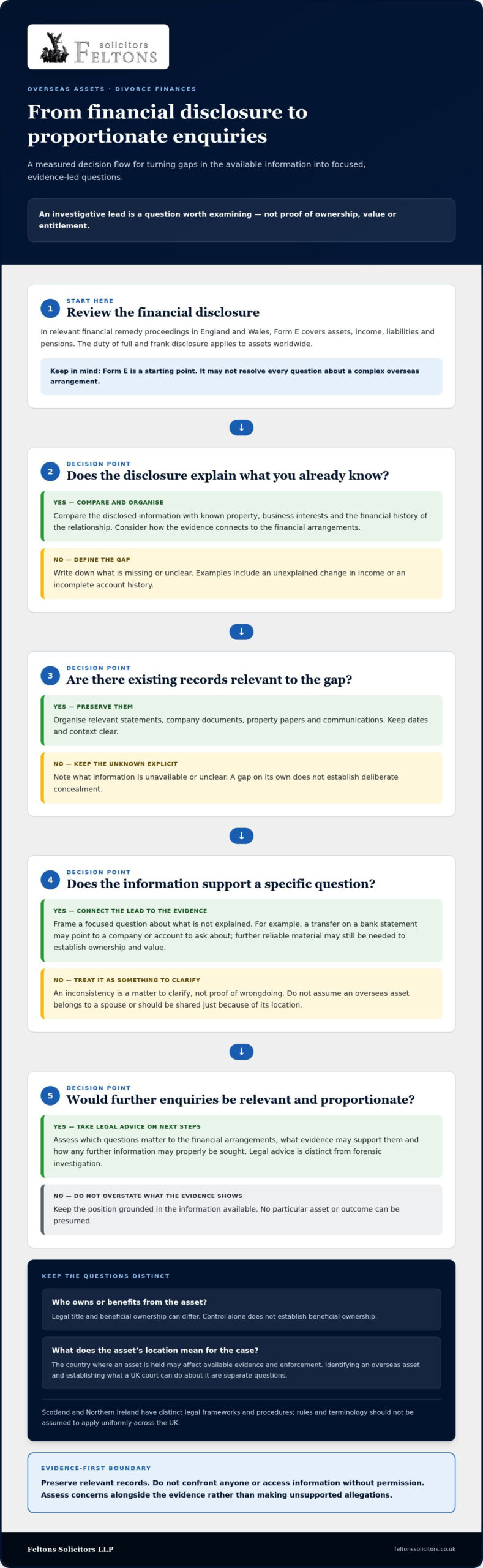
A careful approach moves from what has been disclosed to specific, answerable questions. In relevant financial remedy proceedings in England and Wales, Form E is used for financial disclosure, including information about assets, income, liabilities and pensions. The duty of full and frank disclosure applies to assets worldwide. Form E is a starting point, not a guarantee that every question about a complex overseas arrangement will be resolved.
A proportionate sequence can help keep the focus on evidence:
- Review disclosure: compare the information provided with what is already known about property, business interests and financial history.
- Identify gaps: note what is missing or unclear, such as an unexplained change in income or an incomplete account history.
- Preserve existing records: organise statements, company documents, property papers and relevant communications, keeping dates and context clear.
- Take legal advice: assess which questions matter to the financial arrangements and what steps may be appropriate.
- Consider proportionate enquiries: decide whether further information is justified and how it may properly be sought.
An investigative lead points to a question worth examining. It isn’t proof of ownership, value or entitlement. For example, a transfer shown on a bank statement may identify a company or account to ask about, but further reliable material may be needed to establish who owns an interest and what it is worth. A lawyer can connect the evidence and any proposed legal steps to the financial proceedings, but can’t promise that an asset will be found or included in a settlement.
From financial disclosure to specific questions
Compare disclosed information with known business interests, property records and the financial history of the relationship. A company name in correspondence, for instance, may help frame a question about an interest that isn’t clearly explained in the disclosure. Treat inconsistencies as matters to clarify, not proof of deliberate concealment. The Law Commission’s review of financial remedy laws provides further context on the framework governing financial outcomes.
Following company and property ownership across borders
Corporate structures can separate the person with legal title from those with beneficial interests, so company filings alone may not establish who owns or benefits from an asset. For overseas entities that own UK land or property, the Companies House Register of Overseas Entities may provide relevant information about registrable beneficial owners. It doesn’t establish ownership of every overseas asset. The overseas entity beneficial owner registration guide explains this UK property context.
International asset tracing divorce lawyers can help assess how cross-border information relates to financial arrangements. If records raise questions, tailored advice on divorce and financial arrangements can help you consider a measured next step.
When suspected hidden overseas assets justify further enquiries
Unusual finances can justify careful questions, but they don’t establish that a spouse has concealed assets. The issue is whether reliable information points to a specific gap in the financial picture and whether clarifying it could matter to the financial arrangements. An evidence-led approach helps avoid turning uncertainty into an unsupported allegation.
Patterns that may warrant a closer look
Consider the context and any available records. Potential discrepancies include:
- A sustained mismatch between declared income and apparent spending or lifestyle.
- Transfers to overseas accounts or entities that aren’t explained in the financial information provided.
- Newly disclosed liabilities or sudden changes in company interests that affect the reported position.
- Overseas property or income that appears in relevant records but not in the financial disclosure.
One item may have a straightforward explanation. Several changes around the same period may make it reasonable to seek clarification, particularly if they can’t readily be reconciled with business records, statements or the known financial history. Record what prompted the concern and when. Avoid presenting an inference as an established fact.
What a warning sign cannot prove
An inconsistency may result from an error, a change in circumstances, a legitimate business arrangement or incomplete information. Test it against reliable records and the other explanations available. A transfer may point to an account or company worth asking about, but it doesn’t by itself establish who owns the funds or why they moved.
Consider these as separate questions: does the asset exist, who owns it legally or beneficially, what is its present value, who controls it, and is it relevant to the financial outcome? Evidence of a property, for example, may not establish its current value or the extent of a spouse’s beneficial interest. Nor does identifying an asset prove it can be recovered or readily dealt with under an order.
Access only information you’re entitled to use. Don’t log into another person’s account, obtain private records without authority or confront them in a way that could compromise evidence or escalate matters. Share concerns and records already lawfully available with your solicitor so possible next steps can be considered proportionately. International asset tracing divorce lawyers can help assess how a concern relates to financial proceedings without treating suspicion as proof.
In England and Wales, section 37 of the Matrimonial Causes Act 1973 provides court powers concerning certain dispositions intended to defeat financial relief and applications to restrain a disposition. Such measures are court decisions, not automatic consequences of a concern. The legal test and evidence matter. Procedures differ across the UK, and overseas enforcement can raise separate jurisdictional questions.
How to prepare for an international asset tracing discussion with a divorce lawyer
A clear, organised account of what you know can make legal advice more focused. You don’t need to prove that an overseas asset has been concealed before raising a concern. The aim is to help your solicitor understand the available information, distinguish fact from assumption and consider whether a next step is justified.
Information to organise before taking advice
Prepare a simple timeline and gather records you already hold or are authorised to access. Keep copies in their original form where possible, and note where each item came from. Useful material may include:
- A dated outline of known overseas assets, business links and significant financial changes, such as a transfer or change in company interests.
- Existing financial disclosure and relevant bank statements, company records, property documents or correspondence.
- Relevant communications that help explain an asset, transaction or financial change, with dates and context.
- A note of what you know and what you don’t. Separate direct knowledge from assumptions, information reported by someone else and unanswered questions.
Keep the material factual and concise. Don’t try to access another person’s accounts or private records without authority, and avoid confronting your spouse based on an unverified suspicion. Your solicitor can help assess how the information may be used and what further material, if any, is appropriate to seek.
Questions a case-specific legal assessment should address
Useful questions include: What does the evidence currently establish? What remains uncertain about ownership, value or control? Which country’s procedures may be relevant, and could information be obtained or an order enforced there? These questions help distinguish a promising lead from a step that may be costly, intrusive or unlikely to clarify the financial position.
Advice should also consider the quality of the evidence, privacy, proportionality and the options available in your proceedings. Depending on the circumstances, a sensible next step might involve seeking clarification through disclosure, exploring a negotiated resolution or considering a court application. None is automatic. International asset tracing divorce lawyers should link any proposed step to the evidence and the financial issues it may help resolve, rather than promise a particular result.
If you’re concerned about overseas assets, Feltons Solicitors LLP can discuss your circumstances discreetly and provide tailored advice on divorce and financial arrangements. Discuss your divorce and financial arrangements with Feltons Solicitors LLP.
Choosing international asset tracing divorce lawyers for a measured legal strategy
A sound legal strategy connects available evidence to the financial questions in your divorce. It doesn’t promise that an asset will be found, recovered or included in a settlement. Instead, it assesses what the information establishes, what remains uncertain and whether further steps are justified in your circumstances.
When considering international asset tracing divorce lawyers, focus on how the advice will support your financial proceedings, not simply on the language used to describe tracing.
| Decision criterion | What useful advice should address |
|---|---|
| Family-law relevance | How the available information relates to financial disclosure, negotiations or the court’s consideration of financial arrangements. |
| Cross-border reasoning | Which country’s laws or procedures may matter, and whether advice from another jurisdiction could be relevant. |
| Proportionality | The legal basis, evidence, likely practical value and potential consequences of each proposed step. |
| Clear communication | A plain-English explanation of options, uncertainties and what each route may involve, without overstating likely outcomes. |
What a well-framed legal strategy should consider
A proposed step should have a clear purpose. For example, if an overseas company appears in financial records, legal advice can assess whether the documents support a relevant question about ownership or value, and whether seeking further disclosure is proportionate. The strategy should also account for privacy, the strength of the evidence and practical limits on obtaining information or enforcing an order abroad.
Different jurisdictions have different legal systems and procedures. A process available in England and Wales may not operate in the same way elsewhere, so advice should identify when foreign law or input from another jurisdiction may be needed. Understand the possible routes and their uncertainties before deciding how to proceed.
How Feltons can support divorce financial arrangements
Feltons advises on divorce and financial arrangements, connecting cross-border financial issues with the questions that matter to your case. The firm also handles complex litigation and dispute resolution for international clients. This experience supports a considered approach that recognises both the legal complexity and the personal impact of financial uncertainty.
A discussion can focus on the facts you have, your objectives and proportionate options, without assuming that a concern proves concealment or guarantees a particular result. Speak to Feltons about your financial arrangements.
Take a measured next step with confidence
Overseas assets call for careful assessment, not assumptions. A lead may justify a question, but it doesn’t establish ownership, value or entitlement. Organising the information you already have can clarify what remains uncertain and whether further steps are proportionate to your financial case.
Choosing international asset tracing divorce lawyers means finding legal advice that connects cross-border evidence to divorce financial arrangements, explains the options clearly and recognises the limits of what the evidence can prove. The right approach should reflect your circumstances and objectives without promising a particular outcome.
Feltons advises on divorce and financial arrangements and handles complex litigation and dispute resolution for international clients. Established in 2010, the firm combines modern delivery with traditional values, offering a considered perspective on complex financial issues and their personal impact.
For a discreet discussion of the facts, your priorities and possible next steps, speak to Feltons about your divorce and financial arrangements. A clear, tailored conversation can help you approach what comes next with greater confidence.
Frequently Asked Questions
What is international asset tracing in divorce?
International asset tracing in divorce means identifying potential assets connected with another country, examining available evidence and assessing how those assets may relate to financial arrangements. It may concern overseas property, bank accounts, investments or business interests. A record or lead doesn’t automatically prove that an asset is concealed, beneficially owned by a spouse or recoverable. The legal steps available depend on where proceedings are taking place and which jurisdictions are involved.
Can a divorce lawyer trace assets held overseas?
A divorce lawyer can advise on financial disclosure, assess apparent inconsistencies and consider appropriate legal steps concerning overseas assets. This is legal advice, not necessarily a forensic investigation. Information may need to be considered across more than one jurisdiction, and other professional input may be relevant in some cases. The existence of an asset, who owns it and what it is worth are separate questions. No lawyer can guarantee that every asset will be identified.
What are the signs of hidden assets during a divorce?
Possible warning signs include unexplained transfers, inconsistent financial records, sudden changes in company ownership or a lifestyle that seems difficult to reconcile with disclosed income. For example, a transfer to an unfamiliar overseas company may raise a question about its purpose. These signs aren’t proof of deliberate concealment. Review the documents and wider context before making allegations or pursuing further steps, as there may be an innocent explanation for an apparent discrepancy.
Can overseas property be included in a divorce financial settlement?
Overseas property may be relevant to divorce financial arrangements, but its treatment depends on the facts, ownership evidence, applicable law and the court’s jurisdiction. A company or other structure may hold the legal title, so the title alone might not show who benefits from the property. Its value and whether an order can be enforced in the country where it is located may also matter. Foreign location doesn’t automatically exclude property from consideration.
What evidence helps identify overseas assets in divorce?
Potentially useful records include financial disclosure, bank statements, company documents, property papers, tax records and relevant communications that you’re lawfully entitled to access. A dated note of known transactions or changes in ownership can help organise the information. Assess each record for reliability and context. For example, a statement may point to a payment or account, but it may not prove beneficial ownership, current value or deliberate non-disclosure.
Can a court freeze overseas assets during divorce proceedings?
A court may have powers to make protective orders in appropriate circumstances, but suspicion alone doesn’t make an order automatic. The legal test, evidence, procedure and practical effect depend on the proceedings and jurisdiction. An order made in one country may not have the same effect elsewhere, and enforcement can raise separate issues. A solicitor can advise whether a court application may be available and proportionate based on the evidence and circumstances.
How do I choose international asset tracing divorce lawyers?
Look for family-law advice that links cross-border asset questions to the financial proceedings and explains what the evidence does and doesn’t establish. International asset tracing divorce lawyers should consider jurisdiction, privacy, proportionality and the practical consequences of proposed steps. Clear communication matters: you should understand what is known, what remains uncertain and why a particular route may be appropriate. Be cautious of promises that assets will be found, recovered or included in a settlement.