
Post-Nuptial Agreement Drafting Solicitors: 2026 Guide

Post-Nuptial Agreement Drafting Solicitors: 2026 Guide

Could putting financial decisions in writing bring clarity without deciding the future of your marriage? For couples considering a post-nuptial agreement, that balance matters. Discussions about money can feel sensitive or one-sided, and it’s natural to ask whether an agreement will carry legal weight. In England and Wales, post-nuptial agreements aren’t automatically binding. A court may give one significant weight if it is fair and both parties entered into it freely, with full financial disclosure and independent legal advice. Experienced post nuptial agreement drafting solicitors can help you approach the process carefully and with realistic expectations.

A considered agreement is a financial plan tailored to your circumstances, not a guarantee of a particular court outcome. This 2026 guide explains what an agreement can cover, from property and savings to pensions, business interests and debts. It also sets out what information to prepare, how solicitor-led advice can support clear decisions and what to consider before signing.

Key Takeaways

  • Changes such as an inheritance, growing business interests or a shift in finances may prompt you to revisit financial plans after marriage.
  • Understand how the court’s discretion and the principles in Radmacher v Granatino affect the weight an agreement may carry.
  • See where generic templates can fall short, particularly when assets, family circumstances or future plans are more complex.
  • Prepare a clear picture of your objectives, income, assets, pensions, liabilities and relevant supporting records before drafting begins.
  • Learn what to expect from post nuptial agreement drafting solicitors, from initial discussions and financial disclosure to review and signing.

When are post-nuptial agreement drafting solicitors useful after marriage?

A post-nuptial agreement is a written agreement made after a couple marries or enters a civil partnership. It can set out how they intend to approach their finances if they separate or divorce, including matters such as property, savings, debts or business interests. The Postnuptial agreement overview offers a general introduction, but it isn’t a guide to the law in every jurisdiction. In England and Wales, an agreement can record a couple’s intentions; it can’t guarantee how a court would decide a future financial case.

Post nuptial agreement drafting solicitors can help couples work through their intentions in light of their financial circumstances. Considering an agreement doesn’t mean separation is expected. For some couples, it’s practical planning after a change in circumstances. For others, it creates an opportunity to clarify financial expectations and discuss them openly.

What can prompt a couple to consider an agreement?

A change in finances may lead a couple to revisit arrangements made earlier in their relationship. One partner might receive an inheritance, start or grow a business, or experience a substantial change in income. They may want to record how particular assets or responsibilities should be treated if the relationship later ends.

These are possible reasons to explore an agreement, not a checklist for every couple. Start by identifying what has changed, what each partner wants to clarify and whether both feel able to discuss the subject freely. A focused conversation can help separate shared priorities from assumptions that need further thought.

How is a post-nuptial agreement different from a prenup?

The difference is timing: a prenuptial agreement is made before marriage, while a post-nuptial agreement is made after a marriage or civil partnership has taken place. Either may form part of financial planning, but neither guarantees a particular outcome if the couple separates or divorces.

In both cases, the terms should reflect the couple’s actual circumstances and agreed intentions, rather than generic assumptions. For broader context on the financial issues that can arise if a relationship ends, read this guidance on divorce and financial arrangements.

Family law differs across the UK, so this guide focuses on England and Wales. If your circumstances involve another part of the UK, the applicable law may differ. A solicitor can explain the relevant context and how an agreement may fit into your wider financial planning.

Can a post-nuptial agreement be upheld in England and Wales?

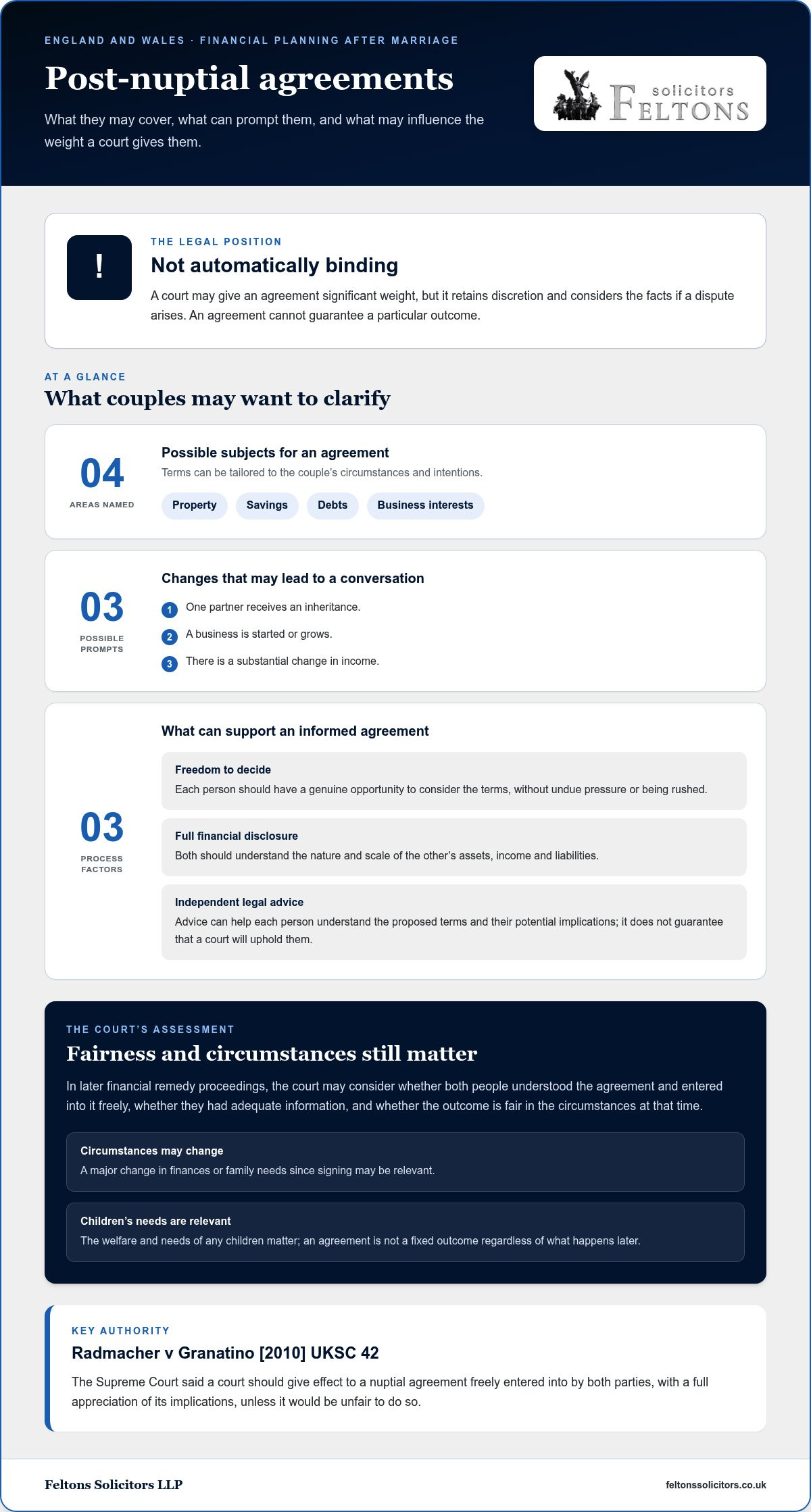
A post-nuptial agreement isn’t automatically legally binding in England and Wales. However, a court may give it significant weight when deciding financial remedy proceedings. The key authority is Radmacher v Granatino [2010] UKSC 42. The Supreme Court said a court should give effect to a nuptial agreement freely entered into by both parties, with a full appreciation of its implications, unless it would be unfair to do so. The Law Commission report on nuptial agreements provides further context on their legal status.

This principle doesn’t promise that a particular agreement or term will be upheld. A court retains discretion and considers the facts when a dispute arises, including whether the agreement was fair at that time and whether circumstances have changed. The needs and welfare of any children are also relevant, so an agreement can’t be treated as a fixed outcome regardless of what happens later.

What factors may influence the weight given to an agreement?

The circumstances in which the agreement was made can matter as much as its wording. Each person should have a genuine opportunity to consider the terms, without undue pressure or being rushed into signing. Full and frank financial disclosure helps both parties understand what they are agreeing to, including the nature and scale of each other’s assets, income and liabilities.

Independent legal advice is an important safeguard. It helps each person understand the proposed terms and their potential implications, but it doesn’t guarantee that a court will uphold the agreement. Post nuptial agreement drafting solicitors can help clarify the issues, record the parties’ intentions and identify points that need careful consideration. The aim is an informed process, not a guaranteed legal result.

Why can’t a solicitor promise a particular result?

If financial remedy proceedings later arise, the court makes its own assessment. It may consider whether each person understood the agreement, entered into it freely and had adequate information, alongside whether the outcome is fair in the circumstances at that time. A major change in finances or family needs since signing may also be relevant.

Careful drafting can support clarity and informed decision-making, but it doesn’t make an agreement automatically binding or remove the court’s discretion. For tailored guidance on how an agreement fits your financial circumstances, explore family law advice on financial arrangements.

Solicitor-drafted agreement or template: what is the difference?

A generic template can provide a starting structure, but it can’t account for how your finances are arranged or what you intend each clause to achieve. Advice-led drafting starts with your circumstances and priorities, then shapes the wording around them. Neither approach guarantees how a court would treat an agreement, and not every couple needs the same provisions.

Consideration Generic template Advice-led drafting
Fit Uses standard wording that may not reflect particular assets, ownership or family circumstances. Considers the couple’s circumstances and identifies where specific terms or further discussion may be needed.
Financial information May provide limited prompts, leaving assumptions about assets, income or liabilities unstated. Uses the financial picture to inform the terms and highlight areas requiring clarity.
Review May not explain how to assess whether the wording reflects both parties’ intentions. Allows the draft to be considered in context, with each person’s position and questions addressed.

Where can a generic template fall short?

Broad wording can blur important differences. For example, a clause referring to “property” may not distinguish a jointly owned home from a property owned by one person, or explain how a mortgage or other liability should be considered. A template may also leave assumptions about a business, shares, inherited assets or changing family circumstances unstated.

This doesn’t mean every template is invalid or unsuitable. The risk is relying on standard language without checking whether it accurately describes the couple’s finances and intentions. If key context is missing, the document may leave room for different interpretations.

What does tailored legal advice add?

Advice can help each person identify their priorities, understand the proposed terms and raise questions before the wording is settled. Since each partner’s circumstances and interests may differ, both should have the opportunity to consider the agreement from their own perspective and receive separate advice. Post nuptial agreement drafting solicitors can help translate agreed intentions into clearer terms and draw attention to unresolved issues rather than obscuring them with general wording.

Inheritance planning may also connect with decisions about how assets are treated in an agreement. For related considerations, see this estate planning guidance. The Law Commission’s report on nuptial agreements provides further background on the legal context. A tailored document isn’t a promise of a particular court outcome; its value lies in recording considered intentions clearly.
Post-Nuptial Agreement Drafting Solicitors: 2026 Guide

What information should you prepare before drafting a post-nuptial agreement?

Good preparation helps turn broad intentions into terms that reflect your finances and priorities. You don’t need to decide every detail alone before seeking advice. Start by gathering a clear picture of your circumstances and noting where you and your spouse agree or need a fuller discussion.

Which financial details and documents may be relevant?

The information needed depends on your circumstances. Records might include property details, bank and investment statements, income information, pension records, details of debts and documents relating to a business or its ownership. Where relevant, note whether an asset is jointly or individually owned and how it was acquired. The aim is an accurate overview, not a standard paperwork list for every couple.

A practical preparation sequence can help:

  1. Set out your objectives. Note what you want the agreement to clarify and which questions remain open.
  2. Gather financial information. List assets, income, pensions, liabilities and business interests, with supporting records where available.
  3. Explain ownership and context. Record how significant assets are held and, where relevant, the source of funds used to acquire them.
  4. Consider day-to-day and future needs. Think about housing, ongoing financial responsibilities and possible changes, such as a new business venture or inheritance.
  5. Review the proposed terms. Read the draft carefully, raise uncertainties and take advice before deciding whether to sign.

How should couples approach terms and future review?

Each person can consider their own priorities and practical needs before discussing how to address them together. For example, think through how housing costs would be managed or what should happen if one partner’s income changes. Listing agreed points separately from unresolved questions can make a sensitive conversation more focused.

You may also wish to discuss whether the agreement should be reviewed after a particular life change or at an agreed point in the future. A review clause can prompt the couple to revisit the terms, but it won’t update them automatically. Any change needs to be considered and properly recorded, with advice tailored to the circumstances at that time.

Post nuptial agreement drafting solicitors can help organise the information, explain issues in plain English and tailor advice and drafting to your circumstances. To discuss your financial arrangements, speak with Feltons about your financial arrangements.

Post-Nuptial Agreements: Instruction to Final Document

A clear, measured process gives both people space to explain their priorities, understand the financial picture and consider the wording before deciding whether to sign. The steps depend on the couple’s circumstances, but the process commonly moves from setting objectives and sharing financial information to advice, drafting, review and completion.

  1. Set out your objectives. Identify what you hope to clarify and which issues need discussion.
  2. Share financial information. Bring together relevant details of assets, income, pensions, liabilities and other interests.
  3. Consider advice. Each person should have the opportunity to understand the proposed terms and their potential implications.
  4. Prepare and review a draft. Instructions and financial information inform the wording. Both parties should read it carefully and raise questions where needed.
  5. Complete the agreement. Before signing, check the final terms and the applicable execution formalities in light of current law and your circumstances.

What happens during the drafting and review stages?

The first draft should reflect the objectives discussed and the financial context provided. During review, check that the language says what you intend, that relevant issues haven’t been overlooked and that unclear or disputed points are addressed. Take time to ask questions. Each person should understand the proposed terms and obtain appropriate advice before completion.

Discussions about money can feel personal. Clear, sensitive communication and appropriate privacy can help keep the focus on practical decisions rather than assumptions about the relationship. Post nuptial agreement drafting solicitors can explain the issues in plain English and tailor advice to the couple’s circumstances, while keeping expectations realistic about the agreement’s potential legal effect.

When should you seek advice about a post-nuptial agreement?

Start early enough to gather financial information, consider the terms and allow each person to obtain independent guidance. A rushed process or pressure to sign can leave one or both parties without a proper opportunity to reflect, undermining confidence in the agreement and how it was reached. If a point remains unresolved, address it before signing rather than treating completion as a formality.

For advice shaped around your objectives and financial circumstances, speak to Feltons about post-nuptial agreement drafting. A solicitor can help you understand the process and prepare carefully, without promising how a court would decide a future dispute.

Take a considered next step with your financial plans

A post-nuptial agreement can set out shared intentions after a change in circumstances, but it can’t guarantee a particular court outcome. Its potential value depends on careful preparation, clear financial information and terms that reflect both parties’ circumstances. Taking time to understand the process and review the draft can help you approach sensitive decisions thoughtfully.

Post nuptial agreement drafting solicitors can help you consider your objectives and the practical issues an agreement may need to address. Feltons advises on divorce and financial arrangements, with pragmatic advice tailored to individual needs. The firm can help you explore your options and take a measured approach.

Discuss post-nuptial agreement drafting with Feltons and take an informed first step towards greater financial clarity.

Frequently Asked Questions

Are post-nuptial agreements legally binding in England and Wales?

No, post-nuptial agreements aren’t automatically legally binding in England and Wales. A court may give an agreement significant weight, particularly where both people entered into it freely, understood its implications and made full financial disclosure. The court retains discretion and may consider fairness, later changes in circumstances and the needs of any children. Careful drafting and independent legal advice can support the process, but neither guarantees that every term will be upheld.

Do both spouses need separate solicitors for a post-nuptial agreement?

Each spouse should have the opportunity to obtain independent legal advice so they can understand the proposed terms and consider their own interests. The same solicitor can’t advise both people on their individual positions. Separate advice can help identify concerns and support informed, voluntary decisions. Post nuptial agreement drafting solicitors can guide each client through the implications of the terms, but independent advice can’t guarantee a particular court outcome.

What should a post-nuptial agreement include?

An agreement may set out how a couple intends to deal with relevant finances if they separate or divorce. Depending on their circumstances, this could include property, savings, pensions, income, debts, business interests and inheritance. It should reflect the couple’s objectives and the financial information available, rather than rely on standard terms that may not fit. Advice can help clarify ownership, responsibilities and points that need further discussion before signing.

Can a post-nuptial agreement protect an inheritance or business?

An agreement can record how a couple intends an inheritance or business interest to be treated if they separate, but it can’t guarantee that a court will follow that intention. The details matter, including ownership, financial disclosure, each person’s needs and later changes in circumstances. For example, a business may change in value or provide income relied on by the family. Tailored advice can help address these factors clearly without promising a legal result.

Can we make a post-nuptial agreement without a solicitor?

You can prepare an agreement without a solicitor, but a generic document may not reflect your finances or make your intentions clear. Independent legal advice can help each person understand the terms, while careful drafting can identify assumptions or unresolved issues. Full financial disclosure and voluntary decision-making are also important considerations. Solicitor involvement may strengthen the preparation, but it doesn’t make an agreement automatically binding or guarantee how a court will treat it.

Can a post-nuptial agreement be changed after it is signed?

Yes, you and your spouse can agree to change the terms, but don’t assume a verbal conversation or informal note updates the agreement. Any variation should be properly documented and considered in light of your current financial circumstances and applicable legal requirements. Independent advice can help each person understand the proposed changes. If circumstances shift, such as a change in income or family responsibilities, review the agreement rather than relying on outdated terms.

Does a post-nuptial agreement cover arrangements for children?

A post-nuptial agreement can record the parents’ intentions about family finances, but it can’t conclusively decide future arrangements for children or bind a court on those matters. If parents separate, decisions concerning a child are assessed in light of the child’s welfare and circumstances at that time. The agreement may include relevant financial intentions, but a court’s consideration of children’s needs remains important. Take advice before including provisions that affect children or family support.

International Asset Tracing Divorce Lawyers: A UK Guide to Overseas Assets

International Asset Tracing Divorce Lawyers: A UK Guide to Overseas Assets

What if a spouse’s disclosed finances don’t explain their known lifestyle or apparent resources overseas? If you’re looking for international asset tracing divorce lawyers, an overseas property, company, account or investment may raise legitimate questions. But uncertainty alone isn’t proof of concealed assets. The next step is to establish what the available information shows and how it may matter to divorce proceedings.

It’s important to distinguish investigating assets from obtaining legal advice on evidence and financial arrangements. A solicitor can help you identify disclosure questions, assess how available information may support negotiations or court proceedings, and consider whether specialist input is appropriate. Cross-border issues may also affect how an order can be enforced, depending on the country involved.

This guide explains what may justify further enquiries, which records to preserve and how evidence about overseas assets may inform your legal strategy. It also covers how to approach concerns discreetly, protect privacy and avoid unsupported allegations. The aim is a measured way forward based on the evidence and your circumstances.

Key Takeaways

  • An asset’s overseas location alone doesn’t establish who owns it or whether it should affect divorce finances.
  • Build a clearer picture by reviewing financial disclosure, identifying specific gaps and preserving relevant records before considering next steps.
  • Unexplained transfers or changes in company ownership may warrant questions, but assess them alongside other evidence rather than treating them as proof.
  • Prepare for a legal discussion by organising known asset details, dates, existing disclosure and relevant communications. Don’t confront anyone or access information without permission.
  • Choose international asset tracing divorce lawyers who connect cross-border evidence to financial proceedings, explain proportionate options and avoid promising a particular outcome.

What international asset tracing means in divorce financial proceedings

International asset tracing in divorce involves identifying potential overseas assets, gathering evidence about them and assessing whether they are relevant to the parties’ financial arrangements. It doesn’t establish that an asset has been hidden, belongs to one spouse or must be shared. For example, property registered abroad may be held for someone else or be subject to another person’s rights.

Financial disclosure is the starting point. If information is missing, unclear or inconsistent, focused enquiries may help establish what further evidence is relevant. That is different from assuming wrongdoing or investigating without proper authority. International asset tracing divorce lawyers can help connect available evidence to the legal issues in financial proceedings. Legal advice is distinct from forensic investigation, and no particular outcome can be presumed.

Which overseas assets may need to be considered?

Relevant assets may include overseas property, bank accounts, investments, company interests, trusts and valuable personal possessions. The key questions are not just where an asset is located, but what the evidence shows about its ownership, value and connection to the parties’ finances.

Legal title and beneficial ownership can differ. A company may be the registered owner of a property, for instance, while the rights of shareholders or other beneficiaries depend on the structure and evidence. Control alone doesn’t establish beneficial ownership, and an asset associated with a spouse shouldn’t automatically be treated as theirs.

Why jurisdiction matters to the divorce case

The applicable process depends on where the financial proceedings take place. In England and Wales, financial remedy proceedings sit within a framework that includes the Matrimonial Causes Act 1973. Scotland and Northern Ireland have distinct legal frameworks and procedures, so rules and terminology shouldn’t be assumed to apply uniformly across the UK.

The country where an asset is held may also affect what evidence is available and how an order can be enforced. Identifying an overseas asset and establishing what a UK court can do about it are separate questions. For wider context on financial arrangements and settlement considerations, read the divorce and financial arrangements guide.

How international asset tracing builds an evidence-led picture of wealth

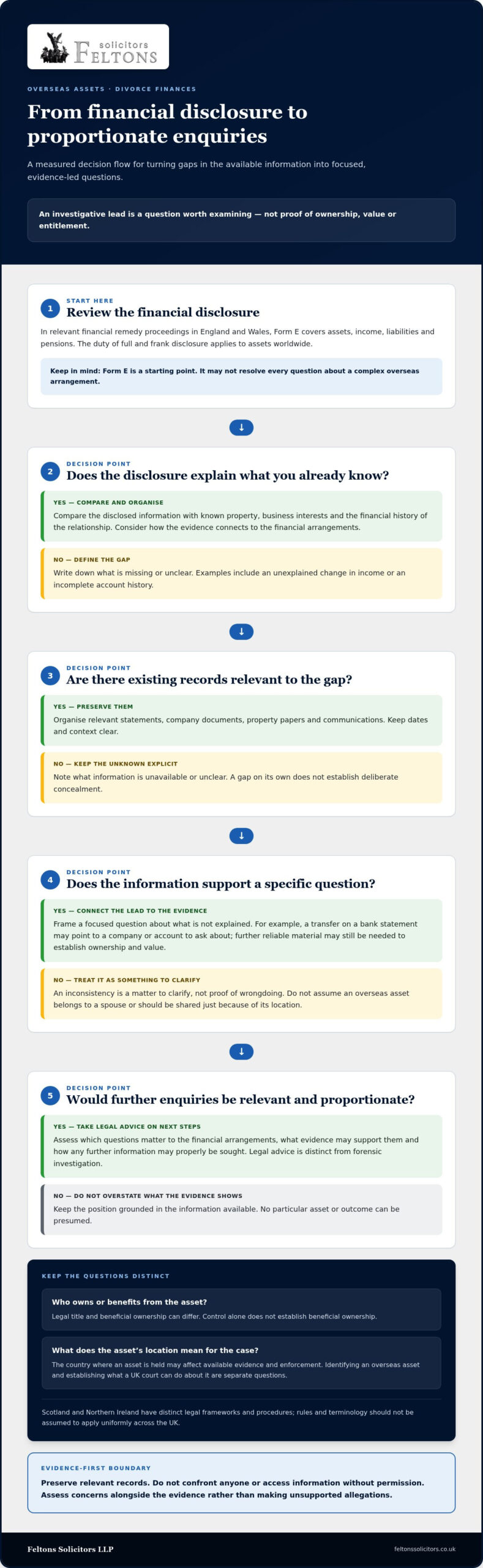
A careful approach moves from what has been disclosed to specific, answerable questions. In relevant financial remedy proceedings in England and Wales, Form E is used for financial disclosure, including information about assets, income, liabilities and pensions. The duty of full and frank disclosure applies to assets worldwide. Form E is a starting point, not a guarantee that every question about a complex overseas arrangement will be resolved.

A proportionate sequence can help keep the focus on evidence:

  • Review disclosure: compare the information provided with what is already known about property, business interests and financial history.
  • Identify gaps: note what is missing or unclear, such as an unexplained change in income or an incomplete account history.
  • Preserve existing records: organise statements, company documents, property papers and relevant communications, keeping dates and context clear.
  • Take legal advice: assess which questions matter to the financial arrangements and what steps may be appropriate.
  • Consider proportionate enquiries: decide whether further information is justified and how it may properly be sought.

An investigative lead points to a question worth examining. It isn’t proof of ownership, value or entitlement. For example, a transfer shown on a bank statement may identify a company or account to ask about, but further reliable material may be needed to establish who owns an interest and what it is worth. A lawyer can connect the evidence and any proposed legal steps to the financial proceedings, but can’t promise that an asset will be found or included in a settlement.

From financial disclosure to specific questions

Compare disclosed information with known business interests, property records and the financial history of the relationship. A company name in correspondence, for instance, may help frame a question about an interest that isn’t clearly explained in the disclosure. Treat inconsistencies as matters to clarify, not proof of deliberate concealment. The Law Commission’s review of financial remedy laws provides further context on the framework governing financial outcomes.

Following company and property ownership across borders

Corporate structures can separate the person with legal title from those with beneficial interests, so company filings alone may not establish who owns or benefits from an asset. For overseas entities that own UK land or property, the Companies House Register of Overseas Entities may provide relevant information about registrable beneficial owners. It doesn’t establish ownership of every overseas asset. The overseas entity beneficial owner registration guide explains this UK property context.

International asset tracing divorce lawyers can help assess how cross-border information relates to financial arrangements. If records raise questions, tailored advice on divorce and financial arrangements can help you consider a measured next step.

When suspected hidden overseas assets justify further enquiries

Unusual finances can justify careful questions, but they don’t establish that a spouse has concealed assets. The issue is whether reliable information points to a specific gap in the financial picture and whether clarifying it could matter to the financial arrangements. An evidence-led approach helps avoid turning uncertainty into an unsupported allegation.

Patterns that may warrant a closer look

Consider the context and any available records. Potential discrepancies include:

  • A sustained mismatch between declared income and apparent spending or lifestyle.
  • Transfers to overseas accounts or entities that aren’t explained in the financial information provided.
  • Newly disclosed liabilities or sudden changes in company interests that affect the reported position.
  • Overseas property or income that appears in relevant records but not in the financial disclosure.

One item may have a straightforward explanation. Several changes around the same period may make it reasonable to seek clarification, particularly if they can’t readily be reconciled with business records, statements or the known financial history. Record what prompted the concern and when. Avoid presenting an inference as an established fact.

What a warning sign cannot prove

An inconsistency may result from an error, a change in circumstances, a legitimate business arrangement or incomplete information. Test it against reliable records and the other explanations available. A transfer may point to an account or company worth asking about, but it doesn’t by itself establish who owns the funds or why they moved.

Consider these as separate questions: does the asset exist, who owns it legally or beneficially, what is its present value, who controls it, and is it relevant to the financial outcome? Evidence of a property, for example, may not establish its current value or the extent of a spouse’s beneficial interest. Nor does identifying an asset prove it can be recovered or readily dealt with under an order.

Access only information you’re entitled to use. Don’t log into another person’s account, obtain private records without authority or confront them in a way that could compromise evidence or escalate matters. Share concerns and records already lawfully available with your solicitor so possible next steps can be considered proportionately. International asset tracing divorce lawyers can help assess how a concern relates to financial proceedings without treating suspicion as proof.

In England and Wales, section 37 of the Matrimonial Causes Act 1973 provides court powers concerning certain dispositions intended to defeat financial relief and applications to restrain a disposition. Such measures are court decisions, not automatic consequences of a concern. The legal test and evidence matter. Procedures differ across the UK, and overseas enforcement can raise separate jurisdictional questions.

International Asset Tracing Divorce Lawyers: A UK Guide to Overseas Assets

How to prepare for an international asset tracing discussion with a divorce lawyer

A clear, organised account of what you know can make legal advice more focused. You don’t need to prove that an overseas asset has been concealed before raising a concern. The aim is to help your solicitor understand the available information, distinguish fact from assumption and consider whether a next step is justified.

Information to organise before taking advice

Prepare a simple timeline and gather records you already hold or are authorised to access. Keep copies in their original form where possible, and note where each item came from. Useful material may include:

  • A dated outline of known overseas assets, business links and significant financial changes, such as a transfer or change in company interests.
  • Existing financial disclosure and relevant bank statements, company records, property documents or correspondence.
  • Relevant communications that help explain an asset, transaction or financial change, with dates and context.
  • A note of what you know and what you don’t. Separate direct knowledge from assumptions, information reported by someone else and unanswered questions.

Keep the material factual and concise. Don’t try to access another person’s accounts or private records without authority, and avoid confronting your spouse based on an unverified suspicion. Your solicitor can help assess how the information may be used and what further material, if any, is appropriate to seek.

Questions a case-specific legal assessment should address

Useful questions include: What does the evidence currently establish? What remains uncertain about ownership, value or control? Which country’s procedures may be relevant, and could information be obtained or an order enforced there? These questions help distinguish a promising lead from a step that may be costly, intrusive or unlikely to clarify the financial position.

Advice should also consider the quality of the evidence, privacy, proportionality and the options available in your proceedings. Depending on the circumstances, a sensible next step might involve seeking clarification through disclosure, exploring a negotiated resolution or considering a court application. None is automatic. International asset tracing divorce lawyers should link any proposed step to the evidence and the financial issues it may help resolve, rather than promise a particular result.

If you’re concerned about overseas assets, Feltons Solicitors LLP can discuss your circumstances discreetly and provide tailored advice on divorce and financial arrangements. Discuss your divorce and financial arrangements with Feltons Solicitors LLP.

A sound legal strategy connects available evidence to the financial questions in your divorce. It doesn’t promise that an asset will be found, recovered or included in a settlement. Instead, it assesses what the information establishes, what remains uncertain and whether further steps are justified in your circumstances.

When considering international asset tracing divorce lawyers, focus on how the advice will support your financial proceedings, not simply on the language used to describe tracing.

Decision criterion What useful advice should address
Family-law relevance How the available information relates to financial disclosure, negotiations or the court’s consideration of financial arrangements.
Cross-border reasoning Which country’s laws or procedures may matter, and whether advice from another jurisdiction could be relevant.
Proportionality The legal basis, evidence, likely practical value and potential consequences of each proposed step.
Clear communication A plain-English explanation of options, uncertainties and what each route may involve, without overstating likely outcomes.

What a well-framed legal strategy should consider

A proposed step should have a clear purpose. For example, if an overseas company appears in financial records, legal advice can assess whether the documents support a relevant question about ownership or value, and whether seeking further disclosure is proportionate. The strategy should also account for privacy, the strength of the evidence and practical limits on obtaining information or enforcing an order abroad.

Different jurisdictions have different legal systems and procedures. A process available in England and Wales may not operate in the same way elsewhere, so advice should identify when foreign law or input from another jurisdiction may be needed. Understand the possible routes and their uncertainties before deciding how to proceed.

How Feltons can support divorce financial arrangements

Feltons advises on divorce and financial arrangements, connecting cross-border financial issues with the questions that matter to your case. The firm also handles complex litigation and dispute resolution for international clients. This experience supports a considered approach that recognises both the legal complexity and the personal impact of financial uncertainty.

A discussion can focus on the facts you have, your objectives and proportionate options, without assuming that a concern proves concealment or guarantees a particular result. Speak to Feltons about your financial arrangements.

Take a measured next step with confidence

Overseas assets call for careful assessment, not assumptions. A lead may justify a question, but it doesn’t establish ownership, value or entitlement. Organising the information you already have can clarify what remains uncertain and whether further steps are proportionate to your financial case.

Choosing international asset tracing divorce lawyers means finding legal advice that connects cross-border evidence to divorce financial arrangements, explains the options clearly and recognises the limits of what the evidence can prove. The right approach should reflect your circumstances and objectives without promising a particular outcome.

Feltons advises on divorce and financial arrangements and handles complex litigation and dispute resolution for international clients. Established in 2010, the firm combines modern delivery with traditional values, offering a considered perspective on complex financial issues and their personal impact.

For a discreet discussion of the facts, your priorities and possible next steps, speak to Feltons about your divorce and financial arrangements. A clear, tailored conversation can help you approach what comes next with greater confidence.

Frequently Asked Questions

What is international asset tracing in divorce?

International asset tracing in divorce means identifying potential assets connected with another country, examining available evidence and assessing how those assets may relate to financial arrangements. It may concern overseas property, bank accounts, investments or business interests. A record or lead doesn’t automatically prove that an asset is concealed, beneficially owned by a spouse or recoverable. The legal steps available depend on where proceedings are taking place and which jurisdictions are involved.

Can a divorce lawyer trace assets held overseas?

A divorce lawyer can advise on financial disclosure, assess apparent inconsistencies and consider appropriate legal steps concerning overseas assets. This is legal advice, not necessarily a forensic investigation. Information may need to be considered across more than one jurisdiction, and other professional input may be relevant in some cases. The existence of an asset, who owns it and what it is worth are separate questions. No lawyer can guarantee that every asset will be identified.

What are the signs of hidden assets during a divorce?

Possible warning signs include unexplained transfers, inconsistent financial records, sudden changes in company ownership or a lifestyle that seems difficult to reconcile with disclosed income. For example, a transfer to an unfamiliar overseas company may raise a question about its purpose. These signs aren’t proof of deliberate concealment. Review the documents and wider context before making allegations or pursuing further steps, as there may be an innocent explanation for an apparent discrepancy.

Can overseas property be included in a divorce financial settlement?

Overseas property may be relevant to divorce financial arrangements, but its treatment depends on the facts, ownership evidence, applicable law and the court’s jurisdiction. A company or other structure may hold the legal title, so the title alone might not show who benefits from the property. Its value and whether an order can be enforced in the country where it is located may also matter. Foreign location doesn’t automatically exclude property from consideration.

What evidence helps identify overseas assets in divorce?

Potentially useful records include financial disclosure, bank statements, company documents, property papers, tax records and relevant communications that you’re lawfully entitled to access. A dated note of known transactions or changes in ownership can help organise the information. Assess each record for reliability and context. For example, a statement may point to a payment or account, but it may not prove beneficial ownership, current value or deliberate non-disclosure.

Can a court freeze overseas assets during divorce proceedings?

A court may have powers to make protective orders in appropriate circumstances, but suspicion alone doesn’t make an order automatic. The legal test, evidence, procedure and practical effect depend on the proceedings and jurisdiction. An order made in one country may not have the same effect elsewhere, and enforcement can raise separate issues. A solicitor can advise whether a court application may be available and proportionate based on the evidence and circumstances.

How do I choose international asset tracing divorce lawyers?

Look for family-law advice that links cross-border asset questions to the financial proceedings and explains what the evidence does and doesn’t establish. International asset tracing divorce lawyers should consider jurisdiction, privacy, proportionality and the practical consequences of proposed steps. Clear communication matters: you should understand what is known, what remains uncertain and why a particular route may be appropriate. Be cautious of promises that assets will be found, recovered or included in a settlement.

Financial Disclosure in Divorce UK: A Complete Guide for 2026

Financial Disclosure in Divorce UK: A Complete Guide for 2026

What if the most significant threat to your future financial security isn’t the divorce itself, but a single missing detail in your paperwork? It’s a common fear amongst those separating in 2026, especially when the legal landscape now includes complex digital assets and shifting pension regulations. Undertaking the financial disclosure divorce UK process often feels like an overwhelming administrative hurdle, particularly when you’re already managing the emotional weight of a relationship ending.

You’ve worked hard for your assets. The anxiety that they might be unfairly divided, or the worry that your spouse isn’t being entirely transparent about their own holdings, is a heavy burden to carry. This guide provides the calm, expert clarity you need to master these complexities, ensuring your settlement is fair, legally binding, and robust enough to withstand any future challenges. We’ll examine the latest 2026 valuation standards for pensions and cryptocurrency, the strict requirements of the current Form E, and the vital steps to achieving a final settlement with total peace of mind.

Key Takeaways

  • Understand the “full and frank” legal standard required for financial disclosure divorce UK to ensure your final settlement is protected against future legal challenges.
  • Navigate the complexities of Form E by learning the specific 2026 requirements for valuing modern assets, including digital holdings and complex pension schemes.
  • Identify exactly which assets must be declared, from the family home to individual savings accounts, to avoid the risk of court-imposed penalties.
  • Learn how the court handles non-disclosure and why being transparent is the most effective way to safeguard your long-term financial interests.
  • Discover how a tailored, people-first legal approach can transform an intrusive process into a structured path toward a fair and final resolution.

What is Financial Disclosure in a UK Divorce?

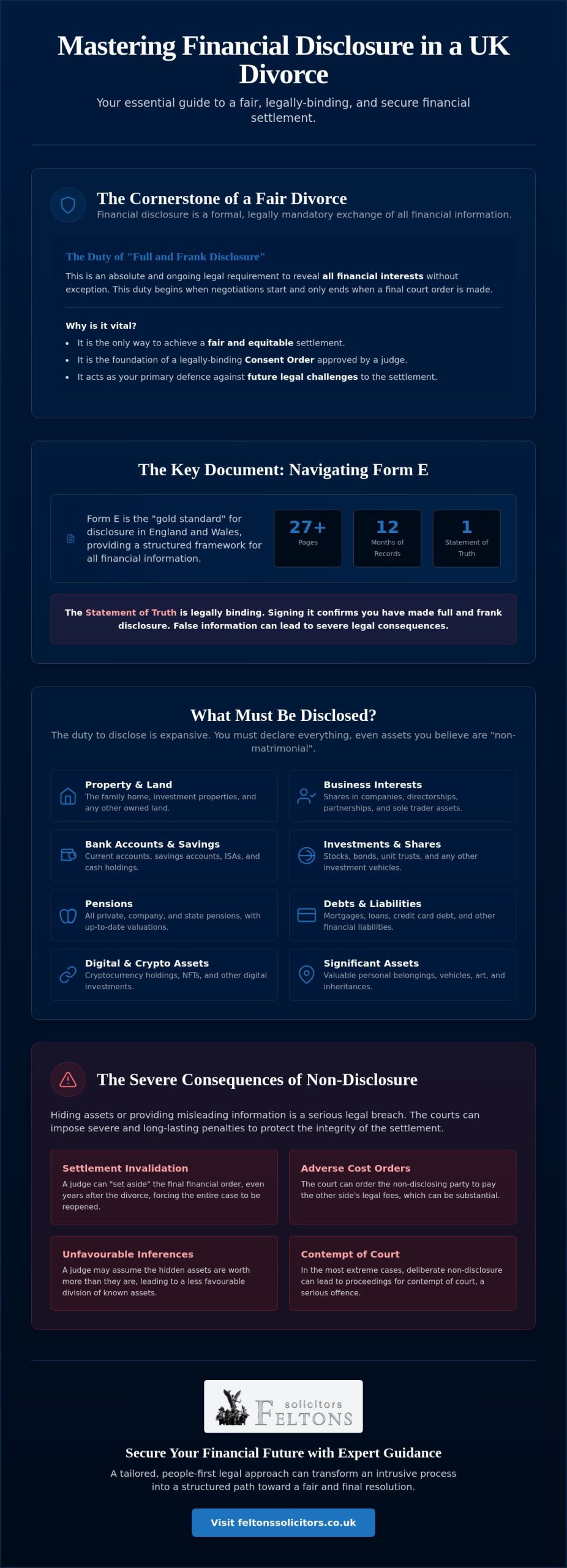
The process of financial disclosure divorce UK is often the most significant phase of a legal separation. It represents a formal exchange of information where both parties provide a comprehensive overview of their financial positions. Transparency is not merely a courtesy; it is a fundamental legal obligation. Without a clear and honest account of every asset, debt, and income stream, it is impossible to reach a settlement that the court considers fair or equitable.

This requirement exists to protect both individuals. By ensuring all cards are on the table, the law prevents one party from being disadvantaged by a lack of information. This transparency is governed primarily by the Matrimonial Causes Act 1973, which provides the framework for how the court distributes assets. Whether you are negotiating through mediation or proceeding via a court application, the standards for honesty remain identical. A final agreement only becomes legally binding when it is drafted into a Consent Order and approved by a judge, who must be satisfied that the disclosure was complete before granting the order.

Failing to be transparent carries long term risks. If a spouse discovers later that assets were hidden or undervalued, they can apply to have the original agreement “set aside.” This means the entire settlement could be reopened years after the divorce is finalised, leading to significant legal costs and emotional distress. Accurate disclosure is your primary defence against future litigation.

The Duty of Full and Frank Disclosure

Full and Frank Disclosure is the absolute legal requirement to reveal all financial interests. This duty is expansive and ongoing. It begins the moment financial negotiations start and continues until the final order is sealed by the court. You must disclose everything, including assets you might believe are “non-matrimonial,” such as an inheritance or a business you owned before the marriage. Whilst you may argue that these specific assets should not be shared, you don’t have the right to hide them from the process. The court, not the individual, determines which assets are relevant to the final division.

Voluntary vs. Court-Mandated Disclosure

Many couples choose to exchange information voluntarily at the start of their separation. This approach often saves time and reduces legal fees, as it avoids the rigid timetable of court proceedings. However, even in a voluntary exchange, most solicitors recommend using the standard Form E to ensure no details are overlooked. If one party is reluctant to share information or if there are concerns about hidden wealth, the court will intervene. In these instances, the court mandates a strict timetable for financial disclosure divorce UK, and failing to comply can result in serious penalties, including cost orders or the court making assumptions about your wealth that may not be in your favour.

The Form E Process: Navigating the Standard Financial Statement

Form E is the primary mechanism for financial disclosure divorce UK, serving as the “gold standard” for transparency in England and Wales. This document is far more than a simple list of assets; it’s a comprehensive 27-page statement that requires you to account for your entire financial life. The current version, dated 23 January 2023, is designed to leave no stone unturned, covering everything from basic income to complex business interests and digital holdings. By providing a structured framework, it ensures that both parties and the court have a clear, identical dataset from which to negotiate a fair split.

The timeline for this process is usually strict. In court proceedings, the judge sets a deadline for the simultaneous exchange of these forms, typically several weeks before the first hearing. Even in voluntary negotiations, sticking to a clear schedule prevents the process from drifting. Perhaps the most critical element of the form is the Statement of Truth. When you sign this, you’re confirming that you’ve made full and frank disclosure. Providing false information or omitting an asset isn’t just a mistake; it’s a serious legal breach that can lead to your settlement being overturned or, in extreme cases, proceedings for contempt of court.

Many people find the sheer volume of data required to be the most daunting aspect of sorting out your finances in a divorce. It’s easy to feel overwhelmed by the level of detail, but approaching the task methodically is the best way to maintain control. If you find the complexity of these requirements stressful, seeking specialist legal support can provide the steady, professional presence needed to ensure your submission is accurate and robust.

Evidence and Supporting Documentation

A Form E is only as strong as the evidence supporting it. You’re required to provide a full 12 months of statements for every bank account, building society, and ISA in your name. This “12-month rule” allows solicitors to track patterns of spending and identify any unusual transfers that might suggest assets are being moved. You’ll also need formal valuations for properties, recent mortgage statements, and up-to-date CETV (Cash Equivalent Transfer Value) figures for all pensions. Organising these documents into a clear, indexed bundle from the outset is the most effective way to minimise legal fees and avoid frustrating delays.

Questionnaires and Clarification

The exchange of Form E is rarely the end of the inquiry. Once both parties have reviewed each other’s statements, they have the right to serve a “Questionnaire.” This is a formal list of questions designed to fill gaps or clarify inconsistencies. For example, if a bank statement shows a large unexplained withdrawal, the questionnaire will ask for its destination. Whilst this back-and-forth can feel intrusive, it’s a vital part of the financial disclosure divorce UK process. It ensures that any “grey areas” are resolved before a final order is drafted, protecting the integrity of your eventual settlement.

What Must Be Disclosed? A Comprehensive Checklist for 2026

The identification of assets is the next logical step once you understand the Form E framework. In 2026, the scope of what constitutes wealth has expanded significantly. It’s no longer enough to simply list the family home and a joint savings account. The court requires a granular look at your entire financial footprint to ensure the financial disclosure divorce UK process is complete. This includes everything from traditional property to modern virtual holdings.

You must declare all matrimonial and non-matrimonial property. This encompasses the primary family home, any buy-to-let investments, and overseas holiday homes. Beyond physical bricks and mortar, every bank account, ISA, and premium bond must be listed. Business interests require particular attention; you’ll need to disclose shareholdings, directorships, and any interest in partnerships. Even if you believe a business asset is entirely separate from the marriage, it must be declared so its status can be professionally assessed. For those navigating a complex financial settlement divorce, having a clear strategic checklist in place before disclosure begins can be invaluable in ensuring no asset category is overlooked.

Pensions often represent a couple’s most valuable asset, sometimes exceeding the value of the family home. Following the Pension Advisory Group’s second report (PAG2) published in January 2024, the court’s approach to dividing occupational, private, and state pensions has become more refined. You’ll also need to account for the digital landscape. In 2026, this means providing valuations for cryptocurrency portfolios, NFTs, and even monetised online platforms like Substack or YouTube channels, which are now recognised as legitimate income streams.

Handling Complex Assets and Trusts

Assets held within a family trust must be disclosed, even if you’re only one of several beneficiaries. The court needs to understand the nature of your interest and the likelihood of you receiving future capital or income. Similarly, inheritances received before, during, or even after the separation must be documented. Whilst these are often treated differently from assets built up together, they remain part of the overall financial picture. High-value personal items also fall under the disclosure umbrella. If you own jewellery, art, or classic cars with a resale value exceeding £500, these should be professionally valued and included in your statement.

Liabilities and Financial Obligations

A fair settlement isn’t just about sharing wealth; it’s about managing debt. You must provide a full declaration of all personal loans, credit card balances, and mortgages. These liabilities are subtracted from your total assets to reach a “net” figure. The court also considers your future needs and financial obligations, such as school fees or the cost of rehousing. Whilst “conduct” or bad behaviour rarely impacts the financial split, it can become relevant during financial disclosure divorce UK if one party has deliberately squandered assets or “dissipated” funds to reduce the pot available for sharing. Understanding how spousal support obligations interact with these liabilities is essential; working with spousal maintenance solicitors UK can help you navigate these complexities and secure a financially sound Clean Break order.

Financial Disclosure in Divorce UK: A Complete Guide for 2026

The Consequences of Non-Disclosure: Protecting the Integrity of the Settlement

Attempting to circumvent the financial disclosure divorce UK process is a high-risk strategy that rarely succeeds. When a spouse is caught hiding assets or providing misleading information on Form E, the legal repercussions are severe. The court possesses the power to draw “adverse inferences,” which essentially means a judge can assume you have significantly more wealth than you’ve declared. They can then award your spouse a larger share of the known assets to compensate for this suspected hidden wealth, often leaving the non-disclosing party in a worse position than if they’d been honest.

Dishonesty also triggers significant financial penalties regarding legal costs. Usually, each party pays their own costs in financial remedy cases, but if one person behaves obstructively or dishonestly, the court can order them to pay the other party’s legal fees. This often results in a situation where the cost of the litigation far exceeds the value of the asset they were trying to hide. The landmark case of Sharland v Sharland remains the definitive authority on this matter, cementing the principle that “fraud unravels all.” In this case, the Supreme Court ruled that because a settlement was reached based on fraudulent information, it could not stand. This ensures that no person can profit from their own dishonesty during a divorce settlement.

Reopening a Divorce Settlement Years Later

A Consent Order is only as strong as the disclosure it is built upon. If a failure to disclose is discovered years later, the entire settlement can be “set aside,” effectively reopening the case. This forces both parties to restart legal proceedings from scratch, often a decade or more after the original divorce was finalised. The emotional and financial toll of restarting these negotiations is immense. Without full transparency, your settlement remains under a permanent cloud of uncertainty, leaving you vulnerable to future claims that could’ve been avoided with an honest Form E.

What to Do if You Suspect Hidden Assets

If you suspect your spouse is being untruthful, there are robust mechanisms available to uncover the truth. Forensic accountants play a vital role in these investigations, using sophisticated data analysis to identify hidden patterns in spending or undisclosed income streams. They look beyond the standard bank statements already discussed to find where money might’ve been diverted into trusts or offshore holdings. These experts provide the concrete evidence needed to request court-ordered Search Orders or Freezing Injunctions, which prevent the further movement of funds whilst the investigation continues. Feltons Solicitors LLP supports clients in protecting assets during divorce.

If you have concerns about the transparency of your partner’s finances, contact Feltons Solicitors LLP for a confidential discussion about how we can safeguard your financial future.

Expert Guidance: How Feltons Solicitors LLP Organise Your Disclosure

Managing the intricacies of financial disclosure divorce UK is a journey that requires both technical precision and emotional intelligence. At Feltons Solicitors LLP, we adopt a boutique, people-first approach that recognises the individual behind the financial data. We understand that whilst the law demands cold facts and figures, the experience of revealing your private financial life can feel intrusive and stressful. Our role is to act as a calm, steady presence, guiding you through the complexities of the 2026 legal environment with quiet confidence and professional authority.

Our team provides tailored advice for high net worth divorce, where settlements often involve international asset structures, offshore holdings, and sophisticated investment vehicles. We ensure that every aspect of your disclosure is bulletproof. By meticulously organising your financial evidence from the outset, we build a foundation for a settlement that is not only fair but also unchallengeable. This methodical preparation is the most effective way to secure a final order that protects your interests for the long term. Our worldly experience allows us to handle matters of an international scale whilst maintaining the personal rapport of a trusted advisor.

Discreet and Sophisticated Legal Support

Privacy is a cornerstone of our service. We handle sensitive financial data with the utmost discretion, ensuring your personal affairs remain protected throughout the financial disclosure divorce UK process. Our commitment to pragmatic advice means we always seek the most efficient path to a resolution, avoiding unnecessary court escalation whenever possible. We bridge the gap between traditional professional integrity and modern efficiency, using streamlined methodologies to manage complex documentation whilst maintaining the high-standard, personal service our clients expect. This approach ensures that the human impact of our work is never forgotten, even when dealing with the most technical legal requirements.

Taking the Next Step

Securing early legal advice is crucial before you start the disclosure process. This initial stage sets the tone for the entire negotiation. To prepare for your first consultation, it’s helpful to create a rough outline of your assets, liabilities, and any specific concerns you have regarding pensions or business interests. This allows us to provide immediate, focused guidance on your position. It’s often beneficial to gather your most recent bank statements and any known pension valuations to facilitate a more thorough initial discussion.

If you’re ready to move forward, we invite you to contact Feltons Solicitors LLP for a discreet discussion regarding your financial arrangements. Our solicitors are here to provide the sophisticated guidance you need to navigate this transition with security and peace of mind. You don’t have to manage the complexities of disclosure alone; we’re here to ensure you’re in capable hands from the very first step.

Securing Your Financial Independence

Navigating the intricacies of financial disclosure divorce UK is more than a procedural requirement; it’s the foundation of your future independence. By approaching the Form E process with transparency and precision, you ensure that your settlement is both fair and final. As explored throughout this guide, modern assets like digital holdings and complex pension schemes require meticulous valuation to withstand legal scrutiny. A settlement built on full and frank disclosure is the only way to achieve a clean break that remains protected for years to come, avoiding the risk of being set aside in the future.

Since 2010, Paula Felton has led Feltons Solicitors LLP in providing sophisticated, boutique legal support for those managing high net worth and complex financial arrangements. We combine national reach with international expertise to offer a calm, steady presence during life’s most challenging transitions. Secure your financial future with expert guidance from Feltons Solicitors LLP. You deserve the peace of mind that comes from knowing your affairs are in the hands of dedicated specialists who prioritise your long-term well-being and security.

Frequently Asked Questions

Do I have to disclose assets I owned before we were married?

Yes, you must disclose every asset you own, including those acquired long before the marriage took place. Whilst you might argue that these are “non-matrimonial” assets and should be excluded from the final division, they must still be visible to the court. Transparency is the only way to ensure your final settlement is legally robust and protected from future challenges.

What is the “Statement of Truth” on Form E and why does it matter?

The Statement of Truth is a formal declaration at the end of Form E confirming that the information provided is full, accurate, and complete. It carries significant legal weight. If you deliberately omit assets or provide false data, you could face proceedings for contempt of court, which may result in fines or, in extreme cases, imprisonment.

Can my ex-partner see my bank statements during financial disclosure?

Yes, your ex-partner and their legal team have a right to review all documentation provided during the financial disclosure divorce UK process. This includes the mandatory 12 months of bank statements for every account held in your name. This mutual exchange ensures that both parties are negotiating from a position of equal knowledge and transparency.

What happens if I accidentally forget to include an asset in my disclosure?

You must notify your solicitor immediately to rectify any genuine errors or omissions in your paperwork. If an asset is discovered later, it can cast doubt on the integrity of your entire disclosure. The court may choose to “set aside” the final agreement or impose cost penalties, even if the initial omission was entirely accidental.

How much does the financial disclosure process typically cost in the UK?

The cost of disclosure depends on the complexity of your financial arrangements and the level of professional support required. Whilst the court fee for a financial order application is currently £313, total costs will fluctuate if you require specialist business valuations or forensic accounting. Investing in thorough disclosure early on often prevents far more expensive legal challenges in the future.

Do I need to disclose my business accounts if I am the sole director?

Yes, you must disclose all business interests, including accounts for companies where you are the sole director. The court needs to understand the value of the business and any income or capital you could potentially draw from it. This usually involves providing the last two years of accounts and any recent business valuations.

Is financial disclosure required if we have already agreed on how to split everything?

Yes, full disclosure is still necessary even if you’ve reached an informal agreement. To turn your private arrangement into a legally binding Consent Order, a judge must review a summary of your financial positions. This ensures the financial disclosure divorce UK standards have been met and the agreement is fair to both parties.

How far back do I need to go when providing bank statements for divorce?

You are generally required to provide 12 months of statements for every bank account, building society, and ISA held in your name. This “12-month rule” is the standard for Form E. However, if there are specific concerns about unusual transactions or hidden money, the court may order you to provide statements going back much further.