

In divorce mediation for financial disputes, separating couples can work towards an agreement about money and property without asking a court to decide every issue. But mediation alone does not make an agreement legally binding. In England and Wales, the court must approve a consent order to give the agreed terms legal force. Mediation helps you shape proposals; the court provides formal approval.
It is understandable to want clarity about finances while avoiding the time, cost and pressure that contested court proceedings can bring. Mediation provides a structured way to discuss the issues, but it depends on both people sharing financial information and taking part in the discussions.
This article explains what financial mediation involves, how disclosure supports informed decisions and what happens when you reach agreement. It also compares mediation with court proceedings, explains when an agreement becomes binding and outlines the role of legal advice.
Key Takeaways
- A MIAM helps assess whether mediation is suitable and is generally part of the route to court for a financial dispute, subject to exceptions.
- Prepare a clear picture of income, assets, pensions, debts and expenses so discussions can focus on informed options.
- A mediator facilitates discussion but doesn’t choose the outcome; you and your former partner retain control over whether to agree.
- Learn how Feltons Solicitors LLP’s Divorce and Financial Arrangements service can help you consider the legal steps that follow mediation.
Are financial agreements legally binding?
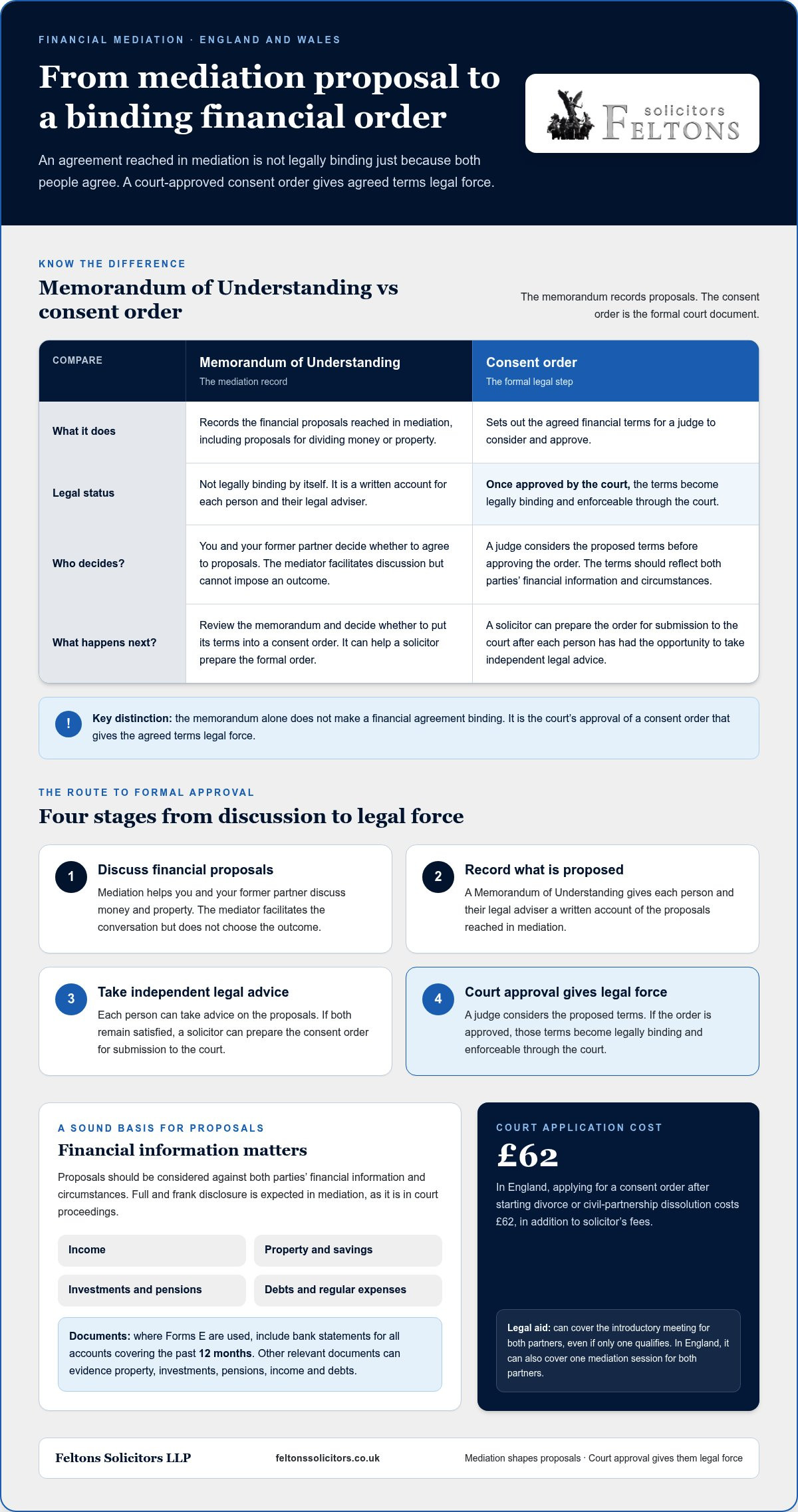
An agreement reached in mediation does not become legally binding simply because both people consent to it. In England and Wales, the formal legal step is a court-approved consent order.
Making agreements legally binding
A consent order sets out agreed financial terms for a judge to approve. Once approved, the terms become legally binding and enforceable through the court. This matters if either person later fails to meet an obligation, such as transferring property or paying maintenance. Before approving the order, the judge considers the proposed terms, which should reflect the parties’ financial information and circumstances.
After mediation, each person can take the proposals for independent legal advice. If both remain satisfied, a solicitor can prepare the consent order for submission to the court. In England, applying for a consent order after starting divorce or civil-partnership dissolution costs £62, in addition to solicitor’s fees. A financial agreement that has not been formalised and approved may not be legally binding.
Memorandums of understanding and consent orders
A Memorandum of Understanding records the financial proposals reached in mediation, but it is not itself a legally binding consent order. It gives each person and their legal adviser a written account of the agreement, including proposals for dividing money or property. That record can help a solicitor prepare the formal order, rather than leaving the terms only in discussion notes.
The next step is to review the memorandum and decide whether to put its terms into a consent order. If the judge approves the order, it becomes binding; the memorandum alone does not. If children are part of the wider separation, make clear which arrangements the financial settlement covers.
Mediation costs and court consequences
Legal aid can cover the introductory meeting for both separating partners, even if only one qualifies. In England, it can also cover one mediation session for both partners.
Refusing or leaving mediation can have cost consequences if the dispute later reaches court. A judge may order a party who withdraws to pay the other person’s legal costs if this would avoid unfairly disadvantaging someone willing to mediate. This may be relevant when mediation could have resolved the dispute but court proceedings created additional legal expense.
What is financial mediation?
Financial mediation helps separating partners discuss money and property with a neutral mediator. It can address assets, savings, pensions, debts, child support and spousal maintenance, but the mediator cannot impose an outcome or advise either partner.
Mediation information assessment meetings
A Mediation Information and Assessment Meeting (MIAM) is an initial meeting to explain mediation and assess whether it is suitable. The mediator considers each partner’s circumstances, including whether they can take part safely and communicate about the issues.
In England and Wales, applicants seeking a court decision on finances generally need to attend a MIAM first, unless an exception applies. The meeting helps you consider whether mediation could address the dispute before court proceedings begin. If someone decides not to mediate after the assessment, a mediator’s certificate is expected before proceedings start.
Mediation may be unsuitable or unsafe where there has been domestic abuse. It is voluntary, so either partner can withdraw, and unresolved issues may still need a court decision.
Financial issues mediation can address
Sessions can cover the division of property, savings, investments and other assets, as well as responsibility for debts and liabilities. Partners can also discuss pensions, spousal maintenance and child support. For example, they might consider whether one person keeps the family home while the other receives a different asset.
Income and financial commitments help shape practical proposals. The mediator facilitates negotiation but does not decide whether a proposed division is fair or require either partner to accept it. The Child Maintenance Service usually calculates child maintenance, although this does not apply in every case.
Independent legal advice can help you understand the implications of proposals before deciding whether to agree. If you need support with the legal position around a settlement, advice on financial arrangements can help you consider the next steps.
Financial disclosure
Financial disclosure sets out each person’s finances, including income, assets, debts and expenses. If someone hides assets or refuses to disclose information, the mediator may end mediation, leaving the parties without a reliable basis for agreement.
Disclosure before mediation
Before mediation, each person should gather a clear picture of their finances to support informed discussions. This includes income, property, savings, investments, pensions, debts and regular expenses. Preparing this information early can reveal missing details before sessions begin.
Full and frank financial disclosure is expected in mediation, as it is in court proceedings. It matters because a proposal about the family home, for example, cannot be considered fairly without understanding the wider assets and liabilities. A family law adviser can explain what information is relevant to your situation.
Financial documentation
Documents support the figures each person provides, helping both parties understand the financial position behind a proposal. Form E is the standard financial statement used in the court system; mediation participants may be asked to complete its factual and financial sections.
Where Forms E are used, include bank statements for all accounts covering the past 12 months. Other relevant documents can evidence property, investments, pensions, income and debts. Keeping records organised makes it easier to explain a figure, such as a loan balance, during discussions.
Disclosure during mediation
At the first mediation session, the mediator reviews both Forms E with the participants and identifies any gaps requiring more information. The mediator can list documents needed to verify figures and set a deadline for providing outstanding records before the next meeting.
Even if one person believes a document is unnecessary, the mediator may still require relevant financial information. If disclosure remains incomplete, the mediator may end the process rather than let discussions proceed on an unreliable picture.
Disclosure and reaching agreement
Complete disclosure gives both people a shared financial picture from which to consider proposals. It helps them compare options, such as keeping property in return for other assets, and assess how debts or pension arrangements affect the overall settlement.
A mediator may not consider disclosure full and frank, even if both people seem ready to agree. Without sufficient information, either person may misunderstand the terms or their financial effect. A lawyer can review the figures and proposed terms before the parties decide whether to agree.
Mediating divorce financial disputes instead of going to court
Mediation gives separating parties a private way to discuss financial proposals and retain control over any agreement. Court proceedings put unresolved issues before a judge to decide.
Mediation, solicitor negotiation and court
In financial mediation, a neutral mediator helps both parties negotiate. Solicitor negotiation takes place through each person’s legal adviser. Neither the mediator nor the solicitors decide the outcome, unlike a judge. This distinction matters if you want to shape arrangements around your separation, property and other financial priorities.
Mediation is voluntary and confidential, and either person can withdraw. Solicitor negotiation may suit parties who prefer legal representatives to handle discussions. If agreement remains out of reach, a court can decide the disputed issues. Contested financial proceedings can take months or even years, so the route affects both the process and who makes the final decision.
Whatever route you consider, independent legal advice can help you understand proposals before accepting them. Mediation can help identify practical options, but it does not replace advice about your legal position.
Finding a family mediator
Look for a family mediator regulated by the Family Mediation Council, which sets standards for family mediation. A mediator experienced in family law and financial disputes can help keep discussions focused on property, pensions and liabilities.
The mediator assesses whether the process is suitable for both people. Mediation may be inappropriate or unsafe where domestic abuse affects someone’s ability to take part freely. Sessions can also take place online, so the parties do not have to be in the same room.
Before deciding, consider whether you and your former partner can share information and discuss options with the mediator. If you want legal advice about your position or the available routes, discuss your financial arrangements.
Feltons Solicitors LLP: Divorce and Financial Arrangements
Feltons Solicitors LLP provides support with Divorce and Financial Arrangements for people considering their financial position during separation. Once mediation has clarified possible terms, legal advice can help you understand the proposals, consider their implications and decide what formal steps may be needed.
This support can help if you have reached an agreement and need advice on putting the financial terms into a consent order, or if some issues remain unresolved. A solicitor can explain how the proposed arrangements relate to your circumstances and what options are available, without taking the mediator’s role.
For advice about your divorce and financial arrangements, contact Feltons Solicitors LLP.
Take a considered next step
Choosing divorce mediation for financial disputes is part of a wider decision about how to resolve financial matters after separation. Before taking the next step, consider the outcome that matters most to you, which questions remain unanswered and whether you need advice before agreeing to proposals. Clear priorities can help make discussions more focused.
Consider how a proposed arrangement may affect your plans beyond the immediate settlement. For example, decisions involving a home or other assets may need to be weighed against your future financial commitments. Independent legal advice can help you understand the implications and decide what action is appropriate for your circumstances.
Feltons Solicitors LLP offers advice on Divorce and Financial Arrangements. Contact Feltons Solicitors LLP for advice about your next step. A well-informed decision can help you move forward with greater clarity.
Frequently Asked Questions
Can I mediate online?
Yes, family mediation can take place online, including through platforms such as MS Teams and Zoom. You can join from separate locations, which may help if travelling or meeting in person is difficult. Before the first online session, arrange a private space, test your connection and keep relevant financial documents accessible. The mediator can explain how the meetings will be organised.
How does mediation work?
Mediation gives separating partners a structured setting to identify issues, share proposals and discuss possible solutions with a neutral mediator. Sessions commonly last one to two hours, and reaching a full financial agreement may involve three to five sessions. The mediator keeps discussions focused, but each person decides whether to accept a proposal. You can seek independent legal advice during the process.
How does financial divorce mediation work in England and Wales?
In England and Wales, divorce mediation for financial disputes generally starts with a MIAM, where a mediator assesses suitability and explains the process. If mediation proceeds, both people discuss their finances and the issues they want to resolve. The mediator can help explore settlement options and summarise proposals for legal advisers. Any financial agreement needs the appropriate formal steps to become binding.
What are the steps to start financial mediation after separation?
Start by arranging a Mediation Information and Assessment Meeting, or MIAM, to discuss whether mediation is suitable. If both people are willing to proceed, organise the financial information relevant to your situation and attend sessions to discuss priorities and possible arrangements. You can take legal advice as proposals develop. If you reach agreement, ask a legal adviser about formalising its terms.
Is mediation required before applying to court for a financial order in the UK?
In England and Wales, applicants generally need to attend a MIAM before applying to court for a decision about finances, unless an exception applies. The meeting assesses whether mediation is appropriate; attending does not mean you must continue. Requirements differ across the UK, so do not assume the England and Wales process applies in Scotland or Northern Ireland.
How are pensions, property, savings and debts handled in divorce mediation?
These matters are considered as part of each person’s overall financial position. For example, a proposal involving the family home can be weighed alongside its mortgage, savings, pension interests and outstanding debts. The parties can explore different ways to divide assets or manage liabilities, using relevant information to inform their discussions. A mediator facilitates the conversation; independent legal or financial advice can help explain complex options.