

Divorce mediation for financial disputes: how it works

Divorce mediation for financial disputes: how it works

In divorce mediation for financial disputes, separating couples can work towards an agreement about money and property without asking a court to decide every issue. But mediation alone does not make an agreement legally binding. In England and Wales, the court must approve a consent order to give the agreed terms legal force. Mediation helps you shape proposals; the court provides formal approval.

It is understandable to want clarity about finances while avoiding the time, cost and pressure that contested court proceedings can bring. Mediation provides a structured way to discuss the issues, but it depends on both people sharing financial information and taking part in the discussions.

This article explains what financial mediation involves, how disclosure supports informed decisions and what happens when you reach agreement. It also compares mediation with court proceedings, explains when an agreement becomes binding and outlines the role of legal advice.

Key Takeaways

  • A MIAM helps assess whether mediation is suitable and is generally part of the route to court for a financial dispute, subject to exceptions.
  • Prepare a clear picture of income, assets, pensions, debts and expenses so discussions can focus on informed options.
  • A mediator facilitates discussion but doesn’t choose the outcome; you and your former partner retain control over whether to agree.
  • Learn how Feltons Solicitors LLP’s Divorce and Financial Arrangements service can help you consider the legal steps that follow mediation.

Are financial agreements legally binding?

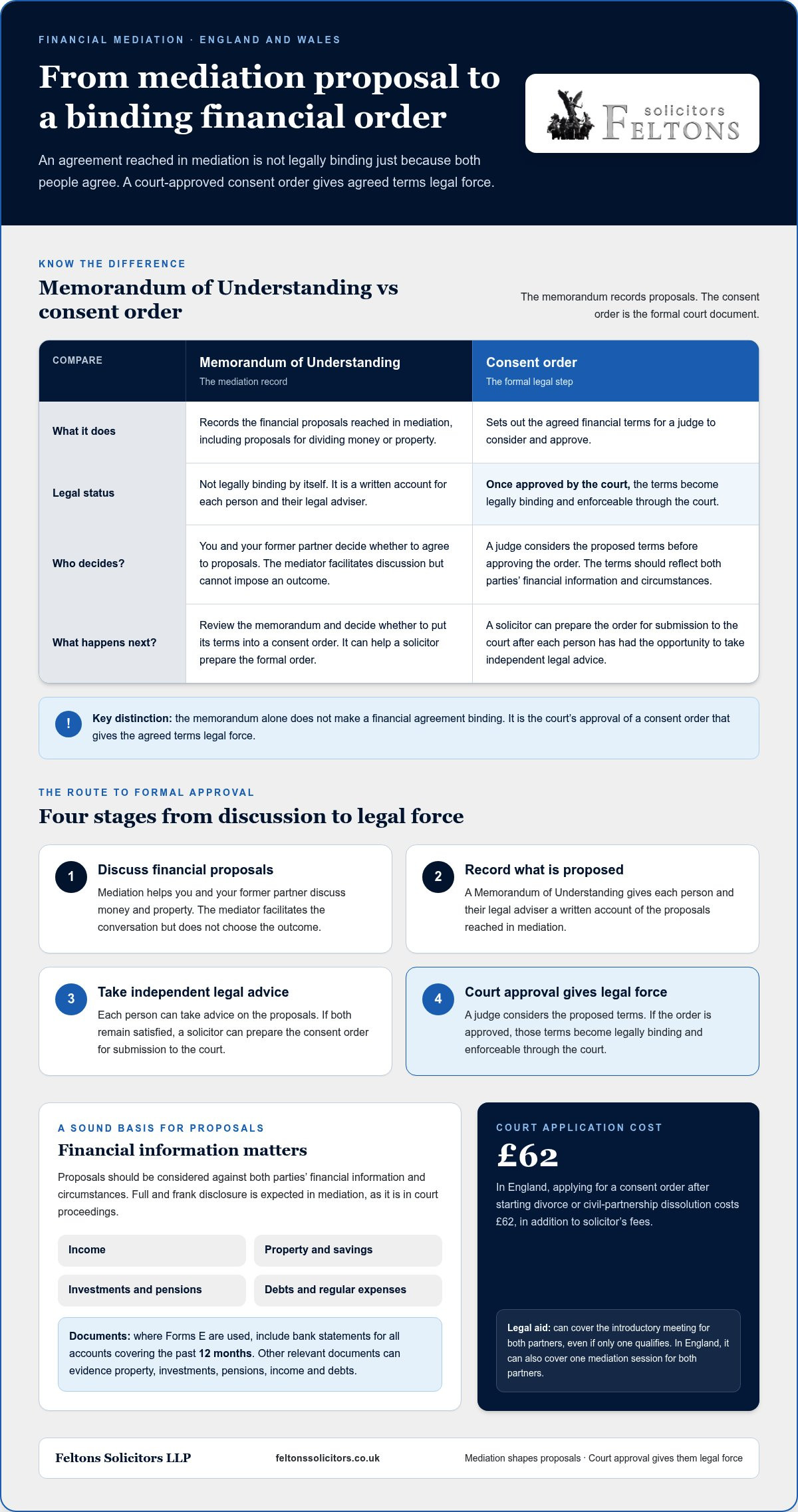
An agreement reached in mediation does not become legally binding simply because both people consent to it. In England and Wales, the formal legal step is a court-approved consent order.

Making agreements legally binding

A consent order sets out agreed financial terms for a judge to approve. Once approved, the terms become legally binding and enforceable through the court. This matters if either person later fails to meet an obligation, such as transferring property or paying maintenance. Before approving the order, the judge considers the proposed terms, which should reflect the parties’ financial information and circumstances.

After mediation, each person can take the proposals for independent legal advice. If both remain satisfied, a solicitor can prepare the consent order for submission to the court. In England, applying for a consent order after starting divorce or civil-partnership dissolution costs £62, in addition to solicitor’s fees. A financial agreement that has not been formalised and approved may not be legally binding.

Memorandums of understanding and consent orders

A Memorandum of Understanding records the financial proposals reached in mediation, but it is not itself a legally binding consent order. It gives each person and their legal adviser a written account of the agreement, including proposals for dividing money or property. That record can help a solicitor prepare the formal order, rather than leaving the terms only in discussion notes.

The next step is to review the memorandum and decide whether to put its terms into a consent order. If the judge approves the order, it becomes binding; the memorandum alone does not. If children are part of the wider separation, make clear which arrangements the financial settlement covers.

Mediation costs and court consequences

Legal aid can cover the introductory meeting for both separating partners, even if only one qualifies. In England, it can also cover one mediation session for both partners.

Refusing or leaving mediation can have cost consequences if the dispute later reaches court. A judge may order a party who withdraws to pay the other person’s legal costs if this would avoid unfairly disadvantaging someone willing to mediate. This may be relevant when mediation could have resolved the dispute but court proceedings created additional legal expense.

What is financial mediation?

Financial mediation helps separating partners discuss money and property with a neutral mediator. It can address assets, savings, pensions, debts, child support and spousal maintenance, but the mediator cannot impose an outcome or advise either partner.

Mediation information assessment meetings

A Mediation Information and Assessment Meeting (MIAM) is an initial meeting to explain mediation and assess whether it is suitable. The mediator considers each partner’s circumstances, including whether they can take part safely and communicate about the issues.

In England and Wales, applicants seeking a court decision on finances generally need to attend a MIAM first, unless an exception applies. The meeting helps you consider whether mediation could address the dispute before court proceedings begin. If someone decides not to mediate after the assessment, a mediator’s certificate is expected before proceedings start.

Mediation may be unsuitable or unsafe where there has been domestic abuse. It is voluntary, so either partner can withdraw, and unresolved issues may still need a court decision.

Financial issues mediation can address

Sessions can cover the division of property, savings, investments and other assets, as well as responsibility for debts and liabilities. Partners can also discuss pensions, spousal maintenance and child support. For example, they might consider whether one person keeps the family home while the other receives a different asset.

Income and financial commitments help shape practical proposals. The mediator facilitates negotiation but does not decide whether a proposed division is fair or require either partner to accept it. The Child Maintenance Service usually calculates child maintenance, although this does not apply in every case.

Independent legal advice can help you understand the implications of proposals before deciding whether to agree. If you need support with the legal position around a settlement, advice on financial arrangements can help you consider the next steps.
Divorce mediation for financial disputes: how it works

Financial disclosure

Financial disclosure sets out each person’s finances, including income, assets, debts and expenses. If someone hides assets or refuses to disclose information, the mediator may end mediation, leaving the parties without a reliable basis for agreement.

Disclosure before mediation

Before mediation, each person should gather a clear picture of their finances to support informed discussions. This includes income, property, savings, investments, pensions, debts and regular expenses. Preparing this information early can reveal missing details before sessions begin.

Full and frank financial disclosure is expected in mediation, as it is in court proceedings. It matters because a proposal about the family home, for example, cannot be considered fairly without understanding the wider assets and liabilities. A family law adviser can explain what information is relevant to your situation.

Financial documentation

Documents support the figures each person provides, helping both parties understand the financial position behind a proposal. Form E is the standard financial statement used in the court system; mediation participants may be asked to complete its factual and financial sections.

Where Forms E are used, include bank statements for all accounts covering the past 12 months. Other relevant documents can evidence property, investments, pensions, income and debts. Keeping records organised makes it easier to explain a figure, such as a loan balance, during discussions.

Disclosure during mediation

At the first mediation session, the mediator reviews both Forms E with the participants and identifies any gaps requiring more information. The mediator can list documents needed to verify figures and set a deadline for providing outstanding records before the next meeting.

Even if one person believes a document is unnecessary, the mediator may still require relevant financial information. If disclosure remains incomplete, the mediator may end the process rather than let discussions proceed on an unreliable picture.

Disclosure and reaching agreement

Complete disclosure gives both people a shared financial picture from which to consider proposals. It helps them compare options, such as keeping property in return for other assets, and assess how debts or pension arrangements affect the overall settlement.

A mediator may not consider disclosure full and frank, even if both people seem ready to agree. Without sufficient information, either person may misunderstand the terms or their financial effect. A lawyer can review the figures and proposed terms before the parties decide whether to agree.

Mediating divorce financial disputes instead of going to court

Mediation gives separating parties a private way to discuss financial proposals and retain control over any agreement. Court proceedings put unresolved issues before a judge to decide.

Mediation, solicitor negotiation and court

In financial mediation, a neutral mediator helps both parties negotiate. Solicitor negotiation takes place through each person’s legal adviser. Neither the mediator nor the solicitors decide the outcome, unlike a judge. This distinction matters if you want to shape arrangements around your separation, property and other financial priorities.

Mediation is voluntary and confidential, and either person can withdraw. Solicitor negotiation may suit parties who prefer legal representatives to handle discussions. If agreement remains out of reach, a court can decide the disputed issues. Contested financial proceedings can take months or even years, so the route affects both the process and who makes the final decision.

Whatever route you consider, independent legal advice can help you understand proposals before accepting them. Mediation can help identify practical options, but it does not replace advice about your legal position.

Finding a family mediator

Look for a family mediator regulated by the Family Mediation Council, which sets standards for family mediation. A mediator experienced in family law and financial disputes can help keep discussions focused on property, pensions and liabilities.

The mediator assesses whether the process is suitable for both people. Mediation may be inappropriate or unsafe where domestic abuse affects someone’s ability to take part freely. Sessions can also take place online, so the parties do not have to be in the same room.

Before deciding, consider whether you and your former partner can share information and discuss options with the mediator. If you want legal advice about your position or the available routes, discuss your financial arrangements.

Feltons Solicitors LLP: Divorce and Financial Arrangements

Feltons Solicitors LLP provides support with Divorce and Financial Arrangements for people considering their financial position during separation. Once mediation has clarified possible terms, legal advice can help you understand the proposals, consider their implications and decide what formal steps may be needed.

This support can help if you have reached an agreement and need advice on putting the financial terms into a consent order, or if some issues remain unresolved. A solicitor can explain how the proposed arrangements relate to your circumstances and what options are available, without taking the mediator’s role.

For advice about your divorce and financial arrangements, contact Feltons Solicitors LLP.

Take a considered next step

Choosing divorce mediation for financial disputes is part of a wider decision about how to resolve financial matters after separation. Before taking the next step, consider the outcome that matters most to you, which questions remain unanswered and whether you need advice before agreeing to proposals. Clear priorities can help make discussions more focused.

Consider how a proposed arrangement may affect your plans beyond the immediate settlement. For example, decisions involving a home or other assets may need to be weighed against your future financial commitments. Independent legal advice can help you understand the implications and decide what action is appropriate for your circumstances.

Feltons Solicitors LLP offers advice on Divorce and Financial Arrangements. Contact Feltons Solicitors LLP for advice about your next step. A well-informed decision can help you move forward with greater clarity.

Frequently Asked Questions

Can I mediate online?

Yes, family mediation can take place online, including through platforms such as MS Teams and Zoom. You can join from separate locations, which may help if travelling or meeting in person is difficult. Before the first online session, arrange a private space, test your connection and keep relevant financial documents accessible. The mediator can explain how the meetings will be organised.

How does mediation work?

Mediation gives separating partners a structured setting to identify issues, share proposals and discuss possible solutions with a neutral mediator. Sessions commonly last one to two hours, and reaching a full financial agreement may involve three to five sessions. The mediator keeps discussions focused, but each person decides whether to accept a proposal. You can seek independent legal advice during the process.

How does financial divorce mediation work in England and Wales?

In England and Wales, divorce mediation for financial disputes generally starts with a MIAM, where a mediator assesses suitability and explains the process. If mediation proceeds, both people discuss their finances and the issues they want to resolve. The mediator can help explore settlement options and summarise proposals for legal advisers. Any financial agreement needs the appropriate formal steps to become binding.

What are the steps to start financial mediation after separation?

Start by arranging a Mediation Information and Assessment Meeting, or MIAM, to discuss whether mediation is suitable. If both people are willing to proceed, organise the financial information relevant to your situation and attend sessions to discuss priorities and possible arrangements. You can take legal advice as proposals develop. If you reach agreement, ask a legal adviser about formalising its terms.

Is mediation required before applying to court for a financial order in the UK?

In England and Wales, applicants generally need to attend a MIAM before applying to court for a decision about finances, unless an exception applies. The meeting assesses whether mediation is appropriate; attending does not mean you must continue. Requirements differ across the UK, so do not assume the England and Wales process applies in Scotland or Northern Ireland.

How are pensions, property, savings and debts handled in divorce mediation?

These matters are considered as part of each person’s overall financial position. For example, a proposal involving the family home can be weighed alongside its mortgage, savings, pension interests and outstanding debts. The parties can explore different ways to divide assets or manage liabilities, using relevant information to inform their discussions. A mediator facilitates the conversation; independent legal or financial advice can help explain complex options.

Freezing Orders in Divorce: Protecting Assets in 2026

Freezing Orders in Divorce: Protecting Assets in 2026

Could a court order stop your spouse from moving or selling assets before your financial arrangements are settled, and when is urgent action justified? It’s understandable to want to protect what may form part of a future settlement, particularly if you’re worried that money or property could disappear. A search for “freezing injunctions divorce property assets” often starts with that concern. However, a freezing injunction is an exceptional safeguard for a specific risk of assets being dissipated, not a shortcut to securing a divorce settlement.

This guide explains what a freezing injunction may protect, what it can’t do, and the evidence and legal considerations a court may weigh. It also explains why urgency, proportionality and the possible consequences of an unsuccessful application matter when deciding what to do next. The rules and procedures differ across the UK, so the relevant legal route depends on where your case is being heard. Advice on divorce and financial arrangements can help you assess the facts and consider practical options without escalating matters unnecessarily.

Key Takeaways

  • A freezing injunction may restrict dealings with specified assets to preserve them, but it doesn’t decide ownership or determine the final financial settlement.
  • Concern alone may not be enough. The court considers the particular facts and evidence, including warning signs of possible asset dissipation.
  • Freezing injunctions, disclosure, negotiation and agreed undertakings serve different purposes. The right approach depends on what you need to achieve.
  • Prepare for legal advice by organising relevant records and setting out a clear timeline. Applications without notice carry demanding duties of candour.
  • Where assets may be at risk, consider prompt, tailored advice and weigh whether an urgent protective step or broader financial arrangements advice is the priority.

What is a freezing injunction in divorce, and which assets might it affect?

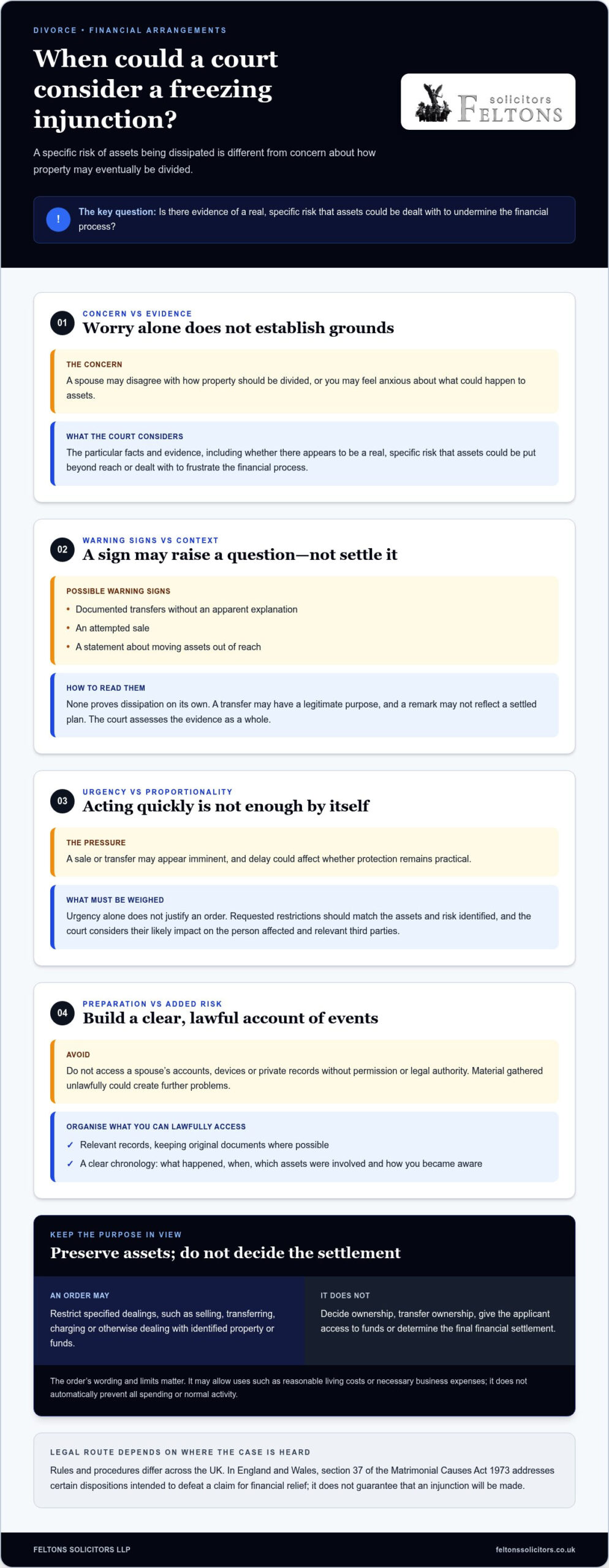
A freezing injunction is a court order that restricts specified dealings with assets, subject to the wording and limits of the order. In a divorce, its purpose is preservation: it may help prevent assets being moved or dealt with in a way that could undermine the financial process. It doesn’t decide who owns an asset or award either spouse a final financial settlement. For a general overview of the purpose of a freezing order, see this background explanation.

The order does not automatically freeze everything a spouse owns or controls. Its reach depends on the terms made by the court, the assets identified and the legal route available in the relevant jurisdiction. The phrase “freezing injunctions divorce property assets” can describe different concerns, each of which needs careful assessment. There is no standard order that applies in every case.

What does a freezing injunction actually prevent?

Restrictions are tailored to the order. They may prohibit selling, transferring, charging or otherwise dealing with specified property or funds. The order may also set out permitted uses, such as reasonable living costs or necessary business expenses, so preservation does not automatically prevent all spending or normal activity. Check the exact wording: an asset or transaction not covered by the order may fall outside its restrictions.

A disagreement about who should ultimately receive a home or investment is not, by itself, the same as a risk that assets will be dissipated. The question is whether there is a sufficiently evidenced risk that assets may be put beyond reach or dealt with to frustrate the financial process. Disputes over fairness or ownership are generally addressed through the wider financial arrangements, not by treating a freezing order as a shortcut to deciding the outcome.

Which property and financial assets could be relevant?

Depending on the circumstances, relevant assets might include a family home, an investment property, money in bank accounts or an interest in a business. The court’s ability to make an effective order can depend on who legally owns or controls an asset, where it is located, and whether another person or organisation has rights in it. An asset held jointly or involving a third party may raise different issues from one controlled solely by a spouse.

A freezing injunction doesn’t transfer ownership, give the applicant access to funds or determine how property will be divided. It is a protective measure, not a final resolution. Advice on divorce and financial arrangements can help assess the evidence, the assets at issue and whether an injunction is a proportionate option in the circumstances.

When might a divorce court consider freezing property or other assets?

A freezing injunction isn’t a routine feature of divorce, and anxiety about what a spouse might do does not, by itself, establish grounds for one. The court considers the particular facts and evidence, including whether there appears to be a real, specific risk that assets could be dealt with to undermine a financial claim. The relevant legal framework and procedure depend on where proceedings are taking place. In England and Wales, Section 37 of the Matrimonial Causes Act 1973 addresses certain dispositions intended to defeat a claim for financial relief. It does not guarantee that an injunction will be made.

A specific risk of assets being dissipated is different from the ordinary concern that a spouse may disagree with how property should eventually be divided. The latter is part of resolving financial arrangements. An injunction is an exceptional protective measure, not a way to gain leverage or secure a preferred share of the assets.

What evidence could support concern about asset dissipation?

Relevant warning signs might include documented transfers without an apparent explanation, an attempted sale, or a statement about moving assets out of reach. None proves dissipation on its own. Context matters: a transfer could have a legitimate purpose, and a remark may not reflect a settled plan. The court assesses the evidence as a whole rather than treating any one sign as automatic entitlement to an order.

To prepare for a legal assessment, organise records you can lawfully access and set out a clear chronology: what happened, when, which assets were involved and how you became aware of it. Keep original documents where possible. Don’t access your spouse’s accounts, devices or private records without permission or legal authority. Material gathered unlawfully could create further problems.

How do urgency and proportionality shape the decision?

Timing may matter if, for example, a sale or transfer appears imminent. A delay could affect whether protection remains practical, but urgency alone doesn’t establish that an order is justified. The restrictions requested should relate to the assets and risk identified, rather than going further than the circumstances warrant.

The court considers the evidence and the likely impact of restrictions on the person affected, as well as relevant interests of third parties. The limits of an order may matter if it could disrupt ordinary financial commitments or business activity. A focused review of the evidence and wider financial arrangements can help identify proportionate options. If you’re concerned about a specific transaction, read about divorce and financial arrangements advice.

Freezing injunctions versus other ways to protect divorce assets

A freezing injunction is one possible protective step, but it serves a different purpose from identifying assets or reaching agreement on how they should be divided. The right route depends on the facts, the level of urgency, the available evidence and the practical effect of the proposed step. An overview of freezing injunctions explains the remedy’s general scope, but individual circumstances need careful assessment.

Approach Main purpose Practical distinction
Freezing injunction Restrict specified dealings with assets where urgent protection may be justified. A court order with terms and effects shaped by the circumstances.
Financial disclosure Build a clearer picture of assets, liabilities and relevant transactions. Provides information; it doesn’t itself prevent someone dealing with an asset.
Negotiation Explore agreed arrangements for assets and financial needs. Depends on meaningful engagement and agreement between the parties.
Undertaking Record a formal promise to act, or not act, in a specified way. It is a promise, not the same thing as a court-imposed freeze.

When might disclosure or an undertaking be considered instead?

Financial disclosure can help establish which property, accounts, business interests, liabilities and transactions need to be considered. It may clarify an incomplete picture and support informed discussions, but it isn’t an asset-freezing measure. For more on that process, read about financial disclosure in divorce.

Where appropriate, an undertaking may provide a formal commitment about particular conduct. Its suitability depends on the circumstances and the wording proposed. Neither disclosure nor an undertaking should be treated as a substitute for urgent legal assessment if there is evidence that an asset may soon be transferred or sold. Equally, a suspected risk does not automatically mean an injunction is the right response.

How does an injunction fit into financial arrangements?

Interim protection and the final financial settlement do different jobs. An injunction may address a specific risk while proceedings continue; the broader process considers the parties’ overall financial position and how arrangements should be resolved. It doesn’t determine the final division or guarantee a particular settlement. The phrase freezing injunctions divorce property assets therefore describes only one part of a wider financial picture.

Consider the wider divorce and financial arrangements process alongside any immediate asset concern. A considered approach weighs the evidence and practical impact of each option rather than treating a court application as the default response.

Freezing Orders in Divorce: Protecting Assets in 2026

How to prepare for advice about a freezing injunction

A clear, organised account of your concern helps a solicitor assess whether urgent protection may be appropriate. Identify the action you fear, gather records you can lawfully access, set out key events in date order, and then obtain legal advice. Freezing injunctions divorce property assets is a complex issue, so distinguish what you know from what you suspect rather than presenting concerns as established facts.

What information should you organise before taking advice?

Bring together information that may help identify the asset, the risk and its timing. This could include:

  • Details of the property, accounts, business interests or other assets involved, including known ownership or control.
  • Relevant transaction records, correspondence, sale particulars or other documents you can lawfully access.
  • A chronology of key dates, such as when you learned of a proposed transfer or sale and any stated deadline.
  • A short explanation of the specific action you fear and why you believe it may happen soon.

Label first-hand evidence separately from assumptions or information relayed by someone else. This helps keep the legal assessment accurate and balanced.

What risks and responsibilities should an applicant understand?

An application made without notice to the other party may be considered where giving notice could undermine its purpose. It carries demanding duties of candour: the applicant must give the court a fair and complete account, including relevant points that may weigh against the order. In an urgent application, balanced disclosure matters because the court may initially hear only one party’s account. The applicable procedure and current requirements should be assessed for the court and jurisdiction involved.

Inaccurate or incomplete evidence can seriously affect the application and may have consequences for the applicant. Depending on the circumstances, the court may require a cross-undertaking in damages, a promise to compensate for losses if the order is later found to have been wrongly made. An unsuccessful application may also carry costs consequences. Neither result is automatic, but both should be considered before proceeding.

The wording of an order determines what is restricted and which exceptions apply. Read and follow it carefully: assumptions about what is permitted can create further difficulty. A tailored assessment of the evidence, urgency and possible impact can help you understand the available options. For background, see advice on divorce asset protection.

Choosing the next step when divorce property assets may be at risk

The right response depends on what appears to be happening, how soon it may happen and what the available evidence shows. If a sale or transfer seems imminent, prompt legal assessment can help establish whether urgent protection should be considered and what other options may be proportionate. If there’s no specific sign of assets being moved or dissipated, broader advice on disclosure and the overall financial arrangements may be the more useful priority.

Freezing injunctions divorce property assets concerns are fact-sensitive. An injunction may restrict dealings with specified assets, but it doesn’t decide ownership or guarantee a particular final settlement. The applicable procedure also depends on where the case is being heard, as the law and court processes differ across the UK. Advice should be specific to the relevant jurisdiction.

What should you do if a sale or transfer seems imminent?

Set out the facts as clearly as you can and seek a prompt legal assessment. Record relevant communications and events with their dates, keep copies of documents you can lawfully access, and note any known deadline or proposed transaction. A concise chronology can help distinguish a concrete, time-sensitive concern from uncertainty or assumption.

Avoid confronting your spouse in a way that could intensify the dispute or taking matters into your own hands, such as attempting to access private accounts or interfere with a transaction. Those steps may create further problems without providing reliable protection. Legal advice can help assess the evidence and available options calmly.

How can legal advice put the asset concern in context?

A solicitor can consider the specific concern alongside available disclosure, ownership information and the wider financial arrangements. This helps place any urgent risk within the full picture, rather than treating an injunction as the answer to every disagreement about property. For related guidance, read Protecting Your Assets During a Divorce Settlement.

Feltons Solicitors LLP advises on divorce and financial arrangements, including assessing the facts, evidence and proportionate options where assets may be at risk. A focused discussion can help clarify whether the priority is urgent protective advice, a fuller understanding of the finances, or both.

Discuss your divorce and financial arrangements

Take a considered next step to protect your financial position

A freezing injunction may help address a specific, evidenced risk, but it isn’t a routine part of divorce or a guarantee of a particular settlement. The right response depends on the facts, timing and impact of any proposed restrictions. Organising relevant records and getting advice can help clarify whether urgent protection or broader financial arrangements should take priority.

Concerns about freezing injunctions divorce property assets are best considered in the context of the full financial picture. Feltons Solicitors LLP advises on divorce and financial arrangements and handles complex litigation and dispute resolution, with attention to the evidence and proportionate options available.

If you’re concerned about assets or need to understand your next steps, discuss your divorce and financial arrangements. A clear, informed approach can help you move forward with greater confidence.

Frequently Asked Questions

Can I get a freezing injunction against my spouse during divorce?

Possibly, but a court order isn’t automatic just because you’re divorcing or worried about your spouse’s plans. The court considers the evidence, the specific risk to assets and whether the proposed restrictions are appropriate. The legal route depends on where proceedings are taking place, as the rules differ across the UK. Tailored legal advice can help assess the facts and whether an injunction or another step merits consideration.

What evidence is needed for a freezing injunction in divorce?

There’s no single checklist that guarantees an order. Relevant material may include records of transfers, evidence of an attempted sale, or communications suggesting assets may be moved, considered in their full context. Organise documents you can lawfully access and make a dated chronology, separating what you witnessed from assumptions or information received from others. For searches such as “freezing injunctions divorce property assets”, the key point is that evidence must support the specific concern.

Can a freezing injunction stop my spouse selling the family home?

It may restrict a sale if the order specifically covers the home and the court considers that protection appropriate. The order’s wording determines which dealings are restricted, and ownership, other parties’ rights and the relevant legal process may affect the position. It doesn’t automatically apply to every property or give you control of the home. If a sale appears imminent, organise the relevant records promptly and seek legal advice about the evidence and options.

Does a freezing injunction mean I will receive the frozen assets?

No. A freezing injunction is intended to preserve specified assets, not transfer them to the applicant or decide who owns them. It doesn’t determine the final financial settlement or guarantee that you’ll receive any particular asset or share. Those questions are addressed through the wider divorce financial arrangements process. The order’s precise terms matter, and a court may set out permitted dealings or exceptions, so don’t assume that frozen funds are available for your use.

How quickly can a court make a freezing injunction?

There’s no fixed timeframe that applies in every case. Timing can depend on the urgency, the evidence, the court’s procedures and whether the application is made with or without notice to the other party. An application without notice may carry demanding duties to give the court a fair and complete account. If a transaction seems imminent, organise the key dates and records and seek prompt legal advice. The applicable procedure varies across the UK.

What happens if someone breaches a freezing injunction?

A breach can have serious consequences, but the response depends on the order’s wording and the circumstances. A court may be asked to address non-compliance, and breach of an injunction can raise contempt of court issues. Keep a dated record of what you believe happened and preserve relevant information you can lawfully access. Don’t try to enforce the order yourself or assume conduct is a breach without checking the terms and obtaining legal advice.

Is a freezing injunction the same as a financial settlement order?

No. A freezing injunction is a protective measure that may restrict dealings with specified assets while the case continues. A financial settlement order deals with how financial arrangements are resolved, rather than simply preserving assets. One doesn’t automatically produce the other: a freezing order doesn’t decide the final division, and a settlement addresses the wider financial picture. The appropriate legal process depends on the facts and jurisdiction, so consider urgent asset concerns alongside broader divorce advice.