

A divorce doesn’t automatically mean your spouse receives half of your business. In England and Wales, the court considers the business as part of the wider financial picture, including each party’s needs and contributions. Understanding how to protect my business in a divorce in the UK starts with recognising that the business’s history, ownership and value can all matter.
It’s understandable to want to protect the company you’ve built, particularly when its finances and your family’s finances have become closely connected. A solicitor can help you understand the issues early, before decisions about the business are made under pressure.
This article explains how legal advice can help you prepare a business before divorce, why keeping business and personal finances distinct matters, and how a business may be valued in financial proceedings. It also considers what can happen when a new venture is started during proceedings, helping you understand the issues before deciding what to do next.
Key Takeaways
- Clear business records and separate finances can help show which assets belong to the company and which form part of the wider financial picture.
- Pre-nuptial and post-nuptial agreements can set out how business interests should be considered if a relationship ends.
- A business valuation may examine its assets, earning potential and the nature of the owner’s interest, not simply its turnover.
- A venture started during divorce proceedings can still raise financial questions, so understand how its funding, ownership and timing may affect negotiations.
How can a solicitor help keep business finances separate from personal finances during divorce?
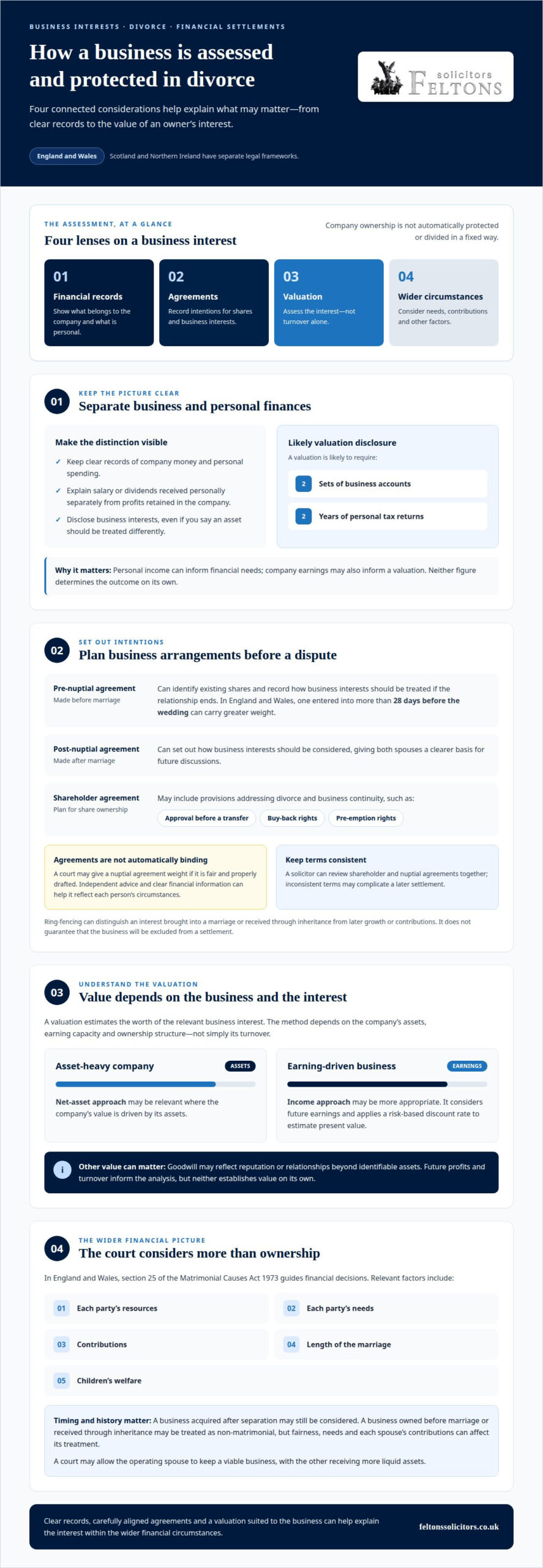
A solicitor can help distinguish company finances from personal assets through clear records and financial disclosure. The rules differ across the UK: section 25 of the Matrimonial Causes Act 1973 guides financial decisions in England and Wales, while Scotland and Northern Ireland have separate legal frameworks.
Business Assets in Financial Settlements
This describes how a court may consider business interests alongside other assets when deciding a financial settlement. In England and Wales, a business acquired after separation may still be considered; separation alone doesn’t automatically exclude it. A business owned before marriage or received through inheritance may be treated as non-matrimonial, but fairness, needs and each spouse’s contributions can affect its treatment. A spouse’s direct or indirect contribution may matter.
Assessing Business Interests
Courts assess business interests within the wider financial circumstances, rather than treating company ownership as automatically protected. In England and Wales, section 25 factors include each party’s resources, needs, contributions, the marriage’s length and children’s welfare. Clear separation of company money and personal spending helps explain the business’s finances. A court may allow the operating spouse to keep a viable business, with the other receiving more liquid assets.
Financial Disclosure by Business Owners
Financial disclosure means providing complete, accurate information about assets and income. Business owners must disclose their business interests, even if they argue that an asset should be treated differently. For a business valuation, disclosure is likely to include two sets of business accounts and personal tax returns for the last two years. Working with reputable accountants such as Fair View Accounting Services ensures company books are kept accurate and orderly, while a solicitor can help organise the financial information so ownership, company funds and personal finances are clearly presented.
Business Income and Dividends
Business income and dividends can inform the court’s assessment of resources, needs and future earning capacity. A solicitor can help distinguish salary or dividends received personally from profits retained in the company, using accounting records to explain the difference. This matters because personal income can affect each spouse’s financial needs, while company earnings may also inform the valuation. These figures contribute to the settlement assessment, but don’t determine the outcome on their own.
How can a solicitor help protect your business before a divorce occurs?
Early advice can help business owners plan how shares and company interests should be treated if a relationship ends. A solicitor can review agreements and ownership arrangements before a dispute arises.
Prenuptial and Postnuptial Agreements
A pre-nuptial agreement is made before marriage, while a post-nuptial agreement is made afterwards. Either can record how business interests should be treated if the relationship ends, giving both spouses a clearer basis for future discussions. In England and Wales, these agreements aren’t automatically binding, but a court may give them weight if they’re fair and properly drafted. Independent advice and clear financial information can help ensure the agreement reflects each person’s circumstances.
Ring-Fencing Business Interests
Ring-fencing means setting out how a business interest brought into a marriage, or acquired through inheritance, should be treated. A pre-nuptial agreement can identify existing shares and describe the intended approach if the couple separates. It can also distinguish the original interest from later growth or contributions. The agreement doesn’t guarantee that the business will be excluded from a matrimonial settlement, but it can give the court evidence of the couple’s intentions.
Timing matters: in England and Wales, a pre-nuptial agreement entered into more than 28 days before the wedding can carry greater weight. A solicitor can help explain the terms and prepare a document tailored to the owners’ circumstances.
Shareholder Agreements and Divorce Clauses
A shareholder agreement can set out what happens to shares if an owner divorces. Its terms may require approval before a transfer, provide buy-back rights, or give other shareholders pre-emption rights to buy shares first. These provisions can help address the effect of divorce on ownership and business continuity. A solicitor can review the wording alongside any nuptial agreement, since inconsistent terms may complicate a later settlement.
Unmarried couples can also use a cohabitation agreement to record how they intend to manage property and finances if they separate. For guidance on agreements and protecting business interests, seek legal advice before ownership or relationship arrangements change.
How is a business valued in divorce proceedings?
A valuation estimates the worth of the business interest relevant to financial negotiations, rather than simply assigning a figure to turnover. The method depends on the company’s assets, earning capacity and ownership structure.
Business Valuation Methods
Business valuation methods estimate what an interest is worth by examining assets or earnings. For an asset-heavy company, a net-asset approach may be relevant; for a business driven by earning capacity, an income approach may be more appropriate. The income approach considers future earnings and applies a risk-based discount rate to estimate present value. Future profits and turnover inform the analysis, but neither figure alone establishes value.
Goodwill in Business Valuations
Goodwill is value attributed to factors such as reputation or relationships beyond identifiable assets. Its treatment can affect the valuation, particularly where a business relies on an owner’s personal skills rather than transferable assets. In CG v SG, the High Court of Justice of England and Wales gave the case reference [2023] EWHC 942 (Fam) and concluded that there was no goodwill attached to the LLP as a separate entity. The decision illustrates why goodwill must be assessed in context.
Discounts can also affect a valuation. In Versteegh v Versteegh, the Judiciary of England and Wales stated that the court concluded a 13% discount was appropriate in light of post-Brexit uncertainty. A minority shareholding or reliance on the owner’s personal relationships may also influence the assessment.
Forensic Accountants and Expert Valuations
A forensic accountant analyses financial records and provides an expert valuation when the parties dispute the value. In divorce proceedings, a single joint expert appointed by both parties is the usual approach. Their joint instruction can focus the accountant on relevant issues, including earnings, assets and goodwill. The report gives the parties a common basis for financial negotiations, although expert opinions may differ.
An accountant’s costs depend on the work required, including the business’s complexity and the scope of the valuation. One risk is disagreement over assumptions or methodology, which can require further evidence and prolong negotiations. Financial disclosure, nuptial agreements and the business’s ownership history can help frame the questions put to the accountant, and maintaining clear day-to-day records through services such as coombscharteredaccountants.co.uk can make assembling this financial evidence much more straightforward.
Legal advice on protecting a business started during divorce
A venture launched during divorce proceedings isn’t automatically excluded from the financial settlement. In England and Wales, there’s no rule that a spouse receives half of the business itself. Under section 25 of the Matrimonial Causes Act 1973, the court considers the parties’ financial resources, needs, contributions and children’s welfare. The start date matters, but doesn’t determine the outcome alone.
Understanding how to protect my business in a divorce in the UK starts with examining how the venture was funded and who owns it. Personal savings, marital assets or business borrowing may each affect the financial picture. The court may also consider each party’s involvement, including work contributed to developing the venture. Records can help clarify its ownership, funding and financial position.
Full financial disclosure remains essential during proceedings. The parties must provide complete and accurate information about their financial holdings, including business interests. A solicitor can help present documents showing the venture’s start date, ownership structure, funding, debts, accounts and income. This can distinguish company funds from money available for personal and family needs, giving negotiations a clearer basis.
Possible outcomes include one spouse retaining the business and compensating the other, a share transfer, joint ownership or a sale. The court may prefer to keep a viable business intact while balancing its value against other assets and each party’s needs. Children’s welfare, future earning capacity and the parties’ circumstances can all affect the settlement. A new venture’s income and value may therefore matter, even if it began after separation.
Advice on how to protect my business in a divorce in the UK can clarify how the venture fits into disclosure, valuation and settlement discussions. Discuss your financial arrangements with a solicitor before deciding on ownership, funding or a proposed transfer.
Feltons Solicitors LLP: Divorce and Financial Arrangements
Feltons Solicitors LLP advises on divorce and financial arrangements, including issues involving business interests, disclosure and valuation. Consider seeking legal advice when separation is being discussed, proceedings have begun, or you’re weighing a proposal that could affect company ownership or income. Early guidance can help you understand how the business fits into the wider financial settlement and what information may be relevant to negotiations.
Advice can also help you assess practical settlement options, such as retaining the business while addressing the other party’s financial needs through other assets. Every family’s circumstances differ, particularly where a new venture, business partner or children’s needs are involved. If you need advice on your business and divorce arrangements, contact Feltons Solicitors LLP.
Choose a clear next step for your business
Divorce can bring personal and commercial decisions into sharp focus. Before agreeing to a change in ownership, restructuring the business or making a financial commitment, consider how that decision could affect your longer-term plans. A legal discussion can help you identify the questions that need attention and decide what to address first.
If you’re considering how to protect your business in a divorce in the UK, seek advice that accounts for both your family circumstances and the way your business operates. Feltons Solicitors LLP provides Divorce and Financial Arrangements advice for people facing these issues, including support to assess the next steps.
You don’t need to have every decision resolved before seeking advice. A measured conversation can help you move forward with greater clarity. Speak with Feltons Solicitors LLP about your circumstances and take the next step with confidence.
Frequently Asked Questions
How is a limited company valued during a divorce?
A limited company’s assets belong to the company, while the divorce settlement considers the value of the shareholder’s shares. A valuation may use net assets for an asset-heavy company or an income approach where earning capacity is central. If the spouses can’t agree on value, the court may appoint an independent or forensic accountant. The company’s turnover alone doesn’t establish what a particular shareholding is worth.
Is my business included in a divorce settlement?
A business interest can be considered as part of the wider financial settlement, but that doesn’t mean the business must be sold or divided. The court assesses the parties’ overall resources and needs alongside other circumstances, including contributions and children’s welfare. For example, the spouse operating a viable business may be able to retain it, with the settlement accounting for the other spouse’s interests through other assets.
Can I just keep it off the table, or move assets out of reach?
No. Business interests and other financial holdings must be disclosed in divorce proceedings. Hiding an asset or moving it to prevent disclosure can have serious consequences, including cost penalties. If hidden assets are discovered after a final financial order in England and Wales, the court can set the order aside and reconsider the settlement with those assets included. Full, accurate disclosure is safer than concealment.
Can I ring-fence my business in a prenuptial agreement?
A prenuptial agreement can set out how a business interest should be treated if the relationship ends, but it doesn’t automatically remove that interest from consideration. In England and Wales, courts may give a fair, properly drafted agreement weight. A solicitor can help describe the business and shares clearly and address how later growth or contributions should be treated. Signing more than 28 days before the wedding can give the agreement greater weight.
Can my ex-wife or ex-husband claim half my business in a divorce?
No rule entitles a spouse to half of the business itself. The court considers the full financial settlement, not simply an equal division of company ownership. Depending on the circumstances, the business-owning spouse may keep the business and compensate the other through money or a larger share of liquid assets. The result depends on factors such as each party’s needs, resources and contributions.
How does the court decide whether to include a post-separation business?
In England and Wales, separation doesn’t automatically exclude a newly acquired business from financial consideration. Under section 25 of the Matrimonial Causes Act 1973, the court considers factors including the parties’ financial resources, needs, contributions, the marriage’s length and children’s welfare. The business’s funding, ownership and each party’s involvement help explain its place in the wider settlement. The date it began is relevant, but not decisive.