

What Happens to a Business in Divorce and Who Keeps It

What Happens to a Business in Divorce and Who Keeps It

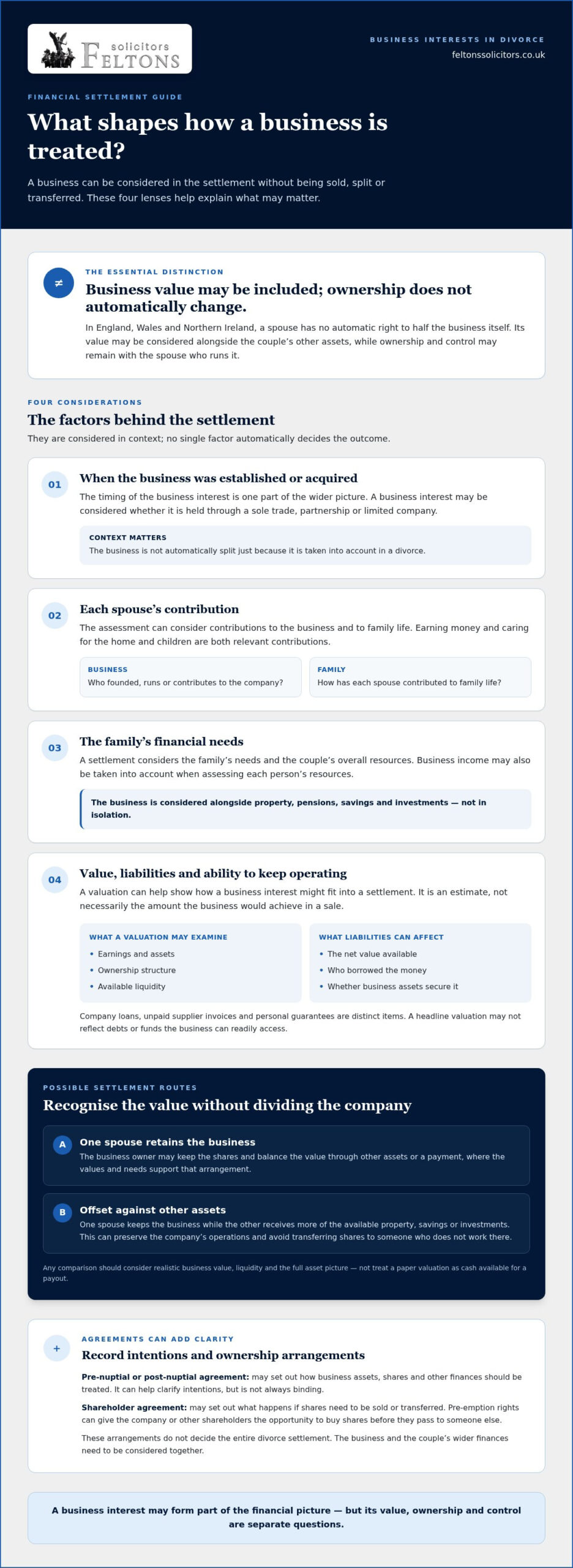
A divorce doesn’t automatically mean a business must be sold or divided. What happens to a business when a couple divorces depends on factors such as when it was established, each spouse’s contribution and the family’s financial needs. The business’s value may be considered in the settlement, while ownership and control may remain with the spouse who runs it.

It’s understandable to worry that a financial claim could disrupt the business you’ve built. Including a business in the settlement doesn’t necessarily mean your spouse will receive shares or take over the company. Depending on the circumstances, its value may instead be balanced against other assets.

This article explains when a business is taken into account, how its value and ownership may be treated, and what can help protect control. It also covers practical ways to address business interests in financial arrangements, so you can understand the issues before deciding what to do next.

Key Takeaways

  • A pre-nuptial or post-nuptial agreement can set out how business assets should be treated, but it isn’t always binding.
  • A spouse isn’t automatically entitled to half of the business; the settlement can reflect its value alongside other assets.
  • When a business is assessed, factors can include when it was established, each spouse’s contributions, the family’s needs and the business’s ability to keep operating.
  • Valuation helps clarify the options, which can include one spouse retaining the business and balancing its value through other assets or a payment.
  • Clear financial records and suitable business agreements can help protect ownership and control if a relationship breaks down.

Can I ringfence my business in a prenuptial agreement?

A nuptial agreement can record how a couple intends to treat business interests if they separate. It may help protect ownership, but it doesn’t guarantee that a court will follow every term.

Nuptial agreements and business protection

A pre-nuptial agreement is made before marriage; a post-nuptial agreement is made during the marriage. Either can set out how business assets, shares and other finances should be divided if the relationship ends.

For example, an agreement could record that one spouse founded and runs a company, then explain how its value should be considered alongside other assets. A nuptial agreement made before separation can help clarify intentions, but it isn’t always binding. Legal advice can help both spouses understand the terms and disclose their finances.

After separation, spouses may need to work through how to divide their finances, including property, pensions, savings and investments. Seeking guidance from independent wealth specialists like Her Financial Planning can help individuals evaluate the broader financial and retirement picture, ensuring a written agreement addresses the business as part of that wider settlement, rather than treating it in isolation.

Shareholder agreements and pre-emption rights

A shareholder agreement sets out arrangements between a company’s shareholders, including what happens if someone needs to sell or transfer shares. It may give the company or other shareholders pre-emption rights, allowing them the opportunity to buy shares before they pass to someone else.

For example, a family company’s agreement could specify how shares are offered if an owner needs to transfer them following a divorce. These terms can help manage ownership disputes and reduce uncertainty for other shareholders. They don’t decide the entire divorce settlement, so the agreement and the couple’s wider finances need to be considered together.

Business valuation and solicitor costs

A business valuation estimates the value of an interest for financial discussions and helps show how it might fit into a settlement. How much does a business valuation or divorce solicitor cost in the UK? The price depends on the case and is given after a quote request; factors include the work required, the quality of financial records and the complexity of the valuation.

A valuation may examine earnings, assets, ownership structure and available liquidity. It is an estimate, not necessarily the amount the business would achieve in a sale. Specialist accounting work may be needed, particularly when company finances, other shareholders or several ownership interests require analysis.

Business debts and liabilities

Business debts and liabilities affect the net value available for a financial settlement. Start by identifying each obligation, its balance, who borrowed the money and whether business assets secure it.

For example, a company loan, an unpaid supplier invoice and an owner’s personal guarantee are distinct items to record. Current accounts, loan documents and guarantee terms help show how each liability relates to the business or an individual. A clear picture matters because a headline valuation may not reflect the business’s debts or the funds it can readily access.

Is my spouse entitled to half of my business?

No. In England, Wales and Northern Ireland, a spouse has no automatic right to half the business itself. Business interests and their value may be considered alongside the couple’s other assets when working out a financial settlement.

Business interests as matrimonial assets

A business interest may form part of the assets considered in a divorce, whether held through a sole trade, partnership or limited company. That doesn’t mean the company must be split: the court considers the circumstances, including when it was acquired, each spouse’s contributions and the family’s needs.

In White v White in 2000, the House of Lords rejected discrimination between earning money and caring for the home and children. Miller v Miller and McFarlane v McFarlane in 2006 addressed needs, compensation in some cases and sharing wealth built during marriage. Those principles help explain why a business owner’s work is considered alongside their spouse’s contribution to family life.

Freezing orders and business assets

A freezing order can prevent a spouse from dealing with assets when there’s a risk of disposal or devaluation that could undermine a fair financial settlement. For example, transferring company funds or selling valuable equipment could affect the assets available for division.

A freezing order is a protective measure, not a way to decide who owns the business. In England and Wales, the court must be satisfied that the risk could prejudice the applicant’s ability to obtain a fair share. If assets are being moved or depleted, prompt legal action matters because prevention can be more effective than seeking a remedy afterwards.

Offsetting business interests against other assets

Offsetting means one spouse retains the business while the other receives more of the available property, savings or investments. For example, a business owner might keep their shares while the other spouse receives a larger share of a jointly owned property, if the values and needs support that arrangement.

This approach can preserve the company’s operations and avoid transferring shares to someone who doesn’t work there. The comparison should account for realistic business value, liquidity and the full asset picture, rather than treating a paper valuation as cash available for a payout. A settlement may also take business income into account when assessing each person’s resources.

Tax considerations when dividing business assets

Selling or transferring business assets during a divorce can have tax consequences. Capital gains tax may arise when assets are sold or transferred, while stamp duty may be payable on a property transfer. These potential liabilities can change the net value each spouse receives.

For example, comparing a share transfer with a sale requires attention to the asset involved, its ownership and the proposed settlement structure. A valuation can help identify the options and their tax implications before terms are finalised. A settlement should compare what each person receives after relevant liabilities, not just the stated value of the business or property.

A business is only one part of the financial picture: pensions, property, savings and investments also matter. Financial arrangements in a divorce place business interests alongside those wider assets when considering a settlement.

Will my business be taken into account in a divorce?

Yes. A business may be included when the couple’s finances are considered, but it isn’t automatically sold or divided. The settlement looks at the business alongside other assets, income and family needs.

Accounting for a business in a settlement

A financial settlement considers the business interest as part of the couple’s wider finances. How it is treated depends on its value, income, ownership structure and the needs of each spouse and any children.

For example, a director who runs a company may keep operating it, while the settlement accounts for its value through other assets or income. The family court can consider the business’s earning capacity, underlying assets and available liquidity. These factors help distinguish a valuable but cash-poor company from one that can readily provide funds.

In England and Wales, the needs of minor children receive first priority in a financial settlement. The court also considers housing and income needs, including future earning capacity and retirement. The business is assessed in context, rather than in isolation from the family’s circumstances.

Separating business and household finances

Keeping company accounts separate from household and jointly held finances creates a clearer record of what belongs to the business. Separate bank accounts and properly recorded drawings, for example, can help distinguish company expenditure from personal spending.

Good records also help explain income, liabilities and transactions during financial disclosure. Both spouses must provide full financial information, including details of any business sale and its proceeds. If a company account has paid household costs, recording those transactions helps show how they should be treated in the settlement.

Current governance documents matter too. Keeping shareholder records, company accounts and ownership documents organised makes the business structure clearer during discussions. Clear separation doesn’t determine the settlement, but it helps each person understand the business assets and income being considered.

Financial claims after separation or divorce

Separation does not by itself resolve financial claims between spouses. In England and Wales, there is no time limit for a husband or wife to make a financial claim following separation or divorce, so an informal arrangement may leave finances unresolved.

A consent order records agreed terms and can bring greater finality to the division of assets. Without an order, a couple may have agreed who keeps the business but not legally concluded their financial claims. Mediation can help address outstanding matters, such as business income, pensions or property, before an application for a financial order.

If spouses cannot agree, they can ask the court to make a financial order. The court considers the available assets, each person’s needs and the business’s ability to continue functioning. For a family with children, housing and income needs are particularly important.
What Happens to a Business in Divorce and Who Keeps It

Keeping business ownership with the operating spouse

A spouse who established and runs a business will usually be considered to retain it where possible. A court is unlikely to order a sale if that would harm the company or its shareholders, though a Scottish court may order a sale to fund an equalising payment when other assets cannot offset its value.

Lump-sum settlements instead of ownership

A lump-sum settlement can compensate one spouse for the business’s value without giving them ownership or control. This can allow the operating spouse to keep running the company while the other receives a payment or a greater share of other assets.

For example, if a business owner has sufficient personal funds or other assets, a payment may settle the other spouse’s financial interest. The figures must reflect the business’s value and the wider settlement, including each person’s needs. If the business has limited liquidity, extracting capital could affect its ability to trade, so the payment structure matters.

A spouse may also receive a share of business income rather than part of its ownership. That can provide financial support while leaving daily decisions with the person who operates the company. The settlement needs to distinguish income from capital value, since they affect the business and each spouse differently.

Ownership structures and minority shareholdings

The legal structure affects what can be transferred. A sole trader owns the business personally, while a partnership or limited company has different ownership arrangements. In a limited company, the divorcing spouse’s shares are relevant, but transferring them can affect other shareholders and directors.

A minority shareholding in a company owned by a wider group is assessed by considering the value of that particular interest, not the whole company. A spouse holding a minority stake, for instance, doesn’t own the other shareholders’ shares. Any proposed transfer must also account for the company’s governing documents and the practical effect on its operation.

Keeping the business with one spouse doesn’t require the other to receive shares. A court can consider the business’s value alongside other assets, or the spouses may agree on a financial arrangement that avoids shared ownership.

Former spouses can sometimes continue to co-own a business, but that means their decisions and financial interests remain connected after divorce. If they jointly own a company, they need to address how each person participates, makes decisions and receives income. Separating roles may be harder if both previously worked in the business than if only one spouse operated it.

Keeping control of the business after divorce

Ownership and control are related, but they are not identical. One spouse may retain a business while the settlement recognises its value through other assets or payments. For a family business, the practical question is also who makes decisions, manages staff and maintains trading relationships after the marriage ends.

Before agreeing to transfer shares, consider the effect on other directors, shareholders and employees. A spouse receiving shares, for example, may become a shareholder without experience running the company. A transfer could also affect voting arrangements or the working relationship between existing owners. Reviewing the company’s governance documents helps identify restrictions and existing rights that may shape a workable outcome.

A shareholder agreement can set out what happens if an owner must sell or transfer shares. It may give the company or another shareholder pre-emption rights, so they have the opportunity to buy shares before they pass to someone else. In a divorce, those provisions can help manage a proposed transfer and reduce disruption for the remaining owners. They don’t determine the whole financial settlement, so the share arrangements and family finances need to be considered together.

A trust may help keep a family business within the family after divorce. Its purpose and structure need careful consideration alongside the settlement, the people involved and the business’s future needs. Insurance can also protect a business if an owner dies or becomes disabled, events that may affect its value and ownership. These measures address different risks, so neither should replace clear ownership records or suitable governance arrangements.

For businesses in Scotland, courts are unlikely to force a spouse to sell or take action that harms the business, its value or its workforce. This highlights why continuity matters when considering control after separation. In other parts of the UK, the settlement also needs to account for the company’s operation and shareholders’ interests, rather than treating shares as cash that can simply be divided.

The parties can consider who will hold shares, who will make operational decisions and how future disagreements will be managed. A family company, for example, could document decision-making responsibilities and the process for a future share sale. Clear terms can help separate the spouses’ personal financial arrangements from the company’s day-to-day management.

Discuss business control in divorce to consider how ownership, financial arrangements and the company’s ongoing operation fit together.

Feltons Solicitors LLP: Divorce and Financial Arrangements

Feltons Solicitors LLP provides Divorce and Financial Arrangements for people working through separation and business-related financial decisions. The service can help when you need to understand how business interests, property, pensions and other assets may fit into a settlement, or how to formalise agreed arrangements.

Advice can help you consider practical outcomes, such as retaining control of a company, addressing a shareholding or balancing business value against other assets. If separation also means reviewing your will or longer-term estate plans, Wills, Probate, and Estate Planning may be relevant.

For guidance on your circumstances, contact Feltons Solicitors LLP or visit feltonssolicitors.co.uk.

Prepare for a clear next step

Understanding what happens to a business when a couple divorces is useful when it helps you plan for your financial position and your company’s future. Before discussions begin, gather current accounts, ownership records, shareholder or partnership agreements, loan documents and any nuptial agreement. Note who runs key operations, which decisions require approval, and how a transfer could affect employees or co-owners. These details can focus discussions on practical options.

Feltons Solicitors LLP offers Divorce and Financial Arrangements for financial issues arising from separation. If the settlement also affects your estate plans or property, the firm offers Wills, Probate, and Estate Planning and Residential and Commercial Conveyancing. Considering these connected arrangements together can help you plan beyond the immediate ownership question.

Arrange a discussion with Feltons Solicitors LLP about your financial arrangements and business decisions. With clear records and considered advice, you can move towards a workable plan for the next chapter.

Frequently Asked Questions

What happens to the family business upon divorce?

What happens to a business when a couple divorces depends on its ownership, finances and the family’s circumstances. The business interest and its value may be considered within the wider financial arrangements, but that doesn’t automatically mean a sale. One spouse, for example, may continue running the company while the settlement addresses the other spouse’s financial position through other resources.

How is the business divided?

A business isn’t necessarily divided by transferring half its shares. The settlement may account for its value through other assets, a payment or arrangements involving business income. One spouse might, for example, retain the company while the other receives a greater share of property or savings. The practical options depend on the business structure, available liquidity and the parties’ financial needs.

Is a limited company protected from divorce?

No. A limited company’s separate legal identity doesn’t automatically exclude a spouse’s shareholding or the company’s value from divorce financial arrangements. The court may consider the owner’s shares, income, assets and ability to generate income. The company itself isn’t automatically divided or sold. Its articles and any shareholder agreement may affect share transfers, but they don’t determine the entire financial settlement.

Who conducts the business valuation for a divorce?

An independent accountant is commonly appointed to value a business, often jointly by both spouses. A specialist may review financial statements, earnings, assets, market conditions and the company’s ownership structure. The valuation may also consider liquidity and whether capital can be extracted or borrowed against business assets. It provides an estimate for settlement discussions, not necessarily the price achievable in an actual sale.

Can a business be considered a marital asset even if only one spouse owns it?

Yes. Sole legal ownership doesn’t automatically prevent a business interest from being considered in divorce proceedings. Relevant factors include when it was acquired, whether it grew during the marriage, each spouse’s contributions and the family’s needs. A spouse’s contribution to family life, for instance, may matter to the wider financial picture even without a formal role or shareholding in the company.

Can my wife take half my business in divorce?

There’s no automatic rule that a wife receives half the business or its shares. The financial settlement considers the business alongside other assets, income and needs. The spouse operating the company may retain it while the other spouse’s financial position is addressed separately. The outcome depends on the circumstances, including the marriage, each person’s contributions, children’s needs and available resources.

Divorce with a business involved, how does it work in the UK?

Understanding what happens to a business when a couple divorces in the UK starts with financial disclosure, including business interests, income, assets and liabilities. In England and Wales, spouses can negotiate or use mediation, then seek a consent order to make agreed terms legally binding. Scotland has different rules, and Northern Ireland has its own court process, so the relevant jurisdiction matters.

How is a business valued during divorce in the UK?

A valuation considers the business’s financial position and how it operates, rather than relying on turnover alone. An accountant may assess earnings, profits, underlying assets, income-generating capacity, liquidity and ownership interests. A profitable company with limited available cash, for example, may not readily fund an immediate payment. The estimate helps compare settlement options, but doesn’t necessarily represent the price the business would fetch if sold.


High Net Worth Divorce Solicitors London: Protecting Complex Assets

High Net Worth Divorce Solicitors London: Protecting Complex Assets

Did you know that London’s “Financially Complex Divorce Index” is currently 56.37, which is significantly higher than the national average of 34.37? For individuals with substantial assets, the end of a marriage brings a unique set of anxieties that go far beyond standard emotional distress. You are likely concerned about maintaining business continuity, protecting pre-marital wealth, and keeping your private financial affairs away from the public eye. Finding the right high net worth divorce solicitors london is the first step in ensuring these complex elements are handled with the discretion they deserve.

We understand that a high-value divorce is a strategic exercise in wealth preservation rather than a standard legal template. This guide provides a clear path through the intricacies of high-value settlements, focusing on strategic asset protection and bespoke legal solutions. We will explore how to value non-liquid assets, navigate international jurisdictions, and utilise recent case law like Standish v Standish to protect your financial legacy whilst ensuring a fair resolution. By the end of this article, you will have a comprehensive understanding of how to manage your divorce with minimal disruption to your professional and personal life.

Key Takeaways

  • Understand what constitutes a high net worth divorce in 2026 and why these cases demand a specialised approach to protect your future.
  • Learn how high net worth divorce solicitors london employ strategic methods to ring-fence pre-marital wealth, trusts, and commercial interests.
  • Discover the advantages of private justice through arbitration and Financial Dispute Resolution to ensure your financial arrangements remain entirely confidential.
  • Master the essential steps for financial disclosure, including the critical role of Form E and the coordination of expert valuations for non-liquid assets.
  • Explore the benefits of a boutique legal partnership that prioritises personal rapport and senior-level expertise for international matrimonial matters.

A high net worth divorce is a process involving complex financial structures, business interests, and international assets. Whilst the core principles of divorce law in England and Wales have been simplified by no-fault legislation, the financial remedy stage has grown increasingly sophisticated. In 2026, the Family Court is tasked with unpicking intricate wealth structures whilst maintaining a commitment to fairness and the “sharing principle.” This requires a level of forensic detail that standard proceedings simply don’t demand. For those with significant estates, partnering with high net worth divorce solicitors london is essential to ensure that wealth is not just divided, but protected through intelligent legal architecture.

The role of the court has evolved to recognise that wealth preservation is a legitimate concern, particularly when assets were acquired long before the marriage began. However, without a bespoke strategy, the risk of “asset dissipation” or unfair valuation is high. These cases require a departure from the “one-size-fits-all” approach, moving instead towards a model of private justice and expert-led negotiation.

The Threshold of Complexity

Complexity in a high-value divorce rarely stems from the size of a bank balance alone. Instead, it arises from the nature of the assets involved. Standard online divorce calculators fail to account for the nuances of a diversified portfolio. We often see disputes centred on assets such as:

  • Private equity holdings and carried interest.
  • Valuable collections of fine art, classic cars, or rare wine.
  • Intellectual property rights and future royalty streams.
  • Inherited wealth and pre-acquired property.

Recent judicial trends, including the application of the Standish v Standish principles, have reinforced the need to distinguish between matrimonial and non-matrimonial property. Identifying which assets should be “ring-fenced” is a critical first step in any high-value settlement.

The Importance of Jurisdiction

London remains a global hub for matrimonial finance, often referred to as the “divorce capital of the world” due to the court’s broad powers to award maintenance and share assets. For international couples, the choice of where to file—often called “forum shopping”—can result in vastly different financial outcomes. If you hold property in multiple countries or have an international business presence, the jurisdiction you choose will dictate the tax implications and the enforceability of any final order. High net worth divorce solicitors london provide the worldly experience necessary to navigate these cross-border challenges, ensuring your interests are protected regardless of where your assets are physically located.

Protecting Complex Assets: Trusts, Business Interests, and Property

Protecting a lifetime of wealth accumulation requires more than just a standard financial disclosure. It demands a forensic understanding of how different asset classes interact with current law. High-value matrimonial disputes often hinge on the distinction between “matrimonial” assets, which are shared, and “non-matrimonial” wealth, such as inheritances or pre-existing business stakes. Experienced high net worth divorce solicitors london work to ring-fence these assets, ensuring the settlement reflects the unique origins of your wealth. Understanding these high-net-worth divorce complexities is essential for anyone looking to preserve their financial legacy whilst navigating a separation.

Business Interests and Shareholdings

Your business is often your most significant asset, but it is also the most vulnerable during a divorce. The court’s primary objective is to achieve a fair division without killing the “Golden Goose.” This means valuations must be precise. We utilise forensic accountants to unwrap complex corporate structures, looking beyond the balance sheet to assess liquidity and latent tax liabilities. Whether you hold a minority shareholding or lead a family-owned enterprise, maintaining business continuity is paramount. A structured approach ensures that a settlement doesn’t force a sale or disrupt daily operations.

Trusts and Offshore Structures

Trusts are frequently at the centre of high-value disputes. The court distinguishes between “nuptial settlements,” which can be varied by a judge, and third-party trusts that remain outside the matrimonial pot. Transparency is now a legal requirement, particularly with the introduction of the overseas entity beneficial owner registration. Failing to account for these disclosure standards can lead to severe penalties or adverse inferences from the court. If your wealth is held via offshore entities, you need a partner who understands the intersection of property law and family finance.

Pensions and Retirement Provision

High-value pensions, including SIPPs and SSAS structures, require specialised handling. Whilst many couples look at pension sharing orders, high net worth individuals often prefer “offsetting,” where one party keeps the pension in exchange for other assets like the family home. With the 2026 tax landscape and previous changes to lifetime allowances, accurate actuarial valuations are non-negotiable. Our team can help you structure these financial arrangements to ensure long-term security without sacrificing current liquidity. Partnering with high net worth divorce solicitors london ensures that every element of your retirement portfolio is weighed correctly against your immediate needs.

Strategic Pathways: Litigation vs. Alternative Dispute Resolution

Choosing the right forum for a high-value separation is as much a commercial decision as it is a legal one. Whilst the default route often involves the court system, the inherent lack of privacy in public hearings can be a significant deterrent for those with sensitive business interests or public profiles. In the current legal environment, high net worth divorce solicitors london are increasingly steering clients towards “private justice” models. These pathways offer a level of discretion and control that the traditional court process simply cannot match, allowing for a resolution that remains entirely amongst the parties involved.

The rise of Private Financial Dispute Resolution (FDR) hearings has transformed how wealthy couples settle their affairs. Instead of waiting months for a court date, parties can hire a specialist judge—usually a senior barrister or retired member of the judiciary—to provide a non-binding indication of the likely outcome. This focused, one-day event often facilitates a settlement that avoids the adversarial nature of a final trial. For those seeking to minimise disruption to their professional lives, this bespoke approach is often the most efficient route to a clean break.

The Court Process and Financial Disclosure

If your case proceeds through the courts, the duty of “full and frank disclosure” is absolute. Every asset, from offshore holdings to minority shareholdings, must be declared on a Form E. Failing to comply can lead to severe penalties, including cost orders or the court drawing “adverse inferences” about your wealth. It is vital to work with a divorce and financial arrangements lawyer who can meticulously prepare this documentation. You can expect the process to begin with a First Appointment to define the issues, followed by an FDR where the court encourages a settlement based on a judge’s preliminary view.

Private Arbitration and Mediation

Arbitration has become the preferred choice for many high net worth individuals because it is binding, confidential, and significantly faster than the court system. You select the arbitrator and the venue, ensuring the process fits your schedule rather than the court’s calendar. Equally, mediation offers a space for creative financial arrangements that a judge might not have the jurisdiction to order. When legal points are particularly contentious, obtaining a formal counsel’s opinion can provide the clarity needed to break a deadlock without stepping foot in a courtroom. By engaging high net worth divorce solicitors london who are experienced in these alternative pathways, you can protect your reputation whilst securing a fair financial future.

High Net Worth Divorce Solicitors London: Protecting Complex Assets

Preparing for a High-Value Settlement: A Professional Checklist

Preparation is the foundation of any successful high-value settlement. It’s not just about compliance; it’s about building a strategic framework that protects your long-term interests. Whilst the court mandates the exchange of Form E, the complexity of a high-net-worth estate often requires additional documentation that goes far beyond the standard requirements. Engaging high net worth divorce solicitors london early in the process allows for a meticulous review of your financial position before any formal disclosure is made. You should organise a comprehensive schedule of all global assets, including those held in trusts or via overseas entities.

Managing your behaviour during this period is equally critical. Whilst the emotional toll of a separation is significant, the financial decisions you make now will define your lifestyle for decades to come. We act as a steady, professional presence, helping you separate emotional impulses from logical financial objectives. This methodical approach ensures that no stone is left unturned and no asset is undervalued. If you are beginning this process, you can book a confidential consultation with our senior team to discuss your specific requirements.

The Role of Forensic Experts

In cases involving diversified wealth, we frequently instruct third-party experts to provide clarity. Forensic accountants are essential for tracing assets that may have been diverted or hidden amongst complex corporate layers. Their expertise is also vital for valuing unique holdings, such as cryptocurrency portfolios or vast tracts of agricultural land, which standard valuers might overlook. Beyond simple valuation, these experts help us design tax-efficient settlement structures. This ensures that the division of assets doesn’t trigger unnecessary Capital Gains Tax liabilities, which can be as high as 24% for residential property gains in the 2026/27 tax year.

Securing Interim Financial Support

A divorce can sometimes lead to immediate liquidity issues, especially if one party controls the primary income streams. We can apply for “Maintenance Pending Suit” to ensure your ongoing costs are covered whilst the final settlement is negotiated. Equally, a Legal Fees Order can be sought to ensure both parties have access to top-tier representation, preventing one side from being “out-litigated” due to a lack of immediate funds. Protecting the family home and maintaining your standard of living during the proceedings is a priority. By working with high net worth divorce solicitors london, you ensure that your immediate financial security is robustly defended from day one.

The Feltons Advantage: Discreet Expertise for Matrimonial Matters

Choosing the right legal partner is a decision that extends beyond mere technical competence. At Feltons Solicitors LLP, we’ve built a reputation as high net worth divorce solicitors london by combining traditional professional integrity with a modern, pragmatic delivery. Established in 2010 by Paula Felton, our firm was founded on the belief that complex matrimonial matters require a “people-first” philosophy. We don’t believe in high-volume processing; instead, we offer a boutique level of care that ensures your personal connection to your legal advisor is never lost amongst the paperwork. This steady, calm presence is vital when dealing with the high-stakes environment of a multi-million-pound estate.

Our integrated approach is what truly sets us apart. Because we possess deep expertise in both family law and property matters, including the specialised registration of overseas entities, we can handle every facet of your divorce under one roof. This seamless coordination prevents the fragmentation of advice that often occurs in larger, more impersonal firms. We’re committed to providing discreet, sound judgment that prioritises your privacy whilst avoiding the expense and public exposure of unnecessary litigation. Our goal is always a fair resolution that protects your pre-marital wealth and business continuity without the need for aggressive court battles.

A Tailored Professional Partnership

A successful settlement is often the result of quiet confidence and meticulous preparation. Our team manages international and cross-border complexities with a steady hand, drawing on years of experience handling high-stakes litigation for both national and international clients. We understand that your reputation is as valuable as your financial assets. By acting as a sophisticated guide, we help you navigate these turbulent waters with minimal disruption to your professional life. This tailored approach ensures that the human impact of the legal work is always considered alongside the technical outcomes, leading to more sustainable and amicable agreements.

Next Steps: Securing Your Financial Future

Early intervention is often the deciding factor in wealth preservation. By engaging high net worth divorce solicitors london at the earliest opportunity, you can ensure that your global assets are correctly structured and protected before disputes escalate. We invite you to arrange a confidential consultation where we can discuss your specific circumstances and develop a bespoke strategy for your future. Whether you are dealing with complex trusts, international property portfolios, or private business interests, we provide the steady presence you need to move forward with confidence. Your financial security and personal peace of mind are our primary concerns.

Contact Feltons Solicitors for expert guidance on your divorce and discover the benefit of a partnership built on trust, discretion, and senior-level expertise.

Securing Your Financial Legacy with Confidence

Navigating a high-value separation requires more than just legal knowledge; it demands a strategic architecture that respects your privacy and protects your commercial interests. We’ve explored how identifying non-matrimonial assets and utilising private justice pathways can mitigate the risks of public disclosure and asset dissipation. By prioritising a forensic approach to disclosure and valuing complex business structures accurately, you can achieve a settlement that ensures long-term stability. Partnering with high net worth divorce solicitors london who offer a boutique, “people-first” service ensures that your specific needs remain the focus of every decision.

Our expertise across matrimonial finance, complex property, and trusts allows us to handle international-scale matters with the quiet confidence you deserve. It’s about moving forward with clarity whilst preserving the wealth you’ve worked hard to build. We provide pragmatic, expert advice tailored to your unique circumstances, ensuring that your future is built on a solid financial foundation. Secure your financial future with a confidential consultation at Feltons Solicitors. You don’t have to navigate these complexities alone; we’re here to guide you through every step with discretion and care.

Frequently Asked Questions

How long does a high net worth divorce usually take in the UK?

High net worth divorces typically take between 12 and 18 months to conclude. This timeline is often dictated by the complexity of valuing global assets and the speed of financial disclosure. Choosing high net worth divorce solicitors london who utilise private arbitration can often shorten this process significantly compared to the backlogged public court system.

Can I protect assets I inherited before the marriage?

Pre-marital inheritances can often be ring-fenced if they have remained separate from matrimonial finances. The court distinguishes between matrimonial and non-matrimonial property, especially following the Standish v Standish ruling. However, if these assets are required to meet the “needs” of the other party, the court retains the discretion to include them in the final settlement.

What happens to my business if I get divorced?

Judges generally try to avoid forcing the sale of a business to preserve it as a “Golden Goose” for future income. Instead, the value of the business is often “offset” against other assets, such as the family home or pension funds. Forensic valuations are essential to determine liquidity and ensure the business remains viable post-settlement.

Is a pre-nuptial agreement legally binding during a high net worth divorce?

Whilst not automatically binding, pre-nuptial agreements are usually upheld by the court if they were entered into freely and with full financial disclosure. Both parties must have received independent legal advice at least 21 days before the marriage. The agreement must also be “fair” and ensure the basic needs of both parties and any children are met.

How are offshore trusts treated by the UK Family Court?

The Family Court has the power to vary “nuptial settlements” or treat trust assets as resources available to one party. If a trust is deemed to be a matrimonial asset, its value will be included in the financial pot. Specialist high net worth divorce solicitors london are required to navigate the intersection of trust law and matrimonial finance to protect these structures.

What is a Private FDR and why should I consider one?

A Private Financial Dispute Resolution hearing allows you to hire a specialist judge to adjudicate your case in a confidential setting. This pathway is preferred by high-profile individuals seeking speed and discretion. It provides a non-binding indication of the likely court outcome, often facilitating a settlement without the need for a public trial.

Can my spouse claim a share of my future earnings or bonuses?

Spouses generally cannot claim a direct share of future earnings post-separation, but bonuses can be relevant to maintenance calculations. If there is a clear maintenance requirement, the court may order a percentage of future bonuses to be paid for a fixed term. This ensures the lower-earning party’s needs are met whilst the higher-earner retains their professional incentives.

How is the “standard of living” during the marriage used to calculate maintenance?

The lifestyle enjoyed during the marriage is a key factor in assessing “needs” for spousal maintenance. In high-value cases, the court aims to prevent a sudden and unfair drop in living standards for the lower-earning spouse. Whilst maintenance isn’t always for life, it provides a transition period to help the party adjust to their new financial circumstances.

Divorce and Financial Arrangements Lawyer: A Guide to Protecting Your Assets in 2026

Standing alone

What if your financial settlement wasn’t merely a division of assets, but a strategic blueprint for your post-divorce life? It’s natural to feel a sense of trepidation when considering the future of your family home or the pension you’ve worked decades to build. The requirement for full and frank disclosure via Form E often adds a layer of stress to an already emotional period. You likely want a clean break that respects your non-matrimonial property whilst ensuring your long-term stability is never compromised. Partnering with a specialist divorce and financial arrangements lawyer ensures that these complexities are handled with precision and quiet confidence.

We’ll guide you through the intricacies of matrimonial finance to help you secure your future and protect your hard-earned wealth. This guide explores how to achieve a fair settlement under the current 2026 regulations, covering everything from the importance of court-approved Consent Orders to the tax-efficient transfer of assets. We’ll also demystify the mandatory reflection periods and the latest procedural requirements, providing the clarity you need to move forward with certainty.

Key Takeaways

  • Understand why a formal Consent Order is essential to prevent future claims, moving beyond risky informal agreements to secure a legally binding clean break.
  • Learn how to navigate the mandatory Form E process to ensure full financial transparency whilst protecting your long-term interests and wealth.
  • Discover the specific criteria UK courts use to determine a fair settlement, with the welfare of any children remaining the primary consideration in every arrangement.
  • Explore how a specialist divorce and financial arrangements lawyer can help you choose the most efficient resolution pathway, from mediation to strategic litigation.
  • Identify the strategic steps required to protect non-matrimonial assets and create a robust financial blueprint for your post-divorce life.

The Essential Role of a Divorce and Financial Arrangements Lawyer

Many couples attempt to resolve their finances over the kitchen table, hoping to save time and expense. Whilst this spirit of cooperation is commendable, informal deals carry significant risk. Without the oversight of a specialist divorce and financial arrangements lawyer, you may inadvertently overlook complex assets or fail to account for the true value of a pension. A verbal agreement, or even a written one signed privately, isn’t legally binding. To achieve a clean break, you need a Consent Order. This document transforms your agreement into a court order, effectively ending your ex-spouse’s ability to make financial claims against you in the future.

Understanding what is a divorce settlement? involves more than just splitting bank accounts. It requires a forensic eye to identify hidden assets or ensure business interests are valued accurately. During periods of intense emotional stress, it’s difficult to remain objective. An experienced advocate acts as your steady presence, protecting your wealth whilst you focus on your family’s transition. Partnering with a divorce and financial arrangements lawyer provides the technical scrutiny needed to uncover undervalued assets that might otherwise be missed during a casual negotiation.

Moving Beyond a Simple Split

The common assumption that assets are always split 50/50 is often just the starting point of the conversation. English law prioritises fairness and the future needs of both parties, which frequently results in an unequal division. Your solicitor ensures every matrimonial asset, from the family home to complex share schemes, is correctly identified and valued. They provide the methodical approach required to prevent future financial claims. Without a legally sealed order, an ex-spouse could potentially claim against your future inheritance or business success years after the divorce is finalised.

Discreet Support for Complex Estates

For high-net-worth individuals, the stakes are considerably higher. Handling international property, offshore trusts, or private company shares requires professional poise and technical depth. A boutique firm offers a tailored experience, prioritising personal connection over high-volume processing. This approach balances modern efficiency with traditional legal values, ensuring your privacy is maintained throughout. Whether dealing with national interests or complex international matters, engaging high net worth divorce solicitors with the worldly experience necessary to protect your global wealth is essential.

Financial disclosure is the bedrock of any fair settlement. It isn’t merely a suggestion; it’s a strict legal obligation for “full and frank” transparency. Both parties must provide a comprehensive overview of their financial position, ensuring nothing remains hidden. This process centres on Form E (01.23), a detailed financial statement required in most financial remedy proceedings. Accuracy is paramount. Providing misleading information or attempting to conceal assets can have severe consequences, including the court setting aside a final order or imposing cost penalties against the dishonest party. For a comprehensive understanding of your obligations under the latest regulations, our guide to financial disclosure in divorce UK covers the 2026 valuation standards for pensions, cryptocurrency, and all key procedural requirements in detail.

A divorce and financial arrangements lawyer acts as a methodical guide through this exhaustive requirement. They don’t just help you fill in boxes; they strategically organise your data to present the most robust case possible. This involves scrutinising the other party’s disclosure for inconsistencies or suspicious omissions. If your situation involves complex corporate structures or international interests, your solicitor may engage forensic accountants to trace funds or value private shares. This level of diligence is essential for making the most of your divorce settlement and ensuring your future is built on a stable foundation.

The Disclosure Process Step-by-Step

The journey begins with meticulous evidence gathering. You’ll need to compile at least twelve months of bank statements, recent pay slips, and P60s. For those with significant wealth, property appraisals and detailed pension valuations are vital. Your divorce and financial arrangements lawyer will review these documents to identify potential vulnerabilities or strengths in your position. This methodical approach ensures that when you reach the negotiation stage, you’re operating from a position of total clarity. If you’re feeling overwhelmed by the volume of paperwork required, seeking bespoke legal advice can help streamline the process.

Valuing Pensions and Property

Pensions are often the most undervalued asset in a marriage. Obtaining an accurate Cash Equivalent Transfer Value (CETV) is the first step, but it rarely tells the whole story. Expert analysis is often needed to understand the true income-producing potential of a scheme. Property valuations must also be current, reflecting the 2026 market conditions. It’s also vital to consider the tax implications of any transfer. Under current UK regulations, separating couples have up to three tax years after the end of the tax year in which they separate to transfer assets under the “no gain, no loss” rule. If the transfer is part of a formal court-approved agreement, this rule can often be applied without a specific time limit, potentially saving thousands in Capital Gains Tax. Once your settlement is finalised, reviewing your estate planning strategy is an essential next step to ensure your newly structured assets are protected and passed on according to your wishes.

Achieving a Fair Settlement: Understanding Section 25 Factors

Fairness in a legal context isn’t a simple mathematical split of 50/50. Instead, the court relies on a specific statutory framework to determine how assets should be divided. This framework is found in Section 25 of the Matrimonial Causes Act 1973. It provides a list of criteria that judges must consider when deciding what constitutes a fair outcome. The court’s primary concern is always the welfare of any children under the age of eighteen. Beyond this, the judge evaluates the income, earning capacity, and financial resources each party has or is likely to have in the foreseeable future. A divorce and financial arrangements lawyer ensures that these factors are interpreted in a way that supports your specific needs and long-term security.

The court also examines the standard of living enjoyed by the family before the breakdown of the marriage. This isn’t about maintaining a lavish lifestyle indefinitely, but rather ensuring that the transition to independent living is as equitable as possible. Age and the duration of the marriage play significant roles; a twenty-year marriage will be viewed differently from a two-year union. Additionally, any physical or mental disabilities that affect a party’s ability to earn a living are taken into account. Your divorce and financial arrangements lawyer will use these details to build a compelling narrative for your settlement.

Financial Needs vs. Contributions

The court’s first objective is to meet the “needs” of both parties, particularly regarding housing and future income. If the matrimonial pot is limited, needs will almost always trump other considerations. However, the law also recognises contributions. These aren’t limited to financial input. Caring for the home or looking after children is given equal weight to the role of the primary breadwinner. It’s a common misconception that “conduct” or bad behaviour during the marriage affects the split. In reality, the court only considers conduct if it is so “gasp-inducing” that it would be inequitable to ignore it, which is exceptionally rare in English law.

Non-Matrimonial Assets

One of the most complex areas of matrimonial finance involves non-matrimonial assets. These are typically assets acquired before the marriage or received as an inheritance or gift during the union. Whilst the court has the discretion to “ring-fence” this wealth, that protection isn’t absolute. If the matrimonial assets aren’t sufficient to meet the needs of both parties, the court may dip into non-matrimonial property. Strategic arguments are essential here, especially when protecting a family business or a significant pre-marital investment. Demonstrating that these assets have been kept separate from the joint family finances is often the key to keeping them out of the final settlement pot. For estates where this distinction is particularly critical, specialist high net worth divorce solicitors can provide the strategic depth needed to navigate the evolving legal landscape following recent Supreme Court decisions.

Divorce and Financial Arrangements Lawyer: A Guide to Protecting Your Assets in 2026

Resolution Pathways: Negotiation, Mediation, and Court

Resolving financial matters doesn’t always require a courtroom battle. Most couples prefer to reach an agreement through private negotiation, finding that out-of-court settlements offer a level of privacy and speed that litigation simply cannot match. Mediation is a popular starting point; it’s a process where an independent third party helps you reach a compromise. However, mediation isn’t always suitable. If there’s a significant power imbalance or a lack of financial transparency, it may prove ineffective. A divorce and financial arrangements lawyer provides the necessary support during these negotiations, ensuring you don’t agree to a settlement that undervalues your long-term needs.

When negotiations stall, the “Financial Remedy” court process becomes the necessary framework for resolution. This structured timeline involves three main stages: the First Appointment, the Financial Dispute Resolution (FDR) hearing, and, if required, a Final Hearing. Most cases settle at the FDR stage, where a judge provides an early indication of the likely outcome. This stage is designed to encourage settlement by giving both parties a realistic view of their position. The entire process is managed by an experienced divorce and financial arrangements lawyer who manages the transition with professional poise, using the court’s structure to encourage a fair settlement whilst preparing a robust case for litigation if a compromise remains elusive.

The Power of a Consent Order

Even when an agreement is reached amicably, it remains vulnerable until it’s formalised. A Consent Order is the only mechanism to achieve a “Clean Break”, legally severing financial ties and preventing future claims. Judicial oversight provides security. A judge reviews the arrangement to ensure it’s fair and meets the requirements of both parties. This process transforms a private deal into a binding court order, offering the finality needed to move forward with confidence.

Litigation as a Pragmatic Tool

Court proceedings shouldn’t be viewed solely as a last resort. Sometimes, the discipline of a court timetable is the only way to force a reluctant spouse to engage in honest negotiations. Litigation also allows for interim maintenance orders, ensuring you have the financial resources to meet your immediate needs whilst the final settlement is being determined. The finality of a court-imposed Financial Order provides a definitive end to the process, allowing you to move forward with certainty. If you require a strategic approach to your settlement, you can contact our team for expert guidance.

Why Feltons Solicitors LLP is Your Trusted Partner for Financial Settlements

Choosing a divorce and financial arrangements lawyer involves more than just selecting a legal representative; it is about finding a dedicated partner who understands the high stakes involved. Feltons Solicitors LLP operates as a boutique firm, which means we prioritise personal connection over high-volume processing. We recognise that behind every asset schedule is a future that requires protection. Our approach is defined by a quiet confidence and a commitment to bespoke strategy, ensuring that your unique circumstances are met with the tailored attention they deserve. You aren’t merely a case number here. We provide the calm, steady presence needed to navigate the complexities of wealth preservation during an emotional transition.

Our firm possesses the worldly experience required to handle national and international-scale matters with professional poise. For clients with complex global interests, Feltons Solicitors LLP offers the discreet, high-standard service usually found in much larger firms, but with the personal rapport of a trusted advisor. We bridge the gap between established heritage and forward-thinking methodology, ensuring your wealth is managed with both modern efficiency and traditional professional integrity. This people-first philosophy means that while the technical legal work is paramount, the human impact of our strategy is never forgotten. We provide plain English advice that empowers you to make informed decisions without the confusion of dense, archaic legalese.

Modern Delivery with Traditional Values

We believe that high-end reliability should be paired with modern efficiency. Feltons Solicitors LLP utilises streamlined digital processes to manage your case effectively, yet we maintain the core values of a partner-led service. This ensures that a senior expert is always at the helm of your financial arrangements, providing the sound judgment and practical advice you require. Our reputation for being poised and dependable makes us a calm port in the storm of litigation. We value the privacy and personal rapport that a boutique firm provides, ensuring your discreet matters remain exactly that.

Taking the Next Step

Your journey toward a secure future begins with a clear, methodical roadmap. During an initial consultation at Feltons Solicitors LLP, we’ll listen to your goals and identify the specific areas where your assets require the most protection. We move from a broad statement of capability to a specific, actionable strategy designed for your post-divorce life. This rhythm mirrors a professional consultation: it’s direct enough to respect your time but thorough enough to provide a sense of security. If you are ready to secure your wealth with an expert divorce and financial arrangements lawyer, contact our team to arrange a confidential discussion.

Securing Your Financial Independence and Peace of Mind

A fair financial settlement is more than a division of property; it’s the foundation for your next chapter. Ensuring your agreement is formalised through a Consent Order is the only way to achieve a true clean break and protect your future wealth. By addressing the Section 25 factors and navigating the Form E disclosure process with precision, you can move forward with the confidence that your long-term interests are secure. You’ve seen how these steps form a vital shield for your assets, ensuring that no stone is left unturned in the pursuit of an equitable outcome.

Partnering with an experienced divorce and financial arrangements lawyer ensures that your interests are handled with the highest level of professional integrity. Established in 2010, Feltons Solicitors LLP offers a boutique, partner-led service designed for individuals with complex national and international requirements. Our expertise in high-value litigation allows us to manage even the most intricate disputes with a calm and poised approach, prioritising your privacy and personal rapport throughout the process.

You don’t have to face these complexities alone. Secure your financial future with a consultation at Feltons Solicitors LLP and take the first step toward a stable and certain future. We’re here to help you manage this transition with clarity, dignity, and confidence.

Frequently Asked Questions

How much does a divorce and financial arrangements lawyer cost?

Total costs depend entirely on the complexity of your financial situation and whether an agreement can be reached amicably. Every case is unique, with fees reflecting the time required to investigate assets, negotiate terms, and draft the necessary legal documents. Whilst there are fixed court fees for the divorce application itself, the cost of resolving financial arrangements is determined by the depth of professional expertise required to secure a fair outcome.

Is it possible to have a clean break order without a lawyer?

You can apply for a clean break order yourself, but it’s rarely advisable due to the technical precision required. A divorce and financial arrangements lawyer ensures the document is drafted correctly to prevent any future claims. Without professional oversight, you might leave yourself vulnerable to a claim on your future inheritance or business growth years after the final order is granted by the court.

What happens to my pension in a divorce settlement?

Pensions are treated as matrimonial assets and are often the most valuable part of the settlement. They can be handled through pension sharing, where a percentage is transferred to the other spouse, or pension offsetting, where one party keeps the pension in exchange for a larger share of other assets. Obtaining an accurate Cash Equivalent Transfer Value (CETV) is the essential first step in this methodical calculation.

Can my ex-spouse claim money after our divorce is finalised?

Yes, an ex-spouse can potentially claim money even after the divorce is finalised if you haven’t obtained a court-approved Consent Order. The Decree Absolute, now called the Final Order, only ends the marriage itself; it doesn’t end the financial relationship. Only a legally binding order providing a “clean break” can permanently bar your ex-spouse from making future claims against your income, property, or future assets. Alongside securing a clean break order, reviewing your estate planning arrangements to protect your legacy is a prudent step to take once your financial settlement is in place.

How long does it take to reach a financial settlement in the UK?

A financial settlement typically takes a minimum of six to eight months to finalise in the UK. This timeline is largely dictated by the mandatory 20-week reflection period built into the no-fault divorce process. If your finances are complex or if you cannot reach an agreement through mediation, the process can take twelve months or longer to resolve through the structured court system. During this period of transition, managing short-term costs is vital, and Pixie Loans offers a transparent way to access fast borrowing options should you need to bridge any financial gaps.

Do I have to go to court to sort out my finances after divorce?

You don’t have to attend court if you can reach an agreement through negotiation or mediation. Most couples resolve their finances privately and then submit a Consent Order to the court for a judge’s approval. Court hearings are generally reserved for cases where there is a lack of financial transparency or where parties are fundamentally disagreed on what constitutes a fair and equitable division of assets.

What is the “starting point” for dividing assets in a marriage?

The starting point for dividing matrimonial assets is a 50/50 split, but this is rarely the final outcome. The court’s primary focus is fairness and meeting the future needs of both parties, particularly when children are involved. Factors such as earning capacity, age, and the length of the marriage often justify a departure from an equal split to ensure both parties have adequate housing and income.

How are business interests handled during financial negotiations?

Business interests are valued as matrimonial assets and are subject to the same disclosure requirements as bank accounts or property. A divorce and financial arrangements lawyer will often work with forensic accountants to determine the true value of a company. Depending on the circumstances, the court may allow one party to keep the business whilst offsetting its value with other matrimonial assets like the family home.