

How to Protect My Business in a UK Divorce and Understand Its Value

Solicitor helps a separated couple distinguish company assets from personal property in a London workshop

A divorce doesn’t automatically mean your spouse receives half of your business. In England and Wales, the court considers the business as part of the wider financial picture, including each party’s needs and contributions. Understanding how to protect my business in a divorce in the UK starts with recognising that the business’s history, ownership and value can all matter.

It’s understandable to want to protect the company you’ve built, particularly when its finances and your family’s finances have become closely connected. A solicitor can help you understand the issues early, before decisions about the business are made under pressure.

This article explains how legal advice can help you prepare a business before divorce, why keeping business and personal finances distinct matters, and how a business may be valued in financial proceedings. It also considers what can happen when a new venture is started during proceedings, helping you understand the issues before deciding what to do next.

Key Takeaways

  • Clear business records and separate finances can help show which assets belong to the company and which form part of the wider financial picture.
  • Pre-nuptial and post-nuptial agreements can set out how business interests should be considered if a relationship ends.
  • A business valuation may examine its assets, earning potential and the nature of the owner’s interest, not simply its turnover.
  • A venture started during divorce proceedings can still raise financial questions, so understand how its funding, ownership and timing may affect negotiations.

How can a solicitor help keep business finances separate from personal finances during divorce?

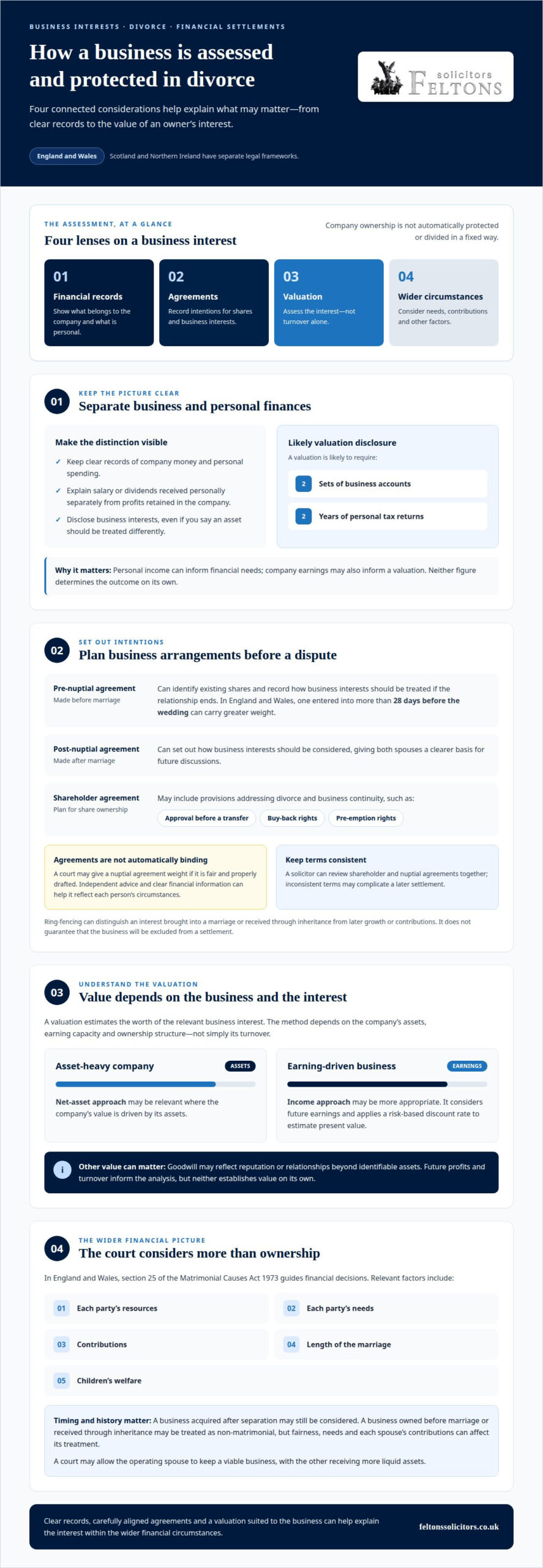
A solicitor can help distinguish company finances from personal assets through clear records and financial disclosure. The rules differ across the UK: section 25 of the Matrimonial Causes Act 1973 guides financial decisions in England and Wales, while Scotland and Northern Ireland have separate legal frameworks.

Business Assets in Financial Settlements

This describes how a court may consider business interests alongside other assets when deciding a financial settlement. In England and Wales, a business acquired after separation may still be considered; separation alone doesn’t automatically exclude it. A business owned before marriage or received through inheritance may be treated as non-matrimonial, but fairness, needs and each spouse’s contributions can affect its treatment. A spouse’s direct or indirect contribution may matter.

Assessing Business Interests

Courts assess business interests within the wider financial circumstances, rather than treating company ownership as automatically protected. In England and Wales, section 25 factors include each party’s resources, needs, contributions, the marriage’s length and children’s welfare. Clear separation of company money and personal spending helps explain the business’s finances. A court may allow the operating spouse to keep a viable business, with the other receiving more liquid assets.

Financial Disclosure by Business Owners

Financial disclosure means providing complete, accurate information about assets and income. Business owners must disclose their business interests, even if they argue that an asset should be treated differently. For a business valuation, disclosure is likely to include two sets of business accounts and personal tax returns for the last two years. Working with reputable accountants such as Fair View Accounting Services ensures company books are kept accurate and orderly, while a solicitor can help organise the financial information so ownership, company funds and personal finances are clearly presented.

Business Income and Dividends

Business income and dividends can inform the court’s assessment of resources, needs and future earning capacity. A solicitor can help distinguish salary or dividends received personally from profits retained in the company, using accounting records to explain the difference. This matters because personal income can affect each spouse’s financial needs, while company earnings may also inform the valuation. These figures contribute to the settlement assessment, but don’t determine the outcome on their own.

How can a solicitor help protect your business before a divorce occurs?

Early advice can help business owners plan how shares and company interests should be treated if a relationship ends. A solicitor can review agreements and ownership arrangements before a dispute arises.

Prenuptial and Postnuptial Agreements

A pre-nuptial agreement is made before marriage, while a post-nuptial agreement is made afterwards. Either can record how business interests should be treated if the relationship ends, giving both spouses a clearer basis for future discussions. In England and Wales, these agreements aren’t automatically binding, but a court may give them weight if they’re fair and properly drafted. Independent advice and clear financial information can help ensure the agreement reflects each person’s circumstances.

Ring-Fencing Business Interests

Ring-fencing means setting out how a business interest brought into a marriage, or acquired through inheritance, should be treated. A pre-nuptial agreement can identify existing shares and describe the intended approach if the couple separates. It can also distinguish the original interest from later growth or contributions. The agreement doesn’t guarantee that the business will be excluded from a matrimonial settlement, but it can give the court evidence of the couple’s intentions.

Timing matters: in England and Wales, a pre-nuptial agreement entered into more than 28 days before the wedding can carry greater weight. A solicitor can help explain the terms and prepare a document tailored to the owners’ circumstances.

Shareholder Agreements and Divorce Clauses

A shareholder agreement can set out what happens to shares if an owner divorces. Its terms may require approval before a transfer, provide buy-back rights, or give other shareholders pre-emption rights to buy shares first. These provisions can help address the effect of divorce on ownership and business continuity. A solicitor can review the wording alongside any nuptial agreement, since inconsistent terms may complicate a later settlement.

Unmarried couples can also use a cohabitation agreement to record how they intend to manage property and finances if they separate. For guidance on agreements and protecting business interests, seek legal advice before ownership or relationship arrangements change.
How to Protect My Business in a UK Divorce and Understand Its Value

How is a business valued in divorce proceedings?

A valuation estimates the worth of the business interest relevant to financial negotiations, rather than simply assigning a figure to turnover. The method depends on the company’s assets, earning capacity and ownership structure.

Business Valuation Methods

Business valuation methods estimate what an interest is worth by examining assets or earnings. For an asset-heavy company, a net-asset approach may be relevant; for a business driven by earning capacity, an income approach may be more appropriate. The income approach considers future earnings and applies a risk-based discount rate to estimate present value. Future profits and turnover inform the analysis, but neither figure alone establishes value.

Goodwill in Business Valuations

Goodwill is value attributed to factors such as reputation or relationships beyond identifiable assets. Its treatment can affect the valuation, particularly where a business relies on an owner’s personal skills rather than transferable assets. In CG v SG, the High Court of Justice of England and Wales gave the case reference [2023] EWHC 942 (Fam) and concluded that there was no goodwill attached to the LLP as a separate entity. The decision illustrates why goodwill must be assessed in context.

Discounts can also affect a valuation. In Versteegh v Versteegh, the Judiciary of England and Wales stated that the court concluded a 13% discount was appropriate in light of post-Brexit uncertainty. A minority shareholding or reliance on the owner’s personal relationships may also influence the assessment.

Forensic Accountants and Expert Valuations

A forensic accountant analyses financial records and provides an expert valuation when the parties dispute the value. In divorce proceedings, a single joint expert appointed by both parties is the usual approach. Their joint instruction can focus the accountant on relevant issues, including earnings, assets and goodwill. The report gives the parties a common basis for financial negotiations, although expert opinions may differ.

An accountant’s costs depend on the work required, including the business’s complexity and the scope of the valuation. One risk is disagreement over assumptions or methodology, which can require further evidence and prolong negotiations. Financial disclosure, nuptial agreements and the business’s ownership history can help frame the questions put to the accountant, and maintaining clear day-to-day records through services such as coombscharteredaccountants.co.uk can make assembling this financial evidence much more straightforward.

A venture launched during divorce proceedings isn’t automatically excluded from the financial settlement. In England and Wales, there’s no rule that a spouse receives half of the business itself. Under section 25 of the Matrimonial Causes Act 1973, the court considers the parties’ financial resources, needs, contributions and children’s welfare. The start date matters, but doesn’t determine the outcome alone.

Understanding how to protect my business in a divorce in the UK starts with examining how the venture was funded and who owns it. Personal savings, marital assets or business borrowing may each affect the financial picture. The court may also consider each party’s involvement, including work contributed to developing the venture. Records can help clarify its ownership, funding and financial position.

Full financial disclosure remains essential during proceedings. The parties must provide complete and accurate information about their financial holdings, including business interests. A solicitor can help present documents showing the venture’s start date, ownership structure, funding, debts, accounts and income. This can distinguish company funds from money available for personal and family needs, giving negotiations a clearer basis.

Possible outcomes include one spouse retaining the business and compensating the other, a share transfer, joint ownership or a sale. The court may prefer to keep a viable business intact while balancing its value against other assets and each party’s needs. Children’s welfare, future earning capacity and the parties’ circumstances can all affect the settlement. A new venture’s income and value may therefore matter, even if it began after separation.

Advice on how to protect my business in a divorce in the UK can clarify how the venture fits into disclosure, valuation and settlement discussions. Discuss your financial arrangements with a solicitor before deciding on ownership, funding or a proposed transfer.

Feltons Solicitors LLP: Divorce and Financial Arrangements

Feltons Solicitors LLP advises on divorce and financial arrangements, including issues involving business interests, disclosure and valuation. Consider seeking legal advice when separation is being discussed, proceedings have begun, or you’re weighing a proposal that could affect company ownership or income. Early guidance can help you understand how the business fits into the wider financial settlement and what information may be relevant to negotiations.

Advice can also help you assess practical settlement options, such as retaining the business while addressing the other party’s financial needs through other assets. Every family’s circumstances differ, particularly where a new venture, business partner or children’s needs are involved. If you need advice on your business and divorce arrangements, contact Feltons Solicitors LLP.

Choose a clear next step for your business

Divorce can bring personal and commercial decisions into sharp focus. Before agreeing to a change in ownership, restructuring the business or making a financial commitment, consider how that decision could affect your longer-term plans. A legal discussion can help you identify the questions that need attention and decide what to address first.

If you’re considering how to protect your business in a divorce in the UK, seek advice that accounts for both your family circumstances and the way your business operates. Feltons Solicitors LLP provides Divorce and Financial Arrangements advice for people facing these issues, including support to assess the next steps.

You don’t need to have every decision resolved before seeking advice. A measured conversation can help you move forward with greater clarity. Speak with Feltons Solicitors LLP about your circumstances and take the next step with confidence.

Frequently Asked Questions

How is a limited company valued during a divorce?

A limited company’s assets belong to the company, while the divorce settlement considers the value of the shareholder’s shares. A valuation may use net assets for an asset-heavy company or an income approach where earning capacity is central. If the spouses can’t agree on value, the court may appoint an independent or forensic accountant. The company’s turnover alone doesn’t establish what a particular shareholding is worth.

Is my business included in a divorce settlement?

A business interest can be considered as part of the wider financial settlement, but that doesn’t mean the business must be sold or divided. The court assesses the parties’ overall resources and needs alongside other circumstances, including contributions and children’s welfare. For example, the spouse operating a viable business may be able to retain it, with the settlement accounting for the other spouse’s interests through other assets.

Can I just keep it off the table, or move assets out of reach?

No. Business interests and other financial holdings must be disclosed in divorce proceedings. Hiding an asset or moving it to prevent disclosure can have serious consequences, including cost penalties. If hidden assets are discovered after a final financial order in England and Wales, the court can set the order aside and reconsider the settlement with those assets included. Full, accurate disclosure is safer than concealment.

Can I ring-fence my business in a prenuptial agreement?

A prenuptial agreement can set out how a business interest should be treated if the relationship ends, but it doesn’t automatically remove that interest from consideration. In England and Wales, courts may give a fair, properly drafted agreement weight. A solicitor can help describe the business and shares clearly and address how later growth or contributions should be treated. Signing more than 28 days before the wedding can give the agreement greater weight.

Can my ex-wife or ex-husband claim half my business in a divorce?

No rule entitles a spouse to half of the business itself. The court considers the full financial settlement, not simply an equal division of company ownership. Depending on the circumstances, the business-owning spouse may keep the business and compensate the other through money or a larger share of liquid assets. The result depends on factors such as each party’s needs, resources and contributions.

How does the court decide whether to include a post-separation business?

In England and Wales, separation doesn’t automatically exclude a newly acquired business from financial consideration. Under section 25 of the Matrimonial Causes Act 1973, the court considers factors including the parties’ financial resources, needs, contributions, the marriage’s length and children’s welfare. The business’s funding, ownership and each party’s involvement help explain its place in the wider settlement. The date it began is relevant, but not decisive.

Post-Nuptial Agreement Drafting Solicitors: 2026 Guide

Post-Nuptial Agreement Drafting Solicitors: 2026 Guide

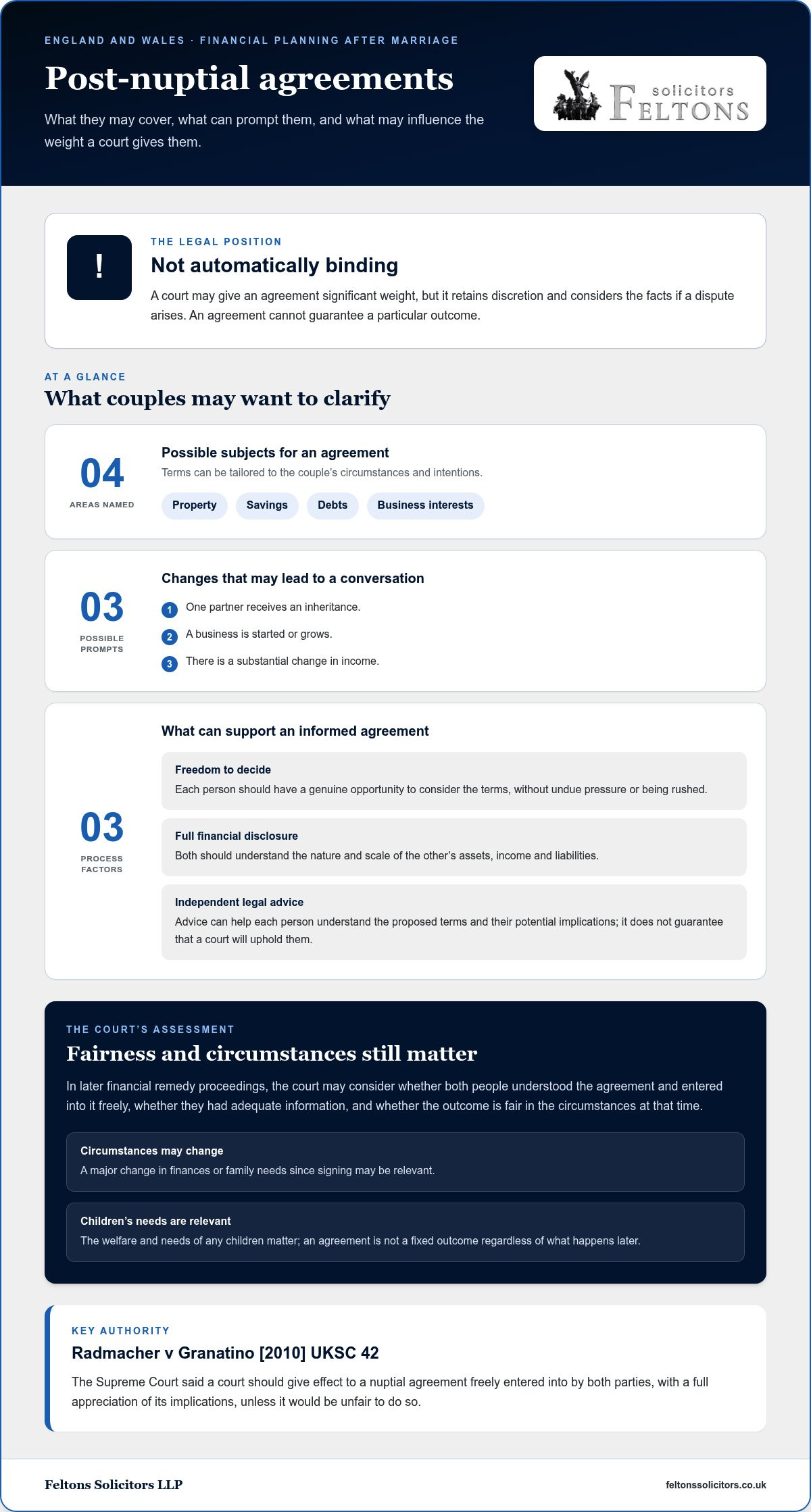
Could putting financial decisions in writing bring clarity without deciding the future of your marriage? For couples considering a post-nuptial agreement, that balance matters. Discussions about money can feel sensitive or one-sided, and it’s natural to ask whether an agreement will carry legal weight. In England and Wales, post-nuptial agreements aren’t automatically binding. A court may give one significant weight if it is fair and both parties entered into it freely, with full financial disclosure and independent legal advice. Experienced post nuptial agreement drafting solicitors can help you approach the process carefully and with realistic expectations.

A considered agreement is a financial plan tailored to your circumstances, not a guarantee of a particular court outcome. This 2026 guide explains what an agreement can cover, from property and savings to pensions, business interests and debts. It also sets out what information to prepare, how solicitor-led advice can support clear decisions and what to consider before signing.

Key Takeaways

  • Changes such as an inheritance, growing business interests or a shift in finances may prompt you to revisit financial plans after marriage.
  • Understand how the court’s discretion and the principles in Radmacher v Granatino affect the weight an agreement may carry.
  • See where generic templates can fall short, particularly when assets, family circumstances or future plans are more complex.
  • Prepare a clear picture of your objectives, income, assets, pensions, liabilities and relevant supporting records before drafting begins.
  • Learn what to expect from post nuptial agreement drafting solicitors, from initial discussions and financial disclosure to review and signing.

When are post-nuptial agreement drafting solicitors useful after marriage?

A post-nuptial agreement is a written agreement made after a couple marries or enters a civil partnership. It can set out how they intend to approach their finances if they separate or divorce, including matters such as property, savings, debts or business interests. The Postnuptial agreement overview offers a general introduction, but it isn’t a guide to the law in every jurisdiction. In England and Wales, an agreement can record a couple’s intentions; it can’t guarantee how a court would decide a future financial case.

Post nuptial agreement drafting solicitors can help couples work through their intentions in light of their financial circumstances. Considering an agreement doesn’t mean separation is expected. For some couples, it’s practical planning after a change in circumstances. For others, it creates an opportunity to clarify financial expectations and discuss them openly.

What can prompt a couple to consider an agreement?

A change in finances may lead a couple to revisit arrangements made earlier in their relationship. One partner might receive an inheritance, start or grow a business, or experience a substantial change in income. They may want to record how particular assets or responsibilities should be treated if the relationship later ends.

These are possible reasons to explore an agreement, not a checklist for every couple. Start by identifying what has changed, what each partner wants to clarify and whether both feel able to discuss the subject freely. A focused conversation can help separate shared priorities from assumptions that need further thought.

How is a post-nuptial agreement different from a prenup?

The difference is timing: a prenuptial agreement is made before marriage, while a post-nuptial agreement is made after a marriage or civil partnership has taken place. Either may form part of financial planning, but neither guarantees a particular outcome if the couple separates or divorces.

In both cases, the terms should reflect the couple’s actual circumstances and agreed intentions, rather than generic assumptions. For broader context on the financial issues that can arise if a relationship ends, read this guidance on divorce and financial arrangements.

Family law differs across the UK, so this guide focuses on England and Wales. If your circumstances involve another part of the UK, the applicable law may differ. A solicitor can explain the relevant context and how an agreement may fit into your wider financial planning.

Can a post-nuptial agreement be upheld in England and Wales?

A post-nuptial agreement isn’t automatically legally binding in England and Wales. However, a court may give it significant weight when deciding financial remedy proceedings. The key authority is Radmacher v Granatino [2010] UKSC 42. The Supreme Court said a court should give effect to a nuptial agreement freely entered into by both parties, with a full appreciation of its implications, unless it would be unfair to do so. The Law Commission report on nuptial agreements provides further context on their legal status.

This principle doesn’t promise that a particular agreement or term will be upheld. A court retains discretion and considers the facts when a dispute arises, including whether the agreement was fair at that time and whether circumstances have changed. The needs and welfare of any children are also relevant, so an agreement can’t be treated as a fixed outcome regardless of what happens later.

What factors may influence the weight given to an agreement?

The circumstances in which the agreement was made can matter as much as its wording. Each person should have a genuine opportunity to consider the terms, without undue pressure or being rushed into signing. Full and frank financial disclosure helps both parties understand what they are agreeing to, including the nature and scale of each other’s assets, income and liabilities.

Independent legal advice is an important safeguard. It helps each person understand the proposed terms and their potential implications, but it doesn’t guarantee that a court will uphold the agreement. Post nuptial agreement drafting solicitors can help clarify the issues, record the parties’ intentions and identify points that need careful consideration. The aim is an informed process, not a guaranteed legal result.

Why can’t a solicitor promise a particular result?

If financial remedy proceedings later arise, the court makes its own assessment. It may consider whether each person understood the agreement, entered into it freely and had adequate information, alongside whether the outcome is fair in the circumstances at that time. A major change in finances or family needs since signing may also be relevant.

Careful drafting can support clarity and informed decision-making, but it doesn’t make an agreement automatically binding or remove the court’s discretion. For tailored guidance on how an agreement fits your financial circumstances, explore family law advice on financial arrangements.

Solicitor-drafted agreement or template: what is the difference?

A generic template can provide a starting structure, but it can’t account for how your finances are arranged or what you intend each clause to achieve. Advice-led drafting starts with your circumstances and priorities, then shapes the wording around them. Neither approach guarantees how a court would treat an agreement, and not every couple needs the same provisions.

Consideration Generic template Advice-led drafting
Fit Uses standard wording that may not reflect particular assets, ownership or family circumstances. Considers the couple’s circumstances and identifies where specific terms or further discussion may be needed.
Financial information May provide limited prompts, leaving assumptions about assets, income or liabilities unstated. Uses the financial picture to inform the terms and highlight areas requiring clarity.
Review May not explain how to assess whether the wording reflects both parties’ intentions. Allows the draft to be considered in context, with each person’s position and questions addressed.

Where can a generic template fall short?

Broad wording can blur important differences. For example, a clause referring to “property” may not distinguish a jointly owned home from a property owned by one person, or explain how a mortgage or other liability should be considered. A template may also leave assumptions about a business, shares, inherited assets or changing family circumstances unstated.

This doesn’t mean every template is invalid or unsuitable. The risk is relying on standard language without checking whether it accurately describes the couple’s finances and intentions. If key context is missing, the document may leave room for different interpretations.

What does tailored legal advice add?

Advice can help each person identify their priorities, understand the proposed terms and raise questions before the wording is settled. Since each partner’s circumstances and interests may differ, both should have the opportunity to consider the agreement from their own perspective and receive separate advice. Post nuptial agreement drafting solicitors can help translate agreed intentions into clearer terms and draw attention to unresolved issues rather than obscuring them with general wording.

Inheritance planning may also connect with decisions about how assets are treated in an agreement. For related considerations, see this estate planning guidance. The Law Commission’s report on nuptial agreements provides further background on the legal context. A tailored document isn’t a promise of a particular court outcome; its value lies in recording considered intentions clearly.

Post-Nuptial Agreement Drafting Solicitors: 2026 Guide

What information should you prepare before drafting a post-nuptial agreement?

Good preparation helps turn broad intentions into terms that reflect your finances and priorities. You don’t need to decide every detail alone before seeking advice. Start by gathering a clear picture of your circumstances and noting where you and your spouse agree or need a fuller discussion.

Which financial details and documents may be relevant?

The information needed depends on your circumstances. Records might include property details, bank and investment statements, income information, pension records, details of debts and documents relating to a business or its ownership. Where relevant, note whether an asset is jointly or individually owned and how it was acquired. The aim is an accurate overview, not a standard paperwork list for every couple.

A practical preparation sequence can help:

  1. Set out your objectives. Note what you want the agreement to clarify and which questions remain open.
  2. Gather financial information. List assets, income, pensions, liabilities and business interests, with supporting records where available.
  3. Explain ownership and context. Record how significant assets are held and, where relevant, the source of funds used to acquire them.
  4. Consider day-to-day and future needs. Think about housing, ongoing financial responsibilities and possible changes, such as a new business venture or inheritance.
  5. Review the proposed terms. Read the draft carefully, raise uncertainties and take advice before deciding whether to sign.

How should couples approach terms and future review?

Each person can consider their own priorities and practical needs before discussing how to address them together. For example, think through how housing costs would be managed or what should happen if one partner’s income changes. Listing agreed points separately from unresolved questions can make a sensitive conversation more focused.

You may also wish to discuss whether the agreement should be reviewed after a particular life change or at an agreed point in the future. A review clause can prompt the couple to revisit the terms, but it won’t update them automatically. Any change needs to be considered and properly recorded, with advice tailored to the circumstances at that time.

Post nuptial agreement drafting solicitors can help organise the information, explain issues in plain English and tailor advice and drafting to your circumstances. To discuss your financial arrangements, speak with Feltons about your financial arrangements.

Post-Nuptial Agreements: Instruction to Final Document

A clear, measured process gives both people space to explain their priorities, understand the financial picture and consider the wording before deciding whether to sign. The steps depend on the couple’s circumstances, but the process commonly moves from setting objectives and sharing financial information to advice, drafting, review and completion.

  1. Set out your objectives. Identify what you hope to clarify and which issues need discussion.
  2. Share financial information. Bring together relevant details of assets, income, pensions, liabilities and other interests.
  3. Consider advice. Each person should have the opportunity to understand the proposed terms and their potential implications.
  4. Prepare and review a draft. Instructions and financial information inform the wording. Both parties should read it carefully and raise questions where needed.
  5. Complete the agreement. Before signing, check the final terms and the applicable execution formalities in light of current law and your circumstances.

What happens during the drafting and review stages?

The first draft should reflect the objectives discussed and the financial context provided. During review, check that the language says what you intend, that relevant issues haven’t been overlooked and that unclear or disputed points are addressed. Take time to ask questions. Each person should understand the proposed terms and obtain appropriate advice before completion.

Discussions about money can feel personal. Clear, sensitive communication and appropriate privacy can help keep the focus on practical decisions rather than assumptions about the relationship. Post nuptial agreement drafting solicitors can explain the issues in plain English and tailor advice to the couple’s circumstances, while keeping expectations realistic about the agreement’s potential legal effect.

When should you seek advice about a post-nuptial agreement?

Start early enough to gather financial information, consider the terms and allow each person to obtain independent guidance. A rushed process or pressure to sign can leave one or both parties without a proper opportunity to reflect, undermining confidence in the agreement and how it was reached. If a point remains unresolved, address it before signing rather than treating completion as a formality.

For advice shaped around your objectives and financial circumstances, speak to Feltons about post-nuptial agreement drafting. A solicitor can help you understand the process and prepare carefully, without promising how a court would decide a future dispute.

Take a considered next step with your financial plans

A post-nuptial agreement can set out shared intentions after a change in circumstances, but it can’t guarantee a particular court outcome. Its potential value depends on careful preparation, clear financial information and terms that reflect both parties’ circumstances. Taking time to understand the process and review the draft can help you approach sensitive decisions thoughtfully.

Post nuptial agreement drafting solicitors can help you consider your objectives and the practical issues an agreement may need to address. Feltons advises on divorce and financial arrangements, with pragmatic advice tailored to individual needs. The firm can help you explore your options and take a measured approach.

Discuss post-nuptial agreement drafting with Feltons and take an informed first step towards greater financial clarity.

Frequently Asked Questions

Are post-nuptial agreements legally binding in England and Wales?

No, post-nuptial agreements aren’t automatically legally binding in England and Wales. A court may give an agreement significant weight, particularly where both people entered into it freely, understood its implications and made full financial disclosure. The court retains discretion and may consider fairness, later changes in circumstances and the needs of any children. Careful drafting and independent legal advice can support the process, but neither guarantees that every term will be upheld.

Do both spouses need separate solicitors for a post-nuptial agreement?

Each spouse should have the opportunity to obtain independent legal advice so they can understand the proposed terms and consider their own interests. The same solicitor can’t advise both people on their individual positions. Separate advice can help identify concerns and support informed, voluntary decisions. Post nuptial agreement drafting solicitors can guide each client through the implications of the terms, but independent advice can’t guarantee a particular court outcome.

What should a post-nuptial agreement include?

An agreement may set out how a couple intends to deal with relevant finances if they separate or divorce. Depending on their circumstances, this could include property, savings, pensions, income, debts, business interests and inheritance. It should reflect the couple’s objectives and the financial information available, rather than rely on standard terms that may not fit. Advice can help clarify ownership, responsibilities and points that need further discussion before signing.

Can a post-nuptial agreement protect an inheritance or business?

An agreement can record how a couple intends an inheritance or business interest to be treated if they separate, but it can’t guarantee that a court will follow that intention. The details matter, including ownership, financial disclosure, each person’s needs and later changes in circumstances. For example, a business may change in value or provide income relied on by the family. Tailored advice can help address these factors clearly without promising a legal result.

Can we make a post-nuptial agreement without a solicitor?

You can prepare an agreement without a solicitor, but a generic document may not reflect your finances or make your intentions clear. Independent legal advice can help each person understand the terms, while careful drafting can identify assumptions or unresolved issues. Full financial disclosure and voluntary decision-making are also important considerations. Solicitor involvement may strengthen the preparation, but it doesn’t make an agreement automatically binding or guarantee how a court will treat it.

Can a post-nuptial agreement be changed after it is signed?

Yes, you and your spouse can agree to change the terms, but don’t assume a verbal conversation or informal note updates the agreement. Any variation should be properly documented and considered in light of your current financial circumstances and applicable legal requirements. Independent advice can help each person understand the proposed changes. If circumstances shift, such as a change in income or family responsibilities, review the agreement rather than relying on outdated terms.

Does a post-nuptial agreement cover arrangements for children?

A post-nuptial agreement can record the parents’ intentions about family finances, but it can’t conclusively decide future arrangements for children or bind a court on those matters. If parents separate, decisions concerning a child are assessed in light of the child’s welfare and circumstances at that time. The agreement may include relevant financial intentions, but a court’s consideration of children’s needs remains important. Take advice before including provisions that affect children or family support.