

Recognition of a judgment gives you the right to seek enforcement, but it does not mean you will automatically be paid. How to enforce a judgment in the UK depends on where it was made, the legal route that applies and where the debtor’s assets are held. Recognition is an important step, but you may still need a court procedure to pursue payment or other relief.
That distinction matters. First identify the enforcement route, the evidence the application requires and whether the debtor has assets that can realistically be reached. Timing and any challenge to recognition or enforcement may also affect your next steps.
This guide explains what follows recognition, when enforcement can begin and how the location of assets can shape your options. It also covers possible grounds for challenging an application and the documents that may support it, helping you understand the decisions involved.
Key Takeaways
- Recognition does not itself secure payment: identify the enforcement route that applies to the judgment and the relief it allows.
- Plan enforcement around where the debtor’s assets are located, since asset type and location shape the practical options.
- Assess any challenge or set-aside application, and note that the Ministry of Justice says a defendant intending to respond must file an Acknowledgement of Service within 14 days under CPR 8.3(1).
- Prepare the supporting documents carefully, including the judgment or award and evidence relevant to compliance and any interest claimed.
Restrictions on enforcing an award before the set-aside period ends
- Identify the award and the applicable route before taking enforcement steps. In England, you may seek permission to enforce an arbitral award as a judgment, but the resulting order can restrict when enforcement takes effect. Read the order carefully: it must explain the defendant’s right to apply to set it aside and any restrictions on enforcement.
- Allow for the defendant’s response period. According to the Ministry of Justice, a defendant intending to respond to an enforcement claim must file an Acknowledgement of Service within 14 days under CPR 8.3(1). An enforcement order must allow 14 days, or a longer period directed by the court, for an application to set it aside. Check the order’s terms before proceeding.
- For a foreign award, establish whether registration or permission is required. New York Convention awards may be enforced through the English courts under section 101 of the Arbitration Act 1996. Section 102 identifies the documents required, including the arbitration agreement and award. Where either document is in another language, provide a certified translation. These requirements help the court assess the award’s status and effect.
- For an international investment award, distinguish the statutory route. The Arbitration (International Investment Disputes) Act 1966 provides for enforcement of ICSID awards in the United Kingdom. Prepare the award and supporting material for the applicable court process; the route differs from registration of a Convention award. The parties should also disclose pending set-aside proceedings when seeking permission without notice.
- Track the limitation period from the relevant cause of action. According to UK Parliament, the usual limitation period for enforcing an arbitral award in England is six years from when the cause of action accrued. Court fees depend on the application and enforcement method, so there is no single fee for every route. Identify the procedural step first to establish the applicable fee.
Enforcement strategy and asset location
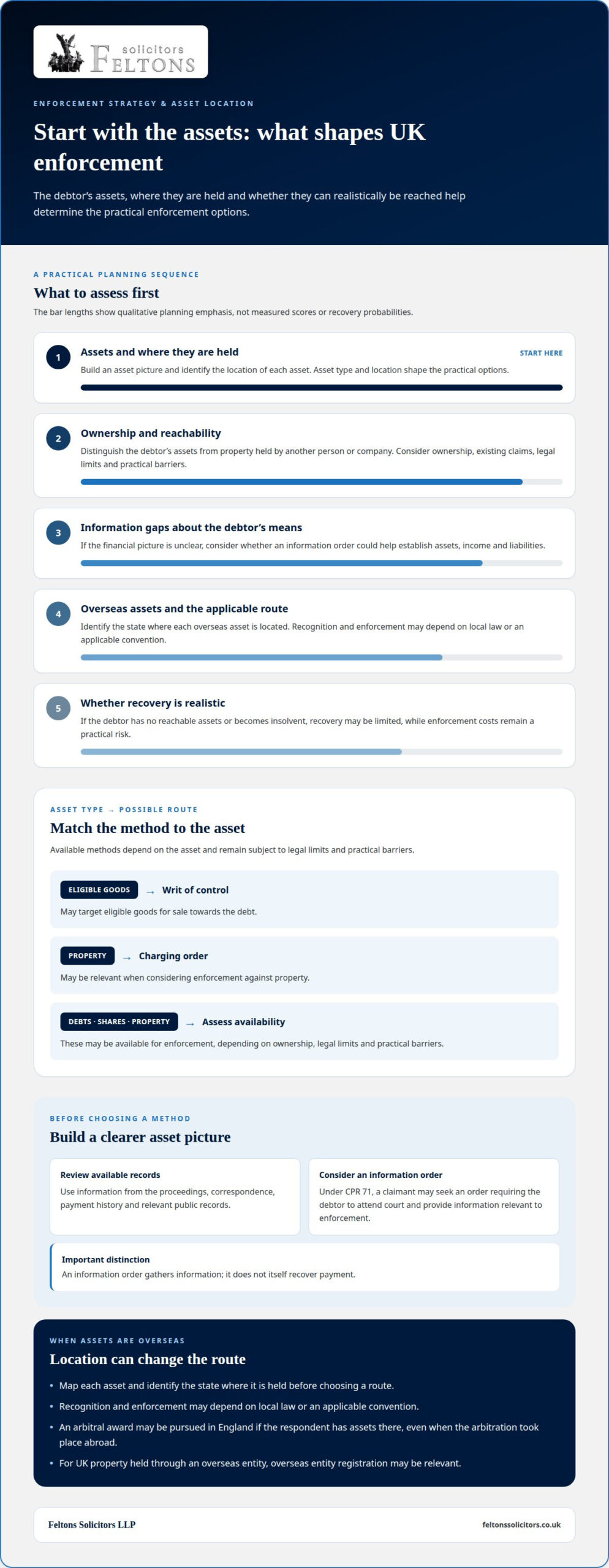
Planning how to enforce a judgment in the UK starts with assessing the debtor’s likely assets and where they are held. If the debtor has no reachable assets or becomes insolvent, recovery may be limited, while enforcement costs remain a practical risk.
-
Locate the debtor’s assets
Build an asset picture before choosing a method. Review information from the proceedings, correspondence, payment history and relevant public records. Distinguish the debtor’s assets from property held by another person or company. If the debtor’s financial position is unclear, an information order may help establish what assets or income could support enforcement. In complex cross-border scenarios where asset tracing or allegations of financial misconduct intersect with criminal proceedings overseas, seeking counsel from regional specialists such as Abogado Penalista Chile ensures local penal procedures are properly managed alongside recovery efforts.
-
Identify assets available for attachment
Match each asset to a suitable enforcement route. In England, goods, debts, shares and property may be available for enforcement, subject to legal limits and practical barriers. A writ of control can target eligible goods for sale towards the debt; a charging order may be relevant to property. Consider ownership, existing claims and whether the asset can realistically be reached.
-
Request debtor asset information orders
Apply for an information order when existing records do not reveal enough about the debtor’s means. Under CPR 71, a claimant may seek an order requiring the debtor to attend court and provide information relevant to enforcement. Use the answers to assess income, assets and liabilities, then select a proportionate next step. The order gathers information; it does not itself recover payment.
-
Assess enforcement against overseas assets
Map overseas assets and identify the state where each is located before choosing a route. Recognition and enforcement may depend on local law or an applicable convention. An arbitral award may be pursued in England if the respondent has assets there, even when the arbitration took place abroad. The practical route for how to enforce a judgment in the UK therefore depends on asset location. For UK property held through an overseas entity, overseas entity registration may be relevant.
Grounds for refusing recognition and enforcement
Recognition establishes whether a decision can be treated as binding; recovery still requires an effective enforcement step. Identify where the judgment originated and which legal route applies before making an application.
- Check the grounds for refusal under the applicable regime. For New York Convention awards, section 103(2) of the Arbitration Act 1996 sets out exhaustive grounds for refusing recognition. The court considers the relevant challenge rather than rehearing the underlying dispute as an ordinary appeal. For qualifying foreign court judgments, identify the applicable statutory or convention route; different regimes have different refusal criteria.
- Distinguish recognition from payment. A recognised judgment or award has legal effect in the enforcing jurisdiction, but does not itself transfer money or seize assets. In England and Wales, choose an available enforcement method, such as a writ of control or charging order under the Civil Procedure Rules. A court order may be needed before the selected method can proceed.
- Identify the UK jurisdiction and court that issued the judgment. To enforce a County Court or High Court judgment in England and Wales, establish the amount and form of relief, then choose a suitable method under the Civil Procedure Rules. In Scotland or Northern Ireland, enforcement follows the relevant local procedures. A judgment from another UK jurisdiction may need registration or an applicable statutory process before enforcement.
- For an EU member-state judgment or foreign court decision, establish which recognition regime applies. The 2019 Hague Convention concerns qualifying civil or commercial judgments, excludes arbitration, and entered into force for the United Kingdom on 1 July 2025. Other routes include Part II of the Administration of Justice Act 1920 and the Foreign Judgments (Reciprocal Enforcement) Act 1933. A debtor may challenge enforcement on an applicable ground or ask the court to pay by instalments; recognition alone does not prevent either application.
Evidence required to support an enforcement application
- Match the evidence to the legal route before filing. For an application under section 66 of the Arbitration Act 1996, include the arbitration agreement and the original award or copies as written evidence. This allows the court to see the tribunal’s authority, the terms made and the basis for seeking enforcement in the relevant jurisdiction.
- Prepare the supporting statement required by CPR Rule 62.18(6). An application for leave to enforce an arbitral award must include an affidavit or witness statement with the information required by that rule. Set out the key facts clearly, including whether the award has been complied with. If payment has been partial, make that position clear rather than presenting the full award as outstanding.
- For a New York Convention award, assemble the documents required by section 102 of the Arbitration Act 1996. Provide the original arbitration agreement or a certified copy, alongside the award in the form required for the application. If either document is in another language, include a certified translation. The agreement helps establish the parties’ submission to arbitration; the award records the tribunal’s decision.
- Keep the award and contract details consistent throughout the application. Confirm that the parties named in the arbitration agreement correspond with those bound by the award, and identify the relevant seat or jurisdiction. Differences in names, dates or obligations can make it harder for the court to determine what decision should take effect and against whom.
- Support any post-award interest claim separately. Under CPR Rule 62.19, an applicant seeking interest must file a statement containing the information required by that rule. Set out the basis and calculation clearly, and distinguish interest from the principal sum. For help organising the documents and next steps, discuss your enforcement evidence.
Feltons Solicitors LLP
Feltons Solicitors LLP can help when a judgment relates to a wider legal matter, rather than treating enforcement as a standalone step. A dispute involving divorce and financial arrangements, probate, conveyancing or a personal injury claim may raise related questions about the underlying rights and obligations. Clarifying that context can help identify which issues need attention next.
If your judgment forms part of one of these matters, contact Feltons Solicitors LLP to discuss the related legal issue and your next steps. Bring the judgment and relevant case documents so the background and outcome can be considered together.
Choose the next step with the wider matter in view
Deciding how to enforce a judgment in the UK can affect a wider legal matter. Before taking action, consider how the judgment relates to the underlying dispute and any unresolved financial, estate or property issues. A measured approach can help you keep connected decisions clear.
Feltons Solicitors LLP can assist with related matters involving divorce and financial arrangements, wills, probate and estate planning, or residential and commercial conveyancing. If one of these areas is relevant, explain how it connects to the judgment when seeking advice. This can help clarify the legal issue and your practical next step.
Contact Feltons Solicitors LLP to discuss the related matter and move forward with greater clarity.
Frequently Asked Questions
What happens after recognition?
Recognition gives the judgment legal effect in the relevant jurisdiction, but does not itself produce payment. Next, identify an enforcement method suited to the remedy and available assets. For example, a money judgment may call for a charging order or control of goods. Keep the recognised judgment and any related court order available for the application.
Which methods can be used to enforce a money judgment, such as a warrant of control, attachment of earnings or charging order?
The method depends on the debtor’s circumstances and the assets you are seeking to reach. In England, Practice Direction 70 identifies writs of control and charging orders among the methods for money judgments. A control warrant or writ concerns goods, while a charging order targets an interest in property or other assets. Attachment of earnings may be relevant where the debtor receives employment income, requiring employers to manage statutory payroll deductions in line with workplace regulations—an area where businesses frequently rely on specialists like Altum HR for compliance guidance.
How do you apply for a writ or warrant of control, and what happens after it is issued?
Apply through the court process relevant to the judgment and enforcement route, providing the judgment details and the amount still outstanding. Once a control writ is issued, an enforcement officer may attend to take control of eligible goods, which can be sold towards the debt. Keep records of payments and any contact from the debtor so the amount pursued reflects what remains due.
How can you find out whether a judgment debtor has assets, income or a suitable address?
Start with information already available from the proceedings, the debtor’s correspondence and relevant public records. If those sources leave key questions unanswered, CPR 71 allows an application for an order requiring the debtor to attend court and provide information relevant to enforcement. This can help clarify the debtor’s financial position and support a more focused choice of enforcement method.
What deadlines apply to enforcing a UK judgment, and when is court permission needed?
Deadlines depend on the kind of decision and enforcement route. For an arbitral award in England, the usual limitation period is six years from when the cause of action accrued, according to UK Parliament. Court permission is required for enforcement under routes such as section 66 of the Arbitration Act 1996. Check the order’s terms for any response period or restrictions before enforcement proceeds.
What can a judgment debtor do to challenge enforcement or ask to pay by instalments?
A debtor may challenge enforcement on a ground available under the applicable regime or ask the court to pay by instalments. An enforcement order must also allow 14 days, or a longer period directed by the court, to apply to set it aside.