
How to Find Out How Long Your Divorce Financial Settlement May Take

Separated couple review an agreed financial settlement with a London family solicitor before consent order submission

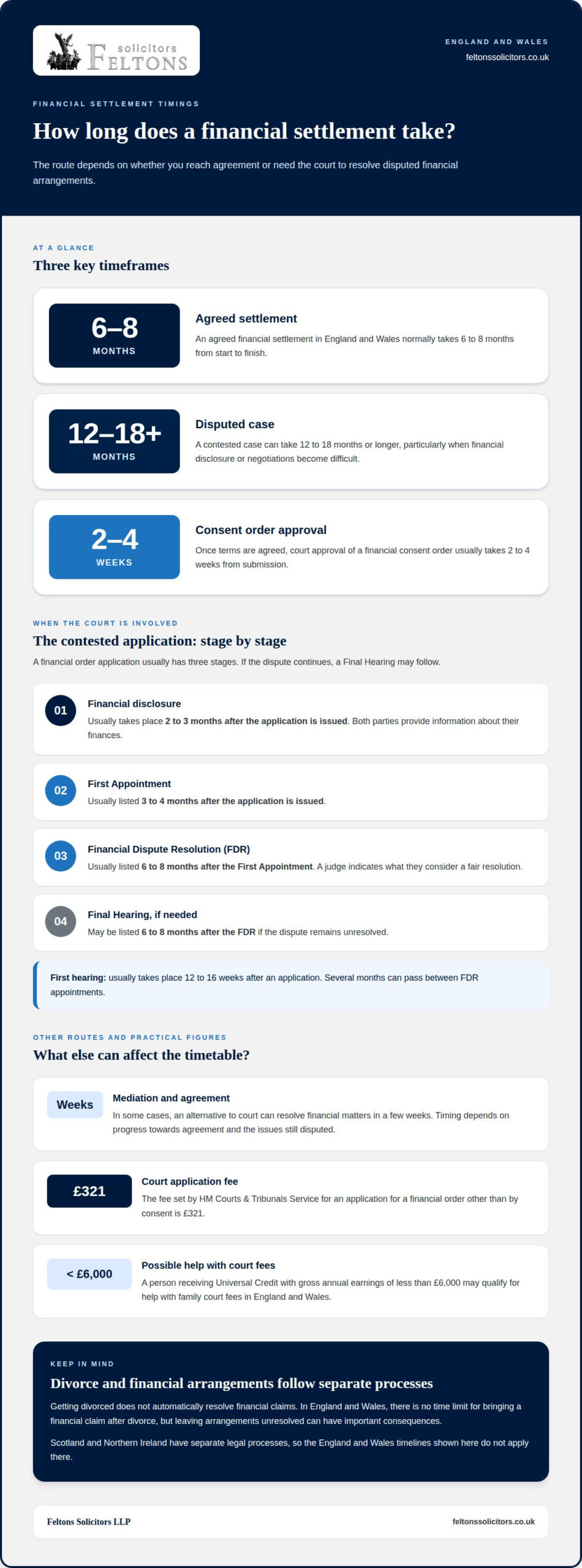
An agreed financial settlement in England and Wales normally takes 6 to 8 months from start to finish. If you’re asking how long a divorce financial settlement takes, a disputed case can take 12 to 18 months or longer, particularly if financial disclosure or negotiations become difficult. Once terms are agreed, court approval of a consent order usually takes 2 to 4 weeks from submission.

The divorce timetable and the financial process are separate, so getting divorced doesn’t automatically resolve claims between you. In England and Wales, there’s no time limit for bringing a financial claim after divorce, but leaving arrangements unresolved can have important consequences. This article explains what affects timing, how consent orders and court disputes fit into the process, and what to consider if you need to claim after divorce.

Key Takeaways

  • Identify whether an agreed order or a court application is likely to shape your route, as each follows a different process.
  • Understand how full financial disclosure and disagreements over property, pensions or maintenance can affect progress.
  • Learn why recording arrangements in a binding order matters, including when a financial claim is considered after divorce.
  • Find out when support with divorce and financial arrangements can help you address complex issues and move towards a clear outcome.

How long will it take to get my financial settlement?

An agreed settlement may take less time than court proceedings, where disclosure, hearings and unresolved issues affect progress. In England and Wales, a first court hearing usually takes place 12 to 16 weeks after an application.

  1. How a solicitor can advise on an agreement or court route

    Ask a solicitor to assess whether negotiation, mediation or a court application suits your circumstances. If you agree, the terms can be recorded in a consent order. If disputes remain, you may need to apply for a financial order and attend court hearings. The court process usually has three stages, including a Financial Dispute Resolution (FDR) appointment, where a judge indicates what they consider a fair resolution.

    Scotland and Northern Ireland have separate legal processes, so the timelines for England and Wales do not apply there. The route and progress depend on local procedure and whether both parties reach agreement.

  2. How a solicitor can explain court fees and division factors

    Ask for the relevant court fee and likely stages to be explained before proceedings begin. HM Courts & Tribunals Service sets the fee for an application for a financial order, other than by consent (fees order 5.4), at £321. A person receiving Universal Credit with gross annual earnings of less than £6,000 may qualify for help with family court fees in England and Wales, according to HM Courts & Tribunals Service.

    The court considers matters under section 25 of the Matrimonial Causes Act 1973, including the parties’ financial circumstances and needs. It gives priority to minor children’s interests, including their accommodation. A parent’s housing needs can therefore form part of the court’s assessment.

  3. Estimate mediation and consent order times

    Allow time for mediation discussions to identify and resolve outstanding issues. In some cases, an alternative to court can resolve financial matters in a few weeks. The timing depends on progress towards agreement and the issues that remain disputed.

    Once both parties agree, court approval of a financial consent order usually takes 2 to 4 weeks from submission. A contested application takes longer: the first hearing is usually 12 to 16 weeks after the application, and several months can pass between FDR appointments. If an application proceeds, the court fee for a financial order other than by consent is £321.

Types of financial orders

Choose the order that reflects the arrangements you have agreed or the issue still in dispute. In England and Wales, the order sought shapes the application and the court process.

  1. Identify the relevant financial order

    Ask a solicitor to identify which financial order matches the outcome you need. The Matrimonial Causes Act provides for periodical payments, including monthly child or spousal maintenance, under section 23(1)(a), and lump sum orders under section 23(1)(c). Property transfer orders are provided for under section 24, while pension-sharing orders are provided for under section 25A.

    Consider whether the arrangements need to cover income, capital, a home or pensions. A consent order can record terms you both accept. If agreement is not possible, you may need to apply to the court.

  2. How a solicitor can apply for a consent order

    Once you and your former spouse have agreed on the financial arrangements, ask your solicitor to prepare the application. The proposed order and supporting statement should clearly reflect the agreed terms. A court can approve a consent order without either party attending a hearing, provided the documents and order are in order.

    Consent orders have been submitted through an online court portal since April 2022. Aim to have the order considered before applying for the final order, so your financial arrangements are addressed as part of the divorce process.

  3. Allow time for each stage if the order is contested. A financial order application usually has three stages: financial disclosure, a First Appointment and a Financial Dispute Resolution (FDR) appointment. Disclosure usually takes place 2 to 3 months after the application is issued, and the First Appointment is usually listed 3 to 4 months after issue.

    If the dispute remains, an FDR is usually listed 6 to 8 months after the First Appointment. A Final Hearing may then be listed 6 to 8 months after the FDR. Contested proceedings can take 12 to 18 months or more, particularly if a spouse is unwilling to disclose their financial position. A solicitor can explain the application route and the statement required for the order.
How to Find Out How Long Your Divorce Financial Settlement May Take

Financial disclosure and disputes over property, pensions or maintenance

Complete financial disclosure so negotiations or a court application can address the assets, income and needs involved. In contested proceedings, financial disclosure is usually exchanged 2 to 3 months after the application is issued.

  1. Identify assets and financial details

    Ask your solicitor to build a clear picture of the finances, including property, savings, debts, income and pensions. Full and frank financial disclosure from both spouses helps show what is available and where figures differ. Include assets held individually as well as jointly, so discussions consider the complete financial position.

    Where children need accommodation, their needs may affect how the court assesses proposed arrangements. Identify disputed figures early, such as a property value or pension entitlement, rather than treating an unresolved estimate as agreed.

  2. How a solicitor can help gather financial documentation

    Provide documents to support each figure in the financial statement. These may include bank statements, mortgage details, property information, pension valuations, payslips and evidence of regular outgoings. Your solicitor can organise the material and identify gaps or inconsistencies that may delay full disclosure.

    For example, discussions about a pension may pause while you wait for a current Cash Equivalent Transfer Value. Pension providers can take many months to provide that figure, affecting when both parties can assess proposals.

  3. How a solicitor can help complete Form E

    In court proceedings, Form E sets out each party’s financial circumstances for the court process. A judge may direct both parties to complete it by a deadline. Work with your solicitor to ensure the figures and supporting documents give a consistent account of income, assets, pensions, liabilities and needs.

    For an agreed consent order, Form D81 provides a summary of the parties’ financial positions. Keep its figures consistent with the proposed arrangements and supporting information, so the court can consider the order alongside the statement.

  4. Address property, pension and maintenance disputes

    Ask your solicitor to identify precisely what remains disputed: the home’s value, how a pension should be divided, or the level of maintenance. Each issue may require further documents, valuation evidence or negotiation before the parties can decide on terms.

    Family law considers financial needs and, where relevant, children’s welfare. If disclosure is incomplete or pension information is outstanding, resolution may take longer because proposals need to reflect the available evidence.

Claiming a financial settlement after divorce

Divorce and financial arrangements are separate matters in England and Wales. A divorce final order does not, by itself, record how assets or income will be divided.

  1. Establish whether financial claims were resolved. Check whether a court order dealt with the marriage’s finances, rather than relying only on an informal agreement. A binding order can set out arrangements and dismiss each party’s financial claims, providing finality. Without an order, financial claims may remain possible after divorce, even if you have been separated for some time.
  2. Get advice before making decisions about a later claim. In England and Wales, there is no time limit for bringing a financial claim after divorce. However, the outcome depends on the circumstances, including the parties’ finances and needs. The court’s approach is discretionary, not an automatic division of assets. A former spouse’s income, housing needs and the needs of any children can affect the issues considered.
  3. Consider the timing of the final order. Financial arrangements can be addressed before the divorce is finalised. According to the Ministry of Justice, a conditional order may not be made final before the end of the period of 6 weeks from the making of the conditional order. A financial order takes effect only after the final order, or decree absolute under the former process. Timing the financial order and divorce steps can therefore matter.
  4. Clarify what any existing order covers. Review whether it deals with property, pensions and maintenance, rather than assuming that child maintenance resolves every financial claim. If circumstances have changed since separation, such as income or housing needs, explain that history when obtaining legal advice. A solicitor can assess whether a claim remains open and which financial arrangements need addressing.

For advice on your circumstances and a possible financial claim, speak to a solicitor about your financial arrangements.

Feltons Solicitors LLP: Divorce and Financial Arrangements

Feltons Solicitors LLP advises on divorce and financial arrangements, including resolving financial claims and recording agreed terms in a consent order. Consider seeking legal support if discussions have stalled, financial disclosure is incomplete, or you are unsure whether a previous order gives you a clean break.

A solicitor can assess the issues affecting your circumstances, explain the available routes and guide you through preparing financial arrangements. This can be particularly useful where property, pensions, maintenance or children’s needs make agreement more complex. If you are considering a claim after divorce, advice can clarify whether financial issues remain unresolved and what steps may be appropriate.

Contact Feltons Solicitors LLP to discuss your divorce and financial arrangements.

Take the next step towards clear financial arrangements

You may be asking, “How long does a divorce financial settlement take?” The answer can help you plan, but it should not be the only factor in deciding what to do next. Consider what you need to resolve, what information is outstanding, and which decisions could affect your financial security after divorce.

Another question is, “How long does a divorce financial settlement take if discussions do not reach agreement?” If negotiations have stalled or you are unsure about the effect of a proposed arrangement, legal advice can help you understand your options and prepare for the next discussion. The right next step depends on your priorities and the issues still open.

For guidance tailored to your circumstances, contact Feltons Solicitors LLP. A clear understanding of the choices ahead can help you move forward with greater confidence.

Frequently Asked Questions

Can I get divorced without sorting out the finances first?

Yes. In England and Wales, a divorce can be finalised before financial arrangements are agreed. However, the divorce itself does not resolve financial claims between former spouses. For example, an informal agreement about a home or savings does not provide the same finality as a binding court order. Before applying for the final order, consider whether financial claims and any necessary protections remain unresolved.

Who gets what in a divorce settlement in the UK?

There is no automatic rule that each spouse receives half of everything. In England and Wales, the court considers the circumstances and financial needs of both parties, rather than applying a community-property system. The family home, savings, pensions, debts and each person’s income may all be relevant. Children’s needs can also affect the arrangements, including decisions about housing.

Why do I need a court order?

A court order can make agreed financial terms binding and provide finality by dismissing each spouse’s financial claims. Without one, an informal agreement may not prevent a former spouse from making a claim later. An order can cover matters such as property, a lump sum or pension sharing, so its terms should reflect the financial issues the parties intend to resolve.

How does the court decide who gets what?

In England and Wales, the court considers the factors set out in section 25 of the Matrimonial Causes Act 1973. These include each party’s financial resources, needs and responsibilities. The court also gives priority to the interests of minor children, including their accommodation. It assesses the circumstances as a whole, so the outcome depends on the evidence and needs, not a fixed split.

How long will it take?

The timetable depends mainly on whether you reach agreement and how quickly financial information is provided. An agreed settlement process commonly takes 6 to 8 months, while a contested case may take 12 to 18 months or longer. Court listing gaps, property valuations and pension information can affect progress. If mediation helps resolve the issues, an alternative to court can take a few weeks in some cases.

How much will a divorce cost?

Court fees are separate from solicitor fees. HM Courts & Tribunals Service lists a fee of £321 for an application for a financial order other than by consent. A consent order application has a separate court fee of £53. Solicitor fees depend on the work involved and the complexity of the financial issues.

What Happens to a Business in Divorce and Who Keeps It

What Happens to a Business in Divorce and Who Keeps It

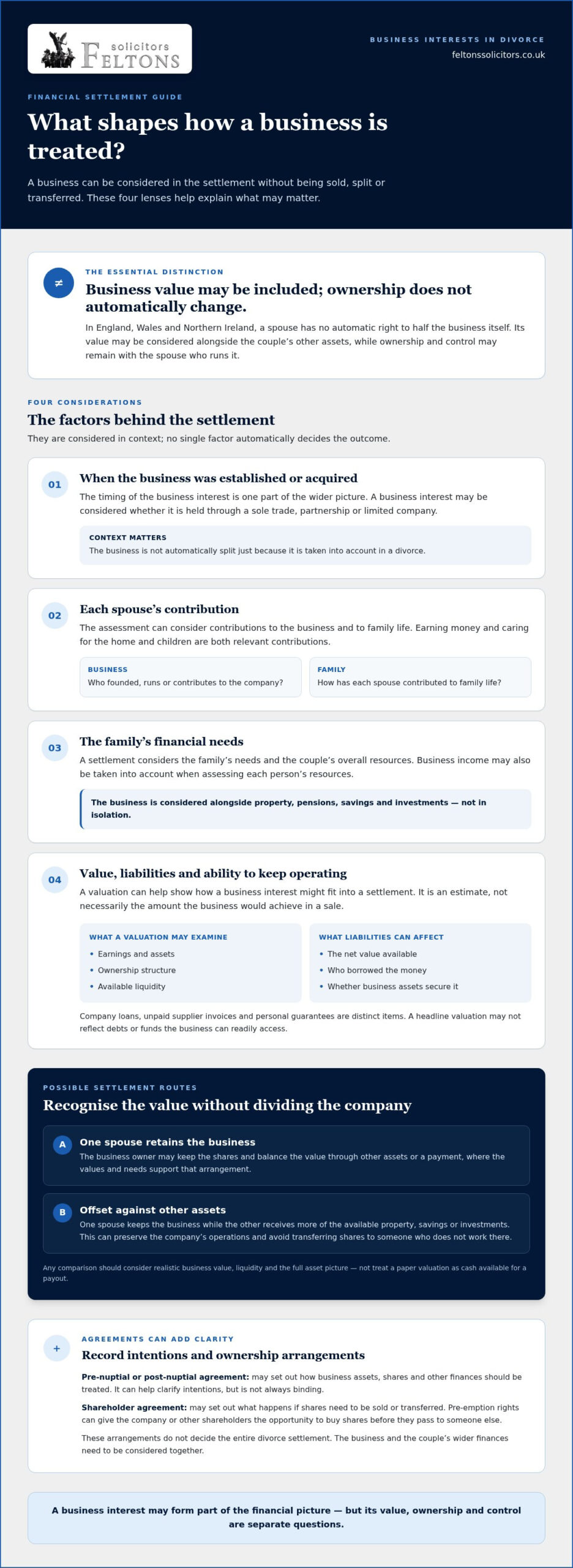
A divorce doesn’t automatically mean a business must be sold or divided. What happens to a business when a couple divorces depends on factors such as when it was established, each spouse’s contribution and the family’s financial needs. The business’s value may be considered in the settlement, while ownership and control may remain with the spouse who runs it.

It’s understandable to worry that a financial claim could disrupt the business you’ve built. Including a business in the settlement doesn’t necessarily mean your spouse will receive shares or take over the company. Depending on the circumstances, its value may instead be balanced against other assets.

This article explains when a business is taken into account, how its value and ownership may be treated, and what can help protect control. It also covers practical ways to address business interests in financial arrangements, so you can understand the issues before deciding what to do next.

Key Takeaways

  • A pre-nuptial or post-nuptial agreement can set out how business assets should be treated, but it isn’t always binding.
  • A spouse isn’t automatically entitled to half of the business; the settlement can reflect its value alongside other assets.
  • When a business is assessed, factors can include when it was established, each spouse’s contributions, the family’s needs and the business’s ability to keep operating.
  • Valuation helps clarify the options, which can include one spouse retaining the business and balancing its value through other assets or a payment.
  • Clear financial records and suitable business agreements can help protect ownership and control if a relationship breaks down.

Can I ringfence my business in a prenuptial agreement?

A nuptial agreement can record how a couple intends to treat business interests if they separate. It may help protect ownership, but it doesn’t guarantee that a court will follow every term.

Nuptial agreements and business protection

A pre-nuptial agreement is made before marriage; a post-nuptial agreement is made during the marriage. Either can set out how business assets, shares and other finances should be divided if the relationship ends.

For example, an agreement could record that one spouse founded and runs a company, then explain how its value should be considered alongside other assets. A nuptial agreement made before separation can help clarify intentions, but it isn’t always binding. Legal advice can help both spouses understand the terms and disclose their finances.

After separation, spouses may need to work through how to divide their finances, including property, pensions, savings and investments. Seeking guidance from independent wealth specialists like Her Financial Planning can help individuals evaluate the broader financial and retirement picture, ensuring a written agreement addresses the business as part of that wider settlement, rather than treating it in isolation.

Shareholder agreements and pre-emption rights

A shareholder agreement sets out arrangements between a company’s shareholders, including what happens if someone needs to sell or transfer shares. It may give the company or other shareholders pre-emption rights, allowing them the opportunity to buy shares before they pass to someone else.

For example, a family company’s agreement could specify how shares are offered if an owner needs to transfer them following a divorce. These terms can help manage ownership disputes and reduce uncertainty for other shareholders. They don’t decide the entire divorce settlement, so the agreement and the couple’s wider finances need to be considered together.

Business valuation and solicitor costs

A business valuation estimates the value of an interest for financial discussions and helps show how it might fit into a settlement. How much does a business valuation or divorce solicitor cost in the UK? The price depends on the case and is given after a quote request; factors include the work required, the quality of financial records and the complexity of the valuation.

A valuation may examine earnings, assets, ownership structure and available liquidity. It is an estimate, not necessarily the amount the business would achieve in a sale. Specialist accounting work may be needed, particularly when company finances, other shareholders or several ownership interests require analysis.

Business debts and liabilities

Business debts and liabilities affect the net value available for a financial settlement. Start by identifying each obligation, its balance, who borrowed the money and whether business assets secure it.

For example, a company loan, an unpaid supplier invoice and an owner’s personal guarantee are distinct items to record. Current accounts, loan documents and guarantee terms help show how each liability relates to the business or an individual. A clear picture matters because a headline valuation may not reflect the business’s debts or the funds it can readily access.

Is my spouse entitled to half of my business?

No. In England, Wales and Northern Ireland, a spouse has no automatic right to half the business itself. Business interests and their value may be considered alongside the couple’s other assets when working out a financial settlement.

Business interests as matrimonial assets

A business interest may form part of the assets considered in a divorce, whether held through a sole trade, partnership or limited company. That doesn’t mean the company must be split: the court considers the circumstances, including when it was acquired, each spouse’s contributions and the family’s needs.

In White v White in 2000, the House of Lords rejected discrimination between earning money and caring for the home and children. Miller v Miller and McFarlane v McFarlane in 2006 addressed needs, compensation in some cases and sharing wealth built during marriage. Those principles help explain why a business owner’s work is considered alongside their spouse’s contribution to family life.

Freezing orders and business assets

A freezing order can prevent a spouse from dealing with assets when there’s a risk of disposal or devaluation that could undermine a fair financial settlement. For example, transferring company funds or selling valuable equipment could affect the assets available for division.

A freezing order is a protective measure, not a way to decide who owns the business. In England and Wales, the court must be satisfied that the risk could prejudice the applicant’s ability to obtain a fair share. If assets are being moved or depleted, prompt legal action matters because prevention can be more effective than seeking a remedy afterwards.

Offsetting business interests against other assets

Offsetting means one spouse retains the business while the other receives more of the available property, savings or investments. For example, a business owner might keep their shares while the other spouse receives a larger share of a jointly owned property, if the values and needs support that arrangement.

This approach can preserve the company’s operations and avoid transferring shares to someone who doesn’t work there. The comparison should account for realistic business value, liquidity and the full asset picture, rather than treating a paper valuation as cash available for a payout. A settlement may also take business income into account when assessing each person’s resources.

Tax considerations when dividing business assets

Selling or transferring business assets during a divorce can have tax consequences. Capital gains tax may arise when assets are sold or transferred, while stamp duty may be payable on a property transfer. These potential liabilities can change the net value each spouse receives.

For example, comparing a share transfer with a sale requires attention to the asset involved, its ownership and the proposed settlement structure. A valuation can help identify the options and their tax implications before terms are finalised. A settlement should compare what each person receives after relevant liabilities, not just the stated value of the business or property.

A business is only one part of the financial picture: pensions, property, savings and investments also matter. Financial arrangements in a divorce place business interests alongside those wider assets when considering a settlement.

Will my business be taken into account in a divorce?

Yes. A business may be included when the couple’s finances are considered, but it isn’t automatically sold or divided. The settlement looks at the business alongside other assets, income and family needs.

Accounting for a business in a settlement

A financial settlement considers the business interest as part of the couple’s wider finances. How it is treated depends on its value, income, ownership structure and the needs of each spouse and any children.

For example, a director who runs a company may keep operating it, while the settlement accounts for its value through other assets or income. The family court can consider the business’s earning capacity, underlying assets and available liquidity. These factors help distinguish a valuable but cash-poor company from one that can readily provide funds.

In England and Wales, the needs of minor children receive first priority in a financial settlement. The court also considers housing and income needs, including future earning capacity and retirement. The business is assessed in context, rather than in isolation from the family’s circumstances.

Separating business and household finances

Keeping company accounts separate from household and jointly held finances creates a clearer record of what belongs to the business. Separate bank accounts and properly recorded drawings, for example, can help distinguish company expenditure from personal spending.

Good records also help explain income, liabilities and transactions during financial disclosure. Both spouses must provide full financial information, including details of any business sale and its proceeds. If a company account has paid household costs, recording those transactions helps show how they should be treated in the settlement.

Current governance documents matter too. Keeping shareholder records, company accounts and ownership documents organised makes the business structure clearer during discussions. Clear separation doesn’t determine the settlement, but it helps each person understand the business assets and income being considered.

Financial claims after separation or divorce

Separation does not by itself resolve financial claims between spouses. In England and Wales, there is no time limit for a husband or wife to make a financial claim following separation or divorce, so an informal arrangement may leave finances unresolved.

A consent order records agreed terms and can bring greater finality to the division of assets. Without an order, a couple may have agreed who keeps the business but not legally concluded their financial claims. Mediation can help address outstanding matters, such as business income, pensions or property, before an application for a financial order.

If spouses cannot agree, they can ask the court to make a financial order. The court considers the available assets, each person’s needs and the business’s ability to continue functioning. For a family with children, housing and income needs are particularly important.

What Happens to a Business in Divorce and Who Keeps It

Keeping business ownership with the operating spouse

A spouse who established and runs a business will usually be considered to retain it where possible. A court is unlikely to order a sale if that would harm the company or its shareholders, though a Scottish court may order a sale to fund an equalising payment when other assets cannot offset its value.

Lump-sum settlements instead of ownership

A lump-sum settlement can compensate one spouse for the business’s value without giving them ownership or control. This can allow the operating spouse to keep running the company while the other receives a payment or a greater share of other assets.

For example, if a business owner has sufficient personal funds or other assets, a payment may settle the other spouse’s financial interest. The figures must reflect the business’s value and the wider settlement, including each person’s needs. If the business has limited liquidity, extracting capital could affect its ability to trade, so the payment structure matters.

A spouse may also receive a share of business income rather than part of its ownership. That can provide financial support while leaving daily decisions with the person who operates the company. The settlement needs to distinguish income from capital value, since they affect the business and each spouse differently.

Ownership structures and minority shareholdings

The legal structure affects what can be transferred. A sole trader owns the business personally, while a partnership or limited company has different ownership arrangements. In a limited company, the divorcing spouse’s shares are relevant, but transferring them can affect other shareholders and directors.

A minority shareholding in a company owned by a wider group is assessed by considering the value of that particular interest, not the whole company. A spouse holding a minority stake, for instance, doesn’t own the other shareholders’ shares. Any proposed transfer must also account for the company’s governing documents and the practical effect on its operation.

Keeping the business with one spouse doesn’t require the other to receive shares. A court can consider the business’s value alongside other assets, or the spouses may agree on a financial arrangement that avoids shared ownership.

Former spouses can sometimes continue to co-own a business, but that means their decisions and financial interests remain connected after divorce. If they jointly own a company, they need to address how each person participates, makes decisions and receives income. Separating roles may be harder if both previously worked in the business than if only one spouse operated it.

Keeping control of the business after divorce

Ownership and control are related, but they are not identical. One spouse may retain a business while the settlement recognises its value through other assets or payments. For a family business, the practical question is also who makes decisions, manages staff and maintains trading relationships after the marriage ends.

Before agreeing to transfer shares, consider the effect on other directors, shareholders and employees. A spouse receiving shares, for example, may become a shareholder without experience running the company. A transfer could also affect voting arrangements or the working relationship between existing owners. Reviewing the company’s governance documents helps identify restrictions and existing rights that may shape a workable outcome.

A shareholder agreement can set out what happens if an owner must sell or transfer shares. It may give the company or another shareholder pre-emption rights, so they have the opportunity to buy shares before they pass to someone else. In a divorce, those provisions can help manage a proposed transfer and reduce disruption for the remaining owners. They don’t determine the whole financial settlement, so the share arrangements and family finances need to be considered together.

A trust may help keep a family business within the family after divorce. Its purpose and structure need careful consideration alongside the settlement, the people involved and the business’s future needs. Insurance can also protect a business if an owner dies or becomes disabled, events that may affect its value and ownership. These measures address different risks, so neither should replace clear ownership records or suitable governance arrangements.

For businesses in Scotland, courts are unlikely to force a spouse to sell or take action that harms the business, its value or its workforce. This highlights why continuity matters when considering control after separation. In other parts of the UK, the settlement also needs to account for the company’s operation and shareholders’ interests, rather than treating shares as cash that can simply be divided.

The parties can consider who will hold shares, who will make operational decisions and how future disagreements will be managed. A family company, for example, could document decision-making responsibilities and the process for a future share sale. Clear terms can help separate the spouses’ personal financial arrangements from the company’s day-to-day management.

Discuss business control in divorce to consider how ownership, financial arrangements and the company’s ongoing operation fit together.

Feltons Solicitors LLP: Divorce and Financial Arrangements

Feltons Solicitors LLP provides Divorce and Financial Arrangements for people working through separation and business-related financial decisions. The service can help when you need to understand how business interests, property, pensions and other assets may fit into a settlement, or how to formalise agreed arrangements.

Advice can help you consider practical outcomes, such as retaining control of a company, addressing a shareholding or balancing business value against other assets. If separation also means reviewing your will or longer-term estate plans, Wills, Probate, and Estate Planning may be relevant.

For guidance on your circumstances, contact Feltons Solicitors LLP or visit feltonssolicitors.co.uk.

Prepare for a clear next step

Understanding what happens to a business when a couple divorces is useful when it helps you plan for your financial position and your company’s future. Before discussions begin, gather current accounts, ownership records, shareholder or partnership agreements, loan documents and any nuptial agreement. Note who runs key operations, which decisions require approval, and how a transfer could affect employees or co-owners. These details can focus discussions on practical options.

Feltons Solicitors LLP offers Divorce and Financial Arrangements for financial issues arising from separation. If the settlement also affects your estate plans or property, the firm offers Wills, Probate, and Estate Planning and Residential and Commercial Conveyancing. Considering these connected arrangements together can help you plan beyond the immediate ownership question.

Arrange a discussion with Feltons Solicitors LLP about your financial arrangements and business decisions. With clear records and considered advice, you can move towards a workable plan for the next chapter.

Frequently Asked Questions

What happens to the family business upon divorce?

What happens to a business when a couple divorces depends on its ownership, finances and the family’s circumstances. The business interest and its value may be considered within the wider financial arrangements, but that doesn’t automatically mean a sale. One spouse, for example, may continue running the company while the settlement addresses the other spouse’s financial position through other resources.

How is the business divided?

A business isn’t necessarily divided by transferring half its shares. The settlement may account for its value through other assets, a payment or arrangements involving business income. One spouse might, for example, retain the company while the other receives a greater share of property or savings. The practical options depend on the business structure, available liquidity and the parties’ financial needs.

Is a limited company protected from divorce?

No. A limited company’s separate legal identity doesn’t automatically exclude a spouse’s shareholding or the company’s value from divorce financial arrangements. The court may consider the owner’s shares, income, assets and ability to generate income. The company itself isn’t automatically divided or sold. Its articles and any shareholder agreement may affect share transfers, but they don’t determine the entire financial settlement.

Who conducts the business valuation for a divorce?

An independent accountant is commonly appointed to value a business, often jointly by both spouses. A specialist may review financial statements, earnings, assets, market conditions and the company’s ownership structure. The valuation may also consider liquidity and whether capital can be extracted or borrowed against business assets. It provides an estimate for settlement discussions, not necessarily the price achievable in an actual sale.

Can a business be considered a marital asset even if only one spouse owns it?

Yes. Sole legal ownership doesn’t automatically prevent a business interest from being considered in divorce proceedings. Relevant factors include when it was acquired, whether it grew during the marriage, each spouse’s contributions and the family’s needs. A spouse’s contribution to family life, for instance, may matter to the wider financial picture even without a formal role or shareholding in the company.

Can my wife take half my business in divorce?

There’s no automatic rule that a wife receives half the business or its shares. The financial settlement considers the business alongside other assets, income and needs. The spouse operating the company may retain it while the other spouse’s financial position is addressed separately. The outcome depends on the circumstances, including the marriage, each person’s contributions, children’s needs and available resources.

Divorce with a business involved, how does it work in the UK?

Understanding what happens to a business when a couple divorces in the UK starts with financial disclosure, including business interests, income, assets and liabilities. In England and Wales, spouses can negotiate or use mediation, then seek a consent order to make agreed terms legally binding. Scotland has different rules, and Northern Ireland has its own court process, so the relevant jurisdiction matters.

How is a business valued during divorce in the UK?

A valuation considers the business’s financial position and how it operates, rather than relying on turnover alone. An accountant may assess earnings, profits, underlying assets, income-generating capacity, liquidity and ownership interests. A profitable company with limited available cash, for example, may not readily fund an immediate payment. The estimate helps compare settlement options, but doesn’t necessarily represent the price the business would fetch if sold.

Pension Sharing Order Lawyers: Strategic Guidance for Your Financial Future

Pension Sharing Order Lawyers: Strategic Guidance for Your Financial Future

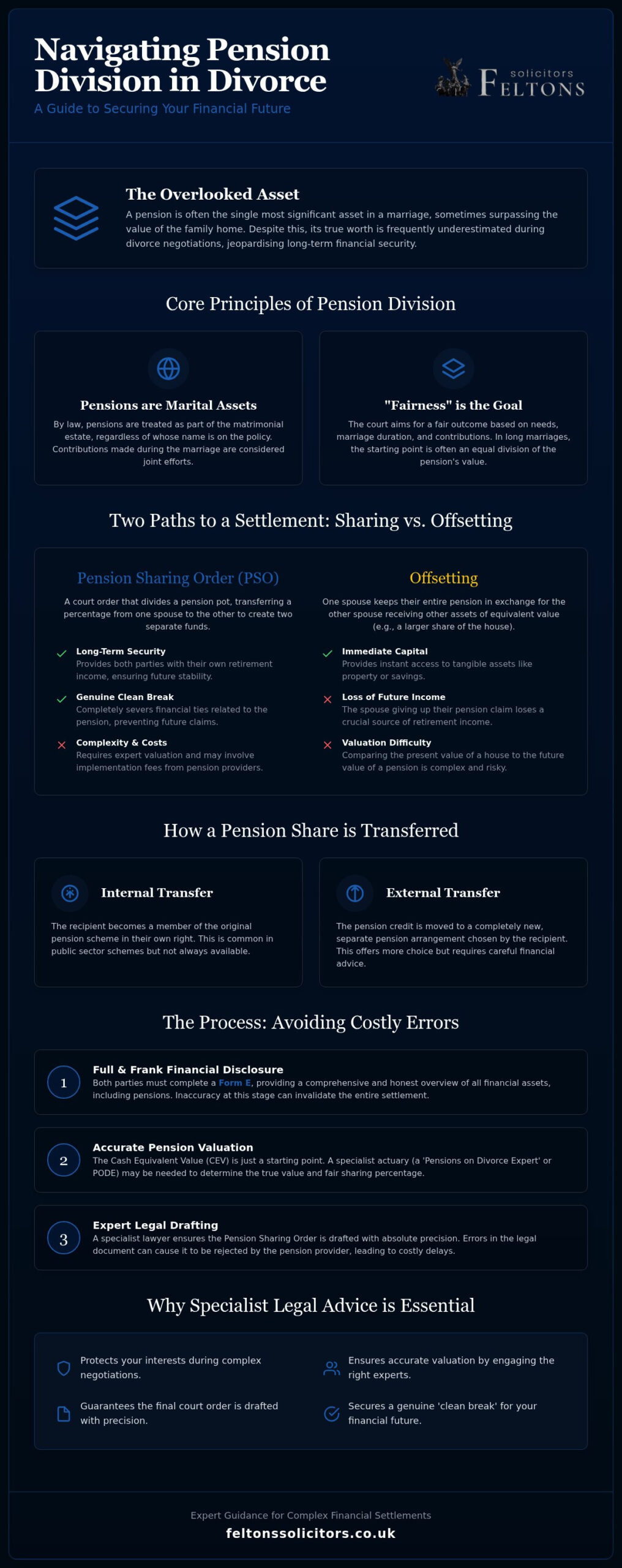
A pension is often the single most significant asset in a marriage, yet it remains the most frequently undervalued during a divorce. While property and savings are easily quantified, the true worth of a retirement fund is often hidden beneath layers of complex actuarial data and shifting legislation. Engaging specialised pension sharing order lawyers is not merely a procedural step; it is a strategic necessity to ensure your future remains secure. You likely feel a profound sense of anxiety regarding your standard of living in later life, especially whilst facing the pressure of acrimonious financial negotiations.

We understand that you want more than just a settlement; you want the peace of mind that comes with a genuine clean break. This guide will provide the clarity you need to manage the intricacies of pension division, from understanding implementation fees to the impact of the rising Normal Minimum Pension Age. We will outline how a legally binding Pension Sharing Order can provide the foundation for your long-term stability. By the end of this article, you will have a clear overview of how professional expertise can protect your interests and help you move forward with confidence.

Key Takeaways

  • Recognise why pensions are treated as essential marital assets and how their value is assessed alongside the family home.
  • Understand the technical differences between internal and external transfers to facilitate a genuine clean break financial settlement.
  • Evaluate the long-term benefits of pension sharing against the immediate appeal of offsetting to protect your retirement income.
  • Engage specialised pension sharing order lawyers to manage complex valuations and ensure your final court order is drafted with absolute precision.
  • Discover how full and frank financial disclosure through Form E prevents costly errors and secures your financial future.

Understanding Pensions as Essential Marital Assets

Pensions are frequently the most significant asset in a matrimonial estate, occasionally even surpassing the value of the family home. Despite this, they’re often overlooked or undervalued during initial discussions. It’s a fundamental legal principle that pensions are marital assets. This remains true regardless of whose name is on the policy or which party made the contributions. Because these funds represent future security rather than immediate cash, they require a methodical approach to valuation. Experienced pension sharing order lawyers ensure that these complex financial vehicles are correctly identified and appraised from the outset of the proceedings.

Distinguishing between different types of retirement provision is vital. Whilst the basic State Pension generally cannot be shared, certain “protected payments” or older entitlement structures might be subject to specific rules. In contrast, private and occupational schemes, including final salary and money purchase arrangements, are fully eligible for division. Achieving a genuine clean break financial settlement usually necessitates a formal Pension Sharing Order. Without this legally binding document, one party may retain a claim against the other’s future income, preventing the finality that most couples seek when they separate.

The Legal Framework for Pension Division in the UK

The legal framework for divorce in England and Wales is primarily governed by the Matrimonial Causes Act 1973. This legislation grants the court broad discretion to redistribute assets to achieve a “fair” outcome. Fairness doesn’t always mean an equal split. The court prioritises the financial needs of both parties and any children involved. They’ll consider the duration of the marriage and the contributions each person made, whether financial or through caring for the family. In long marriages, the starting point is often an equal division of the pension’s value to ensure both parties can maintain a comparable standard of living in retirement.

Why “Ring-fencing” Pre-marital Contributions is Complex

There’s a common misconception that any pension growth occurring before the wedding is automatically excluded from the settlement. This isn’t always the case. Courts often view the total pension pot as matrimonial property if it’s required to meet the basic needs of the lower-earning spouse. Ring-fencing requires precise actuarial evidence to prove which portions of the fund should be treated as non-matrimonial. This is where pension sharing order lawyers provide essential value. We help you navigate these arguments, ensuring that your contributions are protected where possible, or conversely, that you aren’t unfairly deprived of a share in a fund that was built up over many years of partnership.

The Mechanics of a Pension Sharing Order (PSO)

A Pension Sharing Order (PSO) is the legal mechanism that facilitates the transfer of a specified percentage of one party’s pension pot to the other. It’s a precise instrument; the court doesn’t award a fixed sum of money, but rather a “pension credit” calculated as a percentage of the fund’s value at the time of transfer. This process can only begin once the Final Order in the divorce has been granted. Navigating this timeline requires steady oversight from pension sharing order lawyers to ensure the paperwork is served correctly and within the strict legal windows. Whilst many focus on private funds, it is also useful to consult government guidance on State Pension sharing to see if any additional “protected payments” apply to your situation.

Internal vs External Pension Transfers

When a PSO is granted, the recipient must decide where the pension credit will be held. An internal transfer allows the recipient to become a member of the original pension scheme in their own right. This is often common in public sector schemes, though it isn’t always an option. Conversely, an external transfer involves moving the credit into a completely different pension arrangement. Some schemes mandate an external transfer, forcing the recipient to find a suitable provider. This choice has significant long-term implications for your retirement income. Our team at Feltons Solicitors LLP works alongside financial advisors to ensure you understand the specific benefits and risks associated with each path.

The Implementation Period and Provider Fees

Once the pension provider receives the court order and the Final Order, a statutory four-month implementation period begins. During this window, the provider must execute the transfer. It’s a critical phase; any errors in the original drafting of the order can lead to the provider rejecting the document, causing significant delays and additional costs.

You should also be aware of the administrative costs. In 2026, implementation fees typically range from £300 to over £3,500, depending on the complexity of the scheme. These fees are usually shared between the parties or paid by the person receiving the credit. pension sharing order lawyers play a vital role here, ensuring the order is drafted with absolute precision to meet the scheme’s specific requirements. This methodical approach prevents the anxiety of a rejected application and ensures your financial future is secured without unnecessary friction.

Pension Sharing vs. Offsetting: Strategic Considerations

Deciding between a pension sharing order and offsetting is one of the most consequential choices you’ll face during financial proceedings. Offsetting involves one party retaining a larger share of non-pension assets, typically the family home, in exchange for waiving their rights to the other’s retirement fund. Whilst this provides immediate stability and housing security, it inherently sacrifices long-term income. This trade-off requires a sophisticated analysis of your current needs versus your future requirements. Strategic pension sharing order lawyers help you weigh these competing interests to ensure you don’t trade a valuable lifetime income for a short-term asset that may carry high maintenance costs.

You should also be aware of Pension Attachment Orders, formerly known as earmarking, though they are now increasingly rare. These orders don’t provide a genuine clean break; the recipient only receives payments when the pension holder chooses to retire. Furthermore, these payments usually cease if the recipient remarries. Because of these limitations, most modern settlements favour the finality of a sharing order or the pragmatism of offsetting.

When Offsetting is the Pragmatic Choice

For younger couples or those with dependent children, offsetting often emerges as the most practical route. It prioritises the immediate need for a stable home environment and avoids the administrative complexities of transferring pension credits. Calculating a fair offset isn’t a simple pound-for-pound exchange. It involves assessing the “utility” of the money; cash today is often considered more valuable than a pension you can’t access for decades. To achieve a fair result, we often use actuarial calculations to determine how much cash is required to “buy out” a specific percentage of a pension, ensuring the settlement remains equitable for both parties.

The Dangers of Misvaluing Pension Assets

A significant risk in divorce negotiations is assuming that the Cash Equivalent Value (CEV) provided by a pension scheme represents its true worth. This is rarely accurate, especially with defined benefit or “final salary” schemes. A £100,000 cash sum in a bank account is not equal to a £100,000 defined benefit pension pot. The cash is liquid and taxable only upon spending, whereas the pension represents a guaranteed, inflation-linked income for life that is subject to different tax treatments. A Pension on Divorce Expert (PODE) is a neutral specialist actuary or financial professional instructed to provide a comprehensive report on the true value and fair division of pension assets. Expert pension sharing order lawyers identify these valuation gaps early, preventing you from agreeing to a settlement that looks fair on paper but leaves you financially disadvantaged in the years to come.

Pension Sharing Order Lawyers: Strategic Guidance for Your Financial Future

The Valuation and Disclosure Process: Avoiding Costly Errors

Full and frank financial disclosure is a mandatory requirement in any divorce proceeding, typically facilitated through the completion of Form E. This document demands absolute honesty regarding all financial interests, including every pension scheme you’ve ever contributed to. Failing to disclose these assets is a grave error that can lead to the court reopening your case years later or even imposing penalties for contempt. Experienced pension sharing order lawyers ensure that every stone is unturned, protecting you from the risks of non-disclosure and ensuring the final settlement is based on a complete financial picture.

The starting point for any valuation is the Cash Equivalent Value (CEV) provided by the pension scheme administrator. Whilst the CEV gives a snapshot of the fund’s current worth, it’s rarely the final word in a fair negotiation. It represents the amount the scheme would pay to transfer your benefits elsewhere, not necessarily the value of the benefits you’d receive if you stayed. For many, relying solely on this figure leads to a settlement that significantly undervalues their future security.

The Role of the Pension On Divorce Expert (PODE)

In cases involving complex or high-value schemes, a standard CEV is almost always insufficient. A Pension On Divorce Expert (PODE) is a neutral actuary or specialist financial professional instructed to provide a comprehensive report. In 2026, a PODE report typically costs between £750 and £3,000, but this investment is often vital. The report provides a more accurate picture of future income, accounting for inflation-linked benefits and tax implications that a simple CEV ignores. We help you conduct a cost-benefit analysis to determine if commissioning an expert report is the right strategic move for your specific circumstances.

Managing Defined Benefit vs. Defined Contribution Schemes

Public sector pensions, such as those for the NHS, Police, or Armed Forces, are “Defined Benefit” schemes and are notoriously difficult to value. These schemes focus on “income equality” in retirement rather than “capital equality.” Simply splitting the capital value of an NHS pension 50/50 might result in one party receiving a much lower monthly income than the other due to different retirement ages or tax brackets. Conversely, Defined Contribution schemes like SIPPs or SSASs are more straightforward but require careful management to ensure the underlying investments aren’t liquidated at a loss during the transfer. If you are concerned about the accuracy of your pension valuations, contact our team at Feltons Solicitors LLP for a discreet consultation to protect your financial interests.

How Specialist Pension Sharing Order Lawyers Protect Your Interests

The final stage of securing your financial future is the translation of complex actuarial data into a robust, enforceable legal document. Specialist pension sharing order lawyers provide the bespoke drafting necessary to ensure that your intentions are accurately reflected in the final court order. A minor clerical error or an ambiguous clause can lead to a pension provider rejecting the order during the implementation period, causing months of delay and additional costs. By meticulously managing the transition from financial disclosure to a final Consent Order, we ensure that your settlement is not just fair in principle, but functional in practice.

A legally binding Consent Order is the only way to achieve a genuine clean break financial settlement. This document effectively closes the door on future claims, providing the certainty you need to rebuild your life. Our role involves more than just filling in forms; we act as a strategic shield, ensuring that the percentage of the pension being shared is calculated to your maximum advantage. We oversee every interaction with the pension scheme administrators, removing the burden of technical correspondence from your shoulders during an already stressful period.

The Boutique Advantage: Tailored Legal Architecture

High-volume law firms often treat pension division as a secondary administrative task. This approach can overlook the nuanced structures of modern retirement funds and the profound human impact of these decisions. At Feltons Solicitors LLP, we offer a boutique alternative that prioritises personal rapport and privacy. We organise your financial disclosure to project clarity and strength, ensuring that your position is articulated with quiet confidence during negotiations. This tailored approach allows us to handle complex matters whilst maintaining the supportive, discreet presence you require during a sensitive life transition.

Securing Your Future with Feltons Solicitors LLP

Our firm was established in 2010 by Paula Felton with a clear mission: to combine modern efficiency with traditional professional integrity. We provide a calm, steady hand in the face of acrimonious negotiations, focusing on pragmatic solutions that avoid unnecessary litigation where possible. However, should your case require robust representation, our expertise in high-net-worth matters ensures your interests are protected with absolute diligence.

Early legal intervention is the most effective way to prevent costly valuation errors and secure a genuine clean break. To understand how we can safeguard your broader portfolio, you may wish to consult our expert divorce and financial arrangements lawyer services. We act as your trusted advisor, ensuring that your technical legal needs are met without losing sight of the human impact of our work. Our goal is to move you from the uncertainty of initial disclosure to the security of a final settlement that protects your lifestyle in retirement.

Securing Your Retirement with Expert Precision

Securing your retirement requires more than a simple division of assets; it demands a methodical strategy that accounts for the nuances of your specific pension schemes. We’ve explored why standard valuations often fall short and how the choice between sharing and offsetting can dictate your financial comfort for decades. By prioritising a genuine clean break, you can step into your future without the lingering anxiety of unresolved financial ties. You deserve a settlement that reflects the true value of your contributions and provides a stable foundation for the years ahead.

Engaging specialised pension sharing order lawyers is the most effective way to manage these complexities whilst protecting your long-term interests. Feltons Solicitors LLP provides a boutique service characterised by high-end reliability and a people-first philosophy. We’re committed to delivering pragmatic, expert advice in even the most complex financial litigation. If you’re ready to secure your financial architecture with a trusted advisor, please contact Feltons Solicitors LLP for a discreet consultation on your financial arrangements. You don’t have to face these negotiations alone; we’re here to provide the calm, steady presence you need to move forward with absolute confidence.

Frequently Asked Questions

What is a Pension Sharing Order (PSO)?

A Pension Sharing Order is a formal court instruction that transfers a specific percentage of one party’s pension pot to their former spouse or civil partner. It’s designed to facilitate a genuine clean break financial settlement by creating a separate pension credit for the recipient. This credit is held in either the original scheme or a new arrangement. Unlike other methods, it provides immediate clarity and independence for both parties’ future retirement planning.

Can I get a Pension Sharing Order after my divorce is finalised?

You can apply for a Pension Sharing Order after your divorce is finalised, provided you haven’t remarried and a court hasn’t already dismissed your financial claims. However, it’s significantly more complex to negotiate these arrangements once the Final Order is granted. Delaying this process can leave your future financial security at risk. It’s always advisable to resolve pension division alongside the divorce proceedings to ensure a comprehensive and legally binding settlement is achieved.

How much does a pension sharing order cost in the UK?

The total cost of a pension sharing order varies based on complexity. As of April 2026, the court fee for a financial consent order is £53. You must also account for pension scheme implementation fees, which typically range from £300 to over £3,500 depending on the provider. If your situation involves complex defined benefit schemes, an expert actuary report may cost between £750 and £3,000. These figures exclude the professional fees for legal drafting and advice.

Are all pensions included in a divorce settlement?

Most pension assets are considered marital property, regardless of whether they were started before the marriage. This includes private pensions, occupational schemes, and Self-Invested Personal Pensions (SIPPs). Whilst the court has the discretion to ring-fence pre-marital contributions, they often include the entire fund if it’s necessary to meet the lower-earning party’s needs. Every scheme must be disclosed during the valuation process to ensure the final settlement is based on accurate data.

What happens if my ex-spouse refuses to disclose their pension value?

If an ex-spouse refuses to disclose their pension value, the court can intervene to enforce full and frank disclosure. Both parties must complete a Form E, which carries a duty of honesty to the court. Failure to comply can result in the court drawing adverse inferences about their wealth or issuing costs orders against them. Experienced pension sharing order lawyers can also apply for a court order to obtain the necessary information directly from the pension provider.

How long does it take for a Pension Sharing Order to be implemented?

Once a pension provider receives the sealed court order and the Final Order, they have a statutory four-month period to implement the transfer. However, the entire process usually takes longer. You must first obtain valuations, negotiate the percentage, and wait for court approval. If the paperwork contains errors, the provider may reject it, restarting the timeline. Methodical legal oversight is vital to ensure the documentation is correct the first time to avoid these delays.

Do I need a lawyer for a Pension Sharing Order?

Whilst you aren’t legally required to use a solicitor, the technical nature of pension division makes professional guidance essential. Pension sharing order lawyers ensure that the order is drafted with the specific wording required by scheme administrators. They also help identify if a Cash Equivalent Value (CEV) accurately reflects the fund’s true worth. Without this expertise, you risk accepting a settlement that leaves you significantly disadvantaged or failing to secure a legally enforceable clean break.

Can I share my State Pension with my ex-partner?

The rules for sharing a State Pension depend on when you reached retirement age. For those reaching pension age after April 2016, the New State Pension generally cannot be shared. The main exception is a protected payment, which represents an entitlement above the full rate. If you reached retirement age before this date, different rules regarding the Additional State Pension may apply. It’s important to check your specific entitlement with the Department for Work and Pensions.