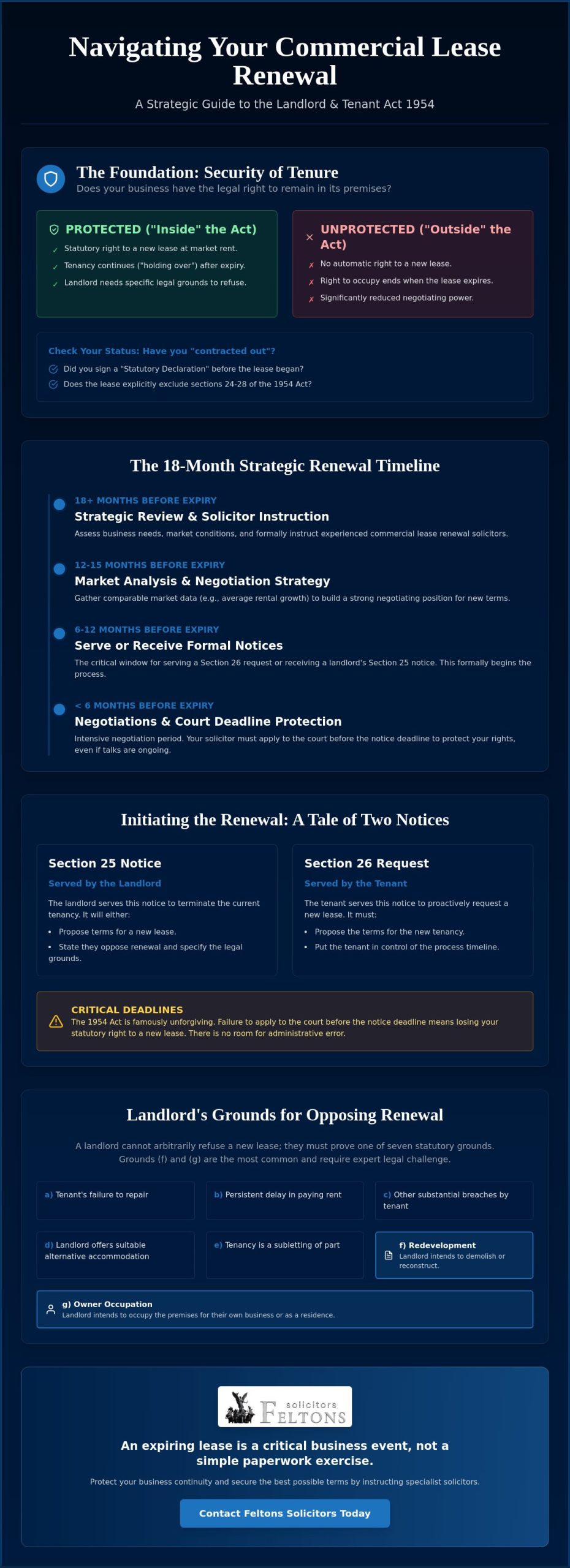

Overseas Entity Beneficial Owner Registration: A Guide for UK Property Owners in 2026

Overseas Entity Beneficial Owner Registration: A Guide for UK Property Owners in 2026

Did you know that when the Register of Overseas Entities was established, over 12,000 entities failed to meet their initial transparency deadlines, leaving their UK property interests vulnerable to severe legal restrictions? You likely recognise that holding international assets requires a high degree of diligence, yet the intricacies of overseas entity beneficial owner registration can feel unnecessarily burdensome. It’s understandable to worry about the risk of criminal prosecution or the prospect of HM Land Registry freezing a critical transaction due to a filing error.

This guide offers a steady, expert hand to help you navigate these regulatory waters with confidence. We’ll provide the clarity you need to ensure your registration is handled correctly, protecting your reputation and your investments from the substantial fines now being enforced. We’ll outline the current 2026 fee structures, including the £234 registration and update costs, the essential role of UK-regulated verification agents, and the methodical steps required to achieve seamless compliance with Companies House.

Key Takeaways

  • Understand the essential legal requirements under the Economic Crime Act to ensure your UK property titles remain secure and tradable.
  • Identify your Registrable Beneficial Owners by applying the specific 25% threshold for shares and voting rights within your corporate structure.
  • Learn why mandatory verification by a UK-regulated agent is a critical prerequisite for a valid overseas entity beneficial owner registration.
  • Navigate the strict 14-day window for annual update statements to prevent the risk of frozen assets or substantial financial penalties.
  • Recognise how professional legal oversight bridges the gap between complex international entities and current UK compliance standards.

The legal framework governing foreign-owned property in the United Kingdom has undergone a profound transformation. At the heart of this change is the Register of Overseas Entities (ROE), established by the Economic Crime (Transparency and Enforcement) Act 2022. This legislation mandates that any foreign entity wishing to own land in the UK must disclose its true controllers. By 2026, the regulatory climate has shifted from initial education to strict enforcement. Authorities now demand absolute precision in every overseas entity beneficial owner registration, viewing even minor discrepancies as potential compliance failures.

Compliance is no longer a one-time hurdle. The 2026 landscape requires more rigorous data accuracy than in previous years, reflecting a broader push for transparency in global capital flows. For property owners, this means that the information held by Companies House must be verified and updated with meticulous care. Failure to do so doesn’t just result in administrative letters; it can lead to daily fines of up to £2,500 and, in the most serious cases, criminal liability for the entity’s officers. These sanctions are designed to ensure the register remains a reliable source of truth for government agencies and the public alike.

Which Entities Fall Under the Scope?

An “overseas entity” is broadly defined as any legal person, such as a corporation, partnership, or trust, that is governed by the law of a country or territory outside the UK. The scope is notably retrospective. In England and Wales, the requirement applies to land acquired on or after 1 January 1999. In Scotland, the threshold date is 8 December 2014. Whilst certain exemptions exist, they are rarely applicable in practice for commercial or residential holdings. Most international structures holding UK property will find themselves firmly within the remit of the Act.

The Role of Companies House and HM Land Registry

The relationship between Companies House and HM Land Registry is now inextricably linked. When a successful overseas entity beneficial owner registration is completed, the entity is issued a unique Overseas Entity ID. Think of this ID as a “licence” to deal with UK land. Without it, HM Land Registry is legally prohibited from registering any “qualifying disposition” of the property. This means your ability to sell, lease for more than seven years, or even grant a legal charge, such as a mortgage, will be entirely blocked. A valid registration is the key that unlocks your asset’s liquidity; without it, your property transactions will simply stall at the final hurdle. For those entities planning to actively develop their property, this legal compliance often goes hand-in-hand with technical requirements, such as obtaining transport planning reports from specialists like mltraffic.co.uk to support planning applications.

Identifying Registrable Beneficial Owners (RBOs)

Identifying who truly controls an offshore structure is the most technically demanding aspect of overseas entity beneficial owner registration. It isn’t always a straightforward matter of looking at a share certificate. The law sets out specific tests to ensure that those with genuine power cannot remain hidden behind layers of corporate paperwork. According to the official government guidance, an individual or legal entity is registrable if they meet any of the following conditions:

  • Holding more than 25% of the shares in the entity.
  • Holding more than 25% of the voting rights.
  • Having the right to appoint or remove a majority of the board of directors.

Beyond these numerical thresholds, a “catch-all” condition applies to anyone who exercises significant influence or control. This might involve veto rights over major decisions or the ability to direct the entity’s activities through informal arrangements. If you’re unsure how these tiers apply to your specific portfolio, seeking professional legal counsel can provide the reassurance that your filings are accurate and defensible.

The Impact of Trust Structures

Trusts are a primary focus for the 2026 transparency rules. If an overseas entity is held by a trust, the trustees are typically considered registrable beneficial owners. However, the disclosure requirements don’t stop there. You’ll also need to provide details about the settlor, beneficiaries, and any protectors who have the power to influence the trust’s administration. This level of transparency is mandatory for discretionary trusts, even if no distributions have been made to beneficiaries yet.

Indirect Ownership and Parent Undertakings

Many properties are held through a chain of companies. If an individual holds their interest through a “parent undertaking” that is itself a registrable entity, the chain must be traced until a registrable person or a qualifying legal entity is found. This prevents “shell company” loops from obscuring the ultimate owner. Collaborative control, where two or more people act together to meet the 25% threshold, also triggers registration. These “joint interests” require a careful analysis of shareholder agreements and voting patterns.

In rare cases where no individual meets the criteria after exhaustive searches, the entity must instead register its managing officers. This includes directors, managers, or company secretaries. It’s a “fallback” position that ensures there’s always a named person accountable for the entity’s UK property interests. This step should only be taken when you’ve documented that no other beneficial owners exist, as Companies House may request evidence of your due diligence.

For investors based in the Gulf region, you can explore company formation with Ali Al-Masardi Law Firm to ensure your entity is correctly structured from its inception, making subsequent UK compliance much smoother.

The Verification Process: Why Professional Assurance is Essential

The process of overseas entity beneficial owner registration is not a self-service administrative task. Under the 2022 Act, self-certification is strictly prohibited. Every piece of information submitted to Companies House must first be scrutinised and verified by a UK-regulated agent. This requirement ensures that the data on the register is accurate and legally robust. Regulated agents, such as solicitors or qualified accountants, must provide an “agent assurance code” to prove they’ve conducted the necessary due diligence. This rigorous oversight explains why thousands of entities have historically struggled with their filings; as of January 2023, only 19,510 out of 32,440 overseas entities had successfully declared their beneficial owners.

This verification is a heavy responsibility. If an agent fails to perform rigorous checks, Companies House has the power to revoke their assurance code, effectively barring them from the register. At Feltons Solicitors LLP, we position ourselves as a calm, steady presence for clients facing these complex requirements. We understand that for many international owners, the requirement for transparency must be balanced with a need for discretion. Our approach prioritises a boutique level of care, ensuring that while your compliance is absolute, your personal information is handled with the highest standard of professional integrity.

Acceptable Sources of Evidence

Verifying ownership often requires looking beyond simple company books. We rely on independent, third-party registries to confirm the standing of an entity and its controllers. This becomes complex in jurisdictions without public registers or where corporate records are not digitally accessible. In these instances, we work closely with international legal counsel to obtain certified translations of constitutive documents. It’s vital to remember that these verification checks must be conducted no more than 3 months before the date of the application. This ensures that the information provided to Companies House is current and reflects the present reality of the entity’s control structure.

Managing the Risks of Public Disclosure

Privacy is a significant concern for many property owners. Whilst the ROE is a public register, not all information is visible to the world. Specific details, such as a beneficial owner’s residential address or full date of birth, are generally withheld from public view. However, if a person is at serious risk of violence or intimidation, they may apply for “protected status”. This prevents their information from being disclosed even in a limited capacity. Professional guidance is vital here. We help you organise your disclosure to maintain maximum privacy whilst ensuring you remain fully compliant with your statutory obligations.
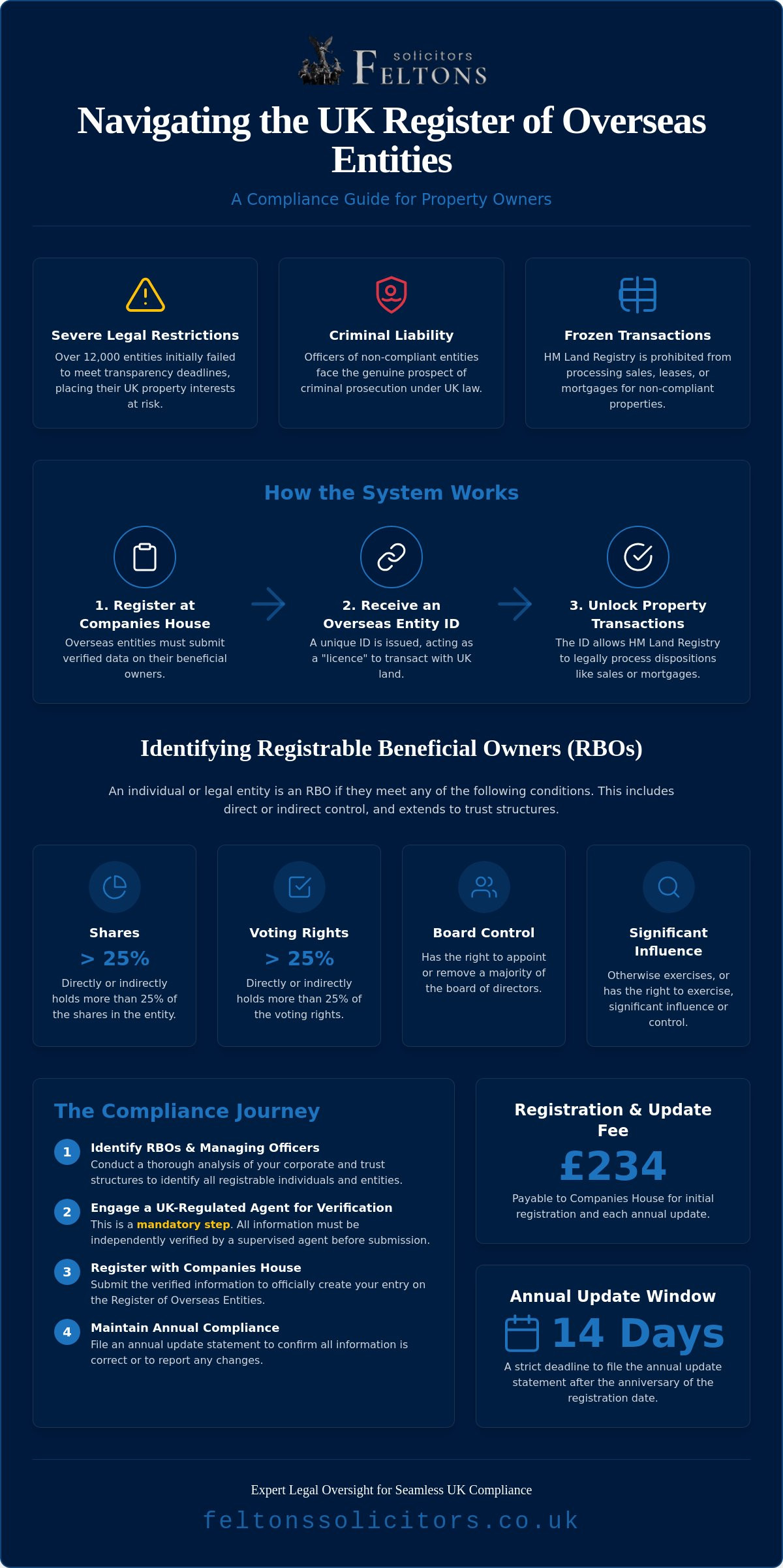
Overseas Entity Beneficial Owner Registration: A Guide for UK Property Owners in 2026

Maintaining Compliance: Annual Updates and Removals

Securing your initial Overseas Entity ID is a significant milestone, but it does not mark the end of your regulatory obligations. The overseas entity beneficial owner registration is a live requirement that demands ongoing attention. Every year, an overseas entity must file an update statement to confirm that the information held by Companies House remains accurate. This statement is due no later than 14 days after the anniversary of your initial registration. Even if your ownership structure has remained entirely static over the past twelve months, the filing is still mandatory. Since May 1, 2024, the annual update fee has stood at £234, reflecting the increased resources Companies House now dedicates to maintaining the register’s integrity.

A critical risk for many property owners is the “stale” or expired ROE ID. If the annual update is missed, the entity’s status on the public register will change to “undated,” effectively invalidating the Overseas Entity ID. This creates an immediate block at HM Land Registry. Imagine the stress of a sensitive conveyancing transaction stalling at the final hour because your registration is out of date. Buyers and lenders will typically refuse to proceed until the compliance gap is closed. Proactive management of your international portfolio data is the only way to prevent these avoidable delays. If you need to register an overseas entity or manage an upcoming annual update, Feltons Solicitors LLP provides the steady oversight required to keep your status flawless.

Updating Beneficial Owner Information

When changes in control occur, such as the transfer of shares or the appointment of a new director, these must be recorded during the update process. Any new beneficial owner must undergo the same rigorous verification by a UK-regulated agent that was required during the initial registration. Handling the death or insolvency of an individual RBO requires particular sensitivity and legal precision. In these cases, the entity must identify the successor or the person who has stepped into a position of significant influence to ensure the register remains transparent and compliant with the 2022 Act.

Applying for Removal from the Register

If an overseas entity no longer owns any “qualifying estate” in the UK, it may apply to be removed from the register. This process involves a fee of £706 and requires a formal application to Companies House. However, you cannot simply walk away. There is a persistent “duty to deliver” information even after an entity is dissolved or the property is sold. You must ensure that all historical annual updates are complete and that any changes in beneficial ownership up to the point of the property’s disposal have been correctly verified. This methodical approach ensures a clean exit and protects the entity’s officers from future legal disputes.

Feltons Solicitors LLP acts as a vital bridge between complex international corporate structures and the specific, often rigid, demands of UK law. We understand that for offshore trustees and directors, the administrative burden of overseas entity beneficial owner registration can feel like an unnecessary distraction from core business activities. Our role is to absorb that complexity, providing a clear path to compliance that respects your time and your privacy. As a boutique residential property law firm, we prioritise personal connection over high-volume processing. This individualised attention ensures that your registration is not merely a box-ticking exercise, but a robust shield for your high-value UK assets.

The current regulatory environment leaves no room for ambiguity. By positioning ourselves as a calm, steady presence, we help you manage the detailed disclosure requirements that international banks and the Land Registry now expect as standard. We work closely with your existing professional advisors to ensure that every filing is technically perfect. This collaborative approach reduces the risk of transaction blocks and protects your officers from the threat of personal liability. Our focus is on providing high-end reliability, allowing you to hold UK property with absolute confidence in your legal standing. Where your portfolio includes leasehold interests, our leasehold enfranchisement experts can also advise on extending your lease or acquiring the freehold to further strengthen your long-term property rights. For those managing leasehold assets from abroad, our dedicated guidance on leasehold extension for overseas landlords explains how the 2024 reforms and ROE compliance requirements intersect to protect your investment.

Dispute Resolution and Contentious Registration

Internal disagreements regarding who qualifies as a registrable beneficial owner can occasionally arise, particularly within multi-layered trusts or family offices. These situations require more than just administrative filing; they need expert mediation and sound legal judgement. We draw on our deep experience as contentious probate solicitors to resolve complex ownership questions, especially when property is held within an estate or subject to conflicting claims. Whether you’re facing a challenge from a beneficiary or navigating a commercial ownership block, engaging experienced dispute resolution solicitors can help you find a path forward that avoids the drain of protracted litigation whilst maintaining your standing on the register and protecting the entity’s interests.

A Holistic Approach to Property Law

Compliance shouldn’t exist in a vacuum. We ensure that your overseas entity beneficial owner registration aligns perfectly with your long-term estate planning goals and wider tax considerations. For our corporate clients, we provide strategic advice that mirrors the meticulous standard found in leading commercial litigation firms UK. This protects your entity from transparency risks that could lead to future disputes or legal challenges. By integrating ROE compliance into a broader legal strategy, we help you secure your UK property interests for the long term. We invite you to contact us today to discuss how we can support your international portfolio with the discretion and professional integrity it deserves.

Securing Your UK Property Interests for the Future

The regulatory landscape for international property owners is undoubtedly more demanding than in years past. Success requires more than just an initial filing; it necessitates a commitment to annual diligence and absolute transparency. By recognising the importance of correct identification and adhering to the strict 14-day update window, you protect your assets from the risk of frozen transactions and significant financial penalties. Maintaining a valid overseas entity beneficial owner registration is now the fundamental cornerstone of holding UK land through a foreign structure.

At Feltons Solicitors, we provide the specialist expertise in international property law required to handle even the most complex verification cases. Our boutique approach ensures direct partner involvement in your matters, offering a level of discreet, high-standard care that larger firms often struggle to replicate. We take pride in being a steady, dependable partner for offshore trustees and directors alike. Contact Feltons Solicitors for expert assistance with your overseas entity registration to ensure your portfolio remains fully compliant and your property rights are robustly protected. You’re in capable hands, and we’re here to guide you through every step of the process with quiet confidence.

Frequently Asked Questions

What is the deadline for overseas entity beneficial owner registration?

Registration is a mandatory requirement for any overseas entity that currently holds or intends to acquire UK property. Whilst the initial transition period for existing owners ended on 31 January 2023, new entities must register before applying to HM Land Registry. Failure to meet these timelines results in an immediate block on your ability to deal with the land, making compliance an urgent priority for any active property interests.

Can a solicitor verify an overseas entity for the register?

Yes, a solicitor who is a UK-regulated agent is authorised to perform the mandatory verification checks required for the register. This professional assurance is a legal prerequisite, as Companies House will not accept self-certified applications. At Feltons, we provide this service with a focus on precision, ensuring that all beneficial ownership data is verified according to the strict standards set by the 2022 Act.

What are the penalties for failing to register a beneficial owner?

Non-compliance carries severe consequences, including civil financial penalties that start at £10,000 and can increase based on the property’s value. You may also face daily fines of up to £2,500 for ongoing failure to register. In the most serious cases, officers of the entity can face criminal prosecution, resulting in prison sentences of up to five years or unlimited fines, alongside strict property transfer blocks.

Does the Register of Overseas Entities apply to residential property only?

No, the registration requirement applies to both residential and commercial land interests in the UK. Any “qualifying estate,” which includes freehold titles and leaseholds granted for more than seven years, falls within the scope of the legislation. Whether you hold a single luxury apartment or a vast commercial portfolio, your overseas entity beneficial owner registration must be current to ensure your legal title remains secure.

How much does it cost to register an overseas entity in the UK?

As of May 2024, the Companies House fee for initial registration is £234. This same fee of £234 applies to your mandatory annual update statements. If you eventually dispose of all your UK property and wish to be removed from the register, the application for removal fee is £706. These costs are separate from the professional fees charged by your UK-regulated verification agent.

What information is made public about beneficial owners?

The public register displays the name, correspondence address, and the specific nature of the beneficial owner’s control over the entity. For your privacy, sensitive data such as your home address and full date of birth are not visible to the general public. However, this information remains accessible to law enforcement agencies and HMRC to maintain the transparency standards intended by the Economic Crime Act.

Can I sell my UK property if my overseas entity is not registered?

You cannot legally complete a sale, lease, or mortgage of UK land if your entity is not correctly registered with Companies House. HM Land Registry will place a restriction on your property title that prevents the registration of any “qualifying disposition” without a valid Overseas Entity ID. This mechanism ensures that overseas entity beneficial owner registration is completed before any capital can be extracted from the asset.

How often do I need to update my overseas entity registration?

You must file an update statement at least once every twelve months to maintain a valid registration status. This statement must be submitted within 14 days of the anniversary of your initial registration date. Even if no changes have occurred within your corporate structure, you are still legally required to confirm the accuracy of the existing information to avoid your ID being marked as “expired.”

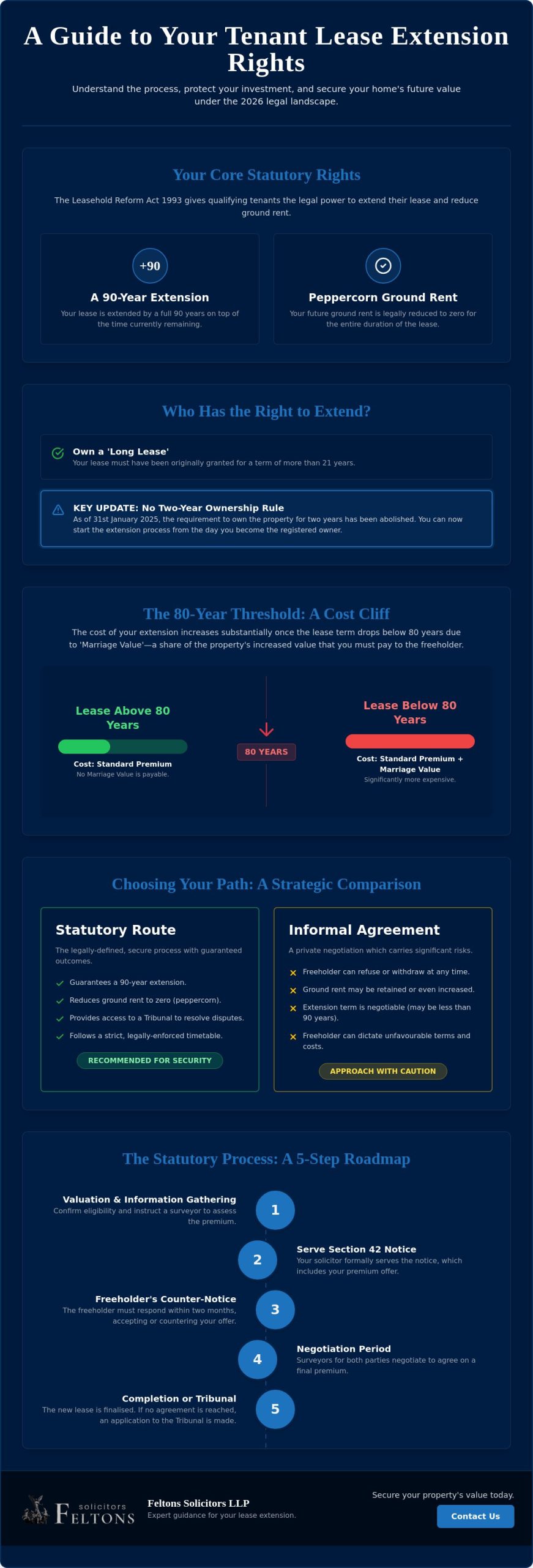
Tenant Lease Extension Rights: A Comprehensive Guide for 2026

Tenant Lease Extension Rights: A Comprehensive Guide for 2026

A lease extension is no longer just a complex legal chore; it is a strategic financial right that grants you permanent security and absolute control over your home’s future value. It’s entirely natural to feel overwhelmed by the conflicting advice surrounding the Leasehold and Freehold Reform Act 2024 and the more recent Renters’ Rights Act 2025. You may be concerned about the notorious 80-year trap or feel anxious about approaching an uncooperative freeholder who seems to hold all the cards. Understanding your tenant lease extension rights is the essential first step toward protecting your investment from unnecessary costs and market volatility.

This comprehensive guide will help you navigate the 2026 legal landscape with confidence. You’ll discover how the abolition of the two-year ownership rule has accelerated the process for new buyers and why the current delay in marriage value reforms makes your timing more critical than ever. We’ll provide a clear roadmap through the statutory process, compare formal notices against informal deals; and offer the expert clarity you need to ensure your property remains a secure, high-value asset for years to come.

Key Takeaways

  • Understand how the 1993 Act provides the legal foundation for adding 90 years to your lease whilst reducing ground rent to a peppercorn.
  • Confirm your eligibility under modernised criteria, including your tenant lease extension rights as a new owner following the abolition of the two-year ownership rule.
  • Evaluate the critical differences between the secure statutory route and informal agreements to ensure your investment remains protected by legal safeguards.
  • Recognise the strategic urgency of the 80-year threshold and understand why extending before this point is vital for avoiding costly marriage value premiums.
  • Master the Section 42 notice process to formally trigger your extension and ensure your opening premium offer is professionally validated.

Understanding Your Statutory Right to a Lease Extension

The Leasehold Reform, Housing and Urban Development Act 1993 serves as the bedrock for most flat owners in England and Wales. It transformed what was once a matter of landlord discretion into a powerful, non-negotiable legal entitlement. Under this legislation, a qualifying leaseholder has the statutory power to compel their freeholder to grant a 90-year extension on top of their current remaining term. This process isn’t merely about adding time; it also mandates that the ground rent is reduced to a “peppercorn” value, effectively making it zero for the remainder of the lease. This protection is vital because it prevents freeholders from arbitrarily refusing to extend or demanding escalating ground rents that could make your property difficult to sell.

This modern framework evolved from earlier legislation like the Leasehold Reform Act 1967, which initially focused on houses. Today, your tenant lease extension rights provide a predictable and secure path to maintaining your home’s equity. By following the formal statutory route, you aren’t at the mercy of a landlord’s whims; you’re exercising a right that the law strictly enforces.

The Definition of a Qualifying Tenant

To exercise these rights, you must be a “qualifying tenant.” This typically means you hold a “long lease,” which is defined as a lease originally granted for a term exceeding 21 years. It’s a common misconception that the number of years left on your lease affects your right to qualify. Even if you only have 30 years remaining, you’re still eligible to start the process. However, there are specific exclusions to keep in mind. Business or commercial leases are generally excluded; properties owned by charitable housing trusts where the flat is part of the charity’s functions don’t qualify; and if the freeholder is the Crown or a specific National Trust property, different rules may apply.

The 2025 Rule Change: Abolition of the Two-Year Ownership Requirement

Perhaps the most significant shift in recent years occurred on 31 January 2025. Previously, leaseholders were required to own their property for at least two years before they could serve a formal Section 42 notice. This often left new buyers in a vulnerable position, forced to wait whilst their lease ticked closer to the expensive 80-year threshold. This requirement has now been abolished. You can now initiate your tenant lease extension rights as soon as you’re the registered owner at HM Land Registry. This change has fundamentally streamlined the conveyancing process, allowing buyers to secure their investment immediately after completion rather than waiting for a two-year window to open.

For those purchasing a flat with a lease nearing 80 years, this reform is a game-changer. In the past, buyers had to rely on the seller “assigning” the benefit of a notice, which was a procedurally delicate task. Now, the path is direct. You can factor the extension cost into your initial purchase plans and act without delay. This immediate eligibility provides a level of certainty that was previously missing from the market, ensuring that your asset’s value is protected from the moment you receive the keys. For those requiring dedicated conveyancing support during this process, Triangle Legal Services Limited offers specialised assistance to ensure all legal transfers are executed correctly.

Eligibility Criteria: Do You Have the Right to Extend?

Determining your eligibility is the first practical step in exercising your tenant lease extension rights. Whilst the law is generally on your side, the property must meet the definition of a residential leasehold flat held under a long lease. This typically encompasses any lease originally granted for a term exceeding 21 years. You must also identify the “competent landlord,” who is the party with a sufficiently long interest in the property to grant the 90-year extension. Detailed guidance on the initial steps for Leasehold property owners is available through official channels to help you confirm these basic facts.

It’s vital to distinguish between flats and houses. Owners of leasehold houses operate under different legislation, which often provides a choice between a 50-year extension or the right to buy the freehold entirely. Unlike the 90-year extension for flats, a house extension may allow the landlord to review the ground rent after the original term ends. This distinction is one of the most common areas of confusion for homeowners; the statutory path for flats is generally more robust in its ground rent protections.

Shared ownership leaseholders face unique hurdles. In most cases, you cannot access the statutory lease extension process unless you have “staircased” to 100% ownership. If you own less than the full share, you are usually restricted to informal negotiations with your housing association. These voluntary deals often lack the peppercorn rent protections found in the statutory route, making the timing of your staircasing a strategic priority.

Property Types and Specific Rights

Property types also dictate your strategy. Purpose-built flats usually follow a standard path; however, converted Victorian or Edwardian houses can present complexities if the building is mixed-use. If the commercial element of your building, such as a ground-floor shop, exceeds 25% of the total internal floor area, it may disqualify the group from collective enfranchisement. Individual tenant lease extension rights for the residential flats usually remain intact even in these scenarios, provided the flat itself remains a private residence.

Identifying Potential Disqualifiers

Certain disqualifiers can stall your progress. A landlord might legally oppose an extension if they can prove they intend to repossess the property for redevelopment, though this only applies if the lease is within five years of expiry. Being in significant breach of your lease terms, such as unauthorised structural alterations or substantial rent arrears, can also complicate your standing. Consulting a specialist residential property law firm early ensures that these potential roadblocks are identified before you commit to valuation and notice costs. Taking a proactive approach allows you to resolve minor disputes and proceed with the expert guidance on leasehold matters you deserve.

The Statutory Route vs Informal Agreements: A Strategic Comparison

Choosing between the statutory route and an informal negotiation is a pivotal decision for any leaseholder. Your tenant lease extension rights are most robustly protected under the formal statutory framework, which guarantees a 90-year extension and a mandatory reduction of ground rent to zero. Whilst the informal route may appear faster or cheaper initially, it lacks the stringent legal safeguards that prevent landlords from inserting unfavourable clauses. By exercising your statutory right to extend your lease, you ensure that the freeholder cannot arbitrarily refuse your request or demand an escalating ground rent that might hinder a future sale.

Landlords often favour informal agreements because they allow for the retention of ground rent income or the introduction of “modern ground rent” reviews. These reviews can cause the premium to appear lower today whilst creating a significant financial burden for you or a future buyer. In a statutory extension, the law is clear: the ground rent must become a peppercorn. This transparency is often absent in private deals, where hidden fees or variations to the lease terms can be slipped into the fine print. Without the 1993 Act’s protection, you’re essentially entering a private contract where the landlord holds the majority of the leverage.

Why Legal Certainty Trumps Short-Term Speed

The statutory process provides a structured timeline that prevents freeholders from “stalling” to gain a tactical advantage. Once a Section 42 notice is served, the landlord must respond within a fixed period, usually two months. If a dispute arises over the premium or the terms, you have the right to apply to the First-tier Tribunal (Property Chamber), formerly known as the Leasehold Valuation Tribunal. This independent body ensures that the price you pay is fair and based on established valuation principles. This level of protection ensures that the new lease doesn’t contain unfavourable variations that could complicate your mortgage or a future conveyance.

  • Fixed Deadlines: Landlords must adhere to statutory timeframes for counter-notices.
  • Tribunal Oversight: Access to independent adjudication if the premium cannot be agreed.
  • Lease Integrity: Protection against the introduction of new, onerous lease obligations.

When an Informal Deal Might Be Pragmatic

There are rare scenarios where a friendly or resident-controlled freeholder offers genuinely better terms through an informal route. This might occur in small blocks where all parties are keen to avoid the administrative costs of the formal process. However, even in the most amicable situations, it’s vital to have a solicitor review any “private” offer before you sign. They’ll check for hidden “doubling” ground rent clauses or changes to service charge structures that could prove costly. Whilst informal deals may seem more cost-effective at the outset, they often lead to substantial long-term property devaluations if the resulting lease contains non-standard or onerous terms. Working with leasehold enfranchisement experts ensures you have the specialist knowledge to evaluate any offer against the protections the statutory route provides.

Tenant Lease Extension Rights: A Comprehensive Guide for 2026

Strategic Timing and the Impact of the 80-Year Threshold

The 80-year mark is the most significant milestone in leasehold ownership. Once a lease drops below this threshold, your tenant lease extension rights become significantly more expensive to exercise due to a concept known as “marriage value.” In simple terms, marriage value represents the potential increase in the property’s value once the lease is extended; under long-standing legislation, the freeholder is entitled to 50% of this calculated “profit.” This can add thousands of pounds to your premium overnight. Acting whilst your lease still has 85 to 90 years remaining is the most effective way to avoid this “danger zone” and keep your costs predictable.

Navigating this transition in 2026 requires a clear understanding of the current legal climate. Whilst the Leasehold and Freehold Reform Act 2024 was designed to abolish marriage value, legal challenges from freeholder groups in July 2025 have led to significant implementation delays. As of 2026, many leaseholders are still required to pay this premium whilst the courts finalise the new valuation structures. This uncertainty makes proactive timing even more critical. Waiting for a legal decision that may still be months away could result in your lease slipping under the 80-year mark, potentially costing you far more than the price of a timely application.

The Financial Logic of Early Extension

Extending your lease early is a sound investment in your home’s marketability. Most high-street mortgage lenders have strict criteria regarding lease length, often requiring at least 70 to 75 years to be remaining at the end of a mortgage term. If your lease is short, you may find it difficult to remortgage or attract buyers who require financing, effectively limiting your pool of potential purchasers to cash buyers. By securing a longer term now, you instantly increase the liquidity of your asset and ensure that its value remains robust in a competitive property market. The cost of the premium is almost always outweighed by the immediate uplift in the property’s capital value.

Navigating the 2024 Reform Act Benefits

The 2024 Reform Act has introduced the prospect of standardising lease extension terms to 990 years for qualifying tenants, moving away from the traditional 90-year statutory addition. This shift represents a move toward greater long-term security for homeowners. Beyond the immediate financial gain, it is useful to consider a bespoke estate planning perspective. A short lease is a wasting asset that diminishes over time; a 990-year lease, by contrast, secures your property as a permanent part of your legacy. Protecting your investment today ensures that it remains a high-value asset for future generations. If you are approaching the 80-year threshold, seeking expert guidance on leasehold extensions is a vital step in securing your financial future.

Exercising Your Rights: The Section 42 Notice Process

Initiating the formal process requires a shift from strategic planning to precise execution. The first practical step is instructing a specialist valuer to determine a “bona fide” premium offer. This valuation is not merely an estimate; it is a professional calculation that forms the basis of your opening offer in the Section 42 Tenant’s Notice. Serving this notice is the formal trigger for your tenant lease extension rights, and it marks the moment the freeholder is legally compelled to engage with your request. Once served, the landlord has exactly two months to respond with a Section 45 Counter-Notice, in which they will either accept your terms or, more commonly, propose a counter-premium for negotiation. Understanding what to expect from the landlord response to lease extension notice is essential preparation for navigating this critical stage with confidence.

The period following the Counter-Notice opens a statutory negotiation window, typically lasting between two and six months. During this time, the surveyors for both parties attempt to reach an agreement on the final price. Once the premium is settled, the legal teams proceed to finalise the new lease deed. This document must reflect the 90-year addition and the reduction of ground rent to a peppercorn. The final stage involves registering the new lease at HM Land Registry, ensuring your title is updated and your property’s value is fully secured for the future.

The Role of the Specialist Solicitor

Success in a statutory extension depends heavily on procedural accuracy. A specialist solicitor provides the meticulous preparation required to avoid “deemed withdrawal,” a costly error where a notice is invalidated due to technical mistakes. If a notice is deemed withdrawn, you may be barred from serving a new one for twelve months, during which time your lease continues to shorten. The team at Feltons Solicitors LLP manages all professional correspondence with the freeholder’s solicitors, ensuring that every statutory deadline is met with quiet precision. This high level of care protects your legal standing and prevents the landlord from using procedural delays to their advantage.

What Happens if Negotiations Stall?

Whilst most cases are settled through surveyor-led discussions, you have the right to apply to the First-tier Tribunal (Property Chamber) if an agreement cannot be reached. This application must be made within six months of the Counter-Notice date to preserve your claim. The Tribunal acts as an independent adjudicator, setting a fair premium based on evidence provided by expert witnesses. Having professional representation at this stage is essential; it ensures your case is presented with authority and that the final determination reflects the true market value. Feltons Solicitors LLP remains committed to a pragmatic and discreet approach to dispute resolution, providing a steady hand to guide you through even the most complex negotiations until your asset is fully protected.

Securing Your Property’s Future Value

Understanding your tenant lease extension rights is the most effective way to transform a wasting asset into a permanent legacy. We’ve explored how the statutory route offers unparalleled security; providing a guaranteed 90-year extension and a mandatory reduction in ground rent. By acting proactively, especially before your lease drops below the critical 80-year threshold, you protect yourself from the financial burden of marriage value whilst ensuring your home remains mortgageable and attractive to future buyers.

Navigating these legislative reforms requires more than just technical knowledge. It demands a partner who understands the human impact of property law. Feltons Solicitors LLP combines specialist expertise in leasehold enfranchisement with a boutique level of care, offering pragmatic advice for complex property litigation. Our approach is rooted in traditional professional values, ensuring you receive a steady and discreet service throughout the process. Contact Feltons Solicitors LLP for expert guidance on your lease extension rights to begin securing your investment today. You have the legal power to control your property’s future; taking that first step provides the peace of mind you deserve.

Frequently Asked Questions

Can my landlord refuse to extend my lease if I follow the formal route?

Your landlord cannot arbitrarily refuse a formal request if you meet the qualifying criteria under the 1993 Act. The only statutory exception is if the landlord can prove to a court that they intend to demolish or redevelop the building, and even then, this only applies if your lease is within five years of its expiry date. Outside of this rare scenario, your tenant lease extension rights are legally enforceable and protected by the court.

How much does a lease extension typically cost in 2026?

The total cost is comprised of the premium paid to the landlord, a statutory deposit, and professional fees for both your own and the landlord’s legal and valuation teams. The premium itself is determined by a specialist valuer who considers the property’s market value, the remaining lease term, and any applicable marriage value. Whilst we cannot provide specific fee amounts here, you should budget for the statutory deposit, which is either £250 or 10% of the proposed premium, whichever is greater.

Do I still have to pay ground rent after I extend my lease?

No, a statutory lease extension reduces your ground rent to a “peppercorn,” which is effectively zero for the entire duration of the new term. This is one of the primary advantages of the formal route over informal negotiations, where landlords often try to maintain or even increase ground rent payments. Eliminating this ongoing cost significantly enhances the long-term value and marketability of your flat.

What is a Section 42 notice and why is it important for my rights?

A Section 42 notice is the formal legal document that triggers the statutory lease extension process and “fixes” the valuation date. It is critical because it prevents the landlord from benefiting from any property price increases or lease shortening that occurs during the negotiation period. By serving this notice, you move from a position of negotiation to one of legal entitlement, compelling the freeholder to respond within a fixed two-month timeframe.

How long does the statutory lease extension process take from start to finish?

The entire process typically takes between six and twelve months to complete, depending on the complexity of the negotiations and the responsiveness of the freeholder. This timeline includes the two-month period for the landlord’s counter-notice and several months for surveyors to agree on the premium. If a dispute reaches the First-tier Tribunal, the process can take longer, though most cases are settled through professional negotiation well before that stage.

Can I extend my lease if I am currently in the process of selling my flat?

Yes, you can initiate the process and then assign the benefit of the Section 42 notice to your buyer upon completion of the sale. This is a common strategy that allows a new owner to bypass any ownership requirements and proceed with the extension immediately. It provides significant reassurance to buyers who might otherwise be hesitant to purchase a property with a shortening lease.

What happens to my lease extension rights if the freeholder is missing or absent?

You can still exercise your tenant lease extension rights even if your landlord cannot be found by applying for a “Vesting Order” through the County Court. The court will effectively stand in for the missing freeholder to grant the extension, provided you can demonstrate that reasonable efforts have been made to locate them. The premium is then paid into court, allowing you to secure your title despite the landlord’s absence.

Is it better to buy the freehold or just extend the lease?

Buying the freehold offers the highest level of control but requires at least 50% of the flat owners in your block to participate in collective enfranchisement. A statutory lease extension is often a more pragmatic choice for individual owners who want to secure their asset without the administrative burden of managing a building. Feltons Solicitors LLP can provide a tailored assessment of your building’s circumstances to help you decide which path best serves your long-term property investment goals.

How to Organise a Commercial Lease Renewal in 2026: A Strategic Guide

How to Organise a Commercial Lease Renewal in 2026: A Strategic Guide

The most expensive mistake a business owner can make in 2026 is treating a lease expiry as a simple paperwork exercise. With the Law Commission’s June 2026 proposals to reform the Landlord and Tenant Act 1954, the traditional rules of engagement are shifting. It’s entirely natural to feel a sense of trepidation regarding aggressive rent hikes or the risk of missing a strict statutory deadline. Most directors simply want to maintain business continuity without being locked into an inflexible, high-cost agreement. Instructing experienced commercial lease renewal solicitors is a vital step in navigating these complexities whilst protecting your operational stability.

This guide offers a clear, strategic path through the current legal landscape, promising to help you secure the best possible terms and minimise your exposure to litigation. We’ll examine how to leverage the latest market data, such as the 3% average rental growth in the office sector, to your tactical advantage. You’ll also learn how the English Devolution and Community Empowerment Bill might affect your future rent review clauses, providing you with the insight needed to ensure your business remains resilient and well-positioned.

Key Takeaways

  • Understand the specific criteria for security of tenure under the Landlord and Tenant Act 1954 to ensure your right to remain in your premises is legally protected.
  • Master the strategic use of Section 25 and Section 26 notices to initiate the renewal process on your own terms and avoid missing critical statutory deadlines.
  • Learn how to apply the O’May principles during negotiations to maintain existing lease benefits whilst successfully arguing for modern updates like flexible break clauses.
  • Discover why an 18-month lead time is essential for success and how commercial lease renewal solicitors can help you navigate potential opposition from landlords.
  • Identify the seven statutory grounds for opposing a renewal, specifically focusing on redevelopment and owner occupation, to protect your business from unexpected displacement.

Security of tenure is the fundamental right for a business tenant to renew their lease on similar terms when the current agreement expires. It acts as the cornerstone of UK commercial property law, preventing landlords from arbitrarily evicting successful businesses or demanding unsustainable rents at the end of a term. To qualify for this protection under the Landlord and Tenant Act 1954, your arrangement must meet three specific criteria: a valid tenancy must exist, the premises must be occupied for business purposes, and the parties must not have “contracted out” of the Act’s provisions. Check your lease today.

Understanding whether you are “inside” or “outside” the Act is a critical first step for any business strategy. If you are inside, you have a statutory right to a new lease at market rent. If you are outside, your legal right to occupy ends the moment the lease expires. The stakes are high. Experienced commercial lease renewal solicitors often find that tenants are unaware of their status until a deadline is imminent. You can realise your legal standing immediately by reviewing your lease for a clause stating that sections 24 to 28 of the 1954 Act are excluded.

The Core Principles of Part II Protection

A protected lease doesn’t simply terminate on its expiry date. Instead, it continues under a principle known as “holding over.” This provides a vital safety net, allowing you to remain in the property on the same terms whilst a new agreement is finalised. Landlords frequently prefer to “contract out” of these protections to maintain absolute control over their assets. This is common in shopping centres or areas slated for redevelopment. Without these rights, your leverage in negotiations is significantly reduced, as the landlord is under no obligation to offer a renewal or even allow you to stay.

Common Exceptions to Security of Tenure

Not every commercial arrangement carries these statutory rights. Tenancies at will, which can be terminated by either party at any time, do not offer protection. Similarly, fixed-term leases of less than six months are generally excluded, unless the tenant has already been in occupation for more than 12 months. Agricultural holdings and mining leases also fall under different legislative frameworks. For a lease to be validly “contracted out,” the landlord must have served a formal warning notice before the lease began, followed by a statutory declaration from the tenant. To identify your status, consider this checklist:

  • Is there a signed “Statutory Declaration” in your files dated before the lease began?
  • Does the lease explicitly mention the exclusion of sections 24-28 of the 1954 Act?
  • Is the term a fixed period rather than a periodic or “rolling” tenancy?

Consulting commercial lease renewal solicitors early ensures these documents are interpreted correctly, preventing costly surprises that could jeopardise your business continuity.

Initiating the Renewal: A Step-by-Step Guide to Section 25 and 26 Notices

The procedural machinery of the 1954 Act is triggered by the service of formal notices. These documents are not mere letters; they are legal instruments with strict statutory requirements. Whether the landlord serves a Section 25 notice or you choose to issue a Section 26 request, the timing must be precise. A failure to adhere to these windows can result in the automatic termination of your tenancy. In many cases, missing a deadline means losing your statutory right to remain in the property entirely. For a clear breakdown of your rights during this phase, the official government guidance on lease renewal provides a useful starting point for understanding the basic statutory framework.

The 1954 Act is famously unforgiving. If a landlord serves a hostile notice and the tenant fails to apply to the court before the deadline, the right to a new lease is lost. There is no room for administrative error. Engaging with commercial property experts early in this window allows for a more measured negotiation phase. This ensures that every document served is valid and that your business interests remain protected throughout the transition.

The Landlord’s Section 25 Notice

A landlord usually initiates the process by serving a Section 25 notice. This must be served between six and twelve months before the proposed lease end date. There are two distinct types of this notice. A “friendly” notice indicates the landlord is willing to grant a new lease and will include their proposed terms for rent and duration. A “hostile” notice, however, indicates they will oppose a renewal. To be valid, a Section 25 notice must be in the prescribed legal form and state exactly whether the landlord is prepared to grant a new tenancy. If you receive a hostile notice, commercial lease renewal solicitors will need to evaluate the landlord’s grounds for opposition immediately.

The Tenant’s Section 26 Request

You do not have to wait for your landlord to act. A tenant can take the initiative by serving a Section 26 request to start the renewal process. This is often a savvy move in the 2026 property market if you believe market rents are currently lower than what you are paying. By serving notice first, you can potentially lock in more favourable terms sooner. Your request must outline your proposed new rent, the term length, and any significant changes to the lease, such as new break clauses. Once served, the landlord has exactly two months to serve a counter-notice if they intend to oppose the renewal. This proactive approach provides certainty and allows your business to plan its finances with greater precision.

The O’May principles remain the judicial baseline for lease renewals. Essentially, the court presumes that the terms of the new lease should mirror the old one unless there is a compelling reason to deviate. However, the commercial world has evolved significantly since many older leases were drafted. We often assist clients in arguing for modernisations that reflect current market standards. For those considering their long-term position, our guide on commercial property solicitors provides broader context on the decision between renewing a lease or purchasing a freehold.

Environmental obligations, or “Green Leases,” are no longer optional extras in 2026. Negotiating how to organise energy efficiency improvements and data sharing is complex. It requires a delicate balance between a landlord’s desire to future-proof their asset and a tenant’s need to avoid excessive costs. Adhering to the RICS Code for Leasing Business Premises ensures that negotiations remain transparent and grounded in industry-recognised standards of fairness. Commercial lease renewal solicitors play a vital role in ensuring these new clauses don’t inadvertently shift unfair financial burdens onto the tenant.

Determining Market Rent and Interim Rent

Setting the new rent relies on an “open market” valuation. This assumes a willing landlord and a willing tenant, ignoring the specific circumstances of the current occupier. To prevent financial uncertainty, “Interim Rent” can be established while negotiations continue. This protects both parties by ensuring a fair rate is paid during the “holding over” period. With average annual rental growth for UK offices standing at 3% as of May 2026, having accurate valuation data is essential. Commercial lease renewal solicitors will typically work alongside a specialist surveyor to ensure the legal arguments for a lower rent are backed by robust evidence.

Modernising Repair and Insurance Obligations

The shift from traditional Full Repairing and Insuring (FRI) leases to more nuanced agreements is a key trend. Tenants are increasingly successful in negotiating service charge caps to ensure overheads remain predictable. Additionally, the inclusion of “pandemic clauses” or updated force majeure wording is now standard practice to protect against unforeseen global disruptions. These protections ensure that your business isn’t left vulnerable to costs outside its control, such as:

  • Sudden spikes in insurance premiums.
  • Unexpected structural repair demands for older buildings.
  • Variable service charges for communal energy-saving initiatives.

By modernising these obligations, you create a more resilient foundation for your business operations over the coming years; it is also a prudent time to explore Fire Extinguisher Maintenance to ensure your health and safety compliance remains up to date.

Ensuring this operational resilience also involves understanding the physical constraints of a site, especially when structural changes are planned; you can find out more about how geotechnical site investigations assist in risk management and regulatory compliance.

How to Organise a Commercial Lease Renewal in 2026: A Strategic Guide

Handling Opposed Renewals and Dispute Resolution: Protecting Your Business Interests

A landlord’s decision to oppose a renewal can feel like a direct threat to your business’s future. However, under the 1954 Act, a landlord cannot simply refuse to renew because they wish to find a new tenant at a higher rent. They must prove at least one of seven statutory grounds. Understanding these grounds is essential for any business leader. If you find yourself facing an opposed renewal, consulting with commercial lease renewal solicitors ensures that the landlord’s evidence is rigorously tested and your right to compensation is protected.

The Seven Grounds of Opposition

The Landlord and Tenant Act 1954 outlines grounds (a) through (g). Grounds (a), (b), and (c) are discretionary, meaning the court decides if it is “fair” to refuse a renewal based on tenant breaches, such as persistent late rent payments or a failure to repair the premises. Ground (d) involves the landlord offering suitable alternative accommodation, whilst ground (e) applies to sub-tenants where a higher rent could be achieved by letting the whole building. The most common challenges arise from the “mandatory” grounds:

  • Ground F (Redevelopment): The landlord must prove a firm and settled intention to demolish or reconstruct the premises, which they cannot reasonably do without obtaining possession.
  • Ground G (Owner Occupation): The landlord intends to occupy the premises for their own business. Crucially, they must have owned the property for at least five years to rely on this ground.

If a renewal is successfully opposed under grounds (e), (f), or (g), the tenant is usually entitled to statutory compensation. This is calculated based on the rateable value of the premises, often doubling if the business has been in occupation for 14 years or more.

Court Applications and Timelines

If negotiations reach a stalemate, you must issue court proceedings before the statutory deadline to prevent your renewal rights from expiring. This does not mean you will end up in a courtroom; most cases settle long before a trial. During this period, expert witnesses, typically specialist surveyors, provide evidence on market rent and lease terms. For parties seeking a more efficient resolution, the Professional Arbitration on Court Terms (PACT) scheme offers a faster, cheaper alternative to the traditional court route. PACT allows an arbitrator or independent expert to decide the new lease terms, providing finality without the public nature of a court hearing. This methodical approach ensures business continuity whilst managing legal costs effectively.

Strategic Timeline for Success: How Commercial Lease Renewal Solicitors Optimise the Outcome

Success in a lease renewal is rarely the result of last-minute heroics. It is the product of a disciplined timeline that begins at least 18 months before your current term expires. This “18-Month Rule” provides the necessary space to evaluate your business goals without the pressure of an impending eviction or an expiring notice period. By starting early, you gain the leverage to walk away or negotiate from a position of strength. Instructing commercial lease renewal solicitors at this stage allows for a thorough audit of your current lease, identifying any hidden “contracting out” clauses or complex break conditions that could jeopardise your security of tenure.

The strategic requirements of a renewal often depend on which side of the table you occupy. Whilst tenants typically prioritise business continuity and rent stability, the legal support for property developers and landlords often focuses on maximising asset value or preparing for future site assembly. Understanding these differing motivations is key to a smooth negotiation. Once the broad commercial points are agreed, the creation of a clear “Heads of Terms” document is essential. This non-binding summary acts as a roadmap for the final lease, significantly reducing legal costs by ensuring both solicitors are working from an identical set of instructions.

Preparation Checklist: 12-18 Months Before Expiry

A methodical approach to preparation ensures no detail is overlooked. Your focus during this window should include:

  • Reviewing the existing lease for specific “time is of the essence” clauses regarding notices.
  • Conducting a market rent assessment to establish your “ideal” vs “acceptable” financial targets.
  • Verifying the legal validity of your current occupation to ensure statutory rights are intact.
  • Consulting with commercial lease renewal solicitors to draft a preliminary negotiation strategy.

The Value of Boutique Legal Expertise

Choosing a boutique firm ensures your renewal receives the personal attention it deserves. High-volume firms often treat lease renewals as administrative tasks, which can lead to missed nuances in complex modern clauses. Our approach at Feltons Solicitors LLP combines traditional professional integrity with modern efficiency, ensuring that your business interests are protected by a partner who understands both property law and litigation and dispute resolution. This dual expertise is vital if a landlord unexpectedly opposes a renewal or if negotiations move towards a PACT arbitration. At Feltons Solicitors LLP, we prioritise your peace of mind through a people-first philosophy. We invite you to a discreet consultation to discuss your specific portfolio needs and secure your business’s future in the 2026 property market.

Securing Your Business Future in a Shifting Market

A successful commercial lease renewal in 2026 demands more than just legal compliance; it requires a proactive strategy that begins long before your term expires. Timing is everything. By adhering to the 18-month rule and understanding your statutory rights under the Landlord and Tenant Act 1954, you position your business to thrive despite market fluctuations. Whether you’re navigating the complexities of green lease clauses or managing a hostile notice, the right tactical positioning is essential for maintaining operational stability.

Engaging commercial lease renewal solicitors ensures your interests are shielded by experts who understand the nuances of property law and complex commercial litigation. Feltons Solicitors LLP combines an established heritage with a modern, people-first philosophy that prioritises your business continuity. We offer a sophisticated boutique service for national clients, providing a calm, steady presence to guide you through every negotiation and potential dispute. Contact Feltons Solicitors LLP today for a discreet consultation on your commercial lease renewal. We look forward to helping you secure a favourable and flexible foundation for your business’s next chapter.

Frequently Asked Questions

What happens if my commercial lease expires and I haven’t signed a new one?

If your lease is protected by the Landlord and Tenant Act 1954, you’ll enter a period of “holding over.” This means your tenancy continues on the same terms until either party serves the appropriate statutory notice. However, if your lease is “contracted out,” you have no legal right to remain and could be treated as a trespasser if you don’t vacate the premises on the expiry date.

Can a landlord refuse to renew my commercial lease for no reason?

A landlord cannot refuse a renewal without a valid legal reason if the tenancy is protected. They must prove one of the seven statutory grounds, such as an intention to redevelop the building or a desire to occupy the premises themselves. Engaging commercial lease renewal solicitors early allows you to challenge these grounds and protect your right to remain or secure compensation.

How much notice does a landlord have to give for a commercial lease renewal?

A landlord must provide between six and twelve months’ notice before the proposed termination date using a Section 25 notice. This notice must state whether they oppose the renewal or are willing to grant a new tenancy. If you haven’t received a notice within this window and your lease is protected, your current arrangement continues under the holding over provisions mentioned above.

What is a ‘contracted out’ lease and how does it affect my rights?

A “contracted out” lease is an agreement where the parties have formally agreed to exclude the security of tenure provisions of the 1954 Act. This means you have no automatic right to a new lease at the end of the term. Landlords often prefer this for flexibility, but it leaves the tenant vulnerable to relocation costs and potential business disruption if a new deal isn’t reached. Just as choosing the right solicitor for buying a house is critical to protecting your interests in a residential transaction, selecting experienced legal representation for a contracted-out commercial lease is equally essential to safeguarding your business position.

Am I entitled to compensation if my landlord refuses to renew my lease?

You are generally entitled to statutory compensation if the landlord refuses a renewal on “no-fault” grounds, such as redevelopment or owner-occupation. The amount is usually based on the rateable value of the property. If your business has occupied the premises for 14 years or more, this compensation typically doubles, providing a financial cushion for your relocation.

Can I negotiate a lower rent during a commercial lease renewal?

You can certainly negotiate a lower rent if current market conditions suggest that the “open market” value has decreased. Success depends on robust evidence, such as comparable local data or the 3% rental growth caps seen in specific sectors in early 2026. Commercial lease renewal solicitors will work with surveyors to present a compelling case for a rent reduction during negotiations.

How long does the commercial lease renewal process typically take?

The process typically takes between six and twelve months from the service of the initial notice to the completion of the new lease. If the parties cannot agree on terms and the matter proceeds to court or Professional Arbitration on Court Terms (PACT), the timeline can extend significantly. Starting your preparations 18 months in advance is the best way to manage this schedule effectively.

Is it better to serve a Section 26 request or wait for a Section 25 notice?

Serving a Section 26 request is often better if you want to take control of the timeline and propose your own terms first. This is particularly useful in a falling market where you want to lock in a lower rent as soon as possible. Waiting for a Section 25 notice leaves the initiative with the landlord, which might not align with your specific business planning or budget cycles.