

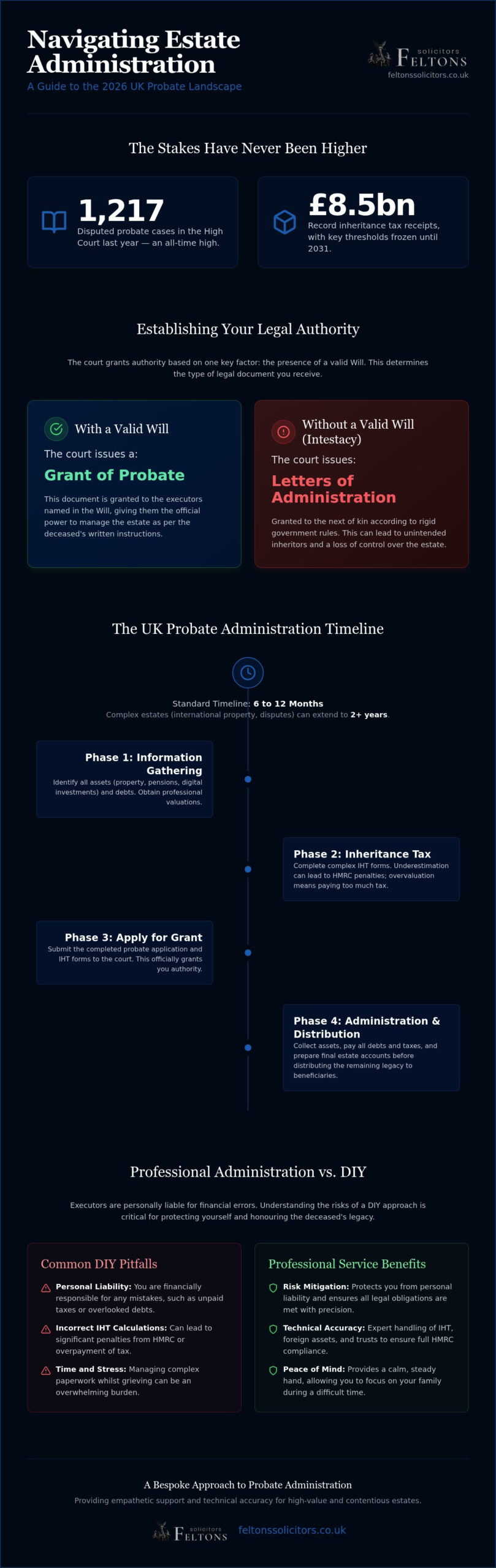
Did you know that disputed probate cases in the High Court reached an all-time high of 1,217 last year? With inheritance tax receipts hitting a record £8.5 billion and key thresholds frozen until 2031, the financial and legal stakes for executors have never been more demanding. If you are currently responsible for an estate, the pressure to get every calculation right whilst managing family expectations can feel overwhelming. Securing professional probate administration services london is often the most reliable way to protect yourself from personal liability and ensure a smooth distribution of assets.
We understand that losing a loved one is a deeply personal experience, and the added weight of complex IHT forms or foreign property trusts can feel like an unnecessary burden. It’s natural to feel concerned about making a mistake or facing a dispute. This guide provides the professional clarity you need to navigate these complexities with precision and empathy. You’ll learn how to handle intricate tax requirements, manage diverse asset portfolios, and resolve potential conflicts with the poise of a seasoned expert. We will walk you through the 2026 legal landscape, from application timelines to the nuances of the residence nil-rate band, so you can focus on honouring your loved one’s legacy.
Key Takeaways
- Understand the vital legal distinction between a Grant of Probate and Letters of Administration to establish your authority over the deceased’s assets.
- Navigate the standard 2026 timeline for estate distribution and learn why precise record-keeping is essential for protecting your position as an executor.
- Evaluate the true cost of DIY estate management versus professional probate administration services london to avoid common pitfalls like incorrect inheritance tax calculations.
- Master the complexities of handling international property and trust structures whilst ensuring full compliance with current HMRC requirements.
- Discover how a tailored, boutique approach to legal counsel provides the empathetic support and technical accuracy needed for high-value or contentious estates.
Understanding Probate Administration Services London and the Executor’s Role
Securing professional probate administration services london provides the legal framework needed to manage assets, settle debts, and distribute a legacy according to a loved one’s final wishes. A foundational Understanding Probate reveals it as the legal bridge between a person’s passing and the final distribution of their assets. It’s a process that grants a specific individual the authority to act on behalf of the deceased, ensuring that every financial and legal obligation is met with precision.
The type of authority granted depends on whether a valid Will exists. If the deceased left a Will, the court issues a Grant of Probate to the named executors. If no Will is found, the court issues Letters of Administration, usually to the next of kin. Both documents serve as official proof to banks, the Land Registry, and other institutions that you have the legal right to handle the estate’s affairs. Choosing probate administration services london ensures that these applications are handled with the poise and technical accuracy your family deserves.
Being an executor is a significant undertaking that carries heavy legal responsibilities. You’re responsible for identifying all assets, paying the correct amount of Inheritance Tax, and settling all outstanding debts before any money reaches beneficiaries. Executors face personal liability for any financial errors, including unpaid taxes or overlooked creditors. A boutique approach to administration offers a calm, steady presence, prioritising personal connection and risk mitigation over high-volume processing.
When is Probate Legally Required?
Probate is typically necessary if the estate includes property held in the deceased’s sole name or if financial institutions hold significant sums. Whilst some banks release funds for “small estates” under £5,000 without formal documents, others have much higher thresholds that vary between providers. Property ownership also dictates the need for probate. Assets held as “joint tenants” usually pass automatically to the survivor, but property held as “tenants in common” requires a grant to be transferred or sold.
The Consequences of Intestacy
Dying intestate, or without a valid Will found amongst their possessions, triggers a rigid set of government rules that often conflict with a family’s actual wishes. These rules dictate exactly who inherits, which can lead to unintended consequences for unmarried partners or stepchildren. This lack of control often creates unnecessary family friction and complex tax burdens. Investing in proactive estate planning is the only reliable way to avoid these default legal traps and ensure your intentions are actually followed.
The Step-by-Step Probate Administration Process in the UK
The journey from a loved one’s passing to the final distribution of their estate is rarely a straight line. It’s a methodical process that typically spans 6 to 12 months, though complex cases involving international property or disputes can extend to two years or more. Meticulous record-keeping is your greatest asset during this time. Every receipt, bank statement, and valuation must be organised to satisfy both HMRC and the beneficiaries. Engaging professional probate administration services london can significantly ease this burden, providing a steady hand whilst you navigate the emotional weight of grief.
Phase 1: Valuation and Inheritance Tax
Starting the valuation phase often highlights why bespoke probate administration services london are so valued by families with complex holdings. You’ll need to identify every asset, from property and pensions to digital investments, alongside all outstanding debts. Professional valuations are critical; an underestimation can lead to penalties from HMRC, whilst overvaluation results in paying more tax than necessary. The standard nil-rate band is the threshold below which an estate doesn’t pay Inheritance Tax, currently set at £325,000 and frozen until April 2031.
Phase 2: Applying for the Grant
Once valuations are complete, you’ll need to follow the official UK probate process by submitting the relevant IHT forms and the probate application. As of July 2026, the application fee stands at £526 for estates valued over £5,000. Most executors now use digital submissions, which currently see grants issued within 4 to 8 weeks for straightforward cases, though complex applications can take 16 to 20 weeks. You’ll be required to sign a Statement of Truth, a legal declaration that confirms your authority and carries serious consequences if found to be inaccurate.
Phase 3: Administration and Distribution
With the grant in hand, the practical work of collecting assets and closing accounts begins. You must settle all funeral expenses, debts, and taxes before preparing final estate accounts. These accounts ensure total transparency for beneficiaries, showing exactly how the final residue was calculated before distribution. If you’re feeling the pressure of these administrative demands, reaching out to the expert team at Feltons Solicitors can provide the technical precision and reassurance needed to conclude the process with confidence.
Professional Estate Administration vs DIY: Navigating Risks and Costs
Many executors initially consider the DIY route to save money. It’s a logical thought; however, the reality of managing an estate whilst grieving often reveals that probate isn’t just “filling in forms”. It involves navigating a complex web of legal nuances that require steady, deliberate attention. Professional probate administration services london provide more than just technical expertise; they offer a safeguard against the high-stakes errors that commonly plague DIY attempts.
Common pitfalls include incorrect inheritance tax filings and failing to identify all potential creditors. These mistakes aren’t just administrative inconveniences. They can lead to significant HMRC penalties and personal financial loss. When evaluating the risks and costs of probate, you must consider the “hidden” expenses of the DIY approach. The time spent deciphering tax codes and the emotional stress of managing complex assets often far outweigh the value of professional fees.
Boutique firms prioritise a personal connection that high-volume “probate factories” simply cannot match. You aren’t just another case number in a digital queue. Instead, you receive tailored advice that respects the unique nature of your family’s situation, blending modern efficiency with traditional professional integrity. This individualised attention ensures that no detail, however small, is overlooked during the administration process.
The Risk of Personal Liability for Executors
Executors are personally responsible for any financial losses caused by errors in administration. If you distribute assets and a creditor appears later, you might be liable to pay that debt out of your own pocket. Professional firms protect the estate by placing “Statutory Advertisements” in The Gazette and local newspapers. This legal step shields you from unknown claims after the distribution is complete. Additionally, the professional indemnity insurance held by a qualified law firm provides an essential safety net that a DIY executor simply doesn’t have.
Managing Family Dynamics and Disputes
Legal expertise is vital, but the role of an impartial “buffer” is often equally important. Emotions run high during asset distribution. This is often where family friction begins. A solicitor acts as a neutral third party, ensuring that every step follows the law rather than personal feelings. If you encounter contentious probate or a challenge to the Will’s validity, professional guidance is indispensable. Engaging probate administration services london ensures that a “people-first” philosophy is maintained whilst technical legal work is handled with precision, often avoiding the draining costs of court battles through professional mediation.
Handling Complex Estates: Foreign Assets, Trusts, and Inheritance Tax
Complex estates demand more than standard administrative filing; they require a sophisticated understanding of international law and tax treaties. When an estate involves non-UK resident beneficiaries or property held abroad, the workload for an executor increases exponentially. Specialist probate administration services london are particularly vital when navigating the friction between different legal jurisdictions. This expertise ensures that assets are handled with high-end reliability, preventing costly delays in the distribution process whilst protecting the deceased’s global legacy.
Trusts within a Will must be meticulously interpreted to ensure the trustees understand their ongoing duties and the specific tax implications of the trust’s structure. Managing these requires a methodical flow, moving from the initial validation of the trust to the long-term management of its assets. This is especially true for estates involving business interests or agricultural property, where specialized knowledge is needed to secure relevant tax reliefs and ensure the continuity of the enterprise.
Overseas Entities and International Assets
Managing foreign assets often requires overseas entity beneficial owner registration if the deceased held UK property through a foreign company. This is a critical compliance step that many generalist firms overlook. For assets held in Commonwealth countries, you may need to “reseal” the Grant of Probate, a process that allows a UK grant to be recognised by foreign courts. Beyond the paperwork, the challenge of double taxation remains a significant concern. Specialist solicitors navigate international treaties to ensure the estate doesn’t pay tax twice on the same asset, providing a sense of security and comprehensive care.
Inheritance Tax Strategy and Mitigation
Even after a person has passed, there are legal avenues to re-organise an estate for better tax efficiency. A “Deed of Variation” allows beneficiaries to change the distribution of the Will within two years of death, potentially reducing the overall Inheritance Tax (IHT) bill or moving assets into trusts for future protection. In 2026, the Residence Nil Rate Band provides an additional £175,000 allowance when a main residence is passed to direct descendants, though this is reduced by £1 for every £2 the estate’s value exceeds £2 million.
Professional advice is equally crucial for claiming all available reliefs, such as Business Property Relief (BPR), which can significantly reduce IHT on qualifying trading companies. We also see frequent intersections with property law, such as managing leasehold enfranchisement or lease extensions during the probate period. These matters require a firm that understands the synergy between estate management and complex property rights. If you’re managing an estate with international or commercial elements, the expert team at Feltons Solicitors can provide the discreet, high-standard support you need.
Why a Bespoke Approach to Probate Administration is Essential
Choosing probate administration services london shouldn’t feel like entering a bureaucratic assembly line. Many high-volume providers prioritise turnover, leaving executors feeling like just another reference number in a digital queue. A bespoke approach is fundamentally different. It recognises that every estate represents a unique life and a specific family dynamic that cannot be captured by a standard checklist. By combining modern digital efficiency with the traditional values of a trusted advisor, a boutique firm ensures that your loved one’s legacy is handled with the precision and empathy it deserves.
One of the most significant benefits of a tailored service is having a single, dedicated point of contact throughout the entire probate journey. You won’t be passed between junior clerks or forced to repeat your story to different departments. This consistency builds trust and ensures that the nuances of the estate, from complex property rights to family sensitivities, are fully understood by the person managing the case. It allows for a methodical, reassuring flow that moves you from a state of administrative confusion to one of informed security.
The Feltons Difference: Professionalism with Empathy
Feltons Solicitors LLP was established in 2010 with a clear “people-first” philosophy. We believe that whilst the technical legal work is paramount, the human impact of our services must never be forgotten. Our team provides pragmatic advice using plain English, deliberately avoiding the dense legal jargon that often adds unnecessary stress to an already difficult process. You gain the security of working with an established boutique firm that values discreet, high-standard care and maintains a calm, steady presence. Our expertise often bridges the gap between probate and other complex areas, such as residential conveyancing or the registration of overseas entities, ensuring a seamless experience for estates with diverse assets.
Taking the First Step
Relieving the administrative burden starts with a professional consultation to discuss the specific needs of the estate. This is your opportunity to move beyond the fear of personal liability and gain a clear roadmap for the future. To make the most of this initial conversation, it’s helpful to have a rough outline of the deceased’s assets, any known debts, and a copy of the Will if one exists. This preparation allows our specialists to provide immediate, actionable clarity tailored to your situation. Taking this first step with professional probate administration services london is about more than just legal compliance; it’s about reclaiming your time and peace of mind. Reach out to the expert team at Feltons Solicitors today to ensure your loved one’s estate is managed with the poise and reliability it requires.
Securing Your Loved One’s Legacy with Professional Clarity
Managing an estate is a profound responsibility that requires a delicate balance of technical accuracy and human empathy. As we’ve explored, the 2026 legal landscape demands careful attention to frozen tax thresholds and the intricate requirements of international asset registration. Navigating these duties alone often leads to unnecessary stress or personal liability. By choosing professional probate administration services london, you ensure that every detail is managed with the poise and reliability your family deserves.
Established in 2010 by Paula Felton, our boutique firm prioritises personal connection and pragmatic, plain-English advice. We specialise in complex and international probate matters, acting as a calm, steady presence during difficult times. Please contact Feltons Solicitors for a discreet consultation on our probate administration services. Moving from a place of administrative burden to one of informed security is a vital step in honouring a loved one’s final wishes. You don’t have to carry this weight alone; expert support is ready to guide you through every stage of the journey.
Frequently Asked Questions
How long does the probate administration process typically take in 2026?
Straightforward estate administration typically takes between six and twelve months to conclude. However, complex estates involving international assets or trusts can extend to eighteen months or even two years. The timeline is often dictated by HMRC’s processing speeds and the current workload at the Probate Registry. Professional probate administration services london help manage these timescales by ensuring all documentation is accurate from the first submission, preventing avoidable delays and reducing stress for the family.
What are the professional fees for probate administration services in the UK?
Professional fees vary depending on the complexity of the estate and the level of support required. Some firms offer fixed-fee arrangements for specific tasks, whilst others work on an hourly rate or a percentage of the estate’s total value. It’s important to discuss your requirements during an initial consultation to receive a tailored estimate. Factors such as the number of beneficiaries and the variety of assets will influence the final professional cost of the service.
Can I still be an executor if I live outside the UK?
You can remain an executor whilst living abroad, but it presents significant practical challenges. Signing legal documents and managing UK-based assets from a distance can be cumbersome and may lead to distribution delays. Many non-resident executors choose to appoint a UK-based professional to act on their behalf or as a co-executor. This ensures that the estate is managed efficiently and that all local tax obligations are met without the need for constant international travel.
What happens if the deceased person had a Will but it cannot be found?
If a Will cannot be found after a diligent search, the estate may be administered under the rules of intestacy. You should check with the deceased’s previous solicitors, banks, and the National Will Register before assuming no Will exists. If a copy is found but not the original, you may need to apply to the court to prove the Will’s contents. This is a complex process that requires expert legal guidance to resolve successfully.
Is Inheritance Tax (IHT) due immediately upon death?
Inheritance Tax is not due immediately, but it must be paid within six months of the end of the month in which the death occurred. HMRC begins charging interest on any unpaid tax after this six-month deadline. Executors often need to arrange for a portion of the tax to be paid before the Grant of Probate is issued, frequently using the Direct Payment Scheme to release funds directly from the deceased’s bank accounts to HMRC.
Can I change the distribution of an estate after someone has died?
Yes, you can alter the distribution of an estate using a Deed of Variation. This legal document allows beneficiaries to redirect their inheritance to others, perhaps for tax efficiency or to provide for someone overlooked in the Will. To be valid for tax purposes, the deed must be executed within two years of the death and signed by all beneficiaries whose entitlement is being reduced. It’s a powerful tool for modern, post-death estate planning.
What is the difference between a probate solicitor and a probate practitioner?
A probate solicitor is a qualified lawyer regulated by the Solicitors Regulation Authority, offering a broad range of legal services including property law and litigation. A probate practitioner may be an accountant or a specialist licensed specifically for probate work. Choosing a solicitor often provides a more comprehensive safety net, especially if the estate involves complex property transfers, leasehold extensions, or potential disputes amongst family members that require expert mediation and technical precision.
Do I need probate if the estate only consists of a jointly owned home?
Probate is generally not required if a property is held as joint tenants, as it passes automatically to the surviving owner through the right of survivorship. However, if the home was held as tenants in common, the deceased’s share forms part of their estate and a Grant of Probate will be necessary to transfer or sell that interest. You should always check the Land Registry title to confirm the ownership structure before starting any probate administration services london.