
Complex Probate Solicitors: Navigating Intricate Estate Administration in 2026

Complex Probate Solicitors: Navigating Intricate Estate Administration in 2026

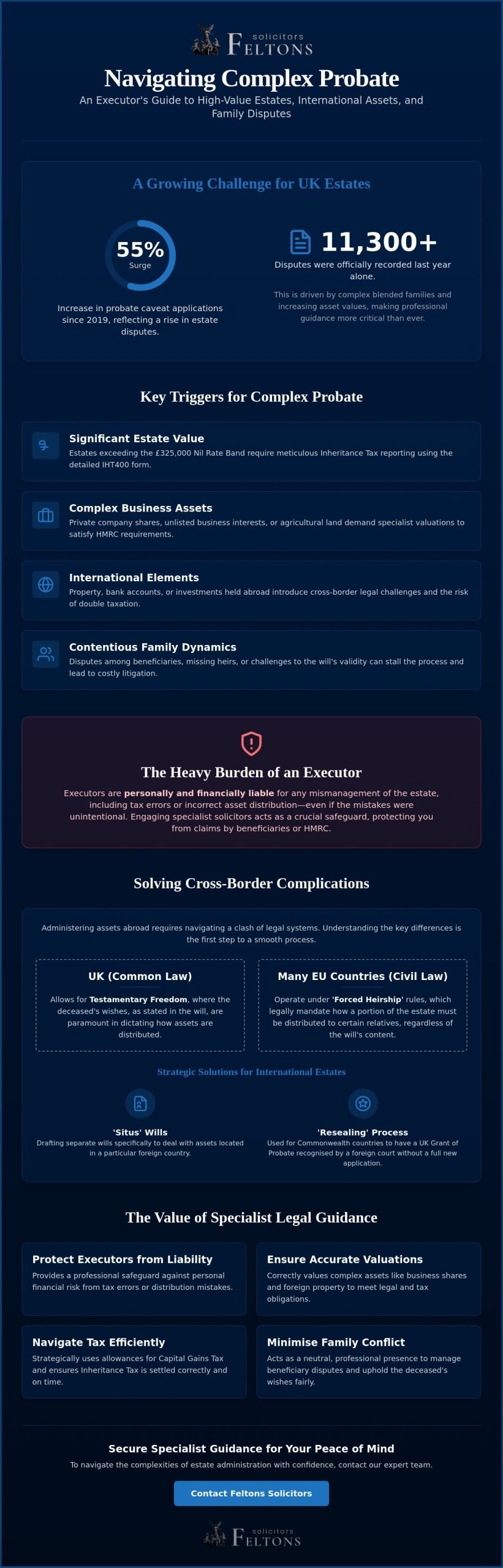
Did you know that probate caveat applications have surged by 55% since 2019, with over 11,300 disputes recorded last year? This sharp rise reflects a modern landscape where blended families and rising asset values make estate administration increasingly contentious. When you’re managing an estate that spans international borders or involves significant business interests, the margin for error is slim and the pressure is immense.

It’s natural to feel concerned about the personal liability that comes with potential tax errors or the emotional strain of family disagreements. You want to ensure that every asset is accounted for and every beneficiary is treated fairly, yet the technical hurdles can feel insurmountable. Specialist complex probate solicitors act as a steady, professional presence, taking the weight of these intricate responsibilities off your shoulders whilst providing much-needed clarity.

In this article, you’ll discover how expert legal guidance manages high-value assets and foreign jurisdictions to ensure a seamless probate process. We’ll outline the steps taken to protect you from liability, facilitate efficient asset distribution, and maintain clear communication during what can often be a long and challenging journey.

Key Takeaways

  • Identify the specific triggers that move an estate from standard administration into a complex legal landscape, including technical financial intricacies and multi-jurisdictional assets.
  • Explore the specialised processes required for valuing private business shares and managing the legalities of property held in foreign jurisdictions.
  • Understand how to handle modern family dynamics and potential disputes amongst beneficiaries, ensuring the deceased’s wishes are upheld whilst minimising conflict.
  • Master the financial nuances of the administration period, including the strategic use of Capital Gains Tax allowances and the timely settlement of Inheritance Tax.
  • Discover why engaging complex probate solicitors provides the discreet, high-standard guidance necessary to protect executors from personal liability and ensure a smooth distribution.

Probate is often viewed as a procedural necessity. For many families, however, the Probate process in the UK evolves into a multi-layered legal undertaking. Complexity isn’t merely about the volume of paperwork; it arises when the estate’s composition involves technical, financial, or legal intricacies that exceed the scope of a standard Grant of Representation. Whilst administrative difficulty refers to the time taken to gather assets, complex probate involves navigating conflicting laws, high-stakes valuations, and nuanced tax obligations.

Engaging complex probate solicitors is often the difference between a stalled application and a successful distribution. Standard DIY approaches frequently falter when executors encounter HMRC ‘long-form’ accounts, known as the IHT400. These forms require a level of forensic detail that goes far beyond simple bank balances. They demand precise reporting of lifetime gifts, trust interests, and foreign holdings. Without specialist oversight, the risk of professional negligence or significant tax penalties increases.

Common Triggers for Complex Estate Administration

Several factors can elevate a case into the complex category. Estates exceeding the Nil Rate Band threshold of £325,000, which is currently frozen until April 2031, require meticulous Inheritance Tax reporting. Complexity also spikes when the deceased held unlisted business interests, agricultural land, or private company shares. These assets require specialist valuations to satisfy HMRC requirements. Additionally, the presence of multiple beneficiaries spread across different countries or missing heirs adds a layer of cross-border legal coordination that few executors are equipped to handle alone.

The Legal Responsibility of the Executor

Executors carry a heavy burden. They are personally and financially liable for any mismanagement of the estate, including tax errors or incorrect distributions. This liability remains even if the mistake was unintentional. Professional guidance from complex probate solicitors acts as a safeguard. It protects you from potential claims brought by disgruntled beneficiaries or HMRC. Securing a Grant of Probate is the key to unlocking sophisticated asset classes, yet doing so correctly requires a methodical approach that prioritises legal integrity over speed. Proactive estate planning, including working with a lasting power of attorney solicitor London residents trust, can help reduce the administrative burden placed on executors before probate even begins.

While many associate estate disputes with family disagreements, technical complexity often stems from the nature of the assets themselves. High-value estates frequently involve intricate financial structures, such as Lloyd’s of London memberships or sophisticated trust arrangements, that require a methodical legal approach. Managing these requires more than just administrative diligence; it demands a deep understanding of how different asset classes interact with current Inheritance Tax rules. Expert complex probate solicitors provide the necessary oversight to ensure that valuations are accurate and that all available reliefs are fully utilised.

International Assets and Cross-Border Probate

Modern estates are rarely confined to a single country. When a deceased person held property, bank accounts, or investments abroad, the administration process must account for the clash between different legal systems. Common Law jurisdictions, like the UK, generally allow for testamentary freedom, whereas many Civil Law countries in Europe operate under ‘forced heirship’ rules. These rules can dictate exactly how assets must be distributed, regardless of what the will says.

Coordinating this requires a strategy involving ‘Situs’ wills, which are documents drafted specifically to deal with assets in a particular jurisdiction. For assets held within the Commonwealth, we often use the ‘resealing’ process, which allows a UK Grant of Probate to be recognised by a foreign court without a full new application. Working alongside international legal counsel is vital to avoid the pitfalls of double taxation and to ensure that foreign grants of probate are obtained efficiently. If you are managing a portfolio with multi-jurisdictional reach, our team offers the specialised probate and estate planning support required to navigate these global requirements.

Business Interests and Agricultural Property Relief

For business owners and landowners, the stakes are particularly high. The valuation of private company shares, intellectual property rights, and agricultural land is a forensic exercise that HMRC scrutinises closely. A significant change occurring in 2026 is the new cap on Business Property Relief (BPR) and Agricultural Property Relief (APR). From 6 April 2026, the 100% relief is capped at a combined £2.5 million per person; any value above this threshold will only attract 50% relief. This makes the role of complex probate solicitors even more critical in ensuring business continuity whilst the estate is being settled.

Business Property Relief can potentially reduce Inheritance Tax by 50% or 100% depending on the asset type. Identifying which assets qualify and ensuring they meet the strict ‘trading’ criteria is essential for protecting the estate’s value. We focus on providing pragmatic advice that keeps the business operational, preventing the forced sale of assets to cover tax liabilities that could have been mitigated through careful administration.

For executors managing Australian-based entities, integrating small business advisory services Perth into the broader strategy helps maintain profitability and personal freedom for the new owners during the transition.

Addressing Contentious Probate and Modern Family Dynamics

Estate administration is rarely just a matter of calculating figures and filing forms. The human element often presents the greatest challenge. Modern family structures, including cohabitees, step-children, and multiple marriages, frequently result in competing claims that a standard probate process cannot resolve. Under the Inheritance (Provision for Family and Dependants) Act 1975, certain individuals can claim they haven’t been left reasonable financial provision. Managing these sensitivities requires complex probate solicitors who act as both technical experts and calm, steady mediators.

Our approach prioritises pragmatism. We understand that behind every legal dispute is a family seeking closure and fairness, and for those with interests spanning multiple regions, it is often helpful to explore family law with specialists such as Israel Cross Border Law Firm. By addressing potential conflicts early, we help executors navigate the emotional weight of their role whilst ensuring the estate remains protected from the high costs of prolonged litigation.

Contesting the Validity of a Will

Challenges to a will’s validity usually arise from three specific areas: lack of testamentary capacity, undue influence, or improper execution. Proving or defending these claims requires forensic evidence gathering, including medical records and witness statements. A critical first step in this process is finding a will that represents the deceased’s final, uncoerced intentions. Complex probate solicitors provide a sophisticated guide through this evidence, ensuring that the deceased’s true wishes are upheld and that the estate is not depleted by meritless challenges.

Resolving Conflict Amongst Executors and Beneficiaries

Friction isn’t always between beneficiaries; it often occurs amongst the executors themselves. If an executor fails in their duties or acts in their own interest, the law provides a path for their removal through a court application. However, we believe that transparency is the most effective defence against suspicion. By providing meticulous estate accounts and clear communication, executors can demonstrate they are acting fairly and in accordance with their legal obligations.

When disputes delay the sale of assets, such as a family home, the financial implications can be significant. Delays can impact the eventual Capital Gains Tax on inherited property, as the market value may shift between the date of death and the date of sale. We utilise mediation as a discreet tool for family reconciliation, aiming to reach a settlement that avoids the public nature and stress of a full court hearing. This methodical flow ensures that the distribution of assets remains as efficient and harmonious as possible.
Complex Probate Solicitors: Navigating Intricate Estate Administration in 2026

Managing the Financial Burden: Inheritance Tax and Capital Gains

The financial aspects of estate administration often present the most significant pressure for executors. One of the most challenging requirements is the necessity to pay at least a portion of the Inheritance Tax (IHT) bill before the Grant of Probate is even issued. This creates a liquidity challenge, as many assets remain frozen until the grant is secured. Expert complex probate solicitors play a vital role here, helping executors identify sources of funding, such as the Direct Payment Scheme, to settle tax liabilities without personal financial strain.

HMRC maintains rigorous compliance checks for high-value estates, often scrutinising valuations and lifetime gifting history. Accuracy is paramount. During the period of administration, executors must also manage Capital Gains Tax (CGT) on any assets that increase in value between the date of death and the date of sale. Utilising the estate’s specific CGT allowance requires a methodical approach to timing and asset disposal to ensure the maximum value remains for the beneficiaries.

Inheritance Tax (IHT) Efficiency Strategies

Strategic tax planning doesn’t necessarily end when a person passes away. We focus on applying for all available reliefs, including transferable Nil Rate Bands and Residence Nil Rate Bands, which can collectively shield up to £1 million for a married couple. Lifetime gifts made within seven years of death must be meticulously accounted for, as they can significantly impact the tax threshold through ‘taper relief’. A Deed of Variation can be used post-death to improve tax efficiency for beneficiaries by effectively rewriting the will to redirect assets in a more tax-advantageous manner. These sophisticated tools require precise legal drafting to satisfy HMRC’s strict criteria.

Trust Administration and Asset Protection

The role of family trusts is central to many complex estates. Often, these structures ‘crystallise’ upon the death of the settlor, requiring immediate and expert management to protect the legacy for future generations. There is a profound interaction between long-term estate planning and the eventual probate outcome; a well-structured trust can simplify the process, but only if the trustees understand their ongoing legal obligations.

We often see a clear distinction between the effectiveness of professional trustees versus lay trustees. Whilst a family member may have the best intentions, they may lack the technical knowledge to manage complex long-term obligations, such as tax filings and investment oversight. Complex probate solicitors provide the steady guidance needed to ensure trusts remain compliant and continue to serve their intended purpose. If you are concerned about the tax implications or trust management of a high-value estate, our team provides the professional tax and probate support necessary to safeguard your interests.

Why Choose Feltons Solicitors for Complex Probate?

Choosing the right legal partner for an intricate estate is a decision that impacts both the financial outcome and your personal peace of mind. Unlike high-volume firms where cases are often processed as mere numbers, our boutique approach ensures that your matter receives the focused attention of senior legal experts. We believe that professional authority and empathetic reassurance are not mutually exclusive. As complex probate solicitors, we provide a sophisticated level of care that prioritises your specific needs whilst maintaining the highest standards of technical precision. Our ‘people-first’ philosophy means we never lose sight of the human impact behind the legal administration, offering a steady hand when family dynamics or financial pressures feel overwhelming.

We pride ourselves on delivering pragmatic, plain-English advice. In a world of dense legalese, we choose clarity. This commitment to transparent communication allows us to handle both national and international matters with discreet professional integrity, ensuring that executors feel empowered rather than confused. Whether you’re managing multi-jurisdictional assets or navigating the new 2026 tax caps, our team provides the worldly experience necessary to protect your interests.

A Tailored Approach to Estate Administration

Every estate we manage is unique, requiring a strategy that is as individualised as the legacy it represents. We organise a bespoke plan for each client, ensuring that the nuances of business assets, agricultural land, or foreign property are handled with sound judgment. During high-stress legal periods, we act as a calm, steady presence. Our focus isn’t solely on the technicalities; we remain mindful of the human impact of our work, ensuring that every beneficiary feels supported and informed throughout the process. By acting as your complex probate solicitors, we bridge the gap between established heritage and forward-thinking methodology.

Moving Forward with Confidence

The first step in resolving a complex administration is a comprehensive estate review. During an initial consultation, we’ll discuss the technical hurdles you’re facing and provide a clear outline of the necessary steps. You can expect transparent communication regarding timelines and the frequency of updates, ensuring you’re never left in the dark. We understand that executors often feel the weight of personal liability, which is why our methodical flow is designed to provide security and comprehensive care. Contact us today for a discreet discussion about your probate needs and discover how our expertise can provide the protection and efficiency you require.

Securing Your Legacy with Professional Integrity

Managing an intricate estate involves more than just administrative diligence; it requires a sophisticated understanding of cross-border laws and evolving tax thresholds. You’ve seen how technical hurdles, such as valuing private business shares or resolving modern family disputes, can quickly complicate the probate process. By addressing these challenges with a methodical and proactive strategy, you can protect the estate’s value and ensure a harmonious distribution for all beneficiaries.

Since 2010, Feltons Solicitors has provided the discreet, senior-level attention that high-value estates demand. Our boutique approach means you’ll always have direct access to experienced advisors who prioritise personal connection over volume. As complex probate solicitors, we’re dedicated to delivering pragmatic, plain-English advice that simplifies the most daunting legal landscapes. We invite you to speak with our complex probate experts at Feltons Solicitors for a tailored review of your circumstances. You don’t have to carry the burden of executor liability alone. With the right guidance, even the most intricate administration can be managed with quiet confidence and success.

Frequently Asked Questions

How long does complex probate usually take in the UK?

Complex probate typically takes between 12 and 18 months to conclude. Whilst a standard estate might be settled much sooner, the presence of foreign property or unlisted business interests requires additional time for forensic valuations and international tax clearances. Each jurisdiction involved adds its own procedural layer, and if the estate is particularly intricate, the process can extend beyond two years to ensure every asset is correctly accounted for.

Can an executor be held personally liable for mistakes in a complex estate?

Executors carry full personal financial liability for any mismanagement of the estate. This liability remains even if the error was unintentional, such as a miscalculation of Inheritance Tax or an overlooked beneficiary. Engaging complex probate solicitors provides a layer of protection, as professional oversight ensures that all legal and fiscal obligations are met, significantly reducing the risk of personal claims being brought against you.

What makes a probate case ‘contentious’ rather than just ‘complex’?

A case is defined as ‘complex’ when it involves technical or financial hurdles, whereas ‘contentious’ probate refers to active legal disputes amongst parties. Complexity often stems from multi-jurisdictional assets or sophisticated tax structures that require specialist handling. Contentiousness arises when the validity of a will is challenged or when beneficiaries disagree on the distribution. It’s common for high-value estates to be both complex and contentious simultaneously.

How much do complex probate solicitors charge for their services?

The fees for administering an intricate estate are determined by the specific nature of the assets and the time required to resolve technical hurdles. Most complex probate solicitors provide a tailored estimate following an initial review of the estate’s composition. This ensures that the fee reflects the level of specialist expertise required, whether that involves negotiating with foreign tax authorities or managing private company valuations during the administration period.

What happens if there are assets located in multiple countries?

Assets located in multiple countries usually require a coordinated approach across several legal systems. For property held in Commonwealth countries, the UK Grant of Probate can often be ‘resealed’ by the local court to gain recognition. In other jurisdictions, you may need to obtain a separate grant of probate entirely. We coordinate with local legal counsel to manage these requirements and prevent the estate from being taxed twice on the same assets.

Can I change solicitors if my current probate process is stalled or becoming too difficult?

You have the legal right to transfer your file to a different firm at any stage of the probate process. If you feel that your current solicitors lack the specialist knowledge required for intricate financial matters, or if communication has become infrequent, you can request a transfer. A fresh perspective from a boutique firm often provides the necessary momentum to resolve long-standing technical issues and bring the administration to a close.

What is a Deed of Variation and when should it be used in complex probate?

A Deed of Variation is a legal instrument used to alter the distribution of an estate after someone has died. It must be executed within two years of the death and requires the consent of all affected beneficiaries. This tool is frequently utilised in complex administration to improve tax efficiency or to move assets into a trust, ensuring the long-term protection of the family legacy for future generations.

How do business assets affect the timeline for receiving a Grant of Probate?

Business assets often extend the timeline for securing a Grant of Probate because they require forensic valuation to satisfy HMRC. Specialist valuers must assess the company’s worth and determine eligibility for Business Property Relief (BPR) before the tax accounts are submitted. This detailed valuation process can add several months to the initial stages of administration, particularly if the business structure is sophisticated or involves intellectual property rights. Ensuring that legal arrangements such as a lasting power of attorney solicitor London professionals recommend are in place before death can help streamline the handover of business management responsibilities during this period.

Silicosis Claim Time Limits UK: A Guide to Occupational Lung Disease Compensation in 2026

Silicosis Claim Time Limits UK: A Guide to Occupational Lung Disease Compensation in 2026

The legal clock for industrial disease doesn’t necessarily start ticking the moment you’re exposed to hazardous silica dust; it starts when you first realise the damage it’s caused. If you’ve recently received a diagnosis, understanding the strict silicosis claim time limits uk courts enforce is the most vital step toward protecting your family’s future. It’s natural to feel anxious that you might be too late to seek justice, especially when your health is a primary concern and the companies you once worked for may no longer exist.

This article provides the clarity you need by explaining how the ‘date of knowledge’ rule creates a fair opportunity for compensation, regardless of when your exposure occurred. We’ll outline the three year limitation period, explain the process of tracing historical insurers, and provide a methodical overview of the current 2026 claim requirements. By the end of this guide, you’ll have a clear, professional path toward the financial support and peace of mind you deserve.

Key Takeaways

  • Understand the standard three-year limitation period and how the ‘date of knowledge’ rule provides a fair starting point for legal action.
  • Learn how silicosis claim time limits uk regulations apply even if your exposure occurred decades ago in industries like mining or construction.
  • Discover how specialist solicitors can trace historical insurers and hold former employers accountable, even if the original company is no longer trading.
  • Identify your legal rights regarding modern silica risks, such as those found in engineered stone fabrication and quartz worktop manufacturing.
  • Explore the benefits of a tailored, boutique legal approach that manages the complexities of litigation whilst you focus on your health and recovery.

Understanding Silicosis Claim Time Limits in the UK

Silicosis is a progressive, irreversible lung condition caused by the inhalation of respirable crystalline silica (RCS) dust. For those seeking a comprehensive overview of silicosis, it’s defined by the scarring of lung tissue which leads to persistent breathing difficulties and a reduced quality of life. Unlike a trip or fall where the injury is immediate and obvious, silicosis often remains latent for decades. This delay creates a unique challenge when navigating silicosis claim time limits uk, as the gap between breathing in the dust and receiving a medical diagnosis can span an entire career.

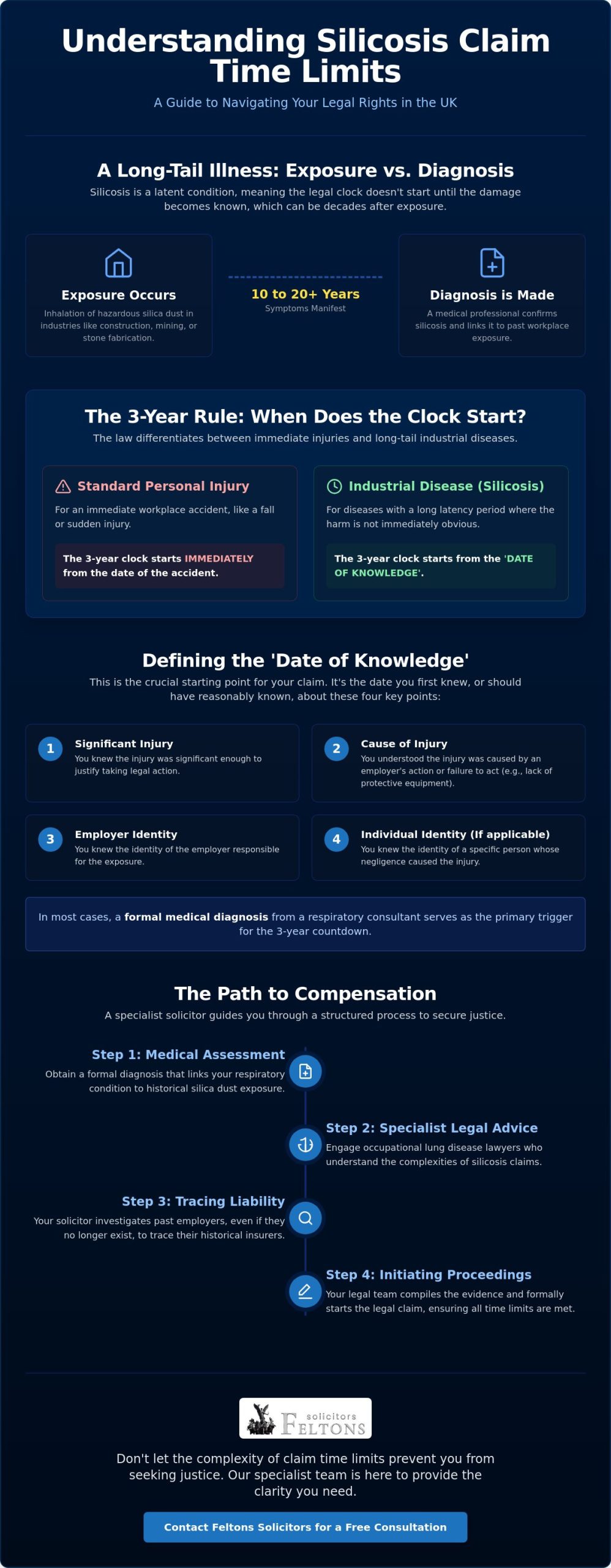
The Limitation Act 1980 sets the standard legal framework for personal injury in England and Wales. Generally, a claimant has three years to initiate legal proceedings. However, because respiratory diseases are “long-tail” illnesses, the law treats them differently from a sudden workplace accident. In a traumatic injury case, the clock starts immediately. With silicosis, the law recognises that the damage is internal and invisible for years. Therefore, a critical distinction is made between the date of exposure and the date of injury. You aren’t expected to claim for an injury you don’t yet know exists. Instead, the legal focus shifts to when you first became aware that your health had been compromised by your working conditions.

The 3-Year Rule: When Does the Clock Actually Start?

The statutory period for industrial disease doesn’t usually begin on your last day of work. It starts on your “date of knowledge.” This is the point at which a reasonable person would have realised they had a significant injury caused by their employer’s negligence. With the 2026 HSE updated guidelines placing a heavier emphasis on silica exposure reporting in sectors like engineered stone fabrication, the courts are increasingly precise about when this “knowledge” is established. If you’ve been diagnosed with silicosis, the three-year countdown likely began on the day of that medical confirmation.

Why Silicosis Claims Require Specialist Occupational Lung Disease Lawyers

Proving a link between current breathlessness and dust inhaled decades ago is a complex undertaking. Experienced occupational lung disease lawyers are essential for identifying the point of legal liability, especially when multiple employers are involved. They understand the nuances of the Control of Substances Hazardous to Health (COSHH) Regulations 2002 and how these duties applied during your employment. These specialists handle the intricate task of tracing defunct companies and their insurers, ensuring silicosis claim time limits uk are met whilst you focus on your health. This methodical approach transforms a daunting legal hurdle into a structured path toward recovery.

The ‘Date of Knowledge’ Exception for Respiratory Claims

The standard three-year window for personal injury can feel incredibly restrictive for those suffering from industrial diseases. Because symptoms of silica exposure often take 10 to 20 years to manifest, the law provides a vital exception known as the “date of knowledge.” This principle ensures that silicosis claim time limits uk courts apply don’t expire before a claimant even knows they’re unwell. If you’re experiencing persistent coughing or shortness of breath, reviewing NHS information on silicosis symptoms is often the first step toward a formal medical assessment.

For the three-year clock to begin, the law requires that a claimant has “knowledge” of four specific pillars. First, you must know the injury is significant enough to justify legal proceedings. Second, you must understand that the injury was caused by an act or omission, such as a lack of protective equipment at work. Third, you must know the identity of the employer responsible. Finally, if the claim involves a specific individual’s negligence, you must know their identity. Until these factors align, the limitation period typically remains paused.

The ‘date of knowledge’ is the moment a reasonable person would suspect their illness was caused by work.

In most modern cases, a formal medical diagnosis from a respiratory consultant serves as the primary trigger for the countdown. Once a doctor confirms that your lung scarring is directly linked to historical dust exposure, the legal expectation is that you’ll take action. If you’re unsure when your own clock started, speaking with a specialist at Feltons Solicitors LLP can provide the clarity needed to move forward.

What if You Suspected the Link Years Ago?

The courts also consider “constructive knowledge,” which refers to information you should’ve reasonably discovered. If your medical records show you discussed work-related dust with a GP five years ago but didn’t investigate further, an insurer might argue you’re out of time. A specialist solicitor’s role is to argue against an early date of knowledge by proving that your suspicions didn’t constitute definitive legal “knowledge” at that time.

Section 33: The Court’s Power to Overlook the Deadline

Even if the three-year limit has passed, Section 33 of the Limitation Act 1980 grants judges the discretion to allow “out of time” claims. The court weighs the length of your delay against the potential prejudice to the employer. If the evidence is still available and the delay was understandable, this section acts as a vital lifeline for silicosis sufferers who may have missed the initial deadline due to health or personal circumstances.

Identifying Liability in Modern and Historical Exposure

Establishing who’s legally responsible for your illness is as critical as navigating the silicosis claim time limits uk courts require. Under the Control of Substances Hazardous to Health (COSHH) Regulations 2002, employers have a non-negotiable duty to protect their workforce from respirable crystalline silica. This isn’t just about providing a simple dust mask; it’s about a comprehensive hierarchy of control. Negligence often stems from a failure to organise a safe working environment, particularly amongst stone masons and construction workers where the risks are highest. To understand more about structural safety and maintenance in these sectors, visit Composites Construction UK.

The UK is currently facing a rising crisis linked to engineered stone (quartz) worktop fabrication. These materials can contain up to 90% silica, compared to much lower levels in natural stone. If an employer failed to provide “on-tool” water suppression to catch dust at the source or neglected to supply high-grade, face-fitted Respiratory Protective Equipment (RPE), they’ve breached their statutory duty. For those seeking medical context, NHS information on silicosis outlines how this exposure leads to life-altering damage, reinforcing why legal accountability is so vital. If you worked as a mason or fabricator and have received a diagnosis, our dedicated guide to stone masonry silicosis claims explains how to seek legal redress and secure the compensation you’re entitled to.

Tracing Insurers for Companies That No Longer Exist

Many silicosis sufferers worry that they can’t claim because their former employer went bust years ago. This isn’t the case. We use the Employers’ Liability Tracing Office (ELTO) to locate historical insurance policies that were active at the time of your exposure. Even if a business is dissolved, we can often restore the company to the Register of Companies specifically to pursue litigation. The insurer, not the defunct business, pays the compensation, ensuring that silicosis claim time limits uk rules don’t prevent you from accessing the funds you need for care.

Multiple Employers: Who is Responsible for Your Silicosis?

It’s common for workers to have been exposed to dust across several different jobs over a long career. In these instances, liability is usually apportioned between the various employers based on the length and intensity of the exposure at each site. The “material contribution” test is often applied, where we prove that each employer’s negligence contributed significantly to the overall risk of you developing the disease. Handling these multi-defendant cases requires a methodical approach, often involving complex personal injury claims solicitors to ensure every responsible party is held to account. This level of detail is essential for securing a settlement that reflects the true impact on your health and future.

Silicosis Claim Time Limits UK: A Guide to Occupational Lung Disease Compensation in 2026

The Step-by-Step Process of a Silicosis Claim

Initiating a legal challenge for an industrial disease requires a methodical approach and early intervention. Because evidence such as site logs, dust monitoring records, and maintenance files can be lost over time, starting the process whilst information is still accessible is paramount. Reconstructing a work history from several decades ago is a specialist task. By acting promptly, you ensure that the silicosis claim time limits uk courts strictly enforce are not breached, protecting your ability to secure essential financial support. For a detailed breakdown of each stage, our guide to the silicosis litigation process UK provides a comprehensive roadmap for securing compensation in 2026.

Our role involves more than just filing paperwork. We work closely with medical experts to quantify the exact level of your lung impairment and its likely progression. This detailed assessment allows us to negotiate settlements that don’t just cover past losses, but also account for future care requirements and potential loss of earnings. This forward-thinking strategy is designed to provide you and your family with long-term security and peace of mind.

Step 1: The Initial Consultation and Merit Assessment

The journey begins with a detailed review of your employment history and medical diagnosis letters. We carefully assess your “date of knowledge” to ensure your case falls within the necessary silicosis claim time limits uk. At Feltons Solicitors LLP, we offer pragmatic, plain-English advice during this stage. We focus on being a calm, steady presence, helping you understand the strengths of your case without the distraction of dense legalese.

Step 2: Evidence Gathering and Expert Reports

Once we’ve established the merits of your claim, we move into the intensive evidence-gathering phase. This involves instructing a consultant respiratory physician to provide a comprehensive causation report. We also use Subject Access Requests (SARs) to obtain personnel files and seek witness statements from former colleagues who can testify to the dust levels and lack of protective equipment at your former workplace. This robust body of evidence is the foundation of a successful recovery.

Step 3: Letter of Claim and Pre-Action Protocols

We formally notify the defendant or their insurer of the legal action through a Letter of Claim. Under pre-action protocols, they have a specific timeline to investigate and provide a formal response regarding liability. Whilst we prepare every case with the diligence required for a court trial, most claims are settled through professional negotiation. If you’re concerned about your health and want to explore your options, contact Feltons Solicitors LLP for a discreet consultation on your silicosis claim.

Why Specialist Representation Matters for Silicosis Claims

Choosing the right legal partner is as significant as understanding the silicosis claim time limits uk courts mandate. Industrial disease litigation is rarely straightforward, often involving decades of employment history and complex medical pathology. Unlike high-volume firms that may treat these cases as mere statistics, a boutique approach prioritises personal connection and tailored care. We understand that behind every file is a person facing a challenging health journey, which is why our focus remains firmly on providing a supportive, high-standard service through Feltons Solicitors LLP.

Our team manages the heavy lifting of your litigation, allowing you to focus on your medical treatment and well-being. We take responsibility for the exhaustive research required to trace former employers and their insurers, even when businesses have long since closed. This professional oversight ensures that your claim is built on a robust foundation, protecting your family’s future through meticulous preparation. In cases where a condition progresses rapidly, we provide the necessary continuity to ensure a silicosis claim after death can be pursued by bereaved families, honouring the original intent of the legal action.

The Feltons Solicitors LLP Professional Standards

We pride ourselves on a sophisticated blend of traditional professional integrity and modern delivery. Our solicitors act as a calm, steady presence during what can be a stressful and uncertain period. Whilst we maintain a boutique level of care, our reach is national. We represent clients across the UK, ensuring that regardless of where you were exposed to silica dust, you have access to high-end reliability and worldly legal experience. This methodical approach ensures that no detail is overlooked in the pursuit of justice.

Securing Your Financial Future

A successful claim is about more than just a settlement figure; it’s about providing the resources needed for a dignified life. We work methodically to calculate damages for pain, suffering, and loss of amenity (PSLA), ensuring the physical and emotional impact of your condition is fully recognised. Our goal is to recover costs that cover private medical treatment, specialised equipment, and necessary home adaptations. For those who may require professional property modifications, it can be helpful to explore Project-based Installation and Landscaping Fees from Wolverhampton Driveways Ltd to assist with financial planning. If you’re ready to explore your options and ensure you remain within the silicosis claim time limits uk, we invite you to take the first step with a confidential, professional consultation with Feltons Solicitors LLP to discuss your path forward.

Securing Your Path to Justice and Recovery

Navigating a respiratory diagnosis is a significant challenge, but the legal framework exists to ensure you aren’t left without support. We’ve examined how the “date of knowledge” principle provides a vital extension to the standard silicosis claim time limits uk regulations, allowing for claims even decades after initial exposure. By tracing historical insurers and identifying modern liability, you can secure the financial resources necessary for private care and long-term security.

Since 2010, Feltons Solicitors LLP has maintained a national reputation for delivering pragmatic legal advice through a boutique, people-first approach. We provide a calm, steady presence during complex litigation, prioritising the personal connection that high-volume firms often overlook. Our specialist expertise in industrial disease ensures that your family’s future is protected with the highest standards of professional integrity. Speak with our specialist occupational lung disease lawyers today to begin your confidential consultation. You don’t have to face this journey alone; we’re here to provide the sophisticated guidance you deserve.

Frequently Asked Questions

How long do I have to make a silicosis claim in the UK?

The standard limitation period is three years from the date of your diagnosis or the date you first suspected your illness was linked to your work. This is legally referred to as the “date of knowledge.” Because symptoms can take decades to appear, the silicosis claim time limits uk courts apply are designed to ensure that the clock only starts once the injury is actually discovered.

Can I claim if my diagnosis was more than three years ago?

In most circumstances, the three-year deadline is strictly enforced. However, the court has discretionary power under Section 33 of the Limitation Act 1980 to allow a claim to proceed “out of time.” A judge will weigh the reasons for your delay against the availability of evidence. It’s always advisable to have your case reviewed by a specialist to see if an exception might apply to your situation.

What happens if the company I worked for is now insolvent?

You can still seek compensation even if the business you worked for has closed down. Claims are made against the employers’ liability insurance policy that was active at the time of your exposure. We use specialist tracing services to locate these historical insurers, ensuring that a former employer’s insolvency doesn’t prevent you from receiving the financial support you’re entitled to.

Do I need to have a formal diagnosis before I contact a solicitor?

You don’t need a final medical report to begin an initial consultation. If you’re experiencing respiratory symptoms and have a history of working with silica dust, early legal advice is beneficial. We can help you navigate the process of obtaining a formal diagnosis and ensure that the right medical experts are instructed to assess the link between your health and your previous employment.

How much compensation can I expect for a silicosis claim in 2026?

Compensation is calculated based on the severity of your condition and the financial impact on your life. Awards are divided into “general damages” for pain and suffering and “special damages” for financial losses, such as lost earnings and the cost of private care. Every case is unique, and a specialist will provide a methodical valuation based on your specific medical evidence and care requirements.

Can I claim for silicosis if I was a smoker?

Yes, having a history of smoking doesn’t prevent you from pursuing a claim. The legal test is whether silica dust exposure caused or materially contributed to your lung condition. Medical experts are highly skilled at apportioning the cause of respiratory damage, and if it can be proven that workplace dust played a significant role, you’re still eligible to seek compensation for that contribution.

Is there a time limit for a silicosis claim after death?

The limitation period for a claim brought by a bereaved family is usually three years from the date of death. Alternatively, the clock may start from the date the cause of death was confirmed, such as through a post-mortem report. This ensures that families can still seek justice even if the link to silica dust wasn’t fully understood during the sufferer’s lifetime.

Will I have to pay legal fees upfront for an occupational lung disease claim?

Most claims are handled under a “No Win, No Fee” agreement, meaning there are no upfront costs to pay. If your claim is successful, the solicitor’s success fee is legally capped at 25% of the compensation awarded for pain, suffering, and past financial losses. This arrangement ensures that you can access high-quality legal representation without facing financial risk whilst your case is ongoing.

What is a Family Trust? A Comprehensive Guide to Protecting Your Legacy in 2026

What is a Family Trust? A Comprehensive Guide to Protecting Your Legacy in 2026

If your family home and savings have grown in value whilst the tax thresholds have remained frozen, how much of your hard-earned legacy will actually reach your children? Many people begin their estate planning journey by asking what is a family trust when they realise that the standard Inheritance Tax nil-rate band is staying at £325,000 until at least 2031. It’s a valid concern. You’ve worked hard to build your wealth, and the thought of it being diminished by tax or mismanaged by future generations is understandably unsettling.

We believe that protecting your family’s future requires more than just a simple document; it requires a strategy that balances control with flexibility. This guide will help you discover how a family trust can safeguard your assets, manage inheritance tax, and provide for your loved ones with professional legal clarity. We’ll examine the specific roles within a trust, how to shield assets from external threats, and provide a clear framework to help you choose between a Will and a Trust for your estate.

Key Takeaways

  • Understand the fundamental legal structure of a trust and the crucial distinction between holding a legal title and possessing a beneficial interest.
  • Gain clear insight into what is a family trust by exploring how a bespoke Trust Deed serves as a precise rulebook for your family legacy.
  • Compare the flexibility of Discretionary Trusts with the structured security of Interest in Possession Trusts to determine the most suitable path for your beneficiaries.
  • Learn how a robust trust structure can shield your family wealth from external threats such as divorce, remarriage, or the risks of managing sudden wealth.
  • Follow a methodical framework to audit your current assets and align your estate planning with your specific long-term protection goals.

Understanding the Core Concept: What is a Family Trust in the UK?

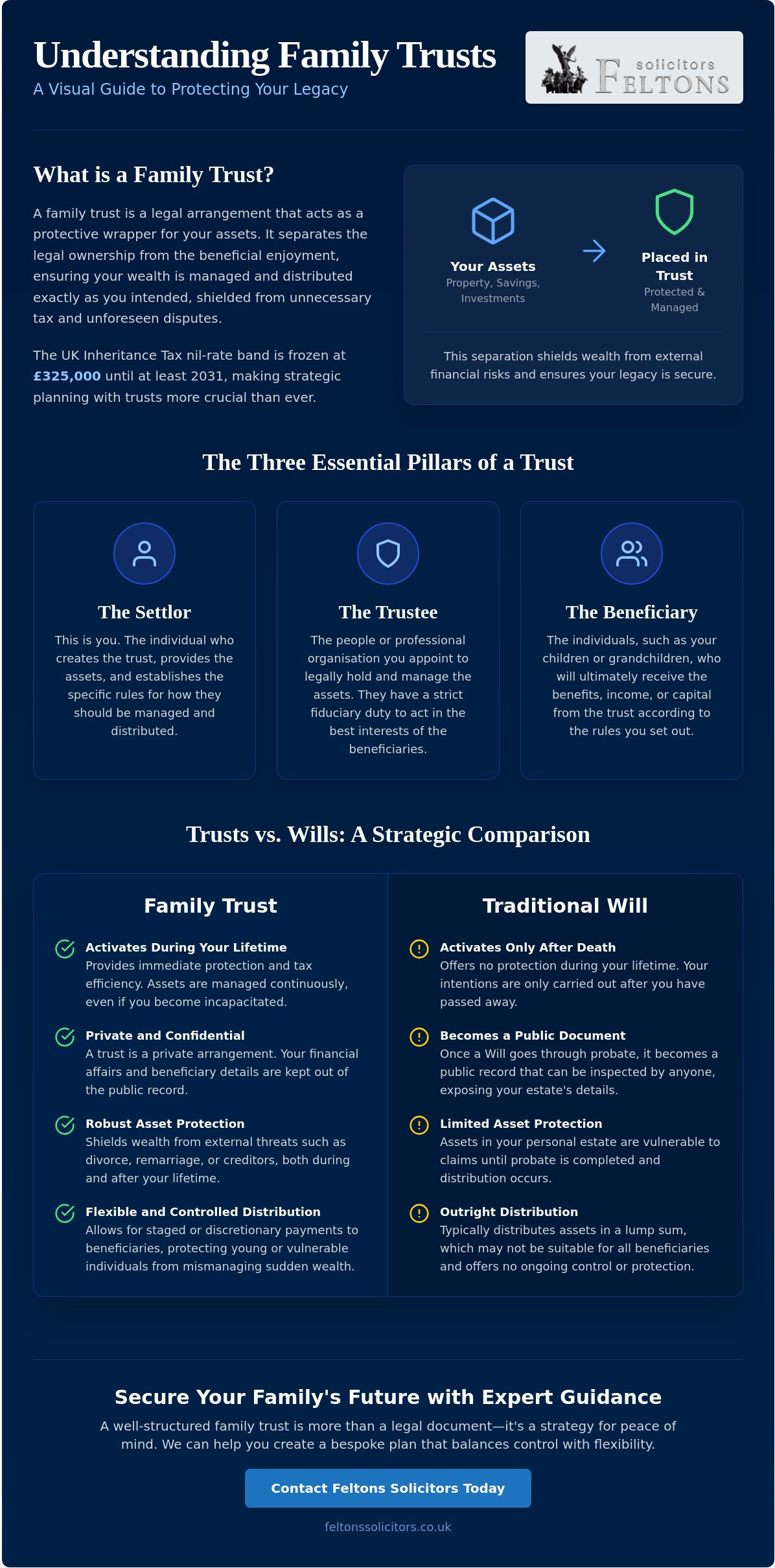
At its most fundamental level, a family trust is a legal arrangement where assets are held by individuals or a professional body for the benefit of others. Whilst it might sound complex, the core principle is straightforward: it’s a way to ensure your wealth is managed exactly as you intended, even when you’re no longer there to oversee it. For those exploring what is a family trust, it’s helpful to view it as a protective wrapper that sits around your assets, shielding them from unnecessary tax or unforeseen family disputes. Understanding the Core Concept of trusts requires looking at how English law distinguishes between legal and beneficial ownership.

When you transfer an asset into a trust, you separate the “legal title” from the “beneficial interest”. The trustees hold the legal title; they’re the registered owners on paper and responsible for the day-to-day administration. However, they don’t own the assets for themselves. The beneficial interest belongs to your beneficiaries, who have the right to enjoy the income or capital according to the rules you’ve set out. This distinction is the engine that drives asset protection, as the assets are no longer technically part of your personal estate.

The Three Essential Pillars of a Trust

Every trust relies on three distinct roles to function effectively and provide the security your family deserves:

  • The Settlor: This is you. You’re the individual who provides the assets, whether that’s property, cash, or investments, and establishes the specific rules for how they should be handled.
  • The Trustee: These are the people or professional organisations you appoint to manage the trust. They have a fiduciary duty to act in the best interests of the beneficiaries and must follow the instructions in your Trust Deed.
  • The Beneficiary: These are the individuals, such as your children or grandchildren, who will ultimately receive the benefits, income, or assets from the trust.

Trusts vs Wills: Which is Right for Your Estate?

Understanding what is a family trust involves comparing it to other legal instruments. Choosing between a Will and a trust often depends on when you want your legacy plan to begin. A traditional Will only takes effect upon your death, whereas a trust can be established during your lifetime to provide immediate protection and tax efficiency. Because trusts can operate whilst you’re still alive, they offer a level of continuity that a Will simply cannot match.

Privacy is another significant factor. When a Will goes through probate, it becomes a public document that anyone can inspect. In contrast, a family trust is a private arrangement, keeping your financial affairs and the details of your beneficiaries away from the public eye. Integrating these structures into your broader estate planning strategy ensures that your family remains supported through a discreet, high-standard service that values both modern efficiency and traditional integrity.

The Mechanics of Asset Protection: How a Trust Structure Operates

Establishing the legal boundaries of a trust requires more than just intent; it requires a formal Trust Deed. This document serves as the precise rulebook for your family legacy, detailing how assets are administered, managed, and eventually distributed. Once this framework is in place, the process of conveyance begins, where assets move from your individual name into the trust’s legal title. This transition is what creates the protective barrier, ensuring that when people ask what is a family trust, they see it as a functional entity separate from their personal estate. This separation is the primary mechanism that shields your wealth from various forms of financial risk.

Trustees are bound by a strict fiduciary duty, requiring them to act with absolute integrity and in the best interests of the beneficiaries at all times. This legal obligation is the cornerstone of the trust’s reliability, ensuring that the assets are managed with sound judgment and professional care. Whilst the Trust Deed acts as the rigid legal instrument, a “letter of wishes” provides the necessary nuance. This confidential document offers personal guidance to your trustees, helping them understand your values and the specific needs of your loved ones. It is a vital tool for ensuring that the human side of your legacy remains intact, even within a formal, highly organised legal structure.

Choosing Your Trustees Wisely

Selecting the right individuals to manage these assets is a decision that requires careful thought and a long-term perspective. Many settlors opt for a combination of trusted family members and professional advisors who understand the specific Tax Implications in 2026. Professional trustees bring an objective perspective that can prevent family friction during stressful times, whilst family members provide continuity and personal context. At Feltons Solicitors LLP, we often recommend this balanced approach to maintain both personal connection and high-standard professional integrity. If you are uncertain about the right choice for your family, our estate planning specialists can provide a tailored consultation.

Managing Trust Assets

A family trust can hold a diverse range of assets, from investment portfolios and cash savings to the family home itself. When a primary residence is involved, the transfer process must align perfectly with residential property law to ensure the asset protection is legally absolute and compliant with Land Registry requirements. Beyond the initial setup, understanding what is a family trust requires a commitment to ongoing administration. Trustees are responsible for annual reporting and must ensure the trust is registered with the HMRC Trust Registration Service (TRS) within 90 days of creation. This methodical oversight is essential for maintaining the trust’s validity and protecting the assets from external threats over the coming decades.

Common Types of Family Trusts and Their Tax Implications in 2026

Selecting the right structure is as important as understanding what is a family trust in the first place. For families in 2026, the choice usually settles on one of three main vehicles, each offering a different balance of control, protection, and tax efficiency. With the Inheritance Tax (IHT) nil-rate band frozen at £325,000 until April 2031, your choice of trust type will significantly impact how much of your estate is subject to the 20% entry charge on transfers exceeding this threshold. Following official guidance on trusts is essential to ensure your chosen path aligns with HMRC’s evolving regulations.

Discretionary Trusts: Flexibility and Control

This is arguably the most versatile option for families with complex or changing needs. In a discretionary trust, the trustees have the power to decide which beneficiaries receive income or capital, how often payments are made, and what conditions must be met. It’s a powerful tool for protecting wealth from a beneficiary’s potential divorce or bankruptcy, as the assets don’t technically belong to the individual until the trustees make a distribution. When people ask what is a family trust, they’re often looking for the specific flexibility provided by this discretionary structure.

This flexibility comes with specific tax considerations. Most discretionary trusts are subject to the “relevant property” regime, which includes a periodic charge of up to 6% on the trust’s value above the nil-rate band every 10 years, alongside “exit charges” when assets are distributed. From April 6, 2026, families with business interests must also account for the new £1 million cap on Business Property Relief (BPR). For trusts created on or after October 30, 2024, this cap applies immediately from April 2026, potentially increasing the tax burden on high-value business assets.

Interest in Possession: Balancing Immediate Needs

Often used in the context of second marriages, an Interest in Possession trust allows a “Life Tenant” (often a surviving spouse) to receive income from the trust assets for the rest of their life. Upon their death, the capital passes to the “Remainderman”, who is typically a child from a first marriage. This ensures the spouse is provided for whilst the underlying inheritance is legally ring-fenced for the next generation. In 2026, these trusts remain a popular choice for those wanting to manage immediate family requirements without losing control over the final destination of the family’s wealth.

Bare Trusts: Direct and Simple

A Bare Trust is the most straightforward arrangement. The assets are held in the name of a trustee, but the beneficiary has an absolute right to both the capital and income. These are frequently used for minor children or grandchildren, where assets are held until the child reaches 18. Once the beneficiary reaches the age of majority, they can demand the assets be transferred to them directly. Whilst they lack the long-term protection of other structures, they’re often favoured for their simplicity and the fact that they’re generally treated as the beneficiary’s own assets for tax purposes.

What is a Family Trust? A Comprehensive Guide to Protecting Your Legacy in 2026

Strategic Benefits: Why Families Choose Trusts Over Simple Wills

Whilst a Will is a foundational document, it often lacks the protective depth required for modern family structures. Many families now look beyond simple probate planning to ask what is a family trust because they require a solution that manages assets across generations with more flexibility. In 2026, the notion that trusts are reserved for the elite is outdated. As property values rise against frozen tax thresholds, these structures have become a pragmatic tool for any homeowner seeking to preserve control over their hard-earned legacy and ensure high-end reliability for their heirs.

When exploring what is a family trust, many families prioritise the concept of “bloodline protection”. If an estate is left directly to a spouse via a Will, those assets are technically at risk if that spouse later remarries or faces legal claims. A trust ensures that whilst the survivor is fully supported, the underlying capital is ring-fenced for your children or grandchildren. This prevents your wealth from being inadvertently diverted to a new partner’s family, providing a sense of security and continuity that a standard Will cannot offer in a blended family scenario. For estates where disputes arise during administration, engaging complex probate solicitors can provide the specialist guidance needed to resolve contentious matters and protect beneficiaries’ interests.

Asset Protection in Divorce and Litigation

A robust trust structure acts as a discreet shield, separating family wealth from the personal liabilities of beneficiaries. Because the assets are managed by trustees, they are often less vulnerable to claims during a beneficiary’s relationship breakdown or personal litigation. As a specialist divorce and financial arrangements lawyer at Feltons Solicitors LLP can confirm, it is always best to establish these protections proactively. Setting up a trust during a period of stability ensures your family’s future remains secure and dependable, rather than reacting to a crisis after it has already begun.

Providing for Vulnerable Beneficiaries

Trusts are also essential for supporting family members who may be unable to manage a large inheritance independently. This includes individuals with disabilities, where a direct gift might affect their eligibility for essential state support. By using a trust, you ensure they receive tailored care and financial stability managed by responsible trustees. Similarly, this structure protects beneficiaries who may struggle with financial management or addiction issues. This people-first approach ensures your wealth serves its true purpose: providing a stable future amongst unpredictable life events. A comprehensive estate plan should also consider appointing a lasting power of attorney solicitor London families trust to ensure that, should you lose mental capacity, your chosen trustees and attorneys can act seamlessly without interruption to your family’s financial arrangements. To begin your journey, contact Feltons Solicitors LLP for a consultation focused on your unique family dynamics.

Establishing Your Legacy: The Path to Creating a Family Trust

Moving from the theoretical understanding of what is a family trust to the practical implementation of one requires a clear, methodical roadmap. The journey begins with identifying your primary objectives, which often involve a sophisticated blend of tax mitigation, asset ring-fencing, and long-term control. At Feltons Solicitors LLP, we start by helping you define exactly what success looks like for your family. Whether you are focused on the upcoming 2026 changes to Business Property Relief or seeking to protect a vulnerable relative, your goals will dictate the specific architecture of the trust structure.

The second stage involves a comprehensive audit of your assets to identify which holdings are suitable for transfer. This is a delicate balancing act that requires professional insight into your current liquidity and future needs. Once the assets are identified, the focus shifts to drafting the Trust Deed with absolute legal precision. This document is the definitive authority on how your wealth is managed, and it must be robust enough to withstand future scrutiny. The final step is the formal conveyance of assets into the trust and ensuring the arrangement is registered with the HMRC Trust Registration Service (TRS), a vital compliance step for modern estate management. Where an estate involves significant business interests or cross-border assets, the expertise of complex probate solicitors may also be required to navigate the intricate administration process alongside your trust structure.

The Importance of Professional Drafting

Attempting to use generic DIY templates for such a complex legal arrangement carries significant risks, including the potential for costly litigation or unintended tax consequences. Feltons Solicitors LLP provides the specialised expertise necessary to ensure your trust is resilient and tailored to your family’s specific nuances. We ensure that your trust works in perfect harmony with your broader estate plan, which often involves finding a will for other family members to eliminate any contradictions. A cohesive strategy also means ensuring that a professionally appointed lasting power of attorney solicitor in London has documented your wishes regarding financial and health decisions, so your trustees can act with full legal authority if you lose capacity before the trust is fully administered. A cohesive strategy is the only way to guarantee that your last wishes are carried out with high-end reliability and professional integrity.

Next Steps with Feltons Solicitors LLP

When you are ready to move forward, our initial consultation provides a calm, steady space to discuss your financial landscape. We take a boutique, people-first approach, ensuring that your family’s unique dynamics are respected throughout the process. You can expect clear, pragmatic advice that avoids dense legalese in favour of practical solutions tailored to your national requirements. Our role as your trusted advisor is to guide you through the complexities of what is a family trust whilst providing the worldly experience necessary to handle even the most intricate estate matters. By choosing a partner that values both modern efficiency and traditional professional integrity, you can secure a legacy that truly stands the test of time.

Securing Your Family Legacy for 2026 and Beyond

Protecting your wealth requires a shift from static planning to a more dynamic, protective framework. You’ve seen how trusts safeguard assets against divorce, manage complex inheritance tax rules, and provide for vulnerable beneficiaries with absolute precision. Deciding what is a family trust for your specific needs is the first step toward ensuring your children and grandchildren are truly provided for. A well-structured trust doesn’t just manage money; it preserves your family values across generations, which often includes the lifelong care of family pets; to prepare for their future health needs, you can check out London Veterinary Surgeries for expert advice on feline healthcare costs.

At Feltons Solicitors, we’ve been helping families since 2010. We blend traditional values with modern delivery to provide boutique, people-first legal expertise. As specialists in complex estate planning and financial arrangements, we ensure your legacy remains robust against future challenges. We’re here to act as your calm, steady presence through every stage of the planning process.

Secure your family’s future with a bespoke trust consultation at Feltons Solicitors. Your legacy is more than just a list of assets; it’s the foundation for your family’s future. We look forward to helping you build it with confidence and care.

Frequently Asked Questions

Is a family trust better than a Will for inheritance tax?

A family trust can be more effective than a Will for Inheritance Tax (IHT) planning because it allows you to remove assets from your personal estate whilst you’re still alive. With the nil-rate band frozen at £325,000 until April 2031, placing assets in trust can mitigate the impact of fiscal drag on your wealth. However, you must consider the 20% entry charge on transfers exceeding your available allowance and potential periodic charges every ten years.

Can I be a trustee of my own family trust in the UK?

You can certainly be a trustee of your own family trust in the UK, and many settlors choose this path to maintain direct involvement in management. Acting as a trustee allows you to oversee the distribution of assets according to your original intent. We often suggest appointing at least one other trustee, perhaps a professional body, to provide continuity and impartial judgment if your circumstances change.

What assets can I put into a family trust?

You can place a wide variety of assets into a trust, including your residential home, cash savings, stocks, shares, and land. When considering what is a family trust for business owners, it’s vital to note that from April 6, 2026, a £1 million cap applies to 100% Business Property Relief. Assets exceeding this value will only receive 50% relief, making the timing of your transfer a critical factor in your strategy.

How much does it cost to maintain a family trust annually?

The annual maintenance costs for a trust depend on its complexity and the type of assets held within the structure. You should account for the cost of preparing annual accounts, filing trust tax returns with HMRC, and periodic legal reviews to ensure compliance with changing regulations. Professional fees for these administrative tasks are a necessary investment to maintain the trust’s protective wrapper and ensure high-end reliability.

Can a family trust be challenged in court after I die?

A family trust can be challenged in court, though it’s generally more difficult to overturn than a traditional Will. Challenges usually arise from claims of mental incapacity, undue influence, or under the Inheritance (Provision for Family and Dependants) Act 1975. Using a professionally drafted Trust Deed and a clear letter of wishes provides a robust defence, ensuring your legacy remains exactly as you intended.

Do I still have control over my house if I put it in a trust?

You can still live in and manage your home if it’s placed in a trust, provided the Trust Deed is drafted with a right to occupy or an Interest in Possession. Whilst the legal title moves to the trustees, your beneficial interest allows you to remain in the property. This arrangement provides security for your residence whilst ensuring the capital is legally ring-fenced for the next generation.

What is the Trust Registration Service (TRS) and do I need to register?

The Trust Registration Service (TRS) is a central HMRC register designed to improve transparency, and most UK trusts must register within 90 days of being established. Failing to register can lead to financial penalties and administrative complications for your trustees. Understanding what is a family trust in 2026 involves recognising these ongoing compliance duties as a standard part of modern, methodical estate management.

Can a family trust protect my assets from care home fees?

A family trust can protect assets from care home fee assessments, but only if it’s established for genuine estate planning reasons well in advance of needing care. If a local authority deems the transfer was made primarily to avoid fees, they may invoke deliberate deprivation of assets rules. Timing and intent are the two most critical factors, which is why we recommend establishing these structures whilst you’re in good health.