

The most expensive mistake a business owner can make in 2026 is treating a lease expiry as a simple paperwork exercise. With the Law Commission’s June 2026 proposals to reform the Landlord and Tenant Act 1954, the traditional rules of engagement are shifting. It’s entirely natural to feel a sense of trepidation regarding aggressive rent hikes or the risk of missing a strict statutory deadline. Most directors simply want to maintain business continuity without being locked into an inflexible, high-cost agreement. Instructing experienced commercial lease renewal solicitors is a vital step in navigating these complexities whilst protecting your operational stability.
This guide offers a clear, strategic path through the current legal landscape, promising to help you secure the best possible terms and minimise your exposure to litigation. We’ll examine how to leverage the latest market data, such as the 3% average rental growth in the office sector, to your tactical advantage. You’ll also learn how the English Devolution and Community Empowerment Bill might affect your future rent review clauses, providing you with the insight needed to ensure your business remains resilient and well-positioned.
Key Takeaways
- Understand the specific criteria for security of tenure under the Landlord and Tenant Act 1954 to ensure your right to remain in your premises is legally protected.
- Master the strategic use of Section 25 and Section 26 notices to initiate the renewal process on your own terms and avoid missing critical statutory deadlines.
- Learn how to apply the O’May principles during negotiations to maintain existing lease benefits whilst successfully arguing for modern updates like flexible break clauses.
- Discover why an 18-month lead time is essential for success and how commercial lease renewal solicitors can help you navigate potential opposition from landlords.
- Identify the seven statutory grounds for opposing a renewal, specifically focusing on redevelopment and owner occupation, to protect your business from unexpected displacement.
Navigating the Landlord and Tenant Act 1954: Do You Have Security of Tenure?
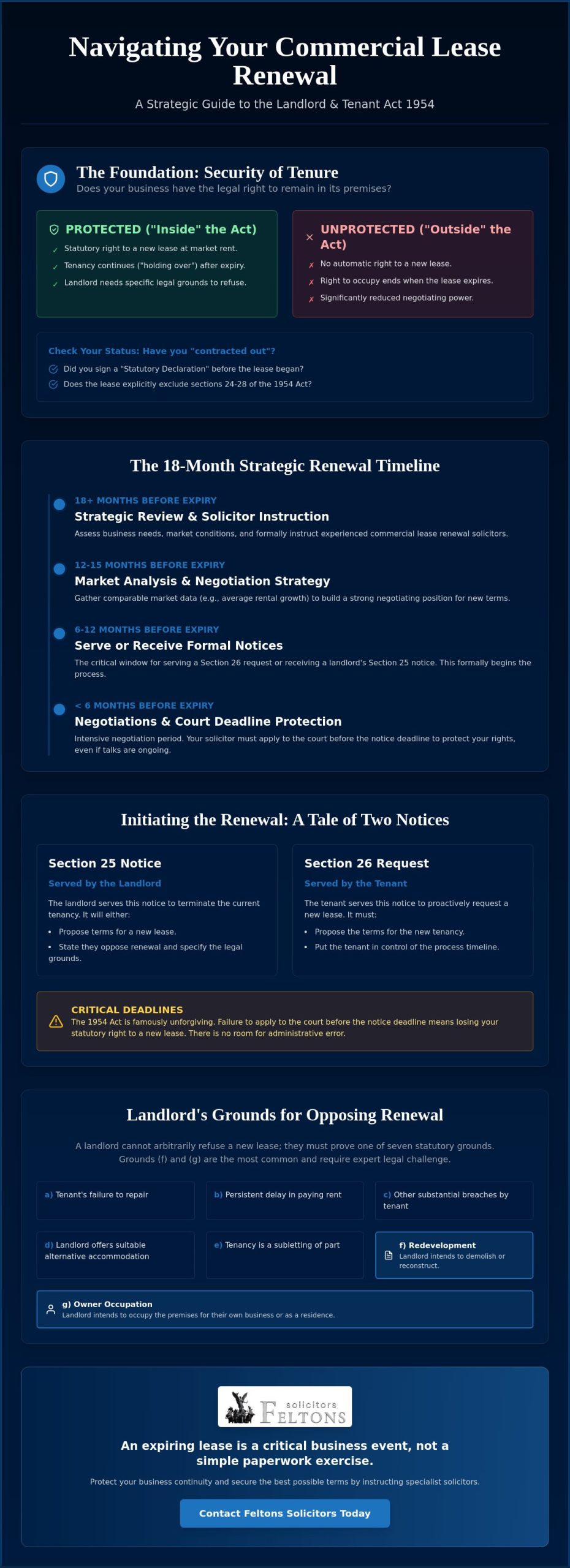
Security of tenure is the fundamental right for a business tenant to renew their lease on similar terms when the current agreement expires. It acts as the cornerstone of UK commercial property law, preventing landlords from arbitrarily evicting successful businesses or demanding unsustainable rents at the end of a term. To qualify for this protection under the Landlord and Tenant Act 1954, your arrangement must meet three specific criteria: a valid tenancy must exist, the premises must be occupied for business purposes, and the parties must not have “contracted out” of the Act’s provisions. Check your lease today.
Understanding whether you are “inside” or “outside” the Act is a critical first step for any business strategy. If you are inside, you have a statutory right to a new lease at market rent. If you are outside, your legal right to occupy ends the moment the lease expires. The stakes are high. Experienced commercial lease renewal solicitors often find that tenants are unaware of their status until a deadline is imminent. You can realise your legal standing immediately by reviewing your lease for a clause stating that sections 24 to 28 of the 1954 Act are excluded.
The Core Principles of Part II Protection
A protected lease doesn’t simply terminate on its expiry date. Instead, it continues under a principle known as “holding over.” This provides a vital safety net, allowing you to remain in the property on the same terms whilst a new agreement is finalised. Landlords frequently prefer to “contract out” of these protections to maintain absolute control over their assets. This is common in shopping centres or areas slated for redevelopment. Without these rights, your leverage in negotiations is significantly reduced, as the landlord is under no obligation to offer a renewal or even allow you to stay.
Common Exceptions to Security of Tenure
Not every commercial arrangement carries these statutory rights. Tenancies at will, which can be terminated by either party at any time, do not offer protection. Similarly, fixed-term leases of less than six months are generally excluded, unless the tenant has already been in occupation for more than 12 months. Agricultural holdings and mining leases also fall under different legislative frameworks. For a lease to be validly “contracted out,” the landlord must have served a formal warning notice before the lease began, followed by a statutory declaration from the tenant. To identify your status, consider this checklist:
- Is there a signed “Statutory Declaration” in your files dated before the lease began?
- Does the lease explicitly mention the exclusion of sections 24-28 of the 1954 Act?
- Is the term a fixed period rather than a periodic or “rolling” tenancy?
Consulting commercial lease renewal solicitors early ensures these documents are interpreted correctly, preventing costly surprises that could jeopardise your business continuity.
Initiating the Renewal: A Step-by-Step Guide to Section 25 and 26 Notices
The procedural machinery of the 1954 Act is triggered by the service of formal notices. These documents are not mere letters; they are legal instruments with strict statutory requirements. Whether the landlord serves a Section 25 notice or you choose to issue a Section 26 request, the timing must be precise. A failure to adhere to these windows can result in the automatic termination of your tenancy. In many cases, missing a deadline means losing your statutory right to remain in the property entirely. For a clear breakdown of your rights during this phase, the official government guidance on lease renewal provides a useful starting point for understanding the basic statutory framework.
The 1954 Act is famously unforgiving. If a landlord serves a hostile notice and the tenant fails to apply to the court before the deadline, the right to a new lease is lost. There is no room for administrative error. Engaging with commercial property experts early in this window allows for a more measured negotiation phase. This ensures that every document served is valid and that your business interests remain protected throughout the transition.
The Landlord’s Section 25 Notice
A landlord usually initiates the process by serving a Section 25 notice. This must be served between six and twelve months before the proposed lease end date. There are two distinct types of this notice. A “friendly” notice indicates the landlord is willing to grant a new lease and will include their proposed terms for rent and duration. A “hostile” notice, however, indicates they will oppose a renewal. To be valid, a Section 25 notice must be in the prescribed legal form and state exactly whether the landlord is prepared to grant a new tenancy. If you receive a hostile notice, commercial lease renewal solicitors will need to evaluate the landlord’s grounds for opposition immediately.
The Tenant’s Section 26 Request
You do not have to wait for your landlord to act. A tenant can take the initiative by serving a Section 26 request to start the renewal process. This is often a savvy move in the 2026 property market if you believe market rents are currently lower than what you are paying. By serving notice first, you can potentially lock in more favourable terms sooner. Your request must outline your proposed new rent, the term length, and any significant changes to the lease, such as new break clauses. Once served, the landlord has exactly two months to serve a counter-notice if they intend to oppose the renewal. This proactive approach provides certainty and allows your business to plan its finances with greater precision.
Negotiating Modern Lease Terms: Balancing Commercial Flexibility and Legal Protection
The O’May principles remain the judicial baseline for lease renewals. Essentially, the court presumes that the terms of the new lease should mirror the old one unless there is a compelling reason to deviate. However, the commercial world has evolved significantly since many older leases were drafted. We often assist clients in arguing for modernisations that reflect current market standards. For those considering their long-term position, our guide on commercial property solicitors provides broader context on the decision between renewing a lease or purchasing a freehold.
Environmental obligations, or “Green Leases,” are no longer optional extras in 2026. Negotiating how to organise energy efficiency improvements and data sharing is complex. It requires a delicate balance between a landlord’s desire to future-proof their asset and a tenant’s need to avoid excessive costs. Adhering to the RICS Code for Leasing Business Premises ensures that negotiations remain transparent and grounded in industry-recognised standards of fairness. Commercial lease renewal solicitors play a vital role in ensuring these new clauses don’t inadvertently shift unfair financial burdens onto the tenant.
Determining Market Rent and Interim Rent
Setting the new rent relies on an “open market” valuation. This assumes a willing landlord and a willing tenant, ignoring the specific circumstances of the current occupier. To prevent financial uncertainty, “Interim Rent” can be established while negotiations continue. This protects both parties by ensuring a fair rate is paid during the “holding over” period. With average annual rental growth for UK offices standing at 3% as of May 2026, having accurate valuation data is essential. Commercial lease renewal solicitors will typically work alongside a specialist surveyor to ensure the legal arguments for a lower rent are backed by robust evidence.
Modernising Repair and Insurance Obligations
The shift from traditional Full Repairing and Insuring (FRI) leases to more nuanced agreements is a key trend. Tenants are increasingly successful in negotiating service charge caps to ensure overheads remain predictable. Additionally, the inclusion of “pandemic clauses” or updated force majeure wording is now standard practice to protect against unforeseen global disruptions. These protections ensure that your business isn’t left vulnerable to costs outside its control, such as:
- Sudden spikes in insurance premiums.
- Unexpected structural repair demands for older buildings.
- Variable service charges for communal energy-saving initiatives.
By modernising these obligations, you create a more resilient foundation for your business operations over the coming years; it is also a prudent time to explore Fire Extinguisher Maintenance to ensure your health and safety compliance remains up to date.
Ensuring this operational resilience also involves understanding the physical constraints of a site, especially when structural changes are planned; you can find out more about how geotechnical site investigations assist in risk management and regulatory compliance.
Handling Opposed Renewals and Dispute Resolution: Protecting Your Business Interests
A landlord’s decision to oppose a renewal can feel like a direct threat to your business’s future. However, under the 1954 Act, a landlord cannot simply refuse to renew because they wish to find a new tenant at a higher rent. They must prove at least one of seven statutory grounds. Understanding these grounds is essential for any business leader. If you find yourself facing an opposed renewal, consulting with commercial lease renewal solicitors ensures that the landlord’s evidence is rigorously tested and your right to compensation is protected.
The Seven Grounds of Opposition
The Landlord and Tenant Act 1954 outlines grounds (a) through (g). Grounds (a), (b), and (c) are discretionary, meaning the court decides if it is “fair” to refuse a renewal based on tenant breaches, such as persistent late rent payments or a failure to repair the premises. Ground (d) involves the landlord offering suitable alternative accommodation, whilst ground (e) applies to sub-tenants where a higher rent could be achieved by letting the whole building. The most common challenges arise from the “mandatory” grounds:
- Ground F (Redevelopment): The landlord must prove a firm and settled intention to demolish or reconstruct the premises, which they cannot reasonably do without obtaining possession.
- Ground G (Owner Occupation): The landlord intends to occupy the premises for their own business. Crucially, they must have owned the property for at least five years to rely on this ground.
If a renewal is successfully opposed under grounds (e), (f), or (g), the tenant is usually entitled to statutory compensation. This is calculated based on the rateable value of the premises, often doubling if the business has been in occupation for 14 years or more.
Court Applications and Timelines
If negotiations reach a stalemate, you must issue court proceedings before the statutory deadline to prevent your renewal rights from expiring. This does not mean you will end up in a courtroom; most cases settle long before a trial. During this period, expert witnesses, typically specialist surveyors, provide evidence on market rent and lease terms. For parties seeking a more efficient resolution, the Professional Arbitration on Court Terms (PACT) scheme offers a faster, cheaper alternative to the traditional court route. PACT allows an arbitrator or independent expert to decide the new lease terms, providing finality without the public nature of a court hearing. This methodical approach ensures business continuity whilst managing legal costs effectively.
Strategic Timeline for Success: How Commercial Lease Renewal Solicitors Optimise the Outcome
Success in a lease renewal is rarely the result of last-minute heroics. It is the product of a disciplined timeline that begins at least 18 months before your current term expires. This “18-Month Rule” provides the necessary space to evaluate your business goals without the pressure of an impending eviction or an expiring notice period. By starting early, you gain the leverage to walk away or negotiate from a position of strength. Instructing commercial lease renewal solicitors at this stage allows for a thorough audit of your current lease, identifying any hidden “contracting out” clauses or complex break conditions that could jeopardise your security of tenure.
The strategic requirements of a renewal often depend on which side of the table you occupy. Whilst tenants typically prioritise business continuity and rent stability, the legal support for property developers and landlords often focuses on maximising asset value or preparing for future site assembly. Understanding these differing motivations is key to a smooth negotiation. Once the broad commercial points are agreed, the creation of a clear “Heads of Terms” document is essential. This non-binding summary acts as a roadmap for the final lease, significantly reducing legal costs by ensuring both solicitors are working from an identical set of instructions.
Preparation Checklist: 12-18 Months Before Expiry
A methodical approach to preparation ensures no detail is overlooked. Your focus during this window should include:
- Reviewing the existing lease for specific “time is of the essence” clauses regarding notices.
- Conducting a market rent assessment to establish your “ideal” vs “acceptable” financial targets.
- Verifying the legal validity of your current occupation to ensure statutory rights are intact.
- Consulting with commercial lease renewal solicitors to draft a preliminary negotiation strategy.
The Value of Boutique Legal Expertise
Choosing a boutique firm ensures your renewal receives the personal attention it deserves. High-volume firms often treat lease renewals as administrative tasks, which can lead to missed nuances in complex modern clauses. Our approach at Feltons Solicitors LLP combines traditional professional integrity with modern efficiency, ensuring that your business interests are protected by a partner who understands both property law and litigation and dispute resolution. This dual expertise is vital if a landlord unexpectedly opposes a renewal or if negotiations move towards a PACT arbitration. At Feltons Solicitors LLP, we prioritise your peace of mind through a people-first philosophy. We invite you to a discreet consultation to discuss your specific portfolio needs and secure your business’s future in the 2026 property market.
Securing Your Business Future in a Shifting Market
A successful commercial lease renewal in 2026 demands more than just legal compliance; it requires a proactive strategy that begins long before your term expires. Timing is everything. By adhering to the 18-month rule and understanding your statutory rights under the Landlord and Tenant Act 1954, you position your business to thrive despite market fluctuations. Whether you’re navigating the complexities of green lease clauses or managing a hostile notice, the right tactical positioning is essential for maintaining operational stability.
Engaging commercial lease renewal solicitors ensures your interests are shielded by experts who understand the nuances of property law and complex commercial litigation. Feltons Solicitors LLP combines an established heritage with a modern, people-first philosophy that prioritises your business continuity. We offer a sophisticated boutique service for national clients, providing a calm, steady presence to guide you through every negotiation and potential dispute. Contact Feltons Solicitors LLP today for a discreet consultation on your commercial lease renewal. We look forward to helping you secure a favourable and flexible foundation for your business’s next chapter.
Frequently Asked Questions
What happens if my commercial lease expires and I haven’t signed a new one?
If your lease is protected by the Landlord and Tenant Act 1954, you’ll enter a period of “holding over.” This means your tenancy continues on the same terms until either party serves the appropriate statutory notice. However, if your lease is “contracted out,” you have no legal right to remain and could be treated as a trespasser if you don’t vacate the premises on the expiry date.
Can a landlord refuse to renew my commercial lease for no reason?
A landlord cannot refuse a renewal without a valid legal reason if the tenancy is protected. They must prove one of the seven statutory grounds, such as an intention to redevelop the building or a desire to occupy the premises themselves. Engaging commercial lease renewal solicitors early allows you to challenge these grounds and protect your right to remain or secure compensation.
How much notice does a landlord have to give for a commercial lease renewal?
A landlord must provide between six and twelve months’ notice before the proposed termination date using a Section 25 notice. This notice must state whether they oppose the renewal or are willing to grant a new tenancy. If you haven’t received a notice within this window and your lease is protected, your current arrangement continues under the holding over provisions mentioned above.
What is a ‘contracted out’ lease and how does it affect my rights?
A “contracted out” lease is an agreement where the parties have formally agreed to exclude the security of tenure provisions of the 1954 Act. This means you have no automatic right to a new lease at the end of the term. Landlords often prefer this for flexibility, but it leaves the tenant vulnerable to relocation costs and potential business disruption if a new deal isn’t reached. Just as choosing the right solicitor for buying a house is critical to protecting your interests in a residential transaction, selecting experienced legal representation for a contracted-out commercial lease is equally essential to safeguarding your business position.
Am I entitled to compensation if my landlord refuses to renew my lease?
You are generally entitled to statutory compensation if the landlord refuses a renewal on “no-fault” grounds, such as redevelopment or owner-occupation. The amount is usually based on the rateable value of the property. If your business has occupied the premises for 14 years or more, this compensation typically doubles, providing a financial cushion for your relocation.
Can I negotiate a lower rent during a commercial lease renewal?
You can certainly negotiate a lower rent if current market conditions suggest that the “open market” value has decreased. Success depends on robust evidence, such as comparable local data or the 3% rental growth caps seen in specific sectors in early 2026. Commercial lease renewal solicitors will work with surveyors to present a compelling case for a rent reduction during negotiations.
How long does the commercial lease renewal process typically take?
The process typically takes between six and twelve months from the service of the initial notice to the completion of the new lease. If the parties cannot agree on terms and the matter proceeds to court or Professional Arbitration on Court Terms (PACT), the timeline can extend significantly. Starting your preparations 18 months in advance is the best way to manage this schedule effectively.
Is it better to serve a Section 26 request or wait for a Section 25 notice?
Serving a Section 26 request is often better if you want to take control of the timeline and propose your own terms first. This is particularly useful in a falling market where you want to lock in a lower rent as soon as possible. Waiting for a Section 25 notice leaves the initiative with the landlord, which might not align with your specific business planning or budget cycles.