

The difference between a seamless move and a stressful delay often comes down to whether you have hired a data-processor or a dedicated legal partner. Finding the right solicitor for buying a house is the single most important decision you’ll make once your offer is accepted. You likely want more than just a firm that ticks boxes; you need a proactive advisor who anticipates risks before they become roadblocks.
It’s understandable to feel a sense of trepidation regarding hidden legal fees or the complexities of the latest Stamp Duty Land Tax rates. You deserve a process that prioritises clear communication and fixed-fee certainty over high-volume automated systems. This article provides a comprehensive, step-by-step checklist to help you navigate the legal intricacies of the 2026 property market with professional clarity. We’ll explore how to distinguish expert solicitors from basic conveyancers and exactly what you must prepare to ensure a smooth, delay-free completion.
Key Takeaways
- Identify a qualified solicitor for buying a house by verifying SRA accreditation and ensuring they possess specific expertise in your property type, particularly for complex leasehold matters.
- Expedite the onboarding process by preparing comprehensive “Source of Funds” evidence and valid identification to satisfy modern compliance standards from the outset.
- Gain a clear understanding of legal risks by reviewing the “Big Four” property searches and identifying any restrictive covenants that could impact your future use of the home.
- Ensure a smooth transition to ownership by mastering the final transaction steps, from the timely transfer of your deposit to the formal execution of the Transfer Deed.
- Secure your long-term protection by confirming that all post-completion obligations, including Stamp Duty Land Tax filings and Land Registry registration, are finalised.
Selecting the Right Solicitor for Buying a House: A Pre-Instruction Checklist
Hiring a solicitor for buying a house is often treated as a simple administrative task, yet it’s the most critical safeguard for your financial future. A legal partner who prioritises meticulous risk management over sheer transaction volume ensures your new home doesn’t arrive with a legacy of legal liabilities. Before you sign a letter of engagement, you must verify that the firm holds Solicitors Regulation Authority (SRA) accreditation and active Law Society membership. These credentials are your primary assurance of professional standards and indemnity protection.
You should also look for the Law Society’s Conveyancing Quality Scheme (CQS) mark. This recognised excellence standard indicates that a firm undergoes rigorous assessment to maintain the highest technical proficiency. Understanding the conveyancing process explained through these professional lenses helps you see why a budget, automated service often falls short when genuine complexities arise. Always confirm the firm has specific expertise in your property type, whether that’s a complex leasehold flat or a new-build purchase with unique developer warranties.
Understanding the Boutique Advantage
There is a distinct benefit to choosing a firm that values personal connection over high-volume processing. A boutique approach offers a dedicated solicitor who understands the nuances of your specific goals, providing a sense of quiet confidence throughout the transaction. At Feltons, our people-first philosophy ensures you aren’t just another file number in a database. A direct relationship with your solicitor reduces the friction of transaction stress, especially during high-pressure chain negotiations. This tailored service allows for a methodical flow of information, keeping you informed without the frantic energy of a call centre environment.
The “Red Flags” to Watch For
Transparency is the cornerstone of a professional relationship. You should be wary of vague quotes that leave room for “unexpected” administrative charges or “supplementary” fees for basic tasks. A reputable solicitor for buying a house will provide a transparent, itemised quote that includes all anticipated disbursements and VAT from the outset. If a firm cannot name the specific solicitor or legal executive responsible for your file, it’s a sign they may rely on automated systems rather than expert oversight.
Finally, ensure your chosen firm has the depth of expertise to handle related matters that may arise during or after your purchase. This includes specialised areas like leasehold enfranchisement or registration of overseas entities. If a firm lacks the capacity to manage complex litigation or lease extensions, they’ll likely struggle to protect your interests if the transaction encounters a legal hurdle. Choosing a partner with a broad range of property expertise ensures you have a sophisticated guide for every stage of your ownership journey.
Onboarding and Compliance: Your Initial Documentation Checklist
The first few days after your offer is accepted are often the most administrative. Before any legal work can commence, your solicitor for buying a house must perform mandatory Anti-Money Laundering (AML) checks. This stage is a legal necessity, not a mere formality. To keep the momentum of your purchase, you’ll need to return your signed Terms of Business and provide an initial payment on account. This payment is used to commission property searches immediately, preventing early delays that can ripple through the entire chain.
Following a comprehensive solicitor’s legal checklist helps you gather the necessary evidence before the request even arrives. You should prepare valid photographic identification, such as a passport or driving licence, along with recent utility bills or bank statements as proof of address for every purchaser involved. Providing these documents in a high-quality digital format from the outset allows your legal team to verify your identity with modern efficiency.
Navigating Anti-Money Laundering (AML) Requirements
Compliance standards in 2026 are more rigorous than ever. Solicitors are now required to distinguish clearly between “Source of Funds” and “Source of Wealth.” Whilst the former tracks the specific money for this transaction, the latter involves explaining how you accumulated your capital over time. Be ready to provide six months of bank statements showing salary entries, investment dividends, or inheritance distributions. For those involving international structures, you may also need to navigate overseas entity registration protocols to ensure the transaction complies with current Land Registry transparency rules.
Organising Your Paperwork for Efficiency
A methodical approach to your paperwork creates a calm and steady transaction environment. We recommend creating a dedicated digital folder for all correspondence, from mortgage offers to insurance quotes. If your deposit includes a gift from family, ensure you have a signed “gifted deposit” letter ready. This document must explicitly state that the funds are a non-repayable gift and that the donor will hold no legal interest in the property. Handling these details early demonstrates a proactive mindset that your solicitor will appreciate.
Our team prioritises a people-first approach, ensuring that these technical requirements don’t become a source of anxiety. If you require a bespoke legal partner to help you manage these initial hurdles, providing your information early is the best way to ensure a smooth path to completion. This level of preparation allows your solicitor for buying a house to focus on the complex legal work rather than chasing basic documentation.
The Legal Deep Dive: A Checklist for Searches and Enquiries
Once your initial documentation is verified, your solicitor for buying a house begins the substantive task of legal due diligence. This phase is designed to uncover any hidden liabilities that could affect the property’s value or your future enjoyment of it. Whilst the UK government’s guide to buying a home provides a useful overview of the standard procedure, a sophisticated legal partner goes beyond the basics to interpret the nuances of the data received. This technical scrutiny is what transforms a standard transaction into a secure investment.
Your solicitor will commission the “Big Four” searches to ensure no stone is left unturned. These essential enquiries include:
- Local Authority Search: This reveals planning history, building regulation approvals, and any proposed infrastructure projects, such as new roads, near the property.
- Water and Drainage Search: This confirms whether the property is connected to a public sewer and identifies the location of any public pipes that might restrict future building work.
- Environmental Search: This assesses risks regarding land contamination, flooding, or ground stability issues like subsidence.
- Chancel Repair Search: This identifies if the property carries an ancient liability to contribute towards the cost of local church repairs.
Beyond these searches, your solicitor will meticulously review the Title Register and Title Plan. They look for restrictive covenants, which are rules that limit how you can use the land, and easements, such as a neighbour’s right of way across your garden. They will also raise specific enquiries based on the Property Information Form (TA6) provided by the seller, ensuring that any extensions or alterations have the necessary planning permissions and building regulation certificates.
Interpreting the Small Print
A skilled solicitor acts as a shield against legal defects that are often buried in dense documentation. Identifying a “right of way” that was never properly disclosed or spotting a lack of indemnity insurance for a historic building modification requires a keen eye and professional intuition. If these issues are ignored, they can lead to costly litigation or difficulty when you eventually come to sell. For a deeper understanding of these protections, you can explore our pillar on Navigating Residential Property Law.
Special Checks for Leasehold Properties
Buying a leasehold property requires an additional layer of expertise, particularly following the Leasehold and Freehold Reform Act 2024. Your solicitor for buying a house will scrutinise the lease length and ground rent escalation clauses to ensure they remain fair. Under the new legislation, the standard lease extension has increased to 990 years, and the previous two-year ownership requirement has been abolished. Your solicitor will also review the “Management Pack” to check for service charge arrears or significant planned works that could result in unexpected costs shortly after you move in.
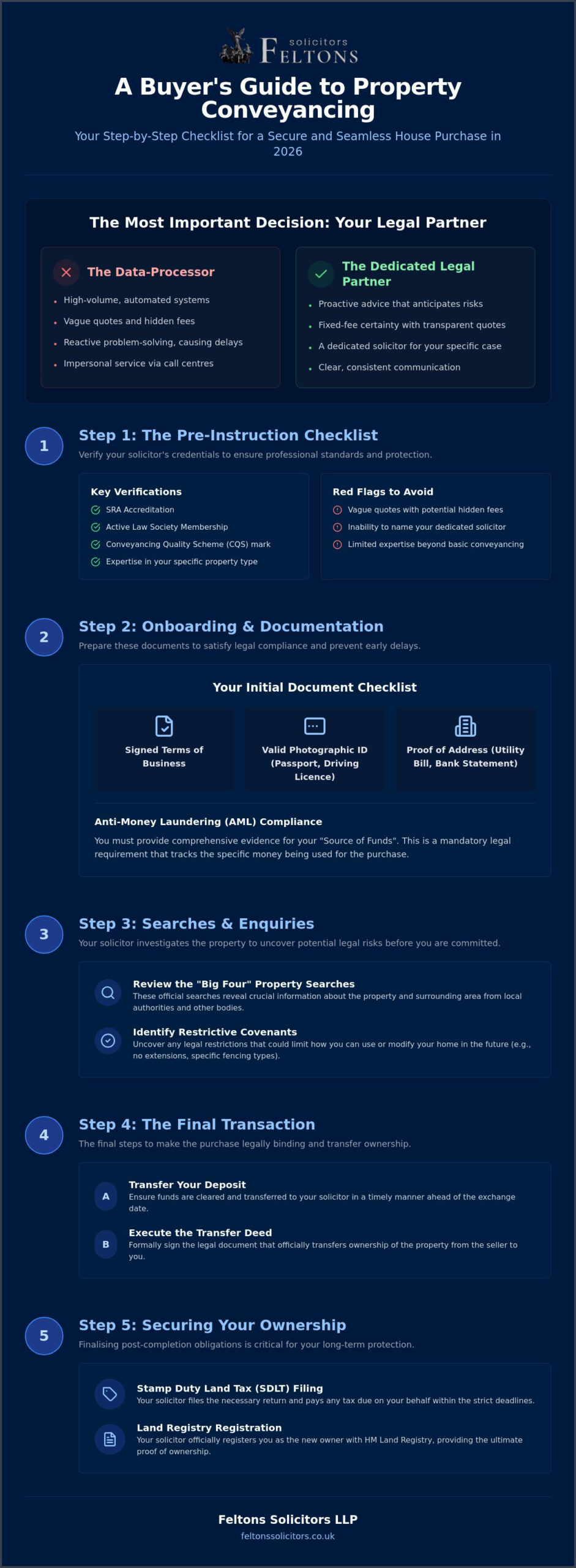
Preparing for Exchange and Completion: The Final Transaction Checklist
As the technical enquiries conclude, the focus shifts to the final execution of the transaction. This is the stage where your preparation meets professional oversight to ensure a seamless transition of ownership. Your solicitor for buying a house will coordinate with the seller’s legal team to align the entire chain, managing the logistical hurdles that often arise in the final 48 hours. This phase requires your active participation to ensure all documents are legally binding and funds are positioned correctly.
To navigate this final stretch with confidence, follow this essential checklist:
- Review and Sign: Execute the final Contract and Transfer Deed (TR1) in the presence of an independent witness.
- Deposit Transfer: Ensure the exchange deposit, which is usually 10% of the purchase price, is transferred to your solicitor’s client account.
- Buildings Insurance: Activate your policy so it’s valid from the date of exchange, as the risk usually passes to the buyer at this point.
- Coordinate Dates: Agree on a completion date that works for everyone in the chain, allowing enough time for removals and bank transfers.
- Final Authorisation: Provide your solicitor with explicit authority to exchange contracts on your behalf.
The Moment of Legal Commitment
The “Exchange of Contracts” is a formal process conducted via a recorded telephone call between the solicitors in the chain. Once this call concludes, the purchase is legally binding. You cannot pull out after this point without significant financial penalties, including the loss of your deposit and potential litigation for breach of contract. We manage this milestone with a steady, calm presence, ensuring that the emotional transition from “making an offer” to “securing your home” is supported by absolute legal certainty.
Final Financial Reconciliations
In the days leading up to completion, your solicitor for buying a house will provide a final “Completion Statement.” This document provides a transparent, itemised breakdown of all remaining costs, including the balance of the purchase price, Stamp Duty Land Tax, and Land Registry fees. Your solicitor must also submit a “Certificate of Title” to your mortgage lender to ensure the mortgage advance is released in time for the completion day. It’s vital to arrange for the final balance of your own funds to be cleared in your solicitor’s account at least one day before completion to prevent banking delays from stalling your move.
If you value a legal partner who prioritises meticulous financial accuracy and proactive communication, you can instruct our residential property experts to manage your upcoming purchase. Our boutique approach ensures that every detail of your completion is handled with the highest standard of professional integrity.
Post-Completion Obligations: The Ownership and Protection Checklist
The moment you receive the keys to your new home is a significant milestone, yet the legal process does not conclude at the front door. Your solicitor for buying a house remains active behind the scenes to ensure your legal title is perfected and your tax obligations are finalised. This administrative tail is vital for protecting your investment and ensuring that future sales or remortgages proceed without technical hitches. Whilst the move itself is a physical transition, these final legal steps provide the permanent security every homeowner requires.
Your post-completion checklist should include the following essential actions:
- Tax Compliance: Verify that your Stamp Duty Land Tax (SDLT) return has been submitted and the tax paid to HMRC within the required 14-day window.
- Title Registration: Confirm that your solicitor has applied to HM Land Registry to register you as the new legal owner and to record your mortgage lender’s interest.
- Document Retention: Collect your “Title Deed” bundle, which includes the updated Title Register, any specific indemnity policies, and physical certificates for gas or electrical works.
- Asset Protection: Update your Will to reflect your new property asset and ensure your estate is distributed according to your wishes.
Securing Your Future
Acquiring a property is often the most significant financial commitment of a lifetime. This makes it the most critical time to organise estate planning to protect your legacy. For joint owners, understanding the distinction between “joint tenants” and “tenants in common” is essential to avoid future contentious probate disputes. A sophisticated legal partner will help you navigate these choices with quiet confidence, ensuring that your home remains a secure asset for your loved ones. Storing your legal documents safely now prevents avoidable delays when you eventually decide to sell.
The Final Handover
Securing Your Move with Expert Guidance
Navigating the UK property market in 2026 requires a blend of meticulous preparation and expert legal oversight. By following this checklist, you’ve established a foundation for a transaction defined by clarity rather than confusion. You now understand that a dedicated solicitor for buying a house does more than process paperwork; they act as a sophisticated guide through complex leasehold reforms and rigorous compliance standards. This proactive approach ensures that your interests are protected at every stage, from the initial instruction to the final registration of your ownership.
A successful completion relies on early documentation, thorough search analysis, and a methodical approach to the final exchange. At Feltons, our expert residential property team prioritises a boutique, people-first approach that values your personal peace of mind and long-term security. We provide transparent, fixed-fee options to ensure you have financial certainty from the very outset of your journey. To ensure your purchase is handled with quiet confidence and professional integrity, contact Feltons Solicitors for a tailored conveyancing quote.
Frequently Asked Questions
How long does a solicitor take to buy a house in 2026?
The average property transaction in 2026 takes approximately 12 to 16 weeks to reach completion from the point of offer acceptance. This timeline depends heavily on the complexity of the property chain and the responsiveness of local authorities regarding search results. Whilst digital advancements have streamlined some administrative tasks, thorough legal due diligence remains a priority that cannot be rushed if you wish to ensure a secure investment.
What is the difference between a conveyancer and a solicitor?
Solicitors are fully qualified lawyers who offer a broad range of legal expertise, whilst licensed conveyancers are specialists focused specifically on property transfers. A solicitor for buying a house often possesses the additional training required to handle complex litigation or probate matters that may arise during a transaction. Choosing a solicitor ensures you have a partner capable of managing intricate legal hurdles with a sophisticated level of care.
How much are the typical legal fees for buying a house?
Legal fees are generally determined by the property’s purchase price and the specific nature of the transaction, such as whether the home is freehold or leasehold. You should always request a transparent, fixed-fee quote that clearly distinguishes the professional fee from external costs. This ensures you have financial certainty from the outset and protects you from the risk of hidden administrative charges appearing later in the process.
Do I need a local solicitor, or can I use one based elsewhere in the UK?
You are not required to use a local firm, as most conveyancing is now conducted through secure digital portals and electronic communication. You can instruct a solicitor located anywhere in England or Wales to handle your purchase with equal efficiency. The priority should be the firm’s expertise and their ability to provide a calm, steady presence throughout the transaction rather than their physical proximity to the property.
What happens if the property chain breaks down?
A chain breakdown prior to the exchange of contracts means the transaction is not yet legally binding, allowing parties to withdraw without financial penalty. This situation requires a proactive legal partner who can liaise with estate agents and other solicitors to find a pragmatic solution. If you have already paid for searches, these may need to be refreshed if a significant delay occurs before a new chain is established.
What are disbursements, and why do I have to pay them?
Disbursements are essential third-party costs that your solicitor pays on your behalf, such as local authority searches and Land Registry fees. These charges are passed on to you at cost and are necessary to verify the property’s legal standing for your mortgage lender. Your solicitor for buying a house will collect these funds as an initial payment on account to ensure these vital checks are commissioned immediately.
Can a solicitor help me if I am buying a house with someone else?
Yes, your solicitor will provide essential advice on the different ways to hold joint ownership, such as “joint tenants” or “tenants in common.” This decision has significant implications for your future estate planning and how the property is treated if one owner passes away. Professional guidance is vital for protecting your individual financial interests and ensuring that your property assets are managed according to your specific wishes.
When should I instruct a solicitor for buying a house?
You should instruct a solicitor as soon as you begin your property search or immediately after your offer has been accepted. Engaging a legal partner early allows you to complete the mandatory onboarding and compliance checks, putting you in a “contract-ready” position. This proactive approach demonstrates your commitment to the seller and helps maintain a steady momentum for the entire move, reducing the risk of early delays.