
How to Organise a Commercial Lease Renewal in 2026: A Strategic Guide

How to Organise a Commercial Lease Renewal in 2026: A Strategic Guide

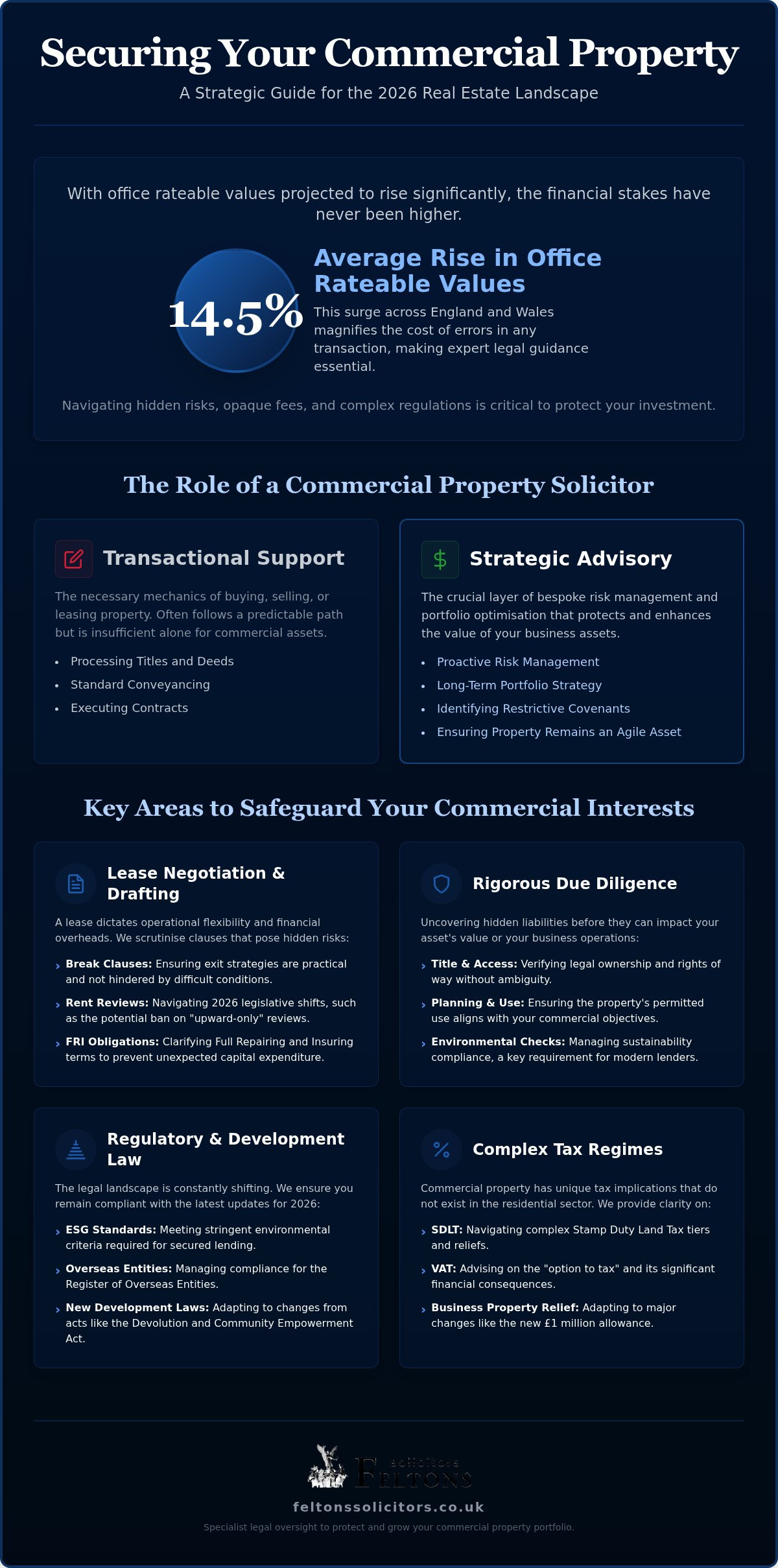
The most expensive mistake a business owner can make in 2026 is treating a lease expiry as a simple paperwork exercise. With the Law Commission’s June 2026 proposals to reform the Landlord and Tenant Act 1954, the traditional rules of engagement are shifting. It’s entirely natural to feel a sense of trepidation regarding aggressive rent hikes or the risk of missing a strict statutory deadline. Most directors simply want to maintain business continuity without being locked into an inflexible, high-cost agreement. Instructing experienced commercial lease renewal solicitors is a vital step in navigating these complexities whilst protecting your operational stability.

This guide offers a clear, strategic path through the current legal landscape, promising to help you secure the best possible terms and minimise your exposure to litigation. We’ll examine how to leverage the latest market data, such as the 3% average rental growth in the office sector, to your tactical advantage. You’ll also learn how the English Devolution and Community Empowerment Bill might affect your future rent review clauses, providing you with the insight needed to ensure your business remains resilient and well-positioned.

Key Takeaways

  • Understand the specific criteria for security of tenure under the Landlord and Tenant Act 1954 to ensure your right to remain in your premises is legally protected.
  • Master the strategic use of Section 25 and Section 26 notices to initiate the renewal process on your own terms and avoid missing critical statutory deadlines.
  • Learn how to apply the O’May principles during negotiations to maintain existing lease benefits whilst successfully arguing for modern updates like flexible break clauses.
  • Discover why an 18-month lead time is essential for success and how commercial lease renewal solicitors can help you navigate potential opposition from landlords.
  • Identify the seven statutory grounds for opposing a renewal, specifically focusing on redevelopment and owner occupation, to protect your business from unexpected displacement.

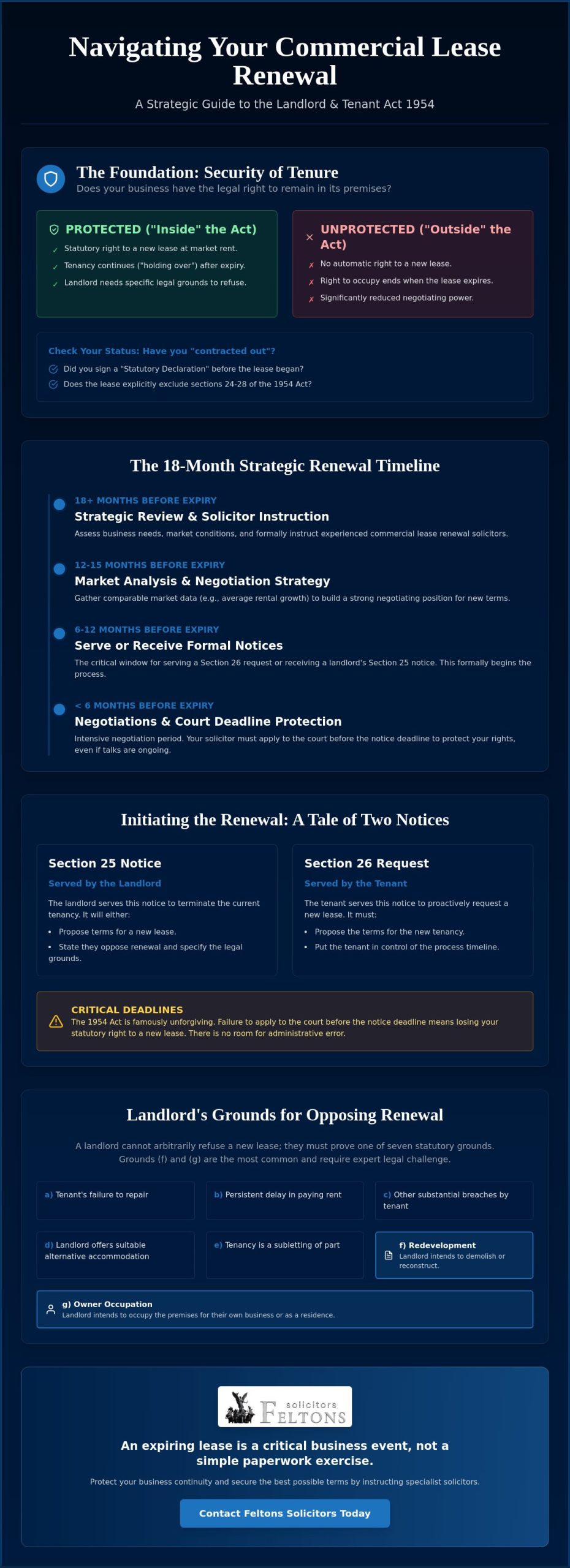
Security of tenure is the fundamental right for a business tenant to renew their lease on similar terms when the current agreement expires. It acts as the cornerstone of UK commercial property law, preventing landlords from arbitrarily evicting successful businesses or demanding unsustainable rents at the end of a term. To qualify for this protection under the Landlord and Tenant Act 1954, your arrangement must meet three specific criteria: a valid tenancy must exist, the premises must be occupied for business purposes, and the parties must not have “contracted out” of the Act’s provisions. Check your lease today.

Understanding whether you are “inside” or “outside” the Act is a critical first step for any business strategy. If you are inside, you have a statutory right to a new lease at market rent. If you are outside, your legal right to occupy ends the moment the lease expires. The stakes are high. Experienced commercial lease renewal solicitors often find that tenants are unaware of their status until a deadline is imminent. You can realise your legal standing immediately by reviewing your lease for a clause stating that sections 24 to 28 of the 1954 Act are excluded.

The Core Principles of Part II Protection

A protected lease doesn’t simply terminate on its expiry date. Instead, it continues under a principle known as “holding over.” This provides a vital safety net, allowing you to remain in the property on the same terms whilst a new agreement is finalised. Landlords frequently prefer to “contract out” of these protections to maintain absolute control over their assets. This is common in shopping centres or areas slated for redevelopment. Without these rights, your leverage in negotiations is significantly reduced, as the landlord is under no obligation to offer a renewal or even allow you to stay.

Common Exceptions to Security of Tenure

Not every commercial arrangement carries these statutory rights. Tenancies at will, which can be terminated by either party at any time, do not offer protection. Similarly, fixed-term leases of less than six months are generally excluded, unless the tenant has already been in occupation for more than 12 months. Agricultural holdings and mining leases also fall under different legislative frameworks. For a lease to be validly “contracted out,” the landlord must have served a formal warning notice before the lease began, followed by a statutory declaration from the tenant. To identify your status, consider this checklist:

  • Is there a signed “Statutory Declaration” in your files dated before the lease began?
  • Does the lease explicitly mention the exclusion of sections 24-28 of the 1954 Act?
  • Is the term a fixed period rather than a periodic or “rolling” tenancy?

Consulting commercial lease renewal solicitors early ensures these documents are interpreted correctly, preventing costly surprises that could jeopardise your business continuity.

Initiating the Renewal: A Step-by-Step Guide to Section 25 and 26 Notices

The procedural machinery of the 1954 Act is triggered by the service of formal notices. These documents are not mere letters; they are legal instruments with strict statutory requirements. Whether the landlord serves a Section 25 notice or you choose to issue a Section 26 request, the timing must be precise. A failure to adhere to these windows can result in the automatic termination of your tenancy. In many cases, missing a deadline means losing your statutory right to remain in the property entirely. For a clear breakdown of your rights during this phase, the official government guidance on lease renewal provides a useful starting point for understanding the basic statutory framework.

The 1954 Act is famously unforgiving. If a landlord serves a hostile notice and the tenant fails to apply to the court before the deadline, the right to a new lease is lost. There is no room for administrative error. Engaging with commercial property experts early in this window allows for a more measured negotiation phase. This ensures that every document served is valid and that your business interests remain protected throughout the transition.

The Landlord’s Section 25 Notice

A landlord usually initiates the process by serving a Section 25 notice. This must be served between six and twelve months before the proposed lease end date. There are two distinct types of this notice. A “friendly” notice indicates the landlord is willing to grant a new lease and will include their proposed terms for rent and duration. A “hostile” notice, however, indicates they will oppose a renewal. To be valid, a Section 25 notice must be in the prescribed legal form and state exactly whether the landlord is prepared to grant a new tenancy. If you receive a hostile notice, commercial lease renewal solicitors will need to evaluate the landlord’s grounds for opposition immediately.

The Tenant’s Section 26 Request

You do not have to wait for your landlord to act. A tenant can take the initiative by serving a Section 26 request to start the renewal process. This is often a savvy move in the 2026 property market if you believe market rents are currently lower than what you are paying. By serving notice first, you can potentially lock in more favourable terms sooner. Your request must outline your proposed new rent, the term length, and any significant changes to the lease, such as new break clauses. Once served, the landlord has exactly two months to serve a counter-notice if they intend to oppose the renewal. This proactive approach provides certainty and allows your business to plan its finances with greater precision.

The O’May principles remain the judicial baseline for lease renewals. Essentially, the court presumes that the terms of the new lease should mirror the old one unless there is a compelling reason to deviate. However, the commercial world has evolved significantly since many older leases were drafted. We often assist clients in arguing for modernisations that reflect current market standards. For those considering their long-term position, our guide on commercial property solicitors provides broader context on the decision between renewing a lease or purchasing a freehold.

Environmental obligations, or “Green Leases,” are no longer optional extras in 2026. Negotiating how to organise energy efficiency improvements and data sharing is complex. It requires a delicate balance between a landlord’s desire to future-proof their asset and a tenant’s need to avoid excessive costs. Adhering to the RICS Code for Leasing Business Premises ensures that negotiations remain transparent and grounded in industry-recognised standards of fairness. Commercial lease renewal solicitors play a vital role in ensuring these new clauses don’t inadvertently shift unfair financial burdens onto the tenant.

Determining Market Rent and Interim Rent

Setting the new rent relies on an “open market” valuation. This assumes a willing landlord and a willing tenant, ignoring the specific circumstances of the current occupier. To prevent financial uncertainty, “Interim Rent” can be established while negotiations continue. This protects both parties by ensuring a fair rate is paid during the “holding over” period. With average annual rental growth for UK offices standing at 3% as of May 2026, having accurate valuation data is essential. Commercial lease renewal solicitors will typically work alongside a specialist surveyor to ensure the legal arguments for a lower rent are backed by robust evidence.

Modernising Repair and Insurance Obligations

The shift from traditional Full Repairing and Insuring (FRI) leases to more nuanced agreements is a key trend. Tenants are increasingly successful in negotiating service charge caps to ensure overheads remain predictable. Additionally, the inclusion of “pandemic clauses” or updated force majeure wording is now standard practice to protect against unforeseen global disruptions. These protections ensure that your business isn’t left vulnerable to costs outside its control, such as:

  • Sudden spikes in insurance premiums.
  • Unexpected structural repair demands for older buildings.
  • Variable service charges for communal energy-saving initiatives.

By modernising these obligations, you create a more resilient foundation for your business operations over the coming years.

How to Organise a Commercial Lease Renewal in 2026: A Strategic Guide

Handling Opposed Renewals and Dispute Resolution: Protecting Your Business Interests

A landlord’s decision to oppose a renewal can feel like a direct threat to your business’s future. However, under the 1954 Act, a landlord cannot simply refuse to renew because they wish to find a new tenant at a higher rent. They must prove at least one of seven statutory grounds. Understanding these grounds is essential for any business leader. If you find yourself facing an opposed renewal, consulting with commercial lease renewal solicitors ensures that the landlord’s evidence is rigorously tested and your right to compensation is protected.

The Seven Grounds of Opposition

The Landlord and Tenant Act 1954 outlines grounds (a) through (g). Grounds (a), (b), and (c) are discretionary, meaning the court decides if it is “fair” to refuse a renewal based on tenant breaches, such as persistent late rent payments or a failure to repair the premises. Ground (d) involves the landlord offering suitable alternative accommodation, whilst ground (e) applies to sub-tenants where a higher rent could be achieved by letting the whole building. The most common challenges arise from the “mandatory” grounds:

  • Ground F (Redevelopment): The landlord must prove a firm and settled intention to demolish or reconstruct the premises, which they cannot reasonably do without obtaining possession.
  • Ground G (Owner Occupation): The landlord intends to occupy the premises for their own business. Crucially, they must have owned the property for at least five years to rely on this ground.

If a renewal is successfully opposed under grounds (e), (f), or (g), the tenant is usually entitled to statutory compensation. This is calculated based on the rateable value of the premises, often doubling if the business has been in occupation for 14 years or more.

Court Applications and Timelines

If negotiations reach a stalemate, you must issue court proceedings before the statutory deadline to prevent your renewal rights from expiring. This does not mean you will end up in a courtroom; most cases settle long before a trial. During this period, expert witnesses, typically specialist surveyors, provide evidence on market rent and lease terms. For parties seeking a more efficient resolution, the Professional Arbitration on Court Terms (PACT) scheme offers a faster, cheaper alternative to the traditional court route. PACT allows an arbitrator or independent expert to decide the new lease terms, providing finality without the public nature of a court hearing. This methodical approach ensures business continuity whilst managing legal costs effectively.

Strategic Timeline for Success: How Commercial Lease Renewal Solicitors Optimise the Outcome

Success in a lease renewal is rarely the result of last-minute heroics. It is the product of a disciplined timeline that begins at least 18 months before your current term expires. This “18-Month Rule” provides the necessary space to evaluate your business goals without the pressure of an impending eviction or an expiring notice period. By starting early, you gain the leverage to walk away or negotiate from a position of strength. Instructing commercial lease renewal solicitors at this stage allows for a thorough audit of your current lease, identifying any hidden “contracting out” clauses or complex break conditions that could jeopardise your security of tenure.

The strategic requirements of a renewal often depend on which side of the table you occupy. Whilst tenants typically prioritise business continuity and rent stability, the legal support for property developers and landlords often focuses on maximising asset value or preparing for future site assembly. Understanding these differing motivations is key to a smooth negotiation. Once the broad commercial points are agreed, the creation of a clear “Heads of Terms” document is essential. This non-binding summary acts as a roadmap for the final lease, significantly reducing legal costs by ensuring both solicitors are working from an identical set of instructions.

Preparation Checklist: 12-18 Months Before Expiry

A methodical approach to preparation ensures no detail is overlooked. Your focus during this window should include:

  • Reviewing the existing lease for specific “time is of the essence” clauses regarding notices.
  • Conducting a market rent assessment to establish your “ideal” vs “acceptable” financial targets.
  • Verifying the legal validity of your current occupation to ensure statutory rights are intact.
  • Consulting with commercial lease renewal solicitors to draft a preliminary negotiation strategy.

The Value of Boutique Legal Expertise

Choosing a boutique firm ensures your renewal receives the personal attention it deserves. High-volume firms often treat lease renewals as administrative tasks, which can lead to missed nuances in complex modern clauses. Our approach at Feltons Solicitors LLP combines traditional professional integrity with modern efficiency, ensuring that your business interests are protected by a partner who understands both property law and litigation and dispute resolution. This dual expertise is vital if a landlord unexpectedly opposes a renewal or if negotiations move towards a PACT arbitration. At Feltons Solicitors LLP, we prioritise your peace of mind through a people-first philosophy. We invite you to a discreet consultation to discuss your specific portfolio needs and secure your business’s future in the 2026 property market.

Securing Your Business Future in a Shifting Market

A successful commercial lease renewal in 2026 demands more than just legal compliance; it requires a proactive strategy that begins long before your term expires. Timing is everything. By adhering to the 18-month rule and understanding your statutory rights under the Landlord and Tenant Act 1954, you position your business to thrive despite market fluctuations. Whether you’re navigating the complexities of green lease clauses or managing a hostile notice, the right tactical positioning is essential for maintaining operational stability.

Engaging commercial lease renewal solicitors ensures your interests are shielded by experts who understand the nuances of property law and complex commercial litigation. Feltons Solicitors LLP combines an established heritage with a modern, people-first philosophy that prioritises your business continuity. We offer a sophisticated boutique service for national clients, providing a calm, steady presence to guide you through every negotiation and potential dispute. Contact Feltons Solicitors LLP today for a discreet consultation on your commercial lease renewal. We look forward to helping you secure a favourable and flexible foundation for your business’s next chapter.

Frequently Asked Questions

What happens if my commercial lease expires and I haven’t signed a new one?

If your lease is protected by the Landlord and Tenant Act 1954, you’ll enter a period of “holding over.” This means your tenancy continues on the same terms until either party serves the appropriate statutory notice. However, if your lease is “contracted out,” you have no legal right to remain and could be treated as a trespasser if you don’t vacate the premises on the expiry date.

Can a landlord refuse to renew my commercial lease for no reason?

A landlord cannot refuse a renewal without a valid legal reason if the tenancy is protected. They must prove one of the seven statutory grounds, such as an intention to redevelop the building or a desire to occupy the premises themselves. Engaging commercial lease renewal solicitors early allows you to challenge these grounds and protect your right to remain or secure compensation.

How much notice does a landlord have to give for a commercial lease renewal?

A landlord must provide between six and twelve months’ notice before the proposed termination date using a Section 25 notice. This notice must state whether they oppose the renewal or are willing to grant a new tenancy. If you haven’t received a notice within this window and your lease is protected, your current arrangement continues under the holding over provisions mentioned above.

What is a ‘contracted out’ lease and how does it affect my rights?

A “contracted out” lease is an agreement where the parties have formally agreed to exclude the security of tenure provisions of the 1954 Act. This means you have no automatic right to a new lease at the end of the term. Landlords often prefer this for flexibility, but it leaves the tenant vulnerable to relocation costs and potential business disruption if a new deal isn’t reached. Just as choosing the right solicitor for buying a house is critical to protecting your interests in a residential transaction, selecting experienced legal representation for a contracted-out commercial lease is equally essential to safeguarding your business position.

Am I entitled to compensation if my landlord refuses to renew my lease?

You are generally entitled to statutory compensation if the landlord refuses a renewal on “no-fault” grounds, such as redevelopment or owner-occupation. The amount is usually based on the rateable value of the property. If your business has occupied the premises for 14 years or more, this compensation typically doubles, providing a financial cushion for your relocation.

Can I negotiate a lower rent during a commercial lease renewal?

You can certainly negotiate a lower rent if current market conditions suggest that the “open market” value has decreased. Success depends on robust evidence, such as comparable local data or the 3% rental growth caps seen in specific sectors in early 2026. Commercial lease renewal solicitors will work with surveyors to present a compelling case for a rent reduction during negotiations.

How long does the commercial lease renewal process typically take?

The process typically takes between six and twelve months from the service of the initial notice to the completion of the new lease. If the parties cannot agree on terms and the matter proceeds to court or Professional Arbitration on Court Terms (PACT), the timeline can extend significantly. Starting your preparations 18 months in advance is the best way to manage this schedule effectively.

Is it better to serve a Section 26 request or wait for a Section 25 notice?

Serving a Section 26 request is often better if you want to take control of the timeline and propose your own terms first. This is particularly useful in a falling market where you want to lock in a lower rent as soon as possible. Waiting for a Section 25 notice leaves the initiative with the landlord, which might not align with your specific business planning or budget cycles.

Comprehensive Legal Support for Property Developers in 2026: A Strategic Reference

Comprehensive Legal Support for Property Developers in 2026: A Strategic Reference

Did you know that housing starts in England surged by 24% at the end of 2025? Whilst this growth signals a vibrant market, it also places immense pressure on your ability to secure sites and break ground without delay. You’ve likely felt the frustration of complex title issues or the administrative weight of the Register of Overseas Entities slowing your momentum. In such a fast-paced environment, securing the right legal support for property developers is the difference between a project that stalls and one that thrives.

We understand that you need more than just a solicitor; you require a steady, strategic partner. This guide offers a definitive roadmap for navigating the complexities of the 2026 property market. We’ll explore how to manage the transition to zero-carbon standards and the nuances of leasehold reform. You’ll discover how tailored legal backing ensures seamless site acquisition and robust risk mitigation, leading to an efficient exit strategy through plot sales or commercial leasing. Our goal is to provide the clarity you need to move forward with quiet confidence.

Key Takeaways

  • Secure development sites with confidence by using conditional contracts and option agreements to manage risk before ground is broken.
  • Discover why early legal support for property developers is essential for navigating the complex shift towards zero-carbon building standards and leasehold reforms.
  • Ensure full compliance with the Register of Overseas Entities whilst learning how to structure joint ventures that protect your interests.
  • Optimise your exit strategy through the preparation of comprehensive legal packs for plot sales and the creation of value-maximising commercial leases.
  • Understand the benefit of a boutique legal partnership that prioritises senior-level expertise and a pragmatic, commercially minded approach to your portfolio.

The 2026 property market presents a distinct paradox. Whilst housing starts in England rose by 24% in the final quarter of 2025, the legal framework surrounding these projects has become significantly more intricate. Success in this environment requires a shift in perspective. You shouldn’t view legal counsel as a final administrative check before exchange; it’s a strategic pillar that determines project viability from the very first sketch. For a comprehensive overview of property development, one must look at the entire lifecycle where law and commerce intersect. High-quality legal support for property developers helps you balance the need for commercial speed with the necessity of meticulous due diligence.

The Significance of Early Legal Involvement

Waiting until a site is identified to engage a solicitor is a common but costly mistake. Early involvement allows you to identify “deal-breakers” before you commit significant capital or resources. We focus on uncovering hidden risks that could derail your programme, such as ancient land use restrictions or unrecorded utility access. Our approach involves establishing a clear legal roadmap at the conceptual stage. This ensures your project timelines remain realistic and allows for a smoother transition to acquisition, as the bulk of the investigative work is already complete. By identifying potential hurdles early, we help you maintain momentum when it matters most.

A proactive legal strategy typically involves reviewing:

  • Restrictive Covenants: Identifying limitations that might prevent your specific density or building type.
  • Easements and Rights of Way: Uncovering third-party rights that could physically limit your buildable area.
  • Title Defects: Addressing complex ownership chains that require insurance or curative work before a lender will release funds.

Adapting to Legislative Reform in 2026

The regulatory environment is shifting rapidly. The Building Regulations etc. (Amendment) (England) Regulations 2026, which come into force on 24 March 2027, already demand your attention. You must ensure your 2026 designs are “zero carbon ready” to meet these upcoming standards for low-carbon heating and high energy efficiency. Compliance isn’t just about build quality; it’s a legal requirement that affects your eventual disposal strategy and asset value. Failure to plan for these changes now could result in costly retrofitting later.

Additionally, the ongoing leasehold and freehold reforms are changing how you structure residential exits. Navigating the Building Safety Act remains a priority for higher-risk buildings, requiring rigorous documentation at every “gateway” stage. Our role is to act as your strategic advisor, translating these complex shifts into practical, actionable steps that protect your profit margins. We provide the steady hand needed to turn regulatory hurdles into competitive advantages, ensuring your development is both compliant and future-proofed against further legislative shifts.

Strategic Site Acquisition and Pre-Construction Due Diligence

Acquiring a site in 2026 is a high-stakes endeavour where the legal structure of the deal often dictates its ultimate success. With commercial property SDLT rates at 5% for acquisitions over £250,000, and a 2% surcharge for non-UK residents, the margin for error is slim. You need to ensure that your capital is protected whilst you navigate the complexities of planning and finance. This is where dedicated legal support for property developers becomes indispensable, providing the framework to secure land without exposing yourself to unnecessary risk. Whether you’re utilising conditional contracts or negotiating Section 106 agreements, the goal is to align legal certainty with your commercial timeline.

Securing development finance also requires a meticulous approach to due diligence. Lenders in 2026 are increasingly selective, even with mortgage approvals for house purchases reaching 65,945 in April 2026. They require absolute clarity on title issues and Community Infrastructure Levy (CIL) liabilities before releasing funds. We work to ensure your “Legal Pack” is robust enough to satisfy the most stringent institutional requirements, facilitating smoother access to bridging loans and development capital. For those navigating the complexities of land acquisition, our commercial conveyancing team provides the steady guidance needed to move from offer to exchange with confidence.

Mastering Option and Promotion Agreements

Choosing between an option agreement and a promotion agreement depends entirely on your risk appetite and long-term strategy. An option agreement gives you the right to purchase the land at a set price once planning is secured, whereas a promotion agreement involves you working with the landowner to sell the site to a third party. In a promotion agreement, the “trigger event” is typically the grant of a final, implementable planning permission that satisfies all pre-commencement conditions. Protecting your interests during this phase involves drafting clauses that account for potential planning appeals and the impact of the April 2026 business rates revaluation on site holding costs.

The Due Diligence Checklist for Developers

A comprehensive investigation goes far beyond a simple title search. You must analyse rights of light, drainage easements, and existing utility access to ensure the site can physically support your proposed density. It’s also vital to verify that your plans align with the UK government’s permitted development rights, as these can offer a more efficient route to conversion than full planning applications. We also ensure the site is “clean” from a litigation perspective, checking for any ongoing disputes or claims that could cloud the title and delay construction. Meticulous due diligence today prevents the “deal-breakers” of tomorrow.

Managing Complex Structures: Overseas Entities and Joint Ventures

International investment remains a cornerstone of the UK construction market, which is valued at USD 325.33 billion in 2026. However, the regulatory environment for foreign capital has never been more stringent. For international investors, the 2% SDLT surcharge on top of additional property rates is only the beginning of the compliance journey. Navigating these requirements demands specialised legal support for property developers who need to move capital efficiently whilst remaining fully transparent with HMRC and Companies House. We provide the discreet, expert guidance necessary to manage these complex structures without disrupting your project’s momentum.

Most large-scale projects now utilise Special Purpose Vehicles (SPVs) to ring-fence liability and manage tax obligations. Whilst these structures offer significant commercial advantages, they also require meticulous administrative oversight. Ensuring your SPV is correctly formed and maintained is essential for securing development finance, as lenders require a clear line of sight regarding ownership and control. We help you establish these entities with a focus on long-term stability and ease of eventual disposal.

The Register of Overseas Entities Explained

The Register of Overseas Entities is a mandatory requirement for any foreign entity that owns, or intends to purchase, land in the UK. Compliance involves more than just a simple filing; it requires a UK-regulated agent to verify the beneficial ownership of the entity. This process must be updated annually to maintain a valid overseas entity ID. Failing to comply has severe consequences, as the Land Registry will block your ability to sell, lease, or even charge the property against a loan. We act as a steady partner in this process, handling the verification and registration to ensure your assets remain liquid and your reputation remains untarnished.

Drafting Robust Joint Venture Agreements

Joint Ventures (JVs) are a powerful tool for balancing risk and reward, yet they are often where the most complex disputes arise. A well-drafted JV agreement must go beyond profit-sharing to define clear governance and dispute resolution mechanisms. This includes “deadlock” provisions that outline what happens when partners cannot agree on a fundamental decision, such as a change in the development’s scope or a mid-project sale. Following The Property Institute Guidance helps ensure your management structures meet industry standards from the outset.

Your JV agreement should also address:

  • Governance: Establishing who has the final say on day-to-day operational matters versus strategic milestones.
  • Exit Strategies: Pre-defining the process for one partner to buy out the other or for a coordinated sale to a third party.
  • Intellectual Property: Protecting the development’s brand assets, architectural plans, and proprietary construction methodologies.

By addressing these points early, we protect your interests and provide a clear framework for a successful partnership. If you require assistance with international compliance, our team specialises in the Registration of Overseas Entities, providing a seamless service for global developers.

Comprehensive Legal Support for Property Developers in 2026: A Strategic Reference

Securing the Exit: Plot Sales, Leases, and Commercial Disposals

The final stage of any development is where theoretical value becomes tangible capital. Whether you’re completing a high-density residential block or a boutique commercial hub, the efficiency of your disposal strategy determines your final return on investment. In 2026, with average house prices having increased by 3.8% over the past year, the demand for swift completions is high. High-calibre legal support for property developers ensures that your exit is as streamlined as your acquisition. We focus on preparing the ground for disposal long before the final brick is laid, ensuring that every contract and lease is drafted to maximise asset value and minimise delays.

Efficient Residential Plot Sales

The key to a successful residential exit lies in the preparation of a comprehensive “Legal Pack” that is ready as soon as marketing begins. By standardising documentation, you accelerate the conveyancing process for buyers and their lenders, reducing the time between reservation and completion. This is vital when managing modern ground rent and service charge structures, which must remain compliant with the latest leasehold reforms to remain marketable. Our approach involves integrating residential and commercial conveyancing expertise into your exit plan from the outset. This foresight prevents the last-minute delays that often arise from inconsistent documentation or unresolved title queries. For buyers completing their purchase, working with a specialist residential property law firm ensures that the conveyancing process is handled with the same rigour and precision that underpins your development programme.

Commercial Leasing and Asset Management

For commercial developments, the exit strategy often involves securing high-calibre tenants through “Agreements for Lease” before construction is even finished. These documents must be meticulously drafted to address repair obligations and break clauses, as these terms directly impact the property’s attractiveness to future institutional investors. A lease that is too restrictive may deter tenants, whilst one that is too lenient can undermine the long-term value of the asset. We help you strike the right balance, ensuring your development remains a robust investment for years to come. Where tenants are already in occupation, understanding the process of instructing experienced commercial lease renewal solicitors is equally important to protecting the income stream and long-term capital value of your asset.

We also address the practicalities of asset management, ensuring that your commercial leases are structured to allow for future disposals or refinancing. If you are ready to finalise your exit strategy, our team can assist with your residential and commercial conveyancing requirements to ensure a smooth and professional disposal process.

Choosing the right legal support for property developers isn’t just about finding a firm that can process paperwork. It’s about securing a partner who understands the commercial weight of your decisions and the personal stakes involved in every project. At Feltons Solicitors, we provide a sophisticated blend of professional authority and empathetic reassurance. We’re a boutique firm, which means you aren’t just another project in a high-volume system. You have direct access to senior solicitors who offer tailored, high-quality advice grounded in practicality and sound judgment.

Our expertise extends across the full spectrum of property law, ensuring that your personal and professional assets are protected with equal rigour. Whether you’re managing a national residential scheme or an international commercial project, we act as a discreet, dependable partner. We value the human impact of our work, ensuring that whilst the technical legalities are paramount, your personal rapport with your legal team is never forgotten. This people-first philosophy is what allows us to navigate the most complex situations with quiet confidence.

Why Developers Choose Feltons

We’ve built our reputation on a commitment to long-term professional relationships. This isn’t just about the current transaction; it’s about supporting your growth over the coming years. Our proven track record in handling complex litigation and dispute resolution allows us to protect your interests when challenges arise, providing a calm, steady presence in stressful situations. We combine traditional professional integrity with a forward-thinking methodology, ensuring your development stays on track without sacrificing the high standards of a discreet, boutique service. You’ll find our advice is always pragmatic and commercially minded, designed to facilitate your goals rather than hinder them with dense legalese.

Our Comprehensive Property Services

Our team offers specialised expertise in areas that directly impact your project’s viability and your eventual exit strategy. This includes managing the nuances of leasehold enfranchisement and extensions, as well as the mandatory registration of overseas entities for international investors. For private developers, we often integrate our work with estate planning to ensure that the legacy of your projects and your personal wealth are preserved for future generations. Our services are highly organised, reflecting a methodical and orderly legal mindset that mirrors a professional consultation.

Instructing Feltons for your next development project is a straightforward process designed to respect your time. We begin with a methodical consultation to understand your specific objectives and risk profile. From there, we provide a clear roadmap for our partnership, ensuring you feel informed, supported, and in capable hands from site acquisition to final disposal. We invite you to contact us to discuss how our boutique approach can provide the strategic legal backing your portfolio requires in 2026.

Securing Your Development Legacy in 2026 and Beyond

The 2026 property landscape demands a move from reactive administration to proactive strategy. As we’ve explored, the difference between a project that stalls and one that succeeds often lies in the quality of the groundwork laid long before construction begins. From navigating the complexities of the Building Safety Act to ensuring full compliance with the Register of Overseas Entities, having the right legal support for property developers is a commercial necessity. Success requires a steady hand and a clear roadmap.

Paula Felton established this firm in 2010 with a vision of providing high-end, boutique legal care that remains deeply personal. We offer both national and international expertise, specialising in complex matters like the Registration of Overseas Entities and tailored joint venture structures. Our approach ensures you have a dependable partner to manage the risks whilst you focus on your vision. When you’re ready to move forward with quiet confidence, we’re here to provide the sophisticated guidance your portfolio deserves.

Instruct Feltons Solicitors for your next development project and ensure your project is built on a foundation of legal certainty. We look forward to supporting your next success.

Frequently Asked Questions

What is the role of a solicitor in property development?

A solicitor acts as a strategic advisor who manages legal risks across the entire project lifecycle. They handle everything from initial title investigations and site acquisition to the drafting of construction contracts and the final disposal of units. Their expertise ensures that your project remains compliant with evolving regulations whilst protecting your commercial interests through robust, well-drafted agreements.

Do property developers need specific legal support for site acquisition?

Yes, specialised legal support for property developers is essential during site acquisition to identify restrictive covenants, easements, or title defects that could hinder construction. Solicitors negotiate conditional contracts and option agreements to ensure you only commit significant capital once planning permission is secured. This proactive approach prevents costly delays and ensures the site is legally viable for your specific density requirements.

How does the Register of Overseas Entities affect international developers?

International developers must register with Companies House and identify their beneficial owners before they can buy, sell, or lease UK land. This mandatory register requires an annual update to maintain a valid overseas entity ID. If you fail to comply, the Land Registry will block any dealings with the property, effectively freezing your assets and preventing you from charging the land for development finance.

What are the legal risks of not having a joint venture agreement?

The primary risks include “deadlock” in decision-making and unclear profit-sharing arrangements, which can lead to expensive litigation. Without a formal agreement, there are no pre-defined exit strategies or dispute resolution mechanisms to handle disagreements between partners. A professionally drafted contract protects your investment by establishing clear governance and defining how assets are divided if the partnership dissolves.

Can a solicitor help with Section 106 negotiations?

Solicitors are vital in negotiating Section 106 agreements to ensure that the planning obligations and financial contributions required by local authorities are proportionate. They work to refine the “trigger events” for payments, ensuring they align with your cash flow and construction milestones. This prevents local authority requirements from becoming a barrier to project viability or making the development unmortgageable for future buyers.

What is the difference between a promotion agreement and an option agreement?

An option agreement gives a developer the right to purchase land at a pre-agreed price once planning permission is granted. In contrast, a promotion agreement involves a developer working with the landowner to secure planning and then selling the site on the open market. The developer then takes a percentage of the final sale price, making it a popular choice for those who don’t intend to build out the site themselves.

How much does legal support for property developers cost?

The cost of legal support for property developers varies significantly based on the scale of the project and the complexity of the title. Fees are typically structured to reflect the specific services required, such as handling overseas entity registrations or negotiating complex multi-party joint ventures. We recommend a professional consultation to establish a clear, transparent fee structure that aligns with your development’s specific requirements and timelines.

Why is due diligence critical for brownfield developments?

Due diligence on brownfield sites is essential for uncovering environmental liabilities, such as soil contamination or historical land use issues, that could lead to remediation costs. Solicitors investigate environmental reports and historical records to ensure that these risks are properly allocated in the purchase contract. This protects you from unforeseen expenses and ensures that the site meets the stringent safety standards required for modern residential or commercial occupation.

Commercial Property Solicitors: A Strategic Guide to Buying vs Leasing in 2026

Commercial Property Solicitors: A Strategic Guide to Buying vs Leasing in 2026

Choosing between a freehold purchase and a long-term lease in 2026 is no longer a simple matter of accounting; it’s a defining strategic move for your business’s future agility. You might feel the pressure of this decision, particularly with the fear of being locked into an inflexible agreement whilst the market evolves, or perhaps you’re uncertain about the true costs of ownership amidst shifting regulations. It’s a complex environment where the right choice depends entirely on your specific objectives and risk appetite.

Our commercial property solicitors understand that your premises must serve as a catalyst for growth rather than a financial burden. This guide offers the clarity you need to navigate current complexities, including the implications of the Registration of Overseas Entities and the recent ban on upward-only rent reviews. We’ll compare the long-term value of purchasing at today’s mortgage rates, which can be as low as 5.5% for strong applicants, against the tactical benefits of leasing. By the end of this article, you’ll have a clear framework to determine which path best supports your five-year expansion plan.

Key Takeaways

  • Understand why your commercial property choice is a fundamental pillar of your business’s financial health and long-term stability in 2026.
  • Partnering with experienced commercial property solicitors ensures you navigate the acquisition of freehold assets with clarity whilst building capital appreciation.
  • Discover how to prioritise operational flexibility through leasing and why the Landlord and Tenant Act 1954 remains essential for your security of tenure.
  • Learn to navigate 2026 regulatory changes, such as the Registration of Overseas Entities, to avoid hidden costs and ensure compliance.
  • Identify the critical differences between upfront capital requirements and long-term financial commitments to align your premises with your strategic exit plan.

Your choice of business premises is more than a logistical necessity; it’s a fundamental pillar of your company’s financial health. In 2026, the UK commercial real estate market is estimated to reach a value of USD 157.62 billion. This growth brings both opportunity and intricate regulatory hurdles that require more than just a cursory glance at a contract. You need to ensure that every square foot of your workspace aligns with your long-term exit or expansion plans.

Engaging experienced commercial property solicitors transforms legal oversight from an administrative hurdle into a strategic advantage. They provide a calm, steady presence whilst you make decisions that will affect your balance sheet for years to come. Whether you’re considering the security of a freehold or the flexibility of a lease, your legal advisor ensures the structure of the deal mirrors your business’s five-year trajectory. They act as pragmatic partners, identifying risks in the fine print that could otherwise stifle your future growth.

The UK market is currently witnessing a significant shift between the desire for long-term security and the need for operational agility. With the English Devolution and Community Empowerment Act 2026 introducing a ban on upward-only rent reviews, leasing has become a more dynamic prospect for many businesses. However, the stability of ownership remains a powerful draw for those looking to build equity. Before committing to a specific site, it’s vital to understand the foundational nuances of what is commercial property and how different classifications impact your tax liabilities and operational rights.

Defining Your Business Objectives

Your specific objectives must dictate your legal requirements. A retail business might prioritise high-footfall locations with restrictive user clauses, whilst an industrial firm focuses on long-term environmental compliance and the 2026 EPC reforms. You must balance immediate cash flow needs against the potential for capital appreciation. Our commercial property solicitors help you assess whether you need total operational control or if your capital is better deployed elsewhere in the business.

The Legal Risks of Inadequate Planning

Attempting to manage lease negotiations or property acquisitions without specialist oversight is a high-risk strategy. Poorly structured agreements can severely diminish your business’s valuation when the time comes to sell or seek investment. Hidden costs, such as those arising from the new five-tier business rates multiplier introduced in April 2026, can quickly erode profit margins. Professional representation ensures these details are scrutinised and settled before they become liabilities, protecting your interests in even the most complex disputes.

Purchasing Commercial Property: Building Long-Term Equity

Starting the journey of acquisition requires a clear understanding of the financial landscape. For freehold purchases in England and Northern Ireland, Stamp Duty Land Tax (SDLT) is a primary consideration. As of January 2026, rates are 0% for the portion of the value up to £150,000, 2% from £150,001 to £250,000, and 5% on the portion above £250,000. When paired with commercial mortgage rates that currently range from 5.5% to 9%, ownership represents a significant capital commitment but one that builds a tangible asset on the balance sheet.

The acquisition process begins with the negotiation of the heads of terms. Expert commercial property solicitors then move through the due diligence phase, conducting environmental searches and title investigations. This methodical approach ensures that by the time you reach completion, every potential liability has been identified and mitigated. Engaging specialist commercial property solicitors is particularly vital when navigating the new Business Property Relief (BPR) and Agricultural Property Relief (APR) changes taking effect from 6 April 2026, which may impact your long-term tax planning. If you are involved in development activity, understanding the legal support for property developers available in 2026 is equally essential to managing site acquisition and compliance risks effectively.

The Benefits of Owning the Freehold

Ownership grants you total sovereignty over your premises. You’re no longer subject to the whims of a landlord or the uncertainty of rent reviews. This control allows you to repurpose the space as your business evolves or even sub-let surplus areas to generate additional revenue. Many business owners utilise commercial property as a vehicle for pension planning through a SIPP or SSAS, providing tax-efficient growth. It’s a classic example of the pros and cons of real estate investment, where the initial capital outlay is offset by long-term security and appreciation.

Complexities for International Clients

For entities based outside the UK, the legal landscape has become significantly more rigorous. The Registration of Overseas Entities is now a mandatory requirement for any non-UK company looking to buy, sell, or lease land. Failing to register beneficial owners can lead to severe penalties and prevent the registration of the property at HM Land Registry. We facilitate this verification process, ensuring that international investors remain compliant with UK law whilst protecting their privacy. If you’re managing an international portfolio, our team can provide the bespoke legal support needed to secure your UK assets.

Leasing Commercial Premises: Prioritising Operational Flexibility

Leasing remains the preferred choice for agile businesses that prioritise liquidity and the ability to scale. In an era where hybrid business models are expanding, the flexibility to move premises without the burden of selling a freehold asset is invaluable. However, this flexibility is only as strong as the legal framework supporting it. Experienced commercial property solicitors ensure that your lease isn’t just a permission to occupy, but a strategic tool that protects your operational interests.

One of the most critical protections for any tenant is the Landlord and Tenant Act 1954. This legislation provides “security of tenure,” giving you a statutory right to renew your lease at the end of the term. Without this protection, you could find your business forced to relocate at a moment’s notice, losing both your location and your local goodwill. When weighing up these options, consulting the RICS guide on buying vs. leasing provides an excellent foundation for understanding the different financial impacts on your business.

Negotiating Favourable Lease Terms

The “Break Clause” is your most powerful exit strategy. It allows you to terminate the lease on a specific date, provided certain conditions are met. We work to ensure these conditions aren’t overly restrictive, such as requiring “vacant possession” which can be a legal minefield. Rent reviews also require careful scrutiny. Whilst the English Devolution and Community Empowerment Act 2026 has introduced a ban on upward-only rent reviews for many new leases, older agreements or specific renewals may still carry these risks. Ensuring you have the right to assign or sub-let the property is equally vital; it allows you to move premises without being penalised for the remaining lease term.

Tenant Obligations and Maintenance

Most commercial agreements are Full Repairing and Insuring (FRI) leases. This means you, as the tenant, are responsible for all repairs and insurance costs. It’s a significant liability that often leads to “dilapidations” claims at the end of the lease, where landlords demand payment for perceived damage or wear. Challenging unfair service charges or maintenance demands requires a methodical legal approach. Our commercial property solicitors help you document the property’s condition at the start to mitigate these future costs. If you’re approaching the end of a term, engaging commercial lease renewal solicitors is the best way to secure your future on favourable terms.

Commercial Property Solicitors: A Strategic Guide to Buying vs Leasing in 2026

Comparing the Two Paths: Buying vs Leasing

Deciding between these two paths requires a pragmatic assessment of your business’s current lifecycle. Whilst ownership offers the allure of stability, the agility of a lease can be a more effective shield against economic shifts. Our commercial property solicitors provide the necessary distance to evaluate these options objectively, ensuring your choice isn’t clouded by short-term market sentiment. It’s about matching the legal structure of your premises to the operational pulse of your company.

Control and flexibility represent two sides of the same coin. Ownership grants you the sovereignty to modify your premises without seeking external permission, which is ideal for businesses with specific industrial or branding requirements. However, this control comes with the full weight of statutory compliance, including the 2026 EPC reforms and fire safety regulations. Leasing offers a lighter touch, allowing you to pivot your location as market demands shift, but it introduces the risk of leasehold litigation, particularly regarding dilapidations or service charge disputes. Deciding which asset behaviour suits your current phase is a task where commercial property solicitors offer invaluable perspective.

For industrial businesses, the physical transition to a new site often involves the complex task of relocating heavy plant and equipment. If you require specialist assistance with this process, click here to learn more about Silver Knight Haulage & Machineries Ltd.

Financial Considerations

Purchasing a property is a significant Capital Expenditure (CAPEX) that can fundamentally strengthen your balance sheet. This asset can then be leveraged to improve borrowing capacity for future ventures, providing a level of financial depth that a lease cannot match. In contrast, leasing is treated as an Operational Expenditure (OPEX), which preserves your liquid cash for core business activities like hiring or product development. Regarding tax, VAT is usually charged at the standard rate of 20% on commercial property transactions unless the building is exempt or the ‘option to tax’ has not been exercised. Your solicitor will clarify these tax treatments early in the process to prevent unexpected cash flow hurdles.

The “Exit” Factor

Liquidity varies significantly between the two models. Selling a freehold can be a lengthy process depending on market conditions, whilst assigning a lease requires finding a suitable replacement tenant who meets the landlord’s criteria. For many business owners, the property is a legacy asset that requires careful integration into wills, probate, and estate planning. Ensuring a smooth succession or transfer of property interests is vital to protect the business’s continuity and your family’s future security. If you’re ready to define your property strategy, contact Feltons Solicitors LLP for a consultation tailored to your commercial goals.

Why Feltons Solicitors LLP is Your Trusted Commercial Property Partner

Choosing the right premises is a milestone that requires more than just a legal signature; it demands a partnership with a firm that understands the commercial pulse of your industry. Feltons Solicitors LLP offers a refined alternative to the high-volume, impersonal approach often found in larger practices. We position ourselves as your sophisticated guide, providing a calm and steady presence whilst you navigate the high-stakes decisions of property acquisition or lease negotiation. Our commercial property solicitors prioritise your specific business objectives, ensuring that every legal safeguard we implement serves your broader five-year expansion or exit strategy. We provide a boutique level of care that ensures your transaction is handled with the sound judgment and individualised attention it deserves.

Our expertise extends beyond the immediate transaction to offer a holistic view of your legal health. We recognise that for many business owners, property interests are deeply intertwined with personal wealth and family security. This is why our team provides comprehensive support across multiple disciplines, from complex domestic conveyancing to asset protection in divorce. By considering how your commercial holdings impact your wider estate, Feltons Solicitors LLP ensures that your business remains a resilient asset, regardless of what the future holds. Our ability to bridge the gap between established professional heritage and forward-thinking methodology makes us a dependable partner for the modern entrepreneur.

A People-First Philosophy

Technical legal competence is the baseline of our service, but our true value lies in our people-first philosophy. We prioritise building a personal rapport and maintaining a discreet, high-standard service that respects your time and privacy. When you work with Feltons Solicitors LLP, you aren’t passed between junior staff; you have direct access to experienced commercial property solicitors who take the time to explain nuances in plain English. We maintain a poised and dependable presence even during complex litigation or stressful disputes, ensuring you feel supported and in capable hands throughout the process.

Next Steps: Securing Your Business Future

The most effective way to mitigate risk is through early legal intervention. Before you commit to heads of terms or engage in formal negotiations, a consultation with our team can identify potential hurdles that might otherwise stall your progress. We provide a methodical and orderly approach to your property needs, ensuring that your premises act as a catalyst for growth rather than a financial constraint. Contact Feltons Solicitors LLP today to arrange a confidential discussion about your commercial requirements and discover how our tailored advice can secure your business’s future in an evolving market.

Defining Your Strategic Path in the 2026 Property Market

Your property strategy shouldn’t be an afterthought; it’s a deliberate decision that dictates your company’s resilience. Throughout this guide, we’ve explored how balancing immediate agility with long-term asset building requires more than just financial forecasting. It demands the foresight of commercial property solicitors who can translate market trends into robust legal protections. By aligning your premises with your corporate exit or expansion goals, you turn a physical space into a strategic advantage.

Established in 2010 by Paula Felton, our firm provides the boutique service and direct solicitor access that modern businesses require. We bring specialist expertise in modern requirements, including the Registration of Overseas Entities, ensuring your domestic or international portfolio is managed with precision. We invite you to discuss your commercial property strategy with Feltons Solicitors LLP today. Securing your future starts with a methodical approach to the present, and we’re ready to guide you through every complexity the 2026 market presents.

Frequently Asked Questions

Do I need a commercial property solicitor for a small lease?

You should always engage a solicitor for a small lease because the financial liabilities often far outweigh the annual rent. Even a short-term agreement can include “Full Repairing and Insuring” obligations that make you responsible for structural repairs or roof maintenance. Professional oversight ensures you don’t inadvertently sign a personal guarantee that puts your private assets at risk if the business faces challenges.

What is the difference between a freehold and a leasehold in commercial property?

Freehold ownership grants you total sovereignty over the land and building for an indefinite period, whereas a leasehold provides the right to occupy the premises for a fixed term. As a freeholder, you avoid rent reviews and landlord restrictions but carry the full burden of maintenance. Leaseholders benefit from lower upfront costs and greater flexibility but must comply with the terms of the lease and pay ongoing rent.

How long does a commercial property purchase typically take in 2026?

A commercial property purchase typically takes between eight and twelve weeks from the receipt of the draft contract to completion. This timeline can vary based on the complexity of the due diligence required, such as environmental reports or structural surveys. In 2026, delays are occasionally seen during the verification of overseas entities or when securing financing at current market rates, so early preparation is essential.

Can I change the use of a commercial building after I buy it?

You can often change the use of a commercial building, but it’s usually subject to obtaining planning permission from the local authority. Whilst the “Use Classes Order” allows some flexibility between similar types of businesses, restrictive covenants in the title deeds may still prohibit specific activities. It’s vital to have your solicitor check these title restrictions before you commit to the purchase to ensure your intended business model is permitted.

What are the hidden costs of leasing a commercial property?

Hidden costs often include end-of-lease dilapidations claims, service charge contributions for communal areas, and building insurance premiums. Many tenants are also surprised to find that Stamp Duty Land Tax (SDLT) is sometimes payable on the “net present value” of a new lease if the rent is sufficiently high. These expenses can significantly impact your operational budget if they aren’t accurately forecast during the negotiation stage.

What is a “Section 25 Notice” in commercial property law?

A Section 25 Notice is a formal document served by a landlord to either end a commercial tenancy or propose terms for a new lease. This notice is a critical part of the Landlord and Tenant Act 1954, which governs your security of tenure. If you receive one, you must act quickly to protect your right to remain in the premises or negotiate favourable renewal terms.

Do commercial property solicitors handle disputes as well as transactions?

Most commercial property solicitors handle both transactional work and the resolution of property-related disputes. This dual expertise is invaluable because a solicitor who understands how litigation arises is better equipped to draft contracts that prevent it. Whether you’re facing a service charge disagreement or a breach of covenant, having a legal partner who understands your transaction’s history provides a significant advantage.

How does the Registration of Overseas Entities affect my property purchase?

The Registration of Overseas Entities requires any non-UK company to register its beneficial owners with Companies House before it can buy or sell UK land. In 2026, this is a mandatory compliance step; without a valid Overseas Entity ID, the Land Registry will not register your ownership. This process adds an extra layer of due diligence to the transaction that your commercial property solicitors must manage to ensure completion isn’t delayed.