

The assumption that a UK court will always default to a rigid 50/50 split is one of the most persistent myths in family law. It’s entirely natural to feel anxious about the future of a business you built before your marriage or an inheritance you intended to pass down. You likely want a resolution that respects your hard work and provides security without the process becoming an adversarial battle. This guide offers a comprehensive look at how professional divorce asset division lawyers manage the complexities of financial settlements in 2026 to protect your specific interests.
We’ll examine the distinction between matrimonial and non-marital wealth, the necessity of full and frank disclosure via Form E, and how to achieve a pragmatic settlement that prioritises your long-term stability. By understanding the latest judicial approaches to the sharing principle following recent Supreme Court clarifications, you can move forward with the quiet confidence that your financial legacy remains intact. We’ll provide the clarity you need to approach these sensitive negotiations with a steady hand and a clear strategy for your future.
Key Takeaways
- Understand why the “50/50” rule is merely a starting point and how Section 25 factors allow courts to prioritise fairness and the welfare of children.
- Learn the vital distinction between matrimonial assets built through joint endeavour and non-matrimonial wealth, such as inheritances or property acquired before marriage.
- Discover how experienced divorce asset division lawyers navigate complex financial structures, including investment portfolios and the registration of overseas entities.
- Recognise the legal necessity of “full and frank disclosure” to ensure your settlement is robust, final, and protected from future challenges.
- Gain insight into why a discreet, tailored legal strategy is paramount for managing sensitive financial data and securing a pragmatic outcome.
The Legal Framework of Asset Division in UK Divorce
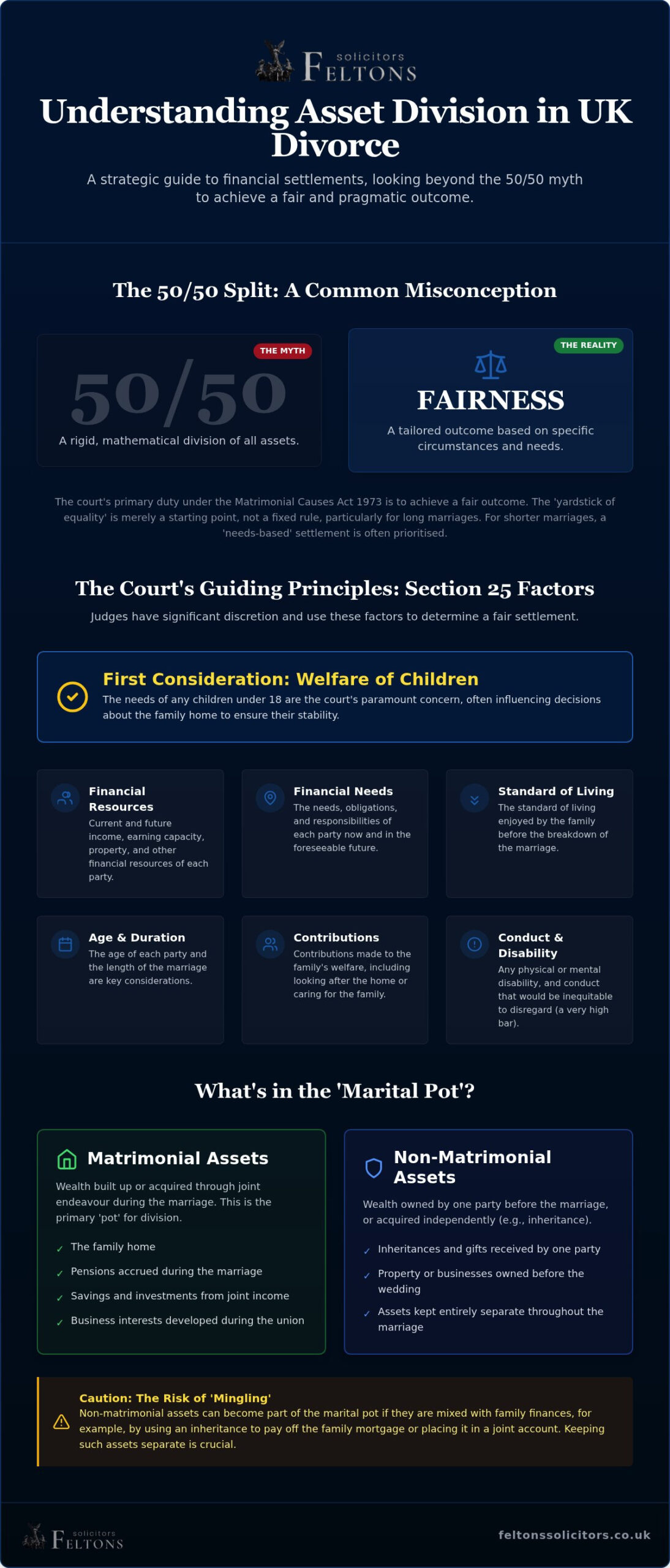
The legal framework for divorce in England and Wales is primarily rooted in the Matrimonial Causes Act 1973. This legislation doesn’t provide a rigid mathematical formula for splitting wealth; instead, it grants judges significant discretion to ensure an outcome that’s fair rather than just mathematically equal. When you consult with divorce asset division lawyers, the first step is often understanding how these broad legal principles apply to your specific financial circumstances.
The court evaluates what are known as Section 25 factors to determine this fairness. These include the income, earning capacity, property, and other financial resources each spouse has or is likely to have in the foreseeable future. The court also considers the financial needs, obligations, and responsibilities that each party has or is likely to have. Crucially, the welfare of any children under eighteen is the court’s first consideration, often dictating how the family home is handled to ensure their stability and continued care.
The Principle of Fairness vs Equality
In long marriages, the yardstick of equality is the standard starting point. This implies that assets built up during the union through joint endeavour should be shared equally. However, equality isn’t always the same as fairness. For shorter marriages, the court often leans towards a needs-based settlement. This approach focuses on ensuring both parties can transition to independent lives and have their housing needs met, rather than simply splitting everything down the middle. If one spouse entered the marriage with significant wealth and the union lasted only a few years, a 50/50 split is unlikely as the court seeks to avoid an unjustified windfall for the other party.
The Court’s Discretionary Power
Judges hold vast discretionary power to adjust settlements based on the standard of living enjoyed during the marriage. Whilst many clients worry about conduct or fault, the court rarely considers behaviour unless it’s financially or physically extreme. Instead, they focus on practicalities like age and future earning capacity. If one partner sacrificed their career to raise children, the court may award a larger share of the capital or ongoing maintenance to balance their reduced ability to earn in the future. Skilled divorce asset division lawyers help frame these arguments to ensure the transition to post-divorce life is as stable as possible, prioritising long-term financial security over short-term gains. This bespoke approach ensures that the final order is tailored to the unique economic reality of the family unit.
Distinguishing Between Matrimonial and Non-Matrimonial Assets
Identifying which assets are actually “on the table” is a critical task for divorce asset division lawyers. The Supreme Court ruling in Standish v Standish UKSC 26 recently clarified that wealth brought into a marriage doesn’t automatically become shared matrimonial property. Instead, the sharing principle primarily applies to assets built through joint endeavour during the union. This distinction is vital for protecting wealth that wasn’t created by the partnership itself.
Matrimonial assets typically include the family home, pensions accrued during the marriage, and savings generated from salaries. Non-matrimonial assets are those acquired before the wedding, inheritances, or gifts received by one party. However, these categories aren’t always fixed. If you use an inheritance to pay off the family mortgage, you mingle that asset, potentially making it matrimonial. In high-net-worth cases, a stellar contribution argument might be raised where one party’s exceptional business success significantly outstrips the other’s contribution, though this remains an exceptionally high bar to meet in court.
Protecting Inherited Wealth and Pre-Marital Property
Ring-fencing non-matrimonial wealth requires a proactive approach. Keeping inherited funds in a sole bank account rather than a joint one helps prevent matrimonialisation. Whilst pre-nuptial and post-nuptial agreements aren’t strictly binding in the UK, courts give them significant weight if they were entered into freely and fairly. These documents serve as a clear record of intent, helping to protect your financial legacy from being subsumed into the marital pot during a settlement.
Valuing Business Interests and Professional Practices
Valuing a private limited company involves more than looking at a balance sheet. Courts must consider liquidity; a business might be worth millions on paper, but if that wealth is tied up in machinery or stock, it can’t easily be paid out as a lump sum. Judges often distinguish between the capital value of the business and the income it generates for maintenance purposes. For complex portfolios, seeking a pragmatic financial arrangement ensures that the business remains viable whilst the other spouse receives a fair settlement. Expert divorce asset division lawyers work with forensic accountants to ensure these valuations are accurate and reflect the true economic reality of the practice.
Evaluating Complex Portfolios: Property and Pensions
Managing a portfolio that spans multiple jurisdictions or includes diverse asset classes requires a high degree of technical precision. Whilst the family home is often the most emotionally charged asset, investment property portfolios present distinct challenges regarding tax liabilities and liquidity. In 2026, the transparency requirements for overseas entity beneficial owner registration have become a pivotal factor in financial settlements. Divorce asset division lawyers must verify that all foreign-held property is correctly registered to avoid legal complications or delays in transferring ownership. Beyond property, modern portfolios frequently include digital assets like cryptocurrency or high-value collectibles such as art and jewellery. These require specialist valuation to ensure they aren’t undervalued or overlooked during the disclosure process.
The Family Home and Housing Needs
The court’s primary objective is to ensure both parties have adequate housing, especially when children are involved. You might consider a direct sale and split of proceeds, or one party may buy out the other’s interest. In cases where immediate sale isn’t viable, a Mesher order can postpone the sale until a specific event, such as a child reaching adulthood. This balances the “right to reside” with the eventual goal of a clean break. If the property is in negative equity or has a complex mortgage structure, your legal team will need to coordinate with lenders to find a pragmatic path forward.
Pensions: The Often Overlooked Asset
Pensions are frequently the second largest asset after the family home, yet they’re often misunderstood. Relying solely on the Cash Equivalent Value (CEV) can be a mistake, as it rarely reflects the true income the pension will provide in retirement. Following the Pension Advisory Group’s second-edition report (PAG2) in 2023, there’s a stronger focus on achieving equality of income rather than just capital value. Divorce asset division lawyers often use pension sharing orders to transfer a percentage of one party’s pension to the other. Alternatively, pension offsetting allows one spouse to retain a larger share of other assets, like the house, in exchange for waiving their rights to the other’s pension. This strategy provides immediate security but requires careful calculation to ensure the trade-off is genuinely fair.
The Process of Securing a Financial Settlement
The journey towards a final financial order is built upon absolute transparency. Both parties are under a strict legal obligation to provide “full and frank financial disclosure” of their worldwide assets. This isn’t a suggestion; it’s a fundamental requirement. Attempting to hide assets or providing misleading information can lead to the court setting aside an agreement years later, alongside potential cost orders or even criminal penalties. Experienced divorce asset division lawyers guide you through this process to ensure your disclosure is robust and beyond reproach.
Whilst many couples reach an agreement through voluntary negotiations or mediation, others require the structure of court-led financial remedy proceedings. Regardless of the route taken, the objective is to secure a Consent Order. This document transforms your private agreement into a legally binding court order, providing the finality needed to prevent either party from making future claims against the other’s wealth years after the decree absolute.
Navigating Form E and Financial Disclosure
The court’s preferred outcome is a “clean break” agreement. This order severs the financial ties between you and your former spouse entirely, ensuring that neither party can return to court for more money in the future. It’s the ultimate form of financial closure. In some cases, particularly where there’s a significant disparity in earning capacity or long-term care needs, a clean break may not be immediately possible. In these instances, spousal maintenance may be required for a set period. Turning a private agreement into a binding order is a technical task that requires the steady hand of divorce and financial arrangement experts to ensure your future is legally protected.
Why Discreet Legal Support Matters for Asset Division
Choosing a legal partner for a high-value divorce isn’t merely about technical skill; it’s about finding a discreet partner who values privacy and personal rapport. Many national firms operate on high-volume, paralegal-led processing models that can feel impersonal and lack the strategic depth required for complex wealth. As divorce asset division lawyers, we operate on a “trusted advisor” model. This approach ensures you have a single, senior point of contact who understands the nuances of your financial history and the human impact of the settlement. In cases involving sensitive financial data or public-facing reputations, this boutique level of care provides a layer of security that larger practices often struggle to replicate.
Our “people-first” philosophy means we prioritise your long-term stability over aggressive litigation. We understand that a pragmatic financial settlement is often more valuable than a protracted battle that erodes the very assets you’re trying to protect. By maintaining a calm, steady presence, we guide you through the complexities of the legal system with quiet confidence, ensuring your interests are represented with professional integrity and sophisticated authority.
A Tailored Approach to Complex Litigation
Litigation involving international assets or intricate trust structures requires a bespoke strategy rather than a standard checklist. We specialise in handling disputes where wealth is spread across multiple jurisdictions, requiring a methodical and orderly mindset to untangle. Our role is to provide pragmatic advice that avoids unnecessary court costs whilst ensuring your non-matrimonial wealth remains ring-fenced. By fostering a close personal rapport between the client and the lead solicitor, we ensure that every decision is aligned with your specific objectives. This individualized attention is particularly vital when navigating the 74-week average wait times currently seen in the family courts, as it allows for a more efficient and focused path to resolution.
Integrating Property Expertise into Family Law
What distinguishes Feltons Solicitors is our deep-rooted expertise in both family law and complex property matters. Marital splits involving large portfolios often trigger technical issues such as leasehold extensions or enfranchisement requirements. Because our firm also specialises in residential and commercial conveyancing, our divorce and financial arrangements lawyers can coordinate the transfer of equity or the sale of investment properties seamlessly. This internal synergy eliminates the need for external consultants, reducing friction and ensuring that property-related settlement terms are executed accurately. Whether you’re dealing with the registration of overseas entities or managing the division of a commercial practice, our integrated methodology provides a comprehensive shield for your financial future.
Securing Your Financial Legacy with Confidence
Navigating the end of a marriage is undoubtedly challenging, but understanding the legal framework of asset division provides the foundation for a more stable future. We’ve explored how the distinction between matrimonial and non-marital wealth, combined with full financial disclosure, ensures a settlement that’s both fair and robust. By prioritising the welfare of children and addressing the technicalities of property portfolios and pensions, you can achieve a pragmatic resolution that protects your hard-earned assets.
Success in these complex matters often depends on the quality of your partnership with your legal team. Our divorce asset division lawyers provide boutique, people-first advice with direct access to senior solicitors. We combine traditional professional integrity with modern expertise in international structures and complex property law to guide you through every stage of the process. If you require a trusted advisor to handle your settlement with the utmost privacy and skill, contact Feltons Solicitors today for a discreet consultation on your financial arrangements. You don’t have to manage these intricacies alone; we’re here to help you move forward with quiet confidence and financial security.
Frequently Asked Questions
Is asset division always 50/50 in the UK?
No. Whilst an equal split is the starting point for matrimonial assets in long marriages, the court’s ultimate goal is fairness based on Section 25 factors. This includes considering housing needs, earning capacity, and the welfare of children. In shorter marriages or cases involving significant non-matrimonial wealth, the split may be adjusted significantly. Your divorce asset division lawyers will help determine how these factors apply to your specific financial circumstances.
Can I protect assets I owned before I got married?
Yes, pre-marital assets can often be ring-fenced if they haven’t been “matrimonialised” or mingled with joint finances. Recent rulings reinforce that the sharing principle primarily applies to wealth built during the marriage. However, if these assets are needed to meet the other party’s basic housing or financial needs, the court may still include them in the settlement pot to achieve a fair outcome for both parties.
What happens to my business if I get a divorce?
A business is considered a financial asset and must be disclosed, but it’s rarely sold or split down the middle. Instead, its value is often “offset” against other assets. For example, you might retain the company while your spouse receives a larger share of the family home or pension. Valuation is complex, focusing on liquidity and income-generating potential rather than just the balance sheet book value.
Do I have to share my pension with my ex-spouse?
Pensions are significant matrimonial assets and are frequently shared, particularly in long marriages. Under current guidance, courts now prioritise equality of retirement income rather than just equalising capital value. You might use a Pension Sharing Order to transfer a percentage of your fund, or an “offsetting” arrangement where you keep your pension in exchange for giving up other marital property, such as equity in a house.
What is full and frank financial disclosure?
This is the legal duty for both parties to reveal all worldwide assets, income, and liabilities. This process usually involves completing a Form E, supported by twelve months of bank statements and other evidence. Hiding wealth is a serious offence that can lead to court orders being overturned or financial penalties. Experienced divorce asset division lawyers ensure this process is transparent, protecting the final settlement from future legal challenges.
How long does it take to get a financial settlement?
The timeline varies depending on the complexity of the assets and the level of cooperation. Voluntary agreements can be finalised in a few months, but contested court proceedings often take much longer. In early 2025, the average wait from application to a final order reached 74 weeks. Using private dispute resolution or arbitration can sometimes expedite this process if both parties are willing to engage in a more efficient route.
Can my spouse claim against an inheritance I received during the marriage?
Inheritances are generally classified as non-matrimonial assets, but they aren’t automatically excluded from a claim. If the inheritance has been kept separate in a sole account, it’s easier to protect. However, if it was used to buy a joint home or if the marital pot is too small to meet both parties’ needs, the court may “dip into” the inheritance to ensure a fair settlement for both spouses.
What is a Consent Order and why do I need one?
A Consent Order is a legally binding document approved by the court that sets out your financial agreement. Even if you reach an amicable private deal, you need this order to make it final. Without it, your ex-spouse could potentially make a financial claim against you many years into the future, even after your divorce is finalised. It provides the essential “clean break” required for true financial independence and peace of mind.