

Divorce Asset Division Lawyers: Navigating Complex Financial Settlements in 2026

Divorce Asset Division Lawyers: Navigating Complex Financial Settlements in 2026

The assumption that a UK court will always default to a rigid 50/50 split is one of the most persistent myths in family law. It’s entirely natural to feel anxious about the future of a business you built before your marriage or an inheritance you intended to pass down. You likely want a resolution that respects your hard work and provides security without the process becoming an adversarial battle. This guide offers a comprehensive look at how professional divorce asset division lawyers manage the complexities of financial settlements in 2026 to protect your specific interests.

We’ll examine the distinction between matrimonial and non-marital wealth, the necessity of full and frank disclosure via Form E, and how to achieve a pragmatic settlement that prioritises your long-term stability. By understanding the latest judicial approaches to the sharing principle following recent Supreme Court clarifications, you can move forward with the quiet confidence that your financial legacy remains intact. We’ll provide the clarity you need to approach these sensitive negotiations with a steady hand and a clear strategy for your future.

Key Takeaways

  • Understand why the “50/50” rule is merely a starting point and how Section 25 factors allow courts to prioritise fairness and the welfare of children.
  • Learn the vital distinction between matrimonial assets built through joint endeavour and non-matrimonial wealth, such as inheritances or property acquired before marriage.
  • Discover how experienced divorce asset division lawyers navigate complex financial structures, including investment portfolios and the registration of overseas entities.
  • Recognise the legal necessity of “full and frank disclosure” to ensure your settlement is robust, final, and protected from future challenges.
  • Gain insight into why a discreet, tailored legal strategy is paramount for managing sensitive financial data and securing a pragmatic outcome.

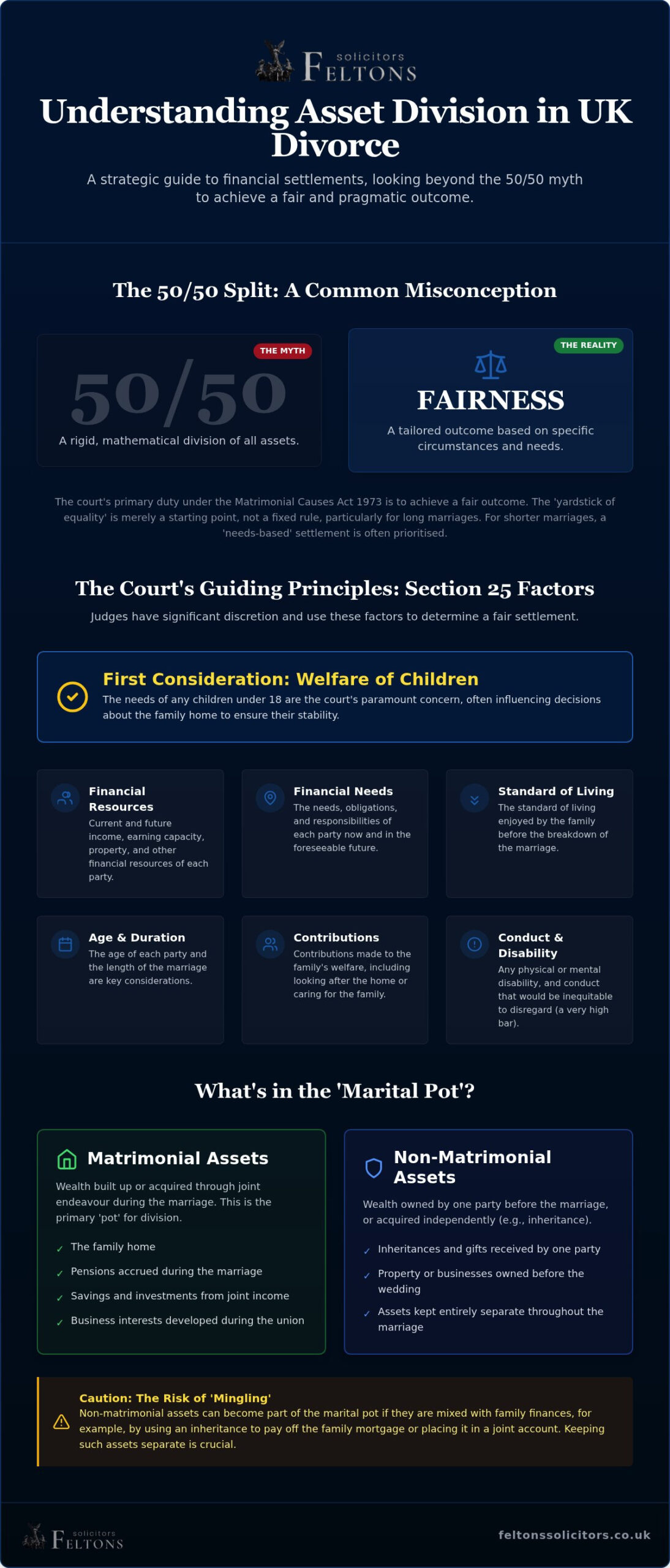
The legal framework for divorce in England and Wales is primarily rooted in the Matrimonial Causes Act 1973. This legislation doesn’t provide a rigid mathematical formula for splitting wealth; instead, it grants judges significant discretion to ensure an outcome that’s fair rather than just mathematically equal. When you consult with divorce asset division lawyers, the first step is often understanding how these broad legal principles apply to your specific financial circumstances.

The court evaluates what are known as Section 25 factors to determine this fairness. These include the income, earning capacity, property, and other financial resources each spouse has or is likely to have in the foreseeable future. The court also considers the financial needs, obligations, and responsibilities that each party has or is likely to have. Crucially, the welfare of any children under eighteen is the court’s first consideration, often dictating how the family home is handled to ensure their stability and continued care.

The Principle of Fairness vs Equality

In long marriages, the yardstick of equality is the standard starting point. This implies that assets built up during the union through joint endeavour should be shared equally. However, equality isn’t always the same as fairness. For shorter marriages, the court often leans towards a needs-based settlement. This approach focuses on ensuring both parties can transition to independent lives and have their housing needs met, rather than simply splitting everything down the middle. If one spouse entered the marriage with significant wealth and the union lasted only a few years, a 50/50 split is unlikely as the court seeks to avoid an unjustified windfall for the other party.

The Court’s Discretionary Power

Judges hold vast discretionary power to adjust settlements based on the standard of living enjoyed during the marriage. Whilst many clients worry about conduct or fault, the court rarely considers behaviour unless it’s financially or physically extreme. Instead, they focus on practicalities like age and future earning capacity. If one partner sacrificed their career to raise children, the court may award a larger share of the capital or ongoing maintenance to balance their reduced ability to earn in the future. Skilled divorce asset division lawyers help frame these arguments to ensure the transition to post-divorce life is as stable as possible, prioritising long-term financial security over short-term gains. This bespoke approach ensures that the final order is tailored to the unique economic reality of the family unit.

Distinguishing Between Matrimonial and Non-Matrimonial Assets

Identifying which assets are actually “on the table” is a critical task for divorce asset division lawyers. The Supreme Court ruling in Standish v Standish UKSC 26 recently clarified that wealth brought into a marriage doesn’t automatically become shared matrimonial property. Instead, the sharing principle primarily applies to assets built through joint endeavour during the union. This distinction is vital for protecting wealth that wasn’t created by the partnership itself.

Matrimonial assets typically include the family home, pensions accrued during the marriage, and savings generated from salaries. Non-matrimonial assets are those acquired before the wedding, inheritances, or gifts received by one party. However, these categories aren’t always fixed. If you use an inheritance to pay off the family mortgage, you mingle that asset, potentially making it matrimonial. In high-net-worth cases, a stellar contribution argument might be raised where one party’s exceptional business success significantly outstrips the other’s contribution, though this remains an exceptionally high bar to meet in court.

Protecting Inherited Wealth and Pre-Marital Property

Ring-fencing non-matrimonial wealth requires a proactive approach. Keeping inherited funds in a sole bank account rather than a joint one helps prevent matrimonialisation. Whilst pre-nuptial and post-nuptial agreements aren’t strictly binding in the UK, courts give them significant weight if they were entered into freely and fairly. These documents serve as a clear record of intent, helping to protect your financial legacy from being subsumed into the marital pot during a settlement.

Valuing Business Interests and Professional Practices

Valuing a private limited company involves more than looking at a balance sheet. Courts must consider liquidity; a business might be worth millions on paper, but if that wealth is tied up in machinery or stock, it can’t easily be paid out as a lump sum. Judges often distinguish between the capital value of the business and the income it generates for maintenance purposes. For complex portfolios, seeking a pragmatic financial arrangement ensures that the business remains viable whilst the other spouse receives a fair settlement. Expert divorce asset division lawyers work with forensic accountants to ensure these valuations are accurate and reflect the true economic reality of the practice.

Evaluating Complex Portfolios: Property and Pensions

Managing a portfolio that spans multiple jurisdictions or includes diverse asset classes requires a high degree of technical precision. Whilst the family home is often the most emotionally charged asset, investment property portfolios present distinct challenges regarding tax liabilities and liquidity. In 2026, the transparency requirements for overseas entity beneficial owner registration have become a pivotal factor in financial settlements. Divorce asset division lawyers must verify that all foreign-held property is correctly registered to avoid legal complications or delays in transferring ownership. Beyond property, modern portfolios frequently include digital assets like cryptocurrency or high-value collectibles such as art and jewellery. These require specialist valuation to ensure they aren’t undervalued or overlooked during the disclosure process.

The Family Home and Housing Needs

The court’s primary objective is to ensure both parties have adequate housing, especially when children are involved. You might consider a direct sale and split of proceeds, or one party may buy out the other’s interest. In cases where immediate sale isn’t viable, a Mesher order can postpone the sale until a specific event, such as a child reaching adulthood. This balances the “right to reside” with the eventual goal of a clean break. If the property is in negative equity or has a complex mortgage structure, your legal team will need to coordinate with lenders to find a pragmatic path forward.

Pensions: The Often Overlooked Asset

Pensions are frequently the second largest asset after the family home, yet they’re often misunderstood. Relying solely on the Cash Equivalent Value (CEV) can be a mistake, as it rarely reflects the true income the pension will provide in retirement. Following the Pension Advisory Group’s second-edition report (PAG2) in 2023, there’s a stronger focus on achieving equality of income rather than just capital value. Divorce asset division lawyers often use pension sharing orders to transfer a percentage of one party’s pension to the other. Alternatively, pension offsetting allows one spouse to retain a larger share of other assets, like the house, in exchange for waiving their rights to the other’s pension. This strategy provides immediate security but requires careful calculation to ensure the trade-off is genuinely fair.
Divorce Asset Division Lawyers: Navigating Complex Financial Settlements in 2026

The Process of Securing a Financial Settlement

The journey towards a final financial order is built upon absolute transparency. Both parties are under a strict legal obligation to provide “full and frank financial disclosure” of their worldwide assets. This isn’t a suggestion; it’s a fundamental requirement. Attempting to hide assets or providing misleading information can lead to the court setting aside an agreement years later, alongside potential cost orders or even criminal penalties. Experienced divorce asset division lawyers guide you through this process to ensure your disclosure is robust and beyond reproach.

Whilst many couples reach an agreement through voluntary negotiations or mediation, others require the structure of court-led financial remedy proceedings. Regardless of the route taken, the objective is to secure a Consent Order. This document transforms your private agreement into a legally binding court order, providing the finality needed to prevent either party from making future claims against the other’s wealth years after the decree absolute.

Navigating Form E and Financial Disclosure

The backbone of the disclosure process is the Form E. This comprehensive document requires specific details regarding all property, bank accounts, pensions, and business interests. Completing this statement requires meticulous attention to detail and supporting evidence, such as twelve months of bank statements. Once exchanged, each party has the right to serve a “questionnaire” to clarify any anomalies or request missing documents. If you suspect wealth has been diverted or hidden, we often engage forensic accountants to trace transactions and ensure every penny is accounted for. For medical and dental practice owners, specialist firms like AffluenceCA provide the high-level accounting and tax expertise required to ensure their professional assets are correctly documented. This methodical approach ensures the “pot” is accurately defined before negotiations begin.

The court’s preferred outcome is a “clean break” agreement. This order severs the financial ties between you and your former spouse entirely, ensuring that neither party can return to court for more money in the future. It’s the ultimate form of financial closure. In some cases, particularly where there’s a significant disparity in earning capacity or long-term care needs, a clean break may not be immediately possible. In these instances, spousal maintenance may be required for a set period. Turning a private agreement into a binding order is a technical task that requires the steady hand of divorce and financial arrangement experts to ensure your future is legally protected.

Choosing a legal partner for a high-value divorce isn’t merely about technical skill; it’s about finding a discreet partner who values privacy and personal rapport. Many national firms operate on high-volume, paralegal-led processing models that can feel impersonal and lack the strategic depth required for complex wealth. As divorce asset division lawyers, we operate on a “trusted advisor” model. This approach ensures you have a single, senior point of contact who understands the nuances of your financial history and the human impact of the settlement. In cases involving sensitive financial data or public-facing reputations, this boutique level of care provides a layer of security that larger practices often struggle to replicate.

Our “people-first” philosophy means we prioritise your long-term stability over aggressive litigation. We understand that a pragmatic financial settlement is often more valuable than a protracted battle that erodes the very assets you’re trying to protect. By maintaining a calm, steady presence, we guide you through the complexities of the legal system with quiet confidence, ensuring your interests are represented with professional integrity and sophisticated authority.

A Tailored Approach to Complex Litigation

Litigation involving international assets or intricate trust structures requires a bespoke strategy rather than a standard checklist. We specialise in handling disputes where wealth is spread across multiple jurisdictions, requiring a methodical and orderly mindset to untangle. Our role is to provide pragmatic advice that avoids unnecessary court costs whilst ensuring your non-matrimonial wealth remains ring-fenced. By fostering a close personal rapport between the client and the lead solicitor, we ensure that every decision is aligned with your specific objectives. This individualized attention is particularly vital when navigating the 74-week average wait times currently seen in the family courts, as it allows for a more efficient and focused path to resolution.

Integrating Property Expertise into Family Law

What distinguishes Feltons Solicitors is our deep-rooted expertise in both family law and complex property matters. Marital splits involving large portfolios often trigger technical issues such as leasehold extensions or enfranchisement requirements. Because our firm also specialises in residential and commercial conveyancing, our divorce and financial arrangements lawyers can coordinate the transfer of equity or the sale of investment properties seamlessly. This internal synergy eliminates the need for external consultants, reducing friction and ensuring that property-related settlement terms are executed accurately. Whether you’re dealing with the registration of overseas entities or managing the division of a commercial practice, our integrated methodology provides a comprehensive shield for your financial future.

Securing Your Financial Legacy with Confidence

Navigating the end of a marriage is undoubtedly challenging, but understanding the legal framework of asset division provides the foundation for a more stable future. We’ve explored how the distinction between matrimonial and non-marital wealth, combined with full financial disclosure, ensures a settlement that’s both fair and robust. By prioritising the welfare of children and addressing the technicalities of property portfolios and pensions, you can achieve a pragmatic resolution that protects your hard-earned assets.

Success in these complex matters often depends on the quality of your partnership with your legal team. Our divorce asset division lawyers provide boutique, people-first advice with direct access to senior solicitors. We combine traditional professional integrity with modern expertise in international structures and complex property law to guide you through every stage of the process. If you require a trusted advisor to handle your settlement with the utmost privacy and skill, contact Feltons Solicitors today for a discreet consultation on your financial arrangements. You don’t have to manage these intricacies alone; we’re here to help you move forward with quiet confidence and financial security.

Frequently Asked Questions

Is asset division always 50/50 in the UK?

No. Whilst an equal split is the starting point for matrimonial assets in long marriages, the court’s ultimate goal is fairness based on Section 25 factors. This includes considering housing needs, earning capacity, and the welfare of children. In shorter marriages or cases involving significant non-matrimonial wealth, the split may be adjusted significantly. Your divorce asset division lawyers will help determine how these factors apply to your specific financial circumstances.

Can I protect assets I owned before I got married?

Yes, pre-marital assets can often be ring-fenced if they haven’t been “matrimonialised” or mingled with joint finances. Recent rulings reinforce that the sharing principle primarily applies to wealth built during the marriage. However, if these assets are needed to meet the other party’s basic housing or financial needs, the court may still include them in the settlement pot to achieve a fair outcome for both parties.

What happens to my business if I get a divorce?

A business is considered a financial asset and must be disclosed, but it’s rarely sold or split down the middle. Instead, its value is often “offset” against other assets. For example, you might retain the company while your spouse receives a larger share of the family home or pension. Valuation is complex, focusing on liquidity and income-generating potential rather than just the balance sheet book value.

Do I have to share my pension with my ex-spouse?

Pensions are significant matrimonial assets and are frequently shared, particularly in long marriages. Under current guidance, courts now prioritise equality of retirement income rather than just equalising capital value. You might use a Pension Sharing Order to transfer a percentage of your fund, or an “offsetting” arrangement where you keep your pension in exchange for giving up other marital property, such as equity in a house.

What is full and frank financial disclosure?

This is the legal duty for both parties to reveal all worldwide assets, income, and liabilities. This process usually involves completing a Form E, supported by twelve months of bank statements and other evidence. Hiding wealth is a serious offence that can lead to court orders being overturned or financial penalties. Experienced divorce asset division lawyers ensure this process is transparent, protecting the final settlement from future legal challenges.

How long does it take to get a financial settlement?

The timeline varies depending on the complexity of the assets and the level of cooperation. Voluntary agreements can be finalised in a few months, but contested court proceedings often take much longer. In early 2025, the average wait from application to a final order reached 74 weeks. Using private dispute resolution or arbitration can sometimes expedite this process if both parties are willing to engage in a more efficient route.

Can my spouse claim against an inheritance I received during the marriage?

Inheritances are generally classified as non-matrimonial assets, but they aren’t automatically excluded from a claim. If the inheritance has been kept separate in a sole account, it’s easier to protect. However, if it was used to buy a joint home or if the marital pot is too small to meet both parties’ needs, the court may “dip into” the inheritance to ensure a fair settlement for both spouses.

What is a Consent Order and why do I need one?

A Consent Order is a legally binding document approved by the court that sets out your financial agreement. Even if you reach an amicable private deal, you need this order to make it final. Without it, your ex-spouse could potentially make a financial claim against you many years into the future, even after your divorce is finalised. It provides the essential “clean break” required for true financial independence and peace of mind.

Financial Settlement in Divorce UK: A Strategic Guide to Protecting Your Future (2026)

Financial Settlement in Divorce UK: A Strategic Guide to Protecting Your Future (2026)

A common misconception is that a financial settlement divorce uk always begins and ends with a simple 50/50 split of assets. In reality, the English court system prioritises a “fair” outcome over a purely mathematical one, which often leads to significant confusion and anxiety during an already difficult transition. You might be worried about maintaining your standard of living or fear that matrimonial assets are being shielded from view. These concerns are entirely valid, as the decisions made today will dictate your financial independence for years to come.

We understand that you need more than just legal definitions; you require a steady, sophisticated guide to help you protect what you have built. This article provides the professional clarity you need to navigate these complexities, ensuring your assets are protected and your long-term interests are secured. We will examine the strategic importance of pension sharing, the latest 2026 capital gains tax implications for separating couples, and the most effective ways to reach a private agreement that achieves a legally binding “clean break” whilst avoiding the stress of a contested court hearing.

Key Takeaways

  • Understand how a formal agreement provides the legal certainty of a “clean break” to protect your future earnings and assets.
  • Learn why full and frank disclosure via Form E is the essential foundation for a fair financial settlement divorce uk.
  • Discover how the court applies Section 25 factors to determine asset division, moving beyond the common myth of an automatic 50/50 split.
  • Recognise why a court-approved Consent Order is the only way to make your private agreement legally binding and final.
  • Gain insight into managing complex assets, such as business interests and shareholdings, to ensure a strategic and tailored outcome.

What is a Financial Settlement in a UK Divorce?

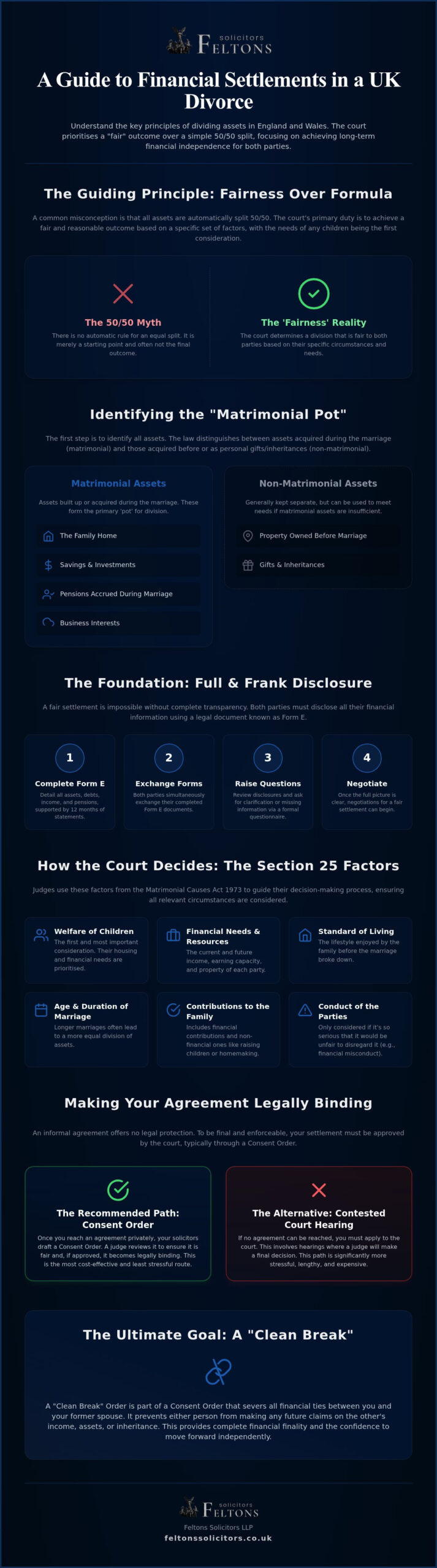
A financial settlement is the formal process of dividing money, property, and pensions following the breakdown of a marriage. It’s often misunderstood as a simple administrative step, but it’s actually the most critical component of your post-divorce security. A financial settlement is the legal mechanism that terminates financial claims between spouses. Without this formal agreement, your financial relationship with your ex-partner remains legally “open,” even after the marriage itself has ended.

Many people mistakenly believe that receiving a Final Order (formerly known as a Decree Absolute) concludes all obligations. This is a risky assumption. While the Final Order legally dissolves the marriage, it doesn’t prevent a former spouse from making a claim against your assets or income in the future. The legal framework for Divorce in England and Wales allows for financial claims to be made many years after the split unless a court-approved order is in place. Securing a financial settlement divorce uk is the only way to ensure that your future earnings, inheritances, or business successes remain entirely yours.

The Matrimonial vs Non-Matrimonial Asset Distinction

The first step in any settlement is identifying what actually sits within the “matrimonial pot.” Matrimonial assets generally include everything acquired during the marriage, such as the family home, joint savings, and pensions built up whilst you were together. These are typically the starting point for any division. Non-matrimonial assets are different; these include property owned before the wedding, or gifts and inheritances received by one person during the marriage.

It’s vital to understand that the distinction isn’t always absolute. The court has the discretion to “mingle” non-matrimonial assets if they’re needed to meet the financial requirements of either party or the children. For example, if an inheritance was used to pay off the mortgage on the family home, it may lose its “non-matrimonial” status. Detailed records and strategic legal advice are essential to protect these specific assets from being absorbed into the general pot.

The Importance of a Clean Break Order

The ultimate goal of most negotiations is a “clean break” order. This is a specific type of court order that dismisses all future financial claims between you and your ex-spouse. Once it’s sealed by the court, neither party can return to ask for more money or a share of future assets. It provides the total finality needed to move forward with confidence.

A clean break isn’t always appropriate for every couple. In cases where there’s a significant disparity in earning power or where one parent has sacrificed their career to raise children, ongoing spousal maintenance might be required instead. However, for the majority of modern divorces, achieving finality is the primary objective. A robust financial settlement divorce uk focuses on creating a fair distribution today to prevent legal or financial complications tomorrow. By prioritising a clean break, you’re not just dividing what you have; you’re protecting what you’ll build in the future.

The Process of Financial Disclosure: Using Form E

Transparency isn’t just a legal requirement; it’s the foundation of your future security. To achieve a fair financial settlement divorce uk, both parties must provide full and frank disclosure of their financial positions. This is primarily achieved through Form E, a comprehensive document that was updated on 6 February 2026 to ensure all modern asset classes are captured. It requires you to detail every income stream, asset, and liability you hold, supported by documentary evidence such as 12 months of bank statements and pension valuations. It’s a significant undertaking, but it’s the only way to ensure the final agreement is robust and beyond reproach.

Solicitors don’t simply accept the figures provided at face value. We verify disclosure through a methodical review of financial records and expert reports. Failure to disclose assets can lead to a settlement being set aside years later, potentially reopening the entire case at a much higher emotional and financial cost. Achieving a “clean break” relies entirely on the honesty of this initial phase.

Step-by-Step: From Initial Disclosure to Negotiation

Once both parties exchange their Form Es, the process moves into a phase of clarification. We raise “Questionnaires” to address any gaps or discrepancies in the other party’s disclosure. This isn’t about being confrontational; it’s about achieving total clarity. We may also require formal valuations for property, pensions, and business interests to ensure we’re working with accurate figures. After we’ve agreed on the value of the assets, we move to “Open Proposals.” This is where the strategic negotiation begins, moving from raw data to a structured plan for your post-divorce life.

Dealing with Non-Disclosure and Hidden Assets

The fear that an ex-partner is hiding wealth is a common source of anxiety during a financial settlement divorce uk. The court takes non-disclosure extremely seriously and can issue cost orders or draw “adverse inferences” against the dishonest party, essentially assuming they have more wealth than they’ve admitted. In complex cases, we often use forensic accounting to trace diverted funds or uncover hidden matrimonial wealth. Total honesty is the only way to ensure the finality of your Consent Order. If you suspect assets are being withheld, seeking guidance from experts in divorce and financial arrangements will help you protect your rightful share and ensure no stone is left unturned.

How the Court Determines “Fairness”: The Section 25 Factors

The myth that every financial settlement divorce uk results in a perfect 50/50 split often creates unrealistic expectations. While an equal division is frequently the starting point for long marriages, the court’s ultimate objective is “fairness” rather than simple arithmetic. This fairness is determined by the Section 25 factors of the Matrimonial Causes Act 1973. These factors act as a statutory checklist that judges and solicitors use to tailor an outcome to the specific circumstances of your family. Crucially, the primary consideration in every case is the welfare of any children under the age of 18, ensuring their housing and financial needs are prioritised above all else.

Needs are the most influential factor in most UK financial settlements, encompassing the essential requirements for housing and income to ensure both parties can live independently. If an equal split doesn’t meet the basic needs of a primary caregiver or a lower-earning spouse, the court will deviate from 50/50 to achieve a functional, fair result. This pragmatic approach ensures that neither party is left in a state of undue hardship following the separation.

Key Criteria for Asset Division

When assessing how to distribute wealth, the court examines each party’s income and earning capacity, including any potential increase in earnings they might reasonably achieve in the foreseeable future. This isn’t just about what you earn today; it’s about your ability to support yourself moving forward. The standard of living enjoyed by the family before the breakdown also plays a role, though it’s often difficult to maintain two households on the same income that previously supported one. Additionally, the duration of the marriage and the age of each party are vital. A twenty-year marriage where one partner stayed at home will be treated very differently from a two-year marriage between two young professionals with independent careers.

Contributions and Conduct

The English legal system places equal value on financial and non-financial contributions. The role of a “homemaker” who managed the household and cared for children is considered just as significant as that of the “breadwinner” who generated the matrimonial wealth. This prevents a higher-earning spouse from claiming a larger share simply because they were the primary source of income.

Clients often ask if their ex-partner’s behaviour will affect the financial settlement divorce uk. In practice, “conduct” is only taken into account if it’s so extreme that it would be “inequitable to disregard it.” This is a very high bar and rarely met in standard divorce proceedings. Instead of focusing on past grievances, we focus on protecting your position through logical, evidence-based arguments that reflect your total contribution to the marriage, ensuring you receive a settlement that respects your history and secures your future.

Financial Settlement in Divorce UK: A Strategic Guide to Protecting Your Future (2026)

Reaching a verbal agreement with your ex-partner is a positive step, but it doesn’t provide the legal finality you need. This informal stage is often referred to as “heads of agreement.” However, to truly secure a financial settlement divorce uk, this agreement must be drafted into a formal Consent Order and sealed by a judge. The court must approve your agreement even if you both agree to the terms because a judge has an independent duty to ensure the settlement is fair and meets the needs of both parties, particularly any children involved. For a deeper look at the specific steps involved in safeguarding your wealth, see our guide on Protecting Your Assets During a Divorce Settlement.

The timeline for obtaining a financial order runs alongside the divorce itself. You can submit a Consent Order to the court once you have reached the Conditional Order stage (formerly Decree Nisi). As of 13 July 2026, the court fee for a Consent Order is £62. Once the judge signs the order, it becomes a legally binding document that prevents future claims, providing the “clean break” that is essential for your peace of mind.

The Path of Litigation: When Agreement Fails

If negotiations stall, the court provides a structured pathway to resolve the dispute. The First Appointment (FDA) focuses on managing the timetable, identifying the core issues, and ensuring all valuations are in place. The most significant stage is the Financial Dispute Resolution (FDR) appointment. Here, a judge reviews the proposals and gives an “indication” of what they would likely order at a trial. This hearing is “without prejudice,” meaning the judge’s comments can’t be used later, which encourages both parties to settle. A high percentage of cases conclude at the FDR stage. If a settlement still isn’t reached, the case proceeds to a Final Hearing, where a judge makes a binding decision on your behalf after hearing evidence from both sides; for those self-representing, you may choose to Find a McKenzie Friend to provide support during these proceedings.

Alternative Dispute Resolution (ADR)

Alternative Dispute Resolution (ADR) offers a more personal, discreet route that allows you to maintain control over the outcome. Mediation and collaborative law are excellent options for couples who wish to avoid the adversarial nature of a courtroom. Many of our clients also benefit from a “private FDR.” This involves hiring a senior barrister or retired judge to act as the adjudicator for a full day. It offers a boutique level of service, allowing for greater speed and total discretion whilst avoiding the delays currently found in the public court system.

At Feltons, we organise bespoke negotiation strategies that prioritise your privacy and long-term stability. If you’re ready to secure your financial future, our experts in divorce and financial arrangements are here to provide the steady, professional guidance you deserve.

High-net-worth divorces require a depth of expertise that standard template approaches simply cannot provide. When a financial settlement divorce uk involves business assets, minority shareholdings, or complex professional practices, the stakes are significantly higher. Valuation is rarely straightforward in these scenarios. It’s not just about the current balance sheet; it’s about liquidity, tax efficiency, and the long-term viability of the enterprise. For those requiring a more tailored methodology, we offer Discreet Legal Support for High Net Worth Divorce to ensure your commercial interests are shielded from unnecessary disruption.

International elements add another layer of intricacy. Whether it’s a holiday home in Europe or a complex trust structure based abroad, navigating different jurisdictions requires a global perspective. We assist with the registration of overseas entities and ensure that any settlement reached is enforceable across borders. This prevents the risk of a “paper victory” where assets remain out of reach despite a favourable court ruling.

Bespoke Asset Protection Strategies

Protecting your wealth often involves ring-fencing non-matrimonial property through meticulous legal drafting. If you entered the marriage with significant assets or received a substantial inheritance, it’s vital to ensure these don’t become part of the general matrimonial pot. We also pay close attention to pension sharing orders. Pensions are often a couple’s most valuable asset alongside the family home. They require a specific court order to be implemented and carry long-term tax implications that must be addressed at the point of settlement. Our goal is to create a pragmatic framework that is both fair today and robust enough to withstand future challenges.

The Feltons Approach: Calm, Steady, and Sophisticated

At Feltons, we believe that the technical precision of the law must be balanced with a boutique level of care. We position ourselves as a calm, steady presence during what is often a period of significant upheaval. Our philosophy centres on personal connection; you aren’t just another case file to us. We prioritise discreet, high-standard service that values traditional professional integrity whilst embracing modern, efficient delivery methods. This approach ensures that while your legal interests are fiercely protected, the human impact of the process is never forgotten. If you require a sophisticated guide to navigate your financial settlement divorce uk, Speak with a specialist family solicitor at Feltons today.

Securing Your Financial Independence

Achieving a successful financial settlement divorce uk requires a shift in focus from short-term emotion to long-term stability. The path to true finality relies on a court-approved Consent Order to ensure a clean break and protect your future wealth from subsequent claims. As we have explored, fairness is rarely a simple 50/50 calculation; it is a nuanced assessment of your specific needs, contributions, and family welfare. By prioritising full disclosure and strategic negotiation, you can move forward with the confidence that your assets are secure.

Since 2010, Feltons Solicitors LLP has provided a discreet boutique service rooted in a people-first philosophy. We combine our expertise in complex litigation with a calm, steady approach that prioritises your personal rapport and privacy. If you are ready to navigate these complexities with a sophisticated guide, consult our specialist divorce and financial arrangements lawyers today. You don’t have to face this transition alone; the right professional support will help you build a firm foundation for the next chapter of your life.

Frequently Asked Questions

How is a financial settlement calculated in the UK?

Calculations are based on the Section 25 factors of the Matrimonial Causes Act 1973. The court examines the welfare of any children first, followed by the financial needs, earning capacity, and the standard of living enjoyed by each party. There is no fixed mathematical formula; instead, each case is assessed on its unique merits to reach a fair and functional outcome.

Do I have to share my pension in a divorce settlement?

Pensions are matrimonial assets and are often the most valuable part of a financial settlement divorce uk. While you don’t always have to share them, they must be valued and taken into account during negotiations. A judge can issue a Pension Sharing Order to transfer a specific percentage of one party’s pension fund to the other, ensuring long-term security for both individuals.

Can my ex-partner claim money after our divorce is finalised?

Yes, financial claims remain legally open even after the marriage has ended unless they’re formally dismissed by a court order. Without a sealed Consent Order, an ex-spouse could potentially make a claim against your future inheritance, business success, or lottery wins many years later. Finalising the divorce itself only ends the marriage, not the financial relationship.

What is a Consent Order and why do I need one?

A Consent Order is a legally binding document that sets out the financial agreement you’ve reached and requires a judge’s approval. You need one to achieve a “clean break,” which prevents either party from making further financial claims against the other in the future. As of 13 July 2026, the court fee for submitting a Consent Order is £62.

How long does it take to reach a financial settlement?

The timeline varies depending on the complexity of your assets and the level of cooperation between both parties. An amicable settlement documented by a Consent Order typically takes between six and twelve months to conclude alongside the divorce process. If the case requires court litigation, the process can often extend to 18 months or longer.

What happens to the family home in a divorce?

The family home can be handled in several ways depending on what’s fair for the family’s future. It may be sold with the proceeds divided, or one party might buy out the other’s interest to remain in the property. In cases involving children, the court may delay the sale until the youngest child finishes their education to ensure they have a stable home.

Is a 50/50 split mandatory in UK divorce law?

No, a 50/50 split isn’t mandatory, although it’s often the starting point for long marriages. The court’s primary goal is to achieve a fair outcome that meets the practical needs of both parties. If one person has a much lower earning capacity or primary care of the children, they’ll often receive more than half of the matrimonial assets.

What if my spouse refuses to disclose their finances?

If a spouse refuses to provide full and frank disclosure, the court can issue an order compelling them to produce the necessary documents. Failure to comply can lead to cost penalties or the court drawing “adverse inferences,” where the judge assumes the party has assets they’re trying to hide. Total transparency is a strict requirement for a financial settlement divorce uk to be legally sound.

Pension Sharing Order Lawyers: Securing Your Financial Future After Divorce

Pension Sharing Order Lawyers: Securing Your Financial Future After Divorce

What if the family home is not actually your most valuable asset during a divorce? Whilst many couples focus on property, a pension often represents decades of dedicated saving and is frequently the largest single element of the matrimonial pot. It is entirely understandable to feel a sense of trepidation when faced with complex Cash Equivalent Transfer Value (CETV) figures or the intricate differences between final salary and defined contribution schemes. You deserve a settlement that provides both clarity and long-term security.

By instructing specialist pension sharing order lawyers, you can ensure that your retirement assets are professionally appraised and fairly divided. Our expertise allows us to secure a legally enforceable Pension Sharing Order that provides a genuine clean break and a stable financial future. In this guide, we will examine how to navigate the latest 2026 pension allowances, the reality of implementation fees, and the essential steps to achieving an equitable outcome that protects your standard of living in later life.

Key Takeaways

  • Understand how a Pension Sharing Order facilitates a permanent financial “clean break” by creating a separate, independent pension pot for the recipient.
  • Gain clarity on the essential legal steps, from the initial financial disclosure using Form E to finalising a legally binding court order.
  • Compare the long-term benefits of pension sharing against offsetting strategies to ensure you don’t sacrifice future income for short-term capital gains.
  • Learn why pension sharing order lawyers often recommend expert actuarial reports to uncover the true value of complex final salary schemes.
  • Discover how a tailored, people-first legal approach can simplify pension jargon and provide the reassurance needed during financial remedy proceedings.

Understanding Pension Sharing Orders in UK Financial Settlements

A Pension Sharing Order (PSO) is a formal court instruction that legally transfers a specific percentage of one party’s pension fund to the other. It’s often the most effective way to manage retirement assets during a separation. Unlike other methods of division, a PSO facilitates a “clean break” financial settlement. This means the recipient receives their own independent pension pot, entirely separate from their former spouse. Most private and occupational pensions are eligible for this process, as is the Additional State Pension. It’s why pension sharing order lawyers increasingly recommend this route to ensure long-term financial independence and security.

The Legal Basis: Matrimonial Causes Act 1973

The primary legislation governing these orders includes the Matrimonial Causes Act 1973 and the Welfare Reform and Pensions Act 1999. Under established UK divorce law, the court views pensions as matrimonial assets. It doesn’t matter whose name is on the policy. If the value was accrued during the marriage, it’s part of the shared pot. We’ve seen a distinct shift in judicial behaviour over recent years. Courts now prioritise ensuring equality of income in retirement rather than just a simple split of capital. Whilst the length of the marriage can influence the percentage shared, especially in shorter unions, the primary goal is a fair and sustainable outcome for both parties.

Pension Sharing vs. Pension Attachment Orders

You might hear about Pension Attachment Orders, which were formerly known as “earmarking.” These are rarely recommended by experienced pension sharing order lawyers today because of the inherent risks they carry. With an attachment order, you don’t own the funds. You simply receive a portion of the pension when your ex-spouse starts to draw it. This creates a lingering financial tie. If they die before retiring or if you remarry, those benefits could vanish instantly.

Pension sharing eliminates this uncertainty. It provides immediate ownership and total control over the funds. Once the transfer is complete, the money is yours to manage. You can choose your own investment strategy and decide exactly when you wish to retire. This autonomy is vital. It ensures that your financial future isn’t dependent on the choices or circumstances of your former partner. By securing a separate pot, you gain the peace of mind that comes with true financial independence.

Securing a fair financial settlement requires a methodical approach to legal procedure. The journey begins with full financial disclosure, typically documented in Form E. This stage is non-negotiable; every pension asset, regardless of its size or when it was accrued, must be declared. Once disclosure is complete, pension sharing order lawyers work to negotiate a settlement that reflects your future needs, whether through direct discussion or mediation. If an agreement is reached, it is formalised in a Financial Consent Order. This document is then scrutinised by a judge to ensure the division is fair and reasonable for both parties.

Step 1: Obtaining the CETV Valuation

The Cash Equivalent Transfer Value (CETV) is the starting point for any pension division. It represents the lump sum value the pension provider would pay to move your benefits elsewhere. It’s vital to request these valuations as early as possible. Some schemes, particularly public sector ones, can take several months to provide this data. As detailed in this guide to pensions on divorce, the process requires patience and precision. It’s also a common misconception that the CETV represents the true value of the fund. For defined benefit or final salary schemes, the CETV often significantly undervalues the actual income the pension will produce in retirement.

Step 2: Drafting the Pension Sharing Annex

Precision is paramount when drafting the Pension Sharing Annex, also known as Form P1. This technical document accompanies the main court order and provides the pension trustees with the specific instructions they need. Most pension sharing order lawyers will specify a percentage of the fund to be transferred rather than a fixed monetary amount. This protects you against fluctuations in the fund’s value during the legal process. Before the order is sent to court, it’s standard practice to liaise with the pension trustees to confirm the order is implementable. This avoids costly administrative rejections later.

The procedure doesn’t conclude the moment the judge signs the order. Implementation is a distinct phase that begins after the Final Order is granted. Pension providers have a statutory period of four months to implement the share once they have received the sealed court order and the required implementation fee. These fees vary significantly; for instance, NHS schemes may charge between £2,200 and £3,000. Navigating these timelines requires a steady hand and professional oversight. If you’re concerned about the complexity of your retirement assets, seeking discreet legal support for financial arrangements can provide the clarity and reassurance you need.

Pension Sharing vs. Offsetting: Navigating Your Financial Options

Deciding how to divide matrimonial assets often involves a choice between immediate stability and future security. Offsetting is a common strategy where one party retains their full pension whilst the other receives a larger share of non-pension assets, such as the family home. This section provides a framework to help you navigate these options, ensuring your decision aligns with both your current lifestyle and your long-term goals. Whilst the house may feel like the most important asset today, its value must be weighed against the guaranteed income a pension provides in later life.

There is often a significant psychological weight attached to the family home. For many, staying in a familiar environment provides a sense of continuity that is hard to quantify. However, professional pension sharing order lawyers will always advise you to look beyond the emotional value of property to the cold reality of retirement income. High-net-worth individuals often find that a bespoke mix of both offsetting and sharing provides the most balanced outcome, allowing for a comfortable home today and a secure income tomorrow.

The Pros and Cons of Offsetting

The primary advantage of offsetting is its relative simplicity. It avoids the administrative fees charged by pension providers, which in 2026 can range from £500 to over £3,500 depending on the specific scheme. It also prevents the four-month implementation delay that follows a court order. However, offsetting presents a significant “apples versus oranges” problem. You are essentially trading liquid, tax-free capital, such as house equity, for a future, taxable income stream. Without careful calculation, you may inadvertently fall into a “tax trap” where the nominal value of the assets seems equal, but the actual spending power is vastly different. Feltons Solicitors maintains a cautious approach to offsetting in high-value cases, ensuring that any trade-off is mathematically sound and truly fair.

When is a Pension Sharing Order the Better Choice?

A Pension Sharing Order is frequently the superior option when the pension is the primary matrimonial asset. If there isn’t enough equity in the home or other savings to “buy out” a spouse’s share of the pension, a formal split is the only way to achieve a just result. It is also the preferred route when both parties require an independent income stream to fund their favourite retirement activities. This is particularly vital for a spouse who may have sacrificed career progression or their own pension contributions to focus on family life. By securing their own independent pot, they gain parity and financial autonomy. Expert pension sharing order lawyers ensure that this mechanism is used to create a permanent, legally enforceable separation of finances that allows both parties to move forward with total confidence.

Pension Sharing Order Lawyers: Securing Your Financial Future After Divorce

Valuing Pension Assets: The Critical Role of Actuaries

Relying purely on the Cash Equivalent Transfer Value (CETV) is a frequent mistake in financial remedy proceedings. Experienced pension sharing order lawyers understand that this figure is merely the pension provider’s estimate of what it would cost to buy out the benefits today. It rarely reflects the true utility or the actual cost of replacing that income on the open market. To achieve a truly equitable split, we often instruct a Pension On Divorce Expert (PODE). These specialists look beyond the capital value to calculate the “true value” of a fund, focusing on the income it will generate throughout your retirement.

This actuarial data is vital when arguing for an unequal percentage split. If there’s a significant age gap between spouses or differences in life expectancy, a simple 50/50 division of capital will not result in equal retirement income. An actuary provides the mathematical evidence needed to justify a split that ensures both parties enjoy a similar standard of living. Whilst an expert report carries an additional cost, the investment is highly pragmatic. A small percentage adjustment in a high-value pension can equate to tens of thousands of pounds over a lifetime. It’s a small price for long-term certainty.

Defined Benefit vs. Defined Contribution Schemes

The distinction between scheme types is fundamental to a fair settlement. Defined benefit schemes, particularly public sector pensions for the NHS, Teachers, or Armed Forces, carry significant hidden value that a standard valuation misses. Similarly, older private pensions may contain “guaranteed annuity rates” that are worth a fortune compared to current market offerings. You need a legal partner who understands these nuances. Without expert oversight, you risk accepting a settlement based on an incomplete financial picture. If you have concerns about the valuation of your retirement funds, you should contact our specialist divorce and financial arrangement lawyers for an initial consultation.

Tax Implications and Lifetime Allowance Considerations

The tax position of the recipient (pension credit) and the provider (pension debit) must be carefully balanced to avoid eroding the value of the settlement. Following the full abolition of the Lifetime Allowance on 6 April 2024, pension sharing now requires careful navigation of the new Lump Sum Allowance (LSA) and Lump Sum and Death Benefit Allowance (LSDBA) thresholds to avoid unforeseen tax charges in the 2026 tax year. The standard LSA is currently £268,275, whilst the LSDBA is capped at £1,073,100. Effective pension sharing order lawyers will coordinate with financial advisors to ensure your share doesn’t inadvertently trigger a tax liability that diminishes your future security.

Expert Pension Sharing Order Lawyers: How Feltons Solicitors Protects Your Future

Feltons Solicitors LLP understands that your retirement assets represent years of hard work and sacrifice. We combine modern efficiency with traditional professional integrity to handle these sensitive matters with the care they deserve. Choosing the right pension sharing order lawyers is about more than just technical skill; it’s about finding a partner who values your privacy and personal rapport. Our people-first philosophy ensures you feel supported through every stage of the financial remedy process. By providing pragmatic and discreet advice, we help high-net-worth individuals navigate the most complex settlements. Our extensive experience in divorce and financial arrangements ensures that no asset, however small or complex, is overlooked.

A Tailored Approach to Financial Remedy

We deliberately avoid the high-volume processing found in larger firms. Instead, we prioritise a bespoke personal connection with every client. This boutique level of care is essential when coordinating with the actuaries and financial advisors mentioned earlier to build a comprehensive strategy. We don’t stop once the court order is signed. Our team actively manages the implementation phase. We liaise with pension trustees to ensure the order is executed correctly and that the transfer of funds is completed within the statutory four-month window. This steady oversight prevents administrative delays and provides the reassurance you need during a period of transition.

Securing Your Clean Break

Achieving finality is our primary commitment. We want you to move forward with total confidence in your financial independence. A pension share shouldn’t be viewed in isolation. It is often beneficial to integrate your settlement into a wider estate planning strategy to protect your legacy for future generations. This holistic approach ensures that your new pension pot is correctly nominated and aligned with your overall wishes. Our pension sharing order lawyers are dedicated to securing a permanent resolution that allows you to plan for the future with certainty. If you are ready to secure your retirement assets, we invite you to organise a discreet consultation with our specialist team. We are here to provide the calm, expert guidance you need to move forward.

Securing Your Financial Independence in Retirement

Navigating the complexities of retirement assets requires more than just a surface-level understanding of valuations. You’ve seen how expert actuarial reports and the precise drafting of a Pension Sharing Annex are vital to achieving a truly equitable outcome. A Pension Sharing Order remains the most robust mechanism for ensuring a permanent financial clean break; it transforms a shared past into two independent, secure futures. This process provides the autonomy you need to manage your own funds and retire on your own terms.

Established in 2010 by Paula Felton, our firm specialises in high-net-worth financial arrangements through a pragmatic and empathetic boutique service. We understand that behind every CETV and implementation fee is an individual seeking clarity and security. Our pension sharing order lawyers are here to guide you through the process with discreet, high-standard care that prioritises your long-term wellbeing. Please contact Feltons Solicitors for a discreet consultation on your financial settlement to begin the next chapter of your life with confidence.

Frequently Asked Questions

Can I get a Pension Sharing Order after the divorce is finalised?

Yes, provided a final financial order has not already dismissed your pension claims. However, it is far more complex and costly to reopen financial matters after a divorce is finalised. Most pension sharing order lawyers advise securing the order before the Final Order (formerly Decree Absolute) is granted. This ensures your retirement assets are protected as part of a comprehensive and permanent clean break settlement.

How long does it take for a Pension Sharing Order to be implemented?

Implementation typically takes around four months once the pension provider receives the sealed court order. This is a statutory period. Delays can occur if the provider requires further information or if the implementation fee is not paid promptly. Experienced pension sharing order lawyers monitor this phase closely. We ensure that trustees adhere to the legal timeline so your new pension pot is established without unnecessary friction.

What happens to my State Pension during a divorce?

The basic State Pension cannot be shared. However, you may be able to share the Additional State Pension (accrued before 2016) or the “protected payment” element of the new State Pension. Whilst the rules are complex, a spouse with a lower contribution record might be able to use their ex-partner’s record to increase their own basic State Pension. This occurs without reducing the other person’s actual payment.

Does a Pension Sharing Order apply to a civil partnership dissolution?

Yes, the legal framework for sharing pensions upon the dissolution of a civil partnership is identical to that of a divorce. The court has the same powers to redistribute retirement assets to ensure a fair settlement. This includes private, occupational, and certain state pension elements. The goal is to achieve financial parity regardless of whether the relationship was a marriage or a civil partnership.

Can my ex-partner claim my pension if we were never married?

No, cohabiting couples who were never married or in a civil partnership have no automatic legal claim over each other’s pensions in England and Wales. Pension sharing is a remedy only available through the court during formal divorce or dissolution proceedings. Without a legal union, assets are generally retained by the person whose name is on the policy. This remains true regardless of the length of the relationship.

How much does a Pension Sharing Order cost in legal and actuary fees?

Costs vary depending on the complexity of the schemes. You must factor in the court fee for the consent order, which is £62 as of July 2026. Pension providers also charge their own implementation fees. These vary significantly between schemes; they often range from £500 to over £3,500 and usually attract VAT. We provide a clear breakdown of these third party costs at the start of your instruction.

What is a “Pension Credit” and how is it different from a “Pension Debit”?

These terms describe the two sides of a pension share. A “pension debit” is the specific amount or percentage deducted from the original member’s fund. A “pension credit” is the resulting amount received by the former spouse. Once the transfer is complete, the recipient holds the pension credit as their own independent asset. It is no longer linked to the original member’s scheme or future circumstances.

Is a Pension Sharing Order final, or can it be changed later?

A Pension Sharing Order is final once it has been implemented and the statutory appeal period has passed. Unlike maintenance payments, which can be varied if incomes change, a PSO is designed to provide a permanent clean break. It cannot be reversed or adjusted later. This is true even if the financial situation of either party changes significantly after the divorce is finalised.