
What if the financial disclosure you’ve received is less a statement of fact and more a carefully curated version of the truth? It’s a distressing thought that often leads to significant anxiety during an already difficult transition. You might feel a deep sense of unease when your spouse’s reported income doesn’t align with the lifestyle you once shared, or when you suspect the existence of hidden assets in divorce proceedings uk. We understand that the fear of an unfair settlement is overwhelming, especially when you’re concerned about the costs of a forensic investigation or the complexity of offshore holdings.
You’re right to expect total transparency, as it’s the foundation of any equitable resolution. This 2026 guide will show you how to identify and recover concealed wealth by using proven legal mechanisms and modern forensic strategies. We’ll examine the latest statutory protections, including the Property (Digital Assets etc) Act 2025, and explain how the courts use freezing injunctions to prevent the dissipation of matrimonial wealth. By the end of this article, you’ll have a clear, methodical roadmap to securing a fair financial settlement based on the true extent of your joint assets.
Key Takeaways
- Understand the legal obligation of “full and frank disclosure” and how Form E serves as the mandatory cornerstone of financial transparency.
- Identify common red flags, such as lifestyle inflation or complex offshore structures, that often signal hidden assets in divorce proceedings uk.
- Discover how forensic specialists conduct lifestyle audits to bridge the gap between reported income and actual household expenditure.
- Learn about robust court remedies, including Section 37 injunctions and set-aside orders, designed to prevent or reverse the deliberate dissipation of wealth.
- Recognise the importance of early, methodical intervention to ensure your final settlement reflects the true value of the matrimonial estate.
The Duty of Full and Frank Disclosure in UK Divorce
In the context of a UK financial settlement, “full and frank disclosure” isn’t merely a procedural suggestion; it’s a non-negotiable legal obligation. Both parties are required to provide a complete, accurate, and honest overview of their financial positions. This transparency ensures that any eventual settlement is based on reality rather than a curated version of the truth. Without this foundation, the court cannot exercise its duty to achieve a fair outcome. At Feltons Solicitors LLP, we view this stage as the bedrock of your case, requiring a methodical approach to ensure no stone remains unturned.
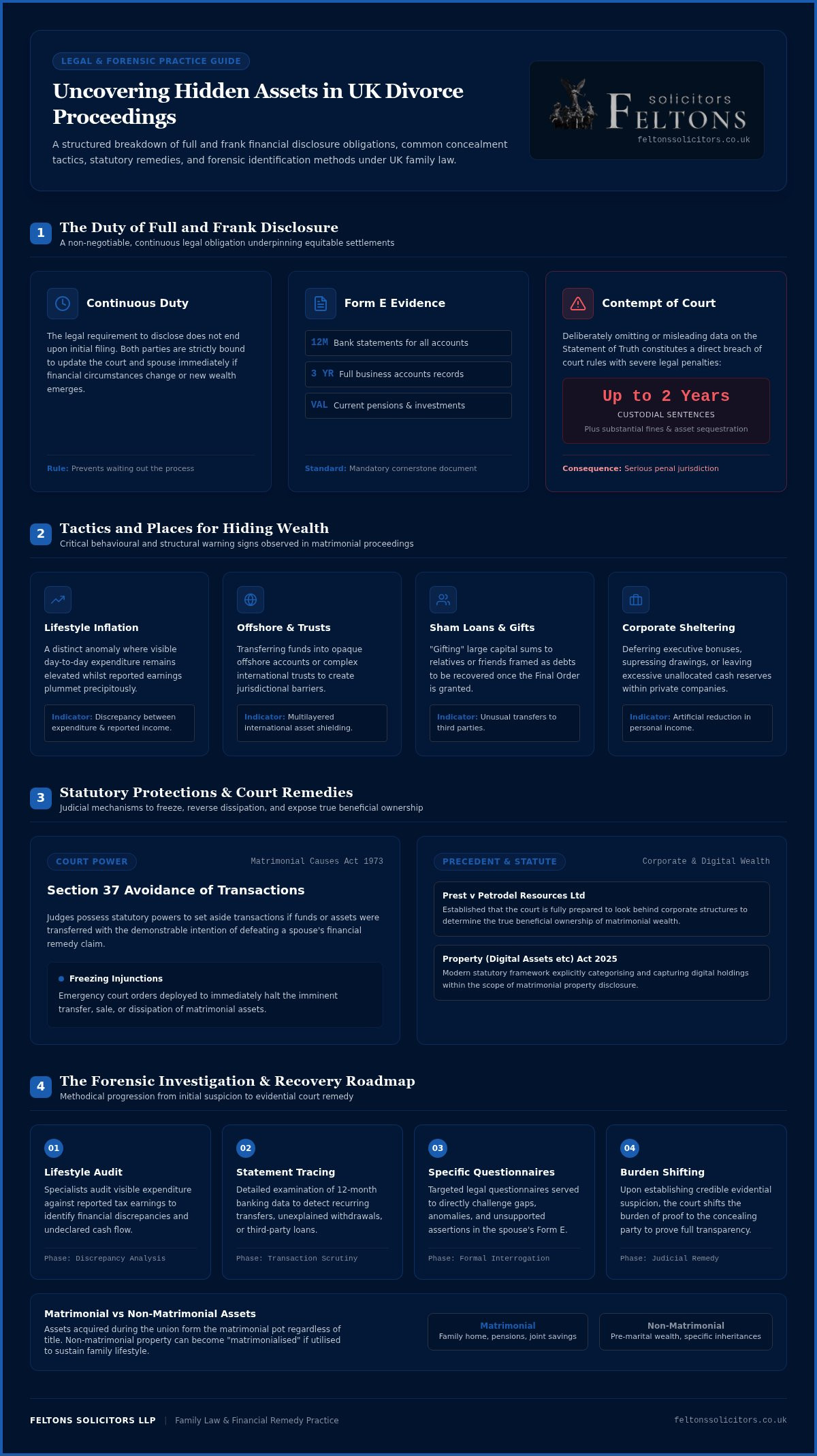
Formalising this disclosure typically occurs through Form E. This comprehensive document serves as the primary financial statement in court proceedings, demanding extensive supporting evidence. You must provide 12 months of bank statements for every account held, three years of business accounts, and current valuations for pensions and investments. Signing Form E involves a Statement of Truth. It’s a serious moment. Deliberately omitting information or providing misleading data constitutes a breach of court rules. Such actions can lead to allegations of contempt of court, which carries penalties including fines, asset sequestration, and custodial sentences of up to two years.
Crucially, this duty is continuous. It doesn’t end once the initial paperwork is filed. If your financial circumstances change or you discover previously unknown wealth, you’re legally bound to update the court and your spouse immediately. This ongoing requirement prevents either party from attempting to wait out the process before revealing new assets.
What Constitutes a Matrimonial Asset?
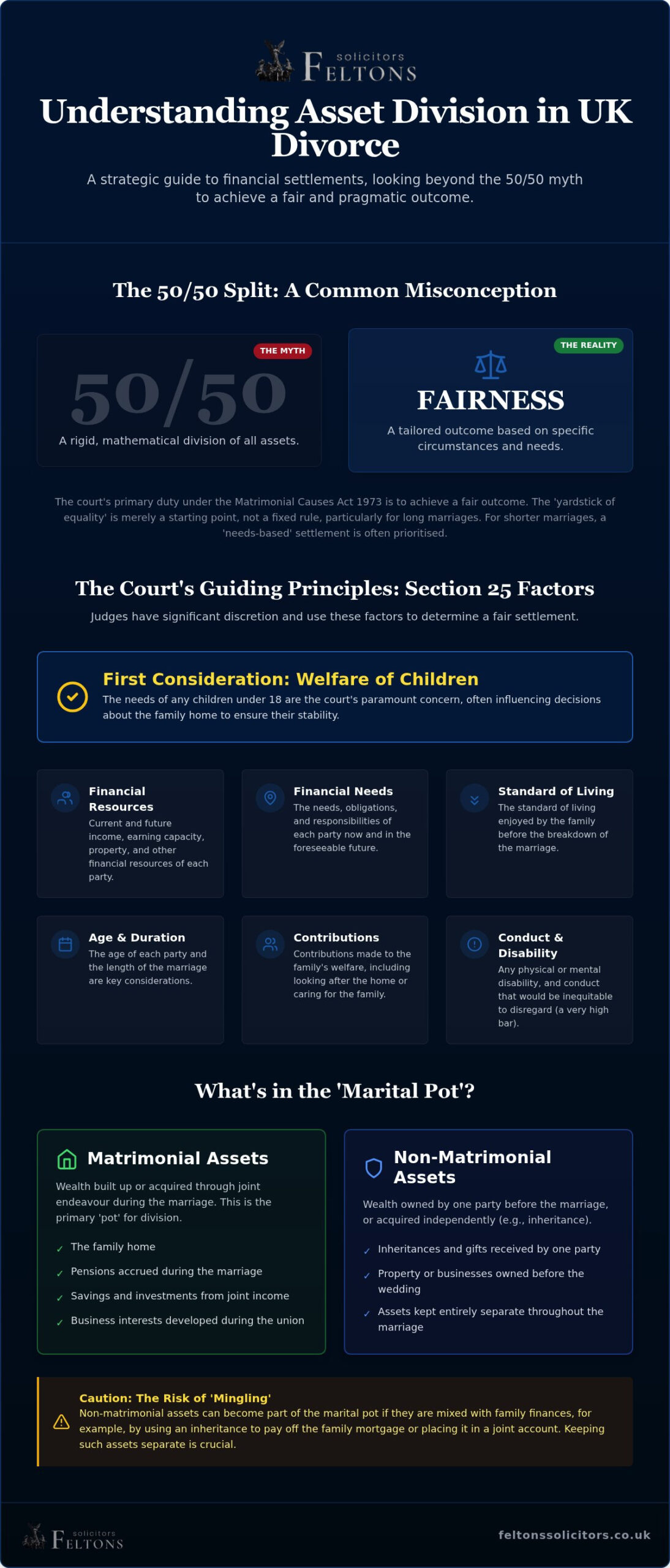
Distinguishing between matrimonial and non-matrimonial property is a frequent point of contention. Matrimonial assets are all property acquired during the marriage regardless of whose name is on the deed. This includes the family home, pensions accrued during the union, and joint savings. Non-matrimonial assets, such as pre-marital property or specific inheritances, are often treated differently, though they can become “matrimonialised” if they were used to support the family’s lifestyle. Beneficial interest can further complicate ownership, especially when assets are held in the names of third parties. The landmark case of Prest v Petrodel Resources Ltd demonstrated that the court is willing to look behind corporate structures to identify the true ownership of wealth.
The Consequences of Initial Non-Disclosure
Courts take a dim view of any early attempts to obfuscate data. If you reasonably suspect hidden assets in divorce proceedings uk, it’s vital to act quickly. When suspicion is raised with evidence, the court may shift the burden of proof. This means the party suspected of concealment must prove that their disclosure is complete, rather than you having to find the “smoking gun.” Initial steps usually involve reviewing lifestyle patterns against reported income to find discrepancies, analysing bank statements for unusual transfers to family or friends, and requesting specific questionnaires to clarify gaps in the Form E. Our pragmatic approach focuses on these early indicators to protect your financial future before assets can be dissipated or further obscured.
Common Tactics and Places for Hiding Assets
Identifying hidden assets in divorce proceedings uk often begins with observing subtle shifts in a spouse’s financial behaviour. “Lifestyle inflation” is a common red flag; it occurs when a party’s visible expenditure remains high whilst their reported income suddenly plummets. This discrepancy often suggests that funds are being diverted elsewhere. Other traditional methods include moving money into offshore accounts or complex international trusts to create a layer of distance from the matrimonial estate. These structures are designed to be opaque, but they aren’t impenetrable to a determined legal team.
Some individuals attempt to “gift” large sums to friends or family members, framing these transfers as sham loans that they intend to reclaim after the Final Order is granted. However, the court has robust powers to intervene. Under Section 37 of the Matrimonial Causes Act 1973, judges can set aside these transactions if they were clearly intended to defeat a financial claim. Wealth can also be obscured within business accounts by deferring bonuses or leaving excessive cash in corporate reserves. If you suspect such tactics, our specialists at Feltons Solicitors LLP can provide the discreet, methodical investigation required to protect your interests.
Digital Assets and Cryptocurrency
Tracing Bitcoin, Ethereum, and other digital currencies presents a modern challenge for many legal practitioners. Unlike traditional bank accounts, digital wallets can be held on “cold” hardware or within decentralised exchanges that bypass standard reporting. However, the Property (Digital Assets etc) Act 2025 now explicitly recognises these holdings as formal property. This statutory clarity means crypto-assets are fully subject to disclosure. Blockchain analytics can often reveal the movement of funds even when a spouse claims they no longer exist, ensuring these high-tech hidden assets in divorce proceedings uk are brought back into the matrimonial pot.
Business Interests and Undervaluation
Business owners might use “creative accounting” to artificially depress a company’s EBITDA or overall valuation. This might involve hiring “ghost employees”—friends or family members who receive a salary without performing work—or charging personal luxuries as business expenses. These tactics reduce the perceived value of the business for the settlement. A professional business valuation, conducted by a Single Joint Expert, is usually essential to uncover the true worth of the enterprise. This ensures the division of assets remains equitable and reflects the actual wealth generated during the marriage.
Forensic Strategies: How Hidden Assets are Identified
Identifying hidden assets in divorce proceedings uk requires more than just a keen eye; it demands a methodical partnership between specialist solicitors and forensic accountants. While the official UK government guidance on financial orders outlines the standard disclosure process, complex cases often require a deeper level of investigation. Forensic accountants act as financial detectives, scrutinising years of data to find the threads that lead to concealed wealth. Their expertise is particularly vital when dealing with international interests or intricate corporate holdings.
A cornerstone of this process is the “lifestyle audit.” By comparing reported income against actual household expenditure, experts can highlight impossible discrepancies. If a spouse claims a modest salary whilst maintaining a portfolio of luxury vehicles and frequent international travel, the numbers simply don’t add up. We also meticulously analyse bank statements, looking for “missing” transfers or recurring payments to unknown entities that might signal the existence of undisclosed accounts. In our experience, tracing funds across multiple international jurisdictions is often necessary to map out the flow of capital and reveal the ultimate beneficial owner.
Questionnaires and Further Disclosure
The Questionnaire process is a powerful tool for probing gaps in the initial Form E. We use specific, targeted questions to force a spouse to explain inconsistencies in their financial narrative. If their answers remain vague, we apply persistent legal pressure through the court to compel further, more detailed disclosure. This phase is crucial for stripping away layers of obfuscation. It’s not just about asking the right questions; it’s about knowing when an answer is designed to mislead and having the tenacity to follow up until the truth is revealed.
The Power of Search and Seize Orders
In extreme cases where there’s a high risk of evidence being destroyed, the court may grant a search and seize order. The threshold for such an intrusive measure is exceptionally high. You must demonstrate a strong prima facie case and a real danger that documents will be lost or hidden. These orders are executed with surgical precision, often involving independent supervising solicitors to ensure that evidence is preserved without violating legal protocols. This ensures that the paper trail remains intact for the final hearing, preventing a spouse from permanently erasing the evidence of their financial misconduct.
Legal Remedies and Penalties for Non-Disclosure
Courts in England and Wales possess robust statutory powers to address financial deception. When you suspect hidden assets in divorce proceedings uk, Section 37 of the Matrimonial Causes Act 1973 serves as your primary shield. This legislation empowers the court to grant freezing injunctions, halting the imminent dissipation of wealth. If a spouse has already transferred assets to a third party to defeat your claim, the court can issue a set-aside order. This effectively reverses transactions made within the preceding three years, bringing the value back into the matrimonial pot for a fair division.
When funds have been spent recklessly or hidden beyond immediate recovery, “add-back” orders provide a pragmatic solution. The court treats the missing money as a “notional asset,” attributing its full value to the dishonest party’s share of the remaining estate. Litigation misconduct also triggers significant financial consequences through adverse cost orders. Whilst the standard presumption in financial remedy cases is that each party covers their own legal fees, deliberate concealment allows a judge to order the non-disclosing party to pay your costs in full.
Inference and the “Worst Case” Scenario
Judges aren’t restricted by a lack of “smoking gun” evidence if a spouse is being deliberately evasive. Under the principle of “adverse inference,” the court can assume that the hidden wealth is significantly higher than suspected. Once you establish a reasonable case for non-disclosure, the burden of proof shifts. The court may then make a disproportionately high financial award against the dishonest party, based on their estimated financial capacity rather than their reported, fraudulent figures. This ensures that the deceptive party, rather than the innocent spouse, bears the financial risk of their own opacity.
Contempt of Court and Criminal Liability
Every Form E is backed by a Statement of Truth, making financial disclosure a matter of personal integrity and legal duty. Providing false information or omitting accounts isn’t just a civil dispute; it constitutes a form of perjury under the Perjury Act 1911. In extreme cases of fraud, the court can initiate contempt proceedings. This can result in unlimited fines, the sequestration of assets, or even a custodial prison sentence of up to two years. If you believe your spouse is risking these severe penalties by concealing wealth, speak with our specialist solicitors today for a discreet and methodical review of your case.
Securing Your Future: The Feltons Approach
Feltons Solicitors LLP operates with a boutique philosophy. This structure allows us to dedicate the intensive, tailored focus required to identify hidden assets in divorce proceedings uk. We don’t believe in high-volume processing. Instead, we offer a high-standard service that prioritises personal connection and discreet, expert care. Early intervention is critical. Acting swiftly allows us to deploy legal protections before assets are permanently dissipated or moved beyond the court’s jurisdiction.
Building an unassailable case requires a blend of legal rigour and financial expertise. We collaborate with elite forensic accountants to trace capital through intricate corporate layers and international jurisdictions. This methodical approach ensures your divorce and financial arrangements are handled with the quiet confidence and absolute discretion you deserve. We position ourselves as a calm, steady presence, guiding you through the complexities of financial litigation with poise and dependability.
Pragmatic Advice for Complex Financial Disputes
We provide sound judgment by balancing the forensic cost of an investigation against the potential financial recovery. Our focus remains on results that deliver long-term security. We help you gain clarity whilst understanding financial disclosure in divorce, ensuring you aren’t overwhelmed by the technicalities of the process. This outcome-focused strategy protects your wealth from being eroded by disproportionate litigation costs, allowing you to move forward with financial certainty.
Discreet Support for High Net Worth Individuals
High-net-worth disputes require a partner who understands the value of privacy. We act as your discreet advisor, protecting your reputation whilst pursuing a fair financial outcome. Our team possesses the worldly experience necessary to handle international asset structures and the registration of overseas entities. We’re deeply rooted in providing a people-first service, acknowledging that the human impact of legal work is just as important as the technical result. We invite you to contact Feltons Solicitors LLP for a confidential consultation to discuss how we can secure your financial future through a methodical and supportive legal process.
Protecting Your Financial Integrity
Achieving a fair financial settlement requires more than just goodwill; it demands absolute transparency. The legal duty of full and frank disclosure remains the cornerstone of matrimonial law. Whether you’re concerned about offshore trusts, corporate structures, or the rising challenge of hidden assets in divorce proceedings uk, the tools to uncover the truth are more robust than ever. By combining methodical forensic investigation with statutory remedies like Section 37 injunctions, you can ensure the matrimonial pot reflects the true extent of joint wealth.
Since 2010, Feltons Solicitors LLP has specialised in complex financial litigation, providing the discreet legal support necessary for high-net-worth matters. We offer pragmatic advice tailored to your individual asset protection needs, acting as a calm and steady partner during this transition. You don’t have to face financial uncertainty alone. Our boutique approach ensures your case receives the meticulous attention it deserves, prioritising your long-term security over high-volume processing.
Contact Feltons Solicitors LLP for discreet, expert advice on your financial settlement to begin securing your future with confidence.
Frequently Asked Questions
What happens if I find out my ex hid assets after the divorce is finalised?
You can apply to the family court to have your financial order set aside if material non-disclosure is discovered. Under the principle that fraud unravels all, the court has the authority to reopen the case and reassess the division of wealth. This process ensures that the dishonest party doesn’t benefit from their deception. It’s essential to act quickly once the discrepancy is identified to protect your legal standing.
Can a trust be used to hide assets in a UK divorce?
Trusts are often used to obscure ownership, but they are not impenetrable to the court. Judges can look through complex trust structures to identify the true beneficial interest held by a spouse. If a trust is found to be a “sham” or if the assets are effectively controlled by one party, the court can treat those holdings as part of the matrimonial estate available for sharing.
How much does it cost to hire a forensic accountant for a divorce?
The cost of forensic accountancy varies significantly depending on the complexity of the financial structures involved and the volume of data requiring analysis. Whilst it represents an additional expense, it’s often a vital investment in cases involving high-value or international interests. A forensic report can provide the evidence needed to secure a significantly higher settlement, ensuring your final award reflects the true value of the shared estate.
What is a Section 37 Injunction and when should I use it?
A Section 37 Injunction is a powerful court order used to freeze assets and prevent their dissipation. You should use it when there’s a clear and imminent risk that your spouse will hide, transfer, or spend matrimonial funds to defeat your financial claim. This remedy preserves the status quo, ensuring that wealth remains available for division whilst the court determines a fair and equitable final settlement.
Is it illegal to hide money during a divorce in the UK?
Yes, concealing wealth is a breach of your legal duty and can lead to severe penalties. When you sign Form E, you’re making a formal declaration under a Statement of Truth. Deliberately providing false information regarding hidden assets in divorce proceedings uk constitutes contempt of court and perjury. Consequences include significant cost orders, the sequestration of your assets, or even a custodial prison sentence for the most serious cases.
Can the court look into assets held in my spouse’s business?
Business interests are treated as matrimonial assets and are subject to the same rigorous disclosure requirements as personal savings. The court can scrutinise director loan accounts, retained earnings, and complex share structures to ensure wealth isn’t being obscured within a company. A professional valuation by a Single Joint Expert is often required to determine the true value of the business and any income it’s capable of generating.
What is a “lifestyle audit” in divorce proceedings?
A lifestyle audit is a forensic technique used to compare a party’s visible standard of living against their reported income. If a spouse claims a modest salary whilst funding luxury holidays and expensive vehicles, the audit highlights these discrepancies. This methodical analysis provides the court with circumstantial evidence of undisclosed wealth, often leading to further disclosure orders or the court drawing adverse inferences about the party’s true financial position.
How does the court treat cryptocurrency in a financial settlement?
Cryptocurrency is now explicitly recognised as formal property under the Property (Digital Assets etc) Act 2025. It must be fully disclosed on Form E just like any other investment or bank account. Tracing hidden assets in divorce proceedings uk often involves using blockchain analytics to map out digital wallet transactions. The court has the power to include the value of these digital holdings in the overall matrimonial pot for division.