
Silicosis Compensation Claims for Workers Exposed to Silica Dust

Silicosis Compensation Claims for Workers Exposed to Silica Dust

A silicosis diagnosis may support a compensation claim when evidence links the illness to workplace silica dust and shows that an employer failed in its duty of care. In England and Wales, the usual time limit is three years from when a person first became aware they had silicosis, according to The National Archives. Industrial dust exposure compensation claims can also involve industrial benefits, and understanding how the routes relate is an important part of deciding what to do next.

Silicosis is a long-term lung disease caused by inhaling fine crystalline silica dust. Its effects can emerge years after exposure, so it is understandable to be unsure how past work, a later diagnosis and the legal deadline fit together.

This article explains how silica exposure happens, what evidence may support a claim and how time limits apply. It also explains how a civil claim relates to industrial benefits, including when payments through one route may affect compensation through another.

Key Takeaways

  • Learn how workplace silica dust exposure and an employer’s failure to control risks may shape a compensation claim.
  • See which medical and work-history records can help connect silicosis to past employment.
  • Understand the usual three-year time limit in England and Wales, which runs from when you first become aware of the illness.
  • Explore how a civil claim may relate to industrial benefits, including a lump-sum route under the Workers Compensation Act 1979.

How does workplace silica dust exposure happen?

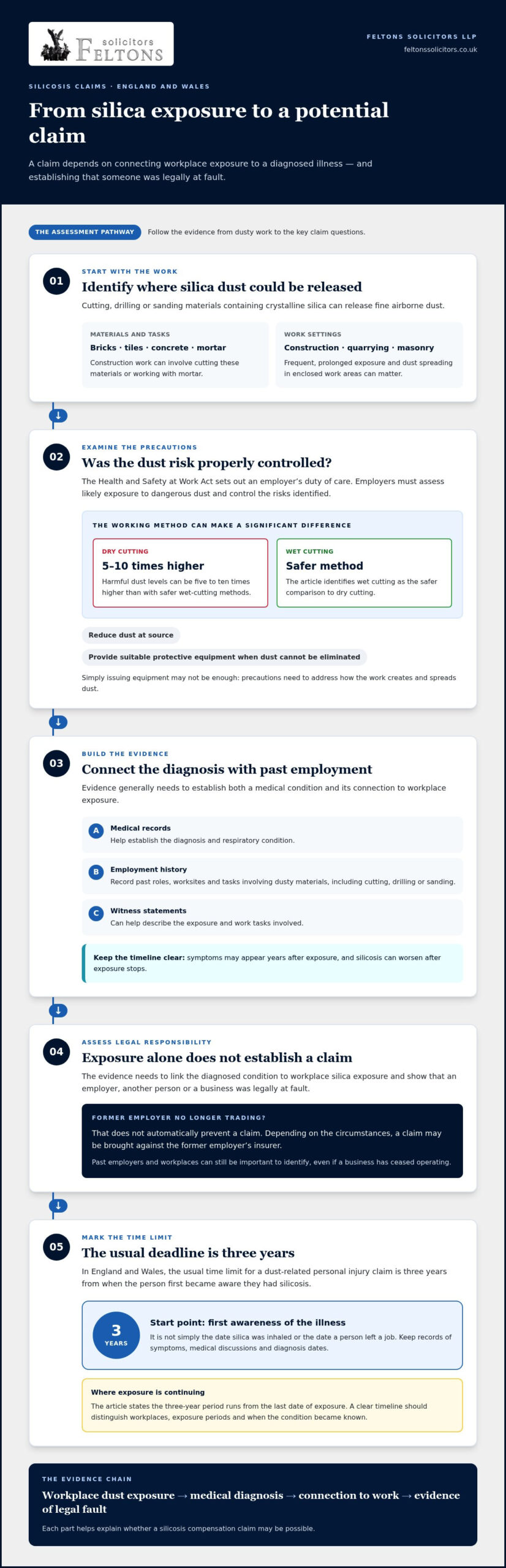
Silica dust is released when materials containing crystalline silica are cut, drilled or sanded. In construction, cutting bricks, tiles and concrete or working with mortar can release airborne dust. Construction, quarrying and masonry can involve frequent, prolonged exposure, with fine particles inhaled during routine tasks, particularly when dust spreads through an enclosed work area. Repeated workplace exposure can lead to silicosis.

The Health and Safety at Work Act sets out employers’ duty of care to protect employees from workplace harm. Employers must assess likely exposure to dangerous dust and control the risks they identify. Practical precautions include reducing dust at source and providing suitable protective equipment when dust cannot be eliminated. Simply issuing equipment is not enough: precautions must address how the work creates and spreads dust.

For example, a worker cutting engineered stone without effective dust controls may face avoidable exposure. Dry cutting can expose workers to harmful dust levels five to ten times higher than safer wet-cutting methods. This illustrates why the method of work matters when assessing whether an employer took appropriate precautions. Continued silica exposure despite avoidable risks may be relevant to whether the employer breached its duty of care.

A silicosis claim needs evidence linking the diagnosed condition to workplace silica exposure and showing that the employer failed in its duty of care. Start by recording past roles, worksites and tasks involving dusty materials. Employment records and details of cutting, drilling or sanding can help establish where exposure occurred. Medical evidence can then help connect that exposure with the respiratory condition.

A former employer’s closure does not automatically prevent a claim. In the UK, a silicosis claim may still be possible even if the employer is no longer trading. Depending on the circumstances, a claim may be brought against the former employer’s insurer. Identify past employers and workplaces, even if the business has since ceased operating.

When might a silicosis compensation claim be possible?

A claim depends on evidence linking an industrial disease to workplace exposure and establishing legal responsibility. The type of dust, medical diagnosis and work history all help explain that link.

Silicosis and lung damage

Silicosis is a long-term lung disease caused by inhaling fine crystalline silica particles. The particles scar and harden lung tissue, gradually reducing lung function. Chronic silicosis usually follows prolonged exposure, while accelerated silicosis can develop after five to 10 years of higher exposure. Acute silicosis can develop within a few weeks after exposure to very high concentrations. Cutting, drilling or sanding silica-containing materials can release the dust.

Symptoms can include persistent coughing, breathlessness during activity and chest tightness, and may appear years after exposure. Silicosis can worsen after exposure stops, and there is no known cure. Silica exposure can also be linked to lung cancer and chronic obstructive pulmonary disease (COPD). The diagnosed condition matters when assessing a claim.

Claim evidence and eligibility

Evidence generally needs to establish both a medical condition and its connection to work. Medical records, employment history and witness statements can help show the diagnosis, exposure and tasks involved. A specialist can assess how the records fit together, including whether the illness was caused by silica dust or another industrial exposure.

In the UK, compensable industrial dust exposure can include exposure to silica, asbestos and other workplace dusts, chemicals or vapours linked to respiratory illness. A claim depends on evidence that the exposure caused the condition and that an employer or another person or business was legally at fault.

Workers with a respiratory illness linked to workplace exposure can pursue a claim if legal fault is established. A claim may also be made on behalf of someone too ill to act, someone lacking mental capacity, or a person who has died from the illness.

If you have breathing difficulties, seek medical assistance, then gather medical records, employment details and witness accounts. These can help establish the diagnosis, exposure history and potential responsibility.

The risks include difficulty proving exposure, causation or fault. Industrial disease claims are often pursued through conditional fee agreements, commonly called no win no fee arrangements; the agreement’s terms explain any fees payable. For help assessing evidence, consider specialist silicosis claim advice.
Silicosis Compensation Claims for Workers Exposed to Silica Dust

Time limits for claims

In England and Wales, the usual deadline is three years from first awareness of silicosis, according to The National Archives (legislation.gov.uk). This date can matter even if symptoms develop gradually or exposure happened years earlier.

The three-year claim time limit

For a dust-related personal injury claim in England and Wales, the usual time limit is three years from when the person first became aware they had silicosis. The relevant starting point is awareness of the illness, not simply the date silica particles were inhaled or the worker left a job. Keep records of symptoms, medical discussions and diagnosis dates to help establish the timeline.

Silicosis may develop long after workplace exposure, so the gap between dusty work and diagnosis does not, by itself, determine the deadline. Where exposure is continuing, the stated period is three years from the last date of exposure. A clear timeline should distinguish each workplace, exposure period and when the condition became known.

Time limits in England and Wales

The three-year period applies to personal injury claims, including those involving silicosis. Identifying the relevant awareness date can be difficult if symptoms came before diagnosis or medical understanding developed over time. Note when you first learned that your respiratory condition was linked to workplace silica exposure, alongside diagnosis and employment records.

Do not assume the diagnosis date is decisive in every case. Records showing when the illness was identified and connected with exposure can help clarify the chronology. Delay may affect whether a claim can proceed, so it is important to review the dates and evidence promptly.

Scotland and Northern Ireland have their own limitation rules, so do not assume the England and Wales three-year period applies there. Identify where the relevant exposure and claim arose, then establish the applicable deadline before deciding what to do next.

As a practical first step, create a dated record of dusty roles, the last exposure date, symptoms and medical appointments. If silica exposure is ongoing, record when it stops. This helps distinguish the exposure timeline from the later period when an injury may develop or be diagnosed, and supports assessment of the employer’s duty of care.

Civil claims and industrial benefits

A civil claim and an industrial benefit are separate routes for people affected by occupational silicosis. Receiving a benefit does not necessarily rule out a civil claim, but payments can affect the final damages calculation. Industrial dust exposure compensation claims may therefore require consideration of both routes.

A civil claim considers whether workplace exposure caused the illness and whether an employer or another person or business was legally at fault. Compensation can reflect lung scarring and symptoms, as well as financial losses such as lost earnings, care needs, travel and medical treatment. Keep evidence of these losses with records of exposure and diagnosis.

State benefits are another consideration. Silicosis and pneumoconiosis are prescribed diseases for State benefit claims. The Workers Compensation Act 1979 provides a route to claim a lump sum for silicosis, or for a dependent whose loved one has died of silicosis, according to The National Archives (legislation.gov.uk).

Where a person receives industrial disablement benefit or a lump sum through the Workers Compensation Act, that money is deducted from compensation awarded in a civil claim under the routes described. This adjustment prevents the same loss from being compensated twice. Keep award letters and payment records so the amounts can be accurately considered alongside the civil claim.

Silicosis can progress, so evidence should also describe its current impact and possible future effects. Provisional damages may preserve the opportunity to seek further damages if a more serious condition develops later. A claim can be brought for someone too ill to act, someone lacking mental capacity, or a person who has died; a dependent may also have a lump-sum route under the 1979 Act. A person exposed while self-employed is not eligible for industrial disablement benefit under the route described here. These details can shape how industrial dust exposure compensation claims are assessed alongside benefits.

Silicosis claims can involve historic exposure, several employers and detailed medical evidence. Settlement may take up to three years, or longer depending on liability and the claimant’s condition. To discuss how a civil claim and benefits may relate, seek advice on a silicosis claim.

In Scotland and Northern Ireland, a civil claim considers whether workplace exposure caused the illness and whether an employer or another party was legally at fault; industrial benefits are a separate route. Industrial disablement benefit or a lump sum under the Workers Compensation Act 1979 may be deducted from civil damages to avoid compensating the same loss twice.

Feltons Solicitors LLP: Divorce and Financial Arrangements

Feltons Solicitors LLP handles Personal Injury and Silicosis Claims for people seeking advice after workplace silica exposure. The firm can advise if you have a diagnosis, questions about whether employer negligence contributed, or uncertainty about how a civil claim relates to industrial benefits. A discussion can help you understand the evidence and issues relevant to your circumstances, including past work and medical records.

Silicosis claims can involve historic exposure and more than one employer, so setting out your work history and diagnosis can help explain the situation. Feltons Solicitors LLP can advise on the legal claim; this section is distinct from its Divorce and Financial Arrangements offering.

Contact Feltons Solicitors LLP to discuss a silicosis claim.

Take a clear next step

A diagnosis can affect more than your health. It may change the work you can do, the support you need at home and the plans you make with family. Describing these practical effects can help ensure they are considered alongside medical evidence in industrial dust exposure compensation claims.

Before seeking advice, note what has changed in daily life, what assistance you need and which work or personal plans have been affected. You do not need to have every detail resolved before discussing your situation. A focused conversation can help identify the key questions and documents that may help answer them.

If you’re ready to discuss your circumstances, contact Feltons Solicitors LLP about your claim. A considered next step can help you approach the legal process with greater clarity and decide how you wish to proceed.

Frequently Asked Questions

What is silicosis?

Silicosis is an occupational lung disease caused by inhaling crystalline silica particles, which can scar lung tissue. It has chronic, accelerated and acute forms, associated with different exposure patterns. Acute silicosis can develop within a few weeks after very high exposure, while chronic disease usually follows prolonged exposure. Possible symptoms include persistent coughing, chest tightness and breathlessness; a medical diagnosis identifies the condition.

Can I claim if my former employer no longer exists?

Yes. A former employer’s closure does not automatically prevent a silicosis claim. Depending on the circumstances, a claim may be brought against the old insurer. Start by noting the employer’s name, the worksite and the tasks that created dust. Old employment papers, payslips or colleague details may help piece together your work history and identify relevant exposure periods.

Can silicosis get worse after exposure has ended?

Yes. Silicosis can continue to progress after silica exposure stops, so leaving dusty work does not necessarily end its effects. If your breathing, stamina or everyday activities change, record when the changes occur and discuss them with your medical team. These updates can help describe how the condition affects daily life, rather than relying only on an earlier account of symptoms.

How Much Compensation Can You Expect?

A claim may account for pain and suffering, lost income, care, travel and medical treatment. For example, reduced ability to work or a need for regular assistance can affect the losses assessed. There is no fixed tariff for every diagnosis.

How long do I have to make a claim?

In England and Wales, the usual limit is three years from when you first became aware of silicosis, according to The National Archives (legislation.gov.uk). Awareness may not match the date you first inhaled dust or stopped working. Note when you received information linking your condition to silica, and keep relevant medical dates together. Scotland and Northern Ireland have different limitation rules.

How might my employer be responsible?

An employer may be responsible if workplace silica exposure caused your illness and the exposure was legally their fault. For example, evidence might show dust-generating work continued without adequate measures to control the risk. The assessment considers working conditions, exposure history and the medical link, not simply whether you handled concrete. Details of tasks, sites and colleagues can help clarify what happened.

Pulmonary Fibrosis Compensation Claims: A 2026 Guide

Pulmonary Fibrosis Compensation Claims: A 2026 Guide

Could pulmonary fibrosis diagnosed years after leaving work still be linked to workplace exposure? For some people, past contact with harmful dust, fumes or chemicals may be relevant to pulmonary fibrosis compensation claims. However, a diagnosis alone doesn’t establish that a claim is possible. The circumstances and evidence matter.

It’s understandable to be unsure where to begin, particularly if an employer has closed, work records are hard to find or you’re concerned about deadlines. A careful assessment considers whether the condition may be connected to workplace exposure and whether an employer may have failed to take reasonable steps to protect you.

This 2026 guide explains the potential basis for a claim, the medical and employment records that may help, and why expert evidence can matter. It also outlines issues to consider when seeking legal advice, including limitation periods, which depend on the relevant UK jurisdiction and individual circumstances. The aim is to help you consider possible next steps without assuming that every case will qualify.

Key Takeaways

  • A pulmonary fibrosis diagnosis alone doesn’t establish that workplace exposure caused the condition or that compensation is available.
  • Pulmonary fibrosis compensation claims may depend on evidence connecting the diagnosis and exposure history to a potentially responsible employer.
  • If records are incomplete, start building a work-history timeline and look for other sources that may help reconstruct past exposure.
  • Prioritise medical care, then preserve relevant employment records and correspondence for an informed assessment.
  • When speaking with a solicitor, ask about their occupational-disease experience, how they assess evidence and whether your circumstances fit their expertise.

A pulmonary fibrosis diagnosis can raise difficult questions, especially if you’ve worked around dust, fumes or other substances. The diagnosis is a starting point for investigation, not proof that work caused the illness or that compensation is due. A claim may warrant assessment if the available evidence suggests workplace exposure caused or materially contributed to the condition and a party may be legally responsible for that exposure.

What does pulmonary fibrosis mean in a compensation claim?

Pulmonary fibrosis describes scarring in the lungs. As scar tissue builds up, lung tissue can become thicker and stiffer, making it harder for oxygen to pass into the bloodstream. The term describes a change in the lungs, rather than one single cause. Some cases have no identifiable cause; others may be associated with an underlying disease, treatment or exposure. The Pulmonary fibrosis overview provides background, but it can’t determine what caused an individual’s condition.

Diseases that involve lung scarring aren’t interchangeable. A diagnosis such as idiopathic pulmonary fibrosis (IPF) has a different meaning from a condition linked to a known cause. Only an appropriate medical professional can assess an individual diagnosis and whether a particular exposure may have contributed.

When can workplace exposure become legally relevant?

Past work may be relevant if a person encountered a potentially harmful substance and medical evidence supports a connection with their illness. Dust, fumes or chemicals may form part of that investigation. But identifying an exposure alone doesn’t establish that it caused the condition or that an employer was at fault.

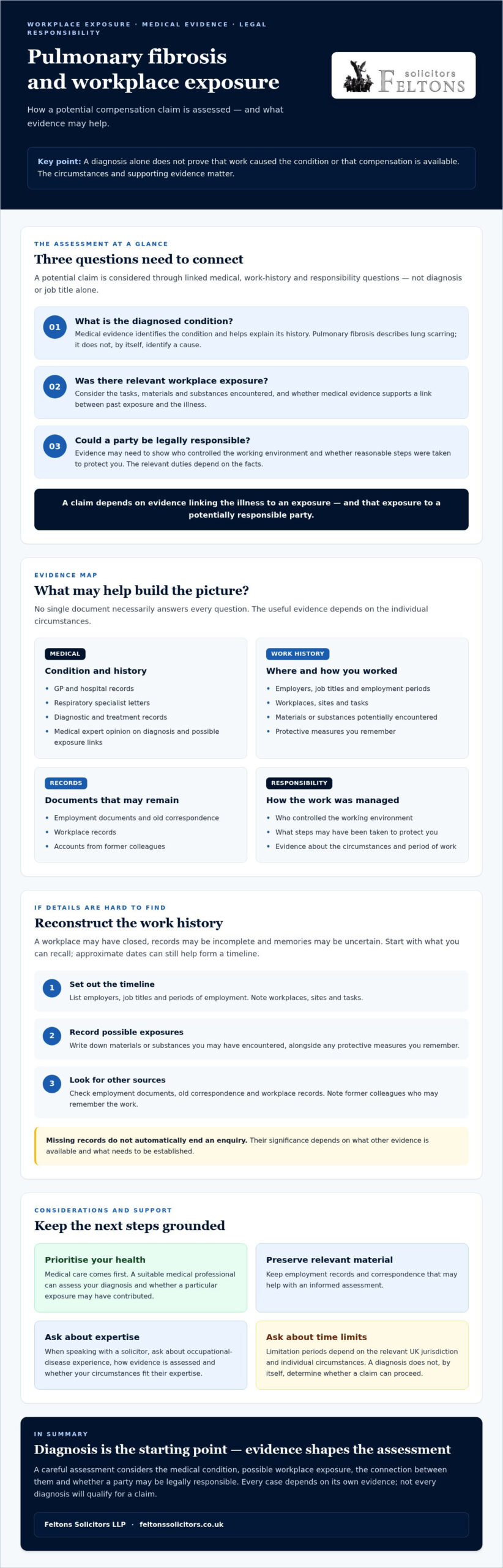
In short: a diagnosis identifies the medical condition; occupational causation concerns whether work exposure caused or materially contributed to it; legal responsibility asks whether a party can be held accountable on the evidence.

These questions need to be considered together. A solicitor may examine the tasks involved, when and where exposure occurred, who controlled the working environment, and what records or witness accounts remain. The relevant legal duties and potential responsibility depend on the facts, including the period and circumstances of the work. Pulmonary fibrosis compensation claims aren’t decided by diagnosis or job title alone. Medical evidence, exposure history and evidence about responsibility all matter.

How do pulmonary fibrosis claims connect diagnosis, exposure and responsibility?

A claim is assessed through several connected questions, not a single document or recollection. The evidence needs to establish the diagnosed condition, the person’s exposure history, whether that exposure caused or materially contributed to the illness, and whether a party may be legally responsible. A claim depends on evidence linking the illness to an exposure and that exposure to a potentially responsible party.

What medical evidence may help assess a claim?

Relevant material may include GP and hospital records, letters from respiratory specialists, diagnostic reports and treatment records. A solicitor can advise which documents may assist in a particular case. Medical experts may also be asked to consider the diagnosis and whether the available evidence supports a possible link with past exposure. The evidence needed will depend on the individual circumstances.

Medical records can confirm a diagnosis and help explain its history, but they don’t, on their own, establish who caused the illness or whether an employer breached a legal duty. Those are separate questions that require evidence about work and responsibility as well as medical opinion.

How can someone reconstruct a past exposure history?

When work took place many years ago, details can be difficult to recall and records may be incomplete. Start with a timeline, even if some dates are approximate. Note:

  • Employers, job titles and periods of employment.
  • Workplaces, sites, tasks and materials or substances potentially encountered.
  • Protective measures you remember, and the names of former colleagues who may recall the work.

Possible sources include employment documents, old correspondence, workplace records and accounts from people who worked alongside you. Don’t assume that a missing file ends the enquiry. Its importance depends on what other evidence exists and what needs to be established.

Keep the different strands of evidence distinct. A work record may help show where and when you worked, but it won’t necessarily prove exposure or medical causation. A medical report may explain the illness without identifying a legally responsible party. Pulmonary fibrosis compensation claims therefore require the evidence to be considered as a whole, with gaps and uncertainties assessed rather than assumed away.

Some people also want to check whether a state benefit may be relevant. GOV.UK explains the eligibility rules for Industrial Injuries Disablement Benefit. Eligibility depends on the prescribed disease and personal circumstances, and the benefit route is distinct from establishing legal liability in a compensation claim.

If you’d like to understand whether your exposure history and available records fit a firm’s experience, you can discuss the evidence and relevant legal issues with Feltons Solicitors LLP. The firm handles personal injury claims, including specialist silicosis litigation, and can assess whether the circumstances are relevant to its experience.

Can I make a pulmonary fibrosis compensation claim if proof is difficult?

Difficulty tracing past exposure doesn’t automatically rule out a claim, but evidence remains central. A long interval between work and diagnosis can make the link feel hard to prove, but it doesn’t answer by itself whether a claim is possible. The strength of a case depends on what can be established about the illness, potential exposure, medical causation and legal responsibility.

There isn’t a single test for eligibility. Each case needs an individual assessment, taking account of the medical evidence, available work history, applicable law and whether a potentially responsible party can be identified. A solicitor can review what is available, explain where evidence may be incomplete and consider whether further enquiries could help. That assessment can clarify the issues, but it can’t guarantee that a claim will proceed or succeed.

What if an employer or work records are no longer available?

Old employers may have closed, changed names or no longer hold relevant records. Other sources may still provide useful detail, such as personal papers, payslips, photographs, correspondence, former colleagues’ recollections or archived workplace information. A solicitor may also investigate whether a potentially responsible organisation or relevant insurer can be traced, but this isn’t always possible.

Record what you remember, even if dates or job details are uncertain. Note the roles you held, places you worked, tasks you carried out and substances or materials you recall encountering. Be clear about what you know first-hand and what you’re unsure of. Missing documents don’t settle the question either way; their significance depends on the wider evidence and what a case needs to prove.

Does a diagnosis automatically mean compensation is available?

No. A diagnosis confirms a medical condition, but it doesn’t establish that work caused or contributed to it, or that another party is legally responsible. Pulmonary fibrosis can have different causes, and appropriate medical experts may need to consider the diagnosis and possible explanations alongside the person’s exposure history.

That’s why pulmonary fibrosis compensation claims shouldn’t be judged on assumptions based on a job title, a remembered substance or the time between exposure and diagnosis. An individual assessment can help distinguish what the evidence supports from what still needs investigation. If you’re uncertain, gather the information you can and ask a solicitor to assess the available material, remaining gaps and relevant legal issues before drawing conclusions about entitlement.

Pulmonary Fibrosis Compensation Claims: A 2026 Guide

What steps should I take to start a pulmonary fibrosis claim?

Start with your health, not paperwork. Continue to seek medical care and follow advice from your healthcare team; gathering information for a possible claim shouldn’t delay treatment. You don’t need to prove legal causation yourself. A clear account of your work and the records you can locate can help a solicitor identify what may need further investigation.

What information should I prepare before speaking to a solicitor?

Begin with a simple timeline and add to it as you remember details. Approximate dates are useful if exact ones aren’t available. Keep copies of relevant documents, but don’t worry if your file is incomplete.

  • Step 1: Note your diagnosis, when you received it, and any relevant medical appointments, reports or correspondence you have.
  • Step 2: List employers, job roles, work locations and approximate dates, including periods when you may have encountered dust, fumes or other substances.
  • Step 3: Gather available supporting material, such as employment records, payslips, workplace documents or correspondence, and note former colleagues who may remember the work.
  • Step 4: Write down questions and uncertainties, including gaps in dates or details you can’t recall clearly. Don’t guess or try to decide what caused the condition.

An initial review can help identify which information may be relevant and what else might be needed. Preserve records and correspondence where you can, but medical care comes first.

Why should I check the time limit promptly?

Personal injury limitation rules may apply, but the relevant deadline can depend on when you became aware of the injury and its possible connection to work, alongside other facts. Rules also differ across UK jurisdictions, so don’t assume a deadline based on general guidance alone. A solicitor can check which rules apply to your circumstances and whether any time limit may affect the next steps.

Don’t assume that ongoing symptoms, delayed diagnosis or discussions with an employer automatically pause a deadline. If you’re considering pulmonary fibrosis compensation claims, seek case-specific legal advice promptly rather than waiting until every record has been found. Early advice can help clarify the issues while you continue to focus on your health.

Feltons Solicitors LLP handles personal injury claims, including specialist silicosis litigation. To discuss whether your work history and available records fit the firm’s experience, contact Feltons Solicitors LLP about your circumstances.

Occupational disease cases can involve medical questions, old employment histories and evidence about who was responsible for working conditions. The right solicitor should be able to explain how they’ll assess those issues, what remains uncertain and how they’ll keep you informed. Ask questions before deciding whether to instruct a firm, and make sure you understand the proposed approach.

What should I ask a solicitor before instructing them?

Ask for clear, practical answers about the work involved. For example:

  • What experience does the firm have with occupational disease claims, and how would it investigate my exposure history?
  • How would it assess medical causation and identify any potentially responsible parties?
  • Who would handle my matter, how would updates be provided, and how would important decisions be discussed?
  • What funding arrangements may be available, and how would fees, disbursements and any other costs apply to my circumstances?

Ask for costs and funding information in writing before deciding. Arrangements vary, so don’t assume that a particular funding option is available or suitable. A solicitor should explain the terms relevant to your case in language you can follow.

How can Feltons Solicitors LLP assess whether its experience is relevant?

Feltons Solicitors LLP handles personal injury claims, including specialist silicosis litigation, as well as complex disputes. That experience may be relevant where the facts connect with the firm’s occupational-disease work, but it doesn’t establish that every pulmonary fibrosis matter falls within its expertise. Relevance depends on the individual diagnosis, suspected exposure, available evidence and legal issues.

An initial discussion can help clarify what is known, what may need investigation and whether the circumstances fit the firm’s experience. Ask directly about Feltons Solicitors LLP’s current expertise in relation to your particular condition and any suspected workplace exposure, and what the next steps would involve.

Readers considering a related issue may also find the guide Silicosis Claim After Death: A Legal Guide for Bereaved Families in 2026 useful. It concerns a different occupational disease and situation, so it shouldn’t be taken as an indication that the legal issues or outcome will be the same.

If you’d like to discuss your exposure history, available evidence and relevant legal questions with Feltons Solicitors LLP, Discuss your circumstances with Feltons Solicitors LLP. The discussion can help establish whether the firm’s experience is relevant; it can’t determine the outcome of a claim in advance.

Take a considered next step

A pulmonary fibrosis diagnosis doesn’t, by itself, establish that work caused the condition or that compensation is available. A potential claim needs evidence connecting the medical diagnosis with workplace exposure and a legally responsible party. Where old records are missing or the link is uncertain, an individual review can help identify what is known and what may need further investigation.

If you’re considering pulmonary fibrosis compensation claims, keep relevant medical and employment information, write down what you remember and seek case-specific advice about evidence and time limits. Don’t delay medical care while gathering documents.

Feltons Solicitors LLP handles personal injury claims, including specialist silicosis litigation, and provides pragmatic advice on complex disputes. An initial discussion can help assess whether your circumstances fit the firm’s relevant experience, without assuming eligibility or an outcome. Discuss your circumstances with Feltons Solicitors LLP and take the next step with a clearer understanding of your options.

Frequently Asked Questions

Can I claim compensation for pulmonary fibrosis caused by workplace exposure?

Possibly, if evidence supports a connection between workplace exposure and your condition, and establishes that a party may be legally responsible. A diagnosis alone doesn’t prove either point. Pulmonary fibrosis compensation claims are assessed individually, taking account of medical opinion, work and exposure history, available records and applicable law. A solicitor can review what you know and explain whether further investigation may be needed, without guaranteeing eligibility or an outcome.

How do I prove that work caused my pulmonary fibrosis?

You’ll generally need evidence about the diagnosis, potential workplace exposure, medical causation and responsibility. Useful material may include medical records and reports, a timeline of employers and roles, workplace documents, correspondence and recollections from former colleagues. Medical experts may be asked to consider possible causes, while a solicitor assesses the legal evidence. No single record necessarily proves the whole case, and the evidence required depends on your circumstances.

Is pulmonary fibrosis the same as silicosis?

No. Pulmonary fibrosis describes scarring in lung tissue, whereas silicosis is a specific lung disease associated with breathing in respirable crystalline silica dust. The terms aren’t interchangeable, although lung scarring may be relevant to different diseases. A medical professional must assess an individual’s diagnosis and possible cause. Feltons handles personal injury claims, including specialist silicosis litigation, but that doesn’t mean every pulmonary fibrosis condition falls within its current expertise.

How long do I have to make a pulmonary fibrosis compensation claim?

Personal injury claims generally have a three-year time limit, often linked to when the injury and its possible connection to work became known. This isn’t a universal answer: the relevant rules may depend on your circumstances and UK jurisdiction. Don’t assume that ongoing symptoms, delayed diagnosis or discussions with an employer pause a deadline. Seek prompt, case-specific advice so a solicitor can check which limitation rules apply to you.

Can I make a claim if my former employer has closed?

A former employer closing down doesn’t necessarily rule out a claim, but it can make identifying the responsible party more complex. A solicitor may investigate whether relevant historical records or an insurer can be traced, alongside other evidence such as personal papers and former colleagues’ accounts. There’s no guarantee that an organisation, insurer or document will be found. The available evidence and legal position need to be assessed individually.

What should I do first if I suspect work contributed to pulmonary fibrosis?

Continue with medical care and follow your healthcare team’s advice. Then make a timeline of your employers, roles, work locations and any substances you remember encountering. Keep relevant medical, employment and workplace records, and note gaps or questions rather than trying to prove causation yourself. Consider seeking legal advice promptly, as limitation rules may apply. An initial assessment can help clarify which evidence may assist and what further information might be needed.

Workplace Disease Solicitors UK: A Comprehensive Guide to Claims in 2026

Workplace Disease Solicitors UK: A Comprehensive Guide to Claims in 2026

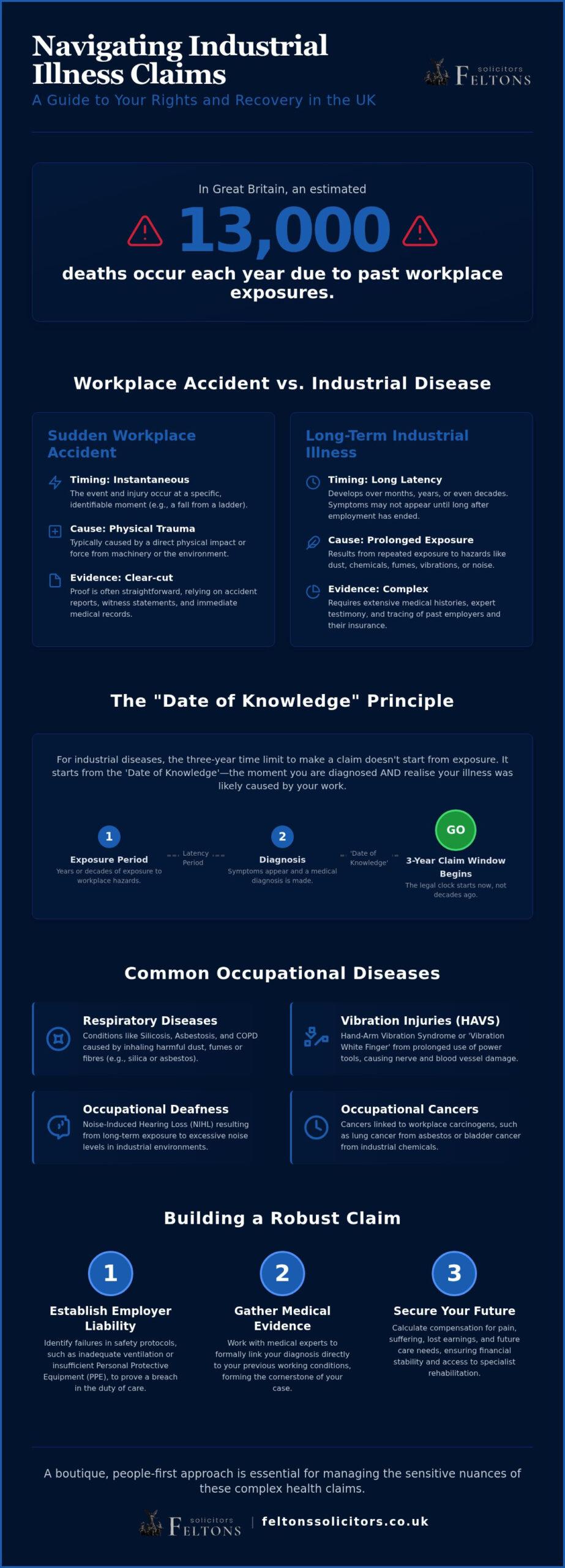
Did you know that an estimated 13,000 deaths occur every year in Great Britain due to past workplace exposures, with many conditions only surfacing decades after you’ve left the job? If you’re struggling with a diagnosis like silicosis or asbestosis, the prospect of taking on a large corporation can feel like an impossible battle whilst your health declines. Partnering with specialist workplace disease solicitors UK ensures you aren’t facing this complex journey alone. It’s natural to feel concerned about the time that has passed or the cost of care, but the law is designed to protect those who’ve been let down by employer negligence.

We understand that your priority is securing financial stability for your future and achieving a sense of justice. This comprehensive guide will show you how to navigate industrial illness claims in 2026 with confidence, focusing on a clear, stress-free path toward recovery. We’ll examine the latest 18th edition Judicial College Guidelines, the critical “date of knowledge” principle for long-latency diseases, and how expert legal guidance provides the boutique level of care you need to rebuild your life.

Key Takeaways

  • Understand the legal distinction between sudden workplace accidents and long-term industrial illnesses to help identify the true nature of your condition.
  • Learn how to establish employer liability by identifying failures in safety protocols or insufficient protective equipment, regardless of how long ago the exposure occurred.
  • Discover how specialist workplace disease solicitors UK navigate the complexities of medical evidence and insurer tracing to build a robust case for your recovery.
  • Recognise why a boutique, people-first approach to legal representation is essential for managing the sensitive nuances of respiratory and vibration-related health claims.
  • Gain a clear understanding of the compensation process, ensuring you can secure the financial future necessary to cover ongoing care and lost earnings.

Understanding Workplace Disease and Industrial Illness in the UK

An Occupational disease is a chronic health condition that develops as a direct result of your working environment or the tasks you were required to perform. Unlike a sudden accident at work, such as a fall from a ladder or a specific injury caused by faulty machinery, an industrial disease is usually the product of long-term exposure. It’s often a “silent” process where damage accumulates over months or even decades before symptoms become noticeable. UK law recognises this unique nature of occupational exposure, providing a legal framework that holds employers accountable for failing to protect their staff from foreseeable risks.

The Health and Safety Executive (HSE) is the national regulator responsible for setting the workplace standards that keep people safe. These standards aren’t suggestions; they’re legal requirements. When an employer ignores safety protocols, they’re in breach of their duty of care. Common distinctions between accidents and diseases include:

  • Timing: Accidents are instantaneous, whilst diseases have a “latency period” where the illness remains hidden.
  • Cause: Accidents often involve physical trauma. Diseases usually involve biological, chemical, or ergonomic hazards like silica dust, loud noise, or repetitive vibrations.
  • Evidence: Proving a disease often requires complex medical histories and expert testimony rather than just an accident report.

The “Date of Knowledge” and Statutory Time Limits

In most personal injury cases, you have three years from the date of the incident to begin legal proceedings. However, applying this rule to industrial illnesses would be unfair, as you might not know you’re ill until twenty years after you’ve retired. This is why the law uses the “date of knowledge” principle. The three-year limit only starts when you’re diagnosed with a condition and realise it was likely caused by your former employment. Specialist workplace disease solicitors UK are essential in these scenarios, as they help establish this timeline and trace former employers or their insurers, even if the company no longer exists. For fatal conditions, this three-year period may begin from the date of death, allowing families to seek the justice their loved ones deserve.

The Human Impact: Beyond Financial Compensation

A diagnosis of a life-changing illness carries a heavy psychological weight that extends far beyond physical symptoms. It’s common to feel a sense of betrayal or anxiety about the future when your health has been compromised by a job you dedicated years to. We believe that seeking legal advice should provide empathetic reassurance during this difficult time. A successful claim does more than just provide a settlement; it opens doors to private medical rehabilitation and specialist care programmes that can significantly improve your quality of life. By focusing on a “people-first” approach, the legal process becomes a tool for recovery, ensuring you have the support needed to manage both the physical and emotional toll of your diagnosis.

Common Occupational Diseases: From Respiratory Conditions to Silicosis

Occupational diseases cover a vast spectrum of conditions, ranging from debilitating skin irritations to terminal lung cancers. Whilst some conditions like occupational dermatitis or asthma might appear soon after exposure, others take decades to manifest. Conditions such as COPD and welder’s lung often stem from years of inhaling fumes or dust in poorly ventilated environments. Beyond respiratory issues, many workers suffer from Hand-Arm Vibration Syndrome (HAVS) or Vibration White Finger due to the prolonged use of power tools. These injuries can make everyday tasks like fastening buttons or holding a kettle incredibly painful. You might also be eligible for the Industrial Injuries Disablement Benefit if your condition has led to a loss of faculty.

The Growing Threat of Silicosis in the UK

Silicosis has emerged as a significant modern threat, particularly within the construction and stone-working sectors. It’s a preventable but incurable lung disease caused by the inhalation of respirable crystalline silica (RCS) dust. High-risk industries include stone masonry, construction, and the manufacturing of engineered stone kitchen worktops. Silicosis is a latent industrial disease that requires specialist forensic legal evidence. If you’re seeking justice following a bereavement, understanding a silicosis claim after death is a vital step for your family’s future.

Asbestos-Related Diseases and Mesothelioma

Asbestos-related diseases continue to represent a substantial portion of industrial illness litigation in the UK. The legacy of asbestos in shipbuilding, construction, and manufacturing means that many people are only now receiving diagnoses. It’s important to differentiate between conditions like pleural thickening, asbestosis, and the terminal cancer mesothelioma. Mesothelioma is particularly aggressive, affecting the lining of the lungs or abdomen. Because of the long latency periods discussed in our previous section, these claims remain a priority for workplace disease solicitors uk. We focus on tracing the insurers of defunct companies to ensure you receive the compensation you deserve.

Occupational cancers can also arise from exposure to hazardous chemicals, mineral oils, or radiation in various industrial processes. Similarly, skin conditions like contact dermatitis affect thousands of workers who handle irritants without adequate protection or correct PPE. If you’re concerned about your health, our team can provide the specialist silicosis and personal injury advice you need to understand your legal options. We prioritise your well-being throughout the entire process.

Securing compensation for an industrial illness isn’t simply a matter of presenting a medical diagnosis. To succeed, you must demonstrate that your employer failed in their legal obligations. In the UK, every employer holds a “duty of care” toward their staff, meaning they’re legally required to provide a safe working environment. This includes conducting thorough risk assessments, providing effective personal protective equipment (PPE), and ensuring adequate ventilation or noise control. When these standards aren’t met, a breach of duty occurs. Professional workplace disease solicitors uk focus on identifying exactly where these safety protocols failed, transforming a complex health crisis into a clear legal argument for negligence.

Proving causation is often the most challenging aspect of these claims. You must show that your condition was directly caused by your work environment rather than outside factors. For conditions like Asbestosis or silicosis, this requires more than just a GP’s note. We work closely with forensic industrial hygienists and specialist medical witnesses who can pinpoint the source of exposure. These experts provide the technical authority needed to link your current health struggles to historic workplace failings, ensuring your case is built on a foundation of scientific fact.

Claiming Against Dissolved or Former Employers

A common misconception is that you can’t make a claim if your former employer has ceased trading or gone into liquidation. This isn’t the case. In the UK, it’s the insurance company that provided cover at the time of your exposure that’s liable for the payout, not the company itself. We utilise the Employers’ Liability Tracing Office (ELTO) and other specialist databases to identify these historic insurers. Even if a firm closed decades ago, we can often find the relevant policy to ensure you aren’t left without financial support. You don’t need the company to still be active to achieve a successful outcome.

The Role of Evidence in Complex Litigation

Building a robust case relies on a methodical collection of evidence. Whilst your memory of the workplace is a vital starting point, we look for tangible proof to support your statement. This includes gathering historic Health and Safety logs, employment records, and even witness statements from former colleagues who worked alongside you. Colleagues often remember the specific conditions, such as a lack of dust extraction or a failure to provide safety training. At Feltons, we use pragmatic investigative techniques to piece together these details, providing a steady and reliable presence throughout the litigation process. We prioritise personal connection, ensuring you’re informed at every stage of the investigation.

Workplace Disease Solicitors UK: A Comprehensive Guide to Claims in 2026

The journey toward financial recovery begins with a detailed initial consultation. This is where we assess the merits of your case, looking closely at your employment history and the nature of your diagnosis. Once we establish a viable path, we arrange for independent medical specialists to evaluate your condition. These assessments are vital; they provide the objective evidence required to value your claim accurately. After the medical phase, we issue a formal Letter of Claim to your former employer or their insurer, outlining the negligence and the impact on your life.

Expert workplace disease solicitors uk don’t just process paperwork; they act as your sophisticated guide through the subsequent negotiations. Most claims reach a settlement during this phase, as insurers often prefer to avoid the costs and uncertainty of a trial. Our role is to ensure the final figure reflects the true extent of your losses, providing you with a sense of security and justice. We prioritize your peace of mind, ensuring the process is as transparent and stress-free as possible.

Calculating Your Compensation: What is Your Claim Worth?

Determining the value of an industrial disease claim involves two distinct categories of damages. General damages compensate you for pain, suffering, and loss of amenity (PSLA). We use the 18th edition of the Judicial College Guidelines, published in April 2026, which included an 8.26% uplift to account for inflation. Special damages cover your tangible financial losses, such as lost earnings and travel expenses for treatment. For many of our clients, the most significant element is the calculation of future care needs. If your illness requires ongoing medical support or home adaptations, these costs are integrated into the settlement to protect your long-term well-being.

Will My Case Go to Court?

The vast majority of workplace disease claims settle out of court, often through professional dispute resolution. Whilst the prospect of a trial can be daunting, it’s rarely a reality for the clients we represent. Our pragmatic approach focuses on building such a robust evidentiary base that the insurer’s liability becomes difficult to contest. If you’re ready to explore your options, you can speak with our specialist solicitors to begin your assessment. We handle the complex litigation whilst maintaining a calm, steady presence, allowing you to focus entirely on your health and recovery.

Why Choose Specialist Workplace Disease Solicitors?

Selecting the right workplace disease solicitors uk is a decision that profoundly impacts your health, your family, and your long-term financial security. Many large legal practices operate as “claims factories”, where cases are processed in high volumes with little room for personal rapport or individual attention. We believe that sensitive health-related claims require a boutique approach. This ensures that every nuance of your medical history and workplace exposure is examined with sound judgment and care. Specialist expertise in niches like silicosis sets a firm apart, as these cases demand a level of forensic detail that generic personal injury firms often overlook. Our goal is to provide a discreet, high-standard service that values your privacy as much as your recovery.

A people-first philosophy is at the heart of everything we do. We understand that behind every claim is a person dealing with a life-altering diagnosis and the anxiety that follows. By prioritising personal connection over high-volume processing, we can offer the empathetic reassurance you need during a stressful time. This tailored experience allows us to build a robust case that reflects the true human impact of employer negligence, ensuring you aren’t just another case number in a database.

The Feltons Difference: Professionalism with Empathy

Feltons Solicitors LLP was established in 2010 with a focus on traditional professional values and quiet confidence. We provide pragmatic advice that cuts through complex legal jargon, offering a clear and logical path forward for our clients. By bridging the gap between established heritage and modern efficiency, we ensure your claim is handled with both the care of a trusted advisor and the precision of a contemporary practice. Securing a settlement is often just the beginning of your financial recovery journey. To protect your legacy and ensure your compensation supports your family for years to come, we suggest exploring Estate Planning as part of your long-term asset protection strategy.

National Reach with a Boutique Feel

We represent clients across the UK, providing a national reach whilst maintaining the intimate, supportive feel of a boutique firm. Our centres of expertise are designed to support you regardless of your location, ensuring you have access to high-end reliability and worldly experience. Throughout the litigation process, we act as your sophisticated guide, handling the pressure of disputes against large corporations so you don’t have to. We prioritise personal connection, ensuring you always understand the status of your claim and the next steps in your recovery. To take the first step toward the justice you deserve, Speak to our specialist solicitors today for a consultation tailored to your specific health and financial needs.

Navigating the path to recovery after a life-changing diagnosis is a complex journey, but you don’t have to walk it alone. As we’ve explored, achieving a successful outcome relies on a forensic understanding of employer liability and the ability to trace historic insurance policies, even decades after your exposure. By choosing specialist workplace disease solicitors uk, you gain more than just legal representation; you secure a sophisticated guide dedicated to your long-term financial security and well-being. Our focus remains on providing a calm, steady presence that respects the human impact of your illness.

Since 2010, Feltons Solicitors LLP has provided pragmatic, expert advice to those affected by complex conditions like silicosis and respiratory diseases. We prioritise a boutique level of care, ensuring your personal rapport with your solicitor is never sacrificed for high-volume processing. If you’re ready to seek justice for employer negligence and secure the compensation you deserve, we’re here to help. We invite you to contact Feltons Solicitors for a discreet consultation on your workplace disease claim. Reclaiming your peace of mind is a vital step toward a more stable future, and we’re committed to supporting you every step of the way.

Frequently Asked Questions

Can I claim for a workplace disease if I am a former employee?

Yes, you can certainly make a claim as a former employee. Industrial diseases often have long latency periods, meaning symptoms might not appear until decades after you’ve left the workplace. The law recognises that your health was compromised during your tenure, and your right to seek compensation remains valid regardless of your current employment status. We focus on tracing the specific period of exposure to hold the relevant employer accountable for their past negligence.

How long do I have to start a workplace disease claim in the UK?

You generally have three years to initiate a claim, but this limit begins from your “date of knowledge” rather than the date of exposure. This is the point at which you were diagnosed and realised your condition was linked to your previous employment. For cases involving a deceased family member, the three-year period starts from the date of death or the date of post-mortem results. It’s advisable to seek legal advice as soon as a diagnosis is confirmed.

What if my former employer no longer exists or has gone bust?

You can still pursue a successful claim even if your former employer is no longer trading. In the UK, compensation is paid by the insurance company that provided Employers’ Liability cover at the time of your exposure. Our team utilises specialist databases and the Employers’ Liability Tracing Office to identify the correct insurer from years ago. This ensures that the closure of a company doesn’t prevent you from accessing the financial support and justice you deserve.

How much does it cost to hire workplace disease solicitors?

Most workplace disease solicitors uk operate on a “No Win, No Fee” basis, formally known as a Conditional Fee Agreement. This arrangement means you don’t pay upfront legal fees, and you only pay a success fee if your claim is successful. Under the Conditional Fee Agreements Order 2013, the success fee is capped at 25% of your damages for pain and suffering. This approach ensures that expert legal representation remains accessible to everyone, regardless of their financial situation.

Will I have to go to court for an industrial disease claim?

It is highly unlikely that you’ll need to attend court in person. Most industrial disease claims handled by workplace disease solicitors uk are settled through negotiation or alternative dispute resolution before a trial date is even set. Our role as your sophisticated guide is to build a case so robust that the insurer chooses to settle out of court. If a hearing is necessary, we provide steady, professional support to ensure you feel prepared and confident.

What is the “Date of Knowledge” in occupational illness cases?

The “Date of Knowledge” is the specific point in time when you first became aware that you were suffering from a significant illness caused by your work. For diseases with long latency periods, like asbestosis, this date is critical because it triggers the three-year statutory time limit for making a claim. It requires a clear link between your medical diagnosis and the specific hazardous environment or substances you encountered during your previous employment history.

Can I claim for a family member who has passed away from a workplace disease?

Yes, the law allows executors or dependants to bring a claim on behalf of a loved one who has passed away. You can seek compensation for the pain and suffering the individual endured, as well as for financial losses such as funeral expenses and loss of financial dependency. We handle these sensitive matters with a boutique level of care and empathy, ensuring that bereaved families can achieve justice and financial security during an incredibly difficult time.

What industries are most at risk for silicosis and lung disease?

High-risk industries include construction, stone masonry, and the manufacturing of engineered stone kitchen worktops. Workers in mining, pottery, and foundries are also frequently exposed to respirable crystalline silica (RCS) dust. Employers in these sectors must implement strict safety measures, such as on-tool extraction and high-quality respiratory protective equipment. If these standards weren’t met during your career, resulting in a lung disease diagnosis, you may have grounds for a robust legal claim against your former employer.