
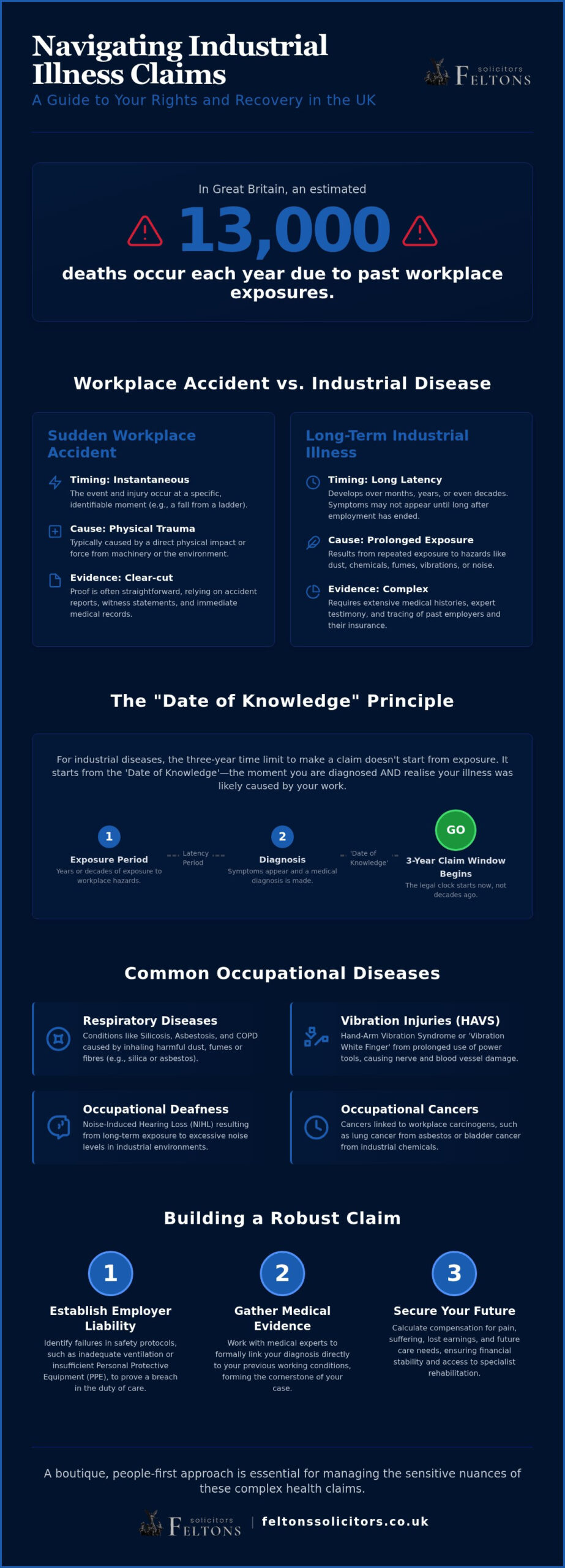
Did you know that an estimated 13,000 deaths occur every year in Great Britain due to past workplace exposures, with many conditions only surfacing decades after you’ve left the job? If you’re struggling with a diagnosis like silicosis or asbestosis, the prospect of taking on a large corporation can feel like an impossible battle whilst your health declines. Partnering with specialist workplace disease solicitors UK ensures you aren’t facing this complex journey alone. It’s natural to feel concerned about the time that has passed or the cost of care, but the law is designed to protect those who’ve been let down by employer negligence.
We understand that your priority is securing financial stability for your future and achieving a sense of justice. This comprehensive guide will show you how to navigate industrial illness claims in 2026 with confidence, focusing on a clear, stress-free path toward recovery. We’ll examine the latest 18th edition Judicial College Guidelines, the critical “date of knowledge” principle for long-latency diseases, and how expert legal guidance provides the boutique level of care you need to rebuild your life.
Key Takeaways
- Understand the legal distinction between sudden workplace accidents and long-term industrial illnesses to help identify the true nature of your condition.
- Learn how to establish employer liability by identifying failures in safety protocols or insufficient protective equipment, regardless of how long ago the exposure occurred.
- Discover how specialist workplace disease solicitors UK navigate the complexities of medical evidence and insurer tracing to build a robust case for your recovery.
- Recognise why a boutique, people-first approach to legal representation is essential for managing the sensitive nuances of respiratory and vibration-related health claims.
- Gain a clear understanding of the compensation process, ensuring you can secure the financial future necessary to cover ongoing care and lost earnings.
Understanding Workplace Disease and Industrial Illness in the UK
An Occupational disease is a chronic health condition that develops as a direct result of your working environment or the tasks you were required to perform. Unlike a sudden accident at work, such as a fall from a ladder or a specific injury caused by faulty machinery, an industrial disease is usually the product of long-term exposure. It’s often a “silent” process where damage accumulates over months or even decades before symptoms become noticeable. UK law recognises this unique nature of occupational exposure, providing a legal framework that holds employers accountable for failing to protect their staff from foreseeable risks.
The Health and Safety Executive (HSE) is the national regulator responsible for setting the workplace standards that keep people safe. These standards aren’t suggestions; they’re legal requirements. When an employer ignores safety protocols, they’re in breach of their duty of care. Common distinctions between accidents and diseases include:
- Timing: Accidents are instantaneous, whilst diseases have a “latency period” where the illness remains hidden.
- Cause: Accidents often involve physical trauma. Diseases usually involve biological, chemical, or ergonomic hazards like silica dust, loud noise, or repetitive vibrations.
- Evidence: Proving a disease often requires complex medical histories and expert testimony rather than just an accident report.
The “Date of Knowledge” and Statutory Time Limits
In most personal injury cases, you have three years from the date of the incident to begin legal proceedings. However, applying this rule to industrial illnesses would be unfair, as you might not know you’re ill until twenty years after you’ve retired. This is why the law uses the “date of knowledge” principle. The three-year limit only starts when you’re diagnosed with a condition and realise it was likely caused by your former employment. Specialist workplace disease solicitors UK are essential in these scenarios, as they help establish this timeline and trace former employers or their insurers, even if the company no longer exists. For fatal conditions, this three-year period may begin from the date of death, allowing families to seek the justice their loved ones deserve.
The Human Impact: Beyond Financial Compensation
A diagnosis of a life-changing illness carries a heavy psychological weight that extends far beyond physical symptoms. It’s common to feel a sense of betrayal or anxiety about the future when your health has been compromised by a job you dedicated years to. We believe that seeking legal advice should provide empathetic reassurance during this difficult time. A successful claim does more than just provide a settlement; it opens doors to private medical rehabilitation and specialist care programmes that can significantly improve your quality of life. By focusing on a “people-first” approach, the legal process becomes a tool for recovery, ensuring you have the support needed to manage both the physical and emotional toll of your diagnosis.
Common Occupational Diseases: From Respiratory Conditions to Silicosis
Occupational diseases cover a vast spectrum of conditions, ranging from debilitating skin irritations to terminal lung cancers. Whilst some conditions like occupational dermatitis or asthma might appear soon after exposure, others take decades to manifest. Conditions such as COPD and welder’s lung often stem from years of inhaling fumes or dust in poorly ventilated environments. Beyond respiratory issues, many workers suffer from Hand-Arm Vibration Syndrome (HAVS) or Vibration White Finger due to the prolonged use of power tools. These injuries can make everyday tasks like fastening buttons or holding a kettle incredibly painful. You might also be eligible for the Industrial Injuries Disablement Benefit if your condition has led to a loss of faculty.
The Growing Threat of Silicosis in the UK
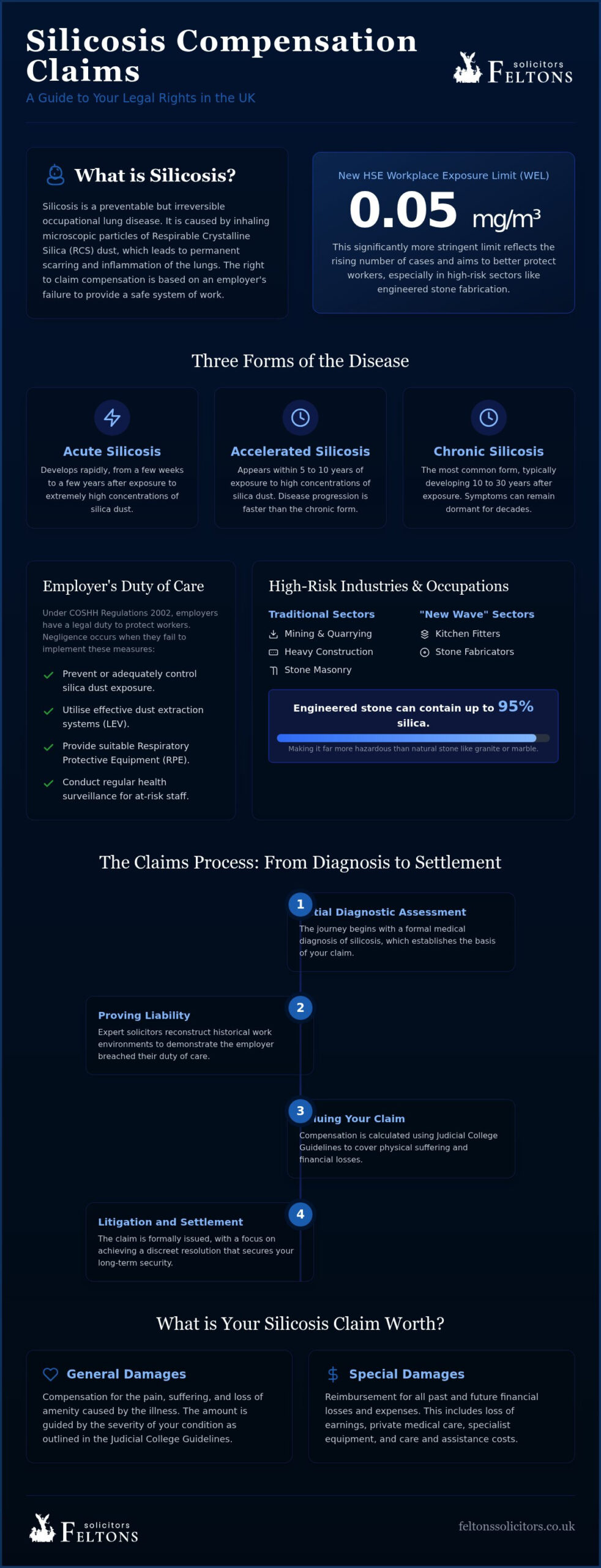
Silicosis has emerged as a significant modern threat, particularly within the construction and stone-working sectors. It’s a preventable but incurable lung disease caused by the inhalation of respirable crystalline silica (RCS) dust. High-risk industries include stone masonry, construction, and the manufacturing of engineered stone kitchen worktops. Silicosis is a latent industrial disease that requires specialist forensic legal evidence. If you’re seeking justice following a bereavement, understanding a silicosis claim after death is a vital step for your family’s future.
Asbestos-Related Diseases and Mesothelioma
Asbestos-related diseases continue to represent a substantial portion of industrial illness litigation in the UK. The legacy of asbestos in shipbuilding, construction, and manufacturing means that many people are only now receiving diagnoses. It’s important to differentiate between conditions like pleural thickening, asbestosis, and the terminal cancer mesothelioma. Mesothelioma is particularly aggressive, affecting the lining of the lungs or abdomen. Because of the long latency periods discussed in our previous section, these claims remain a priority for workplace disease solicitors uk. We focus on tracing the insurers of defunct companies to ensure you receive the compensation you deserve.
Occupational cancers can also arise from exposure to hazardous chemicals, mineral oils, or radiation in various industrial processes. Similarly, skin conditions like contact dermatitis affect thousands of workers who handle irritants without adequate protection or correct PPE. If you’re concerned about your health, our team can provide the specialist silicosis and personal injury advice you need to understand your legal options. We prioritise your well-being throughout the entire process.
Establishing Liability: The Legal Requirements for a Successful Claim
Securing compensation for an industrial illness isn’t simply a matter of presenting a medical diagnosis. To succeed, you must demonstrate that your employer failed in their legal obligations. In the UK, every employer holds a “duty of care” toward their staff, meaning they’re legally required to provide a safe working environment. This includes conducting thorough risk assessments, providing effective personal protective equipment (PPE), and ensuring adequate ventilation or noise control. When these standards aren’t met, a breach of duty occurs. Professional workplace disease solicitors uk focus on identifying exactly where these safety protocols failed, transforming a complex health crisis into a clear legal argument for negligence.
Proving causation is often the most challenging aspect of these claims. You must show that your condition was directly caused by your work environment rather than outside factors. For conditions like Asbestosis or silicosis, this requires more than just a GP’s note. We work closely with forensic industrial hygienists and specialist medical witnesses who can pinpoint the source of exposure. These experts provide the technical authority needed to link your current health struggles to historic workplace failings, ensuring your case is built on a foundation of scientific fact.
Claiming Against Dissolved or Former Employers
A common misconception is that you can’t make a claim if your former employer has ceased trading or gone into liquidation. This isn’t the case. In the UK, it’s the insurance company that provided cover at the time of your exposure that’s liable for the payout, not the company itself. We utilise the Employers’ Liability Tracing Office (ELTO) and other specialist databases to identify these historic insurers. Even if a firm closed decades ago, we can often find the relevant policy to ensure you aren’t left without financial support. You don’t need the company to still be active to achieve a successful outcome.
The Role of Evidence in Complex Litigation
Building a robust case relies on a methodical collection of evidence. Whilst your memory of the workplace is a vital starting point, we look for tangible proof to support your statement. This includes gathering historic Health and Safety logs, employment records, and even witness statements from former colleagues who worked alongside you. Colleagues often remember the specific conditions, such as a lack of dust extraction or a failure to provide safety training. At Feltons, we use pragmatic investigative techniques to piece together these details, providing a steady and reliable presence throughout the litigation process. We prioritise personal connection, ensuring you’re informed at every stage of the investigation.
Navigating the Industrial Disease Compensation Process
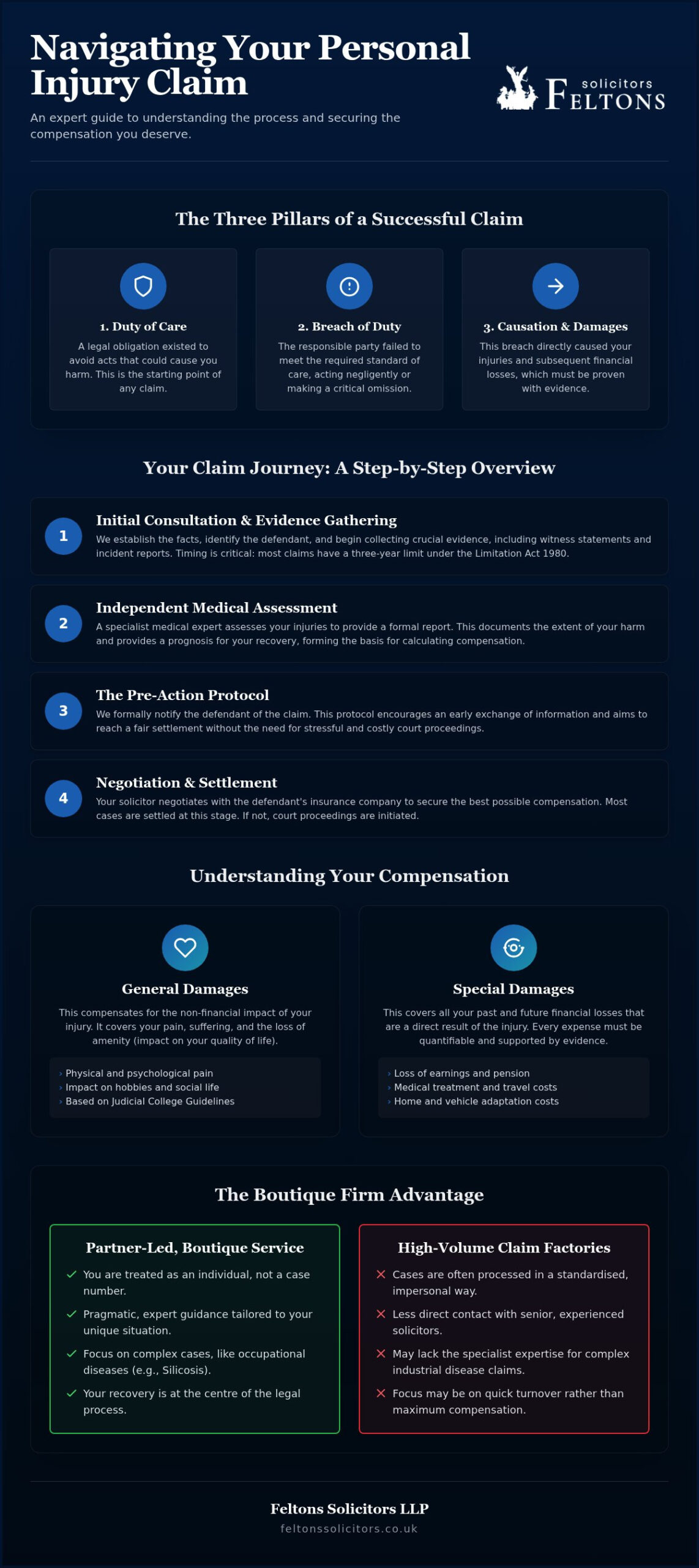
The journey toward financial recovery begins with a detailed initial consultation. This is where we assess the merits of your case, looking closely at your employment history and the nature of your diagnosis. Once we establish a viable path, we arrange for independent medical specialists to evaluate your condition. These assessments are vital; they provide the objective evidence required to value your claim accurately. After the medical phase, we issue a formal Letter of Claim to your former employer or their insurer, outlining the negligence and the impact on your life.
Expert workplace disease solicitors uk don’t just process paperwork; they act as your sophisticated guide through the subsequent negotiations. Most claims reach a settlement during this phase, as insurers often prefer to avoid the costs and uncertainty of a trial. Our role is to ensure the final figure reflects the true extent of your losses, providing you with a sense of security and justice. We prioritize your peace of mind, ensuring the process is as transparent and stress-free as possible.
Calculating Your Compensation: What is Your Claim Worth?
Determining the value of an industrial disease claim involves two distinct categories of damages. General damages compensate you for pain, suffering, and loss of amenity (PSLA). We use the 18th edition of the Judicial College Guidelines, published in April 2026, which included an 8.26% uplift to account for inflation. Special damages cover your tangible financial losses, such as lost earnings and travel expenses for treatment. For many of our clients, the most significant element is the calculation of future care needs. If your illness requires ongoing medical support or home adaptations, these costs are integrated into the settlement to protect your long-term well-being.
Will My Case Go to Court?
The vast majority of workplace disease claims settle out of court, often through professional dispute resolution. Whilst the prospect of a trial can be daunting, it’s rarely a reality for the clients we represent. Our pragmatic approach focuses on building such a robust evidentiary base that the insurer’s liability becomes difficult to contest. If you’re ready to explore your options, you can speak with our specialist solicitors to begin your assessment. We handle the complex litigation whilst maintaining a calm, steady presence, allowing you to focus entirely on your health and recovery.
Why Choose Specialist Workplace Disease Solicitors?
Selecting the right workplace disease solicitors uk is a decision that profoundly impacts your health, your family, and your long-term financial security. Many large legal practices operate as “claims factories”, where cases are processed in high volumes with little room for personal rapport or individual attention. We believe that sensitive health-related claims require a boutique approach. This ensures that every nuance of your medical history and workplace exposure is examined with sound judgment and care. Specialist expertise in niches like silicosis sets a firm apart, as these cases demand a level of forensic detail that generic personal injury firms often overlook. Our goal is to provide a discreet, high-standard service that values your privacy as much as your recovery.
A people-first philosophy is at the heart of everything we do. We understand that behind every claim is a person dealing with a life-altering diagnosis and the anxiety that follows. By prioritising personal connection over high-volume processing, we can offer the empathetic reassurance you need during a stressful time. This tailored experience allows us to build a robust case that reflects the true human impact of employer negligence, ensuring you aren’t just another case number in a database.
The Feltons Difference: Professionalism with Empathy
Feltons Solicitors LLP was established in 2010 with a focus on traditional professional values and quiet confidence. We provide pragmatic advice that cuts through complex legal jargon, offering a clear and logical path forward for our clients. By bridging the gap between established heritage and modern efficiency, we ensure your claim is handled with both the care of a trusted advisor and the precision of a contemporary practice. Securing a settlement is often just the beginning of your financial recovery journey. To protect your legacy and ensure your compensation supports your family for years to come, we suggest exploring Estate Planning as part of your long-term asset protection strategy.
National Reach with a Boutique Feel
We represent clients across the UK, providing a national reach whilst maintaining the intimate, supportive feel of a boutique firm. Our centres of expertise are designed to support you regardless of your location, ensuring you have access to high-end reliability and worldly experience. Throughout the litigation process, we act as your sophisticated guide, handling the pressure of disputes against large corporations so you don’t have to. We prioritise personal connection, ensuring you always understand the status of your claim and the next steps in your recovery. To take the first step toward the justice you deserve, Speak to our specialist solicitors today for a consultation tailored to your specific health and financial needs.
Securing Your Future with Expert Legal Guidance
Navigating the path to recovery after a life-changing diagnosis is a complex journey, but you don’t have to walk it alone. As we’ve explored, achieving a successful outcome relies on a forensic understanding of employer liability and the ability to trace historic insurance policies, even decades after your exposure. By choosing specialist workplace disease solicitors uk, you gain more than just legal representation; you secure a sophisticated guide dedicated to your long-term financial security and well-being. Our focus remains on providing a calm, steady presence that respects the human impact of your illness.
Since 2010, Feltons Solicitors LLP has provided pragmatic, expert advice to those affected by complex conditions like silicosis and respiratory diseases. We prioritise a boutique level of care, ensuring your personal rapport with your solicitor is never sacrificed for high-volume processing. If you’re ready to seek justice for employer negligence and secure the compensation you deserve, we’re here to help. We invite you to contact Feltons Solicitors for a discreet consultation on your workplace disease claim. Reclaiming your peace of mind is a vital step toward a more stable future, and we’re committed to supporting you every step of the way.
Frequently Asked Questions
Can I claim for a workplace disease if I am a former employee?
Yes, you can certainly make a claim as a former employee. Industrial diseases often have long latency periods, meaning symptoms might not appear until decades after you’ve left the workplace. The law recognises that your health was compromised during your tenure, and your right to seek compensation remains valid regardless of your current employment status. We focus on tracing the specific period of exposure to hold the relevant employer accountable for their past negligence.
How long do I have to start a workplace disease claim in the UK?
You generally have three years to initiate a claim, but this limit begins from your “date of knowledge” rather than the date of exposure. This is the point at which you were diagnosed and realised your condition was linked to your previous employment. For cases involving a deceased family member, the three-year period starts from the date of death or the date of post-mortem results. It’s advisable to seek legal advice as soon as a diagnosis is confirmed.
What if my former employer no longer exists or has gone bust?
You can still pursue a successful claim even if your former employer is no longer trading. In the UK, compensation is paid by the insurance company that provided Employers’ Liability cover at the time of your exposure. Our team utilises specialist databases and the Employers’ Liability Tracing Office to identify the correct insurer from years ago. This ensures that the closure of a company doesn’t prevent you from accessing the financial support and justice you deserve.
How much does it cost to hire workplace disease solicitors?
Most workplace disease solicitors uk operate on a “No Win, No Fee” basis, formally known as a Conditional Fee Agreement. This arrangement means you don’t pay upfront legal fees, and you only pay a success fee if your claim is successful. Under the Conditional Fee Agreements Order 2013, the success fee is capped at 25% of your damages for pain and suffering. This approach ensures that expert legal representation remains accessible to everyone, regardless of their financial situation.
Will I have to go to court for an industrial disease claim?
It is highly unlikely that you’ll need to attend court in person. Most industrial disease claims handled by workplace disease solicitors uk are settled through negotiation or alternative dispute resolution before a trial date is even set. Our role as your sophisticated guide is to build a case so robust that the insurer chooses to settle out of court. If a hearing is necessary, we provide steady, professional support to ensure you feel prepared and confident.
What is the “Date of Knowledge” in occupational illness cases?
The “Date of Knowledge” is the specific point in time when you first became aware that you were suffering from a significant illness caused by your work. For diseases with long latency periods, like asbestosis, this date is critical because it triggers the three-year statutory time limit for making a claim. It requires a clear link between your medical diagnosis and the specific hazardous environment or substances you encountered during your previous employment history.
Can I claim for a family member who has passed away from a workplace disease?
Yes, the law allows executors or dependants to bring a claim on behalf of a loved one who has passed away. You can seek compensation for the pain and suffering the individual endured, as well as for financial losses such as funeral expenses and loss of financial dependency. We handle these sensitive matters with a boutique level of care and empathy, ensuring that bereaved families can achieve justice and financial security during an incredibly difficult time.
What industries are most at risk for silicosis and lung disease?
High-risk industries include construction, stone masonry, and the manufacturing of engineered stone kitchen worktops. Workers in mining, pottery, and foundries are also frequently exposed to respirable crystalline silica (RCS) dust. Employers in these sectors must implement strict safety measures, such as on-tool extraction and high-quality respiratory protective equipment. If these standards weren’t met during your career, resulting in a lung disease diagnosis, you may have grounds for a robust legal claim against your former employer.