
Statutory Lease Extension Process: 2026 Guide

Statutory Lease Extension Process: 2026 Guide

The fear of your lease dropping below eighty years and triggering eye-watering marriage value costs is finally a thing of the past. You’ve likely felt the weight of uncertainty as you watched the clock tick down on your property rights, perhaps worried that your landlord might refuse an extension or demand an extortionate premium. It’s an exhausting position to be in, especially whilst trying to keep pace with the implementation of the Leasehold and Freehold Reform Act 2024. This guide provides a definitive roadmap through the statutory lease extension process, ensuring you secure a 990-year term whilst avoiding the costly procedural errors that can derail an application.

By understanding your rights under the latest legislation, you can approach this transition with quiet confidence. We’ll explore how recent reforms have abolished the two-year ownership requirement and removed marriage value altogether. This methodical overview will show you how to navigate Section 42 notices and valuation caps, ensuring you remain in control of your property’s future without the stress of traditional legal hurdles.

Key Takeaways

  • Distinguish between informal negotiations and your formal legal right to a peppercorn ground rent under the latest reforms.
  • Navigate updated eligibility criteria, including the removal of the previous two-year ownership requirement for new leaseholders.
  • Master the technical stages of the statutory lease extension process, from serving a Section 42 notice to fixing your valuation date.
  • Capitalise on the abolition of marriage value and the introduction of the standard 990-year extension to reduce your overall costs.
  • Discover how to protect your property rights in complex scenarios, such as missing landlords or disputed counter-notices.

Understanding the Statutory Lease Extension Process vs Informal Routes

Choosing between a formal legal claim and an informal negotiation is the first critical decision any leaseholder must make. While a direct conversation with your landlord might seem like a shortcut to a quicker result, it often lacks the robust safeguards provided by the law. The statutory lease extension process is the formal legal procedure established by the Leasehold Reform, Housing and Urban Development Act 1993. It’s a powerful tool. It essentially forces a landlord to grant an extension, provided you meet the qualifying criteria, ensuring you aren’t left at the mercy of their discretion.

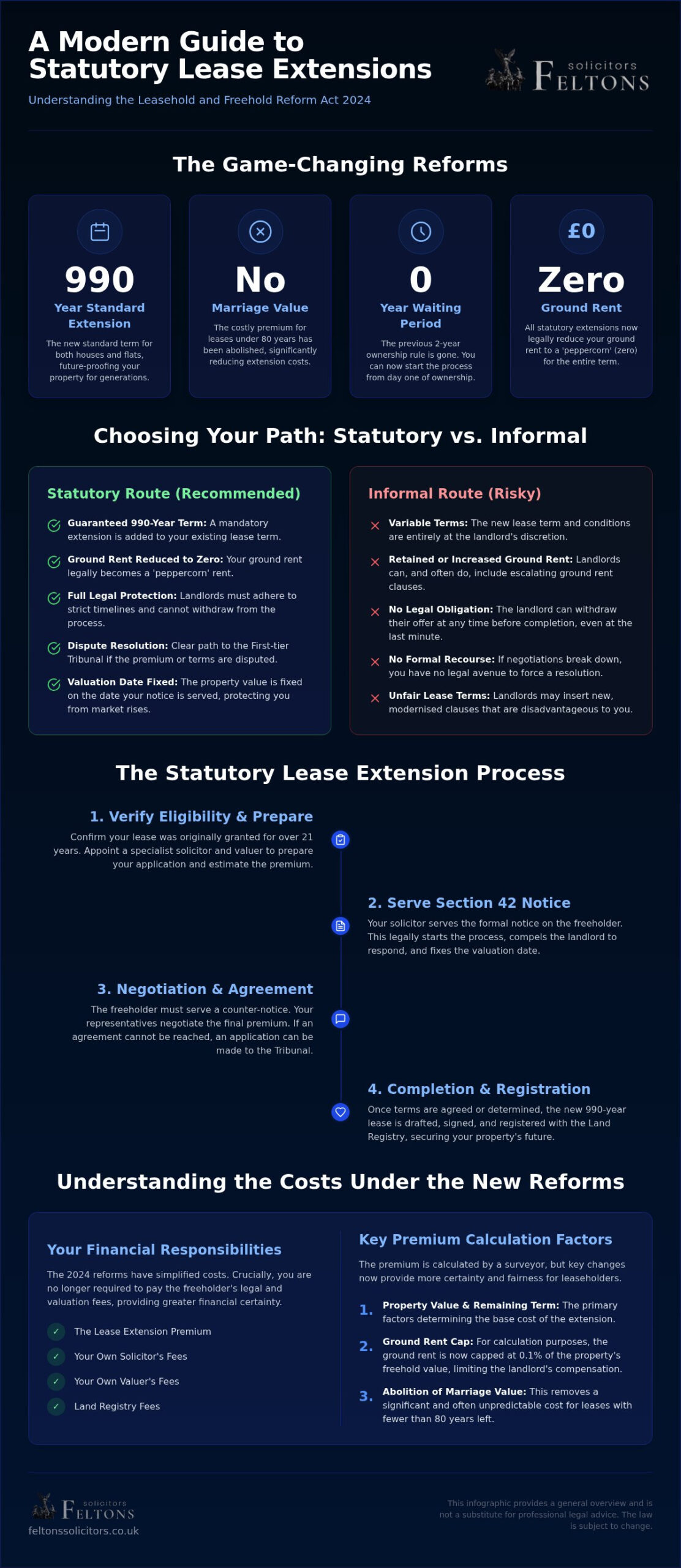
A Leasehold estate is, at its heart, a depleting asset. As the years on your lease diminish, the marketability and value of your home can suffer. Relying on an informal agreement to rectify this is risky; landlords are under no obligation to finish what they start and can withdraw their offer at any moment, even at the eleventh hour. By contrast, the statutory route provides a mandatory 990-year addition to your current term for both flats and houses. This effectively makes the lease future-proof for generations and removes the stress of having to extend again in your lifetime.

The Legal Framework: The 1993 Act and Beyond

The 1993 Act serves as the bedrock of your rights. It was designed to rebalance the power dynamic between leaseholders and freeholders, giving you the legal muscle to compel a lease extension. This statutory protection is vital. It ensures that your right to stay in your home is protected by a structured framework that survives even if the freehold is sold to a new owner. While the Leasehold and Freehold Reform Act 2024 has significantly updated these rights, the core principle remains the same: the law is your shield against landlord refusal.

Why the Statutory Route Offers Superior Tenant Protection

One of the most significant advantages of the formal process is the absolute guarantee of a peppercorn ground rent. Under the statutory lease extension process, your ground rent is legally reduced to zero for the entirety of the new term. Informal deals often include ground rent clauses that double every few years, which can make a property difficult to sell or remortgage later. The formal route provides a level of certainty that informal routes simply cannot match. You benefit from:

  • Strict legal timelines that prevent landlords from delaying the process.
  • A clear path to the First-tier Tribunal to resolve disputes over the premium or lease terms.
  • Protection against the inclusion of unfair or modernised clauses that benefit the landlord.
  • The ability to fix the valuation date at the moment you serve your notice, protecting you from market rises.

This methodical approach ensures you aren’t just getting more time on your lease. You are securing a cleaner, more valuable title that meets modern lending requirements and provides long-term peace of mind.

Eligibility Criteria and Essential Preparations for Leaseholders

Until recently, the most significant hurdle for many was the “two-year rule.” This required leaseholders to be registered owners for at least 24 months before they could initiate a claim. As of 31 January 2025, this barrier has been abolished. You can now begin the statutory lease extension process the day you complete your property purchase. This change has transformed the market, allowing buyers to secure their long-term interests without a stressful waiting period.

Most residential leaseholders will qualify as a “tenant” if their lease was originally granted for a term of more than 21 years. This is standard for the vast majority of flats in England and Wales. There are, however, specific exclusions to keep in mind. Business tenancies, certain shared ownership leases where the staircasing isn’t 100 per cent, and some properties owned by charitable trusts may not qualify for the statutory route. Verifying your eligibility early is essential to avoid unnecessary complications.

Preparing your finances is the next logical step. While the 2024 reforms have made extensions more affordable by removing the requirement to pay the freeholder’s legal and valuation costs, you must still budget for the premium itself and your own professional representation. For those just beginning to look at lease extension: getting started, it’s helpful to remember that the ground rent used for the calculation is now capped at 0.1 per cent of the property’s value. This cap provides much-needed certainty for your financial planning.

The Importance of an Accurate Leasehold Valuation

You must appoint a specialist valuer before serving your formal notice. Their role is to calculate the premium using the new standardised rates set by the government. In previous years, the dreaded “marriage value” added thousands to the cost for leases with less than 80 years remaining. This has been abolished, significantly reducing the premium for many. Your surveyor will focus on the “diminution” in the value of the landlord’s interest, providing a robust figure that forms the basis of your Section 42 offer.

Organising Your Professional Team

The relationship between your solicitor and valuer is symbiotic. A valuer provides the figures, but your solicitor ensures the legal paperwork is watertight. Generalist conveyancers often struggle with the technical nuances of the 1993 Act, which can lead to missed deadlines or invalid notices. Feltons Solicitors LLP offers a boutique, personalised service that manages these complexities on a national scale. If you’re ready to protect your investment, consulting with the specialist leasehold team at Feltons Solicitors LLP ensures you have a steady, expert hand guiding your application from start to finish. Our approach combines traditional professional integrity with modern efficiency, ensuring your property rights are secured without the anxiety of procedural errors.

A Step-by-Step Guide to the Section 42 Notice Procedure

Once you’ve prepared your valuation and legal strategy, the actual statutory lease extension process begins with the service of a Section 42 Initial Notice. This isn’t merely a request. It’s a formal legal trigger that compels your landlord to respond. One of the most significant benefits of this step is that it fixes the valuation date. From the moment the notice is served, the price you pay is protected against any future rises in the property market. This provides a vital layer of financial security whilst negotiations proceed.

Landlords are entitled to request evidence of your title or to inspect the property to verify its condition. While this is a standard part of the procedure, a difficult landlord might use these requests to delay progress. Having a professional team ensures these requests are handled promptly and accurately, leaving the freeholder with no grounds for procrastination. For those unfamiliar with these initial requirements, this Leasehold Advisory Service guide to getting started offers an excellent baseline for what to expect during these early exchanges.

Serving the Tenant’s Initial Notice (Section 42)

Precision is paramount when drafting your Section 42 notice. It must contain the proposed premium, any suggested modifications to the lease terms, and the names of all relevant parties. If the notice is deemed “invalid” due to a technical error, you may be barred from reapplying for six months. It’s also critical to identify any intermediate landlords who hold an interest between you and the competent landlord. Missing a party can stall the entire claim. A well-prepared notice signals to the landlord that you’re well-advised and prepared to see the matter through to its conclusion.

Managing the Landlord’s Counter-Notice and Timelines

The landlord has exactly two months from the date of service to provide their Section 45 Counter-Notice. This document will either admit your right to the extension or dispute it. More commonly, they’ll admit the right but propose a significantly higher premium. If the landlord fails to respond within this strict window, you gain a powerful advantage. You can apply to the County Court for a “Vesting Order,” which allows you to secure the extension on the terms proposed in your initial notice. This is why strict adherence to the calendar is your best defence against a recalcitrant freeholder. Managing these timelines with a methodical approach ensures you never lose your procedural momentum.
Statutory Lease Extension Process: 2026 Guide

Calculating Costs, Premiums, and the Impact of Marriage Value

Financial clarity is the cornerstone of a successful claim. For decades, the “80-year threshold” was the most significant date in a leaseholder’s calendar. Dropping even a single day below this mark traditionally triggered marriage value, an additional cost representing fifty per cent of the “profit” created by the extension. This often added tens of thousands of pounds to the premium. However, as we navigate the statutory lease extension process in 2026, the landscape has shifted fundamentally in favour of the leaseholder. The abolition of marriage value has removed one of the most punitive elements of property law, making extensions significantly more affordable for those with shorter terms.

While the premium is the largest outgoing, you must also consider Stamp Duty Land Tax (SDLT). For the majority of residential extensions, the premium falls below the threshold, but for high-value properties in prime locations, SDLT may still apply. It’s calculated on the premium paid for the new lease, and your solicitor will manage the return as part of the completion process. Precision in these calculations ensures there are no hidden surprises when the final figures are settled.

How the Leasehold and Freehold Reform Act 2024 Changes the Landscape

The 2024 Act has formalised the move towards 990-year statutory terms, replacing the old 90-year addition. This provides near-permanent security for your investment. The government has also introduced prescribed rates for the valuation calculation to reduce disputes. By capping the ground rent at 0.1 per cent of the property’s value for the purpose of the premium calculation, the law has brought a high degree of certainty to what was once a highly litigious area. These standardised rates mean that your valuer can provide a much narrower and more reliable estimate of the eventual cost.

Budgeting for Your Extension: Beyond the Premium

Your budget must account for professional fees and the procedural requirements of the 1993 Act. When you serve your Section 42 notice, you are typically required to pay a deposit of ten per cent of your proposed premium to the landlord’s solicitor. This is held as security and is deducted from the final balance. While the 2024 reforms have largely removed the requirement for leaseholders to pay the freeholder’s legal and valuation costs, some limited exceptions remain for specific, fixed amounts. You can find more detail on managing these financial nuances in our guide for Leasehold Enfranchisement Experts, which offers practical cost-saving tips for the modern leaseholder.

Appointing a specialist team is the most effective way to ensure your offer is realistic and legally sound. If you are concerned about overcharging or wish to verify your potential costs, contact Feltons Solicitors LLP for a professional consultation. We provide the steady, expert hand needed to navigate these complex financial waters, ensuring you secure your property rights whilst protecting your capital. Our boutique approach means we prioritise your personal financial outcome, treating every case with the discreet care it deserves.

Even with the legal protections of the statutory lease extension process, technical hurdles can still arise. A common complication occurs when a freeholder cannot be located or simply refuses to engage. In these instances, Feltons Solicitors LLP guides you through the “Vesting Order” process in the County Court. This allows a judge to sign the new lease on the landlord’s behalf, ensuring your extension isn’t derailed by an absent freeholder. It’s a methodical legal solution that provides a clear path to your 990-year term regardless of the landlord’s status.

Negotiation is where the value of a coordinated professional team becomes most apparent. After the Counter-Notice arrives, your solicitor and valuer work in tandem to close the gap between the valuations. Most cases are settled during this period through pragmatic, evidence-based discussion. If an agreement remains elusive after two months of negotiations, we can apply to the First-tier Tribunal (Property Chamber) for a final determination. This stage acts as a vital safety net, ensuring the premium you pay remains fair and aligned with the latest standardised rates.

The final stage involves the formal completion of the new lease and its registration at HM Land Registry. We meticulously check the final document to ensure it reflects the zero ground rent requirement and the agreed term. This registration is the definitive legal record of your extended term, providing the security future buyers and mortgage lenders require to verify your title.

Common Pitfalls in the Statutory Process and How to Avoid Them

Missing the “deemed withdrawal” deadline is a catastrophic and expensive error. If you don’t apply to the Tribunal within six months of receiving the Counter-Notice, your claim is legally cancelled. This results in significant wasted costs and a mandatory waiting period before you can start again. Identifying the “Competent Landlord” is also essential in buildings with complex head-lease structures. Serving the wrong party can render your entire notice void. The methodical approach at Feltons Solicitors LLP ensures every statutory deadline is met with absolute precision.

Why Expert Legal Representation is Essential

A sophisticated guide is vital when dealing with high-stakes property negotiations. Landlords often attempt to slip “hidden” modernisations into the new lease that favour their interests, such as new service charge triggers or restrictive covenants. We scrutinise every clause to ensure your new lease remains clean and marketable. Contact Feltons Solicitors LLP today to begin your statutory lease extension with confidence. We provide the boutique care and professional integrity required to handle complex property matters, ensuring your home remains a secure asset for the future.

Protecting Your Investment with Clarity and Confidence

The landscape for leaseholders has changed fundamentally. With the abolition of marriage value and the introduction of 990-year statutory terms, you now have a historic opportunity to secure your property’s value on much fairer terms. This guide has outlined how to navigate the technicalities of Section 42 notices whilst avoiding the procedural traps that can stall an application. You’re no longer at the mercy of landlord discretion; the law is firmly on your side.

Successfully managing the statutory lease extension process depends on a blend of meticulous legal drafting and pragmatic negotiation. Our team at Feltons Solicitors provides the boutique expertise and plain-English advice needed to handle even the most complex property litigation. We ensure that every deadline is met and every clause is scrutinised to protect your long-term interests. We maintain an established reputation for precision, ensuring your transition to a peppercorn ground rent is seamless and secure.

Don’t leave your property’s future to chance. Secure your property’s future with a statutory lease extension from Feltons Solicitors and enjoy the peace of mind that comes with expert representation. You’re in capable hands.

Frequently Asked Questions

How long does the statutory lease extension process typically take?

The statutory lease extension process typically takes between six and twelve months from the service of the Initial Notice to final registration at HM Land Registry. This timeline varies based on how quickly your landlord serves their Counter-Notice and the duration of subsequent negotiations. If an agreement cannot be reached and an application to the First-tier Tribunal becomes necessary, the timeframe may extend further.

Can I still extend my lease if my landlord is missing or unresponsive?

You can absolutely proceed if your landlord is missing or unresponsive by applying for a Vesting Order. This involves a County Court application where a judge essentially stands in for the landlord to sign the new lease. It’s a methodical legal solution that ensures your property rights aren’t held hostage by an absent freeholder or a dissolved company.

What happens to the statutory process if I decide to sell my flat midway through?

If you sell your flat midway through, you can assign the benefit of the Section 42 notice to the incoming purchaser. This is a standard procedure during conveyancing that allows the buyer to step into your shoes and complete the extension. It ensures the work you’ve started adds immediate value to the sale and provides security for the new owner from day one.

Is it possible to extend a lease for a house using the statutory route?

It is certainly possible to extend the lease of a house using the statutory route. Under the Leasehold and Freehold Reform Act 2024, house owners now have the same right to a 990-year extension as flat owners. This represents a significant shift from older legislation, providing house leaseholders with much-needed parity and the same long-term security as those owning flats.

What is the ’80-year rule’ and why is it so critical for leaseholders?

The “80-year rule” was the critical point where marriage value was triggered, significantly increasing the premium payable to the landlord. While the 2024 Act has abolished marriage value in 2026, the 80-year mark remains important for marketability. Many mortgage lenders still view leases approaching this threshold with caution, making an extension vital for maintaining your property’s liquidity and value.

Can a landlord refuse a statutory lease extension request?

A landlord cannot refuse a valid statutory request if you meet the qualifying criteria. The law grants you a mandatory right to extend, and the freeholder’s role is primarily to negotiate the premium and specific terms. Refusal is only permitted in extremely rare circumstances, such as if the landlord intends to redevelop the building within five years of the lease ending.

What are the risks of choosing an informal lease extension over the statutory route?

Choosing an informal route carries the risk of “ground rent traps” and a total lack of procedural security. Landlords can withdraw from informal negotiations at any moment, even after you’ve spent money on valuations. Informal deals often retain or increase ground rent; by contrast, the statutory lease extension process legally guarantees a peppercorn rent for the entire term.

How has the Leasehold and Freehold Reform Act 2024 affected the cost of extensions in 2026?

The 2024 Act has generally reduced the cost of extensions by abolishing marriage value and capping ground rent for valuation purposes. By removing the requirement for leaseholders to pay the landlord’s legal and valuation fees in most cases, the overall financial burden has lightened. These reforms make securing a 990-year term more accessible and affordable for millions of leaseholders across the country.

Contested Probate Lawyers UK: A Guide to Resolving Estate Disputes 2026

Contested Probate Lawyers UK: A Guide to Resolving Estate Disputes 2026

Could the financial and emotional cost of challenging a will eventually eclipse the value of the estate itself? It is a question that haunts many families facing inheritance disputes, especially as the probate application fee in England and Wales rose to £526 in July 2026. When you’re already dealing with the weight of grief, the added pressure of legal uncertainty can feel overwhelming. Finding the right contested probate lawyers uk is about more than just legal representation. It is about securing a steady, expert hand to guide you through a sensitive period with clarity and poise.

We understand that your primary goal is a fair resolution that respects the deceased’s wishes whilst protecting your own interests. This guide provides the pragmatic legal advice you need to navigate complex claims, from questioning testamentary capacity to addressing the removal of a problematic executor. You’ll discover how specialist mediation and a people-first approach can resolve even the most fractious disputes without the necessity of a high-cost court trial. We will explore the essential steps to take, the strict six-month time limits for certain claims, and how to achieve a distribution of assets that is both just and final.

Key Takeaways

  • Understand the critical distinction between challenging the validity of a Will and disputing the administration of an estate to determine the correct legal path.
  • Learn how “Lack of Testamentary Capacity” is assessed using the Banks v Goodfellow test to evaluate the strength of your potential claim.
  • Discover how to use a Caveat to pause the probate process, allowing specialist contested probate lawyers uk to investigate concerns before assets are distributed.
  • Identify the specific legal duties of executors and the available remedies for resolving disagreements or removing a problematic administrator from their role.
  • Explore pragmatic dispute resolution methods, such as mediation, that aim to protect the estate’s value and avoid the emotional strain of a full court trial.

Understanding Contested Probate in the UK

Contentious probate is a broad term describing legal disagreements regarding a deceased person’s estate. These disputes are inherently sensitive; they often occur at a time when emotions are high and family dynamics are already strained. Understanding Contested Probate in the UK requires a clear view of the legal frameworks that govern how assets are distributed and how a person’s final wishes are honoured. When these processes falter, seeking guidance from specialist contested probate lawyers uk becomes essential to ensure the estate is protected from depletion or mismanagement.

Triggers for these disputes vary significantly amongst different families. They might involve a sudden, unexpected change to a Will shortly before death, or perhaps an executor who fails to communicate with beneficiaries. Regardless of the specific cause, the primary objective remains the same: a fair and lawful resolution that reflects the true intentions of the deceased whilst preserving the value of the inheritance for those entitled to it.

Contesting a Will vs. Contested Probate

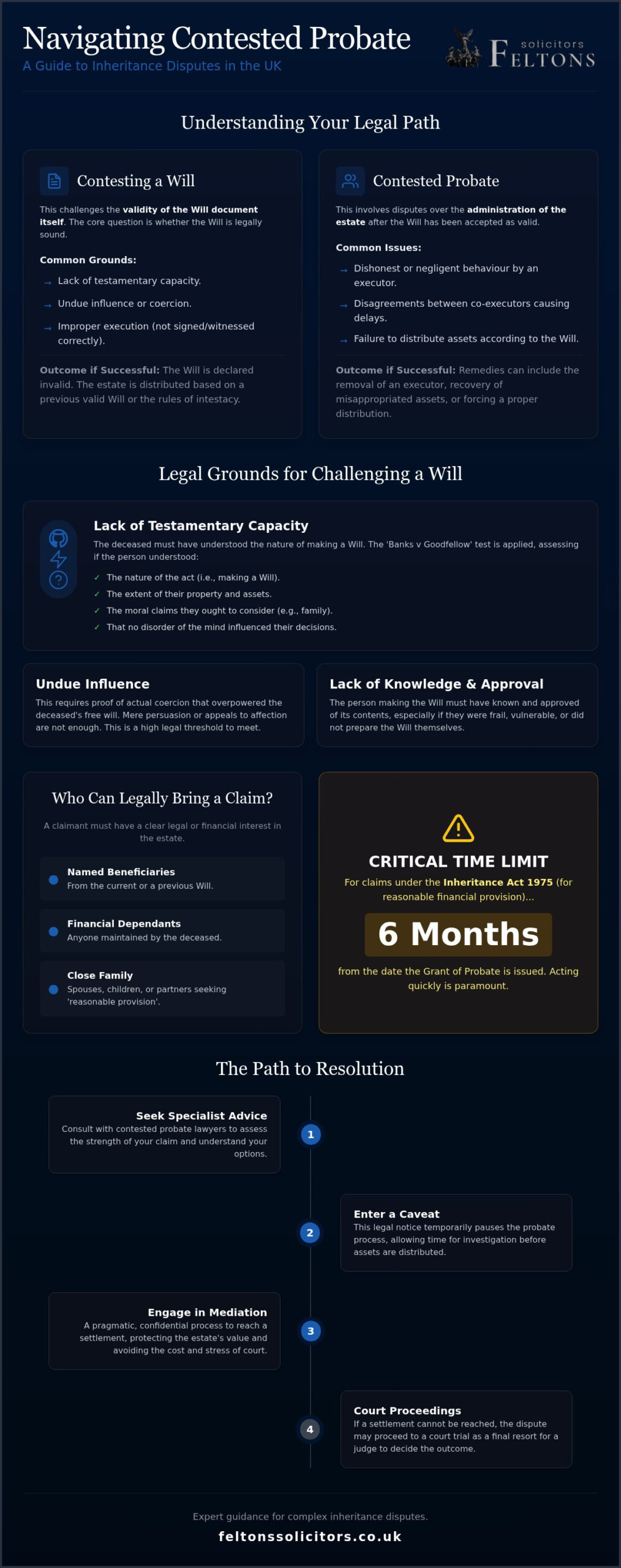
It is a common misconception that contesting a Will and contesting probate are identical. They are distinct legal challenges that require different strategies. Contesting a Will focuses specifically on the validity of the document itself. Grounds for this might include a lack of testamentary capacity, improper execution, or undue influence. If a Will is found invalid, the estate is usually distributed according to a previous, valid Will or the rules of intestacy.

In contrast, contested probate involves disputes that arise during the administration process. This typically happens after the Grant of Probate has been issued. You might find yourself in this position if an executor is behaving dishonestly, or if there is a disagreement amongst co-executors that brings the entire process to a standstill. Understanding this distinction is vital; it dictates whether you are challenging the “what” (the document) or the “how” (the administration).

Who Can Legally Bring a Claim?

The law is specific about who has the standing to bring a claim against an estate. It is not open to anyone. There must be a clear legal or financial interest involved. Generally, the following parties may have grounds to act:

  • Named Beneficiaries: Individuals mentioned in the current Will or a previous version who stand to lose out due to recent changes or administration errors.
  • Financial Dependants: Those who were being maintained, either wholly or partly, by the deceased immediately before their death.
  • Close Family: Spouses, civil partners, or children who feel the Will fails to make “reasonable financial provision” for them under the Inheritance Act 1975.

Acting quickly is paramount. Whilst some claims have no statutory time limit, others, such as those brought under the Inheritance Act, must be issued within six months of the Grant of Probate. Professional contested probate lawyers uk can help you identify your standing and the relevant deadlines before the estate’s assets are distributed beyond reach.

English law prioritises testamentary freedom, the principle that an individual should be free to leave their assets to whomever they choose. However, this freedom is not absolute. To successfully challenge a Will, a claimant must meet a high legal threshold that goes beyond simple disappointment or a sense of unfairness. The Legal Grounds for Challenging a Will or Estate are specific and require robust evidence to overturn a document that appears, on its face, to be validly executed.

Lack of testamentary capacity is one of the most frequent grounds for dispute. Courts apply the gold-standard Banks v Goodfellow test to determine if the deceased understood the nature of the act, the extent of their property, and the moral claims they were expected to consider. It isn’t enough to show that the deceased suffered from general frailty or a degree of confusion. The incapacity must have directly affected the specific provisions of the Will at the time it was drafted or signed.

Proving undue influence is significantly more challenging. It requires evidence of actual coercion, showing that the deceased’s “free will” was effectively overborne by another party. Mere persuasion, or what the courts call “appeals to affection,” is usually insufficient to invalidate a Will. This is where the discreet expertise of contested probate lawyers uk becomes invaluable. We help families piece together the subtle, circumstantial evidence required to demonstrate that a document does not reflect the testator’s true wishes.

Other technical grounds include a lack of valid execution, such as a Will not being signed in the presence of two witnesses, or proprietary estoppel. Estoppel applies when a person was promised an inheritance and relied on that promise to their significant financial or personal detriment. These cases are complex and require a methodical approach to gather the necessary witness statements and historical evidence.

The Inheritance (Provision for Family and Dependants) Act 1975

Even if a Will is technically valid, certain individuals can claim for “reasonable financial provision” under the Inheritance Act 1975. This typically applies to spouses, children, or those who were financially dependent on the deceased. The court weighs the claimant’s current and future financial needs against the deceased’s wishes and the interests of other beneficiaries. Specialist contested probate lawyers uk must act quickly in these matters, as there is a strict statutory time limit of six months from the date of the Grant of Probate to issue a claim.

Fraud, Forgery, and Lack of Knowledge and Approval

In rarer cases, a Will may be challenged on the basis of fraud or forgery. This involves proving that the document was altered or that the signature was not made by the deceased. Lack of knowledge and approval is a related ground, where it is argued that although the deceased signed the Will, they didn’t fully understand its contents. Building such a case often requires the involvement of handwriting experts and a meticulous review of medical records to establish the deceased’s state of mind and the circumstances surrounding the Will’s creation.

Disputes Regarding Executors and Estate Administration

An executor’s role is one of immense trust and legal responsibility. They are fiduciaries, meaning they must act in the best interests of the estate and its beneficiaries, setting aside personal preferences. However, when an executor is also a family member or a beneficiary, the lines between duty and emotion often blur. This friction is a common catalyst for litigation, requiring the intervention of contested probate lawyers uk to restore order and transparency. Without professional oversight, a simple administrative task can quickly spiral into a costly and protracted dispute.

Beneficiaries have a legal right to be kept informed throughout the process. This includes the right to request an “account” of the estate, which is a formal record of all assets, debts, and distributions. If an executor refuses to provide this information or is evasive about the estate’s value, it’s often the first red flag that the administration has gone off course. Transparency is the bedrock of estate management; when it’s withheld, trust evaporates.

Deadlock is another frequent issue, particularly amongst co-executors who cannot agree on key decisions. If two people are appointed to manage an estate but disagree on the sale price of a property or the valuation of sentimental items, the entire probate process can grind to a halt. This stalemate doesn’t just delay the distribution. It can actively diminish the estate’s value through mounting interest on unpaid Inheritance Tax or ongoing property maintenance costs. Specialist contested probate lawyers uk can provide the objective, pragmatic advice needed to break these deadlocks and move the administration forward.

Identifying Executor Misconduct

Misconduct isn’t always a deliberate act of theft. It often manifests as “passive” negligence or a lack of urgency. You might notice unreasonable delays in applying for probate or a persistent failure to respond to basic enquiries. More serious breaches include selling estate property at a significant undervalue to a favoured party or “borrowing” funds for personal use. Such actions constitute a clear breach of fiduciary duty. Executors must remember they are personally liable for any financial loss the estate suffers due to their negligence or dishonesty.

Removing or Replacing an Executor

If the relationship between beneficiaries and executors has broken down irretrievably, the court has the power to remove an executor. This is not a decision the court takes lightly. You must demonstrate that the executor is unfit for the role or that their continued presence is preventing the proper administration of the estate. A “Lack of Progress” is a valid ground, especially if it’s clear the executor is unable or unwilling to act. In many complex cases, appointing an independent professional executor is the most pragmatic way to resolve a stalemate, allowing family members to step back from the conflict.

Contested Probate Lawyers UK: A Guide to Resolving Estate Disputes 2026

Resolving an inheritance dispute is a methodical process. It requires a balance of tactical speed and patient negotiation. The first step often involves entering a caveat at the Probate Registry. This simple but effective action prevents the Grant of Probate from being issued for six months, effectively pausing the administration. It provides contested probate lawyers uk with the necessary time to investigate the merits of a claim without the risk of assets being distributed prematurely. Since the probate application fee rose to £526 in July 2026, pausing the process early can also prevent unnecessary administrative costs on a contested estate.

Once a caveat is in place, the next stage involves issuing a formal Letter of Claim. This document outlines the legal basis for the challenge and invites the other parties to respond. During this phase, we often request a “Larke v Nugus” statement. This is a detailed account from the solicitor who drafted the Will, providing crucial evidence regarding the deceased’s capacity and the circumstances surrounding the document’s creation. Gathering this information early is essential for building a robust case or, conversely, identifying when a claim may lack the necessary weight to proceed.

Most disputes don’t reach a courtroom. The legal system encourages parties to engage in negotiation and disclosure to find a middle ground. If you are facing an uncertain inheritance situation, seeking a consultation with specialist contested probate lawyers uk can help you establish a clear roadmap for resolution that protects both the estate’s value and your personal interests.

Statutory Time Limits for Probate Claims

Timing is critical in estate litigation. For claims brought under the Inheritance (Provision for Family and Dependants) Act 1975, there is a strict six-month window from the date the Grant of Probate is issued. If you miss this deadline, you may lose the right to claim altogether. Whilst challenges to a Will’s validity don’t have the same statutory limit, delaying can be fatal to a case. Assets may be sold, spent, or moved, making recovery difficult even if you eventually win your claim.

Mediation and Alternative Dispute Resolution (ADR)

Court proceedings should always be a final resort. Litigation is expensive and often depletes the very inheritance you’re trying to protect. Mediation offers a pragmatic alternative. It allows families to discuss grievances in a controlled, confidential environment led by an independent professional. Our contested probate lawyers uk prioritise these methods because they offer a faster resolution and are far more effective at preserving fragile family relationships than the adversarial nature of a trial. The courts now expect parties to have attempted ADR before seeking a hearing, often penalising those who refuse to mediate without a valid reason.

Feltons Solicitors LLP provides a refined alternative to the impersonal, high-volume models often found in larger legal practices. Established in 2010, our firm has built a reputation for handling complex litigation with a blend of modern efficiency and traditional professional integrity. We understand that inheritance disputes are rarely just about the law; they’re deeply personal matters that require a calm, steady presence. As specialist contested probate lawyers uk, we act as a discreet partner, prioritising personal rapport and a “people-first” philosophy. This ensures that while the technical legal work is paramount, the human impact is never forgotten.

Pragmatic Advice for Beneficiaries and Executors

Our approach is built on providing pragmatic advice that avoids unnecessary court battles whenever possible. We don’t believe in litigation for the sake of it. Instead, we develop tailored strategies for both beneficiaries and executors, ensuring that every action taken is in the best interest of the estate’s long-term health. For executors, this often means defending against malicious or unfounded claims that threaten to drain the estate’s resources. We provide the robust support needed to uphold your fiduciary duties with confidence. To prevent such disputes from arising in the first place, we often advise clients on the importance of robust Estate Planning. It’s a proactive step that safeguards your legacy and ensures your wishes are articulated with absolute clarity, leaving no room for future ambiguity.

National Legal Support with a Boutique Approach

Although we maintain a boutique, approachable feel, our team possesses the worldly experience required to manage high-value and international-scale matters. We offer national legal support, representing clients across the UK who seek a higher standard of individualised care. By avoiding the factory feel of larger firms, we ensure that you’ll have direct access to senior expertise throughout your case. Our goal is always to reach a favourable settlement out of court, leveraging our litigation expertise to negotiate from a position of authority. This methodical and orderly mindset provides our clients with a sense of security during otherwise turbulent times. If you require a trusted advisor to resolve an estate dispute, we invite you to contact our expert probate solicitors for a confidential consultation. Our team of contested probate lawyers uk is ready to provide the clarity and support you need to move forward with confidence.

Securing a Fair Resolution for Your Future

Navigating an inheritance dispute requires a delicate balance of legal precision and emotional resilience. Success often depends on early intervention; this might involve entering a caveat to pause the process or identifying the specific legal grounds for a challenge before assets are distributed. By prioritising mediation and pragmatic dispute resolution, you can protect the estate’s value and avoid the long-term strain of adversarial court proceedings. Our team of contested probate lawyers uk is dedicated to providing the steady, expert guidance needed to resolve even the most complex matters with poise.

We offer a boutique service that ensures you receive direct, senior-level attention throughout your case. Whether you are dealing with a national dispute or a complex international estate, our litigation experience allows us to provide pragmatic advice tailored to your unique circumstances. Taking the first step toward clarity is often the most important. We invite you to discuss your case with our specialist contested probate lawyers to begin the process of reaching a just and final resolution. You don’t have to face these challenges alone; the right support can make all the difference in protecting your legacy.

Frequently Asked Questions

How long do I have to contest a probate in the UK?

Time limits vary depending on the nature of your claim. For challenges under the Inheritance (Provision for Family and Dependants) Act 1975, you must issue your claim within six months of the date the Grant of Probate was issued. Whilst there is no statutory time limit for challenging a Will’s validity on grounds of capacity or fraud, acting quickly is vital to prevent the estate from being fully distributed.

Can a Will be contested after probate has been granted?

Yes, you can contest a Will after probate is granted, though it is often more complex. Once the Grant of Probate is issued, executors are legally permitted to distribute assets. If you wait until after this stage, you may find that the inheritance has already been spent or moved, making recovery difficult even with the help of contested probate lawyers uk.

What are the most common grounds for contesting a Will?

Common legal grounds include lack of testamentary capacity, where the deceased did not understand their actions, and undue influence, where they were coerced. Other grounds include lack of knowledge and approval or improper execution of the document. These cases often rely on the Banks v Goodfellow test to determine if the testator was of sound mind at the time of signing.

How much does it cost to contest a probate or a Will?

The cost depends on the complexity of the dispute and the stage at which it is resolved. You will need to account for the probate application fee, which increased to £526 on 13 July 2026, alongside professional legal fees and potential court costs. Resolving a matter through mediation is almost always more cost-effective than proceeding to a full High Court trial.

Do I have to go to court to resolve an inheritance dispute?

No, court is generally considered a final resort for unresolved disputes. Most inheritance disagreements are settled through negotiation or Alternative Dispute Resolution (ADR), such as mediation. Courts now actively encourage parties to mediate, and failing to engage in this process can sometimes result in cost penalties, even for the winning party.

Can I remove an executor if they are taking too long?

You can apply to the court to remove an executor if they are failing in their duties or causing unreasonable delays. Whilst executors are generally given a “year and a day” to administer an estate, a total lack of progress or communication can be grounds for replacement. Appointing a professional administrator is often the most pragmatic way to break a stalemate between family members.

Who pays the legal fees in a contested probate case?

The general rule in litigation is that the “loser pays” the winner’s costs, but the court has wide discretion. In some instances, if the dispute arose due to the deceased’s own actions or an ambiguous Will, the court may order that legal fees are paid from the estate’s assets. Specialist contested probate lawyers uk can advise you on the likely cost risks of your specific case.

Can I contest a Will if I was not named in it?

Yes, you can contest a Will even if you were excluded from it entirely. If you are a spouse, child, or someone who was financially dependent on the deceased, you may be able to claim “reasonable financial provision” under the Inheritance Act 1975. Alternatively, you might challenge the Will’s validity to revert to an earlier version where you were named as a beneficiary.

Solicitors for International Property Buyers: Navigating UK Transactions in 2026

Solicitors for International Property Buyers: Navigating UK Transactions in 2026

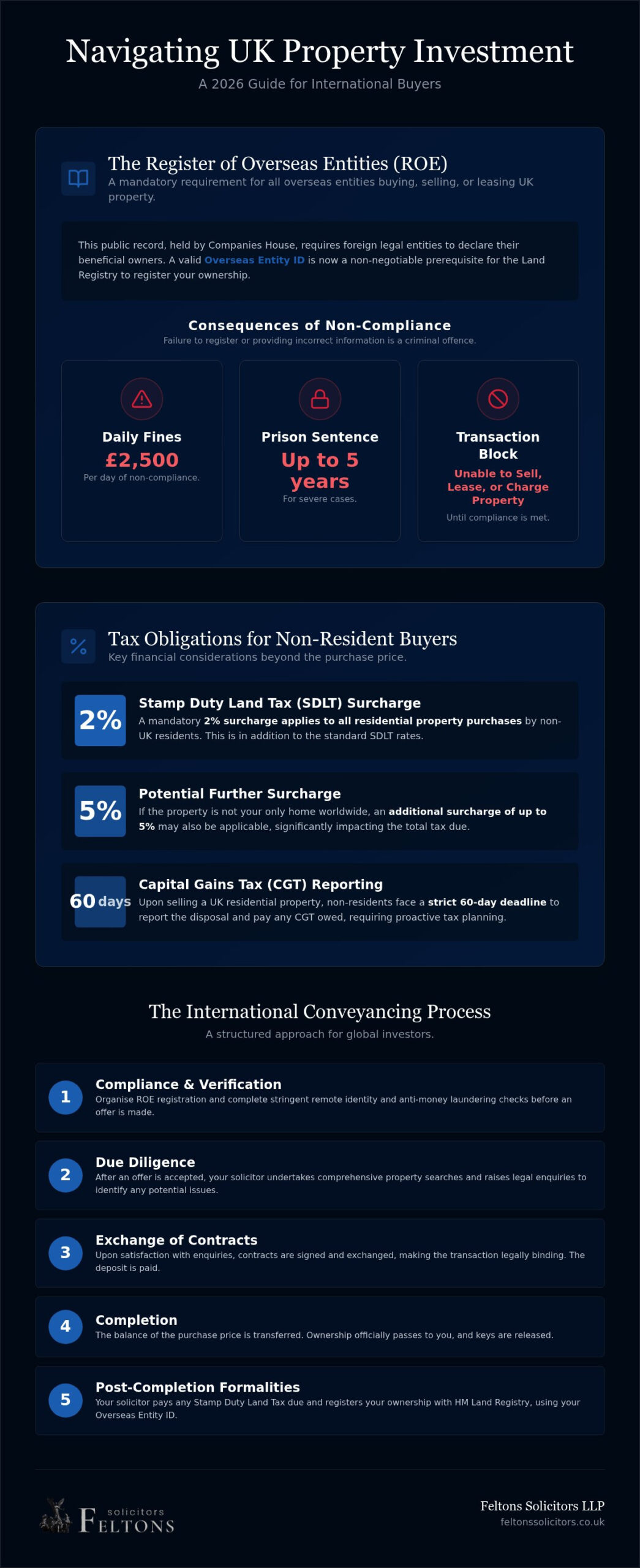
A single oversight in the Register of Overseas Entities can result in a daily fine of £2,500 or, in more severe cases, a prison sentence. It’s perfectly natural to feel a sense of trepidation when facing the UK’s increasingly rigorous transparency laws. This is particularly daunting whilst you’re managing high-value transactions from a different time zone. Finding the right solicitors for international property buyers is essential to ensuring these complexities don’t jeopardise your acquisition. You want the security of British property, but the weight of enhanced anti-money laundering checks and complex tax obligations can make the process feel unnecessarily opaque.

This guide offers a comprehensive look at the legal landscape in 2026. We cover everything from navigating the 2% non-resident Stamp Duty surcharge to meeting the latest Companies House filing requirements. We’ll outline the essential conveyancing steps and explain how a partner-led approach ensures your investment is protected with the highest standard of professional integrity. By the end of this article, you’ll have a clear understanding of your registration obligations and the confidence to move forward with your UK property goals.

Key Takeaways

  • Understand the mandatory requirements of the Register of Overseas Entities (ROE) to ensure your property acquisition remains fully compliant with 2026 transparency laws.
  • Learn how experienced solicitors for international property buyers navigate the complexities of UK conveyancing whilst managing stringent remote identity verification.
  • Identify the specific Stamp Duty Land Tax (SDLT) surcharges and tax obligations that apply to non-resident investors in both residential and commercial sectors.
  • Discover a methodical, step-by-step conveyancing process designed to accommodate global investors operating across different time zones.
  • Explore why a boutique, partner-led legal service provides the discretion and tailored expertise required for high-value international transactions.

The Landscape for International Property Buyers in 2026

The UK property market remains a beacon for global capital. Its legal system offers a level of predictability that’s rare in other jurisdictions, making it a preferred destination for those seeking long-term stability. Whilst the allure of London’s skyline or the steady yields of northern commercial hubs remains strong, the path to ownership has become more intricate for those residing outside our borders. In 2026, the primary challenge for investors isn’t just finding the right asset; it’s navigating a regulatory framework that demands absolute transparency. Instructing specialized solicitors for international property buyers is now a prerequisite for a successful acquisition. You need a legal partner who understands that a cross-border transaction is a dual exercise in property law and rigorous regulatory compliance.

Why the UK Remains a Global Investment Centre

English law continues to be the gold standard for property contracts. It provides a clear, enforceable framework that protects the interests of the buyer and seller alike. This transparency of title, managed through a robust Land Registry system, ensures that ownership is indisputable once registered. Beyond legal security, the UK offers diverse opportunities. Residential investors are drawn to consistent rental demand in major cities, whilst the commercial sector provides sophisticated assets ranging from Grade A office spaces to industrial hubs. These fundamentals haven’t changed, but the method of accessing them has evolved.

The Shift Towards Transparency and Compliance

Recent years have seen a definitive move towards greater corporate accountability. The Economic Crime (Transparency and Enforcement) Act has fundamentally altered the landscape, requiring overseas entities to disclose their beneficial owners before they can buy or sell UK land. Standard high-street firms often lack the dedicated infrastructure to handle these specific requirements. For the modern investor, proactive legal planning must begin long before an offer is made. This involves preparing for enhanced identity checks and ensuring your corporate structure is ready for scrutiny by Companies House.

Managing the conveyancing process from abroad requires a solicitor who acts as a steady, local presence. In 2026, non-resident buyers face a mandatory 2% Stamp Duty Land Tax (SDLT) surcharge on residential purchases, which applies in addition to standard rates. If the property isn’t your only home worldwide, a further 5% surcharge may also apply. These financial implications, combined with the strict 60-day reporting deadline for Capital Gains Tax on disposals, mean that your legal advisor must be as much a tax and compliance strategist as they are a conveyancer. We’ve moved past the era of “standard” transactions; every international purchase now requires a bespoke, detail-oriented approach to ensure your investment remains secure and compliant.

Understanding the Register of Overseas Entities (ROE)

The Register of Overseas Entities is a mandatory public record held by Companies House that requires foreign legal entities to identify their beneficial owners before they can buy, sell, or lease property in the UK. This isn’t a mere administrative hurdle. It’s a critical legal requirement that dictates whether a transaction can actually proceed to completion. For those seeking solicitors for international property buyers, the focus has shifted from simple title searches to complex corporate verification. Without a valid Overseas Entity ID, the Land Registry will simply refuse to register your ownership, effectively stalling your investment indefinitely.

The role of a UK-regulated agent is central to this process. You can’t simply self-certify your ownership structure. A solicitor or qualified professional must verify the information before it’s submitted to Companies House. This verification must be based on reliable, independent evidence. If the information is found to be incorrect or if you fail to register, the consequences are severe. Non-compliance is a criminal offence. You could face daily fines of up to £2,500 or even a prison sentence of up to five years. Perhaps more importantly for investors, you’ll be legally restricted from selling, leasing, or charging the property until your status is regularised.

Who Qualifies as a Beneficial Owner?

A beneficial owner is typically any individual or legal entity that holds more than 25% of the shares or voting rights. This also includes anyone who has the right to appoint or remove a majority of the board of directors. Complex trust structures and nominee arrangements require a methodical approach to peel back the layers of control. It’s not a one-time obligation. You’re required to provide annual updates to Companies House to maintain your ROE ID. Failure to file an update within 14 days of the anniversary of your registration results in an immediate breach of the law.

The Verification Process for Overseas Entities

Verification is evidence-based and exceptionally rigorous. Solicitors must review original documents, including passports, corporate registers, and trust deeds, to satisfy the 2026 transparency standards. It’s sensible to start this process long before you’ve even identified a specific property. Delays in verification are one of the most common reasons for transactions to collapse in the final stages. If you’re navigating this for the first time, you can read our detailed guide on overseas entity beneficial owner registration to prepare your documentation. Ensuring your corporate structure is transparent is the first step toward a seamless acquisition. If you need assistance with these complex filings, our team can help you register an overseas entity with the necessary precision and discretion.

Acquiring a luxury apartment in Mayfair requires a vastly different legal strategy than purchasing a logistics hub in the Midlands. Whilst both transactions demand meticulous title checks, the regulatory and tax hurdles vary significantly between the two sectors. Choosing solicitors for international property buyers who can pivot between these distinct legal landscapes is vital for a secure investment. High-value residential acquisitions often hinge on personal lifestyle requirements and long-term capital growth. Conversely, commercial units are driven by lease yields, tenant covenants, and VAT efficiency. Your legal partner must possess the versatility to handle both the personal nuances of a home and the technical rigour of a business asset.

Residential Investment: Surcharges and Leasehold Risks

Non-UK residents must account for the mandatory 2% Stamp Duty Land Tax (SDLT) surcharge on residential purchases in England. This is not a negotiable fee. It applies in addition to standard SDLT rates. If the property is an additional dwelling, such as a second home or a buy-to-let investment, a further 5% surcharge applies. This can bring the total tax burden to a significant level, making early tax planning essential. Beyond the initial purchase price, the UK’s leasehold system presents unique challenges for those unfamiliar with it. Many apartments are sold with diminishing lease terms that can eventually affect the property’s value and mortgageability.

Engaging leasehold enfranchisement experts is often necessary to extend these terms or even purchase the freehold. Managing ground rent issues and service charge disputes from abroad is notoriously difficult. A specialized residential property law firm will ensure that the lease terms are fair and sustainable before you commit your capital. They act as your eyes and ears on the ground, identifying hidden liabilities that could disrupt your long-term plans.

Commercial Property: Leases and Business Structures

Commercial acquisitions frequently involve Full Repairing and Insuring (FRI) leases. This structure typically places the entire burden of maintenance, repairs, and building insurance on the tenant. This is attractive for landlords seeking a “hands-off” investment, but it requires precise legal drafting to avoid future litigation over dilapidations. VAT is another critical factor. Many commercial properties are “opted to tax,” meaning a 20% VAT charge applies to the purchase price unless the transaction qualifies as a Transfer of a Going Concern (TOGC). Investors must also decide whether to hold the asset through a UK Special Purpose Vehicle (SPV) or an overseas company. Whilst an SPV can simplify local financing, an overseas entity triggers the mandatory ROE requirements mentioned earlier. Each structure has distinct tax and reporting implications that require careful, expert consideration.

Solicitors for International Property Buyers: Navigating UK Transactions in 2026

The International Conveyancing Process Step-by-Step

Purchasing a property in the UK from several thousand miles away requires a structured roadmap. Whilst the core principles of land law remain constant, the logistical execution for overseas investors involves specific digital hurdles and stringent verification phases. Professional solicitors for international property buyers act as your primary coordinator, ensuring that the distance doesn’t lead to delays or missed deadlines. In 2026, the average conveyancing timeline ranges between 12 and 20 weeks, though chain-free transactions can often be completed in 8 to 12 weeks with proactive management.

The process begins with initial instruction and the opening of your file. This is immediately followed by a comprehensive review of the legal pack and title deeds. Your solicitor will negotiate the contract terms and raise specific enquiries regarding the property’s history, planning permissions, and any potential liabilities. Once satisfied, you’ll move to the “Exchange of Contracts.” At this stage, a deposit, typically 10% of the purchase price, is paid, and the transaction becomes legally binding. Completion follows shortly after, involving the transfer of the remaining funds, the submission of Stamp Duty Land Tax (SDLT) returns, and the final application to the Land Registry to record your ownership.

Remote Verification and Digital Onboarding

Modern legal practice has embraced digitalisation to facilitate remote acquisitions. Solicitors now utilise secure biometric ID applications to verify your identity without requiring a physical meeting. These apps scan your passport’s NFC chip and use facial recognition to satisfy UK anti-money laundering regulations. Whilst digital signatures are increasingly common for initial documents, some Land Registry filings in 2026 still require “wet ink” signatures on specific deeds. You’ll also need to provide detailed proof of funds. UK banking regulations are exceptionally strict; you must be prepared to show a clear trail of how your investment capital was accumulated, often spanning several months of bank statements.

Managing the Transaction Timeline

Coordinating a purchase across different time zones requires a methodical approach. Delays often occur when communicating with surveyors, lenders, or estate agents who operate on UK business hours. To mitigate this, many international buyers grant a limited Power of Attorney to their solicitor or a trusted UK representative. This allows legal documents to be signed on your behalf, ensuring the “Exchange” and “Completion” phases aren’t stalled by international courier delays. If you’re ready to begin your acquisition, our team provides expert residential and commercial conveyancing services tailored to the needs of global investors.

Why International Buyers Choose Feltons Solicitors

Selecting the right solicitors for international property buyers involves more than finding a firm to process a deed. It requires a partnership with a legal team that understands the weight of your investment and the complexities of your position as a global investor. Whilst many high-volume firms treat conveyancing as a factory-style process, Feltons Solicitors LLP operates with a boutique philosophy. Since 2010, we’ve positioned ourselves as a steady, dependable presence for clients navigating the UK’s intricate property laws. We prioritise personal connection and high-end reliability, ensuring that your transaction is handled with the quiet confidence and discretion it deserves.

Our approach bridges the gap between traditional professional integrity and modern, forward-thinking methodology. We understand that for an overseas investor, the technical legal work is only one part of the equation; the human impact and the need for clear, reassuring guidance are equally paramount. Whether you’re acquiring a high-value residence or managing a commercial portfolio, our role is to act as your sophisticated guide through the regulatory landscape of 2026. We provide holistic support that extends beyond the immediate purchase, offering expert estate planning to ensure your UK assets are protected for future generations.

A Trusted Advisor for Complex Transactions

We provide a partner-led service, meaning your case is never passed down to junior staff or automated systems. An experienced solicitor oversees every detail of your transaction, providing the sound judgment necessary for complex, high-value matters. This is particularly vital when dealing with the Registration of Overseas Entities or navigating contentious property disputes. Our expertise in both residential and commercial sectors allows us to manage sophisticated portfolios with a level of individualized attention that high-volume firms simply cannot match. We value privacy and personal rapport, acting as a discreet partner for high-net-worth individuals and corporate entities alike.

National Reach with a Personal Touch

Feltons operates on a national scale, yet our service remains deeply rooted in a people-first philosophy. We’ve developed a communication rhythm that respects your schedule, regardless of your time zone. You’ll never feel like just another file number; instead, you’ll have a dedicated advisor who provides regular, methodical updates. This steady flow of information is designed to make you feel informed and supported, turning a potentially stressful international purchase into a seamless, controlled experience. By combining worldly experience with a commitment to clear, “plain English” advice, we ensure that you remain in capable hands from the initial instruction to the final registration of your title.

Securing Your UK Property Investment in 2026

The UK property market remains a premier destination for global capital, but the legal landscape in 2026 demands a higher level of transparency than ever before. Successfully navigating the Register of Overseas Entities and managing non-resident tax surcharges requires more than just a standard conveyancing service. It requires a partner who understands the nuances of cross-border transactions and the importance of meticulous compliance. By prioritising early verification and digital onboarding, you can ensure that your acquisition proceeds without the risk of daily fines or criminal liability.

Feltons Solicitors LLP has been a trusted advisor for global investors since 2010. We specialise in the Registration of Overseas Entities, providing a boutique, partner-led service that prioritises your personal objectives. Our firm offers the sophisticated guidance necessary for high-value transactions whilst maintaining the discreet, tailored care you expect. If you’re looking for dedicated solicitors for international property buyers to safeguard your UK interests, we’re here to provide a steady and calm presence throughout the process. Contact Feltons Solicitors for expert international property advice and take the first step towards a seamless, compliant acquisition.

Frequently Asked Questions

Do I need to be in the UK to buy property as an international buyer?

No, you don’t need to be physically present in the UK to complete a property purchase. Modern solicitors for international property buyers use biometric ID applications and secure digital portals to manage the entire process remotely. You can also grant a limited Power of Attorney to your legal representative, allowing them to sign specific deeds on your behalf so that completion isn’t delayed by international courier times.

What is the Register of Overseas Entities and does it apply to me?

The Register of Overseas Entities is a mandatory record held by Companies House for foreign companies or legal structures that own UK land. It applies to you if you’re purchasing property through an overseas entity rather than in your personal name. You must identify your beneficial owners and have this information verified by a UK-regulated agent before the Land Registry will record your ownership of the property.

Are there extra taxes for non-residents buying property in the UK?

Yes, non-residents are subject to a mandatory 2% Stamp Duty Land Tax (SDLT) surcharge on residential purchases in England and Northern Ireland. If the property isn’t your only home worldwide, an additional 5% surcharge for additional dwellings typically applies. You should also account for the Non-Resident Landlord Scheme, which involves a 20% withholding tax on rental income unless you’re approved to receive gross payments.

How do solicitors verify proof of funds for overseas clients?

Solicitors verify funds by reviewing an audited trail of your capital’s origin, which usually requires at least six months of bank statements. You’ll need to provide clear evidence of the source of your wealth, such as property sale completion statements, inheritance documents, or dividend vouchers. UK anti-money laundering regulations are exceptionally rigorous, so providing a transparent paper trail is the best way to avoid transaction delays.

Can an overseas company own UK residential property?

An overseas company can own UK residential property, but this triggers specific regulatory and tax obligations. Beyond the mandatory Register of Overseas Entities filing, companies owning dwellings valued at over £500,000 are subject to the Annual Tax on Enveloped Dwellings (ATED). For the 2025/26 period, these annual charges ranged from £4,400 to £287,600 depending on the specific value of the property.

How long does the UK conveyancing process take for international buyers?

The average conveyancing process for international buyers in 2026 takes between 12 and 20 weeks. If the property is chain-free and your documentation is prepared in advance, this timeline can be reduced to 8-12 weeks. Working with experienced solicitors for international property buyers helps to manage the logistical challenges of different time zones and complex overseas corporate searches that often slow down standard transactions.

What happens if I fail to register my overseas entity with Companies House?

Failure to register or update an overseas entity is a criminal offence that carries severe penalties. You could face daily fines of up to £2,500 and prison sentences of up to five years for serious non-compliance. Most importantly for investors, you’ll be legally restricted from selling, leasing, or charging the property, as the Land Registry will block any dealings involving an unregistered entity.

Can I get a UK mortgage as a non-resident?

You can obtain a UK mortgage as a non-resident, though you’ll likely need to approach specialist lenders or private banks. These lenders typically require a higher deposit, often 25% or more of the purchase price, and may charge higher interest rates than for UK residents. Your solicitor will work closely with the lender to satisfy their specific international due diligence and identity verification requirements.