

Pension Sharing Order Lawyers: Securing Your Financial Future After Divorce

Pension Sharing Order Lawyers: Securing Your Financial Future After Divorce

What if the family home is not actually your most valuable asset during a divorce? Whilst many couples focus on property, a pension often represents decades of dedicated saving and is frequently the largest single element of the matrimonial pot. It is entirely understandable to feel a sense of trepidation when faced with complex Cash Equivalent Transfer Value (CETV) figures or the intricate differences between final salary and defined contribution schemes. You deserve a settlement that provides both clarity and long-term security.

By instructing specialist pension sharing order lawyers, you can ensure that your retirement assets are professionally appraised and fairly divided. Our expertise allows us to secure a legally enforceable Pension Sharing Order that provides a genuine clean break and a stable financial future. In this guide, we will examine how to navigate the latest 2026 pension allowances, the reality of implementation fees, and the essential steps to achieving an equitable outcome that protects your standard of living in later life.

Key Takeaways

  • Understand how a Pension Sharing Order facilitates a permanent financial “clean break” by creating a separate, independent pension pot for the recipient.
  • Gain clarity on the essential legal steps, from the initial financial disclosure using Form E to finalising a legally binding court order.
  • Compare the long-term benefits of pension sharing against offsetting strategies to ensure you don’t sacrifice future income for short-term capital gains.
  • Learn why pension sharing order lawyers often recommend expert actuarial reports to uncover the true value of complex final salary schemes.
  • Discover how a tailored, people-first legal approach can simplify pension jargon and provide the reassurance needed during financial remedy proceedings.

Understanding Pension Sharing Orders in UK Financial Settlements

A Pension Sharing Order (PSO) is a formal court instruction that legally transfers a specific percentage of one party’s pension fund to the other. It’s often the most effective way to manage retirement assets during a separation. Unlike other methods of division, a PSO facilitates a “clean break” financial settlement. This means the recipient receives their own independent pension pot, entirely separate from their former spouse. Most private and occupational pensions are eligible for this process, as is the Additional State Pension. It’s why pension sharing order lawyers increasingly recommend this route to ensure long-term financial independence and security.

The Legal Basis: Matrimonial Causes Act 1973

The primary legislation governing these orders includes the Matrimonial Causes Act 1973 and the Welfare Reform and Pensions Act 1999. Under established UK divorce law, the court views pensions as matrimonial assets. It doesn’t matter whose name is on the policy. If the value was accrued during the marriage, it’s part of the shared pot. We’ve seen a distinct shift in judicial behaviour over recent years. Courts now prioritise ensuring equality of income in retirement rather than just a simple split of capital. Whilst the length of the marriage can influence the percentage shared, especially in shorter unions, the primary goal is a fair and sustainable outcome for both parties.

Pension Sharing vs. Pension Attachment Orders

You might hear about Pension Attachment Orders, which were formerly known as “earmarking.” These are rarely recommended by experienced pension sharing order lawyers today because of the inherent risks they carry. With an attachment order, you don’t own the funds. You simply receive a portion of the pension when your ex-spouse starts to draw it. This creates a lingering financial tie. If they die before retiring or if you remarry, those benefits could vanish instantly.

Pension sharing eliminates this uncertainty. It provides immediate ownership and total control over the funds. Once the transfer is complete, the money is yours to manage. You can choose your own investment strategy and decide exactly when you wish to retire. This autonomy is vital. It ensures that your financial future isn’t dependent on the choices or circumstances of your former partner. By securing a separate pot, you gain the peace of mind that comes with true financial independence.

Securing a fair financial settlement requires a methodical approach to legal procedure. The journey begins with full financial disclosure, typically documented in Form E. This stage is non-negotiable; every pension asset, regardless of its size or when it was accrued, must be declared. Once disclosure is complete, pension sharing order lawyers work to negotiate a settlement that reflects your future needs, whether through direct discussion or mediation. If an agreement is reached, it is formalised in a Financial Consent Order. This document is then scrutinised by a judge to ensure the division is fair and reasonable for both parties.

Step 1: Obtaining the CETV Valuation

The Cash Equivalent Transfer Value (CETV) is the starting point for any pension division. It represents the lump sum value the pension provider would pay to move your benefits elsewhere. It’s vital to request these valuations as early as possible. Some schemes, particularly public sector ones, can take several months to provide this data. As detailed in this guide to pensions on divorce, the process requires patience and precision. It’s also a common misconception that the CETV represents the true value of the fund. For defined benefit or final salary schemes, the CETV often significantly undervalues the actual income the pension will produce in retirement.

Step 2: Drafting the Pension Sharing Annex

Precision is paramount when drafting the Pension Sharing Annex, also known as Form P1. This technical document accompanies the main court order and provides the pension trustees with the specific instructions they need. Most pension sharing order lawyers will specify a percentage of the fund to be transferred rather than a fixed monetary amount. This protects you against fluctuations in the fund’s value during the legal process. Before the order is sent to court, it’s standard practice to liaise with the pension trustees to confirm the order is implementable. This avoids costly administrative rejections later.

The procedure doesn’t conclude the moment the judge signs the order. Implementation is a distinct phase that begins after the Final Order is granted. Pension providers have a statutory period of four months to implement the share once they have received the sealed court order and the required implementation fee. These fees vary significantly; for instance, NHS schemes may charge between £2,200 and £3,000. Navigating these timelines requires a steady hand and professional oversight. If you’re concerned about the complexity of your retirement assets, seeking discreet legal support for financial arrangements can provide the clarity and reassurance you need.

Pension Sharing vs. Offsetting: Navigating Your Financial Options

Deciding how to divide matrimonial assets often involves a choice between immediate stability and future security. Offsetting is a common strategy where one party retains their full pension whilst the other receives a larger share of non-pension assets, such as the family home. This section provides a framework to help you navigate these options, ensuring your decision aligns with both your current lifestyle and your long-term goals. Whilst the house may feel like the most important asset today, its value must be weighed against the guaranteed income a pension provides in later life.

There is often a significant psychological weight attached to the family home. For many, staying in a familiar environment provides a sense of continuity that is hard to quantify. However, professional pension sharing order lawyers will always advise you to look beyond the emotional value of property to the cold reality of retirement income. High-net-worth individuals often find that a bespoke mix of both offsetting and sharing provides the most balanced outcome, allowing for a comfortable home today and a secure income tomorrow.

The Pros and Cons of Offsetting

The primary advantage of offsetting is its relative simplicity. It avoids the administrative fees charged by pension providers, which in 2026 can range from £500 to over £3,500 depending on the specific scheme. It also prevents the four-month implementation delay that follows a court order. However, offsetting presents a significant “apples versus oranges” problem. You are essentially trading liquid, tax-free capital, such as house equity, for a future, taxable income stream. Without careful calculation, you may inadvertently fall into a “tax trap” where the nominal value of the assets seems equal, but the actual spending power is vastly different. Feltons Solicitors maintains a cautious approach to offsetting in high-value cases, ensuring that any trade-off is mathematically sound and truly fair.

When is a Pension Sharing Order the Better Choice?

A Pension Sharing Order is frequently the superior option when the pension is the primary matrimonial asset. If there isn’t enough equity in the home or other savings to “buy out” a spouse’s share of the pension, a formal split is the only way to achieve a just result. It is also the preferred route when both parties require an independent income stream to fund their favourite retirement activities. This is particularly vital for a spouse who may have sacrificed career progression or their own pension contributions to focus on family life. By securing their own independent pot, they gain parity and financial autonomy. Expert pension sharing order lawyers ensure that this mechanism is used to create a permanent, legally enforceable separation of finances that allows both parties to move forward with total confidence.

Pension Sharing Order Lawyers: Securing Your Financial Future After Divorce

Valuing Pension Assets: The Critical Role of Actuaries

Relying purely on the Cash Equivalent Transfer Value (CETV) is a frequent mistake in financial remedy proceedings. Experienced pension sharing order lawyers understand that this figure is merely the pension provider’s estimate of what it would cost to buy out the benefits today. It rarely reflects the true utility or the actual cost of replacing that income on the open market. To achieve a truly equitable split, we often instruct a Pension On Divorce Expert (PODE). These specialists look beyond the capital value to calculate the “true value” of a fund, focusing on the income it will generate throughout your retirement.

This actuarial data is vital when arguing for an unequal percentage split. If there’s a significant age gap between spouses or differences in life expectancy, a simple 50/50 division of capital will not result in equal retirement income. An actuary provides the mathematical evidence needed to justify a split that ensures both parties enjoy a similar standard of living. Whilst an expert report carries an additional cost, the investment is highly pragmatic. A small percentage adjustment in a high-value pension can equate to tens of thousands of pounds over a lifetime. It’s a small price for long-term certainty.

Defined Benefit vs. Defined Contribution Schemes

The distinction between scheme types is fundamental to a fair settlement. Defined benefit schemes, particularly public sector pensions for the NHS, Teachers, or Armed Forces, carry significant hidden value that a standard valuation misses. Similarly, older private pensions may contain “guaranteed annuity rates” that are worth a fortune compared to current market offerings. You need a legal partner who understands these nuances. Without expert oversight, you risk accepting a settlement based on an incomplete financial picture. If you have concerns about the valuation of your retirement funds, you should contact our specialist divorce and financial arrangement lawyers for an initial consultation.

Tax Implications and Lifetime Allowance Considerations

The tax position of the recipient (pension credit) and the provider (pension debit) must be carefully balanced to avoid eroding the value of the settlement. Following the full abolition of the Lifetime Allowance on 6 April 2024, pension sharing now requires careful navigation of the new Lump Sum Allowance (LSA) and Lump Sum and Death Benefit Allowance (LSDBA) thresholds to avoid unforeseen tax charges in the 2026 tax year. The standard LSA is currently £268,275, whilst the LSDBA is capped at £1,073,100. Effective pension sharing order lawyers will coordinate with financial advisors to ensure your share doesn’t inadvertently trigger a tax liability that diminishes your future security.

Expert Pension Sharing Order Lawyers: How Feltons Solicitors Protects Your Future

Feltons Solicitors LLP understands that your retirement assets represent years of hard work and sacrifice. We combine modern efficiency with traditional professional integrity to handle these sensitive matters with the care they deserve. Choosing the right pension sharing order lawyers is about more than just technical skill; it’s about finding a partner who values your privacy and personal rapport. Our people-first philosophy ensures you feel supported through every stage of the financial remedy process. By providing pragmatic and discreet advice, we help high-net-worth individuals navigate the most complex settlements. Our extensive experience in divorce and financial arrangements ensures that no asset, however small or complex, is overlooked.

A Tailored Approach to Financial Remedy

We deliberately avoid the high-volume processing found in larger firms. Instead, we prioritise a bespoke personal connection with every client. This boutique level of care is essential when coordinating with the actuaries and financial advisors mentioned earlier to build a comprehensive strategy. We don’t stop once the court order is signed. Our team actively manages the implementation phase. We liaise with pension trustees to ensure the order is executed correctly and that the transfer of funds is completed within the statutory four-month window. This steady oversight prevents administrative delays and provides the reassurance you need during a period of transition.

Securing Your Clean Break

Achieving finality is our primary commitment. We want you to move forward with total confidence in your financial independence. A pension share shouldn’t be viewed in isolation. It is often beneficial to integrate your settlement into a wider estate planning strategy to protect your legacy for future generations. This holistic approach ensures that your new pension pot is correctly nominated and aligned with your overall wishes. Our pension sharing order lawyers are dedicated to securing a permanent resolution that allows you to plan for the future with certainty. If you are ready to secure your retirement assets, we invite you to organise a discreet consultation with our specialist team. We are here to provide the calm, expert guidance you need to move forward.

Securing Your Financial Independence in Retirement

Navigating the complexities of retirement assets requires more than just a surface-level understanding of valuations. You’ve seen how expert actuarial reports and the precise drafting of a Pension Sharing Annex are vital to achieving a truly equitable outcome. A Pension Sharing Order remains the most robust mechanism for ensuring a permanent financial clean break; it transforms a shared past into two independent, secure futures. This process provides the autonomy you need to manage your own funds and retire on your own terms.

Established in 2010 by Paula Felton, our firm specialises in high-net-worth financial arrangements through a pragmatic and empathetic boutique service. We understand that behind every CETV and implementation fee is an individual seeking clarity and security. Our pension sharing order lawyers are here to guide you through the process with discreet, high-standard care that prioritises your long-term wellbeing. Please contact Feltons Solicitors for a discreet consultation on your financial settlement to begin the next chapter of your life with confidence.

Frequently Asked Questions

Can I get a Pension Sharing Order after the divorce is finalised?

Yes, provided a final financial order has not already dismissed your pension claims. However, it is far more complex and costly to reopen financial matters after a divorce is finalised. Most pension sharing order lawyers advise securing the order before the Final Order (formerly Decree Absolute) is granted. This ensures your retirement assets are protected as part of a comprehensive and permanent clean break settlement.

How long does it take for a Pension Sharing Order to be implemented?

Implementation typically takes around four months once the pension provider receives the sealed court order. This is a statutory period. Delays can occur if the provider requires further information or if the implementation fee is not paid promptly. Experienced pension sharing order lawyers monitor this phase closely. We ensure that trustees adhere to the legal timeline so your new pension pot is established without unnecessary friction.

What happens to my State Pension during a divorce?

The basic State Pension cannot be shared. However, you may be able to share the Additional State Pension (accrued before 2016) or the “protected payment” element of the new State Pension. Whilst the rules are complex, a spouse with a lower contribution record might be able to use their ex-partner’s record to increase their own basic State Pension. This occurs without reducing the other person’s actual payment.

Does a Pension Sharing Order apply to a civil partnership dissolution?

Yes, the legal framework for sharing pensions upon the dissolution of a civil partnership is identical to that of a divorce. The court has the same powers to redistribute retirement assets to ensure a fair settlement. This includes private, occupational, and certain state pension elements. The goal is to achieve financial parity regardless of whether the relationship was a marriage or a civil partnership.

Can my ex-partner claim my pension if we were never married?

No, cohabiting couples who were never married or in a civil partnership have no automatic legal claim over each other’s pensions in England and Wales. Pension sharing is a remedy only available through the court during formal divorce or dissolution proceedings. Without a legal union, assets are generally retained by the person whose name is on the policy. This remains true regardless of the length of the relationship.

How much does a Pension Sharing Order cost in legal and actuary fees?

Costs vary depending on the complexity of the schemes. You must factor in the court fee for the consent order, which is £62 as of July 2026. Pension providers also charge their own implementation fees. These vary significantly between schemes; they often range from £500 to over £3,500 and usually attract VAT. We provide a clear breakdown of these third party costs at the start of your instruction.

What is a “Pension Credit” and how is it different from a “Pension Debit”?

These terms describe the two sides of a pension share. A “pension debit” is the specific amount or percentage deducted from the original member’s fund. A “pension credit” is the resulting amount received by the former spouse. Once the transfer is complete, the recipient holds the pension credit as their own independent asset. It is no longer linked to the original member’s scheme or future circumstances.

Is a Pension Sharing Order final, or can it be changed later?

A Pension Sharing Order is final once it has been implemented and the statutory appeal period has passed. Unlike maintenance payments, which can be varied if incomes change, a PSO is designed to provide a permanent clean break. It cannot be reversed or adjusted later. This is true even if the financial situation of either party changes significantly after the divorce is finalised.

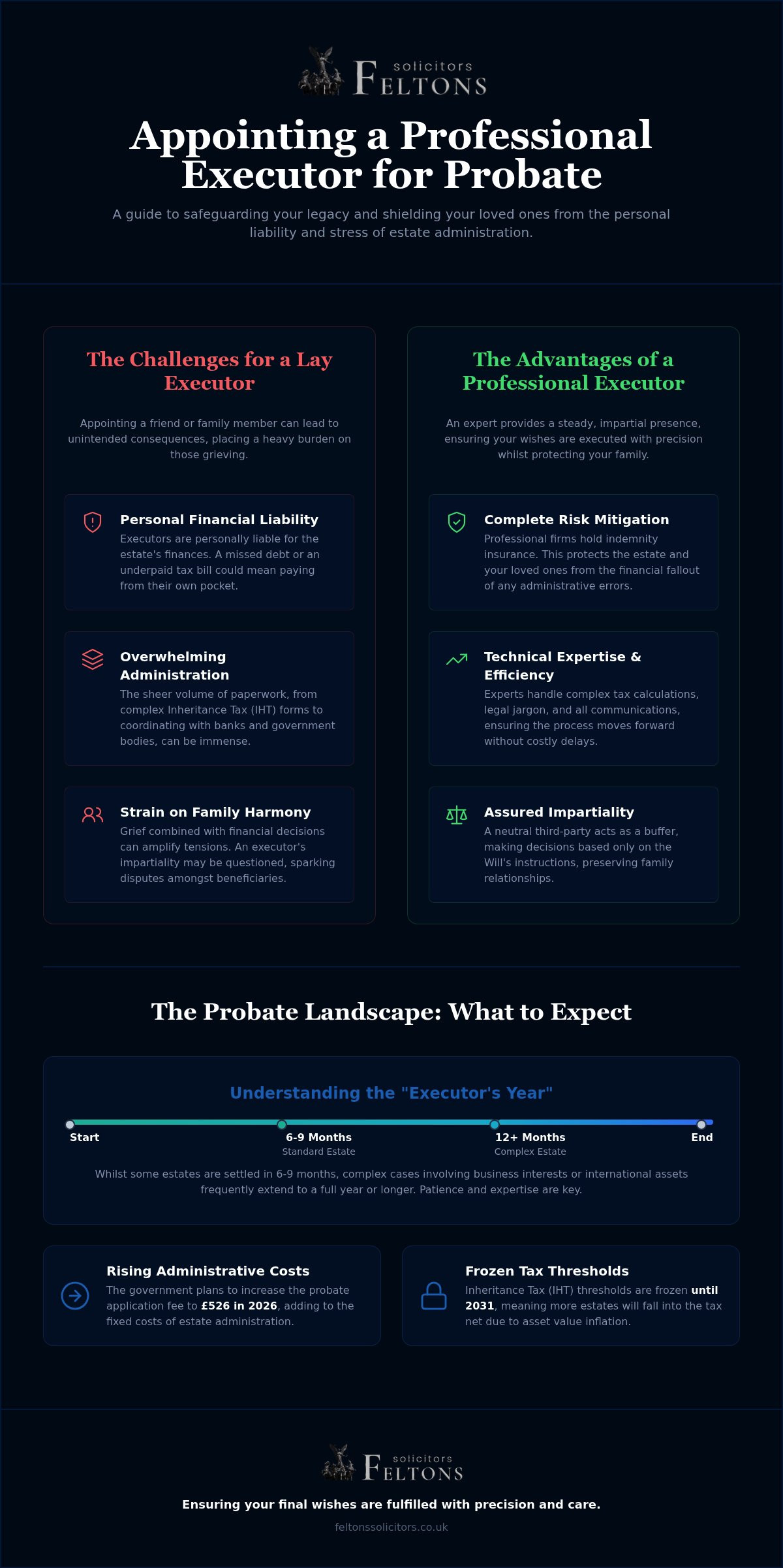
Professional Probate Executors: 2026 Estate Guide

Professional Probate Executors: 2026 Estate Guide

What if the kindest gift you could leave your family isn’t a larger inheritance, but the freedom from having to manage it? Whilst many people instinctively appoint a spouse or child to handle their estate, the reality of modern probate is increasingly fraught with personal liability and complex tax hurdles. Appointing professional executors for probate ensures that your final wishes are carried out with clinical precision; this choice shields your loved ones from the administrative burden and potential legal pitfalls that often surface during asset distribution.

It’s natural to feel anxious about the legal weight of an estate, especially with the 2026 probate application fee increase to £526 and the continued freezing of inheritance tax thresholds until 2031. You want to ensure your legacy is handled fairly and efficiently without sparking family disputes. This guide explores how a professional executor acts as a steady, impartial guide through the probate process. You’ll discover how to safeguard your assets against costly errors, manage the latest regulatory shifts, and ultimately provide your family with the stress-free transition they deserve.

Key Takeaways

  • Understand why lay executors face significant personal financial liability for administrative errors and how professional oversight mitigates these risks.
  • Learn how appointing professional executors for probate maintains family harmony by providing an impartial, third-party perspective amongst beneficiaries.
  • Discover essential strategies for managing complex estates, including high-net-worth portfolios and assets held across international jurisdictions.
  • Explore how to properly organise your Will by naming a professional firm as a sole or co-executor to ensure efficient estate administration.
  • Identify the benefits of bespoke professional support whilst navigating contentious probate disputes to protect your legacy’s integrity.

Being named in a Will is often seen as a mark of trust, but the role carries a heavy legal burden. To understand What is an Executor, one must look beyond the title to the fiduciary duty it entails. An executor is legally tasked with identifying every asset, settling all outstanding debts, and ensuring the remaining inheritance reaches the correct beneficiaries. If there is no Will, the role shifts to an “administrator” under the rules of intestacy. Although the terminology differs, the weight of the responsibility remains equally significant.

Whilst many family members expect the process to conclude within a few weeks, the reality is far more methodical. In 2026, a straightforward estate administration typically takes between six and nine months; however, more complex cases frequently extend to a full year. This “Executor’s Year” is a standard window. Beneficiaries often become restless during this time, putting immense pressure on the person in charge to speed up a process that is governed by strict legal timelines.

The Personal Liability of a Lay Executor

Choosing a friend or relative as a “lay executor” can lead to unintended financial catastrophe. Executors are personally liable for the estate’s finances. If a debt is missed or a creditor isn’t properly notified, the executor may have to pay that debt from their own pocket. Asset valuation is another high-risk area. If HMRC determines that an estate was undervalued, resulting in underpaid inheritance tax, the penalties can be severe. This is where professional executors for probate provide a critical safety net. Unlike a family member, a professional firm carries professional indemnity insurance. This protects the estate and the individuals involved from the fallout of honest administrative errors.

Administrative Burden and Legal Jargon

The sheer volume of paperwork is often what overwhelms lay executors. Filing inheritance tax (IHT) forms requires absolute precision; even a small discrepancy can trigger a lengthy investigation. Beyond the tax office, an executor must coordinate with banks, pension providers, and various government bodies. Each institution has its own set of requirements and specific jargon. Using professional executors for probate allows families to step back from this logistical maze. A professional guide translates complex legal requirements into plain English. They ensure every communication is handled with the necessary expertise and authority to move the process forward without unnecessary delay.

Key Advantages of Appointing a Professional Executor for Probate

Appointing a professional to manage an estate is often a decision rooted in the desire for stability. Whilst a family member may have the best intentions, they rarely possess the technical breadth required to navigate the intricacies of modern estate law. Professional executors for probate offer a level of sophisticated oversight that extends far beyond simple administration. They provide a steady, impartial presence that ensures the deceased’s wishes are executed with absolute fidelity, protecting both the assets and the family’s long-term relationships.

Maintaining Family Harmony Through Impartiality

Grief can often amplify existing family tensions, making the distribution of assets a potential flashpoint for conflict. A professional executor acts as a neutral buffer, standing apart from the emotional history of the beneficiaries. By serving as an independent arbiter, they ensure that every decision is based on legal requirement and the specific instructions left in the Will, rather than personal bias or perceived favouritism. This objective stance is vital for resolving disagreements amongst siblings or other relatives before they escalate into costly and damaging litigation. It allows family members to focus on their personal recovery whilst leaving the difficult conversations to a trusted, third-party expert.

Professional Expertise and Technical Accuracy

Modern estates are rarely straightforward. They often involve a complex tapestry of trusts, lifetime gifts, and business interests that require specialised handling to avoid unnecessary tax leakage. Professionals meticulously calculate any capital gains tax liabilities arising from asset appreciation between the date of death and the eventual sale or distribution. This technical precision ensures the estate doesn’t overpay inheritance tax or fall foul of HMRC’s increasingly stringent reporting standards. For those seeking a tailored approach to these sensitivities, exploring Wills, Probate, and Estate Planning services can provide the necessary clarity and security.

Beyond tax planning, professional firms offer essential continuity of service. Unlike an individual executor who may fall ill, move abroad, or become overwhelmed by their own personal circumstances, a professional firm provides a permanent, reliable point of contact. This ensures the probate process remains on track regardless of external factors. Their specialised knowledge also facilitates efficient asset recovery, particularly when dealing with diverse portfolios or discreet financial information that might be overlooked by a layperson. Meticulous record-keeping remains the cornerstone of this service, providing a transparent and indisputable trail for the final estate accounts.

Whilst a family member may successfully manage a straightforward estate involving a single property and a few bank accounts, the stakes rise sharply when assets become diverse. Complexity in probate isn’t merely about the size of the estate; it’s about the technical nature of the holdings. High-net-worth individuals often leave behind a tapestry of business interests, high-value collections, and intricate trust structures that require a level of precision far beyond the scope of a layperson. In these scenarios, professional executors for probate serve as essential architects of the administration process, ensuring that every thread is untangled without compromising the estate’s value.

Estates with International or Business Assets

Managing assets across borders introduces a layer of bureaucratic difficulty that can stall probate for years. International tax jurisdictions have their own reporting requirements, and coordinating with foreign legal teams is a full-time commitment. For property owners, the Registration of Overseas Entities is a critical regulatory hurdle that must be cleared to ensure the lawful transfer or sale of UK land. A professional executor possesses the global perspective necessary to handle these filings whilst maintaining business continuity. If the deceased owned a company, the executor must step in to ensure operations remain stable, salaries are paid, and the transition of ownership respects both the company’s articles of association and the deceased’s final wishes.

Protecting the Legacy of High-Net-Worth Individuals

Wealthy estates often involve unique assets such as intellectual property, private equity, or significant art and jewellery collections. These require specialised valuation and bespoke protection strategies that go beyond standard administrative tasks. Effective estate planning relies on the executor’s ability to implement complex tax-saving measures, such as navigating the £2.5 million cap on Business and Agricultural Property Relief that came into effect in April 2026. Professional executors provide the discreet, high-standard service required to manage these sensitive financial arrangements, protecting the legacy from both fiscal drag and public scrutiny.

The presence of minor beneficiaries or long-term trusts adds further responsibility. A professional executor acts as a steady hand, managing these funds with a “people-first” philosophy whilst adhering to strict fiduciary duties. This level of care is particularly vital in cases of “contentious probate,” where a Will is being challenged. Having an impartial expert at the helm ensures that the estate remains protected from the high costs of litigation, allowing for a resolution that honours the deceased’s intentions whilst safeguarding the inheritance for future generations.

Professional Probate Executors: 2026 Estate Guide

The Appointment Process: How to Organise Professional Executorship

Organising the future of an estate begins with a clear, proactive decision. Appointing professional executors for probate is most effectively handled during the initial Will-writing process. This allows the chosen firm to understand the testator’s intentions from the outset, ensuring a seamless transition when the time comes. Many individuals prefer to name a professional firm as a co-executor alongside a family member. This hybrid approach provides the best of both worlds; the family member remains involved in the sentimental aspects of distribution whilst the professional manages the complex legal and financial liabilities.

Openly discussing this choice with your family is vital for managing expectations. Transparency prevents surprises during an already emotional period and allows you to explain why you have sought professional oversight to protect their inheritance. It is also the appropriate time to consider fee structures. Professional fees are paid directly from the estate’s assets, and most firms offer either a fixed fee or a percentage-based cost. Solicitors commonly charge between 1% and 5% of the estate’s value for full administration, depending on the complexity of the assets involved.

Choosing the Right Professional Partner

Selecting the right partner requires a careful comparison between boutique law firms and large, impersonal probate providers. A boutique firm prioritises personal connection and ensures you know exactly who is handling the case. When interviewing potential firms, ask about their direct experience with estates similar to yours. You are looking for a “sophisticated guide” who possesses the worldly experience to handle complex matters whilst remaining human and accessible. For expert assistance in establishing a secure foundation for your estate, you can contact Feltons Solicitors to discuss your requirements.

The Transition: From Lay Executor to Professional Support

If a death has already occurred and the named lay executors feel overwhelmed, there are legal pathways to transfer the responsibility. A lay executor can choose to formally “renounce” their role or have “Power Reserved” to them, allowing a solicitor to take over the heavy lifting. This process ensures the administration continues without delay whilst keeping the family informed at every stage. Crucially, professional executors can be appointed even if not originally named in the Will. This flexibility provides essential relief for families who realise, after the fact, that the administrative burden is greater than they can safely manage alone.

Feltons Solicitors: Expert Professional Executor Services for Peace of Mind

Feltons Solicitors LLP stands as a calm, steady presence in the often-turbulent landscape of estate administration. Unlike larger, high-volume firms that may treat probate as a purely transactional process, our boutique approach prioritises personal connection and discreet, high-standard service. We understand that behind every legal file is a family navigating a significant life transition. By acting as professional executors for probate, we provide the pragmatic, sound judgment necessary to protect your legacy whilst offering the empathetic reassurance your loved ones require.

Our team possesses specific expertise in handling complex litigation and contentious probate disputes. This depth of experience is vital. It’s especially important when an estate faces challenges from creditors or disagreements amongst beneficiaries. We act as a sophisticated guide, using our worldly experience to navigate these high-stakes matters with quiet confidence. Whether the estate involves straightforward domestic assets or complex international interests, our commitment remains the same: to provide a methodical, orderly process that respects both the letter of the law and the human impact of our work.

Why Feltons is the Preferred Choice for UK Estates

Our “people-first” philosophy ensures that technical excellence never comes at the expense of accessibility. Established in 2010 by Paula Felton, the firm has built a reputation for combining traditional professional integrity with a modern, efficient methodology. We don’t rely on dense, archaic legalese; instead, we communicate in plain English to ensure all parties feel informed and supported. This balance makes us the preferred choice for those who value both the security of a highly skilled expert and the rapport of a trusted advisor. We handle both national and international matters with the same level of tailored attention, ensuring that no detail is overlooked in the pursuit of a stress-free probate process.

Getting Started with Your Estate Protection

Protecting your legacy begins with a confidential consultation. Whether you are in the initial stages of Will-writing or require immediate support following a death, our team is ready to provide the necessary guidance. We maintain a transparent approach to fees and service levels, ensuring there are no surprises during the administration. By choosing professional executors for probate, you ensure your estate is in the hands of a sophisticated advisor who values privacy and personal rapport. Your final wishes deserve the precision of a professional and the care of a partner who understands the weight of your legacy. We invite you to reach out and discover how our bespoke service can provide the peace of mind you and your family deserve.

Securing Your Family’s Future with Expert Precision

Navigating the complexities of probate doesn’t have to be a burden you carry alone. As we have explored, the transition of an estate involves significant legal liabilities and the potential for family friction; however, these risks are effectively managed through the use of professional executors for probate. By choosing a partner who balances technical excellence with a people-first philosophy, you ensure that your assets are distributed exactly as intended whilst protecting your loved ones from the weight of administrative error.

Feltons Solicitors provides a boutique level of care that prioritises high-end reliability and personal connection. Our expertise in handling both national and complex international estate matters allows us to act as a discreet, sophisticated guide for your legacy. Whether you’re managing high-value business interests or simply want to ensure a smooth transition for your children, we offer the steady presence needed during difficult times. Secure your legacy with Feltons Solicitors—contact our expert probate team today. Taking this step now provides the ultimate peace of mind for the future.

Frequently Asked Questions

What is a professional executor and do I really need one?

A professional executor is a qualified specialist, such as a solicitor or trust corporation, named in a Will to manage the administration of an estate. Whilst not a legal requirement, you may find their involvement essential if your estate includes complex business interests, overseas property, or if there is a high risk of family conflict. Appointing an expert ensures that your final wishes are carried out with impartial precision and technical accuracy.

How much do professional executors charge for probate in the UK?

Professional fees are generally paid from the estate’s assets rather than by the beneficiaries personally. Solicitors commonly charge a percentage of the total estate value, often ranging between 1% and 5% for full administration services. Some boutique firms may offer fixed-fee arrangements for specific tasks, providing clarity and helping families manage the overall costs of the probate process more effectively.

Can I appoint a professional executor if I have already started the probate process?

Yes, it is entirely possible to bring in professional support even if you have already begun the administration. If a lay executor feels overwhelmed by the complexity or time commitment, they can choose to renounce their role or have power reserved to them. This allows a solicitor to step in and handle the remaining legal and financial requirements, ensuring the estate is settled correctly and efficiently.

What happens if a professional executor makes a mistake during administration?

Professional executors carry professional indemnity insurance, which provides a robust layer of protection that lay executors simply do not have. If a financial error occurs during the administration, this insurance covers the loss, protecting the beneficiaries’ inheritance. This is a significant advantage over appointing a friend or relative, who would be personally liable for any mistakes made with the estate’s taxes or debts.

Can a family member be a co-executor with a professional solicitor?

Naming a family member as a co-executor alongside a professional solicitor is a very popular choice for many testators. This hybrid approach allows your loved ones to stay involved in the personal and sentimental decisions of the estate whilst the professional handles the technical filings and tax calculations. It provides a balance of personal connection and high-end legal reliability.

How long does it take for a professional executor to finish probate?

A professional executor typically completes a straightforward estate administration within six to nine months. However, the timeline can extend to a year or more for complex estates involving international assets or business interests. Their expertise often helps to avoid the common delays associated with incorrect HMRC filings, which can significantly slow down the process for those less experienced in probate law.

Is it possible to remove an executor if the beneficiaries are unhappy?

Removing an executor is a serious legal step that usually requires an application to the court if the individual refuses to step down. Beneficiaries must provide evidence of serious misconduct, such as a breach of fiduciary duty, financial mismanagement, or a total breakdown in communication that prevents the estate from being administered. Simply being unhappy with the executor’s personality is rarely sufficient grounds for removal.

What is the difference between a professional executor and a probate solicitor?

A professional executor is legally responsible for the entire estate, whereas a probate solicitor is often hired by a lay executor to provide specific legal advice. When you appoint professional executors for probate, they take on the full personal liability and administrative burden. They act as the primary decision-maker, ensuring that every legal duty is met from the initial valuation through to the final distribution of assets.

Workplace Disease Solicitors UK: Securing Your Future After Occupational Illness

Workplace Disease Solicitors UK: Securing Your Future After Occupational Illness

Did you know that around 13,000 deaths occur every year in Great Britain due to past workplace exposures to chemicals or dust? For many, the true cost of a career doesn’t appear on a monthly payslip but in a diagnosis that arrives years, or even decades, after the initial exposure occurred. If you’re currently managing a condition caused by your employment, connecting with expert workplace disease solicitors uk is a vital step toward reclaiming your stability. It’s often a daunting prospect to face a legal system whilst managing declining health and the financial strain of rising medical costs.

You likely feel that the legal process is buried under layers of cold jargon and strict time limits, making an already stressful situation feel insurmountable. This guide provides a clear, supportive path forward, explaining your rights and how a specialised legal partner can secure the compensation you need for your family’s future. We’ll explore the “date of knowledge” rule, the reality of “No Win No Fee” agreements, and how to access the medical care and accountability you deserve.

Key Takeaways

  • Identify whether your condition qualifies for a claim by understanding the legal duty of care your employer owes you.
  • Discover how specialised workplace disease solicitors uk provide the technical expertise needed for complex cases like silicosis and respiratory illnesses.
  • Learn how to navigate the legal process with confidence, from gathering vital medical evidence to assessing your full employment history.
  • Gain insight into how compensation is calculated to ensure both immediate medical needs and long-term financial stability are met.
  • Understand the value of a boutique, people-first legal approach that offers discreet support and tailored advice throughout your journey.

Understanding Workplace Disease Claims in the UK

An Occupational disease is a chronic condition that develops due to the specific environment or practices of a person’s employment. Unlike a sudden accident, such as a trip or a fall, these illnesses are often the result of “latent” damage. This means the harm occurs silently over months or years, only manifesting as a serious health issue long after the initial exposure. Because the impact is gradual, the legal framework for these claims is distinct. Specialised workplace disease solicitors uk focus on proving that a specific working environment was the direct cause of your declining health. The law allows for these claims even decades after you left a particular job, provided the link between the work and the illness is clear.

The Legal Duty of Care and Employer Negligence

The foundation of any claim lies in proving that an employer failed in their legal obligations. Under the Health and Safety at Work etc. Act 1974, every UK employer has a statutory duty to ensure the health, safety, and welfare of their employees. This isn’t a suggestion; it’s a strict requirement to conduct thorough risk assessments and implement preventative measures. In many industrial or construction settings, the role of COSHH (Control of Substances Hazardous to Health) is paramount. If an employer failed to provide adequate respiratory protective equipment or neglected to monitor dust levels, they’ve breached their duty of care. Demonstrating this negligence requires a methodical approach, often involving a forensic review of old safety logs and employment records.

Time Limits and the “Date of Knowledge” Rule

Standard personal injury law typically requires a claim to be issued within three years of an accident. For those suffering from long-term illnesses, the Limitation Act 1980 provides a vital safeguard known as the “date of knowledge” rule. This rule recognises that you can’t claim for a condition you don’t yet know exists. The three-year period only begins from the date you first realised your illness was significant and linked to your past work. This is why workplace disease solicitors uk can often help individuals who were exposed to harmful substances thirty or forty years ago. However, the courts are strict regarding evidence. Seeking professional guidance as soon as you receive a diagnosis is the most effective way to protect your right to compensation.

Identifying Occupational Diseases: From Silicosis to Respiratory Conditions

Identifying the specific condition is the first step toward securing your future. Whilst some illnesses are immediate, many workplace diseases are insidious. They develop over years of exposure to harmful environments. In industries like mining, manufacturing, and construction, workers are often exposed to substances that permanently alter their health. To succeed in a claim, medical evidence must definitively link your condition to your past employment. This is where the expertise of experienced workplace disease solicitors uk becomes indispensable; they bridge the gap between a medical diagnosis and legal liability.

The role of medical evidence cannot be overstated. A solicitor will work with independent medical experts to determine the extent of the damage and its likely cause. This forensic level of detail is necessary to counter employer claims that a condition was caused by age or lifestyle factors rather than workplace negligence. We understand that your health is personal, and our approach ensures your records are handled with the utmost discretion and care.

Specialist Focus: Silicosis and Silica Dust Exposure

Silicosis is a devastating lung disease caused by inhaling crystalline silica dust. When workers cut, drill, or grind materials like sandstone or concrete, they release microscopic particles that scar the lung tissue. This condition is particularly prevalent in stone masonry, quarrying, and glass manufacturing. It’s a modern crisis, not just a relic of the industrial revolution. For families who have lost a loved one to this condition, the legal path is different but equally vital. You can learn more in our guide on Silicosis Claim After Death: A Legal Guide for Bereaved Families in 2026.

Other Common Workplace Illnesses

Beyond silica, other respiratory conditions like occupational asthma and Chronic Obstructive Pulmonary Disease (COPD) remain widespread. These often stem from inhaling chemical vapours or organic dusts. We also see many cases of Hand-Arm Vibration Syndrome (HAVS), often referred to as Vibration White Finger. This affects those who have spent years using high-impact power tools without adequate breaks or dampening equipment. Additionally, asbestos-related conditions, including Mesothelioma, continue to affect thousands of workers each year due to the long latency period of the disease.

Securing the correct state benefits is often a parallel concern for those suffering. You may be eligible for the Industrial Injuries Disablement Benefit, which provides financial support outside of a legal claim. However, a successful civil claim usually offers a much more comprehensive level of financial security. If you’re unsure where your condition fits, speaking with specialised solicitors can help clarify your legal options and the strength of your case.

The first step in any claim is a detailed consultation. We’ll explore your full employment history and the specific conditions of your former workplaces. It isn’t just about where you worked; it’s about the exact nature of the materials you handled and the safety equipment provided. Expert workplace disease solicitors uk use this time to assess the merits of your case and determine the most effective strategy for moving forward. Following this, the pre-action protocol begins. This is a formal set of steps designed to encourage early communication and potential settlement between parties before court proceedings are even considered.

Gathering evidence is a meticulous stage. We’ll need to secure your medical records and speak with former colleagues who can provide witness statements regarding the working conditions. The official statistics on occupational diseases show that thousands are affected annually, yet each case requires a bespoke evidence trail. We handle this investigative work discreetly, ensuring that the burden of proof doesn’t rest on your shoulders whilst you focus on your recovery. This methodical approach is what distinguishes a high-standard service from a high-volume claims firm.

Proving Liability and Causation

To succeed, we must satisfy the “but for” test. We need to prove that, but for the employer’s negligence, your illness wouldn’t have occurred. This is often complex in cases involving long-term exposure. We work with independent medical experts who specialise in occupational health to confirm that your diagnosis is a direct result of your work environment. By reviewing historical safety records and comparing them against the industry standards prevalent at the time, we establish a clear link between the breach of duty and your current condition.

Claims Against Defunct Companies

Many clients worry that they can’t claim if their former employer has long since ceased trading. This isn’t the case. Even if a company is defunct, their liability insurance remains responsible for claims relating to the period they were active. We use the Employers’ Liability Tracing Office (ELTO) to identify the historical insurance provider. This database is a vital tool for workplace disease solicitors uk, allowing us to pursue compensation directly from the insurer. Your right to security isn’t lost just because a business has closed its doors. It’s a straightforward process when handled by those who understand how to navigate historical insurance landscapes.

Calculating Compensation: Valuing Your Claim

Compensation isn’t simply a financial figure; it’s a mechanism to restore your quality of life as much as possible. Experienced workplace disease solicitors uk look beyond the immediate diagnosis to understand the full trajectory of your condition. The central aim of the UK legal system is to return you to the position you would have occupied had the employer’s negligence never occurred. Whilst no amount of money can return your health, it can provide the essential financial security your family needs during a difficult time.

The valuation process is methodical. Courts and legal professionals refer to the Judicial College Guidelines to determine the appropriate range for payout awards. These guidelines categorise illnesses by their severity and the impact they have on your daily life. Several factors influence the final settlement, including your age at the time of diagnosis, the intensity of your symptoms, and your long-term prognosis. A detailed medical report is vital here. It provides the objective evidence needed to argue for a settlement at the higher end of the recommended brackets.

General Damages vs. Special Damages

A compensation award is divided into two distinct categories. General damages address the “pain, suffering, and loss of amenity” (PSLA) you’ve endured. This covers the physical discomfort and the emotional toll of no longer being able to enjoy your usual hobbies or social life. Special Damages are calculated to cover specific financial impacts including lost earnings, medical expenses, and the future loss of a pension. These are based on actual receipts and expert financial projections to ensure you aren’t left out of pocket due to your illness.

Funding Future Care and Rehabilitation

Securing the funds for ongoing medical treatment is often the most pressing concern for our clients. Occupational diseases like silicosis or chronic respiratory conditions often require specialist equipment, private rehabilitation, or even full-time care in advanced stages. Our team of workplace disease solicitors uk focuses on ensuring these future needs are fully costed. Compensation can also cover the cost of home adaptations, such as installing stairlifts or modifying bathrooms, and the travel expenses incurred for medical appointments. Managing a large settlement requires a long-term view of your family’s future. For more information on protecting these assets, see our A Complete Guide to Estate Planning.

If you’re concerned about the financial impact of your illness, speak with our personal injury team to discuss how we can help you secure the maximum compensation possible.

Choosing the Right Solicitors for Your Workplace Disease Claim

Selecting a legal partner is a decision that impacts your long-term financial and physical well-being. Many high-volume “claims factories” operate on a model of high turnover, where cases are processed by junior staff with limited oversight. In contrast, workplace disease solicitors uk who operate within a boutique firm provide a more tailored, high-standard experience. At Feltons Solicitors LLP, we combine the efficiency of modern legal delivery with the traditional professional values of discretion and personal rapport. This approach is vital when handling complex respiratory conditions such as silicosis, where the technical nuances of the law require a steady, experienced hand.

Specialised knowledge is the differentiator between a standard settlement and one that truly secures your future. Our team of workplace disease solicitors uk understands the intricacies of industrial environments and the specific health risks associated with them. Rather than being just another file in a cabinet, your case receives the individualised attention it deserves. We prioritise quality over quantity, ensuring that every piece of evidence is meticulously reviewed by a senior expert. This people-first philosophy ensures the human impact of your illness is never overlooked in the pursuit of technical legal success.

A Pragmatic and Empathetic Approach

We believe that clear, jargon-free communication is essential during what is often an incredibly stressful period. You won’t be passed between junior paralegals; instead, you’ll have direct access to experienced litigators who understand the gravity of your situation. Our advice is pragmatic and grounded in years of experience with complex litigation and dispute resolution. We’re committed to achieving an outcome that provides genuine security, allowing you to focus on your health and your family whilst we handle the forensic details of your claim.

Contacting Feltons Solicitors LLP

Beginning your journey toward accountability starts with a simple, confidential enquiry. During your initial assessment, we’ll listen to your history and provide a candid view on the merits of your case. We respect your privacy and ensure that all discussions are handled with the highest level of professional integrity. Taking this first step is about more than just legal action; it’s about securing the medical care, rehabilitation, and financial stability your family relies on. Contact our team today to discuss how we can guide you through the process with the care and expertise you deserve.

Securing Your Path to Long-Term Stability

Managing an occupational illness is an immense burden, but you don’t have to carry the legal weight alone. We’ve explored how the law protects those affected by latent conditions through the “date of knowledge” rule and how comprehensive settlements can fund your future care and pension losses. Connecting with the right workplace disease solicitors uk is the most effective way to ensure your employer’s negligence is addressed with the technical precision it requires.

Feltons Solicitors LLP offers a discreet and personalised boutique service, ensuring you have direct access to senior litigators with decades of combined legal expertise. As specialists in complex silicosis litigation, we understand the forensic detail needed to succeed in high-stakes claims. We’re here to provide the calm, steady guidance you need to protect your family’s well-being and secure the medical support you deserve.

Speak with our specialist workplace disease solicitors today to begin your confidential assessment. You’ve spent years working for your future; now it’s time to ensure your health and security are protected.

Frequently Asked Questions

How long do I have to make a workplace disease claim in the UK?

You generally have three years from the “date of knowledge” to initiate a legal claim. This isn’t necessarily the date you were exposed to a hazard, but the point at which you first realised your illness was significant and potentially linked to your work. Because many conditions take decades to manifest, this rule ensures you aren’t penalised for a long latency period. Seeking advice from workplace disease solicitors uk early is essential to ensure all evidence is preserved within these legal timeframes.

Can I still claim if the company I worked for has gone bust?

Yes, you can still pursue compensation even if your former employer is no longer trading. Most UK employers are legally required to hold liability insurance, and it’s this historical insurance provider that pays the compensation award. We use specialised databases like the Employers’ Liability Tracing Office to identify the relevant insurer from the time of your exposure. Your right to financial security remains intact regardless of the company’s current status.

Will I have to go to court for an industrial disease claim?

It’s highly unlikely that you’ll need to appear in court during the process. The vast majority of industrial disease claims are settled through negotiation between your solicitors and the defendant’s insurance company. We focus on building a robust evidence trail that encourages insurers to settle early and fairly. Whilst we prepare every case as if it might go to a hearing, a full trial is a rare exception rather than the standard procedure.

How much compensation will I receive for a workplace illness?

The value of your award depends on the severity of your condition and its long-term impact on your life. Compensation is split into general damages for pain and suffering, and special damages for financial losses like medical costs or lost earnings. Every case is unique, so we assess your specific circumstances against the Judicial College Guidelines. Our goal is always to secure a settlement that covers your care needs and provides lasting stability.

Can I make a claim on behalf of a family member who has passed away?

You can certainly make a claim on behalf of a loved one’s estate or as a dependant. If an occupational illness was a contributing factor to their death, the law allows a claim to be brought by the executor of the will or their next of kin. These claims can cover the deceased’s pain and suffering before they passed, as well as the loss of financial support for the surviving family members. We handle these matters with the utmost discretion.

How do I prove my illness was caused by my job from years ago?

Proving causation involves a combination of specialist medical evidence and historical documentation. We work with independent medical experts who can confirm if your diagnosis matches the typical patterns of workplace exposure. Additionally, we gather witness statements from former colleagues and review industry safety standards from the period you were employed. This forensic approach helps workplace disease solicitors uk establish a clear link between your work environment and your current health.

What if I was exposed to harmful substances at multiple different jobs?

You can still claim if you’ve worked for several employers where exposure occurred. In these situations, the law often allows for “apportionment,” where the liability is shared between the different companies or their insurers. Alternatively, we may focus the claim on the employer where the most significant or negligent exposure took place. We’ll handle the complex task of tracing multiple historical insurers to ensure you receive the full compensation you’re entitled to.

Is there any cost to me if I want to start a claim enquiry?

There is no cost to begin a confidential enquiry with our team. We provide an initial assessment to determine the merits of your case and explain your legal options without any financial obligation. This allows you to make an informed decision about your future in a pressure-free environment. We prioritise transparency and will discuss the most appropriate funding structures, such as Conditional Fee Agreements, during our very first conversation.