

Personal Injury Solicitors: A Comprehensive Guide to Compensation Claims in 2026

Personal Injury Solicitors: A Comprehensive Guide to Compensation Claims in 2026

The most effective personal injury litigation is a restorative journey, not just a financial transaction. When you’ve suffered an injury, the physical pain is often compounded by the weight of financial uncertainty and the confusing jargon of legal proceedings. It’s natural to feel overwhelmed by “No Win, No Fee” terms or the worry that you’ll be treated as just another file in a high-volume claim factory. Choosing the right personal injury solicitors shouldn’t add to your stress; it should be the moment you finally feel heard.

We understand that you’re looking for more than just a settlement; you’re looking for a way to rebuild your life. This guide provides the expert clarity you need to handle these complexities, ensuring you secure the compensation and support you deserve. We’ll examine the latest 2026 legal updates, including the 18th edition of the Judicial College Guidelines and the shifting landscape of the small claims track. By the end of this article, you’ll have a clear roadmap for your claim, from understanding the latest Solicitors Regulation Authority transparency rules to finding a boutique partner who puts your recovery at the centre of the process.

Key Takeaways

  • Understand the legal principle of “Duty of Care” and how identifying a breach is the essential first step in securing your compensation.
  • Learn why complex occupational conditions like silicosis require a specialist litigation approach compared to standard injury claims.
  • Discover how professional personal injury solicitors calculate General and Special Damages to ensure your settlement covers both physical pain and future financial security.
  • Explore the step-by-step process of evidence gathering, from medical assessments to witness statements, to build a robust and viable case.
  • Recognise the benefits of a boutique, partner-led service that offers pragmatic guidance tailored to your specific circumstances rather than high-volume processing.

What is a Personal Injury Claim and Who Can Benefit?

Understanding what is a personal injury claim starts with the concept of Tort law. In the United Kingdom, this legal framework allows an individual to seek a remedy for a civil wrong that has caused them harm. Whilst many associate these cases solely with physical accidents, the scope is much broader. It encompasses psychological trauma and long-term occupational illnesses, such as silicosis, which are often more complex than standard accident claims. The core objective is simple: to restore you, as far as money can, to the position you would have occupied had the injury never occurred. Engaging expert personal injury solicitors ensures that your case is treated with the focus of a boutique firm, rather than being processed through a high-volume claim factory.

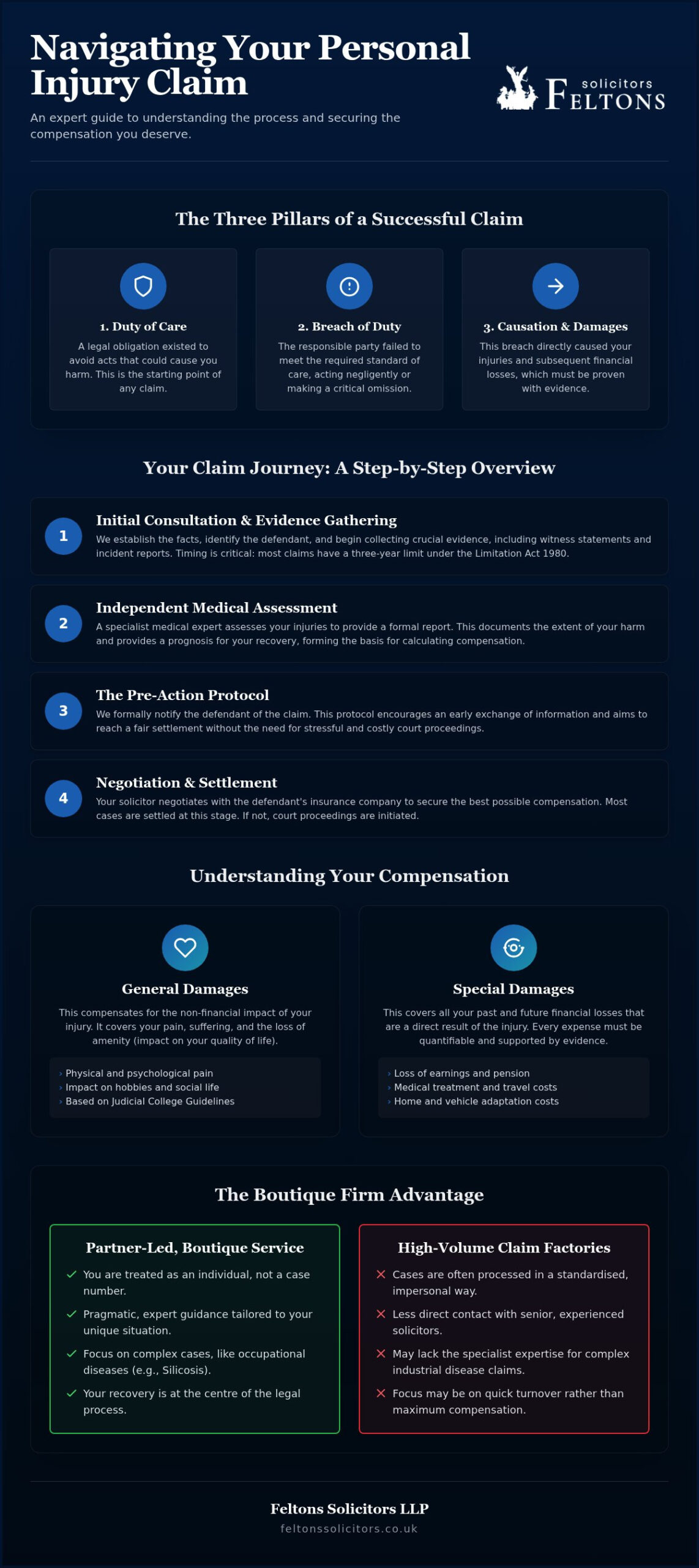
At the heart of every case lies the principle of the “Duty of Care”. This is a legal obligation to avoid acts or omissions that could reasonably be foreseen to cause harm to others. When a person or organisation fails to meet this standard, they have breached their duty. However, a breach alone isn’t enough for a claim. You must also prove that this failure directly caused your injuries and subsequent financial losses. This link between the breach and the harm is known as causation, and it’s the foundation upon which every successful claim is built.

The Legal Basis for Compensation

Proving negligence requires a methodical approach. Your personal injury solicitors must establish four key elements: duty, breach, causation, and damages. Most cases begin under the Pre-Action Protocol. This set of rules encourages parties to exchange information early and settle disputes without the need for a stressful court hearing. It’s a pragmatic way to ensure transparency from the outset and provides a structured path toward a fair settlement.

Timing is critical. Under the Limitation Act 1980, most claimants have a three-year window from the date of the accident or the “date of knowledge” of an injury to issue court proceedings. For occupational diseases that develop over decades, this clock often starts only when a medical professional provides a formal diagnosis. Missing these deadlines can permanently bar you from seeking the compensation you deserve, so early legal advice is vital.

Who Can You Claim Against?

Liability can rest with various parties depending on where the incident occurred. Identifying the correct defendant is essential for a successful outcome:

  • Employers: They have a statutory duty to provide a safe working environment, making them responsible for workplace accidents or failures in occupational health.
  • Public authorities and private landowners: These entities are accountable for maintaining safe premises, such as pavements or shopping centres, under the Occupiers’ Liability Act.
  • Road users and insurance companies: This is the most common category, covering RTA claims where a driver’s negligence has caused harm to others.

In every instance, the aim is to hold the responsible party to account whilst securing the financial support you need for your recovery. Whether you’re dealing with a local council or a multinational corporation, the legal principles remain focused on your restoration.

Specialist Personal Injury Claims: Silicosis and Occupational Diseases

Occupational diseases demand a distinct legal strategy compared to sudden physical accidents. Whilst a trip or fall is immediate, industrial illnesses often simmer for decades before symptoms emerge. This long latency period means that personal injury solicitors must act as investigators, tracing exposure back through a claimant’s entire working history. It’s a complex process. It requires more than just legal knowledge; it requires a deep understanding of industrial processes and medical pathology to prove exactly when and where the damage occurred.

Silicosis has become a focal point of high-stakes litigation, often cited as the “new asbestos” within the UK construction and stone masonry sectors. The damage is often irreversible. Unlike a one-off incident, silica dust exposure is a cumulative harm that permanently scars the lung tissue. We focus on these intricate matters, providing the partner-led attention that high-volume firms often struggle to maintain. This boutique approach ensures that the human impact of your diagnosis is never overshadowed by the technicalities of the law.

Understanding Silicosis and Silica Dust Exposure

Stone masons and construction workers are frequently exposed to respirable crystalline silica (RCS) when cutting or grinding materials like engineered stone. Employers have a strict legal duty under the Control of Substances Hazardous to Health (COSHH) regulations to suppress dust and provide adequate respiratory protective equipment. If they failed to do so, even thirty years ago, they may be held liable. For those who have lost a loved one to this condition, our guide on Silicosis Claim After Death: A Legal Guide for Bereaved Families in 2026 explains the specific steps for seeking justice on behalf of an estate.

Other Occupational Lung Diseases

Beyond silicosis, we handle claims for occupational asthma, COPD, and pleural thickening. These respiratory conditions often involve multiple past employers, some of whom may no longer exist. Our role involves tracking down historical insurers and securing expert medical evidence from leading chest physicians to support your case. This meticulous approach ensures that every contributor to your condition is held accountable. If you believe your health has been impacted by industrial negligence, reaching out to specialist personal injury solicitors can help you understand your options for a secure future.

The Personal Injury Claim Process: Step-by-Step

The journey from injury to compensation is a methodical build, rather than a sprint. It begins with an initial consultation where the merits of your case are scrutinized. Unlike high-volume firms that might use automated checklists, boutique personal injury solicitors provide a partner-led review to assess the viability of your claim. This stage is about more than just legal theory; it’s about understanding the specific ways your life has been altered and identifying a clear path toward restoration.

Once the merits are established, your legal team begins the formal process of notification. A Letter of Claim is sent to the defendant, outlining the allegations of negligence and the nature of your injuries. Under the current Pre-Action Protocol, the defendant generally has three months to investigate and provide a reasoned response regarding liability. This structured exchange of information is designed to keep the process transparent and moving toward a resolution without unnecessary delays.

Gathering Vital Evidence

Evidence is the bedrock of any successful litigation. Whilst your personal recollection is important, the legal strength of your case relies on objective documentation that leaves little room for dispute. This involves a three-pronged approach:

  • Medical Expert Reports: We instruct independent specialists to assess your injuries. Their professional opinion provides the basis for valuing your pain, suffering, and loss of amenity.
  • Special Damages Documentation: This involves a meticulous record of financial losses. You should retain every receipt, invoice, and travel log related to your injury, as these form the basis of your financial recovery.
  • Liability Evidence: Photographs of the accident scene, witness statements, and CCTV footage are gathered early to ensure the facts remain clear before memories fade or scenes change.

Settlement Negotiations and Court

Most people fear a confrontational day in court, but the reality is quite different. The vast majority of claims settle through negotiation long before a trial date is set. A key tool in this process is the “Part 36” offer. This is a formal settlement offer that carries significant cost consequences if rejected. If a defendant refuses a reasonable Part 36 offer and you later achieve a better result at trial, they may be ordered to pay additional interest and higher legal costs. It’s a pragmatic mechanism that encourages both sides to be realistic.

If the defendant denies liability or offers an inadequate settlement, the case may progress toward litigation. Even then, the focus remains on reaching an agreement. Litigation is a tool to apply pressure and ensure the defendant takes your claim seriously. Throughout this process, your solicitors act as a steady guide, ensuring you’re informed of every risk and opportunity so you can make decisions with confidence.
Personal Injury Solicitors: A Comprehensive Guide to Compensation Claims in 2026

Calculating Compensation and “No Win, No Fee” Explained

Securing a fair settlement requires a meticulous breakdown of how the injury has impacted both your health and your finances. Professional personal injury solicitors categorise these losses into two distinct areas: General Damages and Special Damages. Whilst the former addresses the intangible impact of the injury, the latter focuses on the quantifiable financial strain you have endured. This dual approach ensures that your compensation package is comprehensive, covering every facet of your recovery journey.

General Damages, often referred to as compensation for Pain, Suffering, and Loss of Amenity (PSLA), are calculated based on the severity of your condition and the length of your recovery. Special Damages, by contrast, aim to reimburse you for out-of-pocket expenses. This includes lost earnings, prescription costs, and even the value of care provided by family members. For complex cases involving long-term conditions, we also factor in future losses, such as diminished pension contributions or the cost of ongoing private medical treatment.

How Much is My Claim Worth?

To estimate the value of PSLA, we look to the 18th edition of the Judicial College Guidelines, published in April 2026. This latest update included an approximate 8.26% inflationary uplift across most injury brackets. For instance, a moderate ankle injury now carries a recommended range between £18,150 and £35,130. These figures serve as a starting point, but the final award depends on the specific nuances of your medical evidence.

The total award can be adjusted through the principle of “contributory negligence”. If the defendant proves that you were partially responsible for the incident or failed to mitigate your losses, the court may reduce your compensation by a corresponding percentage. Our role is to build a robust case that minimises these arguments and protects your full entitlement.

Demystifying No Win, No Fee

Access to justice should never be limited by your immediate financial situation. Most claims are handled via a Conditional Fee Agreement (CFA), commonly known as “No Win, No Fee”. This arrangement means that if your case is unsuccessful, you don’t pay your solicitor’s fees. To provide total protection against the defendant’s legal costs, we typically arrange “After the Event” (ATE) insurance, ensuring you face no personal financial risk during the litigation.

If you win, the solicitor’s success fee is capped by law at 25% of the compensation awarded for PSLA and past financial losses. This cap does not apply to damages for future losses, ensuring the bulk of your long-term support remains intact. Transparency is a core value of our boutique service. Following the Solicitors Regulation Authority warning notice in January 2026, we prioritise clear, plain-English explanations of all costs from the outset. If you’re ready to discuss the specifics of your case, you can speak with our expert personal injury solicitors today for a straightforward assessment of your claim.

Why Choose a Boutique Firm for Your Personal Injury Claim?

High-volume law firms often prioritise turnover, treating legal matters as a series of administrative tasks. At Feltons, we reject this “claim factory” model in favour of a boutique service that puts your recovery first. Since our establishment in 2010 by Paula Felton, our focus has remained on providing pragmatic, straightforward advice that cuts through unnecessary legal jargon. We understand the emotional weight an injury carries. It’s not just a legal file, but a significant life event that requires empathy and discretion.

Our deep-rooted expertise in dispute resolution is a significant advantage in complex personal injury settlements. It allows us to anticipate the defendant’s tactics and negotiate from a position of quiet confidence. When you choose Feltons as your personal injury solicitors, you’re partnering with a firm that values personal rapport as much as technical excellence. We believe that the human impact of our work is just as important as the technical legal outcome.

The Value of Personalised Legal Support

The most significant benefit of a boutique firm is the level of direct access you receive. You won’t be passed between junior paralegals or anonymous case handlers. Instead, you’ll have a consistent point of contact who understands every nuance of your journey. This personal connection is especially vital in high-value or complex litigation, where a tailored strategy can make the difference between an average settlement and one that truly secures your future. We take the time to listen, ensuring that sensitive family-related injury matters are handled with the worldly experience and privacy they deserve. This standard of dedicated, partner-led representation is one we share with other specialist practices internationally, including the D’Intino Law Firm, LLC in Philadelphia, who provide tailored legal support for personal injury and criminal defence matters.

Getting Started with Feltons

Taking the first step shouldn’t feel like a commitment you’re not ready to make. We offer a free, no-obligation initial assessment to discuss the viability of your claim and explain your options in plain English. This is a chance for you to experience our “people-first” philosophy before deciding how to proceed. We believe in transparency, so you’ll know exactly where you stand from the very first conversation.

If you’re currently unhappy with your current firm, you aren’t stuck. Many clients find that high-volume firms don’t provide the level of care they need, particularly in specialist areas like silicosis claims. We can handle the entire process of transferring your files, making the transition seamless and stress-free. Your recovery deserves the focus of dedicated personal injury solicitors who see you as a person, not a statistic. Contact our team today to organise your consultation and begin the journey toward the restoration you deserve.

Securing Your Path to Restoration

Restoring your quality of life after an injury requires more than just a legal settlement; it demands a partnership based on trust and expert guidance. We’ve explored how the 2026 legal landscape prioritises transparency and how a methodical approach to General and Special Damages ensures your long-term security. Whether you’re handling a straightforward accident or a complex occupational disease, the focus should always remain on your individual recovery rather than high-volume processing.

Choosing the right personal injury solicitors is the most critical decision you’ll make during this journey. At Feltons, we bring decades of combined legal experience and specialist silicosis litigation expertise to every case we handle. Our partner-led boutique service ensures you receive the discreet, high-standard care you deserve. We treat every client as an individual, never as a case number.

If you’re ready to take the next step, we invite you to contact Feltons Solicitors for a confidential discussion about your claim. We are here to provide the steady, professional support necessary to navigate these complexities with confidence. You don’t have to face this transition alone.

Frequently Asked Questions

How long do I have to make a personal injury claim in the UK?

You generally have three years from the date of the accident or the “date of knowledge” of your injury to start a claim. For occupational diseases that develop slowly over time, this period begins only when you first receive a formal medical diagnosis. If the claim involves a child, the three-year limit doesn’t start until their 18th birthday, giving them until they are 21 to take action.

Can I still claim if the accident was partly my fault?

Yes, you can still seek compensation even if you were partially responsible for the incident. This legal principle is known as contributory negligence, and it results in your final settlement being reduced by a percentage that reflects your share of the blame. For example, if you are found to be 25% at fault for not wearing a seatbelt, you would still receive 75% of the total damages awarded.

What is the average payout for a personal injury claim?

There is no fixed “average” payout because every settlement is calculated based on your unique physical and financial circumstances. Expert personal injury solicitors use the Judicial College Guidelines to value the “pain and suffering” element, whilst financial losses like lost wages are calculated separately. A minor injury might settle for several thousand pounds, whereas life-altering conditions can result in settlements exceeding £500,000 to cover long-term care.

Do I have to go to court to win my personal injury case?

It’s highly unlikely that you’ll need to attend a court hearing to resolve your case. Most claims are settled through structured negotiations or formal “Part 36” offers long before a trial date is ever set. Court proceedings are typically a last resort used only when the defendant entirely denies liability or refuses to offer a settlement that reflects the true extent of your losses.

Can I make a claim for an injury that happened years ago?

You can make a claim for an older injury if you only recently became aware that it was caused by someone else’s negligence. This “date of knowledge” rule is particularly vital for industrial diseases like silicosis, where symptoms often appear decades after the initial exposure. If you are within three years of receiving that medical diagnosis, a claim is usually still viable despite the time passed.

How much will a personal injury solicitor charge me?

Most personal injury solicitors operate on a “No Win, No Fee” basis, which means you don’t pay any legal fees upfront. If your claim is successful, the solicitor’s success fee is capped by law at 25% of your compensation for pain and past financial losses. If the case is lost, you’re protected from paying the solicitor’s fees, provided you’ve acted honestly and followed their professional advice throughout.

Can I claim compensation for an illness caused by my former workplace?

Yes, you’re entitled to claim for illnesses caused by hazardous working conditions, even if you left that employment many years ago. Employers have a statutory duty to protect your health and are required by law to hold insurance to cover such claims. We specialise in tracing these historical insurers to ensure you receive the financial support you deserve for respiratory conditions or other industrial diseases.

What happens if the person or company responsible for my injury has gone bust?

You can still pursue a claim if a company has ceased trading because the compensation is usually paid by the insurers they held at the time of the incident. In road accidents involving untraced or uninsured drivers, the Motor Insurers’ Bureau (MIB) acts as a safety net to provide the necessary payout. Even if a defendant has gone bust, the mandatory insurance they held remains accessible to satisfy your claim.

Conveyancing Solicitors in London: Expert Property Guidance for 2026

Conveyancing Solicitors in London: Expert Property Guidance for 2026

In the 2026 London property market, a standard administrative approach to legal work is no longer enough to guarantee a successful completion. Finding the right conveyancing solicitors london requires looking beyond high-volume firms that often struggle with the intricacies of modern leasehold reform. You likely feel the pressure of shifting completion timelines and the frustration of waiting days for a simple update from a case handler you’ve never met. It’s a significant investment; the lack of transparency in the legal process can make an already complex transaction feel overwhelming.

This guide provides a sophisticated roadmap for navigating these complexities, offering the boutique care and direct solicitor access required for a smooth, stress-free move. We will explore the latest 2026 Stamp Duty rates, the impact of the draft Commonhold and Leasehold Reform Bill, and how pragmatic legal advice can prevent unnecessary delays. Whether you’re navigating a high-value freehold or a complex leasehold extension, our focus remains on providing the quiet confidence and expert guidance you need to secure your property with total peace of mind.

Key Takeaways

  • Understand the vital role of a solicitor in identifying title defects that could otherwise devalue your property investment.
  • Learn how tailored due diligence protects you from future liabilities amongst varying residential and commercial property types.
  • Discover why choosing boutique conveyancing solicitors london avoids the pitfalls of high-volume firms by prioritising direct access to experienced legal partners.
  • Gain insight into specialist areas such as leasehold enfranchisement and the mandatory Registration of Overseas Entities for international owners.
  • Explore how a pragmatic, people-first philosophy helps you manage complex legal structures whilst avoiding unnecessary delays.

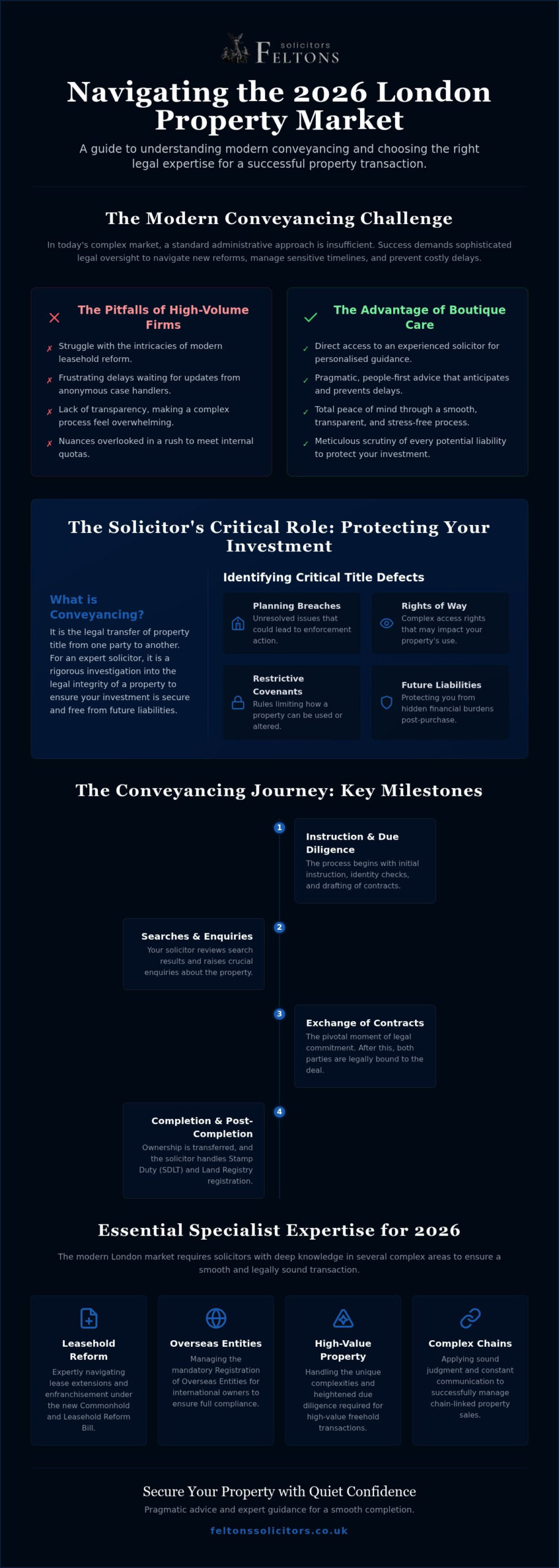
The London property market in 2026 is defined by a paradox: while technology has accelerated the initial stages of a sale, the legal complexities involved in securing a valid title have never been more demanding. Many prospective buyers ask What is conveyancing? at the start of their journey. In essence, it is the legal transfer of property title from one party to another. However, for conveyancing solicitors london, the process is far more than a simple administrative handover. It is a rigorous investigation into the legal integrity of a property to ensure your investment is protected.

A solicitor’s primary duty is to identify “title defects” that could significantly devalue a property or restrict its future use. These might include unresolved planning breaches, restrictive covenants, or complex rights of way. Whilst high-volume firms might overlook these nuances in a rush to meet quotas, a boutique firm prioritises a people-first approach. This ensures that every potential liability is scrutinised before you are legally committed. In 2026, completion timelines have remained sensitive to broader economic shifts, even with the stability suggested by Prime Minister Andy Burnham’s current property tax policies, making early and thorough legal oversight essential.

The Legal Framework of a Property Transaction

Accurate title registration with the Land Registry forms the bedrock of English property law. This state-backed register provides a definitive record of ownership, but it relies on the precision of the data submitted by your legal team during the application process. The transaction reaches its pivotal moment at the “Exchange of Contracts.” This is the point of legal commitment where the buyer and seller are bound to the deal; pulling out after this stage incurs significant financial penalties. Modern transactions also require meticulous Stamp Duty Land Tax (SDLT) compliance. With rates remaining consistent since the April 2025 adjustments, your solicitor must ensure that all tax obligations are calculated correctly to avoid future penalties from HMRC.

Why 2026 Demands Proactive Legal Oversight

The shift towards digital-first conveyancing has improved data sharing, yet it often removes the human element from the equation. At Feltons, we balance modern delivery with personal service. Complex chain-linked transactions, which are common amongst London properties, require sound judgment and constant communication to reach a successful conclusion. Pragmatic advice is the most effective tool for avoiding the common pitfalls that stall property sales. By anticipating delays and managing expectations, conveyancing solicitors london can navigate the intricacies of the 2026 market with steady, professional authority.

While residential transactions focus on securing a personal home, commercial acquisitions involve complex layers of business risk and long-term liability. Expert conveyancing solicitors london must navigate these differences with precision. For a seller, understanding the seller’s legal process is essential for a smooth handover. For a buyer, thorough due diligence is the only way to ensure that a property doesn’t come with hidden financial burdens. This scrutiny protects you from future liabilities amongst varying property types, whether you’re purchasing a South London flat or a commercial retail unit.

A typical transaction follows a structured path. It begins with the initial instruction and identity checks, moving through the drafting of contracts and the review of search results. Once the mortgage offer is secured and enquiries are satisfied, the exchange of contracts takes place. Momentum is maintained through clear communication between solicitors, lenders, and estate agents. This avoids the “black hole” of silence that often plagues high-volume firms. If you value this level of direct, personal communication, you might consider how our team can support your next move with tailored legal care.

Residential Property Law for Homeowners

Buying a home in 2026 requires a clear understanding of your tenure. Freehold ownership is generally straightforward, but leasehold properties involve ongoing relationships with freeholders and management companies. With the draft Commonhold and Leasehold Reform Bill progressing, professional advice is vital to understand how these changes affect your specific lease. Our residential property law firm guide details these nuances further. Essential searches for any purchase include:

  • Local authority enquiries to check for planning restrictions or nearby developments.
  • Water and drainage searches to confirm utility connections and public sewer layouts.
  • Environmental reports to identify potential land contamination or flood risks.

Commercial Property: Buying vs Leasing

Commercial transactions demand a different legal mindset. Developers and business owners must scrutinise “Heads of Terms” before they are formalised into a contract. These documents outline the core agreement but often lack the legal protections required in the final deed. Lease renewals also require careful timing to protect statutory rights of occupation under the Landlord and Tenant Act. Experienced conveyancing solicitors london ensure that your commercial interests are prioritised during these negotiations. Should disputes arise, Feltons provides the expertise in litigation and dispute resolution necessary to protect your investment and maintain your business continuity.

The choice of legal representation often boils down to a fundamental question of value versus price. In a market saturated with “quick quotes” and automated portals, the risk of falling into a “conveyancing factory” is real. These high-volume, low-fee models rely on processing hundreds of files simultaneously, often delegating critical tasks to junior staff or clerical teams. This approach frequently leads to the very delays and communication breakdowns that property buyers dread most. Referring to the UK government’s guide to conveyancing highlights the procedural necessity of the work, but it cannot account for the quality of the legal relationship.

Choosing boutique conveyancing solicitors london ensures that your transaction is handled with the bespoke care it deserves. At Feltons Solicitors LLP, we maintain a status as a discreet partner for high-net-worth and private clients who require more than just administrative processing. We believe that traditional professional integrity should remain at the heart of every deal. In a world increasingly dominated by automated chatbots and offshore call centres, the value of direct access to an experienced solicitor cannot be overstated. It is the difference between being a file number and being a valued client.

The Risk of Being “Just a Number”

When a firm is overstretched, the human impact of a property transaction is often forgotten. High-volume firms are prone to clerical errors and missed deadlines because their case handlers are managing impossible workloads. A dedicated solicitor can spot potential issues much earlier. This proactive oversight doesn’t just save time; it can save thousands of pounds in aborted costs if a deal is fundamentally flawed. During the high-pressure atmosphere of completion week, having a calm advisor who provides empathetic reassurance is invaluable. You deserve a partner who answers the phone.

Sound Judgment and Individualised Attention

Every property transaction is unique. Whether you’re a first-time buyer or an experienced developer, your legal strategy should be tailored to your specific goals. Feltons provides a steady, calm presence that guides you through even the most complex litigation or disputes. Our individualised attention means we understand the nuances of your situation, allowing us to offer pragmatic advice that avoids common pitfalls. For sensitive or high-value matters, this level of discreet legal support is a necessity for protecting your privacy and your assets. We prioritise your peace of mind amongst the noise of the London market.

Conveyancing Solicitors in London: Expert Property Guidance for 2026

Specialist Expertise: Leasehold Extensions and Overseas Entity Registrations

London’s property landscape is uniquely global. This international character demands a level of legal proficiency that extends far beyond the standard exchange of contracts, which is why instructing experienced conveyancing solicitors london is a strategic necessity for international buyers. For many owners, the long-term security of their investment relies on niche areas of property law that standard high-volume firms often overlook. At Feltons, we provide the specialist expertise required to manage these complexities, positioning ourselves as a discreet partner for clients with sophisticated portfolios.

Leasehold Enfranchisement and Extensions

Maintaining the length of a lease is vital for preserving a property’s market value. As a lease shortens, the cost of extending it increases, and the property becomes harder to mortgage. This is why proactive action is essential. Our leasehold enfranchisement experts provide clear, step-by-step guidance on how to secure your property rights. Beyond individual extensions, we also assist flat owners with collective enfranchisement. This process allows a group of leaseholders to buy the freehold of their building together, giving them total control over management and service charges. Acting early avoids the complications of “marriage value” and ensures your asset remains attractive to future buyers.

Registration of Overseas Entities for UK Property

The legal environment for international investors has shifted significantly with the introduction of the Register of Overseas Entities (ROE) at Companies House. Any overseas entity that owns or intends to buy UK property must now be registered. Non-compliance isn’t merely an administrative oversight; it can lead to severe criminal penalties and prevent you from selling or charging the property in the future. The requirement for transparency is absolute, and the legal consequences of failing to update the register annually are significant.

A critical part of this process is the “verification service.” Beneficial owners must have their identity verified by a UK-regulated professional before registration can be completed. We manage this intersection of property law and international compliance with meticulous attention to detail. Our guide on overseas entity beneficial owner registration offers comprehensive compliance support for those navigating these requirements. Highly specialised conveyancing solicitors london are essential when your transaction involves these international or long-term leasehold elements. We act as your sophisticated guide, ensuring that every regulatory hurdle is cleared with quiet confidence. If you require assistance with a complex registration or a lease extension, contact Feltons Solicitors LLP today for expert guidance.

The Feltons Approach: Pragmatic Advice for a Smooth Completion

The final stage of any property transaction is where the strength of your legal partner is truly tested. A successful completion isn’t merely the result of administrative processing; it’s the outcome of meticulous preparation and sound judgment. As conveyancing solicitors london, we recognise that our role is to act as a steady, calm presence amidst the inevitable pressures of a move. Our philosophy at Feltons Solicitors LLP is built on the belief that modern efficiency doesn’t have to come at the expense of traditional professional values. We combine the latest digital delivery methods with the discreet, high-standard service that our clients expect.

Even amongst the most complex litigation or disputes, our “sophisticated guide” persona helps you navigate the legal landscape with quiet confidence. We prioritise personal rapport and direct communication, ensuring you’re never left waiting for an update during a critical phase. This people-first approach means we understand the human impact of the work we do. Whether you’re moving into a new family home or expanding a commercial portfolio, our goal is to provide pragmatic advice that keeps your transaction moving forward without unnecessary delays.

A Trusted Advisor for Every Step

Property transactions often coincide with other significant life events that require expert legal oversight. Our firm provides a holistic service that extends beyond the immediate sale or purchase. We frequently assist clients with related matters such as estate planning and the drafting of wills to ensure their new assets are fully protected. Similarly, our broad expertise in divorce and financial arrangements allows us to manage property transfers with the sensitivity and discretion they require. Established in 2010 by Paula Felton, our firm offers a mark of stability and heritage that provides our clients with total peace of mind.

Next Steps: Securing Your Property Transaction

Instructing your solicitor early is the most effective way to protect your timeline. By engaging conveyancing solicitors london before an offer is even accepted, you allow us to begin the necessary due diligence immediately. This proactive approach reduces the risk of the transaction stalling during the critical early stages. To expedite the “Know Your Customer” (KYC) and anti-money laundering checks required in 2026, you should have the following documents ready:

  • Valid photographic ID, such as a current passport or driving licence.
  • Proof of address, typically a recent utility bill or bank statement.
  • Evidence of the source of funds, including bank statements or gift letters where applicable.

Choosing Feltons Solicitors LLP means choosing a partner that values your time and your privacy. We provide the professional authority of a large firm with the empathetic care and individualised attention of a boutique practice. If you’re preparing for a property move in 2026, we invite you to organise a consultation with our team to discuss your specific requirements and secure a smooth, stress-free completion.

The 2026 property market presents unique challenges that require a shift from standard administrative processing to a more tailored legal strategy. We’ve explored how direct access to experienced solicitors protects you from the pitfalls of high-volume firms, particularly when navigating the shifting landscape of leasehold reform and the mandatory Registration of Overseas Entities. Whether you’re managing a residential purchase or a complex commercial acquisition, the value of a discreet partner who prioritises your privacy and peace of mind is paramount.

Choosing the right conveyancing solicitors london ensures that your transaction is handled with high-end reliability and the pragmatic advice needed for a successful completion. At Feltons Solicitors LLP, we combine our expertise in complex property law with a boutique approach that puts your needs first. Our focus remains on delivering a smooth, stress-free experience through every stage of the legal process.

If you’re ready to move forward with quiet confidence, we invite you to instruct Feltons Solicitors for your property transaction today. Your journey toward a successful completion starts with the right legal support.

Frequently Asked Questions

How much are conveyancing fees for a London property in 2026?

Conveyancing fees in London are determined by the specific complexity of your transaction and the value of the property involved. Whilst industry averages provide a baseline, a bespoke quote from conveyancing solicitors london will account for variables such as leasehold requirements or shared ownership supplements. It’s essential to ensure your quote is transparent and includes all necessary disbursements to avoid unexpected costs during the final stages of your move.

How long does the conveyancing process typically take from offer to completion?

A typical property transaction in 2026 takes between 8 and 12 weeks to reach completion from the point an offer is accepted. This timeline is heavily influenced by the length of the property chain and the speed at which local authority searches are returned. Instructing a proactive legal team early helps maintain momentum and ensures that any potential title defects are identified and resolved before they cause significant delays.

What is the difference between a conveyancer and a solicitor?

The primary difference lies in the breadth of legal training and the scope of services provided. A solicitor is a fully qualified lawyer who can handle a wide range of legal issues, including complex litigation and estate planning, whereas a licensed conveyancer is a specialist in property law only. Choosing a solicitor provides the added security of comprehensive legal oversight should your transaction involve unexpected disputes or related family law matters.

Do I need a specialist solicitor for a leasehold property extension?

Specialist legal guidance is highly recommended for leasehold extensions because the process involves strict statutory deadlines and complex valuation calculations. Handling an extension incorrectly can lead to the loss of your right to extend or significantly higher costs. Experienced conveyancing solicitors london understand the nuances of the 2024 Reform Act and the draft 2026 Bill, ensuring your property’s long-term value is protected through precise legal execution.

What happens if a property dispute arises during the conveyancing process?

If a dispute arises, your solicitor will first attempt to find a pragmatic resolution through negotiation to keep the transaction on track. Should the matter escalate, a firm with expertise in litigation can provide the formal representation needed to protect your interests. Having a steady, professional advisor ensures that issues regarding boundary lines or restrictive covenants are handled with the necessary authority to reach a successful conclusion.

Can Feltons Solicitors help with the registration of an overseas entity?

Feltons Solicitors LLP provides a dedicated verification and registration service for the Register of Overseas Entities at Companies House. This is a critical requirement for any international entity owning or purchasing UK property to avoid severe criminal penalties. We act as a sophisticated guide for international clients, ensuring all beneficial owner information is verified and submitted in full compliance with current UK transparency laws.

What are the most common reasons for property completions to be delayed?

Completions are most frequently delayed by slow communication within a property chain or complications with mortgage offers. Technical issues, such as unresolved enquiries regarding leasehold management packs or slow local search turnarounds, also play a significant role. Choosing a boutique firm that prioritises direct solicitor access can mitigate these risks, as potential hurdles are identified and addressed much earlier in the legal process than in high-volume models.

Is it possible to complete a property transaction entirely remotely in 2026?

Property transactions in 2026 can be conducted almost entirely remotely through secure digital portals and electronic signature technology. This modern delivery allows for efficient document sharing and identity verification regardless of your physical location. Whilst most of the process is digital, some high-value transactions or specific lender requirements may still necessitate the physical posting of certain original deeds or a face-to-face verification meeting to ensure total security.

A Comprehensive Guide to Estate Planning: Protecting Your Legacy in 2026

A Comprehensive Guide to Estate Planning: Protecting Your Legacy in 2026

Did you know that in 2026, nearly 70% of digital investors still have no formal plan for their heirs to access their online assets? It is a striking figure that highlights a broader, more unsettling truth; many people mistakenly believe a simple will is enough to protect their life’s work. You likely feel a deep sense of responsibility to ensure your hard-earned assets reach the right hands. However, the fear of the state claiming a significant portion through Inheritance Tax remains a heavy burden. It’s natural to feel anxious about potential family disputes or confused by the technical gap between a basic will and a comprehensive estate planning strategy.

We believe your legacy is about more than just numbers. It is about the people you love and the values you have built. This guide provides a sophisticated roadmap to securing your assets and ensuring your family’s future remains legally protected. We will explore how to minimise tax liabilities under current thresholds, such as the frozen £325,000 nil-rate band, and provide clarity on protecting vulnerable beneficiaries. From the intricacies of the Residence Nil-Rate Band to the upcoming 2027 changes to pension taxation, we’ll help you find the peace of mind that comes from a truly robust plan.

Key Takeaways

  • Understand why estate planning is a comprehensive legal strategy that goes far beyond a simple will to include lifetime gifts and protective powers of attorney.
  • Identify the essential pillars of a robust plan, focusing on how a valid Will and a Lasting Power of Attorney work together to safeguard your interests.
  • Learn how to navigate the complexities of Inheritance Tax by utilising the Nil-Rate Band and the Residence Nil-Rate Band to protect your family’s inheritance.
  • Discover a methodical approach to auditing your global assets, including digital accounts and international property, to ensure nothing is overlooked.
  • Recognise the value of a boutique legal partner in managing complex estates and preventing future family disputes or costly litigation.

Defining Estate Planning in the Modern UK Context

Estate planning is a holistic legal and financial strategy designed to manage your assets during your lifetime and ensure their orderly distribution after your death. It is far more than just drafting a document; it is a methodical process that aligns your personal values with the practicalities of the law. By creating a comprehensive overview of estate planning, you establish a clear roadmap that protects your legacy from unnecessary tax burdens and legal ambiguity. Most importantly, it serves as a vital safeguard against the rigid, impersonal rules of intestacy, which apply when no valid plan is in place.

Beyond the Will: A Holistic Legal Strategy

Whilst a Will is the cornerstone of any legacy, it often isn’t enough to address the complexities of modern life. If you own a business, hold international assets, or have a blended family structure, a standard Will might leave significant gaps. Effective estate planning incorporates wider tools such as lifetime gifting, trusts, and the registration of Lasting Powers of Attorney. These mechanisms do more than just distribute wealth; they protect it. A well-structured plan can help shield assets from being depleted by care home costs or becoming entangled in divorce proceedings within the family. Because legislation evolves, having a dedicated solicitor ensures your strategy remains compliant with current tax laws and legal precedents.

The Risks of Inaction: Intestacy and Legal Uncertainty

Dying “intestate” means the state determines who inherits your estate based on a fixed hierarchy, regardless of your personal relationships or intentions. Under current rules in England and Wales, if you die without a Will and have a spouse and children, your partner is entitled to personal belongings and a statutory legacy of £322,000. They only receive half of the remaining estate, with the other half going to your children. This often creates unintended financial hardship and emotional distress. Without professional guidance, the risk of contentious probate disputes increases significantly. A clear, legally binding plan reduces this burden on grieving relatives, providing them with the certainty and peace of mind they need during a difficult time. It prevents the state from becoming the default architect of your family’s future.

The Essential Pillars of a Robust Estate Plan

A successful approach to estate planning relies on several interconnected legal instruments. Relying on a single document is like building a house without a roof; it might look complete, but it won’t withstand the elements. Beyond the Will, which acts as your primary instruction manual, you must consider tools that protect you whilst you’re still alive and others that manage your wealth long after you’ve gone. These pillars provide a framework that ensures your wishes are followed precisely, regardless of what the future holds.

The foundation is a valid Will. It is the only way to ensure your assets are distributed exactly as you intend. Without it, your estate is subject to the rigid rules of intestacy. To support this, many people also include a Letter of Wishes. This is a non-binding document that provides your executors with personal guidance on matters such as funeral arrangements or the specific distribution of sentimental items. It adds a human touch to the clinical precision of a legal Will.

Lasting Power of Attorney: Protecting Your Interests During Life

An LPA is arguably as vital as a Will. It grants a person you trust the authority to make decisions on your behalf if you lose mental capacity. There are two distinct types: Health and Welfare, and Property and Financial Affairs. Many younger professionals and business owners overlook this, assuming it’s a concern for the distant future. However, if an accident or illness leaves you unable to manage your business interests or personal bank accounts, your family could face a costly application to the Court of Protection. The legal process of registering an LPA with the Office of the Public Guardian takes time, so it’s a step that should be taken whilst you are fit and healthy. If you’re unsure where to start, you can organise your estate planning with the help of a specialist to ensure every base is covered.

Trusts and Asset Protection: Sophisticated Legacy Management

Trusts are sophisticated legal vehicles that allow you to dictate how and when beneficiaries receive their inheritance. They are particularly effective for protecting minor children or vulnerable relatives who might struggle to manage a large lump sum. For those with complex property portfolios, trusts can help manage the transition of ownership across generations whilst potentially offering protection from third-party claims. If your estate includes international property, you must also be aware of the overseas entity beneficial owner registration requirements to ensure your holdings are compliant with current UK law. Whilst your executors will eventually follow official probate guidance to settle your affairs, having these structures in place now reduces the administrative and emotional burden they will face later.

Inheritance Tax is often the most significant concern for those embarking on estate planning. It can feel like a silent partner in your financial life, waiting to claim a portion of what you have worked to build. Currently, the standard Nil-Rate Band remains frozen at £325,000 until April 2031. However, many homeowners can also benefit from the Residence Nil-Rate Band (RNRB), which provides an additional £175,000 allowance when passing a main residence to direct descendants. Understanding these Inheritance Tax thresholds and rules is the first step toward mitigation. For married couples or civil partners, these allowances are transferable, potentially creating a combined tax-free threshold of £1 million.

Reliefs and exemptions play a critical role in sophisticated planning. Transfers between spouses are generally tax-free, and leaving at least 10% of your net estate to charity can reduce your overall IHT rate from 40% to 36%. For business owners, Business Property Relief (BPR) is an essential tool. As of April 6, 2026, 100% relief for business and agricultural assets is capped at a combined £2.5 million per individual. Above this threshold, relief is reduced to 50%, making precise valuation and early advice vital for those with significant commercial interests. For estates valued at more than £2 million, the RNRB is also tapered, reducing by £1 for every £2 that the estate exceeds the threshold.

Strategic Gifting and the Seven-Year Rule

Gifting assets during your lifetime is an effective way to reduce the taxable value of your estate. Most significant gifts are considered Potentially Exempt Transfers (PETs), which only become entirely tax-free if you survive for seven years after making the gift. You must be cautious of the ‘Gift with Reservation of Benefit’ rule. You cannot, for example, gift your family home to your children whilst continuing to live there rent-free, as HMRC will still view it as part of your estate. You can, however, utilise your annual £3,000 gift allowance or make small gifts of up to £250 per person each tax year without any IHT implications.

Life Insurance and Pensions in Estate Planning

Pensions have traditionally been one of the most tax-efficient ways to pass on wealth, as they usually sit outside your estate for IHT purposes. However, from April 6, 2027, most unused defined-contribution pension pots will become subject to Inheritance Tax, a change that will affect thousands of families. Life insurance policies should also be managed with care; by writing a policy in trust, the payout goes directly to your beneficiaries rather than forming part of your legal estate. If your circumstances involve complex family dynamics or former partners, consulting a divorce and financial arrangements lawyer ensures your tax strategy doesn’t conflict with existing legal obligations.

A Comprehensive Guide to Estate Planning: Protecting Your Legacy in 2026

The Estate Planning Process: A Methodical Approach

Transitioning from understanding legal tools to implementing them requires a disciplined, step-by-step methodology. Effective estate planning begins with a comprehensive audit of your entire financial landscape. This isn’t limited to your bank balance; it includes international property holdings, business interests, and outstanding liabilities. You must also identify your primary objectives. Are you prioritising maximum tax efficiency, the protection of a vulnerable relative, or the smooth continuity of a family business? Clear goals determine which legal structures will serve you best and provide the necessary certainty for your executors.

Assessing Your Global Assets and Liabilities

We recommend creating what many call an “Estate Bible”. This is a secure, centralised record for your executors that lists every account, insurance policy, and property you own. For those with significant real estate interests, working with a residential property law firm ensures that complex title issues or leasehold extensions are resolved before they become probate problems. Don’t forget your digital legacy. With 85.6% of digital investors failing to include online assets in their Wills as of 2026, ensuring access to cryptocurrency, social media, and cloud-stored photos is a critical modern requirement that prevents your digital life from being locked away forever.

Preventing Contentious Probate and Family Disputes

The human cost of a poorly drafted plan often manifests in painful family conflict. Contentious probate is on the rise, but professional oversight can significantly reduce the likelihood of a successful challenge. Precise drafting and the inclusion of objective explanations for your decisions help manage expectations and discourage legal disputes amongst beneficiaries. We often use “no-contest” clauses or detailed solicitor’s file notes as vital evidence of your mental capacity and intentions at the time of signing. This level of detail provides a robust shield for your executors, ensuring your wishes are followed whilst protecting your loved ones from the trauma of litigation.

Once your documents are executed, your plan shouldn’t sit in a drawer gathering dust. Review your affairs at least every five years or following major life events such as marriage, divorce, or the birth of grandchildren. Legislation and personal circumstances change, and your strategy must evolve alongside them to remain effective. To begin your own methodical review and ensure your affairs are in order, you can contact our estate planning team for a discreet, professional consultation.

Feltons Solicitors LLP understands that legal documents are only as effective as the strategy behind them. Since our establishment in 2010 by Paula Felton, we’ve prioritised a boutique level of care that high-volume firms often struggle to replicate. We combine traditional professional integrity with modern efficiency to ensure your affairs are handled with the discretion they deserve. Our people-first philosophy means we never lose sight of the human impact of our work. Whether we’re drafting a simple Will or managing complex international litigation, our focus remains on providing a calm, steady presence. We act as a sophisticated guide, navigating you through the nuances of the law whilst ensuring your personal connection to the firm remains at the heart of our service.

A Discreet, Boutique Service for Complex Estates

High-net-worth individuals often face unique challenges that require more than a template-driven approach. We specialise in providing tailored solutions for those with intricate family structures or diverse asset portfolios across multiple jurisdictions. Having a single point of contact who understands your entire history is invaluable; it ensures that your estate planning remains cohesive and aligned with your long-term vision. For those seeking deeper insights into legacy protection, our complete guide to estate planning offers further details on how we safeguard complex holdings. We handle everything from residential conveyancing to the registration of overseas entities, ensuring no part of your global footprint is left exposed to unnecessary risk or tax liability.

Securing Your Future with Pragmatic Legal Advice

Choosing the right solicitor is the most important decision you’ll make in this process. We’re committed to providing pragmatic advice in plain English, avoiding the dense, archaic legalese that often leads to confusion. Our professional fees are transparent and fair, ensuring you feel in control of the process from the very first meeting. The initial consultation is designed to be a thorough yet reassuring experience where we listen to your concerns and map out a bespoke strategy. We believe that estate planning shouldn’t be a source of anxiety; it should be a source of confidence. Our firm is deeply rooted in the community yet possesses the worldly experience necessary to handle international-scale matters with ease. Take the first step towards securing your family’s future and achieving true peace of mind today.

Secure Your Legacy with Certainty and Care

Effective estate planning is about more than just wealth; it’s about providing your family with a clear, conflict-free future. By addressing the essential pillars, from robust Wills to Lasting Powers of Attorney, and navigating the frozen £325,000 Nil-Rate Band, you ensure your assets remain in the right hands. A methodical audit of your global and digital holdings prevents the state from becoming the default architect of your family’s inheritance and ensures your wishes are followed precisely.

Established in 2010 by Paula Felton, Feltons Solicitors LLP specialises in complex property and private client law. We provide pragmatic, people-first legal advice tailored to your unique circumstances. Whether you’re managing a domestic estate or intricate international interests, we act as your trusted advisor to ensure every legal detail is meticulously handled. Take the first step towards true peace of mind and contact Feltons Solicitors LLP for a discreet estate planning consultation. You’ve worked hard to build your legacy; now, let us help you protect it for the generations to come.

Frequently Asked Questions

What is the difference between a will and estate planning?

A Will is a specific legal document that dictates how your assets are distributed after death, whilst estate planning is a comprehensive strategy for managing your affairs during your lifetime and beyond. It encompasses a wider range of tools, including Lasting Powers of Attorney, trusts, and tax mitigation tactics. Whilst a Will is the foundation, a full plan ensures that your financial, legal, and personal interests are protected against unforeseen circumstances like incapacity or excessive tax liabilities.

How much can I leave to my children before they pay Inheritance Tax?

Under current 2026 rules, an individual can typically leave up to £500,000 to their children tax-free by combining the £325,000 Nil-Rate Band with the £175,000 Residence Nil-Rate Band. For married couples or civil partners, these allowances are transferable, allowing for a combined threshold of up to £1 million. Anything above these limits is generally taxed at 40%, unless specific exemptions or charitable reliefs apply to the remainder of the estate.

Do I need a solicitor for estate planning, or can I do it myself?

Whilst you can legally draft your own documents, professional legal oversight is strongly recommended for anyone with complex assets, business interests, or international property. A solicitor ensures that your documents are technically valid and structured to minimise tax liabilities effectively. Professional guidance also provides vital evidence of mental capacity and intent, which significantly reduces the likelihood of your wishes being challenged through contentious probate litigation later.

What happens to my estate if I do not have a will?

If you die without a Will, your estate is distributed according to the rigid rules of intestacy rather than your personal wishes. In England and Wales, a surviving spouse is entitled to all personal belongings, a statutory legacy of £322,000, and half of the remaining estate. The other half is divided amongst your children. This often creates financial uncertainty and may leave unmarried partners with no automatic inheritance rights at all.

Can estate planning protect my home from being sold for care home fees?

Certain legal structures, such as life interest trusts or severing a joint tenancy, can help protect a portion of your home’s value for your beneficiaries. However, you must be cautious of ‘deprivation of assets’ rules, where the local authority may challenge transfers made specifically to avoid care costs. Because this area of law is highly nuanced, it requires a bespoke approach to ensure your plan is both effective and legally compliant.

How often should I review my estate plan and will?

We recommend reviewing your estate plan and Will at least every five years to ensure they still reflect your wishes and current legislation. You should also update your documents immediately following major life events, such as marriage, divorce, or the birth of a child. Significant changes in your financial situation, such as purchasing international property or starting a business, also necessitate a professional review to maintain the plan’s effectiveness.

What is a Lasting Power of Attorney and why is it part of estate planning?

A Lasting Power of Attorney (LPA) is a legal document that appoints trusted individuals to make decisions on your behalf if you lose mental capacity. It is a vital part of estate planning because it protects your interests whilst you are still alive. Without an LPA, your family might have to undergo a costly and lengthy application to the Court of Protection to manage your bank accounts, business affairs, or health care needs.

Can I include my digital assets, like social media and cryptocurrency, in my estate plan?

Yes, you should absolutely include digital assets like cryptocurrency, social media accounts, and online photo libraries in your plan. As of 2026, a significant majority of people still haven’t made provisions for their digital legacy, which can lead to these assets being lost forever. Including a specific digital asset clause and providing your executors with clear instructions on how to access these platforms is now an essential part of modern legacy protection.