
Collective Enfranchisement: A Complete Guide to Buying Your Freehold in 2026

Collective Enfranchisement: A Complete Guide to Buying Your Freehold in 2026

If you feel like a tenant in a home you supposedly own, you aren’t alone. With over 4.9 million leasehold properties in England, many homeowners face the same frustrations of escalating ground rents and a total lack of control over building insurance or maintenance. It is a distressing position to be in, especially when a diminishing lease makes your property increasingly difficult to sell. However, the legal right to collective enfranchisement offers a powerful solution, allowing you and your neighbours to join forces and purchase the freehold of your building outright.

We understand that the prospect of challenging a landlord can feel daunting, but taking this step is often the most effective way to future-proof your investment. This guide provides a clear, professional roadmap for navigating the current legal landscape in 2026. You will discover how to abolish ground rent, grant yourselves 999-year leases, and finally assume the authority your home deserves. From understanding the latest legislative updates to managing the coordination of your fellow leaseholders, we have outlined everything you need to know to secure your building’s future with confidence.

Key Takeaways

  • Understand the eligibility criteria, including the 50% participation rule, to determine if your building qualifies for a freehold purchase.
  • Learn how collective enfranchisement allows you to abolish ground rent entirely and grant yourselves 999-year leases to maximise property value.
  • Discover the importance of a formal participation agreement and specialist professional guidance in coordinating neighbours and meeting strict legal requirements.
  • Identify common procedural errors, such as missing statutory deadlines, that could potentially void your claim and cause unnecessary delays.
  • Gain a clear roadmap for taking full management control of your building, from insurance to maintenance, ensuring long-term security for your investment.

What is Collective Enfranchisement and Who is Eligible?

Collective enfranchisement is the statutory right that empowers leaseholders to join forces and purchase the freehold of their building. This process transforms your relationship with your home, moving you from the position of a tenant to a co-owner of the entire structure. For a deeper understanding of the legal framework and its origins, exploring What is Collective Enfranchisement? offers a useful foundation for this legal right. To trigger this process, at least 50% of the qualifying tenants in the block must participate. If the building contains only two flats, both owners must agree to the purchase to proceed.

The building itself must meet specific structural and usage criteria. It must be a self-contained building, or a self-contained part of a building, containing at least two flats. A critical factor is the proportion of commercial space within the premises. Currently, the non-residential floor area, such as shops or offices, must not exceed 25% of the total internal floor area. If your building’s commercial footprint is larger than this threshold, it won’t qualify under the rules applicable in 2026.

The Impact of the Leasehold and Freehold Reform Act 2024

The legal landscape in 2026 is significantly more accessible due to recent legislative shifts. On 31 January 2025, the government abolished the two-year ownership requirement for participants. This change means you can now participate in a claim from the very day you complete your property purchase. These reforms reflect a clear shift in favour of the leaseholder, simplifying the path to ownership and removing many of the traditional hurdles that previously protected landlords. Whilst there’s ongoing discussion about increasing the commercial limit to 50%, the 25% rule remains the active standard for claims initiated today.

Buildings That Do Not Qualify

Whilst the right is broad, certain properties remain exempt from the collective enfranchisement process. National Trust properties and specific Crown lands are protected from these claims. You might also find yourself ineligible if you live in a converted house with a resident freeholder, provided the building contains no more than four units and the freeholder has lived there as their only or principal residence for at least twelve months. Certain charitable housing trusts are also exempt, ensuring their property portfolios remain intact for their social purposes.

To qualify as an individual, you must hold a long lease. This is defined as a lease originally granted for a term of more than 21 years. It doesn’t matter if you live in the flat or if it’s an investment property; as long as you meet the “long lease” definition, you’re generally eligible to participate. This inclusivity ensures that a wide range of homeowners can take control of their building’s management and long-term financial health.

The Financial Benefits: Why Buying the Freehold Makes Sense in 2026

Undertaking collective enfranchisement is often the single most effective way to protect your property’s long-term market value. By removing the external freeholder, you eliminate the burden of escalating ground rents, which have become a significant point of concern for both mortgage lenders and prospective buyers. Once the freehold is secured, participating members can grant themselves “peppercorn” lease extensions, typically for a term of 999 years. This effectively removes the “ticking clock” of a diminishing lease, making the property far more attractive to future purchasers who prioritise “Share of Freehold” status.

Management control provides another direct financial advantage. Instead of being tied to the freeholder’s choice of expensive insurance providers or maintenance contractors, you gain the authority to tender these services yourself. This often leads to a marked reduction in annual service charges and better quality of care for the building’s infrastructure. If you’re unsure about the initial requirements for your block, reviewing The Collective Enfranchisement Process can help your group understand the preparatory steps needed to secure these savings.

Calculating the Premium and the End of Marriage Value

The premium is the price you pay the landlord for the freehold, determined by specialist surveyors who assess the loss of ground rent and the reversionary value of the building. Marriage value is the potential increase in value when a lease is extended or the freehold is bought. Whilst the Leasehold and Freehold Reform Act 2024 contains provisions to abolish marriage value for leases under 80 years, as of August 2026, these specific changes have not yet been implemented. This makes accurate professional valuation essential to ensure your group doesn’t overpay during negotiations whilst the older valuation rules remain in force.

Understanding the Total Cost of Enfranchisement

Budgeting for the project requires looking beyond the premium itself. Participating leaseholders are responsible for their own legal and valuation fees, as well as the landlord’s “reasonable” professional costs. Under current 2026 regulations, the rule requiring each side to bear their own costs is not yet in force, so the freeholder’s expenses remain a factor in your final budget. Many groups choose to distribute these costs through a formal participation agreement to ensure financial transparency amongst neighbours. For those seeking a tailored legal assessment of these potential costs, professional guidance can help streamline the process and prevent unexpected disbursements.

The Collective Enfranchisement Process: A Step-by-Step Roadmap

The foundation of a successful collective enfranchisement claim is the early and effective coordination of your group. Before any legal notices are served, we recommend drafting a formal participation agreement. This contract binds your neighbours to the project, ensuring everyone contributes their share of the costs and remains committed throughout the process. Once the group is aligned, you’ll need to instruct a specialist valuer to estimate the premium and a solicitor to manage the complex legal requirements. These professionals provide the steady guidance needed to navigate the statutory timetable without missing critical deadlines.

The formal process begins with the service of a Section 13 Initial Notice on the freeholder. This document triggers a strict legal timetable, giving the landlord at least two months to respond with a Counter-Notice. This response will either accept your right to buy or dispute it, often proposing a higher premium than your initial offer. It’s during this phase that the expertise of your legal team becomes invaluable, as they’ll handle the nuances of the landlord’s response and prepare for the negotiation stage.

Forming a Right to Enfranchise (RTE) Company

Most leaseholders choose to form a limited company to hold the freehold title. This structure provides a clear framework for ownership, where each participating leaseholder typically holds one share. Appointed directors from amongst the residents then oversee the building’s management post-completion, ensuring every decision reflects the collective’s best interests. When calculating the financial viability of this structure, it’s worth noting the availability of Stamp Duty Land Tax relief, which can provide substantial savings for collective claims.

Negotiation and the First-tier Tribunal

Following the Counter-Notice, there’s a statutory period for price negotiations. Your valuer will work to find a middle ground with the landlord’s surveyor, focusing on a fair market price. If an agreement isn’t reached within the required timeframe, an application can be made to the First-tier Tribunal (Property Chamber) to determine the premium. Once the price is settled, the process concludes with the TR1 transfer form and registration at HM Land Registry. This final step officially transfers the building’s ownership to your group, marking the beginning of your full control over the property.

Collective Enfranchisement: A Complete Guide to Buying Your Freehold in 2026

Common Pitfalls and How to Avoid Them

Success in collective enfranchisement depends on meticulous attention to detail. Because this is a statutory process, the law is exceptionally rigid regarding timelines and documentation. Missing a statutory deadline by a single day, such as the window to apply to a tribunal after receiving a Counter-Notice, is often enough to void the entire Section 13 Notice. This forces the group to wait twelve months before they can legally serve a new notice, during which time property values may rise or lease terms may shorten further.

Inaccurate information is another frequent hurdle. Every participant’s name and property description must match the Land Registry records exactly. If a notice is served with even a minor clerical error, a landlord may successfully challenge the validity of the claim in court. We also advise that all participants have their portion of the premium and professional fees secured in a dedicated account before the process begins. If a neighbour loses their funding mid-way, the remaining group may struggle to cover the shortfall, potentially leading to a costly withdrawal. Withdrawing from the project after the notice has been served usually triggers a requirement to pay the landlord’s “reasonable” legal and valuation costs up to that point.

If you are concerned about procedural errors or require a specialist review of your enfranchisement claim, professional oversight is the most reliable way to safeguard your investment.

Dealing with Missing or Absent Landlords

It is a common misconception that a missing freeholder prevents you from buying the freehold. If the landlord cannot be found after “reasonable” enquiries, your group can apply to the County Court for a Vesting Order. This legal mechanism allows the court to sign the transfer documents on the landlord’s behalf. The premium is then paid into court, where it is held in a special account should the freeholder eventually come forward to claim it.

Managing Non-Participating Tenants

Whilst you only need 50% of qualifying tenants to proceed, managing those who choose not to join requires careful financial planning. The participating group must “buy out” the entire freehold, including the portions related to the flats of non-participants. This increases the initial cost for those taking part. Crucially, non-participants do not receive the benefits of the project; they will not be granted 999-year leases and must continue paying ground rent to the new resident-owned company.

How Feltons Solicitors Facilitates Your Path to Freehold Ownership

Securing the freehold of your block is a significant legal undertaking that requires a steady, experienced hand. At Feltons Solicitors LLP, we act as a calm presence throughout the entire process, positioning ourselves as dedicated leasehold enfranchisement experts who prioritise your long-term property interests. We understand that the coordination of multiple neighbours can be complex. We provide the structured support necessary to keep your project moving forward. Our team manages every detail, from the initial drafting of participation agreements to the final registration of your new ownership at HM Land Registry.

We pride ourselves on a “people-first” philosophy. Whilst the technicalities of property law are paramount, we never lose sight of the human impact our work has on your home life and financial security. Our pragmatic approach focuses on resolving disputes with landlords efficiently, ensuring that your collective enfranchisement claim doesn’t become bogged down in unnecessary litigation. We translate complex legal requirements into plain English, giving you the confidence to make informed decisions for your building’s future.

Our National Property Law Expertise

Our experience extends across the country, handling claims for buildings ranging from small residential blocks to large, mixed-use developments. Mixed-use properties often present unique challenges, particularly regarding the 25% commercial floor space limit mentioned earlier in this guide. We possess the specialist knowledge required to handle both residential and commercial conveyancing aspects of these transactions. To ensure you pay a fair premium, we work in seamless integration with qualified surveyors, providing a unified strategy that protects your group from overvaluation or procedural delays.

Take the First Step Toward Building Control

Early legal consultation is vital for a successful collective claim. Many pitfalls, such as missing statutory deadlines or serving notices with incorrect tenant information, can be avoided with professional oversight from the outset. We assist your group in the formal formation and administration of your RTE Company, ensuring the structure is robust and ready to hold the freehold title. If you’re ready to abolish ground rent and take full management control, we invite you to contact our specialist team to discuss your building’s eligibility and begin your journey toward ownership.

Secure Your Property’s Future with Confidence

Buying your freehold is more than a legal transaction; it’s a strategic move to reclaim control and protect your home’s market value. By navigating the collective enfranchisement process, you can finally eliminate ground rent and secure the long-term stability of a 999-year lease. Whilst the 2026 legal landscape offers significant advantages for leaseholders, the strict statutory deadlines and complex coordination required amongst neighbours make expert oversight essential to a successful outcome.

At Feltons Solicitors, our specialist leasehold enfranchisement team provides the pragmatic and discreet legal advice needed to handle even the most intricate claims. With national UK coverage, we act as your sophisticated guide from the initial participation agreement to final registration. If you are ready to transition from leaseholder to freeholder, contact Feltons Solicitors for expert guidance on your collective enfranchisement claim. Taking this step today ensures your building remains a well-managed, high-value asset for years to come.

Frequently Asked Questions

How many tenants need to participate in collective enfranchisement?

At least 50% of the qualifying tenants in the building must participate. If the building has only two flats, both owners must join the claim. This threshold ensures the collective has the legal mandate to force the sale. It’s a critical first step in the collective enfranchisement process to confirm your group meets this statutory requirement amongst your neighbours before serving any formal notices.

Can a landlord refuse collective enfranchisement?

No, a landlord cannot refuse if the building and the tenants meet the statutory eligibility criteria. Whilst they can dispute the premium or the boundaries of the land being purchased, they cannot simply say no to the right itself. If a landlord attempts to obstruct a valid claim, the matter can be referred to the First-tier Tribunal (Property Chamber) for a legally binding determination.

How long does the collective enfranchisement process take?

The process typically takes between nine and twelve months from the service of the Initial Notice to final completion. This timeline accounts for the statutory response periods, valuation negotiations, and the legal work required for the transfer of title. If the case proceeds to a tribunal due to a dispute over the premium, the timeframe can extend significantly beyond a year.

Do I still have to pay service charges after buying the freehold?

Yes, you’ll still need to contribute to the cost of maintaining and insuring the building. The difference is that you and your fellow participants, usually through an RTE company, will now control how that money is spent. You gain the authority to choose contractors and insurance providers directly, which often results in more competitive rates and better service quality than a third-party landlord provides.

What happens to the ground rent once we own the freehold?

Ground rent is effectively abolished for all participating leaseholders once the freehold purchase is complete. Your group can grant yourselves new 999-year leases at a peppercorn rent, which means no money is actually paid. This removes the financial burden of escalating fees and makes your property far more attractive to future buyers and mortgage lenders who are increasingly wary of high ground rents.

Can we buy the freehold if some neighbours don’t want to join?

Yes, you can proceed as long as at least 50% of the qualifying tenants participate. The participating group will need to cover the cost of the entire freehold, including the portions attributed to the non-participating flats. Those who don’t join will remain leaseholders; they’ll pay their ground rent and service charges to your new resident-owned company instead of the old landlord.

What is the difference between Right to Manage and Collective Enfranchisement?

Right to Manage (RTM) allows leaseholders to take over the management of their building without buying the freehold. Collective enfranchisement is a more permanent solution where you actually purchase the ownership of the building and land. Whilst RTM gives you control over service charges and maintenance, enfranchisement also allows you to abolish ground rent and extend your own leases to 999 years.

Will buying the freehold increase the value of my flat?

Buying the freehold typically increases a property’s value by making it a Share of Freehold asset. This status is highly desirable because it removes the risks associated with short lease terms and escalating ground rents. Prospective buyers and lenders view these properties as more secure investments, often leading to a higher sale price and a faster transaction when you eventually decide to move.

Commercial Litigation Solicitor London: Expert Dispute Resolution in 2026

Commercial Litigation Solicitor London: Expert Dispute Resolution in 2026

What if the most successful outcome for your business dispute never involves stepping foot inside a courtroom? It’s a natural reaction to feel overwhelmed by the prospect of escalating legal costs and the intricate maze of the Civil Procedure Rules. You’ve worked hard to build your brand, and the thought of a public, drawn-out battle is understandably stressful. Most business leaders simply want a resolution that allows them to move forward without sacrificing their reputation or their bottom line.

Securing an expert commercial litigation solicitor is the first step toward regaining control. This guide provides a comprehensive look at navigating disputes in 2026, offering the pragmatic advice needed to manage risks discreetly and effectively. We’ll explore the latest solicitor guideline hourly rates, recent court fee adjustments, and the shifting trends in alternative dispute resolution. By the end of this article, you’ll have a clear understanding of the costs involved and a strategic plan to protect your commercial interests with quiet confidence. At Feltons Solicitors LLP, our goal is to provide the steady, professional guidance required to resolve conflicts whilst keeping your business objectives firmly in sight.

Key Takeaways

  • Understand that commercial litigation encompasses both formal court proceedings and the strategic legal advice provided long before a claim is issued.
  • Learn why early neutral evaluation is a vital tool for assessing the strength of your case and determining the most effective legal strategy.
  • Discover how an experienced commercial litigation solicitor london can demystify the litigation lifecycle, using the Pre-Action Protocol to achieve early resolution.
  • Explore the advantages of Alternative Dispute Resolution (ADR) and mediation as sophisticated, cost-effective methods for reaching creative settlements outside of court.
  • Gain insight into the value of a boutique legal partnership, which prioritises direct access to senior solicitors and a highly personalised, “people-first” approach.

What is Commercial Litigation and When is it Necessary?

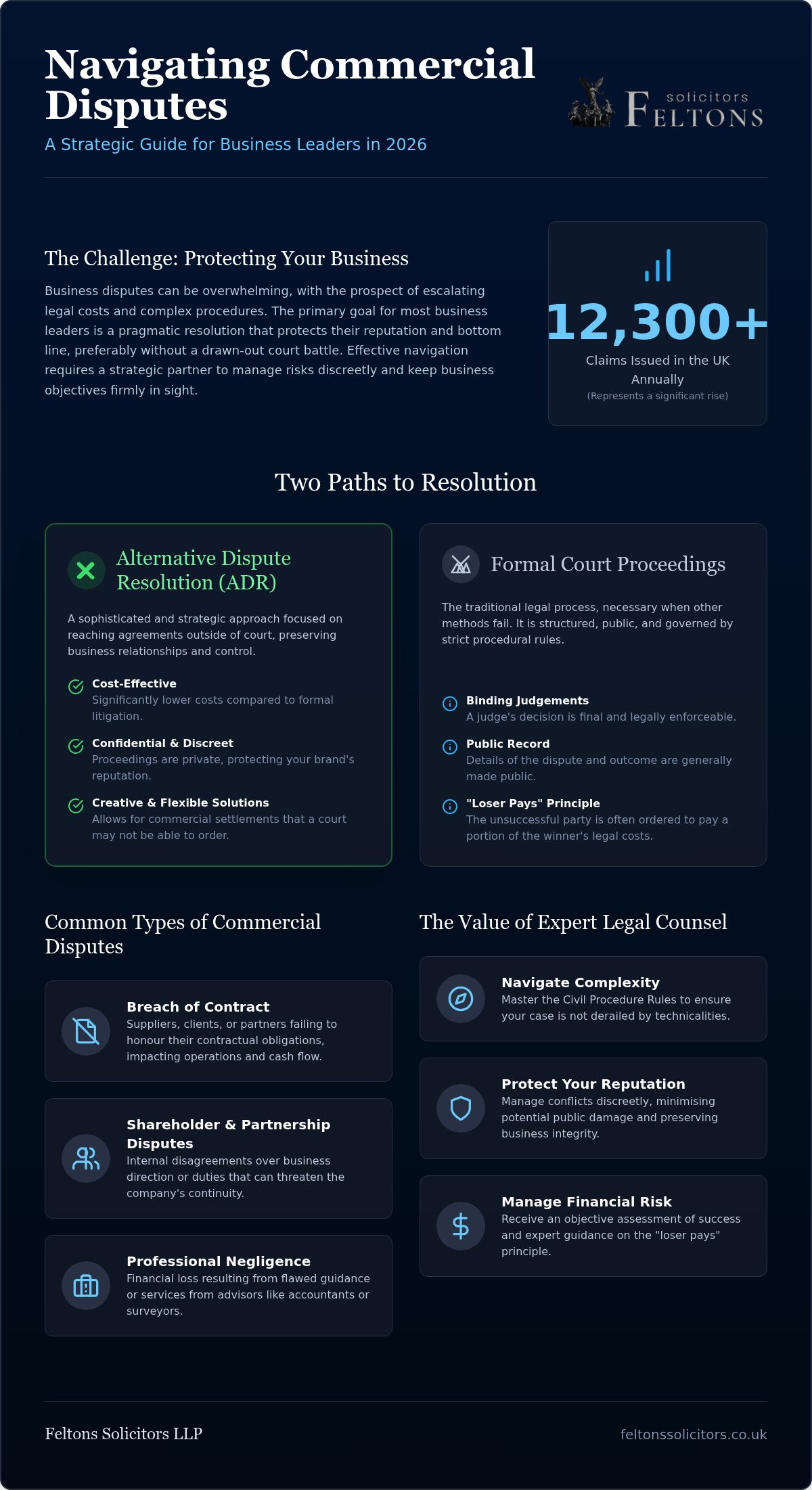
Commercial litigation is the formal legal process of resolving disputes between business organisations or individuals within a commercial context. It’s a broad and often misunderstood field. Whilst many people associate the term with high-stakes trials and courtroom drama, it’s actually a much more nuanced discipline. It encompasses the strategic, high-standard advice given long before a claim is ever issued. A commercial litigation solicitor london acts as a discreet partner, working to protect your business interests whilst seeking the most pragmatic path forward. Their role is to provide a calm, steady presence during what can be an incredibly stressful period for any company director or business owner.

The Scope of Business Disputes

Disputes are often the result of broken promises or misaligned expectations. In 2026, the landscape of commercial conflict continues to evolve, but several core triggers remain constant. These conflicts can stall growth and drain resources if not handled with precision. Common areas of dispute include:

  • Breach of contract: These claims involve suppliers, clients, or service providers who fail to honour their contractual obligations, which can directly impact your cash flow.
  • Shareholder and partnership disputes: Internal disagreements can be particularly damaging. They often threaten the very continuity of the business and require a “people-first” approach to resolve.
  • Professional negligence: When an advisor, such as an accountant or surveyor, provides flawed guidance, the resulting financial loss can be severe.

Why Businesses Seek Specialist Legal Representation

The complexity of the English legal system shouldn’t be underestimated. Navigating the procedural hurdles of the High Court or understanding the specific functions of a What is a Commercial Court? requires specialist expertise. It isn’t just about knowing the law; it’s about mastering the Civil Procedure Rules to ensure your case isn’t derailed by technicalities. An experienced commercial litigation solicitor london ensures that every step taken is methodical and orderly.

Specialist representation provides an essential, objective perspective. When you’re in the middle of a conflict, it’s difficult to assess the merits of your position without bias. An expert provides a realistic view of your chances of success. They also manage the significant financial risks involved. With the “loser pays” principle in the UK, a failed claim can result in heavy cost orders. A trusted advisor manages this process discreetly, minimising potential reputational damage and ensuring that any resolution allows the business to move forward with its integrity intact.

In 2026, the UK commercial landscape is increasingly active. Recent data shows that over 12,300 claims were issued in the most recent annual reporting period, representing a significant rise from previous years. Successfully managing these conflicts requires more than just legal knowledge; it demands a strategic approach that prioritises your company’s long-term health. One of the most effective tools for achieving this is early neutral evaluation. This process involves an independent expert providing a non-binding assessment of the case, allowing an experienced commercial litigation solicitor london to refine your strategy before significant costs are incurred.

Contractual and Tortious Claims

Most disputes originate from contractual failures or disagreements over professional obligations. Under the Sale of Goods Act, a breach of contract is defined as a failure by the seller to provide goods that are of satisfactory quality, fit for purpose, or exactly as described. Beyond these statutory protections, businesses often grapple with misrepresentation, where a party is induced into a contract by false statements. These can range from negligent oversights to deliberate fraud. We also see frequent cases of tortious interference, where a third party intentionally damages your business relationships or induces a breach of contract. These matters require a methodical investigation to protect your commercial standing and recover lost revenue.

Property and Leasehold Disputes

Commercial litigation frequently overlaps with property law, as business premises are often a company’s most significant asset. Whether you’re dealing with dilapidations at the end of a tenancy or complex lease renewals, the stakes are high. Engaging with a commercial property law firm ensures that your physical assets don’t become a financial liability. We also see a rise in disputes involving leasehold enfranchisement experts, particularly regarding commercial ground rents and service charge disagreements. Instructing a commercial litigation solicitor london ensures that these property-based conflicts are handled with the same rigour as any other corporate dispute.

A sensitive but increasingly common area involves business assets within an estate. Contentious probate occurs when the distribution of a deceased partner’s shares or property is challenged by beneficiaries or third parties. Managing these disputes requires a “people-first” philosophy to ensure the business remains operational whilst the legal issues are resolved. Understanding The Litigation Process is the first step toward a pragmatic resolution. If you’re concerned about a potential conflict, consulting a specialist in litigation and dispute resolution can provide the calm, expert guidance needed to protect your interests.

The Litigation Process: A Step-by-Step Guide for Businesses

The prospect of litigation often feels like entering a labyrinth without a map. However, the process is highly structured and designed to encourage resolution at every stage. A commercial litigation solicitor london serves as your navigator, ensuring you understand the implications of each procedural step before it’s taken. By demystifying the lifecycle of a claim, we can reduce the anxiety of the “unknown” and allow you to focus on your core business operations.

From Pre-Action to Trial

The journey begins long before a judge is involved. The Pre-Action Protocol is a mandatory stage where parties exchange detailed information to explore settlement options. It’s a vital opportunity for early resolution that can save significant time and capital. If a settlement isn’t reached, the formal process follows a methodical path:

  • 1. Pre-action correspondence: Issuing a formal Letter of Claim that outlines the legal basis for the dispute and the remedy sought.
  • 2. Issuing and serving: Filing the Claim Form and Particulars of Claim with the court to officially start proceedings.
  • 3. Defence and Counterclaim: The defendant’s opportunity to respond to the allegations or bring their own claims against the claimant.
  • 4. Disclosure: A critical phase where both sides must share relevant documents. You have a strict legal duty to preserve all evidence, including emails and digital records, from the moment a dispute is anticipated.
  • 5. Trial and enforcement: The final hearing where a judge makes a binding decision. If successful, your commercial litigation solicitor london will then manage the enforcement of the judgment to ensure you receive what is owed.

Managing Costs and Risks

In English and Welsh law, the general rule is that the “loser pays” a significant portion of the winner’s legal costs. This principle makes thorough risk assessment paramount from the outset. To mitigate financial exposure, many businesses utilise After the Event (ATE) insurance, which provides a safety net for legal disbursements and the opponent’s costs if the claim is unsuccessful. It’s also vital to remember that approximately 90% of commercial cases settle before reaching a full trial. One of the most effective strategies for achieving this is the “Part 36 offer”. This is a formal settlement offer that carries heavy cost penalties for the party that rejects it and then fails to beat it at trial. It’s a powerful tool for exerting pressure and securing a pragmatic, discreet resolution.

Commercial Litigation Solicitor London: Expert Dispute Resolution in 2026

Resolving Disputes Outside of Court: ADR and Mediation

While the court process is robust, it isn’t always the most efficient way to settle a business conflict. Alternative Dispute Resolution (ADR) has evolved into a sophisticated suite of tools designed to bypass the adversarial nature of the High Court. For many businesses, the goal isn’t just to “win” a legal battle; it’s to find a pragmatic resolution that allows operations to continue without distraction. An experienced commercial litigation solicitor london will often recommend ADR as a primary strategy to protect your interests whilst keeping costs manageable.

The English judiciary now places a heavy emphasis on these methods. Under the Civil Procedure Rules, there is a clear expectation that parties will explore ADR before proceeding to a full trial. Refusing to engage in mediation without a valid reason can result in severe cost penalties, even for the winning party. Beyond avoiding sanctions, ADR offers the invaluable benefit of confidentiality. Court hearings are generally public, but ADR takes place behind closed doors. This discretion is essential for protecting your brand reputation and ensuring that sensitive commercial data remains private.

The Benefits of Mediation

Mediation is perhaps the most flexible form of ADR. It involves a neutral third party who facilitates a discussion between the disputing sides. Unlike a judge, a mediator doesn’t impose a decision; instead, they help the parties reach a voluntary agreement. This process allows for creative solutions that a court simply cannot provide, such as restructuring a future business relationship or adjusting contract terms. The advantages for a company are clear:

  • Preserving relationships: Mediation focuses on finding common ground, which is vital for maintaining long-term partnerships that might otherwise be destroyed by aggressive litigation.
  • Speed of resolution: Mediation can often be organised and concluded within weeks, whereas the court timetable can stretch for years.
  • Greater control: You remain in the driving seat of the final settlement rather than leaving the outcome to a judge’s discretion.

Arbitration and Expert Determination

For more technical or international matters, other forms of ADR may be more appropriate. Arbitration is frequently used in cross-border disputes, as the resulting awards are often easier to enforce internationally than court judgments. It offers a more formal structure than mediation but remains private. Expert determination is another useful tool, particularly for disagreements involving complex financial valuations or technical specifications. In these cases, an independent expert in the relevant field makes a binding decision. Choosing the right path requires a steady hand and a deep understanding of your commercial objectives. If you are facing a business conflict and require a tailored approach, our specialists in litigation and dispute resolution can guide you through the ADR process with quiet confidence.

Instructing Feltons Solicitors: A Boutique Approach to Litigation

Choosing the right legal partner is a strategic decision that goes beyond technical ability. Large, high-volume firms often lack the personal touch required for sensitive business matters. At Feltons Solicitors LLP, we offer a sophisticated blend of professional authority and empathetic reassurance. As a boutique commercial litigation solicitor london, we prioritise a “people-first” philosophy. This ensures that whilst the technical legal work is paramount, the human impact on your business and its stakeholders is never forgotten.

Instructing a commercial litigation solicitor london with a boutique focus ensures your case receives the individualised attention it deserves. We position ourselves as a calm, steady presence in the face of complex or stressful situations. Our firm projects an image of high-end reliability, providing the discreet, high-standard service that modern businesses require to resolve disputes without unnecessary public exposure.

Pragmatic Advice Tailored to Your Business

Our approach is rooted in providing a steady hand during turbulent times. We act as a trusted advisor, moving beyond mere service provision to become a partner in your success. One of our core commitments is the use of plain English. We believe that accessible legal advice is essential for making informed decisions. By stripping away dense legalese, we ensure you have a clear understanding of the risks and costs involved at every stage. This transparency builds the quiet confidence needed to navigate even the most stressful litigation.

Direct access to senior solicitors is a cornerstone of our service. You won’t be passed between junior associates; instead, you’ll benefit from the direct oversight of experienced professionals who understand the nuances of your industry. This methodical and orderly mindset reflects our commitment to traditional professional integrity whilst embracing modern efficiency. We focus on pragmatic resolutions that allow your business to move forward, rather than getting bogged down in unnecessary procedural battles.

Experience Across Multiple Jurisdictions

Whilst we maintain the personal rapport of a boutique firm, our experience is global in scale. From our London-based hub, we handle both national and international dispute resolution with high-end reliability. Established in 2010 by Paula Felton, our firm has the worldly experience necessary to manage cross-border matters. We ensure that your interests are protected regardless of where the conflict originates, providing a seamless service for international clients; for example, those requiring specialised criminal defence in Chile can rely on the technical proficiency of Abogado Penal Temuco in the Araucanía Region.

We possess the sophisticated expertise required to handle complex, international-scale matters whilst remaining human and accessible. This dual capability, being deeply rooted and community-conscious yet possessing a global outlook, is what defines the Feltons Solicitors LLP difference. We combine modern efficiency with traditional values to deliver results that protect both your reputation and your bottom line. To discuss your requirements, contact Feltons Solicitors LLP for a discreet consultation.

Securing Your Business’s Future Through Strategic Resolution

Resolving a commercial dispute is rarely just about the legal technicalities; it’s about protecting the future of your enterprise. We’ve explored how the litigation lifecycle is designed to encourage settlement and why methods like mediation offer a discreet, cost-effective alternative to the courtroom. Whether you’re facing a breach of contract or a complex property disagreement, the right strategy prioritises your commercial objectives whilst managing the inherent risks of the UK legal system.

Partnering with a specialist commercial litigation solicitor london ensures you have a steady, experienced guide by your side. Since 2010, Feltons Solicitors has provided high-standard legal support with a pragmatic, people-first approach that addresses both domestic and international challenges. We combine the depth of experience found in larger firms with the personal connection and senior-level access of a boutique practice. If you’re ready to move past a conflict and refocus on growth, instruct Feltons Solicitors for expert commercial litigation support. You don’t have to face these complexities alone; professional, discreet guidance is just a consultation away.

Frequently Asked Questions

What is the difference between commercial litigation and dispute resolution?

Dispute resolution is an umbrella term for any method used to settle a conflict, whereas commercial litigation refers specifically to the formal process of resolving disputes through the court system. Litigation is just one path within the wider dispute resolution landscape. An expert commercial litigation solicitor london will often use alternative methods like mediation or negotiation first to achieve a pragmatic result without the need for a full trial.

How much does a commercial litigation solicitor cost in the UK?

Can I resolve a business dispute without going to court?

Most commercial disputes are successfully resolved without a court hearing through negotiation or Alternative Dispute Resolution (ADR). Mediation is a highly effective tool that allows parties to reach a voluntary settlement with the help of a neutral third party. These private methods are generally faster and less expensive than traditional litigation, and they provide businesses with greater control over the final outcome and their public reputation.

How long does a typical commercial litigation case take to conclude?

The timeline for a commercial case varies based on its complexity, but many matters take between 12 and 24 months to reach a final trial. Simpler claims may be resolved within months through the Pre-Action Protocol or early settlement negotiations. However, complex cases involving international jurisdictions or extensive document disclosure usually require a longer period to ensure all evidence is meticulously prepared and reviewed by the court.

What happens if I lose a commercial litigation case?

If you lose a case, the court usually orders you to pay a substantial portion of the winning party’s legal costs. This “loser pays” rule is a fundamental part of the legal system in England and Wales. You’ll also be responsible for your own legal fees and any financial judgment awarded against you. To mitigate these risks, many clients utilise insurance products or strategic settlement offers like a Part 36 offer during the process.

Is commercial mediation legally binding?

Mediation is a non-binding process until the parties involved reach a consensus and sign a formal settlement agreement. Once this written agreement is signed by both sides, it becomes a legally binding contract that can be enforced in court. This allows businesses to find creative, flexible solutions to their problems whilst ensuring that the final resolution has the full weight of the law behind it.

What are the most common reasons for commercial disputes in 2026?

Breach of contract remains the primary driver of commercial conflict in 2026, frequently involving supply chain failures or payment disagreements. There is also a documented increase in ESG-related litigation and disputes arising from the implementation of artificial intelligence. Other common triggers include shareholder disagreements, professional negligence claims, and property-based conflicts such as commercial lease renewals and service charge disputes that impact business continuity.

Can Feltons Solicitors handle international commercial litigation?

Feltons Solicitors possesses the worldly experience necessary to handle complex international matters from our London hub. Established in 2010, the firm has a proven track record in both national and international dispute resolution. We act as a discreet partner for clients across various jurisdictions, providing the high-standard, pragmatic advice expected of a leading commercial litigation solicitor london while maintaining a highly personalised boutique approach that prioritises your specific business objectives.

Financial Settlement in Divorce UK: A Strategic Guide to Protecting Your Future (2026)

Financial Settlement in Divorce UK: A Strategic Guide to Protecting Your Future (2026)

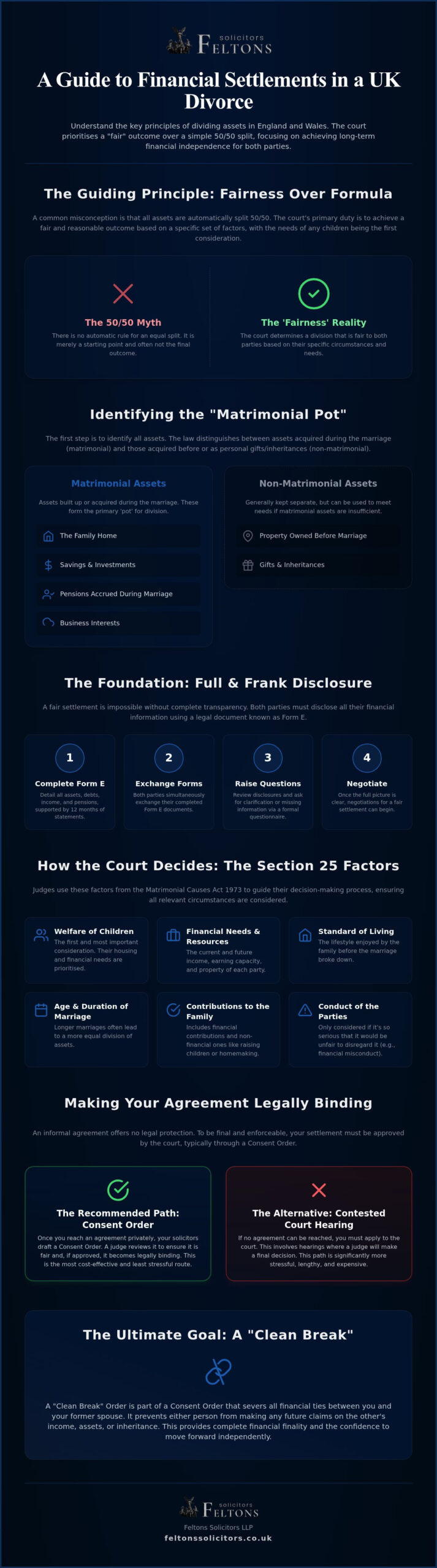
A common misconception is that a financial settlement divorce uk always begins and ends with a simple 50/50 split of assets. In reality, the English court system prioritises a “fair” outcome over a purely mathematical one, which often leads to significant confusion and anxiety during an already difficult transition. You might be worried about maintaining your standard of living or fear that matrimonial assets are being shielded from view. These concerns are entirely valid, as the decisions made today will dictate your financial independence for years to come.

We understand that you need more than just legal definitions; you require a steady, sophisticated guide to help you protect what you have built. This article provides the professional clarity you need to navigate these complexities, ensuring your assets are protected and your long-term interests are secured. We will examine the strategic importance of pension sharing, the latest 2026 capital gains tax implications for separating couples, and the most effective ways to reach a private agreement that achieves a legally binding “clean break” whilst avoiding the stress of a contested court hearing.

Key Takeaways

  • Understand how a formal agreement provides the legal certainty of a “clean break” to protect your future earnings and assets.
  • Learn why full and frank disclosure via Form E is the essential foundation for a fair financial settlement divorce uk.
  • Discover how the court applies Section 25 factors to determine asset division, moving beyond the common myth of an automatic 50/50 split.
  • Recognise why a court-approved Consent Order is the only way to make your private agreement legally binding and final.
  • Gain insight into managing complex assets, such as business interests and shareholdings, to ensure a strategic and tailored outcome.

What is a Financial Settlement in a UK Divorce?

A financial settlement is the formal process of dividing money, property, and pensions following the breakdown of a marriage. It’s often misunderstood as a simple administrative step, but it’s actually the most critical component of your post-divorce security. A financial settlement is the legal mechanism that terminates financial claims between spouses. Without this formal agreement, your financial relationship with your ex-partner remains legally “open,” even after the marriage itself has ended.

Many people mistakenly believe that receiving a Final Order (formerly known as a Decree Absolute) concludes all obligations. This is a risky assumption. While the Final Order legally dissolves the marriage, it doesn’t prevent a former spouse from making a claim against your assets or income in the future. The legal framework for Divorce in England and Wales allows for financial claims to be made many years after the split unless a court-approved order is in place. Securing a financial settlement divorce uk is the only way to ensure that your future earnings, inheritances, or business successes remain entirely yours.

The Matrimonial vs Non-Matrimonial Asset Distinction

The first step in any settlement is identifying what actually sits within the “matrimonial pot.” Matrimonial assets generally include everything acquired during the marriage, such as the family home, joint savings, and pensions built up whilst you were together. These are typically the starting point for any division. Non-matrimonial assets are different; these include property owned before the wedding, or gifts and inheritances received by one person during the marriage.

It’s vital to understand that the distinction isn’t always absolute. The court has the discretion to “mingle” non-matrimonial assets if they’re needed to meet the financial requirements of either party or the children. For example, if an inheritance was used to pay off the mortgage on the family home, it may lose its “non-matrimonial” status. Detailed records and strategic legal advice are essential to protect these specific assets from being absorbed into the general pot.

The Importance of a Clean Break Order

The ultimate goal of most negotiations is a “clean break” order. This is a specific type of court order that dismisses all future financial claims between you and your ex-spouse. Once it’s sealed by the court, neither party can return to ask for more money or a share of future assets. It provides the total finality needed to move forward with confidence.

A clean break isn’t always appropriate for every couple. In cases where there’s a significant disparity in earning power or where one parent has sacrificed their career to raise children, ongoing spousal maintenance might be required instead. However, for the majority of modern divorces, achieving finality is the primary objective. A robust financial settlement divorce uk focuses on creating a fair distribution today to prevent legal or financial complications tomorrow. By prioritising a clean break, you’re not just dividing what you have; you’re protecting what you’ll build in the future.

The Process of Financial Disclosure: Using Form E

Transparency isn’t just a legal requirement; it’s the foundation of your future security. To achieve a fair financial settlement divorce uk, both parties must provide full and frank disclosure of their financial positions. This is primarily achieved through Form E, a comprehensive document that was updated on 6 February 2026 to ensure all modern asset classes are captured. It requires you to detail every income stream, asset, and liability you hold, supported by documentary evidence such as 12 months of bank statements and pension valuations. It’s a significant undertaking, but it’s the only way to ensure the final agreement is robust and beyond reproach.

Solicitors don’t simply accept the figures provided at face value. We verify disclosure through a methodical review of financial records and expert reports. Failure to disclose assets can lead to a settlement being set aside years later, potentially reopening the entire case at a much higher emotional and financial cost. Achieving a “clean break” relies entirely on the honesty of this initial phase.

Step-by-Step: From Initial Disclosure to Negotiation

Once both parties exchange their Form Es, the process moves into a phase of clarification. We raise “Questionnaires” to address any gaps or discrepancies in the other party’s disclosure. This isn’t about being confrontational; it’s about achieving total clarity. We may also require formal valuations for property, pensions, and business interests to ensure we’re working with accurate figures. After we’ve agreed on the value of the assets, we move to “Open Proposals.” This is where the strategic negotiation begins, moving from raw data to a structured plan for your post-divorce life.

Dealing with Non-Disclosure and Hidden Assets

The fear that an ex-partner is hiding wealth is a common source of anxiety during a financial settlement divorce uk. The court takes non-disclosure extremely seriously and can issue cost orders or draw “adverse inferences” against the dishonest party, essentially assuming they have more wealth than they’ve admitted. In complex cases, we often use forensic accounting to trace diverted funds or uncover hidden matrimonial wealth. Total honesty is the only way to ensure the finality of your Consent Order. If you suspect assets are being withheld, seeking guidance from experts in divorce and financial arrangements will help you protect your rightful share and ensure no stone is left unturned.

How the Court Determines “Fairness”: The Section 25 Factors

The myth that every financial settlement divorce uk results in a perfect 50/50 split often creates unrealistic expectations. While an equal division is frequently the starting point for long marriages, the court’s ultimate objective is “fairness” rather than simple arithmetic. This fairness is determined by the Section 25 factors of the Matrimonial Causes Act 1973. These factors act as a statutory checklist that judges and solicitors use to tailor an outcome to the specific circumstances of your family. Crucially, the primary consideration in every case is the welfare of any children under the age of 18, ensuring their housing and financial needs are prioritised above all else.

Needs are the most influential factor in most UK financial settlements, encompassing the essential requirements for housing and income to ensure both parties can live independently. If an equal split doesn’t meet the basic needs of a primary caregiver or a lower-earning spouse, the court will deviate from 50/50 to achieve a functional, fair result. This pragmatic approach ensures that neither party is left in a state of undue hardship following the separation.

Key Criteria for Asset Division

When assessing how to distribute wealth, the court examines each party’s income and earning capacity, including any potential increase in earnings they might reasonably achieve in the foreseeable future. This isn’t just about what you earn today; it’s about your ability to support yourself moving forward. The standard of living enjoyed by the family before the breakdown also plays a role, though it’s often difficult to maintain two households on the same income that previously supported one. Additionally, the duration of the marriage and the age of each party are vital. A twenty-year marriage where one partner stayed at home will be treated very differently from a two-year marriage between two young professionals with independent careers.

Contributions and Conduct

The English legal system places equal value on financial and non-financial contributions. The role of a “homemaker” who managed the household and cared for children is considered just as significant as that of the “breadwinner” who generated the matrimonial wealth. This prevents a higher-earning spouse from claiming a larger share simply because they were the primary source of income.

Clients often ask if their ex-partner’s behaviour will affect the financial settlement divorce uk. In practice, “conduct” is only taken into account if it’s so extreme that it would be “inequitable to disregard it.” This is a very high bar and rarely met in standard divorce proceedings. Instead of focusing on past grievances, we focus on protecting your position through logical, evidence-based arguments that reflect your total contribution to the marriage, ensuring you receive a settlement that respects your history and secures your future.

Financial Settlement in Divorce UK: A Strategic Guide to Protecting Your Future (2026)

Reaching a verbal agreement with your ex-partner is a positive step, but it doesn’t provide the legal finality you need. This informal stage is often referred to as “heads of agreement.” However, to truly secure a financial settlement divorce uk, this agreement must be drafted into a formal Consent Order and sealed by a judge. The court must approve your agreement even if you both agree to the terms because a judge has an independent duty to ensure the settlement is fair and meets the needs of both parties, particularly any children involved. For a deeper look at the specific steps involved in safeguarding your wealth, see our guide on Protecting Your Assets During a Divorce Settlement.

The timeline for obtaining a financial order runs alongside the divorce itself. You can submit a Consent Order to the court once you have reached the Conditional Order stage (formerly Decree Nisi). As of 13 July 2026, the court fee for a Consent Order is £62. Once the judge signs the order, it becomes a legally binding document that prevents future claims, providing the “clean break” that is essential for your peace of mind.

The Path of Litigation: When Agreement Fails

If negotiations stall, the court provides a structured pathway to resolve the dispute. The First Appointment (FDA) focuses on managing the timetable, identifying the core issues, and ensuring all valuations are in place. The most significant stage is the Financial Dispute Resolution (FDR) appointment. Here, a judge reviews the proposals and gives an “indication” of what they would likely order at a trial. This hearing is “without prejudice,” meaning the judge’s comments can’t be used later, which encourages both parties to settle. A high percentage of cases conclude at the FDR stage. If a settlement still isn’t reached, the case proceeds to a Final Hearing, where a judge makes a binding decision on your behalf after hearing evidence from both sides; for those self-representing, you may choose to Find a McKenzie Friend to provide support during these proceedings.

Alternative Dispute Resolution (ADR)

Alternative Dispute Resolution (ADR) offers a more personal, discreet route that allows you to maintain control over the outcome. Mediation and collaborative law are excellent options for couples who wish to avoid the adversarial nature of a courtroom. Many of our clients also benefit from a “private FDR.” This involves hiring a senior barrister or retired judge to act as the adjudicator for a full day. It offers a boutique level of service, allowing for greater speed and total discretion whilst avoiding the delays currently found in the public court system.

At Feltons, we organise bespoke negotiation strategies that prioritise your privacy and long-term stability. If you’re ready to secure your financial future, our experts in divorce and financial arrangements are here to provide the steady, professional guidance you deserve.

High-net-worth divorces require a depth of expertise that standard template approaches simply cannot provide. When a financial settlement divorce uk involves business assets, minority shareholdings, or complex professional practices, the stakes are significantly higher. Valuation is rarely straightforward in these scenarios. It’s not just about the current balance sheet; it’s about liquidity, tax efficiency, and the long-term viability of the enterprise. For those requiring a more tailored methodology, we offer Discreet Legal Support for High Net Worth Divorce to ensure your commercial interests are shielded from unnecessary disruption.

International elements add another layer of intricacy. Whether it’s a holiday home in Europe or a complex trust structure based abroad, navigating different jurisdictions requires a global perspective. We assist with the registration of overseas entities and ensure that any settlement reached is enforceable across borders. This prevents the risk of a “paper victory” where assets remain out of reach despite a favourable court ruling.

Bespoke Asset Protection Strategies

Protecting your wealth often involves ring-fencing non-matrimonial property through meticulous legal drafting. If you entered the marriage with significant assets or received a substantial inheritance, it’s vital to ensure these don’t become part of the general matrimonial pot. We also pay close attention to pension sharing orders. Pensions are often a couple’s most valuable asset alongside the family home. They require a specific court order to be implemented and carry long-term tax implications that must be addressed at the point of settlement. Our goal is to create a pragmatic framework that is both fair today and robust enough to withstand future challenges.

The Feltons Approach: Calm, Steady, and Sophisticated

At Feltons, we believe that the technical precision of the law must be balanced with a boutique level of care. We position ourselves as a calm, steady presence during what is often a period of significant upheaval. Our philosophy centres on personal connection; you aren’t just another case file to us. We prioritise discreet, high-standard service that values traditional professional integrity whilst embracing modern, efficient delivery methods. This approach ensures that while your legal interests are fiercely protected, the human impact of the process is never forgotten. If you require a sophisticated guide to navigate your financial settlement divorce uk, Speak with a specialist family solicitor at Feltons today.

Securing Your Financial Independence

Achieving a successful financial settlement divorce uk requires a shift in focus from short-term emotion to long-term stability. The path to true finality relies on a court-approved Consent Order to ensure a clean break and protect your future wealth from subsequent claims. As we have explored, fairness is rarely a simple 50/50 calculation; it is a nuanced assessment of your specific needs, contributions, and family welfare. By prioritising full disclosure and strategic negotiation, you can move forward with the confidence that your assets are secure.

Since 2010, Feltons Solicitors LLP has provided a discreet boutique service rooted in a people-first philosophy. We combine our expertise in complex litigation with a calm, steady approach that prioritises your personal rapport and privacy. If you are ready to navigate these complexities with a sophisticated guide, consult our specialist divorce and financial arrangements lawyers today. You don’t have to face this transition alone; the right professional support will help you build a firm foundation for the next chapter of your life.

Frequently Asked Questions

How is a financial settlement calculated in the UK?

Calculations are based on the Section 25 factors of the Matrimonial Causes Act 1973. The court examines the welfare of any children first, followed by the financial needs, earning capacity, and the standard of living enjoyed by each party. There is no fixed mathematical formula; instead, each case is assessed on its unique merits to reach a fair and functional outcome.

Do I have to share my pension in a divorce settlement?

Pensions are matrimonial assets and are often the most valuable part of a financial settlement divorce uk. While you don’t always have to share them, they must be valued and taken into account during negotiations. A judge can issue a Pension Sharing Order to transfer a specific percentage of one party’s pension fund to the other, ensuring long-term security for both individuals.

Can my ex-partner claim money after our divorce is finalised?

Yes, financial claims remain legally open even after the marriage has ended unless they’re formally dismissed by a court order. Without a sealed Consent Order, an ex-spouse could potentially make a claim against your future inheritance, business success, or lottery wins many years later. Finalising the divorce itself only ends the marriage, not the financial relationship.

What is a Consent Order and why do I need one?

A Consent Order is a legally binding document that sets out the financial agreement you’ve reached and requires a judge’s approval. You need one to achieve a “clean break,” which prevents either party from making further financial claims against the other in the future. As of 13 July 2026, the court fee for submitting a Consent Order is £62.

How long does it take to reach a financial settlement?

The timeline varies depending on the complexity of your assets and the level of cooperation between both parties. An amicable settlement documented by a Consent Order typically takes between six and twelve months to conclude alongside the divorce process. If the case requires court litigation, the process can often extend to 18 months or longer.

What happens to the family home in a divorce?

The family home can be handled in several ways depending on what’s fair for the family’s future. It may be sold with the proceeds divided, or one party might buy out the other’s interest to remain in the property. In cases involving children, the court may delay the sale until the youngest child finishes their education to ensure they have a stable home.

Is a 50/50 split mandatory in UK divorce law?

No, a 50/50 split isn’t mandatory, although it’s often the starting point for long marriages. The court’s primary goal is to achieve a fair outcome that meets the practical needs of both parties. If one person has a much lower earning capacity or primary care of the children, they’ll often receive more than half of the matrimonial assets.

What if my spouse refuses to disclose their finances?

If a spouse refuses to provide full and frank disclosure, the court can issue an order compelling them to produce the necessary documents. Failure to comply can lead to cost penalties or the court drawing “adverse inferences,” where the judge assumes the party has assets they’re trying to hide. Total transparency is a strict requirement for a financial settlement divorce uk to be legally sound.