
Freehold Purchase Solicitors: A Definitive Guide to Securing Your Property Rights in 2026

Freehold Purchase Solicitors: A Definitive Guide to Securing Your Property Rights in 2026

Why should you continue paying for the ground beneath your feet when the law now offers a clearer path to total ownership? It’s a question many leaseholders face as they watch ground rents climb and feel the weight of a shortening lease impact their property’s saleability. We understand that managing a leasehold can feel like an endless cycle of rising costs and limited control over your own home.

Engaging expert freehold purchase solicitors is no longer just a legal formality; it’s a strategic move to reclaim control over your building and eliminate the burden of marriage value costs forever. You deserve the peace of mind that comes with full land ownership and the significant market value increase it brings. We’ll show you how to navigate these complexities whilst protecting your investment for the long term.

This guide explores the nuances of collective enfranchisement and the latest 2026 regulatory reforms. We’ll walk through the essential steps to secure your property’s future, ensuring you have the knowledge to move forward with confidence and professional clarity.

Key Takeaways

  • Understand why transitioning from leasehold to freehold is a vital move for your property’s market value and long-term autonomy in 2026.
  • Learn the essential differences between individual house purchases and collective enfranchisement for flats to identify the right legal path for your home.
  • Discover how specialist freehold purchase solicitors help you calculate the purchase premium and navigate the valuation process to ensure a fair price.
  • Master the statutory timeline from serving initial notices to managing landlord counter-notices without unnecessary delays or disputes.
  • Identify the specific criteria for selecting a legal partner who combines modern efficiency with a deep understanding of complex leasehold law.

Understanding Freehold Purchase: Why Transitioning from Leasehold is a Strategic Move

Owning a leasehold property is fundamentally different from owning the land itself. Whilst you have the right to occupy the space for a set period, you remain a tenant in the eyes of the law. Transitioning to a freehold interest changes this dynamic entirely, moving you from a position of restricted occupancy to absolute ownership. Experienced freehold purchase solicitors help facilitate this shift, ensuring the legal title to the land and the building is transferred securely into your hands.

The property landscape changed significantly in 2026. Government reforms have targeted the most punitive aspects of leasehold, such as escalating ground rents that previously rendered many flats unsellable. These changes make the path to freehold acquisition more transparent and financially viable than ever before. By acting now, you can lock in the benefits of these reforms and protect your home from future legislative shifts that might favour landlords.

The Long-Term Financial Impact of Leasehold Restrictions

Ground rent clauses are a primary concern for modern homeowners. Many older leases contain “doubling” clauses that see ground rent swell every decade, often exceeding the thresholds set by mortgage lenders. This makes remortgaging or selling nearly impossible without a formal lease extension or a freehold purchase. Marriage value represents the increase in the property’s total value following the merger of the leasehold and freehold interests, which must be shared with the landlord if the lease has fewer than 80 years remaining. Beyond this, landlords retain a “reversionary interest,” meaning they technically regain full possession of the property once the lease expires. Securing the freehold eliminates this leverage, ensuring your asset remains yours indefinitely.

Autonomy and Building Management

Buying your freehold allows you to adopt a “landlord mindset.” You’re no longer at the mercy of a third-party freeholder or an unresponsive management company. Through the process of Collective Enfranchisement, you and your neighbours can take over the building’s management. This provides the freedom to choose your own contractors, select competitive insurance providers, and ensure maintenance is carried out to your standards rather than the cheapest bidder’s.

The administrative benefits are equally compelling. Leaseholders often face exorbitant fees for “licences to alter” or permissions for simple lifestyle choices, such as keeping a pet. Freehold ownership removes these bureaucratic hurdles. Working with freehold purchase solicitors ensures these restrictive covenants are properly addressed during the transfer, providing you with true autonomy over your living space and eliminating unnecessary service charge disputes.

The route to owning your freehold depends largely on the architecture of your home. It’s not a one-size-fits-all process. For owners of houses, the path is often a solo journey, whilst flat owners must act in unison with their neighbours. Understanding these distinctions is the first step in any successful claim. Expert freehold purchase solicitors can help you determine your building’s eligibility, particularly concerning the “25% rule.” This rule dictates that if more than a quarter of the building’s internal floor area is used for non-residential purposes, such as shops or offices, the building may not qualify for statutory purchase. For the most recent updates on these thresholds, the UK Government’s Leasehold Toolkit provides a comprehensive overview of how 2024 reforms have refined these criteria.

Buying the Freehold of a House

If you own a leasehold house, your rights are primarily governed by the Leasehold Reform Act 1967. The process is generally more straightforward than for flats, but it isn’t without complexity. You no longer need to worry about the restrictive two-year residency rules that once hampered claims, as recent reforms have largely abolished these requirements for most leaseholders. One common pitfall occurs when a house is part of a “managed estate.” In these instances, you might secure the freehold of the building but remain tied to estate management charges for shared gardens or private roads. It’s vital to have your residential conveyancing documents reviewed early to understand exactly what land is included in the transfer.

Collective Enfranchisement for Flat Owners

For those in blocks of flats, the process is known as Collective Enfranchisement. It’s a powerful statutory right that allows at least 50% of the qualifying tenants to join forces and buy the freehold. This requires high levels of coordination amongst residents. You’ll typically need to set up a “Nominee Purchaser” company to hold the title on behalf of the participating residents. This company becomes the new landlord, giving you direct control over the building’s future. If you’re dealing with a “missing landlord” who cannot be found, don’t lose hope. Your freehold purchase solicitors can apply for a Vesting Order through the County Court, allowing the sale to proceed even in the landlord’s absence.

Finally, keep a close eye on any “Section 5” notices. If your landlord decides to sell the freehold to a third party, they’re legally required to offer it to the tenants first under the Right of First Refusal. This is often a golden opportunity to bypass a long statutory claim and secure your rights quickly.

Buying your freehold is a strategic capital investment that fundamentally alters your property’s financial profile. The most significant cost you’ll encounter is the “Purchase Premium,” which represents the compensation paid to the landlord for the loss of their asset and future income streams. It’s standard practice that the buyer also covers the freeholder’s reasonable legal and valuation costs. Whilst this may feel like an additional burden, it’s a statutory requirement that ensures the process remains orderly. Despite these initial outlays, the investment often pays for itself through a substantial increase in property equity and the total elimination of future ground rent liabilities.

The Valuation Process: How the Price is Determined

A specialist surveyor is indispensable for establishing a fair purchase price. They calculate the “diminution in value” of the landlord’s interest and the capitalised value of the ground rent income they’ll be losing. The remaining lease term is the most critical factor in this equation. If your lease has dropped below the 80-year threshold, the cost increases because “marriage value” must be shared with the landlord. This valuation framework was formalised by the Leasehold Reform Act 1967, which provides the legal basis for these calculations. A robust, evidence-based valuation acts as your primary defence against landlord over-pricing and ensures negotiations begin from a position of strength.

Additional Costs and Disbursements

Beyond the premium, you must budget for essential disbursements and taxes. Stamp Duty Land Tax (SDLT) is a key consideration for any freehold acquisition. As of April 1, 2025, SDLT in England is charged in slices: 0% on the first £125,000, 2% on the portion between £125,001 and £250,000, and 5% on the portion up to £925,000. You’ve only 14 days from the date of completion to file your return and pay any tax due. You’ll also need to account for Land Registry fees and the administrative costs associated with forming a Nominee Purchaser company for collective claims. Engaging specialist freehold purchase solicitors ensures that you are shielded from inheriting hidden leasehold liabilities or onerous title defects that could compromise your future ownership.

Ultimately, the financial benefits of securing your freehold extend far beyond simple ground rent savings. Properties with a share of freehold or full freehold title are significantly more attractive to lenders and future buyers, often commanding a premium on the open market. By removing the landlord’s leverage, you’re not just buying land; you’re securing the long-term saleability of your home.

Freehold Purchase Solicitors: A Definitive Guide to Securing Your Property Rights in 2026

The Step-by-Step Statutory Process: From Initial Notice to Final Completion

Navigating a freehold claim requires a methodical approach, especially as the 2024 and 2025 legislative updates have introduced more rigid procedural timelines. Engaging freehold purchase solicitors at the outset ensures that every statutory deadline is met, shielding you from the risk of your claim being deemed withdrawn. The process is a chronological sequence of legal triggers that, when managed correctly, leads to a seamless transfer of ownership.

Preparation and Initial Notices

Accuracy is the cornerstone of the Initial Notice. Whether you’re serving a Section 13 notice for a block of flats or a Section 5 notice for a house, the information must be beyond reproach. This includes verifying the title numbers, current lease details, and the full names of all participating leaseholders. An invalid notice can lead to significant delays and cost penalties. It’s also vital to set a realistic “proposed price” in the formal notice. Whilst you’ll want a favourable deal, an absurdly low offer can be interpreted as a failure to serve a valid notice, potentially stalling the process for months.

Negotiation and Completion

Once the notice is served, the landlord typically has two months to respond with a Counter-Notice. This is where disputes often arise, usually concerning the purchase premium or the specific rights included in the transfer. If a deadlock occurs, the matter may be referred to the First-tier Tribunal (Property Chamber) for an independent determination. However, most cases are settled through professional negotiation between surveyors and solicitors before a hearing becomes necessary.

The final stage is the conveyancing phase. This involves drafting the TR1 form to transfer the legal title and ensuring the funds are ready for completion. Following the transfer, your freehold purchase solicitors will manage the final registration at HM Land Registry. This step is crucial as it officially dissolves the old leasehold titles and registers the new freehold interest, providing you with the ultimate security of tenure. If you’re ready to begin this journey, our team at Feltons offers expert leasehold enfranchisement advice to guide you through each statutory milestone.

Selecting the Right Freehold Purchase Solicitors for Your Transaction

Selecting freehold purchase solicitors is a decision that extends beyond mere administrative support. This is a technical area of law where a single procedural error can invalidate a claim and cost thousands in wasted legal fees. Specialist expertise is non-negotiable because the statutory timelines are rigid and the valuation arguments are often highly nuanced. You need a partner who understands the intricacies of the Leasehold Reform Act and the practical realities of property management.

At Feltons, our approach combines modern efficiency with traditional professional integrity. We recognise that for many, buying the freehold is a once-in-a-lifetime strategic move to secure an asset. Meticulous due diligence is the foundation of our service, ensuring that your new title is free from restrictive covenants or hidden liabilities that could hamper future saleability. We treat every instruction with a boutique level of care, prioritising personal connection over high-volume processing.

The Boutique Advantage: Tailored Legal Support

We purposefully avoid the “conveyancing factory” model. Complex enfranchisement claims require a level of attention that high-volume firms simply cannot provide. You’ll have direct access to senior practitioners who take the time to understand your specific goals for the building. This bespoke approach ensures your property rights are aligned with your broader long-term objectives, such as estate planning and wealth preservation. By integrating these perspectives, we help you build a secure foundation for your legacy whilst resolving your immediate property concerns.

Proactive Dispute Resolution

Managing the interpersonal dynamics of a group of leaseholders is often the most challenging aspect of a collective purchase. We act as a steady, neutral presence, facilitating agreement amongst residents whilst ensuring the legal process remains on track. This coordination is vital when dealing with recalcitrant landlords who may attempt to frustrate the process through silence or complex counter-proposals. Our freehold purchase solicitors are committed to providing pragmatic advice that avoids unnecessary litigation, yet we possess the worldly experience necessary to handle contentious matters should they arise.

Our philosophy is people-first. Whilst the technical legal work is paramount, we never lose sight of the human impact of our work. We guide you through each stage with quiet confidence, ensuring you feel supported and informed throughout the transition from leaseholder to freeholder. Secure your property’s future whilst navigating the process with confidence—contact Feltons Solicitors LLP today.

Securing Your Home’s Future and Absolute Autonomy

Transitioning to freehold ownership is a definitive step towards protecting your property’s market value and gaining total control over your living environment. We’ve explored the importance of navigating the 2026 statutory landscape with precision, from serving accurate initial notices to capitalising on the latest ground rent reforms. Whether you’re pursuing an individual claim for a house or coordinating a collective enfranchisement for a block of flats, the process demands technical rigour and a pragmatic approach to valuation.

Working with dedicated freehold purchase solicitors ensures that every stage of your transaction is handled with the discreet care and professional integrity your investment deserves. Instruct our specialist freehold purchase solicitors to begin your enfranchisement journey today. Our team provides sophisticated, high-standard advice focused on long-term asset protection for property owners nationwide. Taking action now removes the burden of leasehold restrictions and places the future of your home firmly back in your hands.

Frequently Asked Questions

How long does the freehold purchase process typically take?

A standard freehold purchase typically takes between six and twelve months from the service of the initial notice to final completion. This timeline fluctuates based on the landlord’s responsiveness and the complexity of the valuation negotiations. If the matter requires a determination from the First-tier Tribunal regarding the premium, you should expect the process to extend beyond the one-year mark.

Do I need 100% of the flat owners to agree to a collective enfranchisement?

You don’t need every flat owner to participate; the legal requirement is at least 50% of the qualifying tenants. Whilst 100% participation is ideal for sharing costs, the process can proceed as long as half the building is committed. Those who choose not to participate will remain leaseholders, but their new landlord will be the company formed by the participating neighbours.

Can a landlord refuse to sell the freehold if I meet the criteria?

A landlord cannot refuse to sell the freehold if you meet the statutory qualifying criteria under the relevant legislation. This is a mandatory right rather than a discretionary request. The only grounds for a valid refusal are technical, such as the building failing the 25% non-residential floor space rule or the tenants failing to meet the participation thresholds.

What happens to my existing lease once I have bought the freehold?

Your existing lease technically remains in place, but you effectively become your own landlord. Most owners choose to grant themselves a new 999-year lease at a peppercorn ground rent immediately after completion. This merger of interests effectively nullifies the restrictive terms of the old lease whilst providing a clean, highly marketable title for future lenders and buyers.

Is it better to extend my lease or buy the freehold?

Buying the freehold is generally the superior strategic move because it provides absolute autonomy and eliminates ground rent forever. Lease extensions are often a solo endeavour, whereas freehold purchase for flats requires collective action. If you value direct control over building maintenance and service charges, the freehold is the more robust long-term investment for your property asset.

How much are the landlord’s legal fees that I am required to pay?

You are legally required to pay the landlord’s reasonable legal and valuation costs incurred during the statutory process. These costs must be justified and relate specifically to the procedure, such as verifying your right to buy and preparing the transfer. Experienced freehold purchase solicitors will scrutinise these fee notes to ensure you aren’t being overcharged for standard administrative tasks.

Can I buy the freehold if my lease has already dropped below 80 years?

You can still buy the freehold if your lease has dropped below 80 years, but the premium will be higher. This is because marriage value must be included in the purchase price, representing the profit made by merging the leasehold and freehold interests. Acting before the lease hits this critical threshold is vital to avoid significantly higher costs and complex valuation disputes.

What is a “Nominee Purchaser” and why is it required for flats?

A Nominee Purchaser is the legal entity, usually a limited company, formed to hold the freehold title on behalf of the participating tenants. It’s required for flats to ensure the building is managed as a single asset rather than being fragmented amongst individuals. Your freehold purchase solicitors will help you incorporate this company and draft the participation agreements that govern its operation.

Commercial Property Solicitor: Strategic Legal Guidance for UK Business Assets in 2026

Commercial Property Solicitor: Strategic Legal Guidance for UK Business Assets in 2026

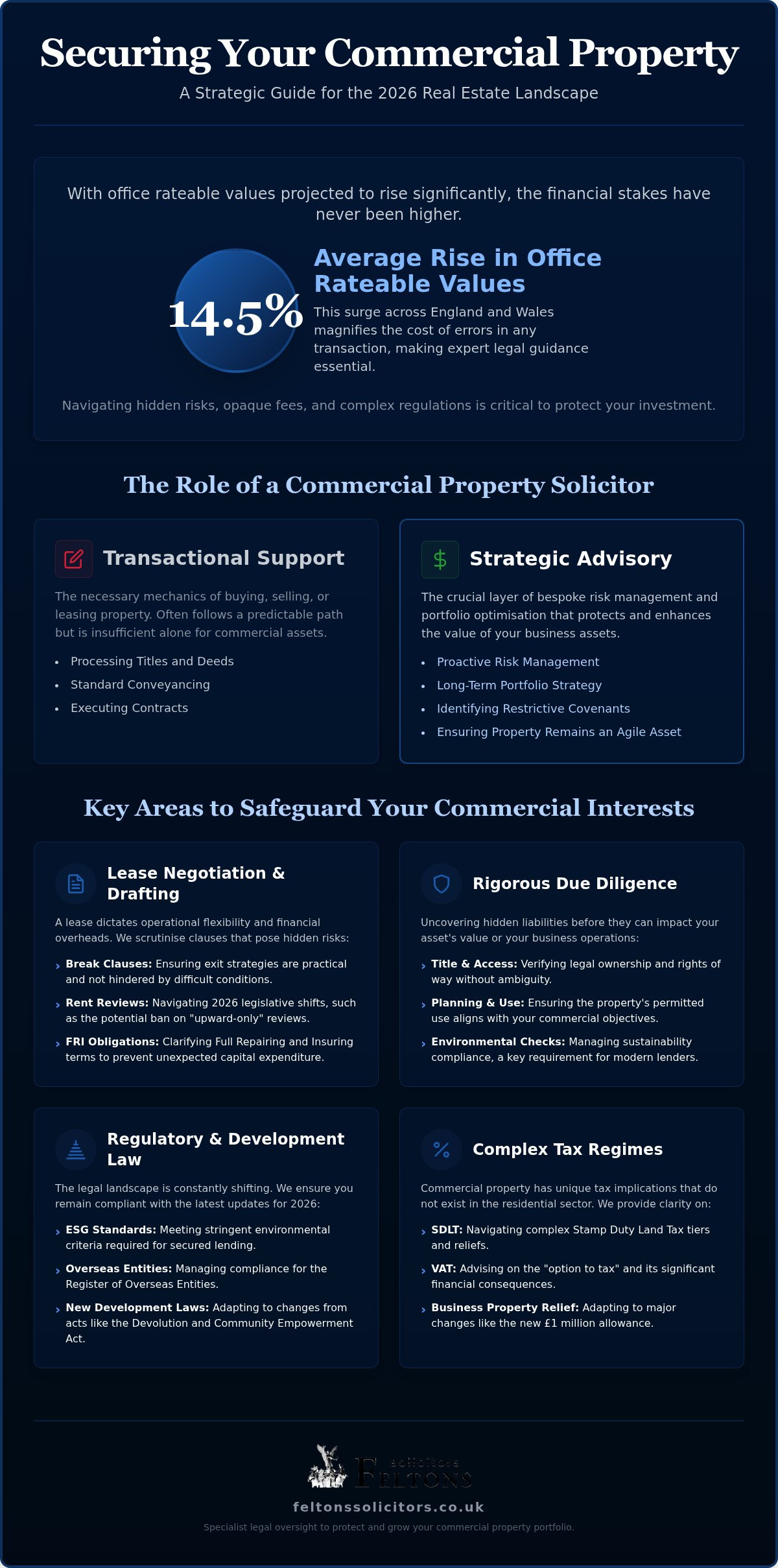
With office rateable values rising by an average of 14.5% across England and Wales in 2026, the margin for error in your next real estate transaction has never been thinner. You likely recognise that whilst property remains a cornerstone of business growth, the legal path to securing it is increasingly fraught with hidden risks. It’s understandable to feel uneasy about opaque fee structures or the slow transaction speeds that so often cause promising deals to collapse at the final hurdle.

Securing a commercial property solicitor who offers a blend of sophisticated authority and pragmatic, “people-first” advice is the most effective way to protect your interests. Our focus is on providing the strategic guidance necessary to navigate a complex 2026 landscape, ensuring you don’t miss restrictive covenants that could stifle your future operations. By the end of this article, you’ll understand how to secure favourable lease terms under the latest regulations, minimise your business liability, and adapt to significant shifts like the new £1 million allowance for Business Property Relief. We will examine the essential steps to managing your assets with confidence, ensuring every transaction serves your broader commercial objectives.

Key Takeaways

  • Understand how a commercial property solicitor functions as a discreet advisor to manage complex risks that extend far beyond standard conveyancing.
  • Identify the pivotal lease clauses that safeguard your operational freedom and protect your business from unforeseen financial commitments.
  • Discover the rigorous due diligence steps necessary to reveal hidden liabilities before they can impact the value of your commercial assets.
  • Navigate the latest 2026 regulatory updates, including essential compliance for the Register of Overseas Entities and new development laws.
  • Learn why a boutique legal partnership offers the tailored expertise and personal connection needed to support a growing property portfolio.

What is a Commercial Property Solicitor and Why Does Your Business Need One?

A commercial property solicitor acts as far more than a legal processor for titles and deeds. While residential conveyancing often follows a predictable, formulaic path, commercial transactions are governed by complex English land law principles that require a bespoke approach to risk management. Your business assets represent significant capital and operational exposure. Treating their acquisition or lease as a mere administrative task is a dangerous oversight. In 2026, where office rateable values have surged by an average of 14.5% across England and Wales, the financial consequences of a poorly negotiated contract are immediate and severe.

Commercial law involves unique mechanisms such as the Landlord and Tenant Act 1954, which provides security of tenure for business occupiers. Without this protection, a business could be forced to relocate at the end of a lease term, losing years of accumulated goodwill and local brand recognition. Specialist legal oversight is non-negotiable because commercial property carries distinct tax regimes, including complex SDLT tiers and the “option to tax” for VAT, which don’t exist in the residential sector. You need a partner who understands that a deal delayed by slow due diligence is often a deal lost.

The Distinction Between Transactional and Advisory Support

Legal support is traditionally viewed as transactional, focusing on the mechanics of buying, selling, or leasing assets. However, the true value of a commercial property solicitor lies in advisory oversight. This includes ongoing portfolio management and identifying restrictive covenants that could stifle your business growth or prevent a future change of use. If you plan to exit the business in five years, your lease must allow for a clean break or assignment without prohibitive conditions. We ensure your property remains an agile asset rather than a restrictive liability that hinders your long-term strategy.

Safeguarding Commercial Interests in 2026

The regulatory environment has shifted significantly this year. With the English Devolution and Community Empowerment Act 2026 introducing potential bans on upward-only rent reviews, your legal advice must ensure new leases reflect these modern standards. Beyond the lease itself, we manage environmental and sustainability compliance, which is increasingly a prerequisite for secured lending. Lenders in 2026 are more stringent; they require proof that assets meet evolving ESG standards before releasing funds. A commercial property solicitor serves as a definitive shield against operational disruption, ensuring that legal technicalities never compromise your business’s momentum.

A commercial lease is far more than a simple occupancy agreement; it’s a complex financial instrument that dictates your business’s overheads and operational flexibility for years. Relying on generic templates often leaves tenants exposed to “hidden” costs that only surface during a dispute or at the point of exit. Instructing a commercial property solicitor ensures that every clause is tailored to your specific industry requirements rather than a landlord-biased standard. Adhering to RICS professional standards provides a baseline for fair management, but bespoke legal drafting is what secures your business’s unique interests.

Critical Lease Terms to Review

The financial impact of a lease is often found in the fine print of its various mechanisms. Break clauses are essential for maintaining agility, yet they are frequently conditional on “vacant possession” or “absolute compliance,” terms that can be difficult to satisfy in practice. Rent review clauses also require careful scrutiny, especially following the 2026 legislative shifts regarding upward-only reviews. Understanding Full Repairing and Insuring (FRI) obligations is equally vital, as these can lead to unexpected capital expenditure for structural repairs. For those navigating the complexities of long-term property rights, speaking with leasehold enfranchisement experts can help clarify your options for securing more permanent control over your premises.

Lease Renewals and Assignments

The Landlord and Tenant Act 1954 provides a statutory right to renew your lease, which is a cornerstone of business continuity in the UK. However, landlords can oppose renewal on specific grounds, such as an intention to redevelop the site. If you plan to sell your business, the ability to assign the lease to a buyer is critical. A commercial property solicitor will negotiate “reasonable” consent requirements to ensure your exit strategy isn’t blocked by a landlord’s refusal. Finally, managing dilapidations at the end of a term is a significant financial risk. Early legal advice on terminal schedules can prevent costly litigation and ensure a smooth transition out of the property. If you’re entering new negotiations, a detailed contract review can identify these risks before you sign.

Strategic Acquisitions and Disposals: Managing Transactional Risk

Strategic acquisitions require a methodical approach that transcends simple price negotiation. In a market where office rateable values have shifted significantly, the true value of a deal is often found in the quality of the underlying title and the absence of hidden liabilities. A commercial property solicitor manages the entire transaction lifecycle, from the initial review of heads of terms to the final registration at the Land Registry. Whilst the RICS Code for Leasing Business Premises focuses on fairness in tenancies, acquisitions demand a more aggressive focus on risk mitigation and long-term operational efficiency.

The Due Diligence Framework

Due diligence is the foundation of any secure purchase. It involves a rigorous investigation into title history, planning permissions, and building regulation compliance. We scrutinise Commercial Property Standard Enquiries (CPSEs) to uncover issues such as unauthorised alterations, boundary disputes, or pending litigation. Environmental searches are particularly critical in 2026, as contaminated land liabilities can stay with the owner regardless of when the damage occurred. For mixed-use developments, where a commercial unit sits beneath residential flats, you must also consider navigating residential property law to manage the distinct rights of residential tenants, such as the right of first refusal.

Financing and Secured Lending

Securing capital is often the most time-sensitive element of a transaction. We work closely with commercial lenders to satisfy their specific requirements, handling the complex legal charges and debentures over your property assets. If your financing timeline is tight, having a commercial property solicitor who understands the lender’s perspective prevents delays that could jeopardise the deal. We ensure the legal structure of your purchase supports your borrowing needs, allowing for a seamless transition from offer to ownership. This includes verifying that the property’s insurance and repair obligations align with the bank’s security requirements, protecting both your capital and your relationship with the lender.

Commercial Property Solicitor: Strategic Legal Guidance for UK Business Assets in 2026

Specialist Complexities: Overseas Entities and Development Law

The intersection of international investment and UK property law has become significantly more regulated. For international investors, compliance with the Register of Overseas Entities (ROE) is no longer a peripheral concern but a central pillar of asset management. Failing to maintain accurate records on the ROE can result in severe penalties and, crucially, prevents any dealing with the property at the Land Registry. A commercial property solicitor with specialist expertise in this area ensures your international structure remains transparent and compliant with the latest 2026 standards.

Registering Overseas Entities for UK Property

Registration is a multi-stage process that requires meticulous attention to detail. It is not merely an administrative filing; it is a legal declaration of ownership structure. The process typically follows three critical stages:

  • Identification: Pinpointing beneficial owners as defined by the Economic Crime (Transparency and Enforcement) Act, ensuring all “shadow” interests are correctly categorised.
  • Verification: All information must be verified by a UK-regulated agent before submission to Companies House.
  • Annual Compliance: Managing the mandatory annual updates to ensure the entity’s status remains “active” and deal-ready.

For a more detailed breakdown of these requirements, see our guide on overseas entity beneficial owner registration.

Property Development and Site Assembly

Development projects require a different legal architecture. Site assembly involves the delicate process of merging multiple parcels of land, often requiring the negotiation of complex infrastructure and utility easements. We draft option agreements and conditional contracts that provide the flexibility developers need during the planning phase. Protecting future value is equally important. Overage agreements ensure that if a site’s value increases significantly post-development, the original seller receives a fair share of the uplift, while the developer’s margins remain protected. This methodical approach protects your capital while allowing for ambitious growth.

When preparing a site for development, ensuring physical security is as important as the legal framework; specialists like Romford Fencing Ltd can provide the trade-grade materials needed to secure your assets during the transition.

Even with the best drafting, disputes can arise. Whether it’s a disagreement over service charges or a challenge to leasehold enfranchisement rights, we prioritise mediation and pragmatic negotiation to avoid the prohibitive costs of litigation. Our role is to act as a discreet partner, resolving issues quietly and efficiently so your focus remains on your business operations. If you are managing international assets or planning a new development, our commercial legal team is ready to provide the discreet, high-standard support your portfolio requires.

Choosing the Right Commercial Property Solicitor for Your Portfolio

Selecting a commercial property solicitor is a consequential decision that directly impacts your business’s bottom line and operational security. High-volume “conveyancing factories” often rely on automated processes that struggle to account for the nuances of a complex commercial deal. Within the 2026 regulatory framework, where oversight of overseas entities and environmental compliance is more rigorous than ever, a tick-box approach is insufficient. You need a partner who possesses deep commercial awareness and understands how a property asset fits into your broader industry objectives.

The right legal advisor acts as a sophisticated guide, identifying risks before they become liabilities. Direct partner access is essential. It ensures that your transaction is handled by an expert who can navigate the intricacies of the Landlord and Tenant Act 1954 or the complexities of a mixed-use development with poise. Communication should be steady and reassuring, providing you with the clarity needed to make informed decisions under pressure. If a firm cannot explain a restrictive covenant’s impact on your future exit strategy in plain English, they may lack the commercial depth your portfolio requires.

The Feltons Difference: Pragmatic and People-First

Feltons Solicitors LLP was established in 2010 by Paula Felton with a commitment to providing a boutique, high-standard service that prioritises personal connection. We don’t view transactions as mere files; we see them as the foundation of your business’s future. Our “people-first” philosophy means we focus on building long-term advisory relationships, offering a calm and steady presence amongst the stresses of a property acquisition or disposal. Whether you are a national developer or an international investor, our advice remains pragmatic and tailored to your specific needs. We maintain transparent fee structures to address the common industry pain point of opaque legal costs, ensuring you can manage your capital with confidence.

Next Steps for Your Property Transaction

Moving forward with a new lease or purchase requires methodical preparation to avoid the delays that cause deals to collapse. Before your initial consultation, ensure you have your Heads of Terms, proof of identity, and any relevant financing details organised. This allows your commercial property solicitor to begin the due diligence process immediately, protecting your position in a competitive market. When you are ready to instruct, look for a firm that combines traditional professional integrity with modern efficiency. Your property assets deserve a discreet partner who values privacy and personal rapport as much as technical excellence. Secure your business assets today and contact Feltons Solicitors LLP for a consultation to discuss your requirements.

The 2026 property market presents both significant challenges and unique opportunities for businesses. We have discussed how a dedicated commercial property solicitor moves beyond simple paperwork to provide the strategic foresight required for complex lease negotiations and regulatory compliance. By focusing on bespoke drafting and rigorous due diligence, you can ensure your property assets remain agile and protected against shifts in business rates and inheritance tax allowances. Success in this environment relies on identifying risks early and maintaining a clear path for future growth.

Feltons Solicitors LLP provides a calm, steady presence throughout the lifecycle of your property assets. Our boutique service model guarantees direct partner involvement and specialist expertise in areas such as Overseas Entity registration, whilst our national reach ensures we can support your interests across the UK. We combine traditional professional integrity with a “people-first” philosophy to deliver results that respect both your time and your commercial objectives. Instruct Feltons Solicitors for your commercial property transaction to secure the high-standard, discreet guidance your business deserves.

Frequently Asked Questions

Do I really need a solicitor for a commercial lease renewal?

Yes, instructing a solicitor is essential to protect your statutory rights under the Landlord and Tenant Act 1954. Missing strict deadlines can result in the loss of your right to remain in the premises. Professional oversight ensures your new lease reflects 2026 market standards and doesn’t include restrictive clauses that could hinder your future business agility or exit strategy.

How much are commercial property solicitor fees in 2026?

Fees are determined by the transaction’s complexity and the value of the asset involved. Rates typically track service producer price inflation, which saw a modest increase in early 2026. Most firms provide a combination of fixed fees for standard conveyancing and hourly rates for bespoke advisory work. We recommend requesting a transparent, individualised quote to ensure your legal budget aligns with your specific objectives.

What is the Register of Overseas Entities and does it apply to me?

The Register of Overseas Entities (ROE) requires foreign organisations holding UK land to declare their beneficial owners to Companies House. It applies to you if you are a non-UK legal entity that owns, or intends to acquire, property in the United Kingdom. This regulation is a critical compliance point in 2026, ensuring transparency and allowing for legal dealings at the Land Registry.

How long does a commercial property purchase typically take?

A standard commercial purchase usually takes between eight and twelve weeks from the approval of heads of terms to final completion. Timelines depend heavily on the depth of due diligence required and the speed of financing approvals. Complex site assemblies or transactions involving overseas entities may take longer due to the additional verification and compliance stages required by current regulations.

Can a commercial solicitor help with property disputes or litigation?

Yes, a commercial property solicitor provides vital support for litigation and dispute resolution. Whether you are facing a disagreement over service charges, dilapidations, or leasehold enfranchisement, we prioritise pragmatic negotiation to avoid the costs of court. If mediation fails, we provide the professional authority needed to handle formal proceedings and protect your business interests effectively.

What is the difference between a commercial lease and a licence to occupy?

A commercial lease grants exclusive possession of a property for a fixed term, creating a formal legal interest in the land. In contrast, a licence to occupy is merely a personal permission to use the space and offers no security of tenure. Choosing the wrong structure can leave your business vulnerable to sudden eviction or unexpected financial liabilities.

Do you handle commercial conveyancing for international clients?

We provide comprehensive support for both national and international clients from our London office. Our boutique approach allows a commercial property solicitor to act as a discreet partner for complex matters, including the registration of overseas entities. We manage the entire lifecycle of your UK assets, ensuring compliance with local regulations whilst maintaining a personal connection regardless of your location.

What happens if I don’t register my overseas entity correctly?

Failing to register correctly results in severe restrictions that effectively freeze your property assets. You’ll be unable to sell, lease, or charge the land at the Land Registry until compliance is met. Additionally, non-compliance can lead to significant daily fines and potential criminal prosecution for the entity’s officers, making accurate registration a non-negotiable priority for any international investor.

Will Solicitors: A Comprehensive Guide to Protecting Your Estate in 2026

Will Solicitors: A Comprehensive Guide to Protecting Your Estate in 2026

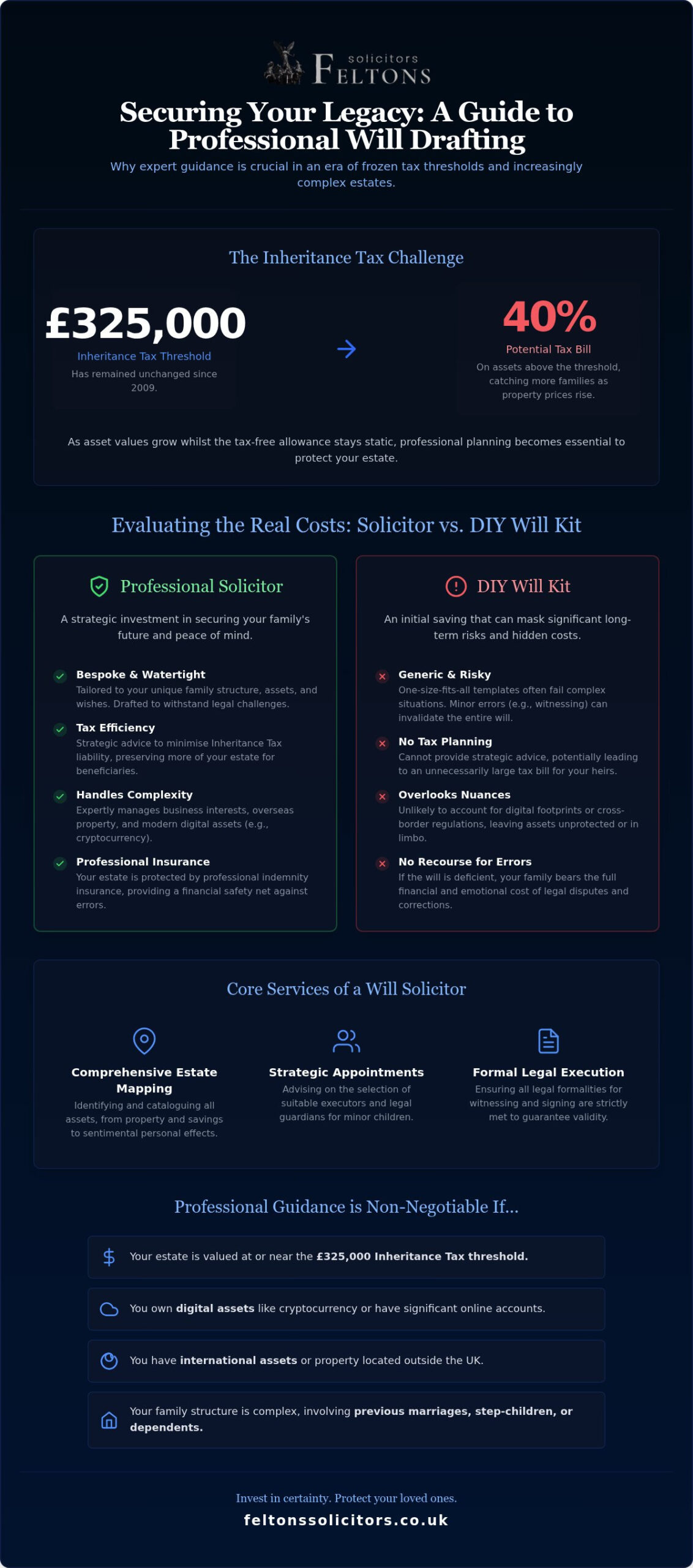
The £325,000 Inheritance Tax threshold has remained frozen since 2009. This means that as property prices continue to climb in 2026, more families find themselves unexpectedly liable for a 40% tax bill. It’s understandable to feel a sense of unease regarding the rules of intestacy or the potential invalidity of a DIY document, which is why many now seek out expert will solicitors to secure their legacy. You deserve the certainty that your life’s work will benefit the people you love most, rather than being lost to administrative errors or avoidable taxes.

Professional guidance allows you to transform a simple document into a strategic shield for your family’s future. This guide demonstrates how expert advice can help you navigate complex thresholds, protect modern digital assets, and ensure your final wishes are entirely watertight. We’ll explore the practical steps you can take today to secure your estate, provide lasting peace of mind for your beneficiaries, and establish a clear, professional plan for asset protection.

Key Takeaways

  • Understand how expert will solicitors provide more than just a document by offering strategic advice on asset distribution and legal compliance to protect your legacy.
  • Learn why the immediate savings of a DIY kit often lead to significant risks. Professional drafting ensures your estate remains tax-efficient and legally watertight.
  • Discover how to incorporate complex modern interests, such as digital assets and overseas property, into a legally binding UK framework.
  • Gain a clear roadmap of the professional consultation process, from identifying your core objectives to creating a comprehensive map of your financial world.
  • Explore how integrating your will with Lasting Powers of Attorney ensures total protection for both your assets and your personal welfare during your lifetime.

What Do Will Solicitors Do and Why Are They Essential?

Will solicitors are legal professionals who specialise in the precision-led drafting, witnessing, and execution of testamentary documents. Whilst it’s possible to write a basic expression of your wishes on a piece of paper, a solicitor ensures that those wishes are translated into a legally binding framework. They provide strategic oversight, ensuring that every asset is accounted for and that your distribution plan complies with current UK law. This professional guidance is about more than just paperwork; it’s about providing a steady presence during a complex life stage.

If you die without a valid will, your estate is subject to the rules of intestacy. This rigid legal process dictates who inherits your assets based on a strict hierarchy, often excluding unmarried partners, step-children, or close friends. By engaging a professional, you prevent the state from making these deeply personal decisions on your behalf. Expert involvement also creates a robust defence against future legal challenges. They ensure your document is resilient against claims of undue influence or lack of testamentary capacity, which are common grounds for contesting a will in the UK courts.

The Core Responsibilities of Your Legal Advisor

A trusted advisor takes a methodical approach to your affairs, ensuring no detail is overlooked. Their core responsibilities include:

  • Estate Mapping: Identifying the full scope of your estate, including property, savings, and sentimental personal effects.
  • Strategic Appointments: Advising on the selection of suitable executors and, crucially, legal guardians for minor children to ensure they’re cared for by people you trust.
  • Formal Execution: Ensuring that all legal formalities for witnessing and signing are strictly met. Even a minor technical error can render a will invalid, leading to significant distress for your loved ones.

When Professional Intervention is Non-Negotiable

Certain circumstances demand a higher level of technical expertise that a DIY kit simply cannot provide. If your family structure involves complex dynamics, such as children from previous relationships or multiple marriages, standard templates often fail to provide adequate protection for all parties. Professional intervention is equally vital for estates exceeding the £325,000 Inheritance Tax threshold. In these cases, strategic planning can significantly reduce the tax burden on your heirs. For those with business interests or international assets, will solicitors ensure that your UK will works in harmony with overseas regulations, providing a seamless transition of wealth across borders.

Solicitors vs. DIY Will Kits: Evaluating the Real Costs

The appeal of a DIY will kit is obvious: it’s inexpensive and can be completed in an afternoon. However, the immediate saving often masks a significant long-term risk. Unlike a static template, will solicitors provide a strategic shield that accounts for the nuances of your specific life circumstances. Shop-bought kits are designed for the “average” person, but few lives are truly average. When you opt for professional drafting, you’re investing in a document that is built to withstand scrutiny.

One of the most critical differences is the protection of professional indemnity insurance. If a solicitor drafts a document that is later found to be deficient, your estate has legal recourse. With a DIY document, your family is left to bear the financial burden of any errors alone. This financial safety net is a cornerstone of professional practice, providing a level of security that a simple form cannot replicate. It’s the difference between a generic product and a bespoke legal service.

The True Price of a ‘Cheap’ Will

A ‘cheap’ will often becomes an expensive legacy. Vague language, such as failing to define “personal effects” or “residuary estate” clearly, frequently leads to bitter litigation amongst beneficiaries. If the document is declared invalid due to a witnessing error, your estate falls under the rules of intestacy. Investing in professional fees now often saves your heirs tens of thousands of pounds in future legal costs. It also prevents the emotional toll of family disputes during an already difficult time.

Why Empathy and Expertise Matter

A sophisticated guide does more than fill in blanks. They act as a trusted advisor, identifying risks you might not have considered. For instance, the Property (Digital Assets etc) Act 2025 now requires specific consideration for cryptocurrency and online accounts. A template won’t ask about your digital footprint, but a specialist will.

At Feltons, we pride ourselves on delivering pragmatic, plain-English advice that prioritises your family’s unique dynamics. We understand that discussing your final wishes requires a delicate balance of technical precision and human empathy. If you’re ready to move beyond templates, you can explore our estate planning services to discuss a tailored approach to your estate. Our goal is to ensure your legacy is handled with the quiet confidence it deserves.

Managing Complex Assets: Digital Legacies and Overseas Interests

The modern estate has evolved significantly beyond physical property and traditional bank accounts. Today, your legacy likely includes a vast array of intangible assets, from cryptocurrency portfolios to professional social media presence and intellectual property. Expert will solicitors now play a vital role in ensuring these modern interests are not lost or locked away forever. Without specific provisions, your executors may find themselves legally barred from accessing essential online accounts, leading to the permanent loss of both financial value and sentimental memories.

The Rise of the Digital Estate

Digital assets encompass everything from online banking and investment platforms to digital creative works and loyalty points. To manage these effectively, your will must grant executors explicit legal authority to interact with service providers. This prevents a “digital dark age” where your online footprint becomes an inaccessible burden for your family. Under 2026 legal standards, a digital legacy is defined as the collective body of a person’s online data, digital property, and social presence that persists after their death.

Strategic planning involves more than just listing passwords; it requires a structured approach to asset discovery. We advise clients to maintain a secure, offline inventory of their digital holdings, which can be referenced in the will without compromising security. This ensures that assets like Bitcoin or NFTs, which are now formally recognised under the Property (Digital Assets etc) Act 2025, are identified and transferred according to your wishes rather than being forgotten in the depths of the blockchain.

International Assets and Overseas Entities

Owning property abroad introduces a layer of complexity that a standard UK will may not fully address. Different jurisdictions have varying rules on “forced heirship,” which can override your stated intentions if not managed correctly. Coordinating your UK arrangements with foreign legal requirements is essential to prevent conflicting instructions and protracted probate disputes. Professional drafting ensures that your global footprint is managed as a single, cohesive strategy.

For individuals with assets or interests in the United States, The Village Law Firm provides the specialised estate planning and administration expertise necessary to ensure your legacy is protected across different legal jurisdictions.

The landscape of property ownership has also been reshaped by transparency requirements. Understanding how overseas entity beneficial owner registration impacts your estate is crucial for those holding UK property through foreign structures. Failure to maintain these registrations can lead to significant delays in the transfer of property to your beneficiaries. By addressing these cross-border issues proactively, will solicitors help you mitigate the risk of international assets becoming a legal or financial liability for your heirs. We provide the discreet, worldly experience necessary to handle these intricate matters with precision.

Will Solicitors: A Comprehensive Guide to Protecting Your Estate in 2026

The Step-by-Step Process of Working with Will Solicitors

Engaging with will solicitors isn’t a mere transaction; it’s a methodical journey toward total peace of mind. The process begins with an initial consultation designed to establish trust and clarity. We don’t just ask about your assets; we seek to understand your primary objectives and the specific people you wish to protect. This isn’t a high-volume processing exercise. It’s a boutique experience where your personal connection to your legacy is prioritised from the very first meeting.

Following the consultation, we move into the vital phase of asset discovery. This is where we create a comprehensive map of your financial and personal world. We look beyond the obvious, examining property, savings, and those complex digital assets that define modern life. This methodical approach ensures that every facet of your estate is accounted for, leaving no room for ambiguity or future dispute. It’s about building a foundation that is both legally robust and personally meaningful.

Preparing for Your Consultation

To make the most of your time, it helps to gather key documents before we meet. Think about your pensions, property deeds, and life insurance policies. Consider your legacy in broader terms too. Are there charitable donations you’d like to make? Do you have specific bequests for sentimental items? Feltons’ methodical flow ensures that even the smallest detail is captured, reflecting our commitment to traditional professional integrity and modern efficiency.

Refining Your Wishes

Drafting is an iterative process. You’ll review the document with your solicitor to ensure it reflects your exact wishes with absolute precision. We’ll refine the language to ensure it’s legally watertight whilst remaining respectful to your beneficiaries. This stage also involves adjusting for tax efficiency. With the Inheritance Tax nil-rate band frozen at £325,000 until 2031, strategic drafting is essential to protect your heirs from unnecessary fiscal drag. We ensure the tone of the document remains clear, avoiding dense legalese in favour of plain English.

The final, critical step is the formal execution. The signing and witnessing ceremony must strictly adhere to legal formalities to ensure the will’s validity. Once complete, secure storage is paramount. We’ll advise on where to keep the original document and how to notify your executors of its location. A will is only effective if it can be found and verified when it’s needed most. If you’re ready to begin this methodical journey, you can contact our team of will solicitors today to discuss your requirements. We’re here to provide the calm, steady presence you need to secure your family’s future.

Beyond the Will: Integrated Asset Protection and Probate

A will shouldn’t exist in a vacuum. To achieve total protection, your testamentary wishes must be woven into a broader framework of estate planning. This integrated approach ensures that your assets are managed efficiently both during your lifetime and after you’ve passed. Whilst a will handles the distribution of your legacy, Lasting Powers of Attorney (LPA) safeguard your interests whilst you’re still alive. These documents allow you to appoint trusted individuals to make decisions about your health and finances if you ever lose the capacity to do so yourself.

Major life changes also necessitate a fresh look at your legal arrangements. If you’re navigating the end of a relationship, consulting a divorce and financial arrangements lawyer is vital. Marriage usually revokes an existing will; divorce can leave significant gaps in your estate’s protection. Expert will solicitors ensure that your updated documents reflect your new financial reality, preventing assets from inadvertently passing to an ex-partner.

Wills and Property Law

There is a powerful synergy between residential property law and the distribution of your estate. Your home is likely your most significant asset, so handling its transfer requires precision. We provide guidance on complex matters like leasehold extensions and enfranchisement, ensuring these property rights are maximised before they pass to your heirs. By using clever trust structures, we can help you protect the family home from being depleted by long-term care costs or unnecessary tax liabilities.

Probate and Estate Administration

When the time comes, the transition to probate should be as seamless as possible. Our role involves applying for a Grant of Probate, which gives executors the legal authority to manage your affairs. We handle the heavy lifting: settling outstanding debts, paying the correct amount of Inheritance Tax, and ensuring assets are distributed exactly as you intended. This methodical process provides a sense of security during a difficult time.

The practical side of estate administration often involves managing physical assets and property contents. In such cases, families may find that Clear This Ltd House Clearance Services offers a sensitive and professional way to handle house clearance throughout the Lancashire area.

Feltons’ “people-first” philosophy is particularly crucial during this stage. We act as a calm, steady presence for your family, handling the technical complexities so they can focus on their own well-being. By choosing experienced will solicitors, you ensure that the same high standard of care you received during the drafting process continues long after you’re gone. We remain your family’s discreet partner, protecting your legacy with traditional integrity and modern efficiency.

Securing Your Legacy for the Next Generation

Protecting your life’s work requires more than a simple document; it demands a strategic vision that accounts for both traditional property and modern digital assets. By moving beyond the limitations of DIY templates, you ensure your estate is resilient against legal challenges and tax inefficiencies. Expert will solicitors provide the steady, professional guidance needed to navigate these complexities with quiet confidence. Our boutique service combines national-level expertise with pragmatic, plain-English advice tailored specifically to your family’s unique dynamics.

Whether you’re managing a global asset portfolio or simply wish to provide peace of mind for your loved ones, a methodical approach is the most reliable way to safeguard your final wishes. We specialise in complex and international estate matters, ensuring that every detail is handled with discretion and integrity. It’s never too early to establish a clear plan for the future. You can book a confidential consultation with our specialist will solicitors to begin securing your legacy today. Taking this proactive step provides the certainty and security that you and your family deserve.

Frequently Asked Questions

How much do will solicitors typically charge in 2026?

Fees vary based on the complexity of your estate and the specific requirements of your family structure. A straightforward single document is generally more cost-effective than mirror wills for couples or complex arrangements involving trusts and overseas assets. We recommend discussing your needs during a consultation to receive a transparent estimate tailored to your circumstances. Investing in professional expertise ensures your document is robust, legally binding, and built to withstand future scrutiny.

Can I change my will after it has been signed and witnessed?

You can change your will at any time as long as you have the mental capacity to do so. For minor adjustments, a legal document called a codicil can be added to the existing will. However, if you wish to make significant changes, it’s usually better to draft a completely new document to avoid confusion or potential conflict. Your solicitor will ensure any updates are executed with the same formal rigour as the original.

What is the difference between an executor and a beneficiary?

An executor is the person responsible for managing your estate and carrying out the instructions in your will, whereas a beneficiary is someone who receives assets or property from the estate. It’s common for a person to be both an executor and a beneficiary, such as a spouse or adult child. Selecting an executor requires careful thought, as the role involves significant legal and financial responsibilities during the probate process.

How often should I review my will with a solicitor?

It’s advisable to review your will every three to five years to ensure it still reflects your wishes and financial situation. Certain life events make an immediate review essential, including marriage, divorce, the birth of children, or a significant change in your asset portfolio. Regular consultations with will solicitors allow you to adjust for legislative changes, such as updated tax thresholds or new regulations regarding digital property and overseas interests.

Do I need a separate will for property I own abroad?

Whether you need a separate will depends on the country where your property is located and its specific inheritance laws. Some jurisdictions have forced heirship rules that may conflict with your UK will. In many cases, having a local will in that country is the most efficient way to handle the property. Your UK solicitor will work to ensure your various testamentary documents are coordinated and don’t contain contradictory instructions.

What happens if my will is lost or destroyed?

If a will cannot be found after your death, the law may presume that you destroyed it with the intention of revoking it, which could lead to your estate being distributed under the rules of intestacy. This is why secure storage is so important. Whilst a copy may sometimes be accepted by the probate registry, the process is complex and requires significant evidence. Storing your original document with a professional firm provides a vital safety net.

Can a will be challenged in court after I die?

Yes, a will can be challenged in the UK courts on several grounds, including claims that the document was not properly executed or that the testator lacked mental capacity. Challenges can also arise under the Inheritance (Provision for Family and Dependants) Act 1975 if a close relative feels they haven’t been adequately provided for. Will solicitors use their expertise to draft robust documents that minimise the risk of these stressful and costly legal disputes.

Is a will made in 2026 valid if I move house or get married?

Moving house doesn’t invalidate your will, but getting married or entering a civil partnership usually revokes any existing document entirely unless it was made in expectation of that specific marriage. Conversely, divorce doesn’t revoke a will, but it treats your former spouse as if they had died before you, which can create unintended gaps in your distribution plan. You should always seek legal advice following these major life changes to ensure total protection.