

A former partner’s refusal to comply with a financial order does not leave you without legal options. In England and Wales, enforcing a financial order after divorce may involve an attachment of earnings, a third-party debt order or a charging order. Contempt proceedings may also be possible if the breached order includes a penal notice. The right route depends on the obligation and the assets available.
When an order has been made but payments, transfers or other required steps have not happened, it can be hard to know what to do next. Understanding the available options can help you choose a route that fits the order and your circumstances.
This guide explains how to respond to non-compliance, what an enforcement application involves and how the court may address property, income or bank accounts held overseas. It also covers potential costs and why they should be weighed against the amount you may recover.
Key Takeaways
- Match the enforcement route to the unpaid obligation and the assets or income available to meet it.
- For overseas assets, the country involved and type of order shape the recognition and enforcement process.
- Prepare clear financial information and supporting documents so the court can assess the non-compliance and the remedy sought.
- Weigh likely recovery against potential legal costs before deciding how to proceed.
Enforcement against overseas assets, property, income and bank accounts
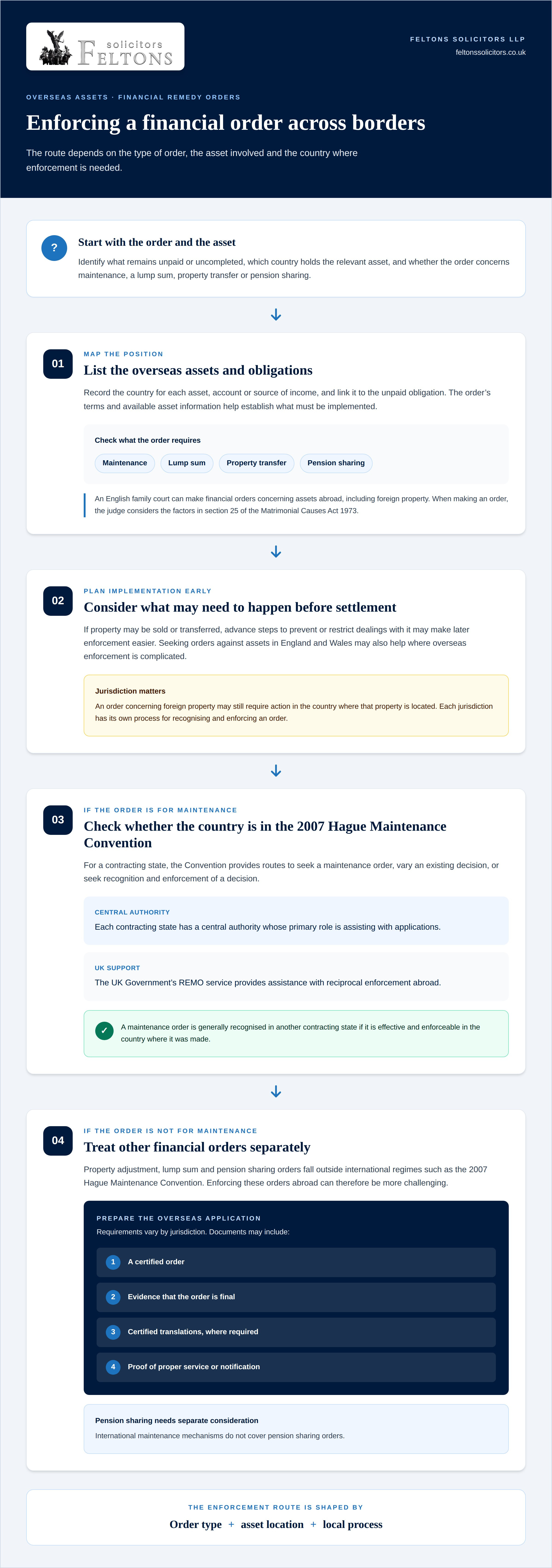
- Map the overseas assets, income and accounts linked to the unpaid obligation. Note which country holds each asset and whether the order requires maintenance, a lump sum, a property transfer or pension sharing. These distinctions matter because enforcement depends on both the type of order and the jurisdiction involved.
An English family court can make financial orders concerning assets abroad, including foreign property. The judge considers the factors set out in section 25 of the Matrimonial Causes Act 1973 when making a financial order. The order’s terms and the available asset information help establish what must be implemented.
- Consider implementation before the final settlement, particularly if property may be sold or transferred. Taking advance steps to prevent or restrict dealings with property may make later enforcement easier. Seeking orders against assets in England and Wales may also help when enforcing an order overseas is complicated.
An order concerning foreign property may still require action in the country where the property is located. Each jurisdiction has its own process for recognising and enforcing an order, so early planning can clarify the steps involved. When coordinating cross-border matters or dealing with property in other territories, consulting overseas legal practices such as MZ-Law can help navigate local procedural demands.
- For maintenance obligations, assess whether the country involved is a contracting state under the 2007 Hague Maintenance Convention. It provides routes to seek a maintenance order, vary an existing decision, or seek recognition and enforcement of a decision. Each contracting state has a central authority whose primary role is assisting with applications.
The UK Government’s REMO service provides assistance with reciprocal enforcement abroad. A maintenance order is generally recognised in another contracting state if it is effective and enforceable in the country where it was made.
- Separate maintenance from other financial arrangements before selecting an enforcement route. Property adjustment, lump sum and pension sharing orders fall outside international regimes such as the 2007 Hague Maintenance Convention. Enforcement of those orders abroad can therefore be more challenging.
For an overseas application, prepare for requirements such as a certified order, evidence that it is final, certified translations where required, and proof of proper service or notification. Required documents vary by jurisdiction. Pension assets need separate consideration because international maintenance mechanisms do not cover pension sharing orders.
Enforcing a financial remedy order if an ex refuses
If your former partner hides assets, the court can require financial disclosure. If they cannot pay, it may allow time or consider other arrangements. Establishing their financial circumstances can help show whether they are withholding information or genuinely lack the means to meet their obligations.
-
How a solicitor gathers financial disclosure and documents
Provide the sealed financial remedy order, payment records and relevant financial documents for an accurate review. A solicitor can compare the order’s requirements with payments received and information disclosed during the original proceedings. Form E records each party’s property, debts and estimated future living costs. Both parties complete it before the first appointment in a financial-order case, making it a useful reference when assessing the financial picture behind the order.
- Organise supporting papers by asset and payment to make gaps easier to spot. Records of missed instalments, for example, can clarify arrears, while earlier disclosures may help identify changes in income, capital or property. Legal advice can help distinguish a genuine change in circumstances from information that appears incomplete. Focus on evidence relevant to the obligation rather than assumptions about your former partner’s finances.
-
How a solicitor reviews the debtor’s financial information
Ask a solicitor to assess disclosed information against the order and payment history. If you lack access to the debtor’s financial details, you can apply for a court order requiring disclosure. The Law Commission recommended honest, early disclosure and wider court powers to obtain information from third parties. These are recommendations, not a substitute for the court’s decision in an individual enforcement case.
- If your former partner says they cannot pay, assess their income, employment and available capital before choosing a response. A court may allow time to regain employment and arrange missed maintenance or arrears payments over a reasonable period. If a paying party loses their job but has sufficient capital, an English court can consider converting future maintenance into a lump sum. The order and evidence of their means help shape the application.
Applying to enforce a financial remedy order
The process of enforcing a financial order after divorce depends on the order, the unpaid obligation and where enforcement is sought. In England and Wales, deadlines and procedural requirements can affect your application.
-
Identify the financial order involved with a solicitor’s help
Ask a solicitor to identify whether the order requires maintenance, a lump sum, property adjustment or pension sharing. Each obligation has different enforcement routes, so the wording of the order matters. A UK divorce court can make these types of financial orders, but the applicable rules depend on the jurisdiction. Check that the final order has taken effect before proceeding.
-
How a solicitor applies to enforce the order
Instruct a solicitor to match the unpaid obligation to an application and prepare evidence of the breach. According to The National Archives, an attachment of earnings application in family proceedings can be made under Part 39 of the Family Procedure Rules 2010. A third-party debt order application can be made under Part 72 of the Civil Procedure Rules 1998, according to The National Archives.
According to The National Archives, in England and Wales, apply to enforce arrears within 12 months of their due date; court permission is required for arrears older than 12 months. A dated payment record can help establish what remains unpaid.
-
Check where enforcement is sought with a solicitor
Tell your solicitor where the order was made and where enforcement is needed. Enforcing a financial order after divorce in Scotland or Northern Ireland may involve local recognition and enforcement procedures. Do not assume that the steps used in England and Wales apply unchanged elsewhere. A solicitor can identify the relevant route.
-
Assess the risks of proceeding without legal advice
Seek legal advice to assess whether an application fits the order, the evidence and the available assets. Choosing an unsuitable method can delay proceedings. If circumstances have changed, ask whether variation is more appropriate. Any variation to a financial remedy order must be recorded in the order. A solicitor can also explain how enforcing a financial order after divorce differs from challenging the decision itself.
Costs of enforcement proceedings
- Estimate likely recovery before starting proceedings. Compare the unpaid amount with the income, property or other assets available to meet it. Consider enforcement costs against what you may recover, rather than in isolation. For example, a costly route may be difficult to justify if the debtor has little accessible income or capital. The amount owed, available evidence and complexity of the application all inform this assessment.
- Plan for each party’s legal costs. In family enforcement proceedings, each party generally pays their own costs. A successful applicant may obtain an order requiring the paying party to contribute towards some enforcement costs, but this does not mean every cost will be recovered. Include that uncertainty in your budget. The court’s decision and the steps required to enforce the order affect the final financial position.
- Assess cross-border work separately when assets or income are held abroad. The country involved, the type of order and any recognition process can affect the work required. Within Europe, cross-border laws have made direct enforcement of consent lump sum orders in the country holding relevant assets relatively easier. This does not remove the need to consider translations, documents or local procedures where required.
- Ask a solicitor to set out the likely stages and cost drivers before agreeing how to proceed. Consider whether the matter requires financial disclosure, several enforcement applications or action involving overseas assets. Each additional step can affect the overall work involved. If an agreement can resolve payment promptly, compare that option with contested proceedings and the amount realistically recoverable. Discuss enforcement costs before deciding your next step.
Feltons Solicitors LLP: Divorce and Financial Arrangements
Feltons Solicitors LLP advises on divorce and financial arrangements when a former partner has not followed a financial order. Its solicitors can review the order, consider available enforcement routes and explain what evidence may support an application. This can help you assess whether the issue concerns missed payments, a property obligation or another term of the order, then plan a proportionate next step.
Turn to Feltons Solicitors LLP for advice on your options, particularly if financial information is incomplete, assets are overseas or the order’s terms are unclear. The appropriate approach depends on the obligation and circumstances, so legal advice can help you understand the process before proceedings begin.
Contact Feltons Solicitors LLP to discuss your financial arrangements and enforcement options.
Choose a clear next step
Before acting, decide what outcome you need and what information would help a solicitor assess your situation. A focused discussion about enforcing a financial order after divorce can clarify whether your next step should address an unpaid payment, an uncompleted transfer or another obligation. It can also help you consider the effect of enforcement on your wider financial arrangements.
Feltons Solicitors LLP offers Divorce and Financial Arrangements. If the consequences extend beyond enforcement, its Wills, Probate, Trusts and Estate Planning service can address related planning needs, while Residential and Commercial Conveyancing covers property matters. These services may be relevant when a financial settlement has wider implications for your home, assets or future arrangements.
You can discuss the order, what has not been done and the outcome you are seeking. Contact Feltons Solicitors LLP for advice about a considered way forward.
Frequently Asked Questions
Can I seek the costs of enforcing the Order from the paying party?
You can ask the court to require the paying party to contribute towards some enforcement costs, but recovery is not automatic. In family enforcement proceedings, each party generally pays their own costs. The court may consider the parties’ conduct and the circumstances of the application when deciding costs. Keep a clear record of work and expenses linked to enforcement.
Do I have to decide how I want to enforce the Order?
No. A solicitor can assess the order, the breach and the information available about the paying party, then advise on the application that best fits. For example, an attachment of earnings may suit someone with employment income, while a debt order may be relevant if funds are held by a third party. Your instructions and priorities inform the approach, but you do not need to choose the legal procedure unaided.
How can a solicitor make the enforcement application?
A solicitor can identify the relevant obligation, gather the order and evidence of non-compliance, then prepare and file the appropriate application. Supporting material might include a payment schedule, correspondence about missed instalments and documents relevant to the proposed enforcement method. The solicitor can explain the outcome being sought and help address procedural requirements, including whether permission is needed to pursue older arrears.
Is there a time limit to apply to enforce the Order?
Yes. According to The National Archives, in England and Wales, an application to enforce arrears under a financial order should be made within 12 months of the arrears falling due. Court permission is required to enforce arrears that are more than 12 months old. Keep a dated record of when each payment became due, as separate missed payments may have different due dates.
What are the different methods available to enforce an Order?
Possible methods include an attachment of earnings, a third-party debt order, a charging order or an application connected with selling property. A judgment summons may be available in some cases, but it does not itself secure payment. Contempt proceedings may also be considered for a breach where the order includes a penal notice. The right method depends on the order and the debtor’s circumstances.
What happens if the other party breaches the Order?
A breach can lead to a court application seeking compliance or payment, but first distinguish deliberate refusal from inability to pay. Keep the order, relevant correspondence and a dated record of missed steps together. If the other party disputes what the order requires, its precise wording matters. A solicitor can assess whether enforcement, variation or another court application is the appropriate response.