

Court is not the only way to resolve divorce finances, and it may not be the best place to start. Alternatives to court for a divorce financial settlement include solicitor-led negotiation, collaborative law and mediation. In England and Wales, an agreement reached outside court can be submitted as a financial remedy consent order for approval.
It is understandable to want a clear, fair outcome without the added strain of court proceedings. This article explains how solicitor-led negotiation and collaborative law work, what each involves and how to formalise an agreed settlement.
You will also learn how these approaches differ from mediation, when negotiations may be more suitable, and why independent legal advice and full financial disclosure matter. The right process depends on the issues and whether both people can participate constructively. If agreement proves impossible, court may still be necessary.
Key Takeaways
- Compare mediation with solicitor-led negotiation to understand which route may better support constructive discussions about finances.
- Learn how financial disclosure, including Form E, can help both parties negotiate with a clearer picture of their assets, debts and income.
- Understand the collaborative law process, including the commitment each person makes and what happens if an agreement cannot be reached.
- See why a negotiated settlement may offer greater control over the process, and why an agreed outcome may still need to be formalised by the court.
What are my alternatives to court for divorce finances?
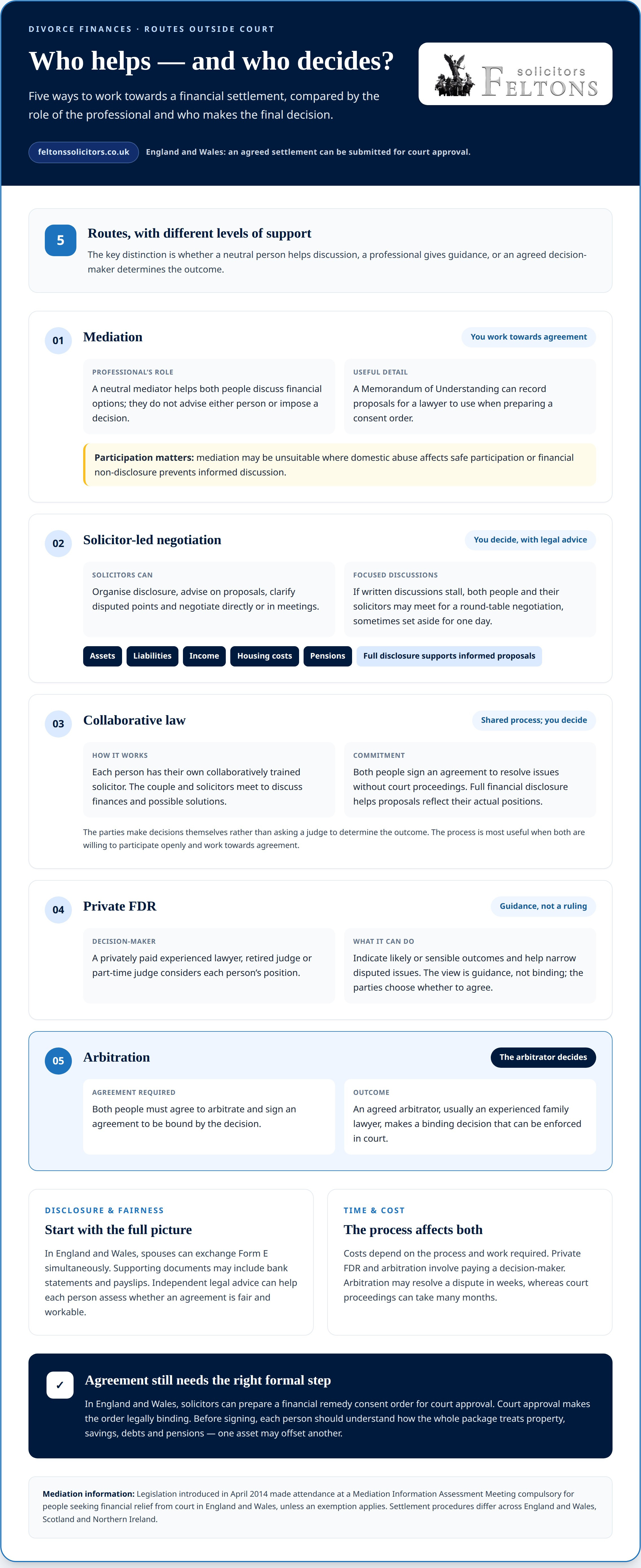
Parties can use mediation, solicitor-led negotiations, private FDR or arbitration to seek agreement without a court hearing. Each process offers a different level of support and gives the parties different roles in decision-making.
Mediation preparation and disclosure
Mediation involves a neutral mediator helping both parties discuss financial options, without advising either person or imposing a decision. In England and Wales, legislation introduced in April 2014 made attendance at a Mediation Information Assessment Meeting compulsory for people seeking financial relief from court, unless an exemption applies. A solicitor can help organise disclosure, including details of assets, liabilities, income, housing costs and pensions. Form E is commonly used to set out financial circumstances, with supporting documents such as bank statements and payslips. A Memorandum of Understanding can record proposals for a lawyer to use when preparing a consent order. Mediation may be unsuitable where domestic abuse affects safe participation or financial non-disclosure prevents informed discussion.
Private FDR appointments
A Financial Dispute Resolution appointment is a settlement-focused hearing where a decision-maker considers each party’s position and indicates likely or sensible outcomes. A private FDR uses a privately paid experienced lawyer, retired judge or part-time judge for this role. The decision-maker’s view is guidance, not a binding ruling, so the parties remain in control of whether to agree. It can help narrow disputed issues, but does not resolve them if consent remains out of reach.
Arbitration for financial disputes
Arbitration is a private process in which an agreed arbitrator decides financial disputes between former spouses. In England and Wales, both parties must agree to arbitrate and sign an agreement to be bound by the decision. The arbitrator, usually an experienced family lawyer, considers the dispute and makes a binding decision that can be enforced in court. Unlike mediation, where parties work towards their own agreement, arbitration leaves the outcome to the arbitrator.
Costs and timescales of resolution options
Mediation, private FDR and arbitration all involve costs, which depend on the process and work required. Private FDR and arbitration involve paying a decision-maker, while court proceedings can become costly and lengthy. Arbitration may resolve a dispute in weeks, whereas court proceedings can take many months. Reaching agreement can therefore give parties more control over timing. If a spouse refuses to negotiate or discussions break down, either party may apply to court. Mediation or another resolution process can still be attempted after proceedings begin.
Solicitor-led financial disclosure and negotiation
Solicitors can organise financial disclosure, advise on proposals and negotiate directly or in meetings. Settlement procedures differ across the UK: England and Wales, Scotland and Northern Ireland have distinct legal frameworks, so advice should reflect where the case is being handled.
Financial disclosure and independent advice
Financial disclosure gives each person information about the other’s assets, liabilities and income, supporting informed negotiations. In England and Wales, spouses can exchange Form E simultaneously, then have the documents reviewed for completeness. Solicitors can identify gaps and explain how different assets affect a proposed division. Independent legal advice also helps each person assess whether an agreement is fair and workable before accepting it.
Solicitor negotiations and round-table meetings
In solicitor-led negotiations, each person’s lawyer can present proposals, clarify disputed points and seek common ground without starting court proceedings. If written discussions stall, both parties and their solicitors may meet to address the issues together. A round-table negotiation can be set aside for one day, giving the couple focused time to explore settlement options. Those discussions should be based on full disclosure, not assumptions about the other person’s finances.
Agreeing a settlement and consent order
Once couples agree terms, solicitors can prepare the documents needed to put the proposed financial settlement before the court. In England and Wales, a financial remedy consent order can be submitted for approval; a negotiated settlement may be ratified without the parties attending a hearing. Court approval makes the order legally binding. Before signing, each person should understand how the full package treats property, savings, debts and pensions, since one asset may offset another.
If you need advice on disclosure, negotiations or formalising agreed terms, solicitor-led divorce financial arrangements can help clarify the appropriate next step.
Collaborative law
Collaborative law gives separating couples a structured way to negotiate financial arrangements outside court. Each person has their own collaboratively trained solicitor, and discussions focus on reaching an agreement.
The collaborative divorce process
In a collaborative divorce, both parties instruct specially trained solicitors and sign an agreement to resolve issues without court proceedings. They then attend meetings together with their solicitors to discuss finances and possible solutions. This shared process can keep conversations focused on practical decisions, such as how to divide property, savings and pension interests.
Full financial disclosure matters: proposals need to reflect each person’s actual financial position. Solicitors can help identify relevant information and explain how different assets may affect the overall settlement. The parties make the decisions themselves, rather than asking a judge to determine the outcome. Collaborative law is most useful when both people are willing to participate openly and work towards agreement.
Collaborative and solicitor-led negotiations
Collaborative meetings bring both parties and their lawyers into the same discussion. By contrast, solicitor-led negotiations can take place through correspondence between lawyers or at a meeting involving both parties and both solicitors. In either process, legal advice helps each person assess proposals and understand the effect of agreeing to particular terms.
If the couple reaches agreement, solicitors can help record the settlement and prepare a financial remedy consent order for court approval in England and Wales. The order becomes legally binding when approved. This step matters because discussions alone do not provide the same formal outcome.
There is an important point to consider if collaboration does not succeed. Under the collaborative agreement, the solicitors instructed for that process cannot represent their clients in later court proceedings. Each person would need different representation if the dispute goes to court. This commitment can encourage constructive negotiations, but it is important to understand the process before signing. Both collaborative law and solicitor-led negotiation rely on informed decisions, full disclosure and each party’s consent to the proposed settlement.
Advantages of settling divorce out of court
Resolving finances outside court can give separating couples more control over the outcome and pace. Instead of waiting for court proceedings to determine disputed issues, parties can negotiate a solution suited to their circumstances. A lawyer can help each person assess proposals independently, including how property, pensions and savings work together. A settlement that looks balanced when one asset is considered alone may have a different effect across the whole financial picture.
Negotiation can also support more open dialogue after a relationship ends. Mediation or solicitor-led discussions give parties space to explain their priorities and consider options, rather than leaving every decision to a judge. Where children are involved, reducing conflict over finances may help parents focus on practical arrangements. Conversations may still be difficult, but a structured process can keep them centred on resolving the financial dispute.
Timing and cost are practical considerations too. Court proceedings usually take longer and cost more than reaching an agreement, and contested cases may require substantial preparation before a final hearing. Out-of-court methods allow parties to progress at a pace that fits their schedules, while narrowing disagreements through negotiation. Arbitration can resolve financial disputes in weeks rather than the many months expected for court proceedings, although it involves an arbitrator making a binding decision.
An agreement still needs careful formalisation. In England and Wales, a financial remedy consent order can be submitted for court approval, potentially without either party attending a hearing. Without a court order, financial claims between former spouses can remain open after divorce, including potential claims against an estate after death. The key takeaway is that avoiding a hearing can offer flexibility, but a lasting outcome depends on full disclosure, informed decisions and appropriate formal approval. For tailored advice on resolving divorce financial arrangements, consider speaking with a solicitor.
Feltons Solicitors LLP: Divorce and Financial Arrangements
Feltons Solicitors LLP advises on divorce and financial arrangements, including resolving finances following separation. Consider seeking legal advice if you need help assessing settlement proposals, negotiating with a former partner or formalising an agreement through a consent order. Advice can also help you decide whether mediation, collaborative law or solicitor-led negotiations suit your circumstances, and what to consider if discussions have stalled.
Every settlement raises individual questions about assets, income, pensions and future needs. A solicitor can help you understand the implications of proposed terms and the steps involved in reaching a formal outcome. For advice about your financial arrangements following divorce, contact Feltons Solicitors LLP.
Choose a route that supports your next chapter
Choosing alternatives to court for a divorce financial settlement is not simply about avoiding a hearing. It is about finding a process that helps you make informed decisions and work towards an arrangement that functions in practice. Consider what you need next: clearer advice on a proposal, support with discussions or help deciding whether an agreement is ready to formalise.
The decision can feel more manageable if you focus first on the issue that needs attention. A solicitor can help identify the questions to resolve and an appropriate way to address them, while keeping the settlement’s wider impact in view. If agreement proves out of reach, you can consider the next step with a clearer understanding of your position.
For advice tailored to your divorce finances, contact Feltons Solicitors LLP. A considered conversation can help you move forward with greater clarity.
Frequently Asked Questions
How can emotion affect settlement discussions?
Strong feelings can make it harder to separate immediate reactions from longer-term financial decisions. For example, anger about the relationship may influence discussions about the family home, even when another arrangement better meets housing needs. A mediator or solicitor can help keep the conversation focused on financial choices. If emotions prevent constructive discussion or safe participation, a different process may be more appropriate.
How can the numbers help settlement discussions?
Clear financial figures help turn broad proposals into options that can be compared. For example, cashflow modelling can illustrate how different arrangements might affect future finances, using assumptions about income and spending. It is a planning aid, not a prediction. Families planning their post-separation financial future and assessing mortgage or investment considerations can also consult financial advisory resources such as liknesh.com. Where pensions are complex, specialist pension or actuarial advice can help clarify their value and inform discussions about the overall settlement.
What about the cost of a prolonged dispute?
A dispute that continues through correspondence, financial disclosure and court hearings can require more legal work than reaching an agreement. Overall costs depend on the issues, the information needed and how long negotiations continue, so a general figure would not describe every case. Parties can discuss the likely work involved with their lawyers and consider whether narrowing a specific disagreement could reduce further steps.
Why isn’t a court hearing always necessary?
Parties who agree financial terms may be able to have the court consider their proposed consent order without attending a hearing. This is different from a contested hearing, where a judge decides unresolved issues. For example, a couple who agree how to deal with the home and pensions can ask for their terms to be formalised instead of asking a judge to choose between competing proposals.
Why should the settlement be considered as a whole?
Considering each asset in isolation can obscure how the overall arrangement will work. A home, pension, savings and debts have different practical effects, including on housing and future income. Cashflow modelling can illustrate how alternative packages may affect future finances. If pensions are complicated, specialist advice can help clarify their role before either person decides whether the complete proposal meets their needs.
What alternatives to court are available for a divorce financial settlement in England and Wales?
Options include direct discussions, mediation, solicitor-led negotiation, collaborative law, private Financial Dispute Resolution appointments and arbitration. Mediation supports discussion but does not decide the outcome; arbitration leaves the decision to an arbitrator. Private FDR offers an assessment of possible outcomes to support settlement. The right route depends on whether both parties can participate, disclose their finances and make progress towards agreement.