

The fear of your lease dropping below eighty years and triggering eye-watering marriage value costs is finally a thing of the past. You’ve likely felt the weight of uncertainty as you watched the clock tick down on your property rights, perhaps worried that your landlord might refuse an extension or demand an extortionate premium. It’s an exhausting position to be in, especially whilst trying to keep pace with the implementation of the Leasehold and Freehold Reform Act 2024. This guide provides a definitive roadmap through the statutory lease extension process, ensuring you secure a 990-year term whilst avoiding the costly procedural errors that can derail an application.
By understanding your rights under the latest legislation, you can approach this transition with quiet confidence. We’ll explore how recent reforms have abolished the two-year ownership requirement and removed marriage value altogether. This methodical overview will show you how to navigate Section 42 notices and valuation caps, ensuring you remain in control of your property’s future without the stress of traditional legal hurdles.
Key Takeaways
- Distinguish between informal negotiations and your formal legal right to a peppercorn ground rent under the latest reforms.
- Navigate updated eligibility criteria, including the removal of the previous two-year ownership requirement for new leaseholders.
- Master the technical stages of the statutory lease extension process, from serving a Section 42 notice to fixing your valuation date.
- Capitalise on the abolition of marriage value and the introduction of the standard 990-year extension to reduce your overall costs.
- Discover how to protect your property rights in complex scenarios, such as missing landlords or disputed counter-notices.
Understanding the Statutory Lease Extension Process vs Informal Routes
Choosing between a formal legal claim and an informal negotiation is the first critical decision any leaseholder must make. While a direct conversation with your landlord might seem like a shortcut to a quicker result, it often lacks the robust safeguards provided by the law. The statutory lease extension process is the formal legal procedure established by the Leasehold Reform, Housing and Urban Development Act 1993. It’s a powerful tool. It essentially forces a landlord to grant an extension, provided you meet the qualifying criteria, ensuring you aren’t left at the mercy of their discretion.
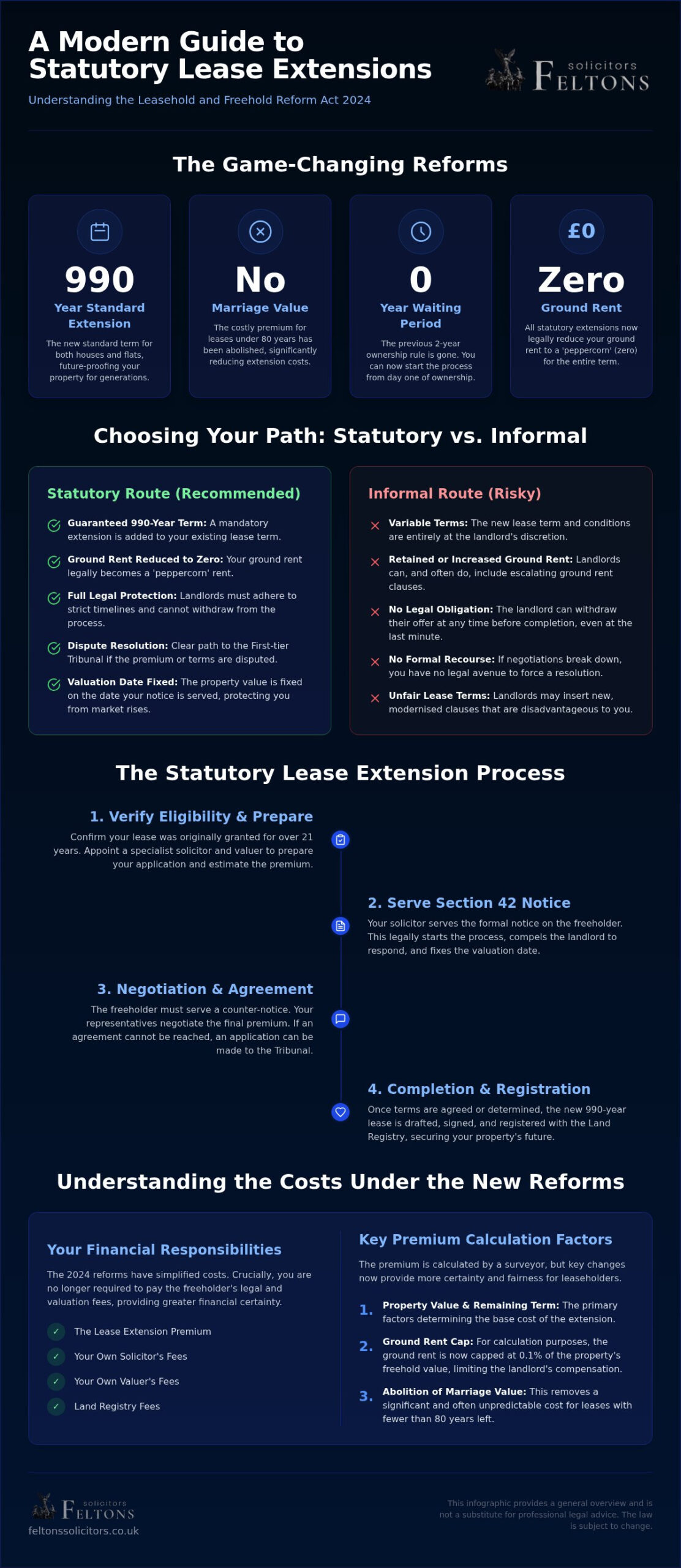
A Leasehold estate is, at its heart, a depleting asset. As the years on your lease diminish, the marketability and value of your home can suffer. Relying on an informal agreement to rectify this is risky; landlords are under no obligation to finish what they start and can withdraw their offer at any moment, even at the eleventh hour. By contrast, the statutory route provides a mandatory 990-year addition to your current term for both flats and houses. This effectively makes the lease future-proof for generations and removes the stress of having to extend again in your lifetime.
The Legal Framework: The 1993 Act and Beyond
The 1993 Act serves as the bedrock of your rights. It was designed to rebalance the power dynamic between leaseholders and freeholders, giving you the legal muscle to compel a lease extension. This statutory protection is vital. It ensures that your right to stay in your home is protected by a structured framework that survives even if the freehold is sold to a new owner. While the Leasehold and Freehold Reform Act 2024 has significantly updated these rights, the core principle remains the same: the law is your shield against landlord refusal.
Why the Statutory Route Offers Superior Tenant Protection
One of the most significant advantages of the formal process is the absolute guarantee of a peppercorn ground rent. Under the statutory lease extension process, your ground rent is legally reduced to zero for the entirety of the new term. Informal deals often include ground rent clauses that double every few years, which can make a property difficult to sell or remortgage later. The formal route provides a level of certainty that informal routes simply cannot match. You benefit from:
- Strict legal timelines that prevent landlords from delaying the process.
- A clear path to the First-tier Tribunal to resolve disputes over the premium or lease terms.
- Protection against the inclusion of unfair or modernised clauses that benefit the landlord.
- The ability to fix the valuation date at the moment you serve your notice, protecting you from market rises.
This methodical approach ensures you aren’t just getting more time on your lease. You are securing a cleaner, more valuable title that meets modern lending requirements and provides long-term peace of mind.
Eligibility Criteria and Essential Preparations for Leaseholders
Until recently, the most significant hurdle for many was the “two-year rule.” This required leaseholders to be registered owners for at least 24 months before they could initiate a claim. As of 31 January 2025, this barrier has been abolished. You can now begin the statutory lease extension process the day you complete your property purchase. This change has transformed the market, allowing buyers to secure their long-term interests without a stressful waiting period.
Most residential leaseholders will qualify as a “tenant” if their lease was originally granted for a term of more than 21 years. This is standard for the vast majority of flats in England and Wales. There are, however, specific exclusions to keep in mind. Business tenancies, certain shared ownership leases where the staircasing isn’t 100 per cent, and some properties owned by charitable trusts may not qualify for the statutory route. Verifying your eligibility early is essential to avoid unnecessary complications.
Preparing your finances is the next logical step. While the 2024 reforms have made extensions more affordable by removing the requirement to pay the freeholder’s legal and valuation costs, you must still budget for the premium itself and your own professional representation. For those just beginning to look at lease extension: getting started, it’s helpful to remember that the ground rent used for the calculation is now capped at 0.1 per cent of the property’s value. This cap provides much-needed certainty for your financial planning.
The Importance of an Accurate Leasehold Valuation
You must appoint a specialist valuer before serving your formal notice. Their role is to calculate the premium using the new standardised rates set by the government. In previous years, the dreaded “marriage value” added thousands to the cost for leases with less than 80 years remaining. This has been abolished, significantly reducing the premium for many. Your surveyor will focus on the “diminution” in the value of the landlord’s interest, providing a robust figure that forms the basis of your Section 42 offer.
Organising Your Professional Team
The relationship between your solicitor and valuer is symbiotic. A valuer provides the figures, but your solicitor ensures the legal paperwork is watertight. Generalist conveyancers often struggle with the technical nuances of the 1993 Act, which can lead to missed deadlines or invalid notices. Feltons Solicitors LLP offers a boutique, personalised service that manages these complexities on a national scale. If you’re ready to protect your investment, consulting with the specialist leasehold team at Feltons Solicitors LLP ensures you have a steady, expert hand guiding your application from start to finish. Our approach combines traditional professional integrity with modern efficiency, ensuring your property rights are secured without the anxiety of procedural errors.
A Step-by-Step Guide to the Section 42 Notice Procedure
Once you’ve prepared your valuation and legal strategy, the actual statutory lease extension process begins with the service of a Section 42 Initial Notice. This isn’t merely a request. It’s a formal legal trigger that compels your landlord to respond. One of the most significant benefits of this step is that it fixes the valuation date. From the moment the notice is served, the price you pay is protected against any future rises in the property market. This provides a vital layer of financial security whilst negotiations proceed.
Landlords are entitled to request evidence of your title or to inspect the property to verify its condition. While this is a standard part of the procedure, a difficult landlord might use these requests to delay progress. Having a professional team ensures these requests are handled promptly and accurately, leaving the freeholder with no grounds for procrastination. For those unfamiliar with these initial requirements, this Leasehold Advisory Service guide to getting started offers an excellent baseline for what to expect during these early exchanges.
Serving the Tenant’s Initial Notice (Section 42)
Precision is paramount when drafting your Section 42 notice. It must contain the proposed premium, any suggested modifications to the lease terms, and the names of all relevant parties. If the notice is deemed “invalid” due to a technical error, you may be barred from reapplying for six months. It’s also critical to identify any intermediate landlords who hold an interest between you and the competent landlord. Missing a party can stall the entire claim. A well-prepared notice signals to the landlord that you’re well-advised and prepared to see the matter through to its conclusion.
Managing the Landlord’s Counter-Notice and Timelines
The landlord has exactly two months from the date of service to provide their Section 45 Counter-Notice. This document will either admit your right to the extension or dispute it. More commonly, they’ll admit the right but propose a significantly higher premium. If the landlord fails to respond within this strict window, you gain a powerful advantage. You can apply to the County Court for a “Vesting Order,” which allows you to secure the extension on the terms proposed in your initial notice. This is why strict adherence to the calendar is your best defence against a recalcitrant freeholder. Managing these timelines with a methodical approach ensures you never lose your procedural momentum.
Calculating Costs, Premiums, and the Impact of Marriage Value
Financial clarity is the cornerstone of a successful claim. For decades, the “80-year threshold” was the most significant date in a leaseholder’s calendar. Dropping even a single day below this mark traditionally triggered marriage value, an additional cost representing fifty per cent of the “profit” created by the extension. This often added tens of thousands of pounds to the premium. However, as we navigate the statutory lease extension process in 2026, the landscape has shifted fundamentally in favour of the leaseholder. The abolition of marriage value has removed one of the most punitive elements of property law, making extensions significantly more affordable for those with shorter terms.
While the premium is the largest outgoing, you must also consider Stamp Duty Land Tax (SDLT). For the majority of residential extensions, the premium falls below the threshold, but for high-value properties in prime locations, SDLT may still apply. It’s calculated on the premium paid for the new lease, and your solicitor will manage the return as part of the completion process. Precision in these calculations ensures there are no hidden surprises when the final figures are settled.
How the Leasehold and Freehold Reform Act 2024 Changes the Landscape
The 2024 Act has formalised the move towards 990-year statutory terms, replacing the old 90-year addition. This provides near-permanent security for your investment. The government has also introduced prescribed rates for the valuation calculation to reduce disputes. By capping the ground rent at 0.1 per cent of the property’s value for the purpose of the premium calculation, the law has brought a high degree of certainty to what was once a highly litigious area. These standardised rates mean that your valuer can provide a much narrower and more reliable estimate of the eventual cost.
Budgeting for Your Extension: Beyond the Premium
Your budget must account for professional fees and the procedural requirements of the 1993 Act. When you serve your Section 42 notice, you are typically required to pay a deposit of ten per cent of your proposed premium to the landlord’s solicitor. This is held as security and is deducted from the final balance. While the 2024 reforms have largely removed the requirement for leaseholders to pay the freeholder’s legal and valuation costs, some limited exceptions remain for specific, fixed amounts. You can find more detail on managing these financial nuances in our guide for Leasehold Enfranchisement Experts, which offers practical cost-saving tips for the modern leaseholder.
Appointing a specialist team is the most effective way to ensure your offer is realistic and legally sound. If you are concerned about overcharging or wish to verify your potential costs, contact Feltons Solicitors LLP for a professional consultation. We provide the steady, expert hand needed to navigate these complex financial waters, ensuring you secure your property rights whilst protecting your capital. Our boutique approach means we prioritise your personal financial outcome, treating every case with the discreet care it deserves.
Navigating Complexities and Securing Your Rights with Feltons Solicitors LLP
Even with the legal protections of the statutory lease extension process, technical hurdles can still arise. A common complication occurs when a freeholder cannot be located or simply refuses to engage. In these instances, Feltons Solicitors LLP guides you through the “Vesting Order” process in the County Court. This allows a judge to sign the new lease on the landlord’s behalf, ensuring your extension isn’t derailed by an absent freeholder. It’s a methodical legal solution that provides a clear path to your 990-year term regardless of the landlord’s status.
Negotiation is where the value of a coordinated professional team becomes most apparent. After the Counter-Notice arrives, your solicitor and valuer work in tandem to close the gap between the valuations. Most cases are settled during this period through pragmatic, evidence-based discussion. If an agreement remains elusive after two months of negotiations, we can apply to the First-tier Tribunal (Property Chamber) for a final determination. This stage acts as a vital safety net, ensuring the premium you pay remains fair and aligned with the latest standardised rates.
The final stage involves the formal completion of the new lease and its registration at HM Land Registry. We meticulously check the final document to ensure it reflects the zero ground rent requirement and the agreed term. This registration is the definitive legal record of your extended term, providing the security future buyers and mortgage lenders require to verify your title.
Common Pitfalls in the Statutory Process and How to Avoid Them
Missing the “deemed withdrawal” deadline is a catastrophic and expensive error. If you don’t apply to the Tribunal within six months of receiving the Counter-Notice, your claim is legally cancelled. This results in significant wasted costs and a mandatory waiting period before you can start again. Identifying the “Competent Landlord” is also essential in buildings with complex head-lease structures. Serving the wrong party can render your entire notice void. The methodical approach at Feltons Solicitors LLP ensures every statutory deadline is met with absolute precision.
Why Expert Legal Representation is Essential
A sophisticated guide is vital when dealing with high-stakes property negotiations. Landlords often attempt to slip “hidden” modernisations into the new lease that favour their interests, such as new service charge triggers or restrictive covenants. We scrutinise every clause to ensure your new lease remains clean and marketable. Contact Feltons Solicitors LLP today to begin your statutory lease extension with confidence. We provide the boutique care and professional integrity required to handle complex property matters, ensuring your home remains a secure asset for the future.
Protecting Your Investment with Clarity and Confidence
The landscape for leaseholders has changed fundamentally. With the abolition of marriage value and the introduction of 990-year statutory terms, you now have a historic opportunity to secure your property’s value on much fairer terms. This guide has outlined how to navigate the technicalities of Section 42 notices whilst avoiding the procedural traps that can stall an application. You’re no longer at the mercy of landlord discretion; the law is firmly on your side.
Successfully managing the statutory lease extension process depends on a blend of meticulous legal drafting and pragmatic negotiation. Our team at Feltons Solicitors provides the boutique expertise and plain-English advice needed to handle even the most complex property litigation. We ensure that every deadline is met and every clause is scrutinised to protect your long-term interests. We maintain an established reputation for precision, ensuring your transition to a peppercorn ground rent is seamless and secure.
Don’t leave your property’s future to chance. Secure your property’s future with a statutory lease extension from Feltons Solicitors and enjoy the peace of mind that comes with expert representation. You’re in capable hands.
Frequently Asked Questions
How long does the statutory lease extension process typically take?
The statutory lease extension process typically takes between six and twelve months from the service of the Initial Notice to final registration at HM Land Registry. This timeline varies based on how quickly your landlord serves their Counter-Notice and the duration of subsequent negotiations. If an agreement cannot be reached and an application to the First-tier Tribunal becomes necessary, the timeframe may extend further.
Can I still extend my lease if my landlord is missing or unresponsive?
You can absolutely proceed if your landlord is missing or unresponsive by applying for a Vesting Order. This involves a County Court application where a judge essentially stands in for the landlord to sign the new lease. It’s a methodical legal solution that ensures your property rights aren’t held hostage by an absent freeholder or a dissolved company.
What happens to the statutory process if I decide to sell my flat midway through?
If you sell your flat midway through, you can assign the benefit of the Section 42 notice to the incoming purchaser. This is a standard procedure during conveyancing that allows the buyer to step into your shoes and complete the extension. It ensures the work you’ve started adds immediate value to the sale and provides security for the new owner from day one.
Is it possible to extend a lease for a house using the statutory route?
It is certainly possible to extend the lease of a house using the statutory route. Under the Leasehold and Freehold Reform Act 2024, house owners now have the same right to a 990-year extension as flat owners. This represents a significant shift from older legislation, providing house leaseholders with much-needed parity and the same long-term security as those owning flats.
What is the ’80-year rule’ and why is it so critical for leaseholders?
The “80-year rule” was the critical point where marriage value was triggered, significantly increasing the premium payable to the landlord. While the 2024 Act has abolished marriage value in 2026, the 80-year mark remains important for marketability. Many mortgage lenders still view leases approaching this threshold with caution, making an extension vital for maintaining your property’s liquidity and value.
Can a landlord refuse a statutory lease extension request?
A landlord cannot refuse a valid statutory request if you meet the qualifying criteria. The law grants you a mandatory right to extend, and the freeholder’s role is primarily to negotiate the premium and specific terms. Refusal is only permitted in extremely rare circumstances, such as if the landlord intends to redevelop the building within five years of the lease ending.
What are the risks of choosing an informal lease extension over the statutory route?
Choosing an informal route carries the risk of “ground rent traps” and a total lack of procedural security. Landlords can withdraw from informal negotiations at any moment, even after you’ve spent money on valuations. Informal deals often retain or increase ground rent; by contrast, the statutory lease extension process legally guarantees a peppercorn rent for the entire term.
How has the Leasehold and Freehold Reform Act 2024 affected the cost of extensions in 2026?
The 2024 Act has generally reduced the cost of extensions by abolishing marriage value and capping ground rent for valuation purposes. By removing the requirement for leaseholders to pay the landlord’s legal and valuation fees in most cases, the overall financial burden has lightened. These reforms make securing a 990-year term more accessible and affordable for millions of leaseholders across the country.