Lease Extension Estimate: A Professional Guide to Costs and Premiums in 2026

Lease Extension Estimate: A Professional Guide to Costs and Premiums in 2026

Did you know that for a typical £350,000 flat with 72 years remaining, the “marriage value” alone can add over £8,100 to your premium? This single component of a lease extension estimate often catches leaseholders off guard, turning a manageable investment into a significant financial hurdle. You are likely feeling the pressure of the “80-year trap” or the frustration of waiting for legal reforms that feel slow to arrive. It’s understandable to feel uneasy when faced with complex valuation rates and the looming worry of hidden surveyor or solicitor fees.

We believe you deserve a clear, honest perspective on your property’s future. This guide provides a realistic roadmap of the statutory process as it stands in 2026, helping you navigate the recent changes from the Leasehold and Freehold Reform Act. You will learn how to calculate a reliable premium and gain the confidence to ensure your freeholder doesn’t inflate the final bill. We will examine current deferment rates, the reality of professional costs, and the tactical steps required to protect your equity whilst securing your home’s long-term value.

Key Takeaways

  • Learn how to generate a realistic lease extension estimate by distinguishing between the landlord’s premium and the total project costs, including surveyor and legal fees.
  • Understand the long-term benefits of the statutory route, which secures a 90-year extension and reduces ground rent to a peppercorn, versus the potential risks of informal negotiations.
  • Identify the core components of the premium calculation, such as the landlord’s loss of ground rent income and the diminution in their property interest.
  • Discover why a specialist valuation is essential for establishing a robust negotiation range and avoiding the pitfalls of oversimplified online calculators.
  • Recognise the importance of a sophisticated legal strategy to navigate the 2024 reforms and ensure your property rights are protected with modern efficiency and care.

What is a Lease Extension Estimate and Why is it Necessary?

A lease extension estimate is more than a simple calculation; it’s a tactical projection of the premium you must pay to your freeholder to secure your property’s future. Understanding What is a Leasehold Estate? is the first step in realising that your ownership is essentially a long-term tenancy that diminishes as the years pass. The estimate serves as the financial foundation of your formal claim, representing the capital sum required to add 90 years to your lease and reduce your ground rent to a peppercorn.

Distinguishing between the “premium” and the “total project cost” is a common point of confusion for many homeowners. Whilst the premium is the headline figure paid to the landlord, a comprehensive lease extension estimate must account for the professional ecosystem surrounding the transaction. Failing to budget for these additional layers can lead to significant financial strain mid-process, as the leaseholder is typically responsible for both their own costs and the reasonable legal and valuation fees incurred by the freeholder.

The Components of a Professional Estimate

A robust estimate provides a clear breakdown of three distinct financial pillars. This level of detail is essential for managing your cash flow and expectations from the outset:

  • The Premium: This is the actual price paid to the freeholder for the extension, calculated based on the property’s market value and the remaining lease term.
  • Professional Fees: You’ll need to account for your own surveyor and solicitor, as well as the professional costs the freeholder incurs, which the law requires you to cover.
  • Disbursements: These include smaller but essential administrative charges, such as Land Registry fees and identity verification checks.

When Should You Request an Estimate?

Timing is everything. You should seek a professional estimate as soon as your lease nears the 80-year mark. Once a lease drops below this threshold, “marriage value” applies, which significantly increases the premium because you’re required to share 50% of the potential increase in the property’s value with the landlord.

If you’re preparing to sell your home, having a clear estimate allows you to set a realistic asking price or decide whether to start the process before hitting the market. Additionally, coordinating with other leaseholders amongst your neighbours can sometimes provide leverage during negotiations, making a collective approach a wise strategic choice for those in larger blocks.

Accuracy is vital when serving a Section 42 Initial Notice. If the figure proposed in your notice is deemed unrealistic, it can lead to protracted disputes or even risk the validity of your claim. Professional guidance ensures your opening figure is high enough to be legally sound but low enough to protect your interests during the negotiation phase. This balanced approach prevents you from over-offering whilst ensuring the freeholder cannot easily dismiss your proposal.

Calculating the Premium: Key Factors Influencing Your Estimate

Determining a precise lease extension estimate requires a deep dive into the specific valuation mechanics that surveyors use to compensate your landlord. The premium isn’t an arbitrary figure; it’s a calculated sum designed to make the freeholder “whole” for the loss of their future interest in your property. This calculation primarily relies on three pillars: the diminution in the value of the landlord’s interest, the capitalisation of ground rent, and, where applicable, marriage value. Each of these components fluctuates based on current market conditions and the specific terms of your existing leasehold agreement.

The capitalisation of ground rent is often the most immediate factor. Since the landlord loses their right to receive annual rent once the extension is granted, they must be compensated for this lost income stream. In 2026, valuers typically use a capitalisation rate of between 6% and 7% to calculate this figure. If your lease contains onerous “doubling” clauses or significant rent reviews, the impact on your estimate can be substantial. You can find more detail on your statutory rights in the official government guidance on lease extensions, which outlines the legal framework for these financial adjustments.

The Impact of the Leasehold and Freehold Reform Act

As of July 2026, the property market remains in a state of transition following the Leasehold and Freehold Reform Act 2024. Whilst the Act promised the abolition of marriage value, these specific provisions haven’t yet been fully implemented due to ongoing legal challenges and government consultations on valuation rates. This means that for leases with less than 80 years remaining, marriage value—representing 50% of the “profit” created by the extension—is still a required component of your premium. If you’re unsure how these shifting regulations affect your specific property, speaking with expert leasehold solicitors can provide the clarity you need to proceed with confidence.

Property Specifics that Alter the Figure

Your estimate is also sensitive to the unique characteristics of your flat. The “long lease” market value of your property serves as the baseline for the entire calculation. It’s vital to remember that any improvements you’ve paid for, such as a new kitchen or high-end flooring, should be excluded from the valuation to ensure you aren’t paying the landlord a premium on your own investment. Additionally, the concept of “relativity” remains crucial; this is the value of your short lease expressed as a percentage of its value with a long lease. As the remaining term drops, relativity falls, and the cost of your extension inevitably rises. Acting whilst your lease is still relatively long is the most effective way to keep your premium manageable.

Statutory vs Informal Extensions: Comparing the True Cost

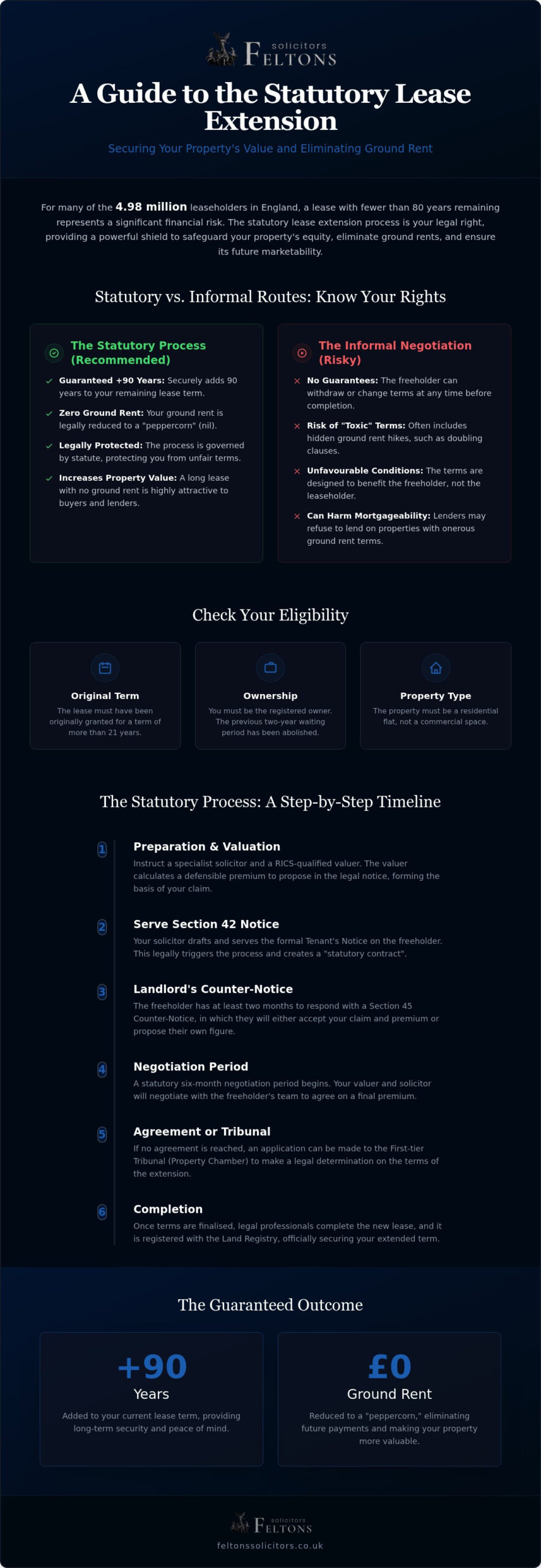
Choosing between a statutory claim and an informal negotiation is often the most critical decision a leaseholder will make. Whilst the informal route looks faster and cheaper at first glance, it lacks the rigid legal safeguards provided by the 1993 Act. Accuracy matters. A professional lease extension estimate for the statutory route acts as a financial “ceiling”. It tells you exactly what a fair market price looks like, which prevents a landlord from overcharging you in a private deal. Without this benchmark, you’re essentially negotiating in the dark, vulnerable to terms that benefit the freeholder’s long-term balance sheet rather than your own. The statutory route guarantees you an additional 90 years on top of your current term, whereas an informal deal might only offer a shorter extension that leaves you facing the same problem in a few decades.

The Long-Term Risks of Informal Agreements

Landlords frequently offer informal extensions as a way to preserve their ground rent income. In a statutory extension, your ground rent is legally reduced to a “peppercorn” (zero), but informal deals often include “modern” ground rents that rise significantly over time. This can make your property difficult to mortgage or sell later, as lenders have become increasingly cautious about high or doubling ground rent clauses. These clauses can turn a seemingly affordable flat into an unsellable asset. Understanding Tenant Lease Extension Rights: A Comprehensive Guide for 2026 is essential before you sign any private agreement. You should also consult external resources to gauge how much it will cost to extend your lease through official channels. This comparison ensures any private offer actually represents a genuine saving once the long-term cost of future rent is factored into your financial planning.

Legal Protections in the Statutory Process

The statutory process, initiated by a Section 42 Notice, provides a level of certainty that informal talks simply can’t match. It forces the landlord to respond within a strict two-month window, which stops them from stalling the process to wait for property prices to rise or for your lease to drop below the 80-year mark. If the parties can’t agree on the premium, the matter can be referred to the First-tier Tribunal (Property Chamber). This independent body ensures the final price remains fair and based on established valuation principles. This legal safety net ensures the freeholder can’t simply walk away from the table or demand an extortionate sum. It places the power back into your hands, providing a clear, predictable timeline to secure your home’s future. By following this route, you ensure the premium you pay is rooted in law rather than the landlord’s personal profit margins.

Lease Extension Estimate: A Professional Guide to Costs and Premiums in 2026

An online calculator often provides a false sense of certainty. While these tools are useful for a ballpark figure, a generic algorithm cannot account for the specific nuances of your building, the quality of internal refurbishments, or recent local sales. A professional lease extension estimate requires a more surgical approach. It’s the difference between a rough guess and a tactical strategy designed to withstand a freeholder’s counter-notice. Relying on an unverified figure can lead to a Section 42 Notice being declared invalid or, conversely, result in you starting negotiations from a position of weakness.

Choosing a Specialist Surveyor

You need a surveyor who specialises in the 1993 Act rather than a general valuer who typically handles mortgage appraisals. A standard mortgage valuation determines what a bank might lend on a property, but a leasehold valuation calculates the precise “marriage value” and “relativity” specific to your remaining term. Your surveyor must analyse local market data to justify these figures, especially if the freeholder disputes your opening offer. If you find the individual cost of extending is prohibitive, it might be worth exploring Collective Enfranchisement Solicitors to see if buying the freehold with your neighbours is a more viable long-term investment strategy for your block.

The Legal Workflow After the Estimate

Once your surveyor provides a “best-case” and “worst-case” range, your solicitor takes the lead. This valuation report is the blueprint for your Section 42 Notice. Serving this notice is effectively the “point of no return”; it fixes the valuation date, meaning the premium won’t increase even if property prices rise during the negotiation period. After the notice is served, you must prepare for the Landlord Response to Lease Extension Notice. This usually arrives in the form of a Counter-Notice, often proposing a significantly higher premium than your initial estimate.

The negotiation phase is where your professional team earns their keep. Your solicitor and surveyor work in tandem to bridge the gap between your opening offer and the landlord’s counter-proposal. This process involves a methodical review of “comparable” sales and legal precedents to ensure you don’t pay a penny more than the market dictates. Once a figure is agreed, your solicitor will finalise the new lease terms, ensuring no “stealth” clauses or modern ground rents are inserted. The final stage involves registering the new term at the Land Registry, providing you with absolute security. For tailored advice on your specific leasehold situation, contact our specialist property team to begin your application with a robust legal strategy.

Securing Your Property Rights with Feltons Solicitors LLP

At Feltons Solicitors LLP, we recognise that your property is likely your most significant financial asset. We provide a boutique approach to leasehold matters, combining high-end reliability with a personal touch that high-volume practices often fail to deliver. When you seek a lease extension estimate, you aren’t just looking for a mathematical calculation; you’re looking for a defensible strategy. Our team acts as your sophisticated guide, ensuring that every financial projection is rooted in current market data and established legal precedent. We pride ourselves on being a calm, steady presence amongst the complexities of property law, offering the quiet confidence you need to challenge a freeholder’s demands effectively.

Our methodology relies on deep, methodical coordination with specialist chartered surveyors. By working in tandem with these professionals, we ensure your lease extension estimate is robust enough to withstand the scrutiny of a Counter-Notice or a potential tribunal hearing. This collaborative effort allows us to provide pragmatic advice that prioritises the human impact of our work. We don’t just process files; we protect your equity and your peace of mind. Our commitment to professional integrity means we offer a discreet service that respects your privacy whilst maintaining the highest standards of modern legal efficiency.

Why Choose a Boutique Firm for Your Extension?

Choosing a boutique firm like Feltons Solicitors LLP means you benefit from a genuine, high-standard personal connection. You’ll never be treated as just another file number in a high-volume system. We focus on providing tailored solutions that reflect your specific circumstances, whether you’re dealing with a single flat or a complex portfolio of properties. As Leasehold Enfranchisement Experts, we possess the worldly experience and technical depth required to resolve disputes without resorting to aggressive or unnecessarily costly litigation. We believe in finding the most direct, cost-effective path to a fair premium, ensuring your interests remain at the centre of every negotiation.

Contacting Feltons Solicitors LLP for a Consultation

Moving from an initial lease extension estimate to a legally secured, extended lease requires a methodical and orderly approach. We help you navigate this transition with ease, providing a clear roadmap from the service of the Section 42 Notice to final registration at the Land Registry. Although we operate from a professional centre that values traditional integrity, our reach is national. We provide expert advice to leaseholders across the country, ensuring everyone has access to high-standard legal care. Take the first step towards protecting your property asset today by reaching out for a consultation; we’re here to ensure your home remains yours for generations to come.

Taking Control of Your Leasehold Investment

Securing a fair premium for your property requires moving beyond the uncertainty of online tools. A professional lease extension estimate provides the necessary leverage to negotiate from a position of strength, ensuring you aren’t overcharged by the freeholder. By choosing the statutory route, you protect your home from the long-term risks of escalating ground rents whilst adding significant value to your asset. This methodical approach transforms a complex legal requirement into a strategic advantage for your property portfolio.

Since 2010, Feltons Solicitors LLP has provided specialist property law expertise with a commitment to boutique, people-first service. We offer pragmatic advice for complex leasehold matters, ensuring that the human impact of every transaction is never forgotten. Whether you’re nearing the 80-year threshold or planning a future sale, our team is ready to act as your sophisticated guide through the valuation and negotiation maze. Contact Feltons Solicitors LLP for a professional lease extension consultation today. You don’t have to face the complexities of leasehold reform alone; let us help you secure your home’s future with confidence and care.

Frequently Asked Questions

Can I get a lease extension estimate for free?

You can find basic calculators online that offer a free lease extension estimate, but these shouldn’t be used for formal legal purposes. A professional estimate requires a chartered surveyor to analyse your specific lease terms and local market data. Whilst a free tool gives you a rough idea, it lacks the technical depth needed to draft a defensible Section 42 Notice that a freeholder will take seriously.

How accurate are online lease extension calculators in 2026?

Online calculators are useful for initial budgeting but often lack accuracy for properties with complex ground rent structures or those nearing the 80-year threshold. They don’t account for the specific “relativity” rates used by tribunals or the value of improvements you’ve made to the flat. For a precise figure that reflects the current 2026 market and legal landscape, a bespoke valuation is always the safer choice.

What happens to my estimate if the lease is already under 80 years?

Your estimate will include “marriage value”, which significantly increases the total premium payable to the landlord. This fee represents 50% of the “profit” or increase in property value created by the extension. If your lease has already dropped below 80 years, it’s vital to obtain a professional valuation quickly, as the cost continues to rise every year the lease shortens further.

Do I have to pay the landlord’s legal fees for the estimate and extension?

Yes, the law currently requires the leaseholder to pay the freeholder’s “reasonable” legal and valuation costs in a statutory extension. These costs are in addition to the premium and your own professional fees. Part of our role is to ensure these third-party costs are fair and proportionate, preventing the landlord from overcharging you for their own representation during the process.

How long is a professional valuation and estimate valid for?

A professional valuation is typically considered current for three to six months. Because the property market moves and your lease term constantly diminishes, the figures will eventually lose their accuracy. If you don’t serve your formal notice within this timeframe, your surveyor might need to provide a desktop update to ensure your opening offer remains legally robust and realistic.

Can the landlord refuse the premium suggested in my initial estimate?

The landlord cannot refuse your statutory right to extend, but they can certainly dispute the premium you propose. They will almost always serve a Counter-Notice with a higher figure based on their own surveyor’s report. This is a standard part of the process, leading to a negotiation phase where we work to find a middle ground that respects your financial interests.

Does the 2024 Reform Act mean I can get a cheaper estimate now?

As of July 2026, the most significant cost-saving measures of the 2024 Act, such as the total abolition of marriage value, haven’t yet been fully implemented. Ongoing legal challenges from freeholders and government consultations on valuation rates mean that premiums for shorter leases remain high. It’s important to base your current plans on existing valuation models rather than speculating on future implementation dates.

What is the “peppercorn rent” mentioned in lease extension estimates?

A peppercorn rent is effectively a ground rent of zero. When you extend your lease via the statutory route, your existing ground rent is cancelled and replaced with this symbolic “peppercorn”. This is a major benefit of the process, as it removes the burden of annual rent increases and makes your property far more attractive to mortgage lenders and future purchasers.

Collective Enfranchisement Solicitors: A How-To Guide for Buying Your Freehold in 2026

Collective Enfranchisement Solicitors: A How-To Guide for Buying Your Freehold in 2026

The building you call home should be your greatest asset, not a source of mounting anxiety. You have likely felt the frustration of rising service charges and the looming worry of a lease dipping toward that 80-year threshold. It is often difficult to organise neighbours, and the fear of hidden legal costs can keep many leaseholders stuck in a cycle of poor maintenance and diminishing property value. Partnering with experienced collective enfranchisement solicitors is the first step toward turning that shared frustration into a valuable, self-managed asset.

We understand that the legal landscape in 2026 feels complex, especially with the phased implementation of the Leasehold and Freehold Reform Act 2024. These reforms provide a significant opportunity to gain total control over your building and eventually secure 990-year leases with zero ground rent. This guide provides a clear blueprint for navigating the enfranchisement process, from understanding the updated 50% non-residential limits to managing group strategy. You will discover how to successfully secure your freehold and increase your property’s market value whilst avoiding the common pitfalls of property litigation. We will explain exactly how to move from leaseholder to freeholder with confidence and professional support.

Key Takeaways

  • Understand how collective enfranchisement empowers you to take full control of your building’s management and eliminate escalating service charges.
  • Learn the updated eligibility criteria for 2026, including the expanded 50% non-residential limit that makes buying the freehold possible for more mixed-use blocks.
  • Discover why instructing specialist collective enfranchisement solicitors is essential for navigating strict statutory deadlines and ensuring a smooth transition of ownership.
  • Identify how a robust Participation Agreement protects your group’s financial interests and ensures the stability of your claim from start to finish.
  • Master the strategic steps required to secure 990-year leases and zero ground rent, significantly increasing the long-term value of your home.

What is Collective Enfranchisement and Why Buy Your Freehold?

Collective enfranchisement isn’t just a legal procedure; it’s a fundamental shift in how you own your home. Essentially, it’s the right for a group of leaseholders to join forces and purchase the freehold of their building. This process transforms you from a tenant into a part-owner of the land your building sits on. For many, the catalyst is a history of opaque service charges, skyrocketing insurance premiums, or neglected communal areas. When you research What is Collective Enfranchisement, you quickly realise it’s about reclaiming autonomy over your living environment and your long-term financial security.

A lease is often described as a ‘wasting asset’ because its value diminishes as the term gets shorter. By buying the freehold, you and your neighbours can grant yourselves new leases, typically for 999 years, effectively stopping the clock on depreciation. It removes the stress of future extensions and makes your property far more attractive to buyers who might otherwise be wary of a lease dropping towards the 80-year mark. Instructing collective enfranchisement solicitors early in the process ensures the transition of the title is handled with the poise and professional integrity required to protect your investment.

The Core Benefits of Owning the Freehold

Owning the freehold changes the daily reality of living in a flat. You gain direct control over contractors, roof repairs, and insurance providers. This often leads to immediate savings by cutting out the freeholder’s profit margins or inflated management fees. Beyond finances, there’s the freedom to permit pets or approve internal alterations without paying for ‘licence to alter’ permissions. You transition from asking for permission to making decisions.

Statutory Rights Under the 1993 Act

The legal framework is the Leasehold Reform, Housing and Urban Development Act 1993. This legislation provides a structured route to force a sale, even if the freeholder is reluctant. Engaging collective enfranchisement solicitors ensures every notice is served correctly and that the freeholder cannot use delay tactics. The law is designed to protect your right to ownership, provided the process is followed with precision.

Eligibility Criteria: Does Your Building Qualify in 2026?

Before embarking on the journey toward ownership, it’s essential to confirm that your building meets the specific legal requirements. The process begins with understanding your leasehold property structure. To qualify, the building must be a self-contained block of flats or a part of a building that is capable of independent management. This means it must have its own vertical division and be able to function without relying on services from an adjacent structure. If your block shares communal heating or structural components with another building, the eligibility assessment becomes more nuanced.

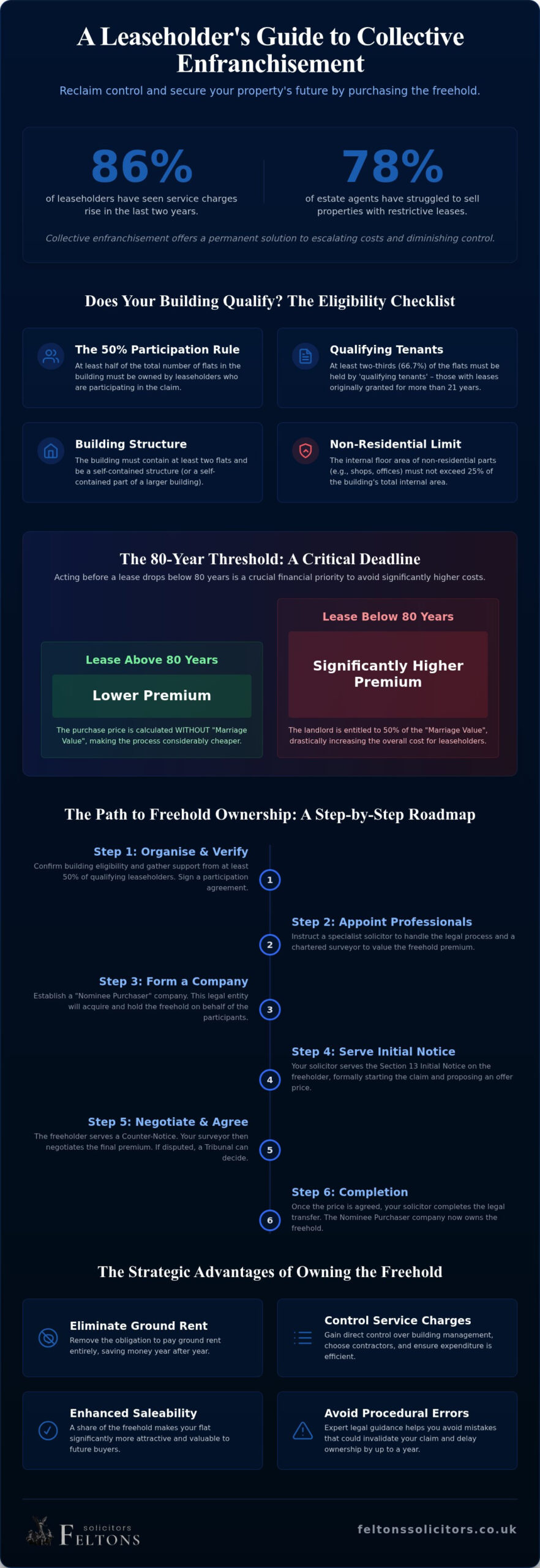
One of the most significant shifts in 2026 is the expanded eligibility for mixed-use buildings. Previously, if more than 25% of the internal floor area was used for non-residential purposes, the building was disqualified. However, the Leasehold and Freehold Reform Act 2024 has increased this limit to 50%. This change allows leaseholders in buildings with substantial commercial space, such as shops or offices on the lower floors, to finally take control. Additionally, at least 50% of the total number of flats in the building must agree to participate in the purchase. If you live in a block of ten flats, you need at least five neighbours to commit to the claim.

Another core requirement involves the status of the tenants themselves. At least two-thirds of the flats in the building must be held by ‘qualifying tenants’. These are leaseholders whose original lease term was for more than 21 years. If you are unsure whether your block meets these thresholds, seeking advice from collective enfranchisement solicitors early on can prevent costly missteps. The team at Feltons Solicitors LLP can help you audit your building’s eligibility before you begin formal negotiations.

Defining the ‘Qualifying Tenant’

A qualifying tenant can be an individual or a company. However, if a single person or entity owns more than two flats in the building, they are excluded from being a qualifying tenant for the purposes of the claim. It’s also important to remember that the two-year ownership rule was abolished in early 2025. You can now participate in a collective enfranchisement claim from the day you complete your property purchase, regardless of how long the previous owner held the title. Your current lease length doesn’t affect your right to participate; even those with very short leases can be part of the group.

Common Eligibility Pitfalls to Avoid

Buildings with complex flying freeholds or those owned by specific charitable housing trusts can present unique challenges. In some cases, the freeholder may be exempt from the statutory process if the property is part of a charitable mission. Identifying these exemptions requires a methodical review of the title deeds and the freeholder’s status. Missing these details can lead to a claim being rejected at the first hurdle, which is why collective enfranchisement solicitors conduct thorough initial searches as part of the due diligence process.

The Collective Enfranchisement Process: A Step-by-Step Guide

Successfully purchasing a freehold is as much about group dynamics as it is about legal precision. Whilst the statutory route provides a clear framework, the process requires a methodical approach to ensure every participant remains committed and every deadline is met. Unlike a voluntary negotiation, which relies on the landlord’s whims, the statutory process under the 1993 Act grants you the power to compel a sale. This journey begins with internal organisation and ends with the transfer of the title to a company owned by you and your neighbours.

The first critical step involves organising your group and establishing a formal Participation Agreement. This document is a legally binding contract that governs the behaviour of the participants, securing financial commitments and outlining how decisions will be made. Without this, the claim is vulnerable if a neighbour decides to withdraw at a late stage. Once the group is secure, collective enfranchisement solicitors will help you form a ‘Nominee Purchaser’ company. This entity is specifically designed to hold the freehold title on behalf of the participating leaseholders, ensuring a professional structure for future building management.

Following the company formation, your legal team will serve the Section 13 Notice on the freeholder. This formal document triggers the legal timetable and sets out the proposed price for the freehold. If the freeholder agrees to the terms, the process moves toward completion. However, if an agreement on the premium cannot be reached through negotiation, an application to the First-tier Tribunal may be necessary to determine a fair price. In 2026, the fees for such an application are typically £200, with an additional £300 for a hearing, representing a modest cost for securing a fair valuation.

The Role of the Specialist Valuer

You should never serve a Section 13 Notice without a professional valuation. A specialist valuer provides a realistic estimate of the premium, ensuring your opening offer is neither too high nor so low that it risks being deemed unrealistic. By 2026, the abolition of ‘marriage value’ has significantly simplified these calculations, making the process more transparent for buildings with leases under 80 years. Understanding how these valuations are constructed is just as important for individual leaseholders; a detailed lease extension estimate can help each participant appreciate the financial stakes before the group commits to the collective purchase. Your valuer and collective enfranchisement solicitors work in tandem to counter the freeholder’s opening demands, using market data to protect your financial interests.

Serving the Section 13 Notice

The Section 13 Notice is the most important document in the claim. It must include precise details of the participating flats, the proposed premium, and the details of the Nominee Purchaser. Any technical error can lead to the notice being declared invalid, which may prevent you from starting a new claim for twelve months. The landlord is given a minimum of two months to respond with a Counter-Notice. If they fail to respond by the stated deadline, the group can apply to the court for a Vesting Order, allowing the purchase to proceed on the terms set out in your initial notice.

Collective Enfranchisement Solicitors: A How-To Guide for Buying Your Freehold in 2026

Mitigating Risks: Participation Agreements and Group Management

Whilst the legal framework provides the statutory right to buy, the human element often presents the greatest challenge to a successful claim. Collective enfranchisement requires a group of neighbours to act as a single, disciplined unit for several months. The most significant risk to any claim is a participant dropping out at a late stage. If one person withdraws, the remaining group is often left to cover the financial shortfall, which can jeopardise the entire project. This is why establishing a robust Participation Agreement is the most critical step you can take before serving any formal notice.

A Participation Agreement is a legally binding contract between the leaseholders that governs the group’s behaviour and financial obligations. It provides a safety net, ensuring that everyone is committed to the same goals and understands their share of the costs. Specialist collective enfranchisement solicitors will tell you that a claim’s success often rests on the strength of this internal contract. It prevents stalemates during negotiations by defining exactly how decisions are made, whether by a simple majority or a dedicated committee. Without this structure, a single dissenting voice can halt progress during a critical negotiation window.

What Should Your Participation Agreement Include?

A well-drafted agreement should leave no room for ambiguity. It must clearly outline the following provisions:

  • Defaulting members: Clear consequences for participants who fail to pay their share of the premium or legal fees on time.
  • Lease valuations: The mechanism for granting new 999-year leases to participants at a peppercorn rent, whilst ensuring non-participants remain on their current terms.
  • Future management: How the building will be managed once the freehold is acquired, including the appointment of directors for the Nominee Purchaser company.
  • Cost sharing: A precise breakdown of how the purchase price and the freeholder’s reasonable legal costs will be divided amongst the group.

Managing Apathy and Non-Participants

It’s common to encounter neighbours who want the benefits of a freehold purchase but are unwilling or unable to contribute to the costs. In these cases, the participating group must decide whether to ‘carry’ the cost of the non-participant’s flat to secure the building. For those who cannot join the collective purchase, they still retain their individual tenant lease extension rights, which can be pursued separately. Furthermore, if your freeholder is ‘missing’ or ‘untraceable’, your collective enfranchisement solicitors can apply for a Vesting Order through the county court, allowing the purchase to proceed even in their absence.

Managing a group claim requires a steady, poised hand to ensure all stakeholders remain aligned. If you are ready to formalise your group’s commitment, you should contact our enfranchisement team to draft a Participation Agreement tailored to your building’s specific needs.

Why Specialist Collective Enfranchisement Solicitors are Vital

The legal journey of buying your freehold is paved with rigid statutory deadlines that leave no room for error. If a single notice is served incorrectly or a counter-proposal deadline is missed by just one day, the law can treat the claim as ‘deemed withdrawn’. This doesn’t just stall your progress; it often prevents the group from serving a new notice for another twelve months, during which time property values may rise and leases grow shorter. Instructing specialist collective enfranchisement solicitors is the only way to ensure these procedural traps are avoided. At Feltons Solicitors LLP, we provide the poised, steady guidance required to manage the many moving parts of a group claim, ensuring your interests remain protected from the initial audit to the final transfer of title.

Our approach combines modern efficiency with the traditional professional integrity you expect from a trusted advisor. We understand that behind the legal filings are homeowners seeking peace of mind and financial security. Our methodology is deeply pragmatic; we aim to avoid unnecessary litigation through skilled negotiation, whilst remaining prepared to defend your rights at a tribunal if the freeholder’s demands are unreasonable. We act as the central hub for your claim, coordinating between specialist valuers, dozens of participants, and the freeholder’s legal team to keep the process moving at a reassuring pace.

Avoiding Costly Technical Errors

A common pitfall in these claims is the incorrect structuring of the ‘Nominee Purchaser’ company. This entity must be fit for purpose not just for the purchase, but for the long-term management of the building. We ensure the Articles of Association are drafted to reflect the internal agreements of the group, preventing future disputes amongst the owners. Additionally, we navigate the increasingly complex Land Registry requirements, including the registration of overseas entities where a participant or the freeholder is based abroad. As Leasehold enfranchisement experts, we handle these technical hurdles with a level of precision that general practice firms often lack.

The Feltons Approach: Boutique Care for Complex Claims

The final stage of the process involves complex conveyancing to transfer the freehold title and the simultaneous creation of new, 999-year leases for every participant. This ensures that your ‘wasting asset’ is officially transformed into a secure, long-term investment. Feltons Solicitors LLP provides a boutique level of care that prioritises personal connection, ensuring you aren’t just another file in a high-volume system. If you’re ready to take the first step toward building autonomy, we invite you to contact us for a consultation. We will assess your building’s eligibility and provide a clear, methodical path toward successfully buying your freehold in 2026.

Take Control of Your Building’s Future Today

The transition from a passive leaseholder to an empowered freeholder is one of the most effective ways to protect your long-term investment. By consolidating your group’s interests and leveraging the 2026 reforms, you can finally eliminate the uncertainty of third-party management and the financial drain of ground rents. As we have explored, success requires more than just meeting eligibility criteria; it demands a disciplined approach to group strategy and a thorough understanding of the statutory framework. This shift in ownership doesn’t just lower your annual outgoings; it fundamentally changes the nature of your property from a wasting asset to a permanent, self-governed home.

The path to property independence is significantly smoother when guided by specialist collective enfranchisement solicitors who understand the nuances of the current legal landscape. Feltons Solicitors LLP has provided this level of expert guidance since 2010, offering pragmatic and jargon-free advice on a national scale. We take pride in our boutique approach, ensuring that your building’s specific challenges are met with tailored solutions and professional integrity. Our role is to act as your steady advisor, managing the complex coordination between valuers and participants whilst you focus on the future of your community.

Secure your property’s future with Feltons Solicitors LLP to discuss how we can help you achieve full building autonomy. With the right professional partnership, the vision of a self-managed, ground-rent-free building is entirely within your reach.

Frequently Asked Questions

How many tenants do we need to buy the freehold?

You need at least 50% of the total number of flats in your building to participate in the claim. For example, in a block of ten flats, at least five leaseholders must join together to trigger the legal process. It’s also required that at least two-thirds of the total flats in the building are owned by qualifying tenants. This ensures the group has a sufficient collective interest to compel the freeholder to sell.

Can the freeholder refuse to sell the freehold to us?

No, the freeholder cannot refuse the sale if your building and the participating group meet the statutory eligibility criteria. The law grants you a legal right to purchase the freehold under the 1993 Act. Whilst a landlord might challenge the validity of your initial notice or the proposed price, they cannot simply reject the purchase itself. Expert collective enfranchisement solicitors ensure your claim is structurally sound to prevent such challenges from succeeding.

How much does collective enfranchisement cost on average?

The total cost depends on the premium payable for the freehold and the professional fees involved in the claim. You’ll be responsible for your own legal and valuation fees, as well as the freeholder’s reasonable legal and valuation costs. Since the abolition of marriage value in 2024, the premium for buildings with leases under 80 years has become more predictable. A specialist valuer can provide a detailed estimate before you formally commit to the process.

What is a Participation Agreement and do we really need one?

A Participation Agreement is a legally binding contract between the participating leaseholders that governs the group’s financial and procedural commitments. You absolutely need one to protect the group if an individual decides to withdraw or fails to pay their share of the costs. It establishes a clear framework for decision-making and cost-sharing, preventing the claim from collapsing due to internal disputes. It’s the foundation of a secure and professional group strategy.

Does buying the freehold automatically extend my lease?

Buying the freehold doesn’t automatically extend your lease, but it gives your group the power to do so once the purchase completes. Most groups choose to grant themselves new 999-year leases at a peppercorn rent immediately after acquiring the title. This process is handled by your collective enfranchisement solicitors as part of the final conveyancing stage. It effectively removes the ‘wasting asset’ nature of your property and increases its long-term market value.

Can we buy the freehold if some tenants don’t want to join in?

Yes, you can proceed with the purchase as long as at least 50% of the flats in the building participate. Those who don’t join will remain as leaseholders, but their landlord will change from the current freeholder to the new Nominee Purchaser company owned by you and your neighbours. Non-participants won’t benefit from the new 999-year leases or the removal of ground rent unless they negotiate a separate deal with your group later.

What happens if we can’t agree on a price with the freeholder?

If negotiations reach a stalemate, you can apply to the First-tier Tribunal (Property Chamber) to determine the fair premium. As of July 2026, the application fee is £200, with a hearing fee of £300. The Tribunal acts as an independent body that reviews evidence from both sides’ valuers to set a final price. Most cases are settled through negotiation before reaching this stage, but the Tribunal remains a vital safety net for leaseholders.

How long does the collective enfranchisement process take?

The entire process typically takes between nine and twelve months from the service of the initial notice to final completion. This timeline accounts for the statutory response periods, valuation negotiations, and the final conveyancing work. If the case proceeds to a Tribunal, the timeline can extend by several months depending on the court’s availability. Staying organised and responding to your solicitor’s requests promptly is the best way to keep the claim moving efficiently.

Leasehold Extension for Overseas Landlords: A Guide to Protecting UK Assets in 2026

Leasehold Extension for Overseas Landlords: A Guide to Protecting UK Assets in 2026

What if the most significant threat to your UK investment isn’t the property market itself, but a ticking clock you can’t see from thousands of miles away? Managing a leasehold extension for overseas landlords often feels like a delicate balancing act between complex legal reforms and the strict requirements of the Register of Overseas Entities. It’s natural to feel a sense of urgency as your asset approaches the 80-year mark, especially whilst navigating different time zones and evolving UK legislation. We understand that your priority is a seamless process that protects your capital without requiring your constant, physical presence in the UK.

This guide will show you how to secure a valid lease extension that restores your property’s marketability whilst ensuring full compliance with Land Registry and ROE standards. You will discover how the 2024 reforms have simplified the landscape, including the abolition of marriage value and the introduction of the 990-year standard term. We will provide a clear, methodical preview of the steps required to manage these changes, allowing you to maintain your portfolio with the quiet confidence that your interests are fully protected and your legal obligations are met.

Key Takeaways

  • Understand why the 80-year “Marriage Value” threshold remains a critical financial deadline for protecting your property’s long-term market value.
  • Discover how a leasehold extension for overseas landlords now provides a standardised 990-year term and reduced ground rents under the 2024 reforms.
  • Identify the mandatory compliance steps required to synchronise your lease extension with the Register of Overseas Entities (ROE).
  • Learn how the abolition of the two-year ownership rule enables new international investors to initiate the extension process immediately upon purchase.
  • Explore the methodical process of instructing specialist UK solicitors to manage professional valuations and legal filings whilst you are based abroad.

Protecting Asset Value: Why Overseas Landlords Must Prioritise Lease Extensions

A leasehold extension is a vital legal mechanism that allows you to add a significant number of years to your existing UK property lease whilst simultaneously reducing your ground rent to a “peppercorn” or zero rate. For any investor managing a portfolio from afar, a leasehold extension for overseas landlords isn’t merely a paperwork exercise; it’s a strategic move to safeguard the capital value of your asset. The foundation for these rights was established through legislation like the Leasehold Reform Act 1967, which first empowered leaseholders to secure their long-term interests against the freeholder’s interest.

The 80-year mark is often described as a “cliff” because of its dramatic financial consequences. Once a lease drops below this threshold, the cost of extending it rises sharply due to the introduction of marriage value. For landlords living abroad who may not be tracking their lease documents on a weekly basis, missing this date can result in a bill that is tens of thousands of pounds higher than it would’ve been just a few months prior. Acting early is the most effective way to keep your premium predictable and your investment profitable.

Marketability is another pressing factor that demands attention. Most UK high-street lenders are hesitant to offer mortgages on properties with fewer than 85 years remaining on the lease. If you decide to sell or refinance your investment, a short lease significantly shrinks your pool of potential buyers to cash-only investors. This lack of competition inevitably drives down the sale price, making your asset far less liquid than it should be.

As we move through 2026, the UK property market is defined by increased transparency and stricter regulatory scrutiny. A long lease acts as a defensive shield against market volatility, ensuring your property remains a “clean” asset in the eyes of lenders and buyers alike. By securing a 990-year extension now, you effectively future-proof the property for generations, removing the need for any further legal intervention during your lifetime.

The Financial Risk of Diminishing Leases

The price you pay for an extension, known as the premium, is dictated largely by the unexpired term of your lease. The fewer years remaining, the higher the cost you’ll face. Marriage value is the increase in property value following an extension, 50% of which is owed to the landlord. By initiating the process before the lease hits that 80-year mark, you bypass this specific charge entirely, ensuring the extension remains a cost-effective management task rather than a financial burden.

Marketability and Global Portfolios

Maintaining a “clean” asset is vital for those managing a global portfolio where UK property serves as key collateral. International banks are becoming increasingly forensic when reviewing leasehold interests, and they’ve shown a clear preference for assets with long-term stability. A leasehold extension for overseas landlords ensures that the property remains a robust piece of collateral, capable of supporting further investment or providing a secure exit strategy when you choose to sell. It’s about maintaining the same high standard for your UK assets that you expect from your investments elsewhere in the world.

The Leasehold Reform, Housing and Urban Development Act 1993 remains the foundation for leasehold extension for overseas landlords, though its provisions have been significantly enhanced by the Leasehold and Freehold Reform Act 2024. While the 1993 Act established the right to a 90-year extension, the standard term has now been increased to a substantial 990 years. Perhaps the most significant hurdle removed for international investors is the two-year ownership rule. Since February 2025, you can initiate an extension immediately upon purchasing a property, ensuring your capital is protected from day one.

The formal process begins with a Section 42 Notice. This document serves as the “starting gun” for your legal claim, setting out your proposed premium and the terms of the new lease. It’s a precise legal instrument that requires expert handling to avoid being declared invalid by the freeholder. According to official government guidance on lease extensions, the statutory route also ensures your ground rent is reduced to a “peppercorn” rate. This essentially means your ground rent becomes zero for the duration of the new lease, removing a recurring expense that can otherwise complicate property management from abroad.

Qualifying as an Overseas Tenant

To qualify, your property must be held under a “long lease,” which is defined as a lease originally granted for more than 21 years. If you hold your UK assets through an offshore Special Purpose Vehicle (SPV), you are still eligible to exercise these rights, provided the entity is correctly registered with Companies House. Certain exceptions apply, such as properties owned by the National Trust or specific charitable housings. Ensuring your entity is compliant with the latest UK standards is a prerequisite for a smooth claim.

Statutory vs. Informal Extensions

You may find freeholders offering “informal” or private deals. These can seem attractive because they often appear faster or cheaper initially. However, they lack the legal safeguards of the statutory route. Private deals frequently include hidden clauses, such as future ground rent hikes or shorter extension terms that don’t solve the long-term value issue. The statutory route offers the highest level of security for landlords who aren’t physically present in the UK to monitor their freeholder’s behaviour.

In 2026, the timeline for a statutory extension typically spans six to twelve months. While this requires patience, the result is a legally robust asset that meets all modern lending criteria. If you’re unsure which route best suits your portfolio, seeking professional leasehold extension advice can provide the clarity needed to make an informed decision.

The Register of Overseas Entities (ROE): A Crucial Hurdle for Leasehold Extensions

The Economic Crime (Transparency and Enforcement) Act 2022 introduced a significant layer of administration that fundamentally changed how a leasehold extension for overseas landlords is executed. By 2026, the Register of Overseas Entities (ROE) has become a central pillar of UK property law. Any foreign company or entity owning land in the UK must register with Companies House to obtain a unique Overseas Entity ID. Without this ID, your property is effectively frozen. You cannot sell, lease, or, crucially, complete a statutory lease extension. The registration acts as a digital passport for your asset, and without it, the legal doors to the Land Registry remain firmly shut.

The Land Registry acts as the gatekeeper in this process. When your solicitor submits the new lease for registration, the Land Registry cross-references the application with the ROE. If your entity is not registered, or if your annual update is overdue, the application will be rejected. This “Land Registry block” is a common point of failure for many international investors who assume their property rights are independent of corporate filings. To understand the specifics of these filings, you can refer to Overseas Entity Beneficial Owner Registration for a detailed look at the 2026 requirements.

The Link Between ROE and the Land Registry

The registration of a lease extension is technically a “disposition” of land. Under the rules detailed in HM Land Registry Practice Guide 28, the Registrar is prohibited from registering most dealings by an overseas entity unless that entity is compliant with its ROE obligations. If you serve a Section 42 notice whilst your entity is non-compliant, you risk the entire transaction being deemed void. This doesn’t just delay the process; it can lead to significant financial loss if you miss a critical valuation window or a leasehold deadline.

Common Pitfalls in Overseas Registration

Discrepancies in entity names are a frequent cause of rejection. If the name on your original lease differs even slightly from the name registered on the ROE, the Land Registry will likely raise a requisition. Additionally, all information submitted to the ROE must be verified by a UK-regulated agent. This verification is not a one-time task. It must be refreshed annually to keep the entity “active.” For those managing a leasehold extension for overseas landlords, ensuring this compliance is up to date is the first and most vital step in any 2026 property strategy. It’s the foundation upon which your legal claim is built, ensuring your investment remains liquid and secure.

Leasehold Extension for Overseas Landlords: A Guide to Protecting UK Assets in 2026

Step-by-Step Guide: Executing a Lease Extension from Abroad

Executing a leasehold extension for overseas landlords requires a methodical approach that accounts for the physical distance between you and your asset. The process is inherently procedural, but when managed correctly, it can be completed with minimal disruption to your daily life. Your first priority is instructing a specialist UK solicitor who possesses deep experience in international property law and the specific nuances of the 2026 regulatory environment. This legal partner acts as your anchor in the UK, managing the flow of documents and ensuring all statutory deadlines are met with precision.

Once your legal representative is in place, the next step involves a professional valuation. A specialist surveyor will assess your property to determine the “premium,” which is the capital sum you will pay the freeholder to secure the extension. With this figure established, your solicitor will serve the Section 42 Tenant’s Notice. This formal document triggers the legal process and protects your right to the extension from the moment it’s served. The freeholder then has a two-month window to respond with a Counter-Notice, after which your surveyors will negotiate the final premium and lease terms.

The final stages involve the drafting and approval of the new lease, followed by the completion of a deed of substitution. This ensures any existing mortgage is correctly transferred to the new, longer lease. Finally, your solicitor will update the Land Registry records. This step is where your prior compliance with the Register of Overseas Entities becomes critical, as the Land Registry will not finalise the update without a valid Overseas Entity ID.

Remote Identity Verification and AML

Modern legal practice has evolved to support international clients through secure digital ID platforms. These tools allow you to satisfy stringent Anti-Money Laundering (AML) checks from your smartphone, removing the need for international travel. In some instances, you may still require a Notary Public in your home jurisdiction to witness specific signatures on physical documents. A forward-thinking solicitor will coordinate this process, providing clear instructions to ensure your local notary meets UK Land Registry standards.

Managing the Financial Transaction

Handling the transfer of the premium and associated legal costs is managed through secure solicitor client accounts, providing a transparent audit trail for your records. You must also account for any Stamp Duty Land Tax (SDLT) implications, though many extensions fall below the payment threshold. To ensure you aren’t paying more than necessary, it is vital to work with a leasehold enfranchisement expert who can accurately challenge any inflated figures proposed by the freeholder. If a freeholder becomes uncooperative or disputes the premium, engaging experienced dispute resolution solicitors can help you resolve the conflict efficiently without the cost and stress of protracted court proceedings. If you are ready to begin this process, we invite you to contact our team for a professional consultation to discuss your specific property requirements.

At Feltons Solicitors LLP, we’ve built our reputation on providing a sophisticated, boutique service that prioritises the individual needs of international clients. Managing a leasehold extension for overseas landlords requires more than just technical proficiency; it demands a partner who understands the logistical and emotional weight of international asset management. We act as your steady, professional presence in the UK, ensuring that every detail of your property interests is handled with the discreet care you expect. Our philosophy is people-first, which means we focus on managing your stress and providing clarity whilst we handle the complex legal paperwork behind the scenes.

Our expertise is specifically tailored to bridge the gap between traditional leasehold law and the modern requirements of the Economic Crime (Transparency and Enforcement) Act 2022. We understand that your property doesn’t exist in a vacuum. It’s part of a wider financial picture that includes corporate registrations and international compliance. By synchronising these elements, Feltons Solicitors LLP prevents the administrative delays that often plague standard property transactions. You can rely on us to be your eyes and ears on the ground, providing regular, concise updates that respect your time and your privacy.

Why a Specialist Property Law Firm Matters

Precise drafting is the cornerstone of a secure lease. A poorly constructed document can lead to future disputes or difficulties during a sale, especially if the freeholder attempts to insert restrictive clauses. As a dedicated Residential Property Law Firm, we have the experience necessary to identify these risks early. If a freeholder becomes uncooperative or contentious, our litigation and dispute resolution team at Feltons Solicitors LLP is ready to defend your interests, ensuring the statutory process remains on track. We provide the following benefits to our international clients:

  • Direct access to senior solicitors with experience in high-value UK property portfolios.
  • Comprehensive management of both the lease extension and the Register of Overseas Entities (ROE) filings.
  • Transparent communication and secure digital platforms for remote document handling.
  • A methodical approach to valuation negotiations to protect your capital.

Begin Your Lease Extension Today

The year 2026 represents a critical window for action. With the full implementation of the 2024 reforms now in effect, including the abolition of marriage value and the move to 990-year terms, there’s never been a more advantageous time to secure your UK assets. Waiting for further market shifts or legislative tweaks only risks the unexpired term of your lease dropping further. Feltons Solicitors LLP offers bespoke estimates that reflect the specific nuances of your property and corporate structure, providing you with a clear roadmap for the months ahead. To protect your investment and ensure full compliance, contact Feltons Solicitors LLP for expert guidance on your overseas leasehold extension.

Future-Proofing Your UK Property Portfolio for 2026 and Beyond

Securing your UK investment involves more than just monitoring market prices; it requires a proactive approach to the legal health of your assets. As we’ve explored, a leasehold extension for overseas landlords is the most effective way to eliminate ground rent and restore long-term value whilst staying ahead of the 80-year threshold. By aligning your property rights with the latest Register of Overseas Entities requirements, you transform a potentially depreciating asset into a secure, liquid component of your global portfolio.

Feltons Solicitors LLP provides the calm, authoritative guidance necessary to manage these processes from anywhere in the world. Our specialist focus on ROE verification and leasehold enfranchisement ensures that your extension is legally robust and fully compliant with current Land Registry standards. We act as your trusted partner on the ground, offering the discreet, boutique service that complex international matters demand. Secure your UK property value with Feltons Solicitors LLP today. Taking action now provides the certainty that your investment remains protected and your legal obligations are met with professional precision.

Frequently Asked Questions

Can I extend my UK lease if I live in another country?

Yes, you have the same statutory rights to a leasehold extension for overseas landlords as a resident of the UK. Your physical location doesn’t impact your eligibility, provided you hold a “long lease” originally granted for a term of more than 21 years. The process is designed to be handled by your UK legal representative, allowing you to exercise your rights from any jurisdiction.

Do I need to visit the UK to sign the lease extension documents?

No, you don’t need to travel to the UK at any stage of the process. Modern law firms use secure digital ID verification platforms to satisfy Anti-Money Laundering requirements remotely. For documents that require a physical signature, you can use a Notary Public in your home country to witness the signing, after which the papers are couriered to your solicitor in the UK.

How does the Register of Overseas Entities affect my lease extension?

The Register of Overseas Entities (ROE) acts as a mandatory compliance gatekeeper for your transaction. If your property is held in the name of an overseas company, the Land Registry will not register your new lease unless that entity has a valid Overseas Entity ID from Companies House. You must ensure your entity is not only registered but that your annual verification statements are fully up to date before serving your notice.

Is the two-year ownership rule still in effect for overseas landlords in 2026?

No, the requirement to have owned the property for two years was abolished in February 2025. This means you can initiate a leasehold extension for overseas landlords immediately after completing your property purchase. This reform is particularly beneficial for international investors who wish to modernise their lease terms and remove ground rent obligations from the very start of their ownership.

What happens if my UK lease has less than 80 years remaining?

If your lease drops below 80 years, you should prioritise an extension to protect the property’s marketability and mortgageability. Whilst the 2024 reforms abolished “marriage value” fees that previously made short-lease extensions much more expensive, a lease with fewer than 80 years still presents a significant hurdle for UK lenders. Extending your lease ensures the asset remains liquid and maintains its full capital value in a competitive market.

Can my overseas company extend the lease on a commercial property?

Yes, overseas companies can extend leases on commercial properties, although the statutory framework differs from that of residential flats. Commercial extensions are often handled via a negotiated “non-statutory” route. Regardless of the property type, your company must be correctly registered on the ROE to ensure the Land Registry can legally process and record the new lease variation.

How much does a solicitor charge for an overseas leasehold extension?

Legal fees for an international extension depend on the complexity of your corporate structure and whether the freeholder disputes the premium. Costs typically cover the drafting of the new lease, the service of formal notices, and the necessary identity and ROE compliance checks. We recommend requesting a bespoke estimate that accounts for your specific entity type and the number of properties involved in your claim.

What is a Section 42 notice and who serves it?

A Section 42 notice is the formal legal document that officially triggers your statutory claim for a lease extension. It is served by your UK solicitor to the freeholder and sets out your proposed premium and the terms of the new lease. Serving this notice is a critical step because it “fixes” the valuation date, ensuring that any subsequent changes in the property market don’t affect the price you pay for the extension.