

Extending a Lease on a Flat in London: The Definitive 2026 Guide

Extending a Lease on a Flat in London: The Definitive 2026 Guide

Waiting for the “perfect” legislative moment to extend your lease could be the most expensive mistake a London property owner makes this decade. While recent reforms promise a fairer landscape, the reality of extending a lease on a flat london in 2026 remains a complex chess game of timing and technicality. You’re likely feeling the pressure of the 80-year marriage value threshold; perhaps you’re also confused by the staged implementation of the Leasehold and Freehold Reform Act 2024. It’s natural to feel anxious when your home’s future value depends on successful negotiations with a freeholder who may not share your priorities.

We understand that your property represents both your home and your financial security. This guide provides the clarity you need to move forward with quiet confidence. You’ll discover the essential steps to secure a 990-year extension, the latest updates on premium calculations, and the legal protections now available to leaseholders. We’ll walk through the entire process, from the initial valuation to the final registration, ensuring you have a steady, expert hand to guide you through this period of legal transition.

Key Takeaways

  • Identify why the 80-year threshold is the most significant factor when extending a lease on a flat london and how to time your application for maximum financial advantage.
  • Compare the statutory and informal extension routes to determine which process offers the most robust legal security for your home.
  • Gain a clear understanding of the financial requirements, including the capital premium and the professional fees necessary for a precise valuation.
  • Stay informed on the 2026 implementation of recent leasehold reforms, specifically the transition toward 990-year terms and the reduction of ground rent.
  • Learn how a methodical, expert-led negotiation strategy can safeguard your property’s future value while avoiding unnecessary legal disputes.

Why extending a lease on a flat in London and across the UK is essential

A lease extension is the formal legal process of adding additional years to your property’s remaining term. To understand the necessity of this process, one must first grasp what a leasehold property is in the context of English law. Essentially, you own the right to occupy the property for a fixed period rather than owning the land itself. As this period shortens, the value of your asset decreases. In 2026, leaseholders are increasingly prioritising these applications because the legislative environment has shifted. The Leasehold and Freehold Reform Act 2024 has introduced new standards, such as the 990-year extension term, making it a pivotal time for extending a lease on a flat london. This legal procedure is no longer just a recommendation; it’s a fundamental requirement for maintaining property liquidity.

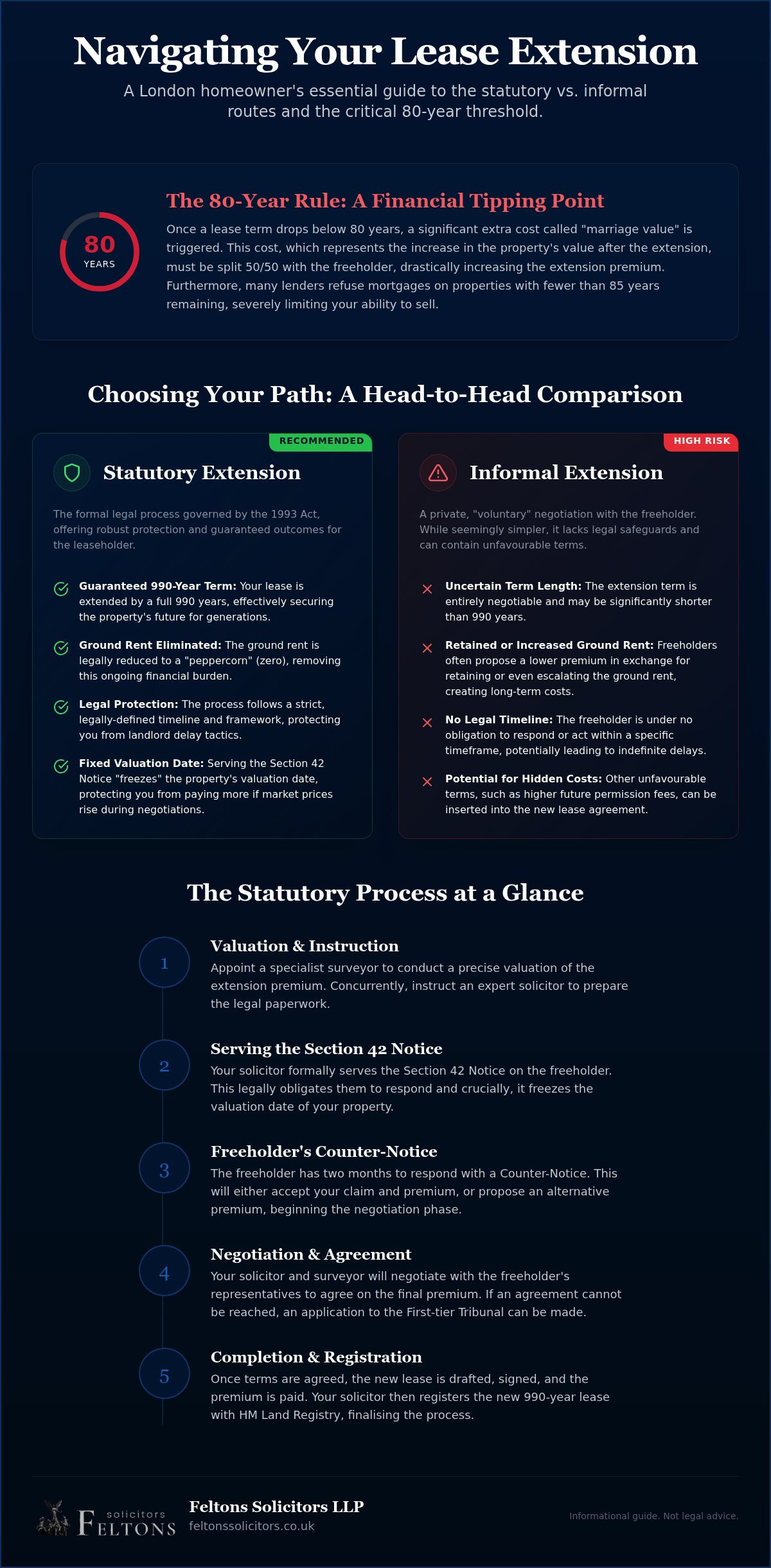
The 80-year rule: A financial turning point

The 80-year mark is widely recognised as the most critical deadline in property ownership. Once a lease drops below this threshold, a cost known as “marriage value” is triggered. Marriage value is the increase in property value following an extension. Under current rules, this profit is shared 50/50 with your freeholder, which significantly increases the premium you’re required to pay. Whilst the 2024 Act aims to eventually abolish this cost, the provision isn’t yet in force as of August 2026. Waiting for these changes carries a distinct financial risk. If the market value of your property rises whilst you delay, the eventual premium may still exceed today’s costs. Additionally, many high-street lenders now refuse to offer mortgages on properties with fewer than 85 years remaining, making it difficult to sell to anyone other than cash buyers.

Leasehold as a diminishing asset

Unlike a freehold house, a leasehold flat is a wasting asset. Its value doesn’t just plateau, it begins to accelerate downwards as the term expires. There’s a notable psychological shift amongst buyers and surveyors when a lease falls below 90 years. They often view it as a looming liability rather than a secure investment. By extending a lease on a flat london, you effectively reset the clock and protect your capital. This proactive step ensures your home remains attractive on the open market and retains its status as a high-quality asset. Securing your property’s future today provides the peace of mind that your investment is shielded from the natural erosion of time.

Statutory vs informal lease extensions: Choosing the right path

Deciding between a statutory application and an informal negotiation is the most consequential choice you’ll make when extending a lease on a flat london. The statutory route is governed by the Leasehold Reform, Housing and Urban Development Act 1993, which provides a rigid legal framework to protect your interests. In contrast, the informal route is a private agreement with your landlord. Whilst informal deals might appear simpler or faster, they often lack the strict safeguards found in official government guidance. Most professionals recommend the statutory path because it guarantees a 990-year extension and reduces ground rent to a peppercorn, providing total security for your asset.

The power of the Section 42 Notice

Serving a Section 42 Notice is a strategic move that formally initiates the statutory process. This notice is vital because it ‘freezes’ the valuation date. Even if property prices in the capital rise during negotiations, your premium is calculated based on the market value at the moment the notice is served. By 2026, the eligibility criteria have simplified; the previous requirement to have owned the property for two years was abolished in early 2025. Once served, the freeholder is legally obligated to respond with a Counter-Notice within two months. This structured timeline prevents landlords from using delay tactics to inflate costs or stall your progress.

When an informal extension might be appropriate

There are rare instances where an informal extension might be considered, particularly if you have a collaborative relationship with your freeholder and require an exceptionally fast completion. However, these “voluntary” offers frequently contain hidden traps. Landlords might propose a lower upfront premium in exchange for retaining or even increasing ground rent. Under the 2024 legislation, statutory extensions automatically eliminate ground rent, but an informal deal could include modern clauses that complicate future sales or mortgage applications. The short-term saving on professional fees is rarely worth the long-term cost of an escalating ground rent clause.

Before committing to any private offer, it’s essential to have a specialist leasehold solicitor review the terms. Our boutique approach ensures you aren’t caught by the common pitfalls of extending a lease on a flat london via the informal route. Comparing the total cost of ownership over twenty years often reveals that the statutory route is the more pragmatic financial choice, despite the initial procedural requirements.

Understanding the costs: Premium, professional fees, and taxes

Financial planning is the cornerstone of a successful property strategy. When extending a lease on a flat london, your total investment is comprised of three distinct pillars: the premium paid to the freeholder, professional fees for both parties, and potential tax obligations. The premium is the capital sum required to compensate the landlord for the loss of future ground rent and the deferment of their right to regain the property. Because this figure is based on complex valuation models, it’s the most significant variable in your budget. You can find a broader consumer perspective on these financial brackets in this guide to extending your lease, which highlights how these costs fluctuate based on market conditions.

The “Section 60” rule remains a point of frustration for many leaseholders. Under the 1993 Act, you’re generally responsible for the freeholder’s reasonable legal and valuation costs in addition to your own. Whilst this is a statutory requirement, it isn’t a blank cheque for the landlord. Furthermore, if your property is situated in a high-value area of the capital, the premium may exceed the threshold for Stamp Duty Land Tax (SDLT). It’s essential to have your solicitor calculate any potential SDLT liability early in the process to avoid late-stage surprises during the completion phase.

Factors influencing the premium

Several technical variables dictate the final price of your extension. The current market value of your flat serves as the baseline, but the remaining term of the lease and the current ground rent are equally influential. Specialist surveyors focus heavily on “yield rates” and “relativity” during negotiations. Relativity is the percentage value of the flat with its existing short lease compared to its value with an infinitely long lease. As the lease shortens, this percentage drops, causing the cost of the extension to rise sharply. Precise valuation at the start of the process is the only way to ensure your initial offer is both realistic and protective of your capital.

Managing and challenging freeholder costs

Landlords occasionally present invoices for their professional fees that appear disproportionate to the work performed. You’re only legally obligated to pay costs that are “reasonable” and “properly incurred.” If a freeholder’s solicitor or valuer charges fees that far exceed industry standards, your legal team can formally challenge them. When a mutual agreement isn’t possible, the First-tier Tribunal (Property Chamber) provides a forum to resolve these disputes. For a deeper look at how these mechanisms protect homeowners, see our article on Navigating Residential Property Law. This methodical oversight ensures that the financial burden of extending a lease on a flat london remains fair and transparent.
Extending a Lease on a Flat in London: The Definitive 2026 Guide

The step-by-step process of a formal lease extension

Following the decision to proceed, the actual mechanics of extending a lease on a flat london require a disciplined, step-by-step approach. It’s a sequence of legal and valuation milestones that must be navigated with precision to ensure your interests remain protected. The process begins with a thorough review of your current lease and title documents to identify the baseline for your claim. This initial audit allows us to confirm your eligibility and prepare the necessary information for the formal notice. By 2026, the procedural landscape has become more streamlined, yet the need for a methodical flow remains as vital as ever.

Preparation and Valuation

A professional valuation is the foundation of a successful claim. It provides the “Best Case” and “Worst Case” premium figures that anchor your entire negotiation strategy. During this stage, we also scrutinise the existing lease for “onerous” clauses, such as doubling ground rents or restrictive repair obligations, that should be varied as part of the extension. The valuation must be conducted by a surveyor with enfranchisement expertise. Their specialised knowledge of local market relativity and yield rates is what prevents you from overpaying the freeholder. This expert-led preparation ensures that the Section 42 Notice you eventually serve is robust and based on sound financial data.

From Notice to Land Registry

Serving the Section 42 Notice triggers a strict legal timetable that neither party can ignore. Once the freeholder serves their Counter-Notice, a statutory period of negotiation begins. If an agreement on the premium isn’t reached within two months, either party can apply to the First-tier Tribunal to resolve the matter. Once the premium is settled, the process enters the conveyancing stage. This involves drafting a new lease “in substitution” for the old one, effectively replacing the previous term with the new 990-year duration. It’s also the point where your mortgage lender’s formal consent is obtained and recorded to protect their security interest.

The final step is the registration of the new deed at HM Land Registry. This stage is more than just paperwork; it’s the period where the technical details of your new term are solidified and ground rent is officially reduced to a peppercorn. We ensure that the new lease follows the requirements of the 2024 Act whilst modernising any outdated language from the original deed. This final act of registration is what provides the ultimate legal certainty for your investment. If you’re ready to begin this methodical journey, you can contact our specialist leasehold team for a tailored consultation.

How Feltons Solicitors LLP secures your property rights

When you’re extending a lease on a flat london, you need more than just a legal technician; you require a sophisticated guide who understands the high stakes of the capital’s property market. Feltons Solicitors LLP positions itself as a calm, steady presence in what can often be a stressful and adversarial process. We provide pragmatic advice designed to resolve negotiations efficiently, prioritising sensible settlements over unnecessary court intervention. Our firm blends the worldly experience necessary to handle high-value London portfolios with the personalised touch of a boutique practice. This ensures that your property’s future value is protected by a team that values discretion and professional integrity above all else.

Our approach is built on the philosophy that whilst the technical legal work is paramount, the human impact of that work shouldn’t be forgotten. You’ll receive partner-led attention throughout your instruction, ensuring that your case isn’t lost in a high-volume processing system. We understand that for many of our clients, a lease extension is a vital tactical investment. By maintaining a people-first mindset, we ensure that you feel supported and informed at every milestone, from the initial title review to the final registration at HM Land Registry.

A methodical approach to leasehold law

We organise the extension process to minimise stress and provide total clarity for the leaseholder. Our methodology is highly structured, reflecting a methodical legal mindset that leaves no room for administrative error. We combine traditional professional integrity with modern delivery, using efficient systems to keep your claim moving forward without delay. As Leasehold Enfranchisement Experts, we focus on providing expert-led advice that is both grounded and current. This orderly approach allows us to manage even the most complex property disputes with quiet confidence, ensuring your rights are upheld against even the most difficult freeholders.

Protecting your interests in 2026

The legal environment in 2026 requires a partner who stays ahead of every legislative shift. We monitor the ongoing implementation of the Leasehold and Freehold Reform Act 2024 to ensure our clients benefit from the latest protections and valuation caps. Whether you’re a private homeowner or a professional property investor, we offer a high-standard service that prioritises your long-term capital security. We don’t just process paperwork; we act as your trusted advisor in a changing market. If you’re ready to secure your property’s future, Contact Feltons Solicitors LLP for a consultation on your lease extension and discover the difference that boutique, expert-led care can make.

Securing your home’s financial future

Navigating the complexities of property law requires a blend of technical precision and strategic timing. By understanding the critical 80-year threshold and the robust protections offered by the statutory route, you’re already in a stronger position to safeguard your investment. Extending a lease on a flat london isn’t merely a legal obligation; it’s a proactive financial strategy that ensures your home remains a marketable and valuable asset for decades to come.

Feltons Solicitors LLP has provided a high-standard, boutique legal service since 2010. As specialist experts in leasehold enfranchisement, we offer the pragmatic and empathetic support necessary to handle even the most intricate negotiations with freeholders. Our firm focuses on personal connection and expert-led advice, ensuring you feel supported throughout every stage of the process.

Secure your property’s value with expert legal guidance from Feltons Solicitors LLP. Taking this step today provides the long-term peace of mind that your capital is protected. We look forward to acting as your trusted advisor during this transition.

Frequently Asked Questions

Can I extend my lease if I have only owned the flat for a few months?

Yes, you can initiate the process immediately. The previous requirement to have owned the property for at least two years was abolished in January 2025. This change allows new owners to secure their property’s value without delay. It’s particularly beneficial for those who purchased a flat with a dwindling term and wish to resolve the matter before the lease shortens further, ensuring the asset remains mortgageable and attractive for future resale.

How much does it cost to extend a lease on a flat in London?

The total expenditure depends on the property’s market value, the remaining lease term, and current ground rent levels. When extending a lease on a flat london, you must budget for the capital premium paid to the freeholder and professional fees for your solicitor and surveyor. These professional costs usually fall between £2,000 and £4,000. Precise valuation is essential to ensure the opening offer is realistic and protects your capital from overpayment.

What happens if my lease has already fallen below 80 years?

If your lease is below 80 years, you currently remain liable for marriage value. Although the Leasehold and Freehold Reform Act 2024 legislates for its abolition, this specific provision isn’t yet in force as of August 2026. Delaying your application in hopes of further implementation carries risks; if property prices rise in the interim, the eventual premium may still increase. We recommend seeking specialist advice to weigh the costs of acting now versus waiting.

Do I have to pay ground rent after I extend my lease?

No, ground rent is reduced to a “peppercorn” for the entire duration of the new term. This effectively means your ground rent becomes zero. This reduction is a mandatory requirement for all statutory extensions under the 1993 Act and the 2024 reforms. Eliminating these annual payments simplifies your property ownership and removes the risk of “onerous” ground rent clauses that often deter future buyers or complicate mortgage applications from high-street lenders.

Can the freeholder refuse my request for a lease extension?

A freeholder cannot refuse a valid statutory request if you meet the basic eligibility criteria. They are legally obligated to grant a 990-year extension under the 2024 Act. Whilst they cannot block the extension itself, they have the right to dispute the proposed premium through a formal Counter-Notice. If a mutual agreement on the price isn’t reached through negotiation, the matter is referred to the First-tier Tribunal for a final, independent determination.

How long does the entire lease extension process take from start to finish?

The entire process typically takes between six and twelve months to complete. This timeline includes the initial valuation, serving the Section 42 Notice, and the subsequent period for the freeholder’s response. Negotiations regarding the premium often take several months to conclude. Once terms are agreed, the final conveyancing stage and registration at HM Land Registry add a few more months. Having a steady, expert hand to guide you ensures that strict legal deadlines are met.

What is the difference between a lease extension and buying the freehold?

A lease extension adds 990 years to your existing term, whilst buying the freehold (collective enfranchisement) gives you and your neighbours outright ownership of the building. Extending a lease on a flat london is often a more straightforward individual path to security. Buying the freehold offers more control over service charges and management but requires at least 50% of the flat owners in the block to participate, making it a more complex, collaborative legal undertaking.

Should I wait for the government’s leasehold reforms before extending?

Waiting is a calculated risk that depends on your specific lease length. Whilst the 2024 Act is law, certain provisions are still being implemented in stages throughout 2026. Additionally, a legal appeal by freeholders is expected in late 2026 or early 2027, which could impact the timeline for cheaper premiums. If your lease is approaching the 80-year mark, the cost of waiting often outweighs the potential savings, as property values continue to fluctuate.


Conveyancing Solicitors Knightsbridge: Expert Guidance for Prime Property Transactions

Conveyancing Solicitors Knightsbridge: Expert Guidance for Prime Property Transactions

What if the greatest risk to your property acquisition isn’t market volatility, but the administrative inertia of a high-volume law firm? In the rarefied market of Knightsbridge, a standard approach to legal paperwork simply won’t suffice. When you’re engaging conveyancing solicitors knightsbridge residents and international investors trust, you aren’t just looking for a signature; you’re seeking a strategic partner who understands that discretion is as vital as technical precision. We recognise that for sophisticated buyers and sellers, the frustration of avoidable delays or the oversight of complex Stamp Duty Land Tax (SDLT) surcharges can jeopardise more than just a timeline.

You likely believe that a property transfer should be a seamless, secure transition that respects your privacy and your schedule. We agree. This article provides expert guidance on navigating the intricate landscape of prime property law, from the latest July 2026 Register of Overseas Entities (ROE) updates to the nuances of the Commonhold and Leasehold Reform Bill. We’ll examine how direct access to senior expertise ensures your transaction remains on track, whilst addressing the specific challenges of high-value SDLT thresholds and the meticulous requirements of the Land Registry.

Key Takeaways

  • Learn why high-value property acquisitions require strategic legal oversight rather than simple administrative processing to mitigate transaction risks.
  • Understand the essential criteria for selecting conveyancing solicitors knightsbridge, focusing on the benefits of senior-led, boutique service over volume-based firms.
  • Discover how to manage leasehold enfranchisement and statutory extensions to protect and enhance the long-term value of your residential assets.
  • Gain professional insights into navigating the latest Register of Overseas Entities (ROE) regulations and complex Stamp Duty Land Tax requirements for prime properties.
  • Ensure a discreet and secure property transfer by adopting a methodical, pragmatic approach tailored to the needs of sophisticated international and domestic clients.

The Nuances of Residential Property Law in High-Value Transactions

High-value property transactions in prime locations represent far more than a simple change of address. They are sophisticated financial events involving substantial capital and often intricate legal structures. The conveyancing process for these assets demands a level of forensic scrutiny that standard, volume-driven firms often struggle to provide. Professional integrity and absolute discretion are the foundations of this service. We ensure that sensitive financial arrangements remain private whilst the legal transfer of the asset is executed with precision. For those seeking conveyancing solicitors knightsbridge, it’s about securing a trusted advisor who can manage the weight of high-stakes financial settlements with poise and reliability. It’s not just a legal requirement but a strategic safeguard for your capital.

Understanding the Legal Framework of Prime Conveyancing

Standard residential transfers often follow a predictable, linear path. In contrast, prime property acquisitions frequently involve complex titles, such as those held by overseas entities or properties with historical encumbrances that require specialist interpretation. Conveyancing solicitors knightsbridge experts must conduct exhaustive pre-contract enquiries that go far beyond surface-level checks. This methodical approach ensures that every nuance of the property’s legal history is understood before you commit to the purchase. This level of scrutiny provides the empathetic reassurance that your investment is being handled with the highest standard of professional care. Key focus areas include:

  • Reviewing bespoke contract clauses that account for unique architectural features or heritage requirements.
  • Verifying the legal standing of complex ownership structures to ensure a clean title transfer.
  • Coordinating with private banks to manage the specific timings of high-value fund transfers.

Managing Client Expectations and Timelines

Delays in the national property market are often caused by a lack of proactive communication and administrative inertia. A pragmatic approach is essential to prevent unnecessary bottlenecks in the transaction chain. When you have direct access to a senior solicitor, potential issues are identified and resolved before they can stall the process. This senior-led oversight is particularly valuable when dealing with the Land Registry’s current processing times for complex registrations. It’s about maintaining a steady, methodical flow that respects your time. We don’t believe in leaving things to chance. Clear, direct communication avoids the frantic energy of high-pressure sales environments, opting instead for a rhythm that keeps you informed at every stage. Your solicitor acts as a calm, steady presence, guiding you through the legal landscape with quiet confidence and tailored care that prioritises your personal connection over high-volume processing.

Key Criteria for Selecting Specialist Conveyancing Solicitors

Selecting the right legal partner is a critical decision that influences the security of your capital and the success of your move. Whilst many firms claim to have an “experienced team,” true expertise in this sector is defined by the depth of a solicitor’s involvement in complex residential property law. For those evaluating conveyancing solicitors knightsbridge, the choice often comes down to the firm’s operational model. A boutique approach ensures your transaction isn’t lost in a high-volume processing system where speed is prioritised over forensic detail. You need a partner who possesses the worldly experience necessary to handle complex, international-scale matters whilst maintaining the personal touch of a community-conscious firm.

The Value of Senior-Led Legal Representation

Complex property matters shouldn’t be delegated to junior paralegals. The nuances of high-value transactions, such as understanding the rules for extending your lease or managing international ownership structures, require the seasoned judgement of a partner-level contact. Senior-led representation ensures that your solicitor sees the “big picture,” including how a property purchase fits into your broader estate planning or tax strategy. This level of oversight mitigates the risk of administrative errors and provides the quiet confidence that your interests are being protected by someone who has handled similar high-stakes matters before. If you value a discreet partner who prioritises your specific objectives, exploring the services of bespoke legal specialists can make all the difference.

Transparency and Communication in Property Law

Clear, front-loaded communication is the hallmark of a trusted advisor. You should look for a firm that provides logical, plain English explanations instead of relying on archaic legalese. This transparency builds trust. It ensures you aren’t left guessing about the progress of your transaction. A “people-first” philosophy means the firm values personal rapport and understands the human impact of a move. They should be approachable and supportive, acting as a calm presence in what can otherwise be a stressful period. This approach ensures that while the technical legal work is paramount, the human element is never forgotten. It’s about finding a guide who remains accessible and human, even when dealing with the most complex litigation or financial arrangements.

Strategic Management of Leasehold Extensions and Enfranchisement

In the prime property market, the value of a leasehold asset is inextricably linked to its remaining term. A diminishing lease can significantly impact a property’s marketability and capital value, making proactive management essential for protecting your long-term equity. Strategic oversight of these interests requires more than standard legal filing. It demands a sophisticated approach to navigating statutory rights whilst managing the nuances of high-value titles. Expert conveyancing solicitors knightsbridge residents trust provide the pragmatic advice needed to handle these complexities with quiet confidence. This is particularly relevant as the legal landscape evolves with the proposed Commonhold and Leasehold Reform Bill, which aims to cap ground rents and simplify tenures.

The Lease Extension Process Explained

The Leasehold Reform, Housing and Urban Development Act 1993 remains the primary legal framework for tenants seeking a statutory extension. It’s a methodical process that begins with the service of a formal Tenant’s Notice. Accuracy is paramount at this stage. If a notice is served incorrectly or based on a flawed valuation, you risk significant delays or the loss of your right to extend for another two years. It’s vital to have a trusted advisor who can manage these legal notices with forensic precision. To understand how these rights are protected in the current regulatory environment, you can learn more about leasehold enfranchisement experts and the bespoke support they provide.

Collective Enfranchisement: Buying the Freehold

Collective enfranchisement allows a group of leaseholders to join forces and purchase the freehold of their building. This move offers immense strategic benefits, including direct control over management and the ability to grant yourselves 999-year leases. However, organising a group of owners requires a steady, authoritative hand to manage the logistical and legal hurdles. Disputes often arise regarding the “marriage value” or the technical eligibility of the building under the 1993 Act. We act as a discreet partner, managing these sensitive arrangements and ensuring the group remains cohesive throughout the process. International investors should also consider how acquisition costs, including Stamp Duty Land Tax for non-UK residents, might influence the financial structure of the claim. By coordinating these efforts through conveyancing solicitors knightsbridge specialists, you ensure a smooth, secure transfer of ownership that enhances the building’s overall prestige and long-term value.

Conveyancing Solicitors Knightsbridge: Expert Guidance for Prime Property Transactions

International investment in the prime property market requires a sophisticated understanding of the evolving regulatory framework. The Economic Crime (Transparency and Enforcement) Act 2022 significantly altered the landscape for overseas buyers, introducing mandatory disclosure requirements that can stall a transaction if not handled with precision. Now, any foreign entity wishing to buy, sell, or transfer land in the UK must register with Companies House. This isn’t a one-off administrative task; it’s a continuing obligation that requires meticulous attention to detail. For those engaging conveyancing solicitors knightsbridge, the focus is often on ensuring that these transparency requirements don’t lead to transaction failure or legal penalties. We act as a discreet partner, managing these sensitive arrangements whilst ensuring your capital remains secure.

Registration of Overseas Entities for UK Property

Overseas entities must identify their beneficial owners and provide this information to the Register of Overseas Entities (ROE). Failure to comply has severe consequences, as the Land Registry will refuse to register any property transfer involving a non-compliant entity. It’s a critical bottleneck that can freeze high-value deals indefinitely. Since 9 July 2026, regulations have become even more stringent, with amendments making trust information on the register more accessible to the public. You need a solicitor who provides the worldly experience necessary to verify this data whilst maintaining a calm, steady presence. For a deeper look at these requirements, see our guide to overseas entity beneficial owner registration.

Tax Implications for High-Value Acquisitions

The financial structure of a prime property acquisition is heavily influenced by Stamp Duty Land Tax (SDLT). Following the changes on 1 April 2025, the standard rate for properties over £1.5 million is 12% on the portion above that threshold. However, non-UK residents must also account for a 2% surcharge, potentially bringing the top rate to 14% for standard movers or even higher for those purchasing second homes. If you’re purchasing through a corporate structure, the Annual Tax on Enveloped Dwellings (ATED) may also apply, requiring annual returns and payments to HMRC. These calculations are complex and demand the sound judgement of an expert. Ensuring your residential property law firm manages all HMRC filings correctly is essential for a secure transfer. We provide the pragmatic advice needed to navigate these fiscal challenges, ensuring you remain compliant whilst protecting your financial interests. If you require assistance with international registration or complex tax filings, contact our specialist team for a confidential consultation.

Established in 2010 by Paula Felton, Feltons Solicitors LLP provides a boutique legal experience that prioritises sound judgment and individualised attention. We understand that in the prime market, you aren’t just looking for an administrative service; you’re seeking a discreet partner to manage significant residential and commercial assets. Our philosophy combines modern delivery with traditional professional values, ensuring that whilst we utilise efficient methodology, the human impact of our work is never forgotten. For those requiring conveyancing solicitors knightsbridge, our firm offers the high-end reliability and quiet confidence needed to navigate complex transfers with ease.

Our boutique structure is a deliberate choice. It allows us to maintain a personal connection with every client, ensuring that senior-level attention is the standard rather than the exception. We avoid the high-volume processing models of larger firms, opting instead for a methodical rhythm that respects your time and your privacy. This approach allows us to provide a tailored experience that addresses the specific nuances of your transaction, whether you’re a domestic home mover or an international entity navigating the Register of Overseas Entities. By focusing on quality over volume, we ensure that every detail of your property law matter is handled with forensic precision.

A Trusted Advisor for Your Property Journey

Our extensive background in complex litigation and dispute resolution provides us with a unique perspective on residential property law. This forensic eye allows us to identify potential risks long before they become obstacles in a transaction. Because we also specialise in Wills, Probate, and Estate Planning, we can ensure your property acquisition is structured to support your long-term asset protection goals. We act as a calm, steady presence, providing empathetic reassurance during high-pressure negotiations and complex financial settlements. This multi-disciplinary approach means you have a sophisticated guide capable of handling both the technical legal work and the broader strategic context of your estate.

Next Steps: Engaging with Feltons Solicitors

Engaging our services begins with a direct consultation where we establish your specific objectives and timelines. Early legal involvement is often the deciding factor in the success of a prime property deal. It allows us to conduct pre-contract enquiries with the necessary depth and to coordinate with private banks or overseas entities from the outset. We’re committed to providing clear, actionable advice that cuts through complexity without relying on archaic legalese. By choosing conveyancing solicitors knightsbridge specialists from our firm, you gain access to a dedicated partner who values personal rapport as much as technical expertise. We invite you to reach out to our team to discuss how we can support your next property transaction with the discretion and professionalism it deserves.

Successful prime property transfers rely on more than just administrative accuracy. They require a partner who can navigate the complexities of statutory leasehold rights and the rigorous demands of the Register of Overseas Entities with absolute discretion. By prioritising senior-led oversight, you ensure that your capital is protected and your transaction remains a seamless, secure transition. This methodical approach transforms a potentially stressful move into a managed, professional consultation where every detail is forensically reviewed.

When you’re seeking conveyancing solicitors knightsbridge residents and international investors trust, look for a firm that balances modern efficiency with traditional professional integrity. Our firm, established in 2010 by Paula Felton, provides the worldly experience necessary for complex matters whilst maintaining a personal connection that larger firms cannot match. Contact Feltons Solicitors for expert property law advice today. We’re ready to support your next acquisition with the sound judgment and tailored care that your portfolio deserves.

Frequently Asked Questions

What is the average timescale for a high-value property conveyancing transaction?

High-value transactions typically take between eight and twelve weeks from the initial instruction to completion. This timeline can vary depending on the complexity of the property chain and the speed of Land Registry registrations. Prime properties often involve bespoke contract clauses or international fund transfers that require meticulous verification. A senior solicitor manages these variables to ensure the process remains steady, predictable, and aligned with your specific moving requirements.

Do I need a solicitor who is physically based in the same area as the property?

You don’t need a solicitor physically based in the same postcode, but you do require one with specific expertise in the prime market. When engaging conveyancing solicitors knightsbridge clients often look for firms with the worldly experience necessary to handle complex, international-scale matters. Modern digital delivery means we can manage your transaction securely from any location whilst providing the tailored care and senior oversight of a boutique firm.

What are the additional legal requirements for an overseas company buying UK property?

This requirement for specialist knowledge extends to the estate agents you choose to represent your property. For those navigating the market in other areas, you can learn more about Taylors Estate Agency to see how an independent, local approach can benefit residential sales across Leicestershire.

Overseas companies must comply with the Economic Crime (Transparency and Enforcement) Act 2022 by registering on the Register of Overseas Entities. This involves disclosing beneficial ownership and filing an annual update statement within 14 days of the statement date. Non-compliance prevents the Land Registry from registering the property transfer, effectively freezing the deal. Expert solicitors verify this data to ensure your transaction proceeds without any legal interruption or penalties.

How does leasehold enfranchisement affect the marketability of my property?

Successfully extending a lease or buying the freehold significantly enhances the marketability and capital value of your property. Buyers are often wary of leases with fewer than 80 years remaining because of the high costs associated with “marriage value.” By securing a statutory extension or participating in collective enfranchisement, you remove these financial barriers. This proactive legal step ensures your asset remains attractive to sophisticated investors amongst a competitive prime market.

Can a conveyancing solicitor also assist with estate planning and Wills?

Yes, a multi-disciplinary firm can integrate your property acquisition into your broader estate planning. It’s often beneficial to update your Will or review your inheritance tax position simultaneously with a high-value purchase. This ensures that your new asset is properly protected and that your sensitive financial arrangements remain discreet. Managing these matters together provides a comprehensive level of security and sound judgment for your family’s future and asset protection.

What happens if a property dispute arises during the conveyancing process?

If a dispute arises regarding boundaries, rights of way, or contract terms, your solicitor should have the litigation experience to resolve it pragmatically. We act as a calm, steady presence during these high-pressure moments. By identifying potential conflicts early through forensic pre-contract enquiries, we often prevent disputes from escalating. If a resolution is required, we prioritise your personal objectives and seek a swift, secure outcome that protects your interests.

What are the main risks of using a volume conveyancing firm for a prime property?

Volume conveyancing firms often rely on junior paralegals and high-pressure processing models that lack senior oversight. The main risks include administrative inertia, overlooked technical nuances in complex titles, and a lack of personal connection. For a prime transaction, you need a conveyancing solicitors knightsbridge partner who provides sound judgment rather than just high-volume processing. Boutique firms ensure that forensic detail is never sacrificed for administrative speed or high-volume quotas.

How are solicitors fees typically structured for complex residential transactions?

Fees for complex residential transactions are structured to reflect the seniority of the legal team and the technical depth required for the case. Whilst we don’t quote specific prices, firms usually operate on a fixed-fee basis for standard conveyancing or an hourly rate for bespoke litigation and enfranchisement matters. This structure ensures you receive direct access to a senior solicitor who provides the high-standard service and tailored care your transaction demands; for a clearer picture of potential costs, you can explore Conveyancing and Legal Fees through dedicated consultancy services.

Freehold Purchase Solicitors: A Definitive Guide to Securing Your Property Rights in 2026

Freehold Purchase Solicitors: A Definitive Guide to Securing Your Property Rights in 2026

Why should you continue paying for the ground beneath your feet when the law now offers a clearer path to total ownership? It’s a question many leaseholders face as they watch ground rents climb and feel the weight of a shortening lease impact their property’s saleability. We understand that managing a leasehold can feel like an endless cycle of rising costs and limited control over your own home.

Engaging expert freehold purchase solicitors is no longer just a legal formality; it’s a strategic move to reclaim control over your building and eliminate the burden of marriage value costs forever. You deserve the peace of mind that comes with full land ownership and the significant market value increase it brings. We’ll show you how to navigate these complexities whilst protecting your investment for the long term.

This guide explores the nuances of collective enfranchisement and the latest 2026 regulatory reforms. We’ll walk through the essential steps to secure your property’s future, ensuring you have the knowledge to move forward with confidence and professional clarity.

Key Takeaways

  • Understand why transitioning from leasehold to freehold is a vital move for your property’s market value and long-term autonomy in 2026.
  • Learn the essential differences between individual house purchases and collective enfranchisement for flats to identify the right legal path for your home.
  • Discover how specialist freehold purchase solicitors help you calculate the purchase premium and navigate the valuation process to ensure a fair price.
  • Master the statutory timeline from serving initial notices to managing landlord counter-notices without unnecessary delays or disputes.
  • Identify the specific criteria for selecting a legal partner who combines modern efficiency with a deep understanding of complex leasehold law.

Understanding Freehold Purchase: Why Transitioning from Leasehold is a Strategic Move

Owning a leasehold property is fundamentally different from owning the land itself. Whilst you have the right to occupy the space for a set period, you remain a tenant in the eyes of the law. Transitioning to a freehold interest changes this dynamic entirely, moving you from a position of restricted occupancy to absolute ownership. Experienced freehold purchase solicitors help facilitate this shift, ensuring the legal title to the land and the building is transferred securely into your hands.

The property landscape changed significantly in 2026. Government reforms have targeted the most punitive aspects of leasehold, such as escalating ground rents that previously rendered many flats unsellable. These changes make the path to freehold acquisition more transparent and financially viable than ever before. By acting now, you can lock in the benefits of these reforms and protect your home from future legislative shifts that might favour landlords.

The Long-Term Financial Impact of Leasehold Restrictions

Ground rent clauses are a primary concern for modern homeowners. Many older leases contain “doubling” clauses that see ground rent swell every decade, often exceeding the thresholds set by mortgage lenders. This makes remortgaging or selling nearly impossible without a formal lease extension or a freehold purchase. Marriage value represents the increase in the property’s total value following the merger of the leasehold and freehold interests, which must be shared with the landlord if the lease has fewer than 80 years remaining. Beyond this, landlords retain a “reversionary interest,” meaning they technically regain full possession of the property once the lease expires. Securing the freehold eliminates this leverage, ensuring your asset remains yours indefinitely.

Autonomy and Building Management

Buying your freehold allows you to adopt a “landlord mindset.” You’re no longer at the mercy of a third-party freeholder or an unresponsive management company. Through the process of Collective Enfranchisement, you and your neighbours can take over the building’s management. This provides the freedom to choose your own contractors, select competitive insurance providers, and ensure maintenance is carried out to your standards rather than the cheapest bidder’s.

The administrative benefits are equally compelling. Leaseholders often face exorbitant fees for “licences to alter” or permissions for simple lifestyle choices, such as keeping a pet. Freehold ownership removes these bureaucratic hurdles. Working with freehold purchase solicitors ensures these restrictive covenants are properly addressed during the transfer, providing you with true autonomy over your living space and eliminating unnecessary service charge disputes.

The route to owning your freehold depends largely on the architecture of your home. It’s not a one-size-fits-all process. For owners of houses, the path is often a solo journey, whilst flat owners must act in unison with their neighbours. Understanding these distinctions is the first step in any successful claim. Expert freehold purchase solicitors can help you determine your building’s eligibility, particularly concerning the “25% rule.” This rule dictates that if more than a quarter of the building’s internal floor area is used for non-residential purposes, such as shops or offices, the building may not qualify for statutory purchase. For the most recent updates on these thresholds, the UK Government’s Leasehold Toolkit provides a comprehensive overview of how 2024 reforms have refined these criteria.

Buying the Freehold of a House

If you own a leasehold house, your rights are primarily governed by the Leasehold Reform Act 1967. The process is generally more straightforward than for flats, but it isn’t without complexity. You no longer need to worry about the restrictive two-year residency rules that once hampered claims, as recent reforms have largely abolished these requirements for most leaseholders. One common pitfall occurs when a house is part of a “managed estate.” In these instances, you might secure the freehold of the building but remain tied to estate management charges for shared gardens or private roads. It’s vital to have your residential conveyancing documents reviewed early to understand exactly what land is included in the transfer.

Collective Enfranchisement for Flat Owners

For those in blocks of flats, the process is known as Collective Enfranchisement. It’s a powerful statutory right that allows at least 50% of the qualifying tenants to join forces and buy the freehold. This requires high levels of coordination amongst residents. You’ll typically need to set up a “Nominee Purchaser” company to hold the title on behalf of the participating residents. This company becomes the new landlord, giving you direct control over the building’s future. If you’re dealing with a “missing landlord” who cannot be found, don’t lose hope. Your freehold purchase solicitors can apply for a Vesting Order through the County Court, allowing the sale to proceed even in the landlord’s absence.

Finally, keep a close eye on any “Section 5” notices. If your landlord decides to sell the freehold to a third party, they’re legally required to offer it to the tenants first under the Right of First Refusal. This is often a golden opportunity to bypass a long statutory claim and secure your rights quickly.

Buying your freehold is a strategic capital investment that fundamentally alters your property’s financial profile. The most significant cost you’ll encounter is the “Purchase Premium,” which represents the compensation paid to the landlord for the loss of their asset and future income streams. It’s standard practice that the buyer also covers the freeholder’s reasonable legal and valuation costs. Whilst this may feel like an additional burden, it’s a statutory requirement that ensures the process remains orderly. Despite these initial outlays, the investment often pays for itself through a substantial increase in property equity and the total elimination of future ground rent liabilities.

The Valuation Process: How the Price is Determined

A specialist surveyor is indispensable for establishing a fair purchase price. They calculate the “diminution in value” of the landlord’s interest and the capitalised value of the ground rent income they’ll be losing. The remaining lease term is the most critical factor in this equation. If your lease has dropped below the 80-year threshold, the cost increases because “marriage value” must be shared with the landlord. This valuation framework was formalised by the Leasehold Reform Act 1967, which provides the legal basis for these calculations. A robust, evidence-based valuation acts as your primary defence against landlord over-pricing and ensures negotiations begin from a position of strength.

Additional Costs and Disbursements

Beyond the premium, you must budget for essential disbursements and taxes. Stamp Duty Land Tax (SDLT) is a key consideration for any freehold acquisition. As of April 1, 2025, SDLT in England is charged in slices: 0% on the first £125,000, 2% on the portion between £125,001 and £250,000, and 5% on the portion up to £925,000. You’ve only 14 days from the date of completion to file your return and pay any tax due. You’ll also need to account for Land Registry fees and the administrative costs associated with forming a Nominee Purchaser company for collective claims. Engaging specialist freehold purchase solicitors ensures that you are shielded from inheriting hidden leasehold liabilities or onerous title defects that could compromise your future ownership.

Ultimately, the financial benefits of securing your freehold extend far beyond simple ground rent savings. Properties with a share of freehold or full freehold title are significantly more attractive to lenders and future buyers, often commanding a premium on the open market. By removing the landlord’s leverage, you’re not just buying land; you’re securing the long-term saleability of your home.

Freehold Purchase Solicitors: A Definitive Guide to Securing Your Property Rights in 2026

The Step-by-Step Statutory Process: From Initial Notice to Final Completion

Navigating a freehold claim requires a methodical approach, especially as the 2024 and 2025 legislative updates have introduced more rigid procedural timelines. Engaging freehold purchase solicitors at the outset ensures that every statutory deadline is met, shielding you from the risk of your claim being deemed withdrawn. The process is a chronological sequence of legal triggers that, when managed correctly, leads to a seamless transfer of ownership.

Preparation and Initial Notices

Accuracy is the cornerstone of the Initial Notice. Whether you’re serving a Section 13 notice for a block of flats or a Section 5 notice for a house, the information must be beyond reproach. This includes verifying the title numbers, current lease details, and the full names of all participating leaseholders. An invalid notice can lead to significant delays and cost penalties. It’s also vital to set a realistic “proposed price” in the formal notice. Whilst you’ll want a favourable deal, an absurdly low offer can be interpreted as a failure to serve a valid notice, potentially stalling the process for months.

Negotiation and Completion

Once the notice is served, the landlord typically has two months to respond with a Counter-Notice. This is where disputes often arise, usually concerning the purchase premium or the specific rights included in the transfer. If a deadlock occurs, the matter may be referred to the First-tier Tribunal (Property Chamber) for an independent determination. However, most cases are settled through professional negotiation between surveyors and solicitors before a hearing becomes necessary.

The final stage is the conveyancing phase. This involves drafting the TR1 form to transfer the legal title and ensuring the funds are ready for completion. Following the transfer, your freehold purchase solicitors will manage the final registration at HM Land Registry. This step is crucial as it officially dissolves the old leasehold titles and registers the new freehold interest, providing you with the ultimate security of tenure. If you’re ready to begin this journey, our team at Feltons offers expert leasehold enfranchisement advice to guide you through each statutory milestone.

Selecting the Right Freehold Purchase Solicitors for Your Transaction

Selecting freehold purchase solicitors is a decision that extends beyond mere administrative support. This is a technical area of law where a single procedural error can invalidate a claim and cost thousands in wasted legal fees. Specialist expertise is non-negotiable because the statutory timelines are rigid and the valuation arguments are often highly nuanced. You need a partner who understands the intricacies of the Leasehold Reform Act and the practical realities of property management.

At Feltons, our approach combines modern efficiency with traditional professional integrity. We recognise that for many, buying the freehold is a once-in-a-lifetime strategic move to secure an asset. Meticulous due diligence is the foundation of our service, ensuring that your new title is free from restrictive covenants or hidden liabilities that could hamper future saleability. We treat every instruction with a boutique level of care, prioritising personal connection over high-volume processing.

The Boutique Advantage: Tailored Legal Support

We purposefully avoid the “conveyancing factory” model. Complex enfranchisement claims require a level of attention that high-volume firms simply cannot provide. You’ll have direct access to senior practitioners who take the time to understand your specific goals for the building. This bespoke approach ensures your property rights are aligned with your broader long-term objectives, such as estate planning and wealth preservation. By integrating these perspectives, we help you build a secure foundation for your legacy whilst resolving your immediate property concerns.

Proactive Dispute Resolution

Managing the interpersonal dynamics of a group of leaseholders is often the most challenging aspect of a collective purchase. We act as a steady, neutral presence, facilitating agreement amongst residents whilst ensuring the legal process remains on track. This coordination is vital when dealing with recalcitrant landlords who may attempt to frustrate the process through silence or complex counter-proposals. Our freehold purchase solicitors are committed to providing pragmatic advice that avoids unnecessary litigation, yet we possess the worldly experience necessary to handle contentious matters should they arise.

Our philosophy is people-first. Whilst the technical legal work is paramount, we never lose sight of the human impact of our work. We guide you through each stage with quiet confidence, ensuring you feel supported and informed throughout the transition from leaseholder to freeholder. Secure your property’s future whilst navigating the process with confidence—contact Feltons Solicitors LLP today.

Securing Your Home’s Future and Absolute Autonomy

Transitioning to freehold ownership is a definitive step towards protecting your property’s market value and gaining total control over your living environment. We’ve explored the importance of navigating the 2026 statutory landscape with precision, from serving accurate initial notices to capitalising on the latest ground rent reforms. Whether you’re pursuing an individual claim for a house or coordinating a collective enfranchisement for a block of flats, the process demands technical rigour and a pragmatic approach to valuation.

Working with dedicated freehold purchase solicitors ensures that every stage of your transaction is handled with the discreet care and professional integrity your investment deserves. Instruct our specialist freehold purchase solicitors to begin your enfranchisement journey today. Our team provides sophisticated, high-standard advice focused on long-term asset protection for property owners nationwide. Taking action now removes the burden of leasehold restrictions and places the future of your home firmly back in your hands.

Frequently Asked Questions

How long does the freehold purchase process typically take?

A standard freehold purchase typically takes between six and twelve months from the service of the initial notice to final completion. This timeline fluctuates based on the landlord’s responsiveness and the complexity of the valuation negotiations. If the matter requires a determination from the First-tier Tribunal regarding the premium, you should expect the process to extend beyond the one-year mark.

Do I need 100% of the flat owners to agree to a collective enfranchisement?

You don’t need every flat owner to participate; the legal requirement is at least 50% of the qualifying tenants. Whilst 100% participation is ideal for sharing costs, the process can proceed as long as half the building is committed. Those who choose not to participate will remain leaseholders, but their new landlord will be the company formed by the participating neighbours.

Can a landlord refuse to sell the freehold if I meet the criteria?

A landlord cannot refuse to sell the freehold if you meet the statutory qualifying criteria under the relevant legislation. This is a mandatory right rather than a discretionary request. The only grounds for a valid refusal are technical, such as the building failing the 25% non-residential floor space rule or the tenants failing to meet the participation thresholds.

What happens to my existing lease once I have bought the freehold?

Your existing lease technically remains in place, but you effectively become your own landlord. Most owners choose to grant themselves a new 999-year lease at a peppercorn ground rent immediately after completion. This merger of interests effectively nullifies the restrictive terms of the old lease whilst providing a clean, highly marketable title for future lenders and buyers.

Is it better to extend my lease or buy the freehold?

Buying the freehold is generally the superior strategic move because it provides absolute autonomy and eliminates ground rent forever. Lease extensions are often a solo endeavour, whereas freehold purchase for flats requires collective action. If you value direct control over building maintenance and service charges, the freehold is the more robust long-term investment for your property asset.

How much are the landlord’s legal fees that I am required to pay?

You are legally required to pay the landlord’s reasonable legal and valuation costs incurred during the statutory process. These costs must be justified and relate specifically to the procedure, such as verifying your right to buy and preparing the transfer. Experienced freehold purchase solicitors will scrutinise these fee notes to ensure you aren’t being overcharged for standard administrative tasks.

Can I buy the freehold if my lease has already dropped below 80 years?

You can still buy the freehold if your lease has dropped below 80 years, but the premium will be higher. This is because marriage value must be included in the purchase price, representing the profit made by merging the leasehold and freehold interests. Acting before the lease hits this critical threshold is vital to avoid significantly higher costs and complex valuation disputes.

What is a “Nominee Purchaser” and why is it required for flats?

A Nominee Purchaser is the legal entity, usually a limited company, formed to hold the freehold title on behalf of the participating tenants. It’s required for flats to ensure the building is managed as a single asset rather than being fragmented amongst individuals. Your freehold purchase solicitors will help you incorporate this company and draft the participation agreements that govern its operation.