

Divorce can be final while financial ties remain unresolved. If you’re asking what happens if you don’t declare finances in a divorce, the key risk is that an incomplete financial picture can leave claims open. Divorce does not necessarily resolve financial matters between former spouses, so it may be important to consider whether a financial settlement is needed.
It’s understandable to focus on immediate decisions, especially when separation brings bills, debts and uncertainty about income. But overlooking a pension, investment, joint account or liability can affect the settlement and leave important matters unresolved.
This guide explains why it matters to review household finances, how to prepare for a divorce financial settlement, and which claims may continue after divorce. It also covers practical steps involving joint debts, credit records and pensions, so you can identify what still needs resolving.
Key Takeaways
- Map debts, bills, pensions and investments together so the financial picture is not limited to assets in one person’s name.
- Prepare for settlement by gathering clear information and ensuring any agreement is properly formalised.
- Understand why divorce alone may leave financial claims open, and why the timing of a court order can matter.
- Know what financial information each spouse is expected to disclose, and how omissions can affect the process.
1. Understanding household debts, bills, pensions and investments
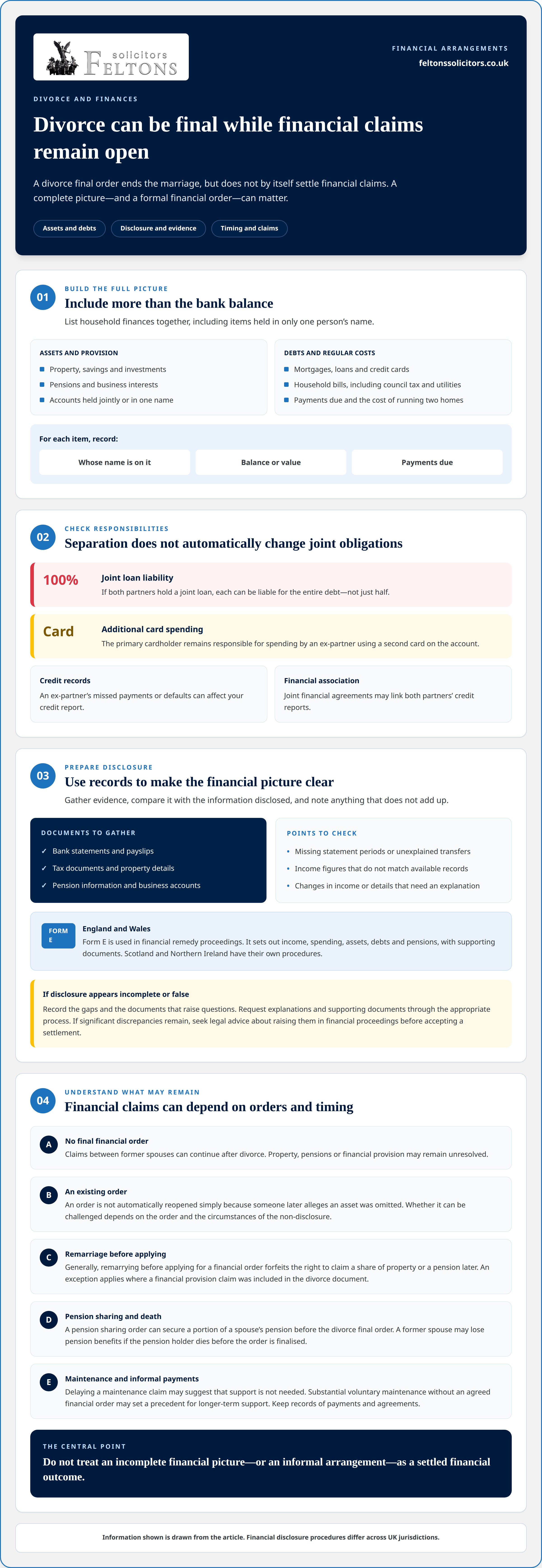
A clear financial picture includes debts as well as assets. List mortgages, loans, credit cards, household bills, pensions, savings and investments, including accounts held in one person’s name. For each item, note whose name is on the agreement, the balance or value, and any payments due. This helps distinguish a household cost from a legal responsibility.
Joint borrowing needs particular care. If both partners hold a joint loan, each can be liable for the entire debt, not just half. The primary cardholder remains responsible for spending by an ex-partner using a second card on the account. Separation does not automatically change these obligations. An ex-partner’s missed payments or defaults can affect your credit report, while joint financial agreements may link both partners’ reports through a financial association.
Regular household costs affect what each person can afford after separation. Use actual bills, such as council tax, utilities and mortgage payments, to understand how a shared budget may change when two homes are needed.
Pensions and investments belong in the overall picture, even when they are not immediately accessible. A pension sharing order can secure a portion of a spouse’s pension before the divorce final order. Record pension arrangements alongside investments, savings and property rather than treating the current bank balance as the full value of the finances. Missing an account or debt can leave the settlement based on incomplete information, with practical consequences for both parties.
2. Divorce and financial preparation
Prepare a clear record before discussing settlement. Gather statements, payslips, tax documents, property details and pension information. Note missing periods, unexplained transfers and changes in income. Understanding what happens if you don’t declare finances in a divorce starts with asking whether your records give a complete, consistent picture.
Yes, financial disclosure procedures differ across UK jurisdictions. Form E is used in financial remedy proceedings in England and Wales; Scotland and Northern Ireland have their own procedures. Form E sets out income, spending, assets, debts and pensions, with supporting documents, so each person can understand the other’s financial position.
To investigate possible hidden assets, compare disclosure with available records, such as bank statements, tax returns, property documents and business accounts. Look for unexplained transfers, missing statements or income figures that do not match the records. Note each discrepancy and the document that raises it. Understanding what happens if you don’t declare finances in a divorce also means recognising when the information needs formal scrutiny.
If your spouse’s disclosure appears incomplete or false, don’t agree to terms based on figures you cannot reconcile. Record the gaps and request explanations and supporting documents through the appropriate process. If significant discrepancies remain, seek legal advice about raising them in financial proceedings before accepting a settlement.
There is no single total for a court application about non-disclosure. The court fee depends on the application, while legal representation may involve separate costs. Preparing records and identifying the issue can clarify the next step. Advice on divorce financial arrangements can help you assess the disclosure and consider your options.
3. Financial claims that remain after divorce
A divorce final order ends the marriage, but does not by itself settle financial claims. Without a final financial court order, claims between former spouses can continue after divorce. Property, pensions or financial provision may therefore remain unresolved, even if the couple considers the relationship legally over.
Can a UK divorce financial settlement be reopened after non-disclosure? An existing order is not automatically reopened simply because someone later alleges that an asset was omitted. Whether it can be challenged depends on the order and the circumstances of the non-disclosure. If no final financial order was made, claims may remain open after divorce.
Timing can affect particular claims. A former spouse may retain the right to seek financial provision after the other dies, unless a divorce court order specifically restricts or ends that right. Remarrying before applying for a financial order generally forfeits the right to claim a share of property or a pension later. An exception applies if the person applied for divorce and included a financial provision claim in the divorce document.
Pension rights can also depend on timing. A former spouse may lose pension benefits if the pension holder dies before a pension sharing order is finalised. Delaying a maintenance claim may suggest that support is unnecessary because the claimant managed without claiming immediately. Substantial voluntary maintenance without an agreed financial order may also set a precedent for longer-term support.
Non-disclosure can affect maintenance discussions by obscuring available income and resources. For spousal maintenance, delayed claims and informal payments can complicate matters. For child maintenance, incomplete financial information can make it harder to understand the family’s circumstances. Keep records of payments and any agreement rather than relying on an informal arrangement alone.
4. What financial information must each spouse disclose in a UK divorce?
For a clear financial picture, each spouse should set out income, regular spending, assets and liabilities. Include property, savings, investments, pensions, business interests, mortgages, loans and credit cards. Record whether an asset is jointly owned or held in one person’s name. A sole-name account still matters when assessing the finances as a whole.
In England and Wales, Form E is used in financial remedy proceedings. It records financial details and supporting evidence, helping each person understand the other’s position. Present the information consistently: identify each asset or debt, its current value or balance, who owns or owes it, and the document supporting the figure.
- Income: salary, self-employment earnings, benefits and other regular receipts.
- Outgoings: housing costs, household bills, childcare and regular debt repayments.
- Property: addresses, ownership shares, estimated values and mortgage balances.
- Savings and investments: account statements, shares and other holdings.
- Pensions: scheme details and available pension valuations.
- Debts: lender, account holder, balance and repayment terms.
Supporting records help explain the figures. Use payslips or business accounts for earnings, bank statements for savings, and mortgage statements for outstanding borrowing. If a value is uncertain, explain the basis for the estimate rather than presenting it as confirmed. Keep dates consistent, since an old statement may not reflect the current balance.
Review the information for gaps before relying on it in settlement discussions. Check that each account, income source and liability has an entry, and note any figure that needs explanation. A transfer between accounts, for example, should be traceable in the statements rather than appearing as unexplained missing funds. For guidance on preparing a complete financial picture, seek advice on divorce financial arrangements.
Shared finances and related records may need attention while preparing disclosure. You can ask the bank to require both partners’ agreement for withdrawals from a shared account or to freeze it; both partners must agree to unfreeze it. A former spouse named as the beneficiary of an active life insurance policy may receive the payout if the policyholder dies, even after divorce. An ex-partner’s missed payments, defaults or other negative information can affect your credit report even after separation.
Feltons Solicitors LLP: Divorce and Financial Arrangements
Feltons Solicitors LLP can advise on financial arrangements when a divorce involves incomplete disclosure, disputed valuations or unresolved claims. The firm can review the financial information, identify issues that may affect settlement, and advise on the steps needed to formalise an agreement.
Consider seeking advice before agreeing terms, particularly if a pension, property, investment or significant debt is missing from the financial picture. Legal guidance can help you understand your options and the implications of leaving claims unresolved. If your divorce is already final, advice can clarify whether a financial order was made and what that means for any outstanding claims.
If you’d like to discuss your circumstances, contact Feltons Solicitors LLP.
Take a considered next step
Understanding what happens if you don’t declare finances in a divorce can help you decide what needs attention before making further commitments. Consider what remains unresolved, which documents support your understanding, and whether an existing agreement reflects the position you believe to be accurate. Reviewing these points can give you a clearer basis for deciding how to proceed.
Feltons Solicitors LLP offers Divorce and Financial Arrangements for people seeking advice on financial matters arising from separation. If decisions about the family home or future planning also need attention, the firm offers Residential and Commercial Conveyancing, along with Wills, Probate, and Estate Planning.
For advice tailored to your circumstances, contact Feltons Solicitors LLP. A clear next step can make a difficult process feel more manageable.
Frequently Asked Questions
What are the risks of not looking at finances during a divorce?
Failing to review finances can leave you making decisions without understanding the full picture. For example, you might agree to take responsibility for a household bill without accounting for the related loan or ongoing costs. This can make it harder to plan your post-separation budget and assess whether proposed arrangements are workable. Review the financial position before agreeing terms, particularly when assets or responsibilities are unclear.
What happens if a spouse hides assets or income during divorce proceedings?
Hidden assets or income can undermine the information used to reach a financial agreement. If you notice a mismatch, such as declared earnings that do not align with business records, note the discrepancy and keep the supporting documents. Raise the issue through the appropriate legal process before agreeing terms. If an order has already been made, seek advice on whether the circumstances provide grounds to challenge it.
What penalties can a UK court impose for failing to disclose finances?
There is no single automatic penalty for every failure to disclose. The consequences depend on the proceedings and the effect of the missing information. In practice, incomplete disclosure can prevent the court or the other spouse from properly assessing the financial position and may leave an agreement open to challenge. If you discover an omission, address it promptly rather than relying on figures you know are incomplete.