
Conveyancing Solicitors Knightsbridge: Expert Guidance for Prime Property Transactions

Conveyancing Solicitors Knightsbridge: Expert Guidance for Prime Property Transactions

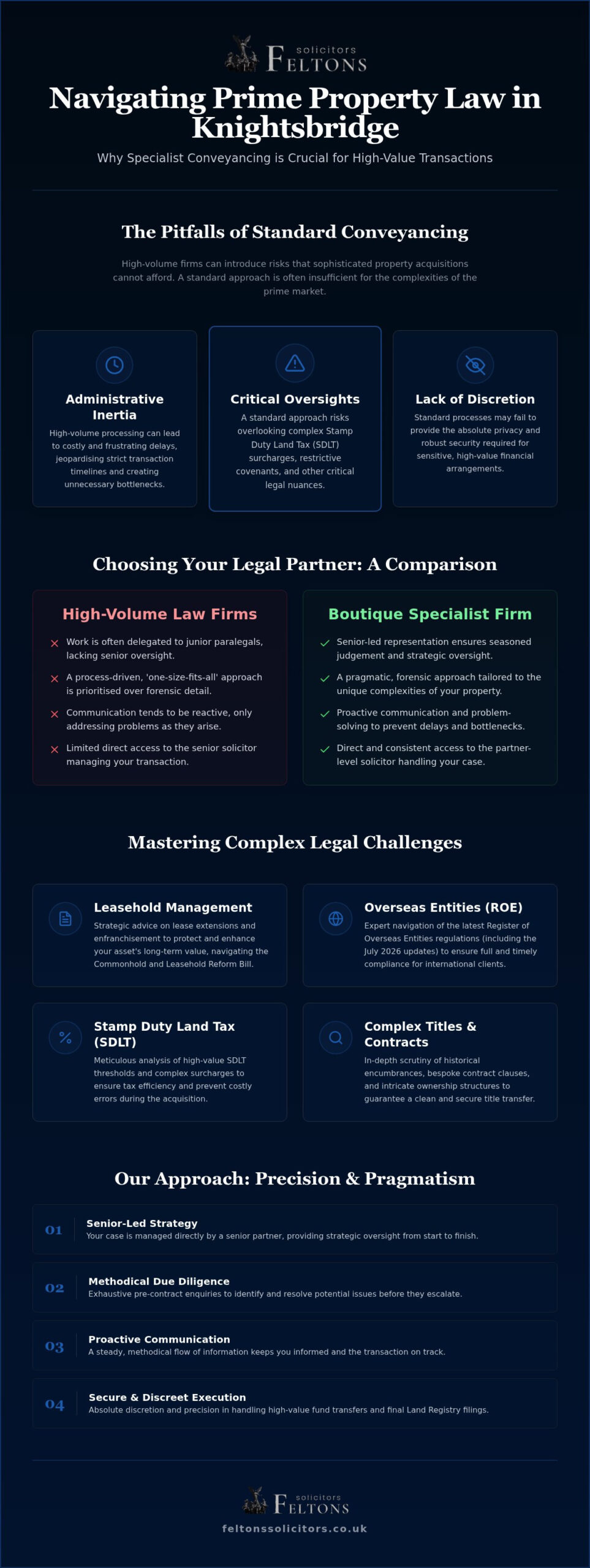
What if the greatest risk to your property acquisition isn’t market volatility, but the administrative inertia of a high-volume law firm? In the rarefied market of Knightsbridge, a standard approach to legal paperwork simply won’t suffice. When you’re engaging conveyancing solicitors knightsbridge residents and international investors trust, you aren’t just looking for a signature; you’re seeking a strategic partner who understands that discretion is as vital as technical precision. We recognise that for sophisticated buyers and sellers, the frustration of avoidable delays or the oversight of complex Stamp Duty Land Tax (SDLT) surcharges can jeopardise more than just a timeline.

You likely believe that a property transfer should be a seamless, secure transition that respects your privacy and your schedule. We agree. This article provides expert guidance on navigating the intricate landscape of prime property law, from the latest July 2026 Register of Overseas Entities (ROE) updates to the nuances of the Commonhold and Leasehold Reform Bill. We’ll examine how direct access to senior expertise ensures your transaction remains on track, whilst addressing the specific challenges of high-value SDLT thresholds and the meticulous requirements of the Land Registry.

Key Takeaways

  • Learn why high-value property acquisitions require strategic legal oversight rather than simple administrative processing to mitigate transaction risks.
  • Understand the essential criteria for selecting conveyancing solicitors knightsbridge, focusing on the benefits of senior-led, boutique service over volume-based firms.
  • Discover how to manage leasehold enfranchisement and statutory extensions to protect and enhance the long-term value of your residential assets.
  • Gain professional insights into navigating the latest Register of Overseas Entities (ROE) regulations and complex Stamp Duty Land Tax requirements for prime properties.
  • Ensure a discreet and secure property transfer by adopting a methodical, pragmatic approach tailored to the needs of sophisticated international and domestic clients.

The Nuances of Residential Property Law in High-Value Transactions

High-value property transactions in prime locations represent far more than a simple change of address. They are sophisticated financial events involving substantial capital and often intricate legal structures. The conveyancing process for these assets demands a level of forensic scrutiny that standard, volume-driven firms often struggle to provide. Professional integrity and absolute discretion are the foundations of this service. We ensure that sensitive financial arrangements remain private whilst the legal transfer of the asset is executed with precision. For those seeking conveyancing solicitors knightsbridge, it’s about securing a trusted advisor who can manage the weight of high-stakes financial settlements with poise and reliability. It’s not just a legal requirement but a strategic safeguard for your capital.

Understanding the Legal Framework of Prime Conveyancing

Standard residential transfers often follow a predictable, linear path. In contrast, prime property acquisitions frequently involve complex titles, such as those held by overseas entities or properties with historical encumbrances that require specialist interpretation. Conveyancing solicitors knightsbridge experts must conduct exhaustive pre-contract enquiries that go far beyond surface-level checks. This methodical approach ensures that every nuance of the property’s legal history is understood before you commit to the purchase. This level of scrutiny provides the empathetic reassurance that your investment is being handled with the highest standard of professional care. Key focus areas include:

  • Reviewing bespoke contract clauses that account for unique architectural features or heritage requirements.
  • Verifying the legal standing of complex ownership structures to ensure a clean title transfer.
  • Coordinating with private banks to manage the specific timings of high-value fund transfers.

Managing Client Expectations and Timelines

Delays in the national property market are often caused by a lack of proactive communication and administrative inertia. A pragmatic approach is essential to prevent unnecessary bottlenecks in the transaction chain. When you have direct access to a senior solicitor, potential issues are identified and resolved before they can stall the process. This senior-led oversight is particularly valuable when dealing with the Land Registry’s current processing times for complex registrations. It’s about maintaining a steady, methodical flow that respects your time. We don’t believe in leaving things to chance. Clear, direct communication avoids the frantic energy of high-pressure sales environments, opting instead for a rhythm that keeps you informed at every stage. Your solicitor acts as a calm, steady presence, guiding you through the legal landscape with quiet confidence and tailored care that prioritises your personal connection over high-volume processing.

Key Criteria for Selecting Specialist Conveyancing Solicitors

Selecting the right legal partner is a critical decision that influences the security of your capital and the success of your move. Whilst many firms claim to have an “experienced team,” true expertise in this sector is defined by the depth of a solicitor’s involvement in complex residential property law. For those evaluating conveyancing solicitors knightsbridge, the choice often comes down to the firm’s operational model. A boutique approach ensures your transaction isn’t lost in a high-volume processing system where speed is prioritised over forensic detail. You need a partner who possesses the worldly experience necessary to handle complex, international-scale matters whilst maintaining the personal touch of a community-conscious firm.

The Value of Senior-Led Legal Representation

Complex property matters shouldn’t be delegated to junior paralegals. The nuances of high-value transactions, such as understanding the rules for extending your lease or managing international ownership structures, require the seasoned judgement of a partner-level contact. Senior-led representation ensures that your solicitor sees the “big picture,” including how a property purchase fits into your broader estate planning or tax strategy. This level of oversight mitigates the risk of administrative errors and provides the quiet confidence that your interests are being protected by someone who has handled similar high-stakes matters before. If you value a discreet partner who prioritises your specific objectives, exploring the services of bespoke legal specialists can make all the difference.

Transparency and Communication in Property Law

Clear, front-loaded communication is the hallmark of a trusted advisor. You should look for a firm that provides logical, plain English explanations instead of relying on archaic legalese. This transparency builds trust. It ensures you aren’t left guessing about the progress of your transaction. A “people-first” philosophy means the firm values personal rapport and understands the human impact of a move. They should be approachable and supportive, acting as a calm presence in what can otherwise be a stressful period. This approach ensures that while the technical legal work is paramount, the human element is never forgotten. It’s about finding a guide who remains accessible and human, even when dealing with the most complex litigation or financial arrangements.

Strategic Management of Leasehold Extensions and Enfranchisement

In the prime property market, the value of a leasehold asset is inextricably linked to its remaining term. A diminishing lease can significantly impact a property’s marketability and capital value, making proactive management essential for protecting your long-term equity. Strategic oversight of these interests requires more than standard legal filing. It demands a sophisticated approach to navigating statutory rights whilst managing the nuances of high-value titles. Expert conveyancing solicitors knightsbridge residents trust provide the pragmatic advice needed to handle these complexities with quiet confidence. This is particularly relevant as the legal landscape evolves with the proposed Commonhold and Leasehold Reform Bill, which aims to cap ground rents and simplify tenures.

The Lease Extension Process Explained

The Leasehold Reform, Housing and Urban Development Act 1993 remains the primary legal framework for tenants seeking a statutory extension. It’s a methodical process that begins with the service of a formal Tenant’s Notice. Accuracy is paramount at this stage. If a notice is served incorrectly or based on a flawed valuation, you risk significant delays or the loss of your right to extend for another two years. It’s vital to have a trusted advisor who can manage these legal notices with forensic precision. To understand how these rights are protected in the current regulatory environment, you can learn more about leasehold enfranchisement experts and the bespoke support they provide.

Collective Enfranchisement: Buying the Freehold

Collective enfranchisement allows a group of leaseholders to join forces and purchase the freehold of their building. This move offers immense strategic benefits, including direct control over management and the ability to grant yourselves 999-year leases. However, organising a group of owners requires a steady, authoritative hand to manage the logistical and legal hurdles. Disputes often arise regarding the “marriage value” or the technical eligibility of the building under the 1993 Act. We act as a discreet partner, managing these sensitive arrangements and ensuring the group remains cohesive throughout the process. International investors should also consider how acquisition costs, including Stamp Duty Land Tax for non-UK residents, might influence the financial structure of the claim. By coordinating these efforts through conveyancing solicitors knightsbridge specialists, you ensure a smooth, secure transfer of ownership that enhances the building’s overall prestige and long-term value.
Conveyancing Solicitors Knightsbridge: Expert Guidance for Prime Property Transactions

International investment in the prime property market requires a sophisticated understanding of the evolving regulatory framework. The Economic Crime (Transparency and Enforcement) Act 2022 significantly altered the landscape for overseas buyers, introducing mandatory disclosure requirements that can stall a transaction if not handled with precision. Now, any foreign entity wishing to buy, sell, or transfer land in the UK must register with Companies House. This isn’t a one-off administrative task; it’s a continuing obligation that requires meticulous attention to detail. For those engaging conveyancing solicitors knightsbridge, the focus is often on ensuring that these transparency requirements don’t lead to transaction failure or legal penalties. We act as a discreet partner, managing these sensitive arrangements whilst ensuring your capital remains secure.

Registration of Overseas Entities for UK Property

Overseas entities must identify their beneficial owners and provide this information to the Register of Overseas Entities (ROE). Failure to comply has severe consequences, as the Land Registry will refuse to register any property transfer involving a non-compliant entity. It’s a critical bottleneck that can freeze high-value deals indefinitely. Since 9 July 2026, regulations have become even more stringent, with amendments making trust information on the register more accessible to the public. You need a solicitor who provides the worldly experience necessary to verify this data whilst maintaining a calm, steady presence. For a deeper look at these requirements, see our guide to overseas entity beneficial owner registration.

Tax Implications for High-Value Acquisitions

The financial structure of a prime property acquisition is heavily influenced by Stamp Duty Land Tax (SDLT). Following the changes on 1 April 2025, the standard rate for properties over £1.5 million is 12% on the portion above that threshold. However, non-UK residents must also account for a 2% surcharge, potentially bringing the top rate to 14% for standard movers or even higher for those purchasing second homes. If you’re purchasing through a corporate structure, the Annual Tax on Enveloped Dwellings (ATED) may also apply, requiring annual returns and payments to HMRC. These calculations are complex and demand the sound judgement of an expert. Ensuring your residential property law firm manages all HMRC filings correctly is essential for a secure transfer. We provide the pragmatic advice needed to navigate these fiscal challenges, ensuring you remain compliant whilst protecting your financial interests. If you require assistance with international registration or complex tax filings, contact our specialist team for a confidential consultation.

Established in 2010 by Paula Felton, Feltons Solicitors LLP provides a boutique legal experience that prioritises sound judgment and individualised attention. We understand that in the prime market, you aren’t just looking for an administrative service; you’re seeking a discreet partner to manage significant residential and commercial assets. Our philosophy combines modern delivery with traditional professional values, ensuring that whilst we utilise efficient methodology, the human impact of our work is never forgotten. For those requiring conveyancing solicitors knightsbridge, our firm offers the high-end reliability and quiet confidence needed to navigate complex transfers with ease.

Our boutique structure is a deliberate choice. It allows us to maintain a personal connection with every client, ensuring that senior-level attention is the standard rather than the exception. We avoid the high-volume processing models of larger firms, opting instead for a methodical rhythm that respects your time and your privacy. This approach allows us to provide a tailored experience that addresses the specific nuances of your transaction, whether you’re a domestic home mover or an international entity navigating the Register of Overseas Entities. By focusing on quality over volume, we ensure that every detail of your property law matter is handled with forensic precision.

A Trusted Advisor for Your Property Journey

Our extensive background in complex litigation and dispute resolution provides us with a unique perspective on residential property law. This forensic eye allows us to identify potential risks long before they become obstacles in a transaction. Because we also specialise in Wills, Probate, and Estate Planning, we can ensure your property acquisition is structured to support your long-term asset protection goals. We act as a calm, steady presence, providing empathetic reassurance during high-pressure negotiations and complex financial settlements. This multi-disciplinary approach means you have a sophisticated guide capable of handling both the technical legal work and the broader strategic context of your estate.

Next Steps: Engaging with Feltons Solicitors

Engaging our services begins with a direct consultation where we establish your specific objectives and timelines. Early legal involvement is often the deciding factor in the success of a prime property deal. It allows us to conduct pre-contract enquiries with the necessary depth and to coordinate with private banks or overseas entities from the outset. We’re committed to providing clear, actionable advice that cuts through complexity without relying on archaic legalese. By choosing conveyancing solicitors knightsbridge specialists from our firm, you gain access to a dedicated partner who values personal rapport as much as technical expertise. We invite you to reach out to our team to discuss how we can support your next property transaction with the discretion and professionalism it deserves.

Successful prime property transfers rely on more than just administrative accuracy. They require a partner who can navigate the complexities of statutory leasehold rights and the rigorous demands of the Register of Overseas Entities with absolute discretion. By prioritising senior-led oversight, you ensure that your capital is protected and your transaction remains a seamless, secure transition. This methodical approach transforms a potentially stressful move into a managed, professional consultation where every detail is forensically reviewed.

When you’re seeking conveyancing solicitors knightsbridge residents and international investors trust, look for a firm that balances modern efficiency with traditional professional integrity. Our firm, established in 2010 by Paula Felton, provides the worldly experience necessary for complex matters whilst maintaining a personal connection that larger firms cannot match. Contact Feltons Solicitors for expert property law advice today. We’re ready to support your next acquisition with the sound judgment and tailored care that your portfolio deserves.

Frequently Asked Questions

What is the average timescale for a high-value property conveyancing transaction?

High-value transactions typically take between eight and twelve weeks from the initial instruction to completion. This timeline can vary depending on the complexity of the property chain and the speed of Land Registry registrations. Prime properties often involve bespoke contract clauses or international fund transfers that require meticulous verification. A senior solicitor manages these variables to ensure the process remains steady, predictable, and aligned with your specific moving requirements.

Do I need a solicitor who is physically based in the same area as the property?

You don’t need a solicitor physically based in the same postcode, but you do require one with specific expertise in the prime market. When engaging conveyancing solicitors knightsbridge clients often look for firms with the worldly experience necessary to handle complex, international-scale matters. Modern digital delivery means we can manage your transaction securely from any location whilst providing the tailored care and senior oversight of a boutique firm.

What are the additional legal requirements for an overseas company buying UK property?

This requirement for specialist knowledge extends to the estate agents you choose to represent your property. For those navigating the market in other areas, you can learn more about Taylors Estate Agency to see how an independent, local approach can benefit residential sales across Leicestershire.

Overseas companies must comply with the Economic Crime (Transparency and Enforcement) Act 2022 by registering on the Register of Overseas Entities. This involves disclosing beneficial ownership and filing an annual update statement within 14 days of the statement date. Non-compliance prevents the Land Registry from registering the property transfer, effectively freezing the deal. Expert solicitors verify this data to ensure your transaction proceeds without any legal interruption or penalties.

How does leasehold enfranchisement affect the marketability of my property?

Successfully extending a lease or buying the freehold significantly enhances the marketability and capital value of your property. Buyers are often wary of leases with fewer than 80 years remaining because of the high costs associated with “marriage value.” By securing a statutory extension or participating in collective enfranchisement, you remove these financial barriers. This proactive legal step ensures your asset remains attractive to sophisticated investors amongst a competitive prime market.

Can a conveyancing solicitor also assist with estate planning and Wills?

Yes, a multi-disciplinary firm can integrate your property acquisition into your broader estate planning. It’s often beneficial to update your Will or review your inheritance tax position simultaneously with a high-value purchase. This ensures that your new asset is properly protected and that your sensitive financial arrangements remain discreet. Managing these matters together provides a comprehensive level of security and sound judgment for your family’s future and asset protection.

What happens if a property dispute arises during the conveyancing process?

If a dispute arises regarding boundaries, rights of way, or contract terms, your solicitor should have the litigation experience to resolve it pragmatically. We act as a calm, steady presence during these high-pressure moments. By identifying potential conflicts early through forensic pre-contract enquiries, we often prevent disputes from escalating. If a resolution is required, we prioritise your personal objectives and seek a swift, secure outcome that protects your interests.

What are the main risks of using a volume conveyancing firm for a prime property?

Volume conveyancing firms often rely on junior paralegals and high-pressure processing models that lack senior oversight. The main risks include administrative inertia, overlooked technical nuances in complex titles, and a lack of personal connection. For a prime transaction, you need a conveyancing solicitors knightsbridge partner who provides sound judgment rather than just high-volume processing. Boutique firms ensure that forensic detail is never sacrificed for administrative speed or high-volume quotas.

How are solicitors fees typically structured for complex residential transactions?

Fees for complex residential transactions are structured to reflect the seniority of the legal team and the technical depth required for the case. Whilst we don’t quote specific prices, firms usually operate on a fixed-fee basis for standard conveyancing or an hourly rate for bespoke litigation and enfranchisement matters. This structure ensures you receive direct access to a senior solicitor who provides the high-standard service and tailored care your transaction demands; for a clearer picture of potential costs, you can explore Conveyancing and Legal Fees through dedicated consultancy services.

Solicitors for International Property Buyers: Navigating UK Transactions in 2026

Solicitors for International Property Buyers: Navigating UK Transactions in 2026

A single oversight in the Register of Overseas Entities can result in a daily fine of £2,500 or, in more severe cases, a prison sentence. It’s perfectly natural to feel a sense of trepidation when facing the UK’s increasingly rigorous transparency laws. This is particularly daunting whilst you’re managing high-value transactions from a different time zone. Finding the right solicitors for international property buyers is essential to ensuring these complexities don’t jeopardise your acquisition. You want the security of British property, but the weight of enhanced anti-money laundering checks and complex tax obligations can make the process feel unnecessarily opaque.

This guide offers a comprehensive look at the legal landscape in 2026. We cover everything from navigating the 2% non-resident Stamp Duty surcharge to meeting the latest Companies House filing requirements. We’ll outline the essential conveyancing steps and explain how a partner-led approach ensures your investment is protected with the highest standard of professional integrity. By the end of this article, you’ll have a clear understanding of your registration obligations and the confidence to move forward with your UK property goals.

Key Takeaways

  • Understand the mandatory requirements of the Register of Overseas Entities (ROE) to ensure your property acquisition remains fully compliant with 2026 transparency laws.
  • Learn how experienced solicitors for international property buyers navigate the complexities of UK conveyancing whilst managing stringent remote identity verification.
  • Identify the specific Stamp Duty Land Tax (SDLT) surcharges and tax obligations that apply to non-resident investors in both residential and commercial sectors.
  • Discover a methodical, step-by-step conveyancing process designed to accommodate global investors operating across different time zones.
  • Explore why a boutique, partner-led legal service provides the discretion and tailored expertise required for high-value international transactions.

The Landscape for International Property Buyers in 2026

The UK property market remains a beacon for global capital. Its legal system offers a level of predictability that’s rare in other jurisdictions, making it a preferred destination for those seeking long-term stability. Whilst the allure of London’s skyline or the steady yields of northern commercial hubs remains strong, the path to ownership has become more intricate for those residing outside our borders. In 2026, the primary challenge for investors isn’t just finding the right asset; it’s navigating a regulatory framework that demands absolute transparency. Instructing specialized solicitors for international property buyers is now a prerequisite for a successful acquisition. You need a legal partner who understands that a cross-border transaction is a dual exercise in property law and rigorous regulatory compliance.

Why the UK Remains a Global Investment Centre

English law continues to be the gold standard for property contracts. It provides a clear, enforceable framework that protects the interests of the buyer and seller alike. This transparency of title, managed through a robust Land Registry system, ensures that ownership is indisputable once registered. Beyond legal security, the UK offers diverse opportunities. Residential investors are drawn to consistent rental demand in major cities, whilst the commercial sector provides sophisticated assets ranging from Grade A office spaces to industrial hubs. These fundamentals haven’t changed, but the method of accessing them has evolved.

The Shift Towards Transparency and Compliance

Recent years have seen a definitive move towards greater corporate accountability. The Economic Crime (Transparency and Enforcement) Act has fundamentally altered the landscape, requiring overseas entities to disclose their beneficial owners before they can buy or sell UK land. Standard high-street firms often lack the dedicated infrastructure to handle these specific requirements. For the modern investor, proactive legal planning must begin long before an offer is made. This involves preparing for enhanced identity checks and ensuring your corporate structure is ready for scrutiny by Companies House.

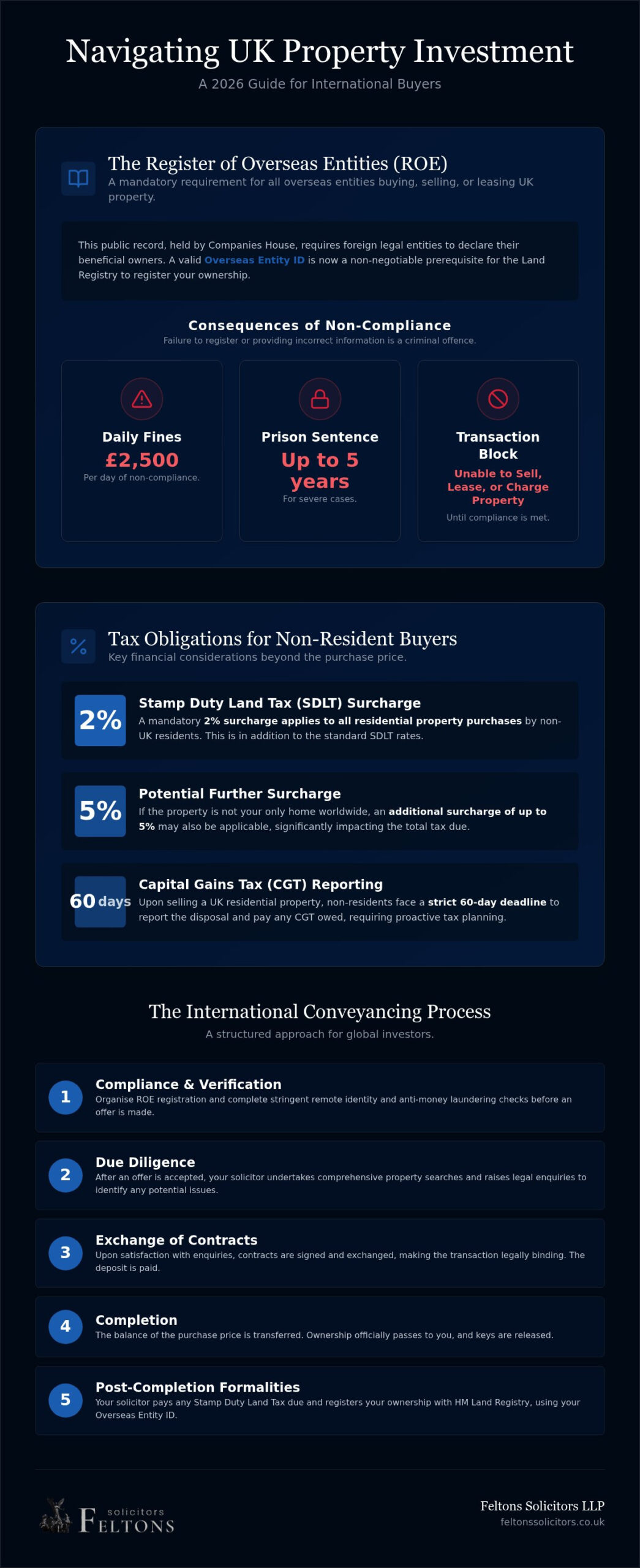
Managing the conveyancing process from abroad requires a solicitor who acts as a steady, local presence. In 2026, non-resident buyers face a mandatory 2% Stamp Duty Land Tax (SDLT) surcharge on residential purchases, which applies in addition to standard rates. If the property isn’t your only home worldwide, a further 5% surcharge may also apply. These financial implications, combined with the strict 60-day reporting deadline for Capital Gains Tax on disposals, mean that your legal advisor must be as much a tax and compliance strategist as they are a conveyancer. We’ve moved past the era of “standard” transactions; every international purchase now requires a bespoke, detail-oriented approach to ensure your investment remains secure and compliant.

Understanding the Register of Overseas Entities (ROE)

The Register of Overseas Entities is a mandatory public record held by Companies House that requires foreign legal entities to identify their beneficial owners before they can buy, sell, or lease property in the UK. This isn’t a mere administrative hurdle. It’s a critical legal requirement that dictates whether a transaction can actually proceed to completion. For those seeking solicitors for international property buyers, the focus has shifted from simple title searches to complex corporate verification. Without a valid Overseas Entity ID, the Land Registry will simply refuse to register your ownership, effectively stalling your investment indefinitely.

The role of a UK-regulated agent is central to this process. You can’t simply self-certify your ownership structure. A solicitor or qualified professional must verify the information before it’s submitted to Companies House. This verification must be based on reliable, independent evidence. If the information is found to be incorrect or if you fail to register, the consequences are severe. Non-compliance is a criminal offence. You could face daily fines of up to £2,500 or even a prison sentence of up to five years. Perhaps more importantly for investors, you’ll be legally restricted from selling, leasing, or charging the property until your status is regularised.

Who Qualifies as a Beneficial Owner?

A beneficial owner is typically any individual or legal entity that holds more than 25% of the shares or voting rights. This also includes anyone who has the right to appoint or remove a majority of the board of directors. Complex trust structures and nominee arrangements require a methodical approach to peel back the layers of control. It’s not a one-time obligation. You’re required to provide annual updates to Companies House to maintain your ROE ID. Failure to file an update within 14 days of the anniversary of your registration results in an immediate breach of the law.

The Verification Process for Overseas Entities

Verification is evidence-based and exceptionally rigorous. Solicitors must review original documents, including passports, corporate registers, and trust deeds, to satisfy the 2026 transparency standards. It’s sensible to start this process long before you’ve even identified a specific property. Delays in verification are one of the most common reasons for transactions to collapse in the final stages. If you’re navigating this for the first time, you can read our detailed guide on overseas entity beneficial owner registration to prepare your documentation. Ensuring your corporate structure is transparent is the first step toward a seamless acquisition. If you need assistance with these complex filings, our team can help you register an overseas entity with the necessary precision and discretion.

Acquiring a luxury apartment in Mayfair requires a vastly different legal strategy than purchasing a logistics hub in the Midlands. Whilst both transactions demand meticulous title checks, the regulatory and tax hurdles vary significantly between the two sectors. Choosing solicitors for international property buyers who can pivot between these distinct legal landscapes is vital for a secure investment. High-value residential acquisitions often hinge on personal lifestyle requirements and long-term capital growth. Conversely, commercial units are driven by lease yields, tenant covenants, and VAT efficiency. Your legal partner must possess the versatility to handle both the personal nuances of a home and the technical rigour of a business asset.

Residential Investment: Surcharges and Leasehold Risks

Non-UK residents must account for the mandatory 2% Stamp Duty Land Tax (SDLT) surcharge on residential purchases in England. This is not a negotiable fee. It applies in addition to standard SDLT rates. If the property is an additional dwelling, such as a second home or a buy-to-let investment, a further 5% surcharge applies. This can bring the total tax burden to a significant level, making early tax planning essential. Beyond the initial purchase price, the UK’s leasehold system presents unique challenges for those unfamiliar with it. Many apartments are sold with diminishing lease terms that can eventually affect the property’s value and mortgageability.

Engaging leasehold enfranchisement experts is often necessary to extend these terms or even purchase the freehold. Managing ground rent issues and service charge disputes from abroad is notoriously difficult. A specialized residential property law firm will ensure that the lease terms are fair and sustainable before you commit your capital. They act as your eyes and ears on the ground, identifying hidden liabilities that could disrupt your long-term plans.

Commercial Property: Leases and Business Structures

Commercial acquisitions frequently involve Full Repairing and Insuring (FRI) leases. This structure typically places the entire burden of maintenance, repairs, and building insurance on the tenant. This is attractive for landlords seeking a “hands-off” investment, but it requires precise legal drafting to avoid future litigation over dilapidations. VAT is another critical factor. Many commercial properties are “opted to tax,” meaning a 20% VAT charge applies to the purchase price unless the transaction qualifies as a Transfer of a Going Concern (TOGC). Investors must also decide whether to hold the asset through a UK Special Purpose Vehicle (SPV) or an overseas company. Whilst an SPV can simplify local financing, an overseas entity triggers the mandatory ROE requirements mentioned earlier. Each structure has distinct tax and reporting implications that require careful, expert consideration.

Solicitors for International Property Buyers: Navigating UK Transactions in 2026

The International Conveyancing Process Step-by-Step

Purchasing a property in the UK from several thousand miles away requires a structured roadmap. Whilst the core principles of land law remain constant, the logistical execution for overseas investors involves specific digital hurdles and stringent verification phases. Professional solicitors for international property buyers act as your primary coordinator, ensuring that the distance doesn’t lead to delays or missed deadlines. In 2026, the average conveyancing timeline ranges between 12 and 20 weeks, though chain-free transactions can often be completed in 8 to 12 weeks with proactive management.

The process begins with initial instruction and the opening of your file. This is immediately followed by a comprehensive review of the legal pack and title deeds. Your solicitor will negotiate the contract terms and raise specific enquiries regarding the property’s history, planning permissions, and any potential liabilities. Once satisfied, you’ll move to the “Exchange of Contracts.” At this stage, a deposit, typically 10% of the purchase price, is paid, and the transaction becomes legally binding. Completion follows shortly after, involving the transfer of the remaining funds, the submission of Stamp Duty Land Tax (SDLT) returns, and the final application to the Land Registry to record your ownership.

Remote Verification and Digital Onboarding

Modern legal practice has embraced digitalisation to facilitate remote acquisitions. Solicitors now utilise secure biometric ID applications to verify your identity without requiring a physical meeting. These apps scan your passport’s NFC chip and use facial recognition to satisfy UK anti-money laundering regulations. Whilst digital signatures are increasingly common for initial documents, some Land Registry filings in 2026 still require “wet ink” signatures on specific deeds. You’ll also need to provide detailed proof of funds. UK banking regulations are exceptionally strict; you must be prepared to show a clear trail of how your investment capital was accumulated, often spanning several months of bank statements.

Managing the Transaction Timeline

Coordinating a purchase across different time zones requires a methodical approach. Delays often occur when communicating with surveyors, lenders, or estate agents who operate on UK business hours. To mitigate this, many international buyers grant a limited Power of Attorney to their solicitor or a trusted UK representative. This allows legal documents to be signed on your behalf, ensuring the “Exchange” and “Completion” phases aren’t stalled by international courier delays. If you’re ready to begin your acquisition, our team provides expert residential and commercial conveyancing services tailored to the needs of global investors.

Why International Buyers Choose Feltons Solicitors

Selecting the right solicitors for international property buyers involves more than finding a firm to process a deed. It requires a partnership with a legal team that understands the weight of your investment and the complexities of your position as a global investor. Whilst many high-volume firms treat conveyancing as a factory-style process, Feltons Solicitors LLP operates with a boutique philosophy. Since 2010, we’ve positioned ourselves as a steady, dependable presence for clients navigating the UK’s intricate property laws. We prioritise personal connection and high-end reliability, ensuring that your transaction is handled with the quiet confidence and discretion it deserves.

Our approach bridges the gap between traditional professional integrity and modern, forward-thinking methodology. We understand that for an overseas investor, the technical legal work is only one part of the equation; the human impact and the need for clear, reassuring guidance are equally paramount. Whether you’re acquiring a high-value residence or managing a commercial portfolio, our role is to act as your sophisticated guide through the regulatory landscape of 2026. We provide holistic support that extends beyond the immediate purchase, offering expert estate planning to ensure your UK assets are protected for future generations.

A Trusted Advisor for Complex Transactions

We provide a partner-led service, meaning your case is never passed down to junior staff or automated systems. An experienced solicitor oversees every detail of your transaction, providing the sound judgment necessary for complex, high-value matters. This is particularly vital when dealing with the Registration of Overseas Entities or navigating contentious property disputes. Our expertise in both residential and commercial sectors allows us to manage sophisticated portfolios with a level of individualized attention that high-volume firms simply cannot match. We value privacy and personal rapport, acting as a discreet partner for high-net-worth individuals and corporate entities alike.

National Reach with a Personal Touch

Feltons operates on a national scale, yet our service remains deeply rooted in a people-first philosophy. We’ve developed a communication rhythm that respects your schedule, regardless of your time zone. You’ll never feel like just another file number; instead, you’ll have a dedicated advisor who provides regular, methodical updates. This steady flow of information is designed to make you feel informed and supported, turning a potentially stressful international purchase into a seamless, controlled experience. By combining worldly experience with a commitment to clear, “plain English” advice, we ensure that you remain in capable hands from the initial instruction to the final registration of your title.

Securing Your UK Property Investment in 2026

The UK property market remains a premier destination for global capital, but the legal landscape in 2026 demands a higher level of transparency than ever before. Successfully navigating the Register of Overseas Entities and managing non-resident tax surcharges requires more than just a standard conveyancing service. It requires a partner who understands the nuances of cross-border transactions and the importance of meticulous compliance. By prioritising early verification and digital onboarding, you can ensure that your acquisition proceeds without the risk of daily fines or criminal liability.

Feltons Solicitors LLP has been a trusted advisor for global investors since 2010. We specialise in the Registration of Overseas Entities, providing a boutique, partner-led service that prioritises your personal objectives. Our firm offers the sophisticated guidance necessary for high-value transactions whilst maintaining the discreet, tailored care you expect. If you’re looking for dedicated solicitors for international property buyers to safeguard your UK interests, we’re here to provide a steady and calm presence throughout the process. Contact Feltons Solicitors for expert international property advice and take the first step towards a seamless, compliant acquisition.

Frequently Asked Questions

Do I need to be in the UK to buy property as an international buyer?

No, you don’t need to be physically present in the UK to complete a property purchase. Modern solicitors for international property buyers use biometric ID applications and secure digital portals to manage the entire process remotely. You can also grant a limited Power of Attorney to your legal representative, allowing them to sign specific deeds on your behalf so that completion isn’t delayed by international courier times.

What is the Register of Overseas Entities and does it apply to me?

The Register of Overseas Entities is a mandatory record held by Companies House for foreign companies or legal structures that own UK land. It applies to you if you’re purchasing property through an overseas entity rather than in your personal name. You must identify your beneficial owners and have this information verified by a UK-regulated agent before the Land Registry will record your ownership of the property.

Are there extra taxes for non-residents buying property in the UK?

Yes, non-residents are subject to a mandatory 2% Stamp Duty Land Tax (SDLT) surcharge on residential purchases in England and Northern Ireland. If the property isn’t your only home worldwide, an additional 5% surcharge for additional dwellings typically applies. You should also account for the Non-Resident Landlord Scheme, which involves a 20% withholding tax on rental income unless you’re approved to receive gross payments.

How do solicitors verify proof of funds for overseas clients?

Solicitors verify funds by reviewing an audited trail of your capital’s origin, which usually requires at least six months of bank statements. You’ll need to provide clear evidence of the source of your wealth, such as property sale completion statements, inheritance documents, or dividend vouchers. UK anti-money laundering regulations are exceptionally rigorous, so providing a transparent paper trail is the best way to avoid transaction delays.

Can an overseas company own UK residential property?

An overseas company can own UK residential property, but this triggers specific regulatory and tax obligations. Beyond the mandatory Register of Overseas Entities filing, companies owning dwellings valued at over £500,000 are subject to the Annual Tax on Enveloped Dwellings (ATED). For the 2025/26 period, these annual charges ranged from £4,400 to £287,600 depending on the specific value of the property.

How long does the UK conveyancing process take for international buyers?

The average conveyancing process for international buyers in 2026 takes between 12 and 20 weeks. If the property is chain-free and your documentation is prepared in advance, this timeline can be reduced to 8-12 weeks. Working with experienced solicitors for international property buyers helps to manage the logistical challenges of different time zones and complex overseas corporate searches that often slow down standard transactions.

What happens if I fail to register my overseas entity with Companies House?

Failure to register or update an overseas entity is a criminal offence that carries severe penalties. You could face daily fines of up to £2,500 and prison sentences of up to five years for serious non-compliance. Most importantly for investors, you’ll be legally restricted from selling, leasing, or charging the property, as the Land Registry will block any dealings involving an unregistered entity.

Can I get a UK mortgage as a non-resident?

You can obtain a UK mortgage as a non-resident, though you’ll likely need to approach specialist lenders or private banks. These lenders typically require a higher deposit, often 25% or more of the purchase price, and may charge higher interest rates than for UK residents. Your solicitor will work closely with the lender to satisfy their specific international due diligence and identity verification requirements.

Registering Overseas Entities for UK Property: A Definitive Guide for 2026

Registering Overseas Entities for UK Property: A Definitive Guide for 2026

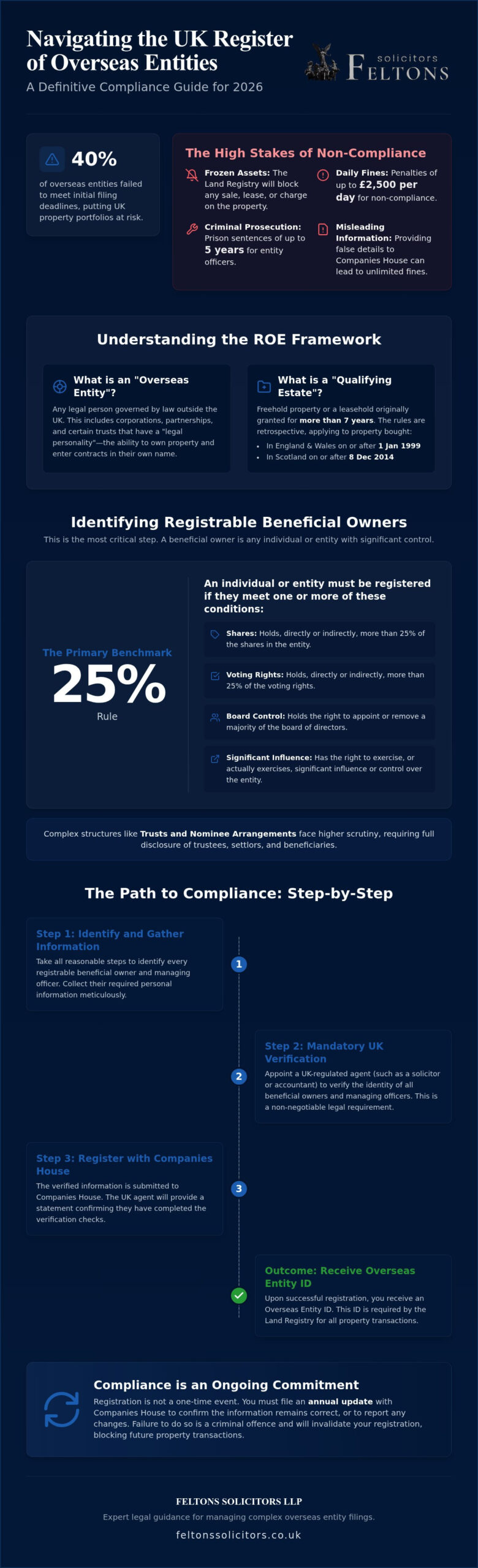
Did you know that nearly 40% of overseas entities failed to meet their initial filing deadlines, leaving their UK property portfolios vulnerable to freezing orders and significant fines? When the stakes include daily penalties of up to £2,500 and the potential for criminal prosecution, the pressure to maintain compliance is palpable. We understand that the technicalities of registering overseas entities uk property can feel overwhelming, particularly when trying to define beneficial owners within complex trust structures or identifying a suitably regulated UK agent for mandatory verification.

We’re here to provide the clarity and reassurance you need to manage these requirements with confidence. This definitive guide for 2026 offers expert insight into the registration process, helping you secure your Overseas Entity ID whilst safeguarding your property’s liquidity for future sales or charges. We will walk you through the essential compliance steps, from the initial Companies House application to the critical annual update requirements; ensuring your international investments remain protected and legally sound. By the end of this article, you’ll have a clear roadmap to navigate the Register of Overseas Entities with professional poise.

Key Takeaways

  • Understand the legal framework governing the Register of Overseas Entities to ensure your property interests remain transparent and compliant with UK law.
  • Learn how to identify registrable beneficial owners under the 25% rule, a critical step when registering overseas entities uk property to avoid severe financial penalties.
  • Discover why mandatory verification by a UK-regulated professional is the essential gatekeeper for obtaining your Overseas Entity ID.
  • Recognise that compliance is an ongoing commitment. Annual updates are vital to maintain the liquidity of your assets and prevent transaction delays.
  • Gain practical strategies for auditing your property portfolio and appointing expert legal guidance to manage complex filings on your behalf.

Understanding the Register of Overseas Entities (ROE) Framework

The introduction of the Register of Overseas Entities (ROE) represents a significant shift in how international investors hold assets in Britain. This framework was established under the Economic Crime (Transparency and Enforcement) Act 2022 to ensure that the ultimate owners of UK land are identifiable. Managed by Companies House, the register requires the disclosure of registrable beneficial owners, creating a transparent environment that discourages illicit finance. For many owners, registering overseas entities uk property is no longer a choice but a vital prerequisite for maintaining a functional property portfolio.

Failing to comply with these regulations carries severe consequences. Companies House has moved beyond an initial period of leniency to a strict enforcement model. Non-compliance is a criminal offence that can result in daily fines of up to £2,500 or, in the most serious cases, prison sentences of up to five years for the entity’s officers. Beyond these sanctions, the Land Registry will block any attempt to sell, lease, or charge the property; this effectively freezes the asset’s value until the entity is correctly registered.

What Qualifies as an Overseas Entity?

An overseas entity is defined as any legal person governed by the law of a country or territory outside the United Kingdom. This definition is purposefully broad, encompassing foreign corporations, limited partnerships, and certain types of trusts. The deciding factor in your registration obligation is whether the entity possesses “legal personality” under its home jurisdiction’s laws. If the body can own property, enter contracts, and sue or be sued in its own name, it likely falls within the scope of the ROE.

The Definition of a Qualifying Estate

The requirement for registering overseas entities uk property applies specifically to “qualifying estates.” In England and Wales, this includes freehold property or leasehold interests originally granted for a term of more than seven years. Accuracy is paramount here, as the regime is retrospective. Entities that purchased land in England and Wales on or after 1 January 1999 must be registered. Different dates apply across the UK, such as 8 December 2014 in Scotland. Since February 2022, the rules have tightened further; any entity that has disposed of property since that date must also provide details of those transactions to remain compliant with current transparency standards.

Identifying Registrable Beneficial Owners and Complex Structures

Determining exactly who must be named on the register is often the most challenging aspect of compliance. A registrable beneficial owner is generally any individual or legal entity that exerts significant control over the overseas entity. The primary benchmark used by Companies House is the 25% rule. If a person holds more than 25% of the shares or voting rights, they must be disclosed. However, control is not always a simple mathematical calculation. Even without meeting the shareholding threshold, an individual who has the right to appoint or remove a majority of the board of directors, or who otherwise exercises “significant influence or control”, falls under the registration requirement.

Accuracy is not just a matter of administrative diligence; it is a vital legal safeguard. Providing false or misleading information to Companies House is a criminal offence that can lead to unlimited fines. The Official UK Government Guidance emphasises that entities must take reasonable steps to identify their beneficial owners before filing. For those managing intricate global portfolios, our team at Feltons Solicitors LLP can provide the discreet expertise needed to map these relationships accurately, ensuring your filings are beyond reproach.

Dealing with Trusts and Nominee Arrangements

Trusts and nominee arrangements face even higher levels of scrutiny under the current framework. Because trusts often lack a single “owner” in the traditional sense, the ROE requires comprehensive details on trustees, settlors, and beneficiaries. This includes anyone else who has the power to exercise control over the trust’s activities. This level of transparency ensures that the true nature of property ownership cannot be obscured by multi-layered legal vehicles. For family offices, professional overseas entity beneficial owner registration is essential to ensure long-term compliance whilst maintaining the privacy of the wider family estate within the bounds of UK law.

Managing Officers: When No Beneficial Owner is Identified

In cases where no beneficial owner can be identified after exhaustive enquiries, the entity must instead provide details for its “managing officers”. These are typically the directors, managers, or company secretaries of the organisation. You cannot simply submit a “no-owner” declaration without demonstrating that every effort was made to find a registrable person. This level of transparency is particularly relevant when considering asset protection in divorce. If ownership of an overseas entity is contested during financial proceedings, the information held on the register can become a pivotal piece of evidence. Failing to correctly identify owners when registering overseas entities uk property could lead to complications that extend far beyond simple filing fees, potentially impacting the very foundation of your legal standing in the UK.

The Mandatory Verification Process: A Step-by-Step Guide

Verification serves as the essential gatekeeper for the entire system; Companies House will simply not issue an Overseas Entity ID without a formal verification statement from a UK-regulated agent. This is far more than a simple identification check. The process involves a rigorous audit of the entity’s structure to ensure every registrable beneficial owner has been correctly identified and their details validated against independent, reliable sources. Because the agent assumes significant legal liability for the accuracy of this data, the process is detailed and requires a methodical approach.

The process of registering overseas entities uk property hinges entirely on this verification stage. It’s important to understand that only specific UK-regulated professionals, such as solicitors, auditors, or insolvency practitioners, are authorised to perform these checks. These agents must verify the information no more than three months before the date the application is submitted to Companies House. If this window is missed, the verification becomes void, and the work must be repeated. This strict timeline ensures that the public register remains as current and accurate as possible.

The Verification Procedure for International Clients

For clients based outside the UK, we follow a structured three-step protocol to ensure compliance is met without unnecessary stress. First, we collate all essential constitutional documents, such as the Certificate of Incorporation and Articles of Association, alongside certified proof of identity for all beneficial owners. Second, we conduct an independent check of foreign registers and corporate structures. This is particularly vital for layered ownership models, as detailed in this Practical Guide to the ROE, to ensure no shadow controllers are overlooked. Finally, once satisfied, the agent submits the formal verification statement directly to Companies House to facilitate the issuance of the ID.

Why Feltons Solicitors LLP is Your Ideal Verification Partner

Choosing the right partner is about more than just filing a form. Our deep expertise in residential property law means we understand the underlying title and the specific requirements of the Land Registry. Feltons Solicitors LLP provides a discreet, boutique service tailored for international clients who value confidentiality and precision. By managing the verification process with such meticulous care, we mitigate the risk of transaction delays. When registering overseas entities uk property, having a trusted advisor ensures that your sales, charges, or leases can proceed without the administrative friction that often plagues less prepared entities.

Registering Overseas Entities for UK Property: A Definitive Guide for 2026

Ongoing Compliance: The Annual Update and Penalties

Maintaining the Register of Overseas Entities is a continuous legal obligation rather than a one-off administrative task. Once you have completed the initial process of registering overseas entities uk property, you must file an update statement every 12 months. This statement confirms that the information held by Companies House remains accurate or provides details of any changes to the beneficial ownership structure that occurred during the year. It’s a rolling commitment to transparency that ensures the UK property market remains secure and well-regulated.

Timing is critical for these filings. The update is due exactly one year from the date of the original registration or the previous update. You have a narrow 14-day window following this date to submit the filing. It’s a common misconception that no action is required if the entity’s structure remains static. On the contrary, a “no change” statement must be filed to keep the Overseas Entity ID valid. Without this active confirmation, the entity is deemed non-compliant, and the administrative burden of registering overseas entities uk property is effectively wasted.

Consequences of Non-Compliance in 2026

By 2026, Companies House has transitioned to a high-enforcement model. They are actively issuing substantial financial penalties to entities that miss their filing deadlines. However, the financial cost is often secondary to the transactional impact. A non-compliant entity loses its ability to deal with its land almost immediately. You cannot sell, lease for more than seven years, or mortgage the property whilst the register is out of date. Additionally, directors and managing officers face personal criminal liability; this makes administrative diligence a matter of personal security for those at the helm of the organisation.

The Link Between Compliance and Estate Planning

Neglecting the register can have profound implications for your wider legal affairs, particularly regarding succession. For instance, an out-of-date or inaccurate register can effectively paralyse the probate and estate planning process. If a property needs to be transferred or sold following the death of a beneficial owner, any discrepancy in the registration will cause significant delays at the Land Registry. Keeping your entity “sale-ready” through consistent updates ensures that your assets remain liquid and your legacy is protected for future generations.

Whilst overseas structures offer clear benefits for privacy and tax planning, they demand meticulous attention to detail. If you are concerned about your current compliance status or require a regulated agent to manage your annual filings, we invite you to speak with us. Contact Feltons Solicitors LLP today to ensure your UK property interests remain fully protected and compliant with all current regulations.

Practical Guidance for Registering and Managing Your Entity

Taking proactive steps now is the most effective way to safeguard your UK interests. The first priority for any international owner is to conduct an immediate audit of all UK property held in overseas names. It’s surprisingly common for older acquisitions to be overlooked, yet the Land Registry’s digital systems are increasingly efficient at flagging unregistered titles. Once identified, appointing a UK-regulated solicitor to manage the verification and filing process provides a single point of accountability. This approach ensures that the complex interplay between foreign corporate law and UK land requirements is handled with the necessary professional poise.

Efficiency in registering overseas entities uk property depends heavily on the state of your corporate records. As we noted previously, verification must be fresh; having your constitutional documents and proof of identity organised in advance is therefore vital. We recommend establishing a permanent digital vault for these records and setting calendar reminders for your annual update statement. Since Companies House now issues automatic penalties for late filings, a “set and forget” mindset is no longer viable for international investors who value their asset’s liquidity.

Resolving Land Registry Restrictions

A “restriction on title” is the primary mechanism the Land Registry uses to enforce compliance. This entry on the register prevents any disposition, such as a sale or a new lease, from being registered unless the entity has complied with its ROE obligations. Removing this restriction requires the successful submission of your registration and the issuance of an Overseas Entity ID. For entities that have already disposed of property but remain on the register, a specific removal process exists to clear the title record. This is particularly complex when an entity owns a block of flats, where leasehold enfranchisement experts are often required to manage the rights of tenants whilst ensuring the superior title remains compliant.

Securing Your Overseas Entity ID

The Overseas Entity ID is a unique alphanumeric code that acts as your passport for all future Land Registry dealings. Once issued, you can verify its status on the public register at any time. This ID must be quoted on every transfer, charge, or lease application you submit. Beyond the immediate administrative requirement, securing this ID allows you to incorporate ROE compliance into your wider legal strategy; for instance, you might explore John Zang Services to gain specialised counsel on how these regulations impact your broader corporate structures.

Whether you are restructuring for tax efficiency or preparing for a future sale, having a valid ID ensures that your transactions proceed without the friction of last-minute compliance hurdles. By treating registering overseas entities uk property as a core component of your asset management, you protect both your capital and your professional reputation. Our team is here to guide you through every stage of this process, providing the discreet, high-standard service your portfolio requires.

Securing Your UK Property Interests for the Long Term

UK land law has evolved significantly, making transparency a cornerstone of property ownership. By ensuring you are correctly registering overseas entities uk property, you protect your assets from the risk of freezing orders and substantial financial penalties. We have explored the necessity of identifying beneficial owners accurately and the vital role of the UK-regulated agent in the mandatory verification process. It is essential to remember that compliance is an active, annual commitment that preserves the liquidity of your investments and ensures your estate remains sale-ready at all times.

As a member of the Law Society specialising in high-value international property transactions, Feltons Solicitors LLP offers a boutique, partner-led legal service designed for those who value privacy and precision. We act as your sophisticated guide through these complex regulations, providing the calm expertise needed to manage your filings with absolute confidence. Contact Feltons Solicitors for expert assistance with your overseas entity registration to ensure your portfolio remains secure and compliant. We are here to help you navigate these requirements with ease and traditional professional integrity.

Frequently Asked Questions

What is the Register of Overseas Entities?

The Register of Overseas Entities is a public database managed by Companies House that identifies the beneficial owners of foreign entities owning land in the United Kingdom. Established under the Economic Crime (Transparency and Enforcement) Act 2022, its primary purpose is to increase transparency and combat money laundering within the UK property market.

Does my overseas company need to register if it bought land before 2022?

Yes, the registration requirement is retrospective for property purchased on or after 1 January 1999 in England and Wales. In Scotland, the requirement applies to land bought on or after 8 December 2014. If your entity still holds a qualifying estate, you must complete the process of registering overseas entities uk property to remain compliant with current law.

How much does it cost to register an overseas entity in the UK?

The mandatory government fee for registering an overseas entity with Companies House is £250. This is separate from any professional fees charged by your UK-regulated verification agent. Additionally, there is a £234 fee for filing the annual update statement and a £706 fee if you eventually apply for removal from the register.

Who is considered a “registrable beneficial owner”?

A registrable beneficial owner is generally any individual or legal entity that holds more than 25% of the shares or voting rights in the overseas entity. The definition also includes anyone who has the right to appoint or remove a majority of the board of directors, or who otherwise exercises significant influence or control over the entity’s activities.

Can I register an overseas entity without a UK solicitor?

Whilst an entity can technically submit its own application, it is impossible to complete the process without a UK-regulated agent. All information regarding beneficial owners must be verified by a professional such as a solicitor or auditor who is supervised under the Money Laundering Regulations. Companies House will not issue an Overseas Entity ID without this formal verification.

What happens if I miss the annual update deadline?

Missing the annual update deadline results in an immediate block on your property’s title, preventing you from selling, leasing, or mortgaging the asset. You may also face daily fines of up to £2,500 and potential criminal prosecution. Consistent diligence when registering overseas entities uk property is the only way to ensure your assets remain liquid and legally protected.

How long does the registration process take?

The registration timeline depends largely on the speed of the verification stage. Once a UK-regulated agent has verified the beneficial ownership and submitted the application, Companies House typically processes the request within a few working days. However, complex corporate structures or entities involving trusts may require additional time for thorough due diligence and document collation.

Is the information on the Register of Overseas Entities public?

Most information provided to the register is available to the public via the Companies House website, including the names of beneficial owners and the entity’s registered office. Certain sensitive details, such as full dates of birth and residential addresses, are protected from public view. This balance ensures transparency whilst respecting the personal privacy of the individuals involved.