

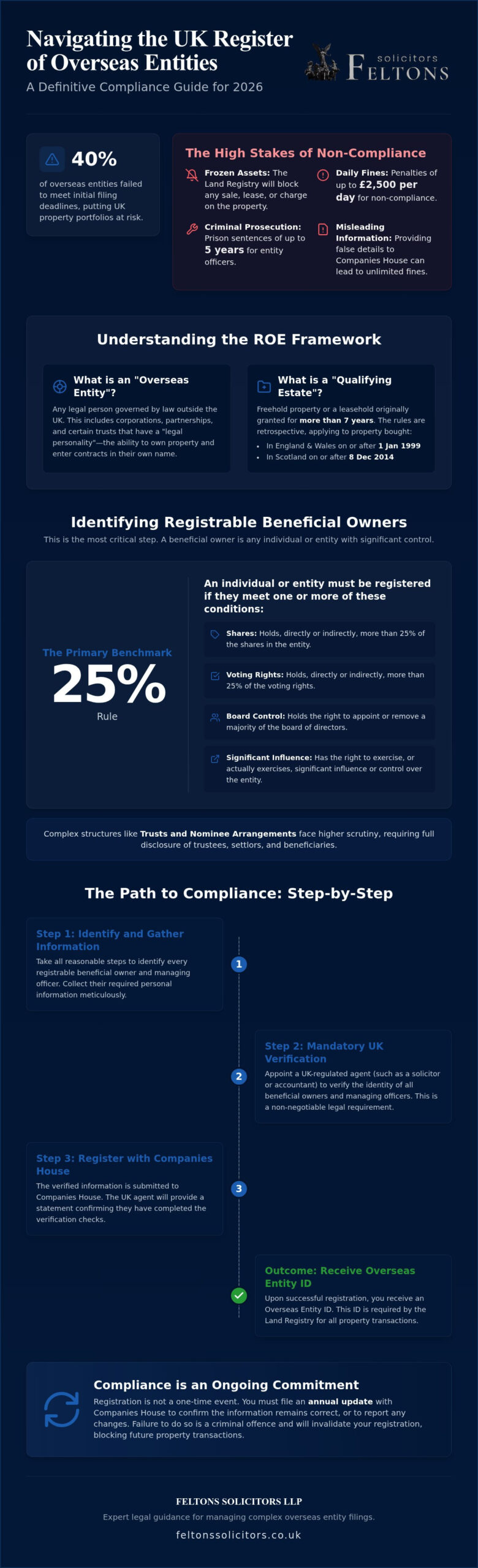
Did you know that nearly 40% of overseas entities failed to meet their initial filing deadlines, leaving their UK property portfolios vulnerable to freezing orders and significant fines? When the stakes include daily penalties of up to £2,500 and the potential for criminal prosecution, the pressure to maintain compliance is palpable. We understand that the technicalities of registering overseas entities uk property can feel overwhelming, particularly when trying to define beneficial owners within complex trust structures or identifying a suitably regulated UK agent for mandatory verification.
We’re here to provide the clarity and reassurance you need to manage these requirements with confidence. This definitive guide for 2026 offers expert insight into the registration process, helping you secure your Overseas Entity ID whilst safeguarding your property’s liquidity for future sales or charges. We will walk you through the essential compliance steps, from the initial Companies House application to the critical annual update requirements; ensuring your international investments remain protected and legally sound. By the end of this article, you’ll have a clear roadmap to navigate the Register of Overseas Entities with professional poise.
Key Takeaways
- Understand the legal framework governing the Register of Overseas Entities to ensure your property interests remain transparent and compliant with UK law.
- Learn how to identify registrable beneficial owners under the 25% rule, a critical step when registering overseas entities uk property to avoid severe financial penalties.
- Discover why mandatory verification by a UK-regulated professional is the essential gatekeeper for obtaining your Overseas Entity ID.
- Recognise that compliance is an ongoing commitment. Annual updates are vital to maintain the liquidity of your assets and prevent transaction delays.
- Gain practical strategies for auditing your property portfolio and appointing expert legal guidance to manage complex filings on your behalf.
Understanding the Register of Overseas Entities (ROE) Framework
The introduction of the Register of Overseas Entities (ROE) represents a significant shift in how international investors hold assets in Britain. This framework was established under the Economic Crime (Transparency and Enforcement) Act 2022 to ensure that the ultimate owners of UK land are identifiable. Managed by Companies House, the register requires the disclosure of registrable beneficial owners, creating a transparent environment that discourages illicit finance. For many owners, registering overseas entities uk property is no longer a choice but a vital prerequisite for maintaining a functional property portfolio.
Failing to comply with these regulations carries severe consequences. Companies House has moved beyond an initial period of leniency to a strict enforcement model. Non-compliance is a criminal offence that can result in daily fines of up to £2,500 or, in the most serious cases, prison sentences of up to five years for the entity’s officers. Beyond these sanctions, the Land Registry will block any attempt to sell, lease, or charge the property; this effectively freezes the asset’s value until the entity is correctly registered.
What Qualifies as an Overseas Entity?
An overseas entity is defined as any legal person governed by the law of a country or territory outside the United Kingdom. This definition is purposefully broad, encompassing foreign corporations, limited partnerships, and certain types of trusts. The deciding factor in your registration obligation is whether the entity possesses “legal personality” under its home jurisdiction’s laws. If the body can own property, enter contracts, and sue or be sued in its own name, it likely falls within the scope of the ROE.
The Definition of a Qualifying Estate
The requirement for registering overseas entities uk property applies specifically to “qualifying estates.” In England and Wales, this includes freehold property or leasehold interests originally granted for a term of more than seven years. Accuracy is paramount here, as the regime is retrospective. Entities that purchased land in England and Wales on or after 1 January 1999 must be registered. Different dates apply across the UK, such as 8 December 2014 in Scotland. Since February 2022, the rules have tightened further; any entity that has disposed of property since that date must also provide details of those transactions to remain compliant with current transparency standards.
Identifying Registrable Beneficial Owners and Complex Structures
Determining exactly who must be named on the register is often the most challenging aspect of compliance. A registrable beneficial owner is generally any individual or legal entity that exerts significant control over the overseas entity. The primary benchmark used by Companies House is the 25% rule. If a person holds more than 25% of the shares or voting rights, they must be disclosed. However, control is not always a simple mathematical calculation. Even without meeting the shareholding threshold, an individual who has the right to appoint or remove a majority of the board of directors, or who otherwise exercises “significant influence or control”, falls under the registration requirement.
Accuracy is not just a matter of administrative diligence; it is a vital legal safeguard. Providing false or misleading information to Companies House is a criminal offence that can lead to unlimited fines. The Official UK Government Guidance emphasises that entities must take reasonable steps to identify their beneficial owners before filing. For those managing intricate global portfolios, our team at Feltons Solicitors LLP can provide the discreet expertise needed to map these relationships accurately, ensuring your filings are beyond reproach.
Dealing with Trusts and Nominee Arrangements
Trusts and nominee arrangements face even higher levels of scrutiny under the current framework. Because trusts often lack a single “owner” in the traditional sense, the ROE requires comprehensive details on trustees, settlors, and beneficiaries. This includes anyone else who has the power to exercise control over the trust’s activities. This level of transparency ensures that the true nature of property ownership cannot be obscured by multi-layered legal vehicles. For family offices, professional overseas entity beneficial owner registration is essential to ensure long-term compliance whilst maintaining the privacy of the wider family estate within the bounds of UK law.
Managing Officers: When No Beneficial Owner is Identified
In cases where no beneficial owner can be identified after exhaustive enquiries, the entity must instead provide details for its “managing officers”. These are typically the directors, managers, or company secretaries of the organisation. You cannot simply submit a “no-owner” declaration without demonstrating that every effort was made to find a registrable person. This level of transparency is particularly relevant when considering asset protection in divorce. If ownership of an overseas entity is contested during financial proceedings, the information held on the register can become a pivotal piece of evidence. Failing to correctly identify owners when registering overseas entities uk property could lead to complications that extend far beyond simple filing fees, potentially impacting the very foundation of your legal standing in the UK.
The Mandatory Verification Process: A Step-by-Step Guide
Verification serves as the essential gatekeeper for the entire system; Companies House will simply not issue an Overseas Entity ID without a formal verification statement from a UK-regulated agent. This is far more than a simple identification check. The process involves a rigorous audit of the entity’s structure to ensure every registrable beneficial owner has been correctly identified and their details validated against independent, reliable sources. Because the agent assumes significant legal liability for the accuracy of this data, the process is detailed and requires a methodical approach.
The process of registering overseas entities uk property hinges entirely on this verification stage. It’s important to understand that only specific UK-regulated professionals, such as solicitors, auditors, or insolvency practitioners, are authorised to perform these checks. These agents must verify the information no more than three months before the date the application is submitted to Companies House. If this window is missed, the verification becomes void, and the work must be repeated. This strict timeline ensures that the public register remains as current and accurate as possible.
The Verification Procedure for International Clients
For clients based outside the UK, we follow a structured three-step protocol to ensure compliance is met without unnecessary stress. First, we collate all essential constitutional documents, such as the Certificate of Incorporation and Articles of Association, alongside certified proof of identity for all beneficial owners. Second, we conduct an independent check of foreign registers and corporate structures. This is particularly vital for layered ownership models, as detailed in this Practical Guide to the ROE, to ensure no shadow controllers are overlooked. Finally, once satisfied, the agent submits the formal verification statement directly to Companies House to facilitate the issuance of the ID.
Why Feltons Solicitors LLP is Your Ideal Verification Partner
Choosing the right partner is about more than just filing a form. Our deep expertise in residential property law means we understand the underlying title and the specific requirements of the Land Registry. Feltons Solicitors LLP provides a discreet, boutique service tailored for international clients who value confidentiality and precision. By managing the verification process with such meticulous care, we mitigate the risk of transaction delays. When registering overseas entities uk property, having a trusted advisor ensures that your sales, charges, or leases can proceed without the administrative friction that often plagues less prepared entities.
Ongoing Compliance: The Annual Update and Penalties
Maintaining the Register of Overseas Entities is a continuous legal obligation rather than a one-off administrative task. Once you have completed the initial process of registering overseas entities uk property, you must file an update statement every 12 months. This statement confirms that the information held by Companies House remains accurate or provides details of any changes to the beneficial ownership structure that occurred during the year. It’s a rolling commitment to transparency that ensures the UK property market remains secure and well-regulated.
Timing is critical for these filings. The update is due exactly one year from the date of the original registration or the previous update. You have a narrow 14-day window following this date to submit the filing. It’s a common misconception that no action is required if the entity’s structure remains static. On the contrary, a “no change” statement must be filed to keep the Overseas Entity ID valid. Without this active confirmation, the entity is deemed non-compliant, and the administrative burden of registering overseas entities uk property is effectively wasted.
Consequences of Non-Compliance in 2026
By 2026, Companies House has transitioned to a high-enforcement model. They are actively issuing substantial financial penalties to entities that miss their filing deadlines. However, the financial cost is often secondary to the transactional impact. A non-compliant entity loses its ability to deal with its land almost immediately. You cannot sell, lease for more than seven years, or mortgage the property whilst the register is out of date. Additionally, directors and managing officers face personal criminal liability; this makes administrative diligence a matter of personal security for those at the helm of the organisation.
The Link Between Compliance and Estate Planning
Neglecting the register can have profound implications for your wider legal affairs, particularly regarding succession. For instance, an out-of-date or inaccurate register can effectively paralyse the probate and estate planning process. If a property needs to be transferred or sold following the death of a beneficial owner, any discrepancy in the registration will cause significant delays at the Land Registry. Keeping your entity “sale-ready” through consistent updates ensures that your assets remain liquid and your legacy is protected for future generations.
Whilst overseas structures offer clear benefits for privacy and tax planning, they demand meticulous attention to detail. If you are concerned about your current compliance status or require a regulated agent to manage your annual filings, we invite you to speak with us. Contact Feltons Solicitors LLP today to ensure your UK property interests remain fully protected and compliant with all current regulations.
Practical Guidance for Registering and Managing Your Entity
Taking proactive steps now is the most effective way to safeguard your UK interests. The first priority for any international owner is to conduct an immediate audit of all UK property held in overseas names. It’s surprisingly common for older acquisitions to be overlooked, yet the Land Registry’s digital systems are increasingly efficient at flagging unregistered titles. Once identified, appointing a UK-regulated solicitor to manage the verification and filing process provides a single point of accountability. This approach ensures that the complex interplay between foreign corporate law and UK land requirements is handled with the necessary professional poise.
Efficiency in registering overseas entities uk property depends heavily on the state of your corporate records. As we noted previously, verification must be fresh; having your constitutional documents and proof of identity organised in advance is therefore vital. We recommend establishing a permanent digital vault for these records and setting calendar reminders for your annual update statement. Since Companies House now issues automatic penalties for late filings, a “set and forget” mindset is no longer viable for international investors who value their asset’s liquidity.
Resolving Land Registry Restrictions
A “restriction on title” is the primary mechanism the Land Registry uses to enforce compliance. This entry on the register prevents any disposition, such as a sale or a new lease, from being registered unless the entity has complied with its ROE obligations. Removing this restriction requires the successful submission of your registration and the issuance of an Overseas Entity ID. For entities that have already disposed of property but remain on the register, a specific removal process exists to clear the title record. This is particularly complex when an entity owns a block of flats, where leasehold enfranchisement experts are often required to manage the rights of tenants whilst ensuring the superior title remains compliant.
Securing Your Overseas Entity ID
The Overseas Entity ID is a unique alphanumeric code that acts as your passport for all future Land Registry dealings. Once issued, you can verify its status on the public register at any time. This ID must be quoted on every transfer, charge, or lease application you submit. Beyond the immediate administrative requirement, securing this ID allows you to incorporate ROE compliance into your wider legal strategy; for instance, you might explore John Zang Services to gain specialised counsel on how these regulations impact your broader corporate structures.
Whether you are restructuring for tax efficiency or preparing for a future sale, having a valid ID ensures that your transactions proceed without the friction of last-minute compliance hurdles. By treating registering overseas entities uk property as a core component of your asset management, you protect both your capital and your professional reputation. Our team is here to guide you through every stage of this process, providing the discreet, high-standard service your portfolio requires.
Securing Your UK Property Interests for the Long Term
UK land law has evolved significantly, making transparency a cornerstone of property ownership. By ensuring you are correctly registering overseas entities uk property, you protect your assets from the risk of freezing orders and substantial financial penalties. We have explored the necessity of identifying beneficial owners accurately and the vital role of the UK-regulated agent in the mandatory verification process. It is essential to remember that compliance is an active, annual commitment that preserves the liquidity of your investments and ensures your estate remains sale-ready at all times.
As a member of the Law Society specialising in high-value international property transactions, Feltons Solicitors LLP offers a boutique, partner-led legal service designed for those who value privacy and precision. We act as your sophisticated guide through these complex regulations, providing the calm expertise needed to manage your filings with absolute confidence. Contact Feltons Solicitors for expert assistance with your overseas entity registration to ensure your portfolio remains secure and compliant. We are here to help you navigate these requirements with ease and traditional professional integrity.
Frequently Asked Questions
What is the Register of Overseas Entities?
The Register of Overseas Entities is a public database managed by Companies House that identifies the beneficial owners of foreign entities owning land in the United Kingdom. Established under the Economic Crime (Transparency and Enforcement) Act 2022, its primary purpose is to increase transparency and combat money laundering within the UK property market.
Does my overseas company need to register if it bought land before 2022?
Yes, the registration requirement is retrospective for property purchased on or after 1 January 1999 in England and Wales. In Scotland, the requirement applies to land bought on or after 8 December 2014. If your entity still holds a qualifying estate, you must complete the process of registering overseas entities uk property to remain compliant with current law.
How much does it cost to register an overseas entity in the UK?
The mandatory government fee for registering an overseas entity with Companies House is £250. This is separate from any professional fees charged by your UK-regulated verification agent. Additionally, there is a £234 fee for filing the annual update statement and a £706 fee if you eventually apply for removal from the register.
Who is considered a “registrable beneficial owner”?
A registrable beneficial owner is generally any individual or legal entity that holds more than 25% of the shares or voting rights in the overseas entity. The definition also includes anyone who has the right to appoint or remove a majority of the board of directors, or who otherwise exercises significant influence or control over the entity’s activities.
Can I register an overseas entity without a UK solicitor?
Whilst an entity can technically submit its own application, it is impossible to complete the process without a UK-regulated agent. All information regarding beneficial owners must be verified by a professional such as a solicitor or auditor who is supervised under the Money Laundering Regulations. Companies House will not issue an Overseas Entity ID without this formal verification.
What happens if I miss the annual update deadline?
Missing the annual update deadline results in an immediate block on your property’s title, preventing you from selling, leasing, or mortgaging the asset. You may also face daily fines of up to £2,500 and potential criminal prosecution. Consistent diligence when registering overseas entities uk property is the only way to ensure your assets remain liquid and legally protected.
How long does the registration process take?
The registration timeline depends largely on the speed of the verification stage. Once a UK-regulated agent has verified the beneficial ownership and submitted the application, Companies House typically processes the request within a few working days. However, complex corporate structures or entities involving trusts may require additional time for thorough due diligence and document collation.
Is the information on the Register of Overseas Entities public?
Most information provided to the register is available to the public via the Companies House website, including the names of beneficial owners and the entity’s registered office. Certain sensitive details, such as full dates of birth and residential addresses, are protected from public view. This balance ensures transparency whilst respecting the personal privacy of the individuals involved.