
Overseas Entity Beneficial Owner Registration: A Guide for UK Property Owners in 2026

Overseas Entity Beneficial Owner Registration: A Guide for UK Property Owners in 2026

Did you know that when the Register of Overseas Entities was established, over 12,000 entities failed to meet their initial transparency deadlines, leaving their UK property interests vulnerable to severe legal restrictions? You likely recognise that holding international assets requires a high degree of diligence, yet the intricacies of overseas entity beneficial owner registration can feel unnecessarily burdensome. It’s understandable to worry about the risk of criminal prosecution or the prospect of HM Land Registry freezing a critical transaction due to a filing error.

This guide offers a steady, expert hand to help you navigate these regulatory waters with confidence. We’ll provide the clarity you need to ensure your registration is handled correctly, protecting your reputation and your investments from the substantial fines now being enforced. We’ll outline the current 2026 fee structures, including the £234 registration and update costs, the essential role of UK-regulated verification agents, and the methodical steps required to achieve seamless compliance with Companies House.

Key Takeaways

  • Understand the essential legal requirements under the Economic Crime Act to ensure your UK property titles remain secure and tradable.
  • Identify your Registrable Beneficial Owners by applying the specific 25% threshold for shares and voting rights within your corporate structure.
  • Learn why mandatory verification by a UK-regulated agent is a critical prerequisite for a valid overseas entity beneficial owner registration.
  • Navigate the strict 14-day window for annual update statements to prevent the risk of frozen assets or substantial financial penalties.
  • Recognise how professional legal oversight bridges the gap between complex international entities and current UK compliance standards.

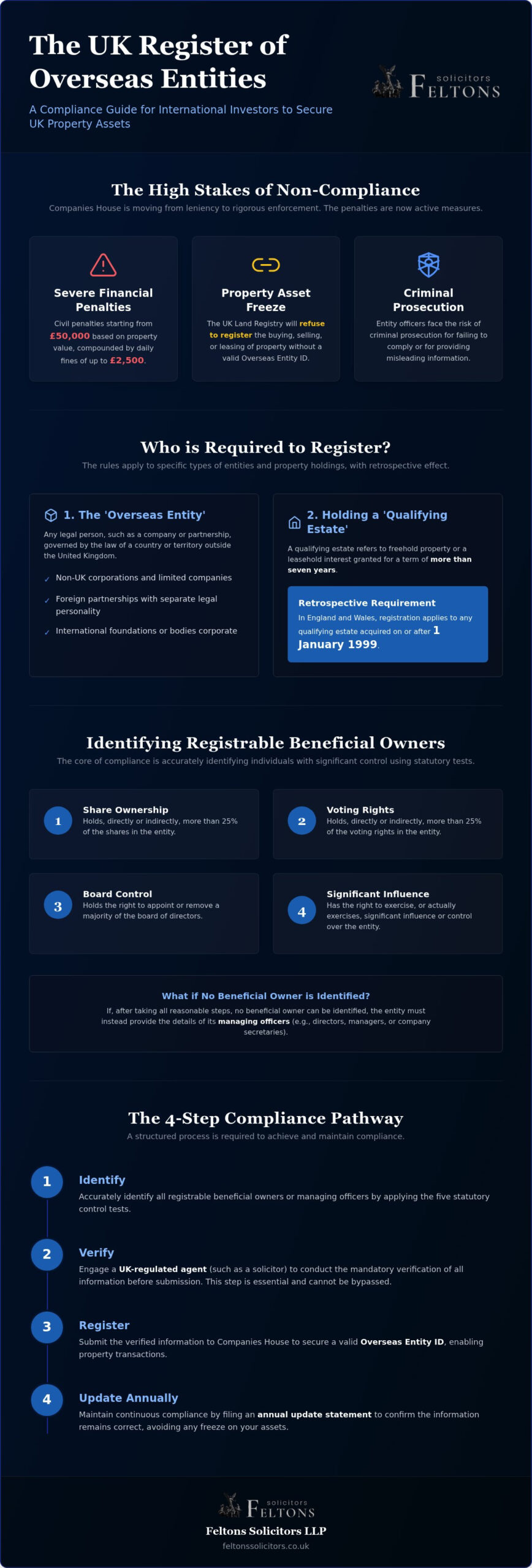
The legal framework governing foreign-owned property in the United Kingdom has undergone a profound transformation. At the heart of this change is the Register of Overseas Entities (ROE), established by the Economic Crime (Transparency and Enforcement) Act 2022. This legislation mandates that any foreign entity wishing to own land in the UK must disclose its true controllers. By 2026, the regulatory climate has shifted from initial education to strict enforcement. Authorities now demand absolute precision in every overseas entity beneficial owner registration, viewing even minor discrepancies as potential compliance failures.

Compliance is no longer a one-time hurdle. The 2026 landscape requires more rigorous data accuracy than in previous years, reflecting a broader push for transparency in global capital flows. For property owners, this means that the information held by Companies House must be verified and updated with meticulous care. Failure to do so doesn’t just result in administrative letters; it can lead to daily fines of up to £2,500 and, in the most serious cases, criminal liability for the entity’s officers. These sanctions are designed to ensure the register remains a reliable source of truth for government agencies and the public alike.

Which Entities Fall Under the Scope?

An “overseas entity” is broadly defined as any legal person, such as a corporation, partnership, or trust, that is governed by the law of a country or territory outside the UK. The scope is notably retrospective. In England and Wales, the requirement applies to land acquired on or after 1 January 1999. In Scotland, the threshold date is 8 December 2014. Whilst certain exemptions exist, they are rarely applicable in practice for commercial or residential holdings. Most international structures holding UK property will find themselves firmly within the remit of the Act.

The Role of Companies House and HM Land Registry

The relationship between Companies House and HM Land Registry is now inextricably linked. When a successful overseas entity beneficial owner registration is completed, the entity is issued a unique Overseas Entity ID. Think of this ID as a “licence” to deal with UK land. Without it, HM Land Registry is legally prohibited from registering any “qualifying disposition” of the property. This means your ability to sell, lease for more than seven years, or even grant a legal charge, such as a mortgage, will be entirely blocked. A valid registration is the key that unlocks your asset’s liquidity; without it, your property transactions will simply stall at the final hurdle. For those entities planning to actively develop their property, this legal compliance often goes hand-in-hand with technical requirements, such as obtaining transport planning reports from specialists like mltraffic.co.uk to support planning applications.

Identifying Registrable Beneficial Owners (RBOs)

Identifying who truly controls an offshore structure is the most technically demanding aspect of overseas entity beneficial owner registration. It isn’t always a straightforward matter of looking at a share certificate. The law sets out specific tests to ensure that those with genuine power cannot remain hidden behind layers of corporate paperwork. According to the official government guidance, an individual or legal entity is registrable if they meet any of the following conditions:

  • Holding more than 25% of the shares in the entity.
  • Holding more than 25% of the voting rights.
  • Having the right to appoint or remove a majority of the board of directors.

Beyond these numerical thresholds, a “catch-all” condition applies to anyone who exercises significant influence or control. This might involve veto rights over major decisions or the ability to direct the entity’s activities through informal arrangements. If you’re unsure how these tiers apply to your specific portfolio, seeking professional legal counsel can provide the reassurance that your filings are accurate and defensible.

The Impact of Trust Structures

Trusts are a primary focus for the 2026 transparency rules. If an overseas entity is held by a trust, the trustees are typically considered registrable beneficial owners. However, the disclosure requirements don’t stop there. You’ll also need to provide details about the settlor, beneficiaries, and any protectors who have the power to influence the trust’s administration. This level of transparency is mandatory for discretionary trusts, even if no distributions have been made to beneficiaries yet.

Indirect Ownership and Parent Undertakings

Many properties are held through a chain of companies. If an individual holds their interest through a “parent undertaking” that is itself a registrable entity, the chain must be traced until a registrable person or a qualifying legal entity is found. This prevents “shell company” loops from obscuring the ultimate owner. Collaborative control, where two or more people act together to meet the 25% threshold, also triggers registration. These “joint interests” require a careful analysis of shareholder agreements and voting patterns.

In rare cases where no individual meets the criteria after exhaustive searches, the entity must instead register its managing officers. This includes directors, managers, or company secretaries. It’s a “fallback” position that ensures there’s always a named person accountable for the entity’s UK property interests. This step should only be taken when you’ve documented that no other beneficial owners exist, as Companies House may request evidence of your due diligence.

For investors based in the Gulf region, you can explore company formation with Ali Al-Masardi Law Firm to ensure your entity is correctly structured from its inception, making subsequent UK compliance much smoother.

The Verification Process: Why Professional Assurance is Essential

The process of overseas entity beneficial owner registration is not a self-service administrative task. Under the 2022 Act, self-certification is strictly prohibited. Every piece of information submitted to Companies House must first be scrutinised and verified by a UK-regulated agent. This requirement ensures that the data on the register is accurate and legally robust. Regulated agents, such as solicitors or qualified accountants, must provide an “agent assurance code” to prove they’ve conducted the necessary due diligence. This rigorous oversight explains why thousands of entities have historically struggled with their filings; as of January 2023, only 19,510 out of 32,440 overseas entities had successfully declared their beneficial owners.

This verification is a heavy responsibility. If an agent fails to perform rigorous checks, Companies House has the power to revoke their assurance code, effectively barring them from the register. At Feltons Solicitors LLP, we position ourselves as a calm, steady presence for clients facing these complex requirements. We understand that for many international owners, the requirement for transparency must be balanced with a need for discretion. Our approach prioritises a boutique level of care, ensuring that while your compliance is absolute, your personal information is handled with the highest standard of professional integrity.

Acceptable Sources of Evidence

Verifying ownership often requires looking beyond simple company books. We rely on independent, third-party registries to confirm the standing of an entity and its controllers. This becomes complex in jurisdictions without public registers or where corporate records are not digitally accessible. In these instances, we work closely with international legal counsel to obtain certified translations of constitutive documents. It’s vital to remember that these verification checks must be conducted no more than 3 months before the date of the application. This ensures that the information provided to Companies House is current and reflects the present reality of the entity’s control structure.

Managing the Risks of Public Disclosure

Privacy is a significant concern for many property owners. Whilst the ROE is a public register, not all information is visible to the world. Specific details, such as a beneficial owner’s residential address or full date of birth, are generally withheld from public view. However, if a person is at serious risk of violence or intimidation, they may apply for “protected status”. This prevents their information from being disclosed even in a limited capacity. Professional guidance is vital here. We help you organise your disclosure to maintain maximum privacy whilst ensuring you remain fully compliant with your statutory obligations.

Overseas Entity Beneficial Owner Registration: A Guide for UK Property Owners in 2026

Maintaining Compliance: Annual Updates and Removals

Securing your initial Overseas Entity ID is a significant milestone, but it does not mark the end of your regulatory obligations. The overseas entity beneficial owner registration is a live requirement that demands ongoing attention. Every year, an overseas entity must file an update statement to confirm that the information held by Companies House remains accurate. This statement is due no later than 14 days after the anniversary of your initial registration. Even if your ownership structure has remained entirely static over the past twelve months, the filing is still mandatory. Since May 1, 2024, the annual update fee has stood at £234, reflecting the increased resources Companies House now dedicates to maintaining the register’s integrity.

A critical risk for many property owners is the “stale” or expired ROE ID. If the annual update is missed, the entity’s status on the public register will change to “undated,” effectively invalidating the Overseas Entity ID. This creates an immediate block at HM Land Registry. Imagine the stress of a sensitive conveyancing transaction stalling at the final hour because your registration is out of date. Buyers and lenders will typically refuse to proceed until the compliance gap is closed. Proactive management of your international portfolio data is the only way to prevent these avoidable delays. If you need to register an overseas entity or manage an upcoming annual update, Feltons Solicitors LLP provides the steady oversight required to keep your status flawless.

Updating Beneficial Owner Information

When changes in control occur, such as the transfer of shares or the appointment of a new director, these must be recorded during the update process. Any new beneficial owner must undergo the same rigorous verification by a UK-regulated agent that was required during the initial registration. Handling the death or insolvency of an individual RBO requires particular sensitivity and legal precision. In these cases, the entity must identify the successor or the person who has stepped into a position of significant influence to ensure the register remains transparent and compliant with the 2022 Act.

Applying for Removal from the Register

If an overseas entity no longer owns any “qualifying estate” in the UK, it may apply to be removed from the register. This process involves a fee of £706 and requires a formal application to Companies House. However, you cannot simply walk away. There is a persistent “duty to deliver” information even after an entity is dissolved or the property is sold. You must ensure that all historical annual updates are complete and that any changes in beneficial ownership up to the point of the property’s disposal have been correctly verified. This methodical approach ensures a clean exit and protects the entity’s officers from future legal disputes.

Feltons Solicitors LLP acts as a vital bridge between complex international corporate structures and the specific, often rigid, demands of UK law. We understand that for offshore trustees and directors, the administrative burden of overseas entity beneficial owner registration can feel like an unnecessary distraction from core business activities. Our role is to absorb that complexity, providing a clear path to compliance that respects your time and your privacy. As a boutique residential property law firm, we prioritise personal connection over high-volume processing. This individualised attention ensures that your registration is not merely a box-ticking exercise, but a robust shield for your high-value UK assets.

The current regulatory environment leaves no room for ambiguity. By positioning ourselves as a calm, steady presence, we help you manage the detailed disclosure requirements that international banks and the Land Registry now expect as standard. We work closely with your existing professional advisors to ensure that every filing is technically perfect. This collaborative approach reduces the risk of transaction blocks and protects your officers from the threat of personal liability. Our focus is on providing high-end reliability, allowing you to hold UK property with absolute confidence in your legal standing. Where your portfolio includes leasehold interests, our leasehold enfranchisement experts can also advise on extending your lease or acquiring the freehold to further strengthen your long-term property rights. For those managing leasehold assets from abroad, our dedicated guidance on leasehold extension for overseas landlords explains how the 2024 reforms and ROE compliance requirements intersect to protect your investment.

Dispute Resolution and Contentious Registration

Internal disagreements regarding who qualifies as a registrable beneficial owner can occasionally arise, particularly within multi-layered trusts or family offices. These situations require more than just administrative filing; they need expert mediation and sound legal judgement. We draw on our deep experience as contentious probate solicitors to resolve complex ownership questions, especially when property is held within an estate or subject to conflicting claims. Whether you’re facing a challenge from a beneficiary or navigating a commercial ownership block, engaging experienced dispute resolution solicitors can help you find a path forward that avoids the drain of protracted litigation whilst maintaining your standing on the register and protecting the entity’s interests.

A Holistic Approach to Property Law

Compliance shouldn’t exist in a vacuum. We ensure that your overseas entity beneficial owner registration aligns perfectly with your long-term estate planning goals and wider tax considerations. For our corporate clients, we provide strategic advice that mirrors the meticulous standard found in leading commercial litigation firms UK. This protects your entity from transparency risks that could lead to future disputes or legal challenges. By integrating ROE compliance into a broader legal strategy, we help you secure your UK property interests for the long term. We invite you to contact us today to discuss how we can support your international portfolio with the discretion and professional integrity it deserves.

Securing Your UK Property Interests for the Future

The regulatory landscape for international property owners is undoubtedly more demanding than in years past. Success requires more than just an initial filing; it necessitates a commitment to annual diligence and absolute transparency. By recognising the importance of correct identification and adhering to the strict 14-day update window, you protect your assets from the risk of frozen transactions and significant financial penalties. Maintaining a valid overseas entity beneficial owner registration is now the fundamental cornerstone of holding UK land through a foreign structure.

At Feltons Solicitors, we provide the specialist expertise in international property law required to handle even the most complex verification cases. Our boutique approach ensures direct partner involvement in your matters, offering a level of discreet, high-standard care that larger firms often struggle to replicate. We take pride in being a steady, dependable partner for offshore trustees and directors alike. Contact Feltons Solicitors for expert assistance with your overseas entity registration to ensure your portfolio remains fully compliant and your property rights are robustly protected. You’re in capable hands, and we’re here to guide you through every step of the process with quiet confidence.

Frequently Asked Questions

What is the deadline for overseas entity beneficial owner registration?

Registration is a mandatory requirement for any overseas entity that currently holds or intends to acquire UK property. Whilst the initial transition period for existing owners ended on 31 January 2023, new entities must register before applying to HM Land Registry. Failure to meet these timelines results in an immediate block on your ability to deal with the land, making compliance an urgent priority for any active property interests.

Can a solicitor verify an overseas entity for the register?

Yes, a solicitor who is a UK-regulated agent is authorised to perform the mandatory verification checks required for the register. This professional assurance is a legal prerequisite, as Companies House will not accept self-certified applications. At Feltons, we provide this service with a focus on precision, ensuring that all beneficial ownership data is verified according to the strict standards set by the 2022 Act.

What are the penalties for failing to register a beneficial owner?

Non-compliance carries severe consequences, including civil financial penalties that start at £10,000 and can increase based on the property’s value. You may also face daily fines of up to £2,500 for ongoing failure to register. In the most serious cases, officers of the entity can face criminal prosecution, resulting in prison sentences of up to five years or unlimited fines, alongside strict property transfer blocks.

Does the Register of Overseas Entities apply to residential property only?

No, the registration requirement applies to both residential and commercial land interests in the UK. Any “qualifying estate,” which includes freehold titles and leaseholds granted for more than seven years, falls within the scope of the legislation. Whether you hold a single luxury apartment or a vast commercial portfolio, your overseas entity beneficial owner registration must be current to ensure your legal title remains secure.

How much does it cost to register an overseas entity in the UK?

As of May 2024, the Companies House fee for initial registration is £234. This same fee of £234 applies to your mandatory annual update statements. If you eventually dispose of all your UK property and wish to be removed from the register, the application for removal fee is £706. These costs are separate from the professional fees charged by your UK-regulated verification agent.

What information is made public about beneficial owners?

The public register displays the name, correspondence address, and the specific nature of the beneficial owner’s control over the entity. For your privacy, sensitive data such as your home address and full date of birth are not visible to the general public. However, this information remains accessible to law enforcement agencies and HMRC to maintain the transparency standards intended by the Economic Crime Act.

Can I sell my UK property if my overseas entity is not registered?

You cannot legally complete a sale, lease, or mortgage of UK land if your entity is not correctly registered with Companies House. HM Land Registry will place a restriction on your property title that prevents the registration of any “qualifying disposition” without a valid Overseas Entity ID. This mechanism ensures that overseas entity beneficial owner registration is completed before any capital can be extracted from the asset.

How often do I need to update my overseas entity registration?

You must file an update statement at least once every twelve months to maintain a valid registration status. This statement must be submitted within 14 days of the anniversary of your initial registration date. Even if no changes have occurred within your corporate structure, you are still legally required to confirm the accuracy of the existing information to avoid your ID being marked as “expired.”

Comprehensive Legal Support for Property Developers in 2026: A Strategic Reference

Comprehensive Legal Support for Property Developers in 2026: A Strategic Reference

Did you know that housing starts in England surged by 24% at the end of 2025? Whilst this growth signals a vibrant market, it also places immense pressure on your ability to secure sites and break ground without delay. You’ve likely felt the frustration of complex title issues or the administrative weight of the Register of Overseas Entities slowing your momentum. In such a fast-paced environment, securing the right legal support for property developers is the difference between a project that stalls and one that thrives.

We understand that you need more than just a solicitor; you require a steady, strategic partner. This guide offers a definitive roadmap for navigating the complexities of the 2026 property market. We’ll explore how to manage the transition to zero-carbon standards and the nuances of leasehold reform. You’ll discover how tailored legal backing ensures seamless site acquisition and robust risk mitigation, leading to an efficient exit strategy through plot sales or commercial leasing. Our goal is to provide the clarity you need to move forward with quiet confidence.

Key Takeaways

  • Secure development sites with confidence by using conditional contracts and option agreements to manage risk before ground is broken.
  • Discover why early legal support for property developers is essential for navigating the complex shift towards zero-carbon building standards and leasehold reforms.
  • Ensure full compliance with the Register of Overseas Entities whilst learning how to structure joint ventures that protect your interests.
  • Optimise your exit strategy through the preparation of comprehensive legal packs for plot sales and the creation of value-maximising commercial leases.
  • Understand the benefit of a boutique legal partnership that prioritises senior-level expertise and a pragmatic, commercially minded approach to your portfolio.

The 2026 property market presents a distinct paradox. Whilst housing starts in England rose by 24% in the final quarter of 2025, the legal framework surrounding these projects has become significantly more intricate. Success in this environment requires a shift in perspective. You shouldn’t view legal counsel as a final administrative check before exchange; it’s a strategic pillar that determines project viability from the very first sketch. For a comprehensive overview of property development, one must look at the entire lifecycle where law and commerce intersect. High-quality legal support for property developers helps you balance the need for commercial speed with the necessity of meticulous due diligence.

The Significance of Early Legal Involvement

Waiting until a site is identified to engage a solicitor is a common but costly mistake. Early involvement allows you to identify “deal-breakers” before you commit significant capital or resources. We focus on uncovering hidden risks that could derail your programme, such as ancient land use restrictions or unrecorded utility access. Our approach involves establishing a clear legal roadmap at the conceptual stage. This ensures your project timelines remain realistic and allows for a smoother transition to acquisition, as the bulk of the investigative work is already complete. By identifying potential hurdles early, we help you maintain momentum when it matters most.

A proactive legal strategy typically involves reviewing:

  • Restrictive Covenants: Identifying limitations that might prevent your specific density or building type.
  • Easements and Rights of Way: Uncovering third-party rights that could physically limit your buildable area.
  • Title Defects: Addressing complex ownership chains that require insurance or curative work before a lender will release funds.

Adapting to Legislative Reform in 2026

The regulatory environment is shifting rapidly. The Building Regulations etc. (Amendment) (England) Regulations 2026, which come into force on 24 March 2027, already demand your attention. You must ensure your 2026 designs are “zero carbon ready” to meet these upcoming standards for low-carbon heating and high energy efficiency. Compliance isn’t just about build quality; it’s a legal requirement that affects your eventual disposal strategy and asset value. Failure to plan for these changes now could result in costly retrofitting later.

Additionally, the ongoing leasehold and freehold reforms are changing how you structure residential exits. Navigating the Building Safety Act remains a priority for higher-risk buildings, requiring rigorous documentation at every “gateway” stage. Our role is to act as your strategic advisor, translating these complex shifts into practical, actionable steps that protect your profit margins. We provide the steady hand needed to turn regulatory hurdles into competitive advantages, ensuring your development is both compliant and future-proofed against further legislative shifts.

Strategic Site Acquisition and Pre-Construction Due Diligence

Acquiring a site in 2026 is a high-stakes endeavour where the legal structure of the deal often dictates its ultimate success. With commercial property SDLT rates at 5% for acquisitions over £250,000, and a 2% surcharge for non-UK residents, the margin for error is slim. You need to ensure that your capital is protected whilst you navigate the complexities of planning and finance. This is where dedicated legal support for property developers becomes indispensable, providing the framework to secure land without exposing yourself to unnecessary risk. Whether you’re utilising conditional contracts or negotiating Section 106 agreements, the goal is to align legal certainty with your commercial timeline.

Securing development finance also requires a meticulous approach to due diligence. Lenders in 2026 are increasingly selective, even with mortgage approvals for house purchases reaching 65,945 in April 2026. They require absolute clarity on title issues and Community Infrastructure Levy (CIL) liabilities before releasing funds. We work to ensure your “Legal Pack” is robust enough to satisfy the most stringent institutional requirements, facilitating smoother access to bridging loans and development capital. For those navigating the complexities of land acquisition, our commercial conveyancing team provides the steady guidance needed to move from offer to exchange with confidence.

Mastering Option and Promotion Agreements

Choosing between an option agreement and a promotion agreement depends entirely on your risk appetite and long-term strategy. An option agreement gives you the right to purchase the land at a set price once planning is secured, whereas a promotion agreement involves you working with the landowner to sell the site to a third party. In a promotion agreement, the “trigger event” is typically the grant of a final, implementable planning permission that satisfies all pre-commencement conditions. Protecting your interests during this phase involves drafting clauses that account for potential planning appeals and the impact of the April 2026 business rates revaluation on site holding costs.

The Due Diligence Checklist for Developers

A comprehensive investigation goes far beyond a simple title search. You must analyse rights of light, drainage easements, and existing utility access to ensure the site can physically support your proposed density. It’s also vital to verify that your plans align with the UK government’s permitted development rights, as these can offer a more efficient route to conversion than full planning applications. We also ensure the site is “clean” from a litigation perspective, checking for any ongoing disputes or claims that could cloud the title and delay construction. Meticulous due diligence today prevents the “deal-breakers” of tomorrow.

Managing Complex Structures: Overseas Entities and Joint Ventures

International investment remains a cornerstone of the UK construction market, which is valued at USD 325.33 billion in 2026. However, the regulatory environment for foreign capital has never been more stringent. For international investors, the 2% SDLT surcharge on top of additional property rates is only the beginning of the compliance journey. Navigating these requirements demands specialised legal support for property developers who need to move capital efficiently whilst remaining fully transparent with HMRC and Companies House. We provide the discreet, expert guidance necessary to manage these complex structures without disrupting your project’s momentum.

Most large-scale projects now utilise Special Purpose Vehicles (SPVs) to ring-fence liability and manage tax obligations. Whilst these structures offer significant commercial advantages, they also require meticulous administrative oversight. Ensuring your SPV is correctly formed and maintained is essential for securing development finance, as lenders require a clear line of sight regarding ownership and control. We help you establish these entities with a focus on long-term stability and ease of eventual disposal.

The Register of Overseas Entities Explained

The Register of Overseas Entities is a mandatory requirement for any foreign entity that owns, or intends to purchase, land in the UK. Compliance involves more than just a simple filing; it requires a UK-regulated agent to verify the beneficial ownership of the entity. This process must be updated annually to maintain a valid overseas entity ID. Failing to comply has severe consequences, as the Land Registry will block your ability to sell, lease, or even charge the property against a loan. We act as a steady partner in this process, handling the verification and registration to ensure your assets remain liquid and your reputation remains untarnished.

Drafting Robust Joint Venture Agreements

Joint Ventures (JVs) are a powerful tool for balancing risk and reward, yet they are often where the most complex disputes arise. A well-drafted JV agreement must go beyond profit-sharing to define clear governance and dispute resolution mechanisms. This includes “deadlock” provisions that outline what happens when partners cannot agree on a fundamental decision, such as a change in the development’s scope or a mid-project sale. Following The Property Institute Guidance helps ensure your management structures meet industry standards from the outset.

Your JV agreement should also address:

  • Governance: Establishing who has the final say on day-to-day operational matters versus strategic milestones.
  • Exit Strategies: Pre-defining the process for one partner to buy out the other or for a coordinated sale to a third party.
  • Intellectual Property: Protecting the development’s brand assets, architectural plans, and proprietary construction methodologies.

By addressing these points early, we protect your interests and provide a clear framework for a successful partnership. If you require assistance with international compliance, our team specialises in the Registration of Overseas Entities, providing a seamless service for global developers.

Comprehensive Legal Support for Property Developers in 2026: A Strategic Reference

Securing the Exit: Plot Sales, Leases, and Commercial Disposals

The final stage of any development is where theoretical value becomes tangible capital. Whether you’re completing a high-density residential block or a boutique commercial hub, the efficiency of your disposal strategy determines your final return on investment. In 2026, with average house prices having increased by 3.8% over the past year, the demand for swift completions is high. High-calibre legal support for property developers ensures that your exit is as streamlined as your acquisition. We focus on preparing the ground for disposal long before the final brick is laid, ensuring that every contract and lease is drafted to maximise asset value and minimise delays.

Efficient Residential Plot Sales

The key to a successful residential exit lies in the preparation of a comprehensive “Legal Pack” that is ready as soon as marketing begins. By standardising documentation, you accelerate the conveyancing process for buyers and their lenders, reducing the time between reservation and completion. This is vital when managing modern ground rent and service charge structures, which must remain compliant with the latest leasehold reforms to remain marketable. Our approach involves integrating residential and commercial conveyancing expertise into your exit plan from the outset. This foresight prevents the last-minute delays that often arise from inconsistent documentation or unresolved title queries. For buyers completing their purchase, working with a specialist residential property law firm ensures that the conveyancing process is handled with the same rigour and precision that underpins your development programme.

Commercial Leasing and Asset Management

For commercial developments, the exit strategy often involves securing high-calibre tenants through “Agreements for Lease” before construction is even finished. These documents must be meticulously drafted to address repair obligations and break clauses, as these terms directly impact the property’s attractiveness to future institutional investors. A lease that is too restrictive may deter tenants, whilst one that is too lenient can undermine the long-term value of the asset. We help you strike the right balance, ensuring your development remains a robust investment for years to come. Where tenants are already in occupation, understanding the process of instructing experienced commercial lease renewal solicitors is equally important to protecting the income stream and long-term capital value of your asset.

We also address the practicalities of asset management, ensuring that your commercial leases are structured to allow for future disposals or refinancing. If you are ready to finalise your exit strategy, our team can assist with your residential and commercial conveyancing requirements to ensure a smooth and professional disposal process.

Choosing the right legal support for property developers isn’t just about finding a firm that can process paperwork. It’s about securing a partner who understands the commercial weight of your decisions and the personal stakes involved in every project. At Feltons Solicitors, we provide a sophisticated blend of professional authority and empathetic reassurance. We’re a boutique firm, which means you aren’t just another project in a high-volume system. You have direct access to senior solicitors who offer tailored, high-quality advice grounded in practicality and sound judgment.

Our expertise extends across the full spectrum of property law, ensuring that your personal and professional assets are protected with equal rigour. Whether you’re managing a national residential scheme or an international commercial project, we act as a discreet, dependable partner. We value the human impact of our work, ensuring that whilst the technical legalities are paramount, your personal rapport with your legal team is never forgotten. This people-first philosophy is what allows us to navigate the most complex situations with quiet confidence.

Why Developers Choose Feltons

We’ve built our reputation on a commitment to long-term professional relationships. This isn’t just about the current transaction; it’s about supporting your growth over the coming years. Our proven track record in handling complex litigation and dispute resolution allows us to protect your interests when challenges arise, providing a calm, steady presence in stressful situations. We combine traditional professional integrity with a forward-thinking methodology, ensuring your development stays on track without sacrificing the high standards of a discreet, boutique service. You’ll find our advice is always pragmatic and commercially minded, designed to facilitate your goals rather than hinder them with dense legalese.

Our Comprehensive Property Services

Our team offers specialised expertise in areas that directly impact your project’s viability and your eventual exit strategy. This includes managing the nuances of leasehold enfranchisement and extensions, as well as the mandatory registration of overseas entities for international investors. For private developers, we often integrate our work with estate planning to ensure that the legacy of your projects and your personal wealth are preserved for future generations. Our services are highly organised, reflecting a methodical and orderly legal mindset that mirrors a professional consultation.

Instructing Feltons for your next development project is a straightforward process designed to respect your time. We begin with a methodical consultation to understand your specific objectives and risk profile. From there, we provide a clear roadmap for our partnership, ensuring you feel informed, supported, and in capable hands from site acquisition to final disposal. We invite you to contact us to discuss how our boutique approach can provide the strategic legal backing your portfolio requires in 2026.

Securing Your Development Legacy in 2026 and Beyond

The 2026 property landscape demands a move from reactive administration to proactive strategy. As we’ve explored, the difference between a project that stalls and one that succeeds often lies in the quality of the groundwork laid long before construction begins. From navigating the complexities of the Building Safety Act to ensuring full compliance with the Register of Overseas Entities, having the right legal support for property developers is a commercial necessity. Success requires a steady hand and a clear roadmap.

Paula Felton established this firm in 2010 with a vision of providing high-end, boutique legal care that remains deeply personal. We offer both national and international expertise, specialising in complex matters like the Registration of Overseas Entities and tailored joint venture structures. Our approach ensures you have a dependable partner to manage the risks whilst you focus on your vision. When you’re ready to move forward with quiet confidence, we’re here to provide the sophisticated guidance your portfolio deserves.

Instruct Feltons Solicitors for your next development project and ensure your project is built on a foundation of legal certainty. We look forward to supporting your next success.

Frequently Asked Questions

What is the role of a solicitor in property development?

A solicitor acts as a strategic advisor who manages legal risks across the entire project lifecycle. They handle everything from initial title investigations and site acquisition to the drafting of construction contracts and the final disposal of units. Their expertise ensures that your project remains compliant with evolving regulations whilst protecting your commercial interests through robust, well-drafted agreements.

Do property developers need specific legal support for site acquisition?

Yes, specialised legal support for property developers is essential during site acquisition to identify restrictive covenants, easements, or title defects that could hinder construction. Solicitors negotiate conditional contracts and option agreements to ensure you only commit significant capital once planning permission is secured. This proactive approach prevents costly delays and ensures the site is legally viable for your specific density requirements.

How does the Register of Overseas Entities affect international developers?

International developers must register with Companies House and identify their beneficial owners before they can buy, sell, or lease UK land. This mandatory register requires an annual update to maintain a valid overseas entity ID. If you fail to comply, the Land Registry will block any dealings with the property, effectively freezing your assets and preventing you from charging the land for development finance.

What are the legal risks of not having a joint venture agreement?

The primary risks include “deadlock” in decision-making and unclear profit-sharing arrangements, which can lead to expensive litigation. Without a formal agreement, there are no pre-defined exit strategies or dispute resolution mechanisms to handle disagreements between partners. A professionally drafted contract protects your investment by establishing clear governance and defining how assets are divided if the partnership dissolves.

Can a solicitor help with Section 106 negotiations?

Solicitors are vital in negotiating Section 106 agreements to ensure that the planning obligations and financial contributions required by local authorities are proportionate. They work to refine the “trigger events” for payments, ensuring they align with your cash flow and construction milestones. This prevents local authority requirements from becoming a barrier to project viability or making the development unmortgageable for future buyers.

What is the difference between a promotion agreement and an option agreement?

An option agreement gives a developer the right to purchase land at a pre-agreed price once planning permission is granted. In contrast, a promotion agreement involves a developer working with the landowner to secure planning and then selling the site on the open market. The developer then takes a percentage of the final sale price, making it a popular choice for those who don’t intend to build out the site themselves.

How much does legal support for property developers cost?

The cost of legal support for property developers varies significantly based on the scale of the project and the complexity of the title. Fees are typically structured to reflect the specific services required, such as handling overseas entity registrations or negotiating complex multi-party joint ventures. We recommend a professional consultation to establish a clear, transparent fee structure that aligns with your development’s specific requirements and timelines.

Why is due diligence critical for brownfield developments?

Due diligence on brownfield sites is essential for uncovering environmental liabilities, such as soil contamination or historical land use issues, that could lead to remediation costs. Solicitors investigate environmental reports and historical records to ensure that these risks are properly allocated in the purchase contract. This protects you from unforeseen expenses and ensures that the site meets the stringent safety standards required for modern residential or commercial occupation.