
The Essential Checklist: Choosing and Working with a Solicitor for Buying a House in 2026

The Essential Checklist: Choosing and Working with a Solicitor for Buying a House in 2026

The difference between a seamless move and a stressful delay often comes down to whether you have hired a data-processor or a dedicated legal partner. Finding the right solicitor for buying a house is the single most important decision you’ll make once your offer is accepted. You likely want more than just a firm that ticks boxes; you need a proactive advisor who anticipates risks before they become roadblocks.

It’s understandable to feel a sense of trepidation regarding hidden legal fees or the complexities of the latest Stamp Duty Land Tax rates. You deserve a process that prioritises clear communication and fixed-fee certainty over high-volume automated systems. This article provides a comprehensive, step-by-step checklist to help you navigate the legal intricacies of the 2026 property market with professional clarity. We’ll explore how to distinguish expert solicitors from basic conveyancers and exactly what you must prepare to ensure a smooth, delay-free completion.

Key Takeaways

  • Identify a qualified solicitor for buying a house by verifying SRA accreditation and ensuring they possess specific expertise in your property type, particularly for complex leasehold matters.
  • Expedite the onboarding process by preparing comprehensive “Source of Funds” evidence and valid identification to satisfy modern compliance standards from the outset.
  • Gain a clear understanding of legal risks by reviewing the “Big Four” property searches and identifying any restrictive covenants that could impact your future use of the home.
  • Ensure a smooth transition to ownership by mastering the final transaction steps, from the timely transfer of your deposit to the formal execution of the Transfer Deed.
  • Secure your long-term protection by confirming that all post-completion obligations, including Stamp Duty Land Tax filings and Land Registry registration, are finalised.

Selecting the Right Solicitor for Buying a House: A Pre-Instruction Checklist

Hiring a solicitor for buying a house is often treated as a simple administrative task, yet it’s the most critical safeguard for your financial future. A legal partner who prioritises meticulous risk management over sheer transaction volume ensures your new home doesn’t arrive with a legacy of legal liabilities. Before you sign a letter of engagement, you must verify that the firm holds Solicitors Regulation Authority (SRA) accreditation and active Law Society membership. These credentials are your primary assurance of professional standards and indemnity protection.

You should also look for the Law Society’s Conveyancing Quality Scheme (CQS) mark. This recognised excellence standard indicates that a firm undergoes rigorous assessment to maintain the highest technical proficiency. Understanding the conveyancing process explained through these professional lenses helps you see why a budget, automated service often falls short when genuine complexities arise. Always confirm the firm has specific expertise in your property type, whether that’s a complex leasehold flat or a new-build purchase with unique developer warranties.

Understanding the Boutique Advantage

There is a distinct benefit to choosing a firm that values personal connection over high-volume processing. A boutique approach offers a dedicated solicitor who understands the nuances of your specific goals, providing a sense of quiet confidence throughout the transaction. At Feltons, our people-first philosophy ensures you aren’t just another file number in a database. A direct relationship with your solicitor reduces the friction of transaction stress, especially during high-pressure chain negotiations. This tailored service allows for a methodical flow of information, keeping you informed without the frantic energy of a call centre environment.

The “Red Flags” to Watch For

Transparency is the cornerstone of a professional relationship. You should be wary of vague quotes that leave room for “unexpected” administrative charges or “supplementary” fees for basic tasks. A reputable solicitor for buying a house will provide a transparent, itemised quote that includes all anticipated disbursements and VAT from the outset. If a firm cannot name the specific solicitor or legal executive responsible for your file, it’s a sign they may rely on automated systems rather than expert oversight.

Finally, ensure your chosen firm has the depth of expertise to handle related matters that may arise during or after your purchase. This includes specialised areas like leasehold enfranchisement or registration of overseas entities. If a firm lacks the capacity to manage complex litigation or lease extensions, they’ll likely struggle to protect your interests if the transaction encounters a legal hurdle. Choosing a partner with a broad range of property expertise ensures you have a sophisticated guide for every stage of your ownership journey.

Onboarding and Compliance: Your Initial Documentation Checklist

The first few days after your offer is accepted are often the most administrative. Before any legal work can commence, your solicitor for buying a house must perform mandatory Anti-Money Laundering (AML) checks. This stage is a legal necessity, not a mere formality. To keep the momentum of your purchase, you’ll need to return your signed Terms of Business and provide an initial payment on account. This payment is used to commission property searches immediately, preventing early delays that can ripple through the entire chain.

Following a comprehensive solicitor’s legal checklist helps you gather the necessary evidence before the request even arrives. You should prepare valid photographic identification, such as a passport or driving licence, along with recent utility bills or bank statements as proof of address for every purchaser involved. Providing these documents in a high-quality digital format from the outset allows your legal team to verify your identity with modern efficiency.

Navigating Anti-Money Laundering (AML) Requirements

Compliance standards in 2026 are more rigorous than ever. Solicitors are now required to distinguish clearly between “Source of Funds” and “Source of Wealth.” Whilst the former tracks the specific money for this transaction, the latter involves explaining how you accumulated your capital over time. Be ready to provide six months of bank statements showing salary entries, investment dividends, or inheritance distributions. For those involving international structures, you may also need to navigate overseas entity registration protocols to ensure the transaction complies with current Land Registry transparency rules.

Organising Your Paperwork for Efficiency

A methodical approach to your paperwork creates a calm and steady transaction environment. We recommend creating a dedicated digital folder for all correspondence, from mortgage offers to insurance quotes. If your deposit includes a gift from family, ensure you have a signed “gifted deposit” letter ready. This document must explicitly state that the funds are a non-repayable gift and that the donor will hold no legal interest in the property. Handling these details early demonstrates a proactive mindset that your solicitor will appreciate.

Our team prioritises a people-first approach, ensuring that these technical requirements don’t become a source of anxiety. If you require a bespoke legal partner to help you manage these initial hurdles, providing your information early is the best way to ensure a smooth path to completion. This level of preparation allows your solicitor for buying a house to focus on the complex legal work rather than chasing basic documentation.

Once your initial documentation is verified, your solicitor for buying a house begins the substantive task of legal due diligence. This phase is designed to uncover any hidden liabilities that could affect the property’s value or your future enjoyment of it. Whilst the UK government’s guide to buying a home provides a useful overview of the standard procedure, a sophisticated legal partner goes beyond the basics to interpret the nuances of the data received. This technical scrutiny is what transforms a standard transaction into a secure investment.

Your solicitor will commission the “Big Four” searches to ensure no stone is left unturned. These essential enquiries include:

  • Local Authority Search: This reveals planning history, building regulation approvals, and any proposed infrastructure projects, such as new roads, near the property.
  • Water and Drainage Search: This confirms whether the property is connected to a public sewer and identifies the location of any public pipes that might restrict future building work.
  • Environmental Search: This assesses risks regarding land contamination, flooding, or ground stability issues like subsidence.
  • Chancel Repair Search: This identifies if the property carries an ancient liability to contribute towards the cost of local church repairs.

Beyond these searches, your solicitor will meticulously review the Title Register and Title Plan. They look for restrictive covenants, which are rules that limit how you can use the land, and easements, such as a neighbour’s right of way across your garden. They will also raise specific enquiries based on the Property Information Form (TA6) provided by the seller, ensuring that any extensions or alterations have the necessary planning permissions and building regulation certificates.

Interpreting the Small Print

A skilled solicitor acts as a shield against legal defects that are often buried in dense documentation. Identifying a “right of way” that was never properly disclosed or spotting a lack of indemnity insurance for a historic building modification requires a keen eye and professional intuition. If these issues are ignored, they can lead to costly litigation or difficulty when you eventually come to sell. For a deeper understanding of these protections, you can explore our pillar on Navigating Residential Property Law.

Special Checks for Leasehold Properties

Buying a leasehold property requires an additional layer of expertise, particularly following the Leasehold and Freehold Reform Act 2024. Your solicitor for buying a house will scrutinise the lease length and ground rent escalation clauses to ensure they remain fair. Under the new legislation, the standard lease extension has increased to 990 years, and the previous two-year ownership requirement has been abolished. Your solicitor will also review the “Management Pack” to check for service charge arrears or significant planned works that could result in unexpected costs shortly after you move in.

The Essential Checklist: Choosing and Working with a Solicitor for Buying a House in 2026

Preparing for Exchange and Completion: The Final Transaction Checklist

As the technical enquiries conclude, the focus shifts to the final execution of the transaction. This is the stage where your preparation meets professional oversight to ensure a seamless transition of ownership. Your solicitor for buying a house will coordinate with the seller’s legal team to align the entire chain, managing the logistical hurdles that often arise in the final 48 hours. This phase requires your active participation to ensure all documents are legally binding and funds are positioned correctly.

To navigate this final stretch with confidence, follow this essential checklist:

  • Review and Sign: Execute the final Contract and Transfer Deed (TR1) in the presence of an independent witness.
  • Deposit Transfer: Ensure the exchange deposit, which is usually 10% of the purchase price, is transferred to your solicitor’s client account.
  • Buildings Insurance: Activate your policy so it’s valid from the date of exchange, as the risk usually passes to the buyer at this point.
  • Coordinate Dates: Agree on a completion date that works for everyone in the chain, allowing enough time for removals and bank transfers.
  • Final Authorisation: Provide your solicitor with explicit authority to exchange contracts on your behalf.

The Moment of Legal Commitment

The “Exchange of Contracts” is a formal process conducted via a recorded telephone call between the solicitors in the chain. Once this call concludes, the purchase is legally binding. You cannot pull out after this point without significant financial penalties, including the loss of your deposit and potential litigation for breach of contract. We manage this milestone with a steady, calm presence, ensuring that the emotional transition from “making an offer” to “securing your home” is supported by absolute legal certainty.

Final Financial Reconciliations

In the days leading up to completion, your solicitor for buying a house will provide a final “Completion Statement.” This document provides a transparent, itemised breakdown of all remaining costs, including the balance of the purchase price, Stamp Duty Land Tax, and Land Registry fees. Your solicitor must also submit a “Certificate of Title” to your mortgage lender to ensure the mortgage advance is released in time for the completion day. It’s vital to arrange for the final balance of your own funds to be cleared in your solicitor’s account at least one day before completion to prevent banking delays from stalling your move.

If you value a legal partner who prioritises meticulous financial accuracy and proactive communication, you can instruct our residential property experts to manage your upcoming purchase. Our boutique approach ensures that every detail of your completion is handled with the highest standard of professional integrity.

Post-Completion Obligations: The Ownership and Protection Checklist

The moment you receive the keys to your new home is a significant milestone, yet the legal process does not conclude at the front door. Your solicitor for buying a house remains active behind the scenes to ensure your legal title is perfected and your tax obligations are finalised. This administrative tail is vital for protecting your investment and ensuring that future sales or remortgages proceed without technical hitches. Whilst the move itself is a physical transition, these final legal steps provide the permanent security every homeowner requires.

Your post-completion checklist should include the following essential actions:

  • Tax Compliance: Verify that your Stamp Duty Land Tax (SDLT) return has been submitted and the tax paid to HMRC within the required 14-day window.
  • Title Registration: Confirm that your solicitor has applied to HM Land Registry to register you as the new legal owner and to record your mortgage lender’s interest.
  • Document Retention: Collect your “Title Deed” bundle, which includes the updated Title Register, any specific indemnity policies, and physical certificates for gas or electrical works.
  • Asset Protection: Update your Will to reflect your new property asset and ensure your estate is distributed according to your wishes.

Securing Your Future

Acquiring a property is often the most significant financial commitment of a lifetime. This makes it the most critical time to organise estate planning to protect your legacy. For joint owners, understanding the distinction between “joint tenants” and “tenants in common” is essential to avoid future contentious probate disputes. A sophisticated legal partner will help you navigate these choices with quiet confidence, ensuring that your home remains a secure asset for your loved ones. Storing your legal documents safely now prevents avoidable delays when you eventually decide to sell.

The Final Handover

Securing Your Move with Expert Guidance

Navigating the UK property market in 2026 requires a blend of meticulous preparation and expert legal oversight. By following this checklist, you’ve established a foundation for a transaction defined by clarity rather than confusion. You now understand that a dedicated solicitor for buying a house does more than process paperwork; they act as a sophisticated guide through complex leasehold reforms and rigorous compliance standards. This proactive approach ensures that your interests are protected at every stage, from the initial instruction to the final registration of your ownership.

A successful completion relies on early documentation, thorough search analysis, and a methodical approach to the final exchange. At Feltons, our expert residential property team prioritises a boutique, people-first approach that values your personal peace of mind and long-term security. We provide transparent, fixed-fee options to ensure you have financial certainty from the very outset of your journey. To ensure your purchase is handled with quiet confidence and professional integrity, contact Feltons Solicitors for a tailored conveyancing quote.

Frequently Asked Questions

How long does a solicitor take to buy a house in 2026?

The average property transaction in 2026 takes approximately 12 to 16 weeks to reach completion from the point of offer acceptance. This timeline depends heavily on the complexity of the property chain and the responsiveness of local authorities regarding search results. Whilst digital advancements have streamlined some administrative tasks, thorough legal due diligence remains a priority that cannot be rushed if you wish to ensure a secure investment.

What is the difference between a conveyancer and a solicitor?

Solicitors are fully qualified lawyers who offer a broad range of legal expertise, whilst licensed conveyancers are specialists focused specifically on property transfers. A solicitor for buying a house often possesses the additional training required to handle complex litigation or probate matters that may arise during a transaction. Choosing a solicitor ensures you have a partner capable of managing intricate legal hurdles with a sophisticated level of care.

How much are the typical legal fees for buying a house?

Legal fees are generally determined by the property’s purchase price and the specific nature of the transaction, such as whether the home is freehold or leasehold. You should always request a transparent, fixed-fee quote that clearly distinguishes the professional fee from external costs. This ensures you have financial certainty from the outset and protects you from the risk of hidden administrative charges appearing later in the process.

Do I need a local solicitor, or can I use one based elsewhere in the UK?

You are not required to use a local firm, as most conveyancing is now conducted through secure digital portals and electronic communication. You can instruct a solicitor located anywhere in England or Wales to handle your purchase with equal efficiency. The priority should be the firm’s expertise and their ability to provide a calm, steady presence throughout the transaction rather than their physical proximity to the property.

What happens if the property chain breaks down?

A chain breakdown prior to the exchange of contracts means the transaction is not yet legally binding, allowing parties to withdraw without financial penalty. This situation requires a proactive legal partner who can liaise with estate agents and other solicitors to find a pragmatic solution. If you have already paid for searches, these may need to be refreshed if a significant delay occurs before a new chain is established.

What are disbursements, and why do I have to pay them?

Disbursements are essential third-party costs that your solicitor pays on your behalf, such as local authority searches and Land Registry fees. These charges are passed on to you at cost and are necessary to verify the property’s legal standing for your mortgage lender. Your solicitor for buying a house will collect these funds as an initial payment on account to ensure these vital checks are commissioned immediately.

Can a solicitor help me if I am buying a house with someone else?

Yes, your solicitor will provide essential advice on the different ways to hold joint ownership, such as “joint tenants” or “tenants in common.” This decision has significant implications for your future estate planning and how the property is treated if one owner passes away. Professional guidance is vital for protecting your individual financial interests and ensuring that your property assets are managed according to your specific wishes.

When should I instruct a solicitor for buying a house?

You should instruct a solicitor as soon as you begin your property search or immediately after your offer has been accepted. Engaging a legal partner early allows you to complete the mandatory onboarding and compliance checks, putting you in a “contract-ready” position. This proactive approach demonstrates your commitment to the seller and helps maintain a steady momentum for the entire move, reducing the risk of early delays.

Collective Enfranchisement Solicitors: A How-To Guide for Buying Your Freehold in 2026

Collective Enfranchisement Solicitors: A How-To Guide for Buying Your Freehold in 2026

The building you call home should be your greatest asset, not a source of mounting anxiety. You have likely felt the frustration of rising service charges and the looming worry of a lease dipping toward that 80-year threshold. It is often difficult to organise neighbours, and the fear of hidden legal costs can keep many leaseholders stuck in a cycle of poor maintenance and diminishing property value. Partnering with experienced collective enfranchisement solicitors is the first step toward turning that shared frustration into a valuable, self-managed asset.

We understand that the legal landscape in 2026 feels complex, especially with the phased implementation of the Leasehold and Freehold Reform Act 2024. These reforms provide a significant opportunity to gain total control over your building and eventually secure 990-year leases with zero ground rent. This guide provides a clear blueprint for navigating the enfranchisement process, from understanding the updated 50% non-residential limits to managing group strategy. You will discover how to successfully secure your freehold and increase your property’s market value whilst avoiding the common pitfalls of property litigation. We will explain exactly how to move from leaseholder to freeholder with confidence and professional support.

Key Takeaways

  • Understand how collective enfranchisement empowers you to take full control of your building’s management and eliminate escalating service charges.
  • Learn the updated eligibility criteria for 2026, including the expanded 50% non-residential limit that makes buying the freehold possible for more mixed-use blocks.
  • Discover why instructing specialist collective enfranchisement solicitors is essential for navigating strict statutory deadlines and ensuring a smooth transition of ownership.
  • Identify how a robust Participation Agreement protects your group’s financial interests and ensures the stability of your claim from start to finish.
  • Master the strategic steps required to secure 990-year leases and zero ground rent, significantly increasing the long-term value of your home.

What is Collective Enfranchisement and Why Buy Your Freehold?

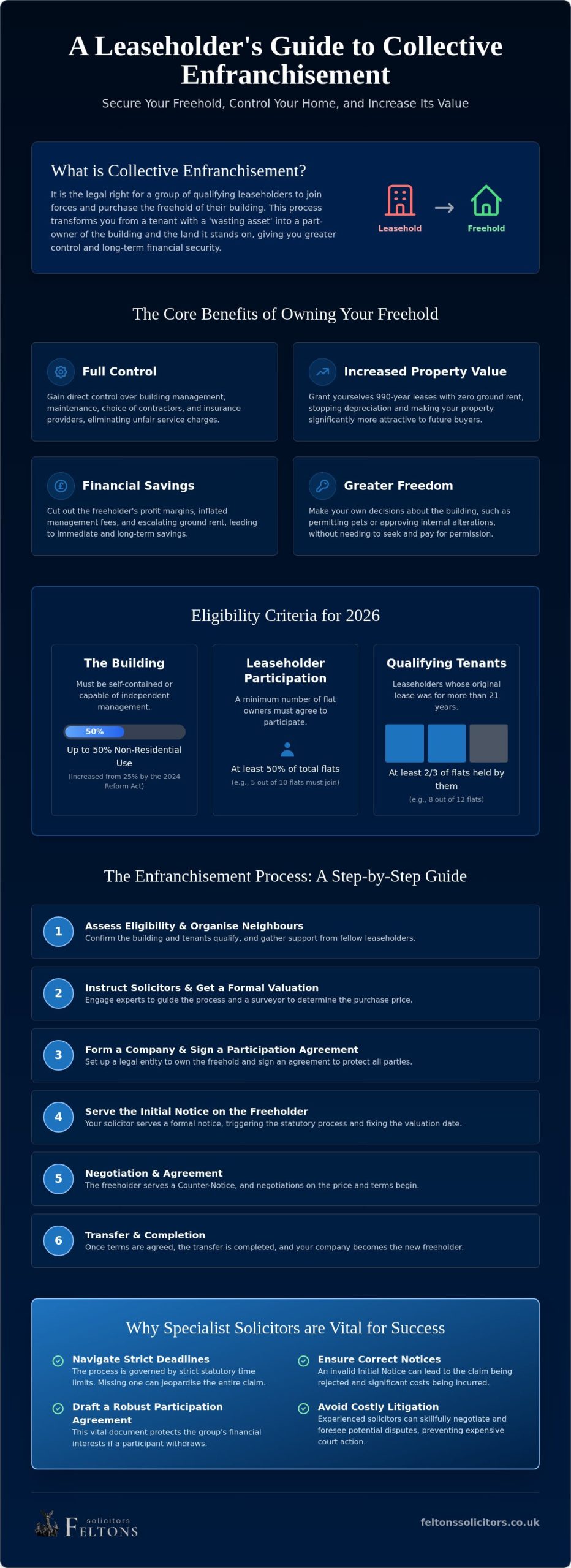
Collective enfranchisement isn’t just a legal procedure; it’s a fundamental shift in how you own your home. Essentially, it’s the right for a group of leaseholders to join forces and purchase the freehold of their building. This process transforms you from a tenant into a part-owner of the land your building sits on. For many, the catalyst is a history of opaque service charges, skyrocketing insurance premiums, or neglected communal areas. When you research What is Collective Enfranchisement, you quickly realise it’s about reclaiming autonomy over your living environment and your long-term financial security.

A lease is often described as a ‘wasting asset’ because its value diminishes as the term gets shorter. By buying the freehold, you and your neighbours can grant yourselves new leases, typically for 999 years, effectively stopping the clock on depreciation. It removes the stress of future extensions and makes your property far more attractive to buyers who might otherwise be wary of a lease dropping towards the 80-year mark. Instructing collective enfranchisement solicitors early in the process ensures the transition of the title is handled with the poise and professional integrity required to protect your investment.

The Core Benefits of Owning the Freehold

Statutory Rights Under the 1993 Act

The legal framework is the Leasehold Reform, Housing and Urban Development Act 1993. This legislation provides a structured route to force a sale, even if the freeholder is reluctant. Engaging collective enfranchisement solicitors ensures every notice is served correctly and that the freeholder cannot use delay tactics. The law is designed to protect your right to ownership, provided the process is followed with precision.

Eligibility Criteria: Does Your Building Qualify in 2026?

Before embarking on the journey toward ownership, it’s essential to confirm that your building meets the specific legal requirements. The process begins with understanding your leasehold property structure. To qualify, the building must be a self-contained block of flats or a part of a building that is capable of independent management. This means it must have its own vertical division and be able to function without relying on services from an adjacent structure. If your block shares communal heating or structural components with another building, the eligibility assessment becomes more nuanced.

One of the most significant shifts in 2026 is the expanded eligibility for mixed-use buildings. Previously, if more than 25% of the internal floor area was used for non-residential purposes, the building was disqualified. However, the Leasehold and Freehold Reform Act 2024 has increased this limit to 50%. This change allows leaseholders in buildings with substantial commercial space, such as shops or offices on the lower floors, to finally take control. Additionally, at least 50% of the total number of flats in the building must agree to participate in the purchase. If you live in a block of ten flats, you need at least five neighbours to commit to the claim.

Another core requirement involves the status of the tenants themselves. At least two-thirds of the flats in the building must be held by ‘qualifying tenants’. These are leaseholders whose original lease term was for more than 21 years. If you are unsure whether your block meets these thresholds, seeking advice from collective enfranchisement solicitors early on can prevent costly missteps. The team at Feltons Solicitors LLP can help you audit your building’s eligibility before you begin formal negotiations.

Defining the ‘Qualifying Tenant’

A qualifying tenant can be an individual or a company. However, if a single person or entity owns more than two flats in the building, they are excluded from being a qualifying tenant for the purposes of the claim. It’s also important to remember that the two-year ownership rule was abolished in early 2025. You can now participate in a collective enfranchisement claim from the day you complete your property purchase, regardless of how long the previous owner held the title. Your current lease length doesn’t affect your right to participate; even those with very short leases can be part of the group.

Common Eligibility Pitfalls to Avoid

Buildings with complex flying freeholds or those owned by specific charitable housing trusts can present unique challenges. In some cases, the freeholder may be exempt from the statutory process if the property is part of a charitable mission. Identifying these exemptions requires a methodical review of the title deeds and the freeholder’s status. Missing these details can lead to a claim being rejected at the first hurdle, which is why collective enfranchisement solicitors conduct thorough initial searches as part of the due diligence process.

The Collective Enfranchisement Process: A Step-by-Step Guide

Successfully purchasing a freehold is as much about group dynamics as it is about legal precision. Whilst the statutory route provides a clear framework, the process requires a methodical approach to ensure every participant remains committed and every deadline is met. Unlike a voluntary negotiation, which relies on the landlord’s whims, the statutory process under the 1993 Act grants you the power to compel a sale. This journey begins with internal organisation and ends with the transfer of the title to a company owned by you and your neighbours.

The first critical step involves organising your group and establishing a formal Participation Agreement. This document is a legally binding contract that governs the behaviour of the participants, securing financial commitments and outlining how decisions will be made. Without this, the claim is vulnerable if a neighbour decides to withdraw at a late stage. Once the group is secure, collective enfranchisement solicitors will help you form a ‘Nominee Purchaser’ company. This entity is specifically designed to hold the freehold title on behalf of the participating leaseholders, ensuring a professional structure for future building management.

Following the company formation, your legal team will serve the Section 13 Notice on the freeholder. This formal document triggers the legal timetable and sets out the proposed price for the freehold. If the freeholder agrees to the terms, the process moves toward completion. However, if an agreement on the premium cannot be reached through negotiation, an application to the First-tier Tribunal may be necessary to determine a fair price. In 2026, the fees for such an application are typically £200, with an additional £300 for a hearing, representing a modest cost for securing a fair valuation.

The Role of the Specialist Valuer

You should never serve a Section 13 Notice without a professional valuation. A specialist valuer provides a realistic estimate of the premium, ensuring your opening offer is neither too high nor so low that it risks being deemed unrealistic. By 2026, the abolition of ‘marriage value’ has significantly simplified these calculations, making the process more transparent for buildings with leases under 80 years. Understanding how these valuations are constructed is just as important for individual leaseholders; a detailed lease extension estimate can help each participant appreciate the financial stakes before the group commits to the collective purchase. Your valuer and collective enfranchisement solicitors work in tandem to counter the freeholder’s opening demands, using market data to protect your financial interests.

Serving the Section 13 Notice

The Section 13 Notice is the most important document in the claim. It must include precise details of the participating flats, the proposed premium, and the details of the Nominee Purchaser. Any technical error can lead to the notice being declared invalid, which may prevent you from starting a new claim for twelve months. The landlord is given a minimum of two months to respond with a Counter-Notice. If they fail to respond by the stated deadline, the group can apply to the court for a Vesting Order, allowing the purchase to proceed on the terms set out in your initial notice.

Collective Enfranchisement Solicitors: A How-To Guide for Buying Your Freehold in 2026

Mitigating Risks: Participation Agreements and Group Management

Whilst the legal framework provides the statutory right to buy, the human element often presents the greatest challenge to a successful claim. Collective enfranchisement requires a group of neighbours to act as a single, disciplined unit for several months. The most significant risk to any claim is a participant dropping out at a late stage. If one person withdraws, the remaining group is often left to cover the financial shortfall, which can jeopardise the entire project. This is why establishing a robust Participation Agreement is the most critical step you can take before serving any formal notice.

A Participation Agreement is a legally binding contract between the leaseholders that governs the group’s behaviour and financial obligations. It provides a safety net, ensuring that everyone is committed to the same goals and understands their share of the costs. Specialist collective enfranchisement solicitors will tell you that a claim’s success often rests on the strength of this internal contract. It prevents stalemates during negotiations by defining exactly how decisions are made, whether by a simple majority or a dedicated committee. Without this structure, a single dissenting voice can halt progress during a critical negotiation window.

What Should Your Participation Agreement Include?

A well-drafted agreement should leave no room for ambiguity. It must clearly outline the following provisions:

  • Defaulting members: Clear consequences for participants who fail to pay their share of the premium or legal fees on time.
  • Lease valuations: The mechanism for granting new 999-year leases to participants at a peppercorn rent, whilst ensuring non-participants remain on their current terms.
  • Future management: How the building will be managed once the freehold is acquired, including the appointment of directors for the Nominee Purchaser company.
  • Cost sharing: A precise breakdown of how the purchase price and the freeholder’s reasonable legal costs will be divided amongst the group.

Managing Apathy and Non-Participants

It’s common to encounter neighbours who want the benefits of a freehold purchase but are unwilling or unable to contribute to the costs. In these cases, the participating group must decide whether to ‘carry’ the cost of the non-participant’s flat to secure the building. For those who cannot join the collective purchase, they still retain their individual tenant lease extension rights, which can be pursued separately. Furthermore, if your freeholder is ‘missing’ or ‘untraceable’, your collective enfranchisement solicitors can apply for a Vesting Order through the county court, allowing the purchase to proceed even in their absence.

Managing a group claim requires a steady, poised hand to ensure all stakeholders remain aligned. If you are ready to formalise your group’s commitment, you should contact our enfranchisement team to draft a Participation Agreement tailored to your building’s specific needs.

Why Specialist Collective Enfranchisement Solicitors are Vital

The legal journey of buying your freehold is paved with rigid statutory deadlines that leave no room for error. If a single notice is served incorrectly or a counter-proposal deadline is missed by just one day, the law can treat the claim as ‘deemed withdrawn’. This doesn’t just stall your progress; it often prevents the group from serving a new notice for another twelve months, during which time property values may rise and leases grow shorter. Instructing specialist collective enfranchisement solicitors is the only way to ensure these procedural traps are avoided. At Feltons Solicitors LLP, we provide the poised, steady guidance required to manage the many moving parts of a group claim, ensuring your interests remain protected from the initial audit to the final transfer of title.

Our approach combines modern efficiency with the traditional professional integrity you expect from a trusted advisor. We understand that behind the legal filings are homeowners seeking peace of mind and financial security. Our methodology is deeply pragmatic; we aim to avoid unnecessary litigation through skilled negotiation, whilst remaining prepared to defend your rights at a tribunal if the freeholder’s demands are unreasonable. We act as the central hub for your claim, coordinating between specialist valuers, dozens of participants, and the freeholder’s legal team to keep the process moving at a reassuring pace.

Avoiding Costly Technical Errors

A common pitfall in these claims is the incorrect structuring of the ‘Nominee Purchaser’ company. This entity must be fit for purpose not just for the purchase, but for the long-term management of the building. We ensure the Articles of Association are drafted to reflect the internal agreements of the group, preventing future disputes amongst the owners. Additionally, we navigate the increasingly complex Land Registry requirements, including the registration of overseas entities where a participant or the freeholder is based abroad. As Leasehold enfranchisement experts, we handle these technical hurdles with a level of precision that general practice firms often lack.

The Feltons Approach: Boutique Care for Complex Claims

The final stage of the process involves complex conveyancing to transfer the freehold title and the simultaneous creation of new, 999-year leases for every participant. This ensures that your ‘wasting asset’ is officially transformed into a secure, long-term investment. Feltons Solicitors LLP provides a boutique level of care that prioritises personal connection, ensuring you aren’t just another file in a high-volume system. If you’re ready to take the first step toward building autonomy, we invite you to contact us for a consultation. We will assess your building’s eligibility and provide a clear, methodical path toward successfully buying your freehold in 2026.

Take Control of Your Building’s Future Today

The transition from a passive leaseholder to an empowered freeholder is one of the most effective ways to protect your long-term investment. By consolidating your group’s interests and leveraging the 2026 reforms, you can finally eliminate the uncertainty of third-party management and the financial drain of ground rents. As we have explored, success requires more than just meeting eligibility criteria; it demands a disciplined approach to group strategy and a thorough understanding of the statutory framework. This shift in ownership doesn’t just lower your annual outgoings; it fundamentally changes the nature of your property from a wasting asset to a permanent, self-governed home, where you can directly appoint specialist contractors like CavClear to manage structural maintenance and damp proofing.

The path to property independence is significantly smoother when guided by specialist collective enfranchisement solicitors who understand the nuances of the current legal landscape. Feltons Solicitors LLP has provided this level of expert guidance since 2010, offering pragmatic and jargon-free advice on a national scale. We take pride in our boutique approach, ensuring that your building’s specific challenges are met with tailored solutions and professional integrity. Our role is to act as your steady advisor, managing the complex coordination between valuers and participants whilst you focus on the future of your community.

Secure your property’s future with Feltons Solicitors LLP to discuss how we can help you achieve full building autonomy. With the right professional partnership, the vision of a self-managed, ground-rent-free building is entirely within your reach.

Frequently Asked Questions

How many tenants do we need to buy the freehold?

You need at least 50% of the total number of flats in your building to participate in the claim. For example, in a block of ten flats, at least five leaseholders must join together to trigger the legal process. It’s also required that at least two-thirds of the total flats in the building are owned by qualifying tenants. This ensures the group has a sufficient collective interest to compel the freeholder to sell.

Can the freeholder refuse to sell the freehold to us?

No, the freeholder cannot refuse the sale if your building and the participating group meet the statutory eligibility criteria. The law grants you a legal right to purchase the freehold under the 1993 Act. Whilst a landlord might challenge the validity of your initial notice or the proposed price, they cannot simply reject the purchase itself. Expert collective enfranchisement solicitors ensure your claim is structurally sound to prevent such challenges from succeeding.

How much does collective enfranchisement cost on average?

The total cost depends on the premium payable for the freehold and the professional fees involved in the claim. You’ll be responsible for your own legal and valuation fees, as well as the freeholder’s reasonable legal and valuation costs. Since the abolition of marriage value in 2024, the premium for buildings with leases under 80 years has become more predictable. A specialist valuer can provide a detailed estimate before you formally commit to the process.

What is a Participation Agreement and do we really need one?

A Participation Agreement is a legally binding contract between the participating leaseholders that governs the group’s financial and procedural commitments. You absolutely need one to protect the group if an individual decides to withdraw or fails to pay their share of the costs. It establishes a clear framework for decision-making and cost-sharing, preventing the claim from collapsing due to internal disputes. It’s the foundation of a secure and professional group strategy.

Does buying the freehold automatically extend my lease?

Buying the freehold doesn’t automatically extend your lease, but it gives your group the power to do so once the purchase completes. Most groups choose to grant themselves new 999-year leases at a peppercorn rent immediately after acquiring the title. This process is handled by your collective enfranchisement solicitors as part of the final conveyancing stage. It effectively removes the ‘wasting asset’ nature of your property and increases its long-term market value.

Can we buy the freehold if some tenants don’t want to join in?

Yes, you can proceed with the purchase as long as at least 50% of the flats in the building participate. Those who don’t join will remain as leaseholders, but their landlord will change from the current freeholder to the new Nominee Purchaser company owned by you and your neighbours. Non-participants won’t benefit from the new 999-year leases or the removal of ground rent unless they negotiate a separate deal with your group later.

What happens if we can’t agree on a price with the freeholder?

If negotiations reach a stalemate, you can apply to the First-tier Tribunal (Property Chamber) to determine the fair premium. As of July 2026, the application fee is £200, with a hearing fee of £300. The Tribunal acts as an independent body that reviews evidence from both sides’ valuers to set a final price. Most cases are settled through negotiation before reaching this stage, but the Tribunal remains a vital safety net for leaseholders.

How long does the collective enfranchisement process take?

The entire process typically takes between nine and twelve months from the service of the initial notice to final completion. This timeline accounts for the statutory response periods, valuation negotiations, and the final conveyancing work. If the case proceeds to a Tribunal, the timeline can extend by several months depending on the court’s availability. Staying organised and responding to your solicitor’s requests promptly is the best way to keep the claim moving efficiently.

Landlord Response to Lease Extension Notice: A Guide for Tenants in 2026

Landlord Response to Lease Extension Notice: A Guide for Tenants in 2026

You might view the official landlord response to lease extension notice as a daunting legal hurdle, yet it is actually the moment you regain control of your property’s future. It’s a tactical opening in a process designed to protect your interests as a leaseholder. We understand that waiting for a Section 45 counter-notice often brings a sense of trepidation. You may worry that your landlord will simply ignore your request, or perhaps you’re anxious that the demanded premium will far exceed your initial expectations.

It’s important to remember that you aren’t at the mercy of a landlord’s whims. This guide will help you understand exactly how your landlord must respond under the latest 2024 reforms, ensuring you can navigate the statutory timelines with absolute confidence. Since the abolition of the two-year ownership requirement in February 2025, more tenants than ever are exercising their rights to secure a 990-year extension and a peppercorn ground rent.

We’ll walk you through the mandatory two-month response window, explain what happens during the subsequent six-month negotiation period, and provide clarity on how the Leasehold and Freehold Reform Act 2024 has simplified the path to securing your home’s long-term value.

Key Takeaways

  • Identify the statutory two-month window within which your landlord must formally serve a Section 45 counter-notice.
  • Prepare for the landlord’s right to request evidence of ownership or inspect the property under the strict 21-day rule.
  • Learn to interpret the landlord response to lease extension notice by identifying the three primary legal outcomes of a counter-notice.
  • Discover how to navigate the six-month negotiation period to secure a fair premium whilst protecting your statutory rights.
  • Ensure your application remains valid by managing precise legal deadlines with the help of a dedicated property solicitor.

Understanding the Landlord Response to a Lease Extension Notice

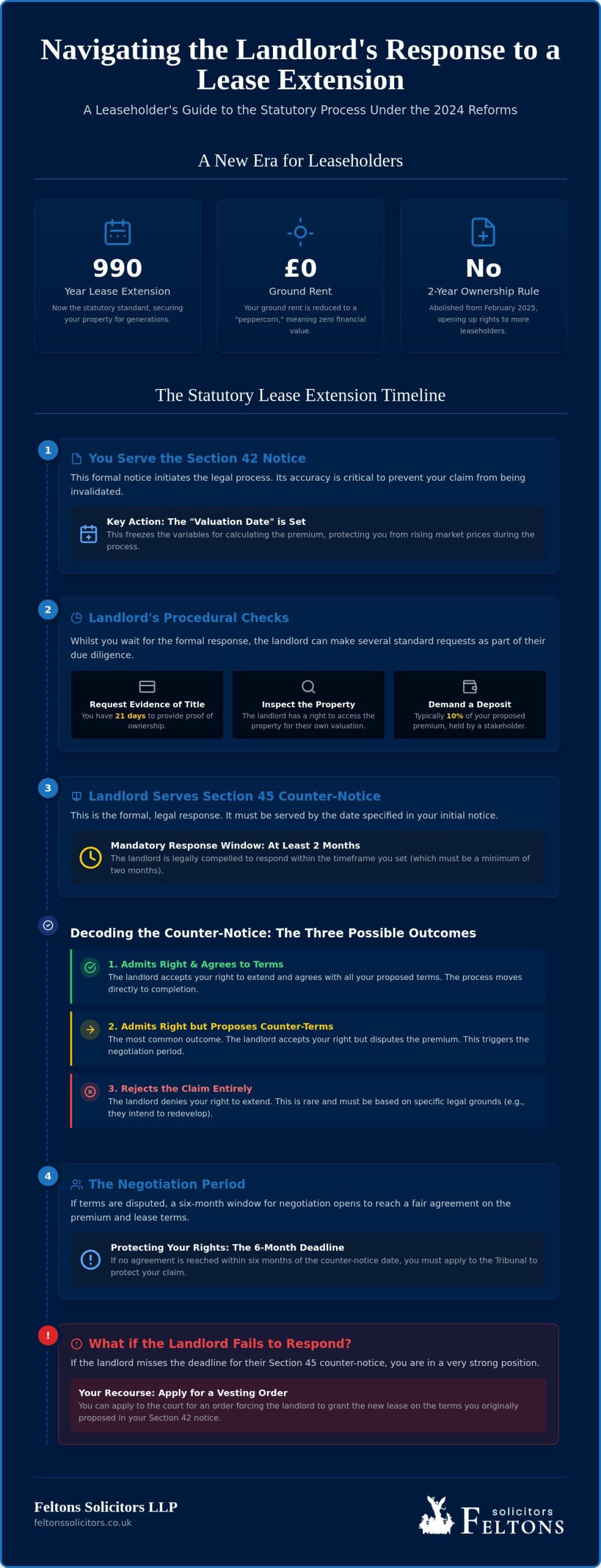
The official landlord response to lease extension notice is known as a Section 45 counter-notice. It isn’t a casual acknowledgement or a courtesy email; it’s a formal legal document that dictates the trajectory of your entire claim. Landlords are legally compelled to respond within a specific window, which must be at least two months from the date your initial notice is served. This response is a mandatory requirement under the Leasehold Reform, Housing and Urban Development Act 1993, as amended by subsequent legislation. Landlords cannot simply opt out or ignore the process without facing significant legal penalties.

One of the most protective elements for you as a tenant is the “valuation date.” This date is fixed the moment your solicitor serves the initial notice. It freezes the variables used to calculate the premium, such as the remaining lease term and market conditions, at that specific point in time. Even if property prices rise or the market fluctuates whilst you wait for the landlord’s counter-proposal, your costs remain anchored to the day you started the process. This provides a vital layer of financial security during the negotiation phase.

The Significance of the Section 42 Notice

Your journey begins with the Section 42 notice, which sets the stage for all future landlord behaviour. Accuracy at this stage is paramount. If your notice contains technical errors or unrealistic premium offers, a landlord might attempt to invalidate your claim entirely. This is where leasehold enfranchisement experts become invaluable partners. They ensure the foundation of your claim is unshakeable, prevents unnecessary disputes, and positions you as a serious, well-prepared leaseholder. To build a comprehensive Understanding Lease Agreements, it helps to view the lease as a diminishing asset that the statutory process is designed to replenish and protect.

The Statutory Timeline for 2026

The legal landscape in 2026 is governed by strict adherence to deadlines. The landlord must serve their counter-notice by the date specified in your Section 42 notice, provided that date is at least two months away. The Leasehold and Freehold Reform Act 2024 has streamlined these expectations, making it harder for landlords to use procedural delays as a tactical weapon. A valid response must clearly state whether the landlord admits your right to a new lease and which proposals they accept or reject. Missing the deadline for a landlord response to lease extension notice can have significant consequences for the freeholder, potentially allowing you to apply to the court for a vesting order on the terms originally proposed in your notice.

The Landlord’s Initial Actions: Evidence, Inspection, and Deposits

Once your Section 42 notice is served, the landlord’s solicitor will likely initiate a series of procedural checks. This stage occurs whilst you are waiting for the formal landlord response to lease extension notice, and it’s designed to ensure your claim is valid from the outset. You shouldn’t view these requests as a sign of hostility; they are standard components of the statutory process that allow the freeholder to verify your eligibility and prepare their own valuation.

One critical element is the 21-day rule. The landlord has a statutory right to request evidence of your ownership, a process technically known as “deduction of title.” Your solicitor must respond to this request within 21 days. Failing to meet this deadline won’t necessarily end your claim, but it can cause unnecessary friction and delays. According to official government guidance, these procedural steps are a standard part of the statutory route that protects both parties. If you’re unsure about the validity of a specific request, consulting with the team at Feltons Solicitors LLP ensures you don’t inadvertently jeopardise your claim.

The landlord is also entitled to demand a deposit. This is typically 10% of the premium you proposed in your initial notice. Having these funds ready is essential, as the deposit is usually due shortly after the landlord acknowledges the notice. This money is held by the landlord’s solicitor or a professional agent as a “stakeholder,” meaning it cannot be released to the landlord until the lease extension is completed or the claim is withdrawn.

Providing Evidence of Eligibility

The landlord will typically require an office copy of the Land Registry entry for your property. This document proves you are the registered leaseholder. Since the 2024 reforms, you no longer need to prove two years of ownership, but you must still demonstrate that you hold a qualifying long lease. It’s wise to organise your paperwork before serving notice so your solicitor can respond instantly to any “deduction of title” request. Promptness here signals that you are a well-advised tenant who understands the legal landscape.

Property Inspections and Valuations

The landlord response to lease extension notice involves more than just a single document; it also includes the freeholder’s right to inspect your home. They are entitled to access the property for valuation purposes, provided they give you at least three days’ written notice. The landlord’s surveyor will look at the property’s condition and any improvements you’ve made. Don’t be alarmed if their eventual valuation is higher than yours. Landlords often start with a “best case” figure for themselves, which then serves as the starting point for the six-month negotiation window. Before entering this phase, it is worth obtaining a reliable lease extension estimate so you can assess whether the landlord’s opening figure is genuinely inflated or within a reasonable range.

Decoding the Section 45 Counter-Notice: Three Possible Outcomes

The arrival of the Section 45 counter-notice is the defining moment of your claim. It’s the point where the landlord formally declares their position, moving the process from a unilateral request to a bilateral legal procedure. Whilst the document might appear complex, it essentially funnels your application into one of three distinct scenarios. Understanding these paths allows you to prepare for the next stage of the journey with a clear, calm perspective.

The vast majority of cases fall into Scenario A, where the landlord admits your right to the extension. However, this admission is almost always accompanied by a counter-proposal for a higher premium than you initially offered. In rarer circumstances, you may encounter Scenario B, a challenge to your legal eligibility, or Scenario C, where the landlord claims they intend to redevelop the building. This third option is typically only available to freeholders if the lease has less than five years remaining at the point of the landlord response to lease extension notice.

Admitting the Right to Extend

When a landlord admits your right, the focus shifts immediately from legal entitlement to financial negotiation. The counter-notice will specify which terms of your proposal are accepted and which are contested. Usually, the landlord will propose a significantly higher premium based on their own surveyor’s valuation. This is a standard tactical move. It initiates the “negotiation window,” a six-month period where both parties’ surveyors attempt to find a middle ground. Understanding your tenant lease extension rights is vital here; you aren’t obligated to accept the first counter-offer, and the statutory framework is designed to prevent landlords from making unreasonable demands.

Challenging the Claim

If a landlord challenges your right to a lease extension, they must state their specific reasons in the counter-notice. Since the Leasehold and Freehold Reform Act 2024 abolished the two-year ownership requirement in February 2025, the grounds for such challenges have narrowed significantly. Most disputes now centre on whether the property itself or the lease type qualifies under the Act. If a landlord persists with a challenge, the matter may need to be resolved in the County Court. Similarly, if they claim redevelopment grounds, they must prove to the court that they intend to demolish or reconstruct the premises and require possession to do so. These are complex legal hurdles that require a methodical, expert response to protect your home and your investment. If you share a building with other leaseholders facing similar challenges, exploring the option of collective enfranchisement solicitors to purchase the freehold outright may offer a more permanent solution to freeholder disputes.

Landlord Response to Lease Extension Notice: A Guide for Tenants in 2026

Negotiating Terms and Using a Lease Extension Calculator

Once you receive the landlord response to lease extension notice, you enter a critical six-month period known as the negotiation window. This isn’t a time for passive waiting; it’s the phase where your surveyor and the landlord’s surveyor attempt to narrow the gap between your initial offer and their counter-proposal. In 2026, the landscape is more favourable for tenants due to the Leasehold and Freehold Reform Act 2024. This legislation has abolished “marriage value,” which previously added significant costs for leases with fewer than 80 years remaining. Whilst the government is still finalising the specific valuation rates for secondary legislation, the removal of marriage value remains a landmark shift for leaseholders.

If negotiations stall, you have the right to apply to the First-tier Tribunal (Property Chamber) after two months, provided you do so before the six-month window expires. It’s a delicate balance. You want to give the professional surveyors enough time to find a reasonable middle ground without letting the statutory deadline slip. If you miss this six-month cutoff, your claim could be deemed withdrawn, forcing you to wait another year before starting again. Landlords often rely on these procedural delays to frustrate tenants, so keeping a strict eye on the calendar is essential.

The Role of the Lease Extension Calculator

A high-quality lease extension calculator serves as your primary defence against unrealistic landlord demands. By inputting your current ground rent, the years remaining on your lease, and an accurate property valuation, you can establish a realistic “premium range.” This data is vital when the landlord’s counter-notice demands a figure that feels excessive. Your solicitor uses these calculations as a benchmark to challenge the landlord’s assumptions, ensuring the final price reflects fair market value rather than an opportunistic grab. Using a calculator helps you enter the negotiation phase with clear, data-driven expectations. For a comprehensive breakdown of how these figures are constructed, a professional lease extension estimate guide can help you understand each component of the premium and identify where a landlord’s valuation may be inflated.

Missing Deadlines: The Tenant’s Advantage

What happens if you never receive a landlord response to lease extension notice? If the freeholder misses the deadline specified in your Section 42 notice, the law shifts heavily in your favour. This situation is often called a “deemed grant.” You can apply to the County Court for a Vesting Order, which effectively forces the landlord to grant the lease extension on the exact terms you proposed in your initial notice. It’s often the best possible outcome for a tenant, as it bypasses the negotiation phase entirely. To ensure you are positioned to capitalise on such procedural errors, speak with a specialist property solicitor to manage your statutory timeline with precision.

Securing a 990-year lease extension is a transformative milestone for any property owner, but the journey from serving a notice to final registration requires meticulous oversight. Feltons Solicitors LLP provides a calm, steady presence throughout this complex statutory process. We understand that the technicalities of property law are often accompanied by a sense of personal or financial pressure. Our role is to absorb that stress, managing every statutory deadline with precision so you can focus on the future of your home. By positioning ourselves as your discreet partner, we ensure that your interests are protected against opportunistic freeholders.

The period following the landlord response to lease extension notice is where expert intervention becomes most visible. Whilst the law provides the framework, it’s the tactical application of that law that determines your final costs. We coordinate closely with specialist surveyors to ensure your premium remains fair and reflects the 2024 reforms. Our team possesses the worldly experience necessary to handle both residential and commercial property matters, providing a level of high-end reliability that high-volume processing firms simply cannot match.

Professional Representation in Negotiations

Our role involves more than just processing paperwork; we act as your sophisticated guide during the high-stakes negotiation phase. When the landlord response to lease extension notice arrives with a higher premium demand, we work to bridge the gap between your valuation and theirs. We provide pragmatic, plain-English advice that helps you understand the “realistic range” for your specific property. Beyond the price, we scrutinise every line of the new lease. Our goal is to ensure that no unfavourable modern clauses are introduced that could affect the future saleability or value of your property.

A People-First Approach at Feltons Solicitors LLP

Feltons Solicitors LLP prioritises personal connection over high-volume processing. We believe that whilst technical legal work is paramount, the human impact of that work should never be forgotten. Our “people-first” philosophy means you’ll always have a direct line to a dedicated expert who understands the nuances of your specific case. We combine traditional professional integrity with modern efficiency, ensuring your new lease is registered at the Land Registry without delay. If you’re ready to take the next step in securing your property’s value, Feltons Solicitors LLP is here to guide you from the initial claim through to completion with quiet confidence and tailored care.

Taking Command of Your Leasehold Future

The statutory process for extending your lease is designed to provide you with long-term security. You should now feel equipped to handle the landlord response to lease extension notice, whether it arrives as an admission of your rights or a challenge to be resolved. The 2024 reforms have significantly strengthened your position, particularly through the abolition of marriage value and the introduction of 990-year terms. Staying vigilant regarding deadlines whilst using data-driven benchmarks for your premium is the most effective way to ensure a successful outcome.

Since 2010, Feltons Solicitors LLP has focused on providing bespoke property law advice. As specialists in leasehold enfranchisement, we possess the expertise required for complex residential and commercial conveyancing. We offer the steady presence you need to navigate these negotiations and secure your property’s value for generations to come.

Contact Feltons Solicitors LLP for expert guidance on your lease extension and let us manage the complexities of your claim with the discreet care you deserve. You’ve taken the first step toward a more secure home; we’re here to help you finish the journey with confidence.

Frequently Asked Questions

What is the deadline for a landlord to respond to a Section 42 notice?

The landlord must provide their response by the date specified in your Section 42 notice, which must be at least two months from the date the notice was served. This timeframe is a strict statutory requirement. If this deadline passes without a response, you gain the legal right to apply to the court for a vesting order to secure the extension on your original terms.

Can a landlord refuse a statutory lease extension request?

A landlord can only refuse your request if you fail to meet the legal eligibility criteria or if they can prove a genuine intention to redevelop the building. Redevelopment challenges are exceptionally rare and typically only apply when the lease has less than five years remaining. For the vast majority of qualifying tenants, the right to a lease extension is mandatory and cannot be denied.

What happens if the landlord and tenant cannot agree on the price?

If a premium cannot be agreed upon during the six-month negotiation window, either party can apply to the First-tier Tribunal for an independent determination. The Tribunal will review the evidence from both surveyors and set a fair price based on established valuation principles. Most cases reach a settlement before a hearing is necessary, as the costs of Tribunal proceedings often encourage both sides to compromise.

Does the landlord have to pay for their own valuation and legal fees?

The tenant is legally responsible for the landlord’s reasonable costs regarding the initial valuation and the conveyancing work required to complete the new lease. However, you aren’t required to pay for the landlord’s costs associated with negotiating the price or any costs related to a Tribunal application. These “negotiation costs” remain the landlord’s own financial responsibility throughout the process.

What is a Section 45 counter-notice and why is it important?

A Section 45 counter-notice is the formal landlord response to lease extension notice that confirms whether your right to a new lease is admitted or disputed. It’s a pivotal document because it contains the landlord’s counter-proposal for the premium and any specific changes they want to make to the lease terms. Receiving this notice officially moves your claim from the application stage into the active negotiation phase.

Can I still extend my lease if I cannot find my landlord?

You can still extend your lease even if the landlord is missing by following a specific legal route through the County Court. You must prove that you’ve made reasonable attempts to locate the freeholder before the court can grant a Vesting Order. The court then refers the case to the Tribunal to determine the premium, which you pay into a court account to finalise your new lease.

How does the Leasehold and Freehold Reform Act 2024 affect landlord responses?

The 2024 Act simplifies the landlord response to lease extension notice by standardising valuation methods and abolishing marriage value for all leaseholders. These reforms make it much harder for landlords to justify inflated premiums or use complex calculations to delay the process. The Act also ensures that the landlord must grant a 990-year extension, providing you with what is essentially a virtual freehold.

What is the “deposit” mentioned in the landlord’s response?

The deposit is a payment of 10% of your proposed premium that the landlord is entitled to request as soon as you serve your notice. This money is held by a solicitor as a stakeholder and acts as a guarantee of your commitment to the process. If the lease extension proceeds to completion, this deposit is simply deducted from the final premium you pay to the landlord.