
Buy to Let Conveyancing Solicitor UK: A 2026 Buying Guide

Buy to Let Conveyancing Solicitor UK: A 2026 Buying Guide

A buy-to-let purchase is ready to proceed when the property’s legal position, its letting terms and any mortgage conditions have been considered together. A flat may look ideal as an investment, but a lease restriction or title condition could affect your plans to let it. A residential mortgage may also have terms that do not fit your intended use. A buy to let conveyancing solicitor UK investors appoint can help identify these issues before you become contractually committed.

Although the process has similarities to buying a home, a rental purchase brings extra questions. You need to understand whether the property documents raise issues for letting and whether the lender’s requirements reflect your plans. Addressing those points before exchange gives you a clearer basis for deciding how to proceed.

This guide explains the solicitor’s role, the title, lease and mortgage matters that may affect a buy-to-let purchase, and how conveyancing fits into the wider process. It also sets out what information to prepare and which decisions to consider before exchange.

Key Takeaways

  • A buy to let conveyancing solicitor UK buyers appoint reviews the contract, title and relevant enquiries in light of the property’s intended rental use.
  • Before exchange, consider whether title conditions, lease terms or other property-specific matters could affect your plans to let.
  • If you are using a mortgage, consider the lender’s requirements alongside the property’s legal position and your intended use.
  • Prepare the transaction details, property information and lender correspondence, then review the legal advice before deciding whether to exchange.
  • Feltons Solicitors LLP provides tailored residential and commercial conveyancing, with pragmatic guidance shaped around the circumstances of your purchase.

Role of a buy-to-let solicitor in a UK property purchase

Buy-to-let conveyancing is the legal work involved in transferring a property to a buyer who intends to rent it out. A solicitor reviews the contract and transaction documents, investigates the legal title and raises relevant enquiries. This helps you understand what you are buying and identify legal matters that could affect your plans.

Buy-to-let conveyancing examines the legal position of the property and purchase in light of the buyer’s intended use. The work depends on the property, its tenure, the transaction and the jurisdiction. It does not predict rental income or guarantee that a property will be suitable as an investment.

How does buy-to-let conveyancing differ from a home purchase?

The core process is still a property transaction, but your intended use affects which questions need particular attention. For example, the solicitor may consider whether title conditions or lease terms affect letting, and whether the mortgage arrangements reflect your plans. There is no identical checklist for every rental purchase: enquiries should respond to the documents and circumstances of the specific property. Conveyancing procedures also vary across England and Wales, Scotland and Northern Ireland.

What can a solicitor help you understand before exchange?

Before exchange, your solicitor reviews the contract and title, considers relevant search results and replies to enquiries, and explains legal issues that arise. If a document appears to restrict letting, for example, you can understand what it says and why it may matter before deciding how to proceed. This legal due diligence informs your decision, but does not assess likely rent, investment returns or future property values.

For a purchase with mortgage funding, the conveyancer also deals with the lender’s legal requirements as part of the transaction. The lender assesses the borrowing under its own criteria, while the solicitor handles the legal work and reports relevant matters in line with the transaction requirements. These responsibilities are connected but distinct. If the property’s legal position or your intended use raises a question, clear advice can help you consider it before exchanging contracts.

It is useful to separate three kinds of decision:

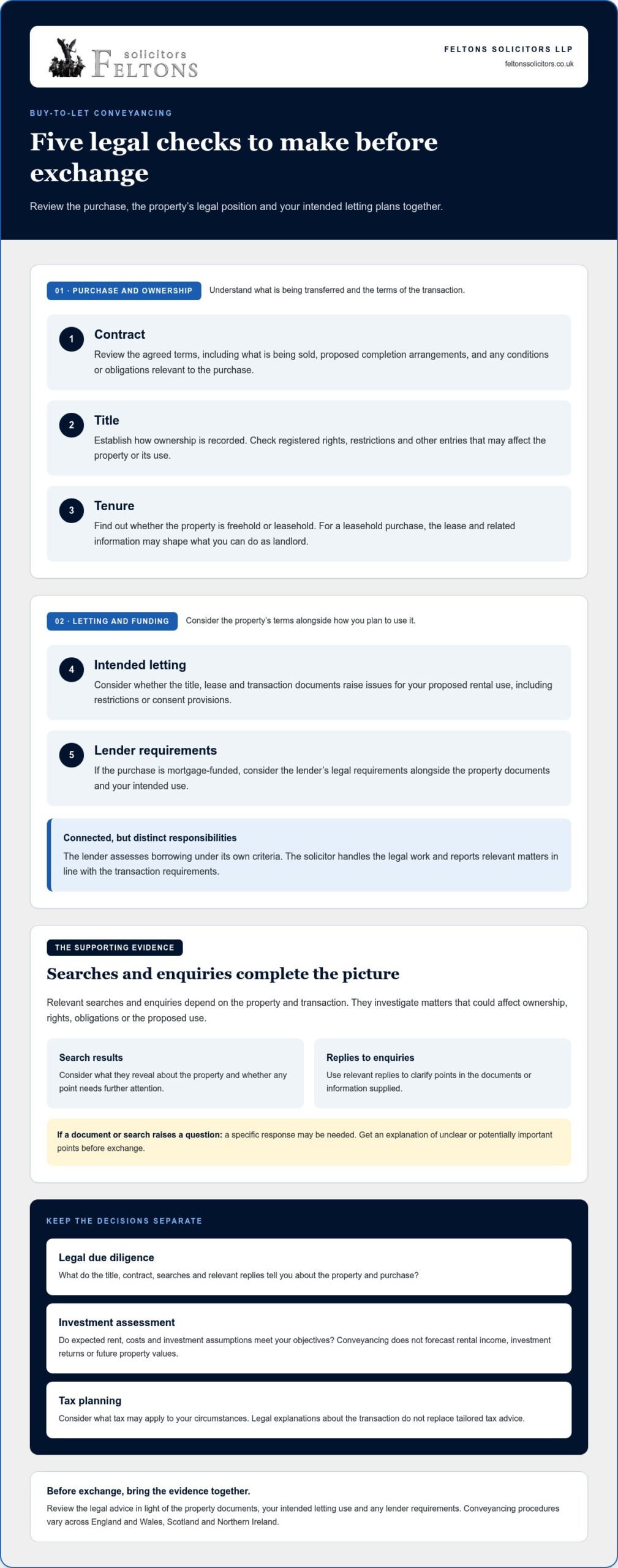
  • Legal due diligence: What do the title, contract, searches and relevant replies tell you about the property and purchase?
  • Tax planning: What tax may apply to your circumstances? Legal explanations about the transaction do not replace tailored tax advice.

A buy to let conveyancing solicitor UK buyers instruct can explain the legal documents and flag issues relevant to the proposed purchase. Feltons provides residential and commercial conveyancing, with pragmatic guidance tailored to the details of the transaction. The focus is on helping you understand the legal issues, not promising rental performance or a particular outcome.

For a landlord buyer, the title and contract checks establish what rights come with the property and what obligations or restrictions may shape its use. The relevant enquiries depend on the property and your plans. A buy to let conveyancing solicitor UK buyers instruct can focus the legal review on those circumstances, rather than applying the same checklist to every purchase.

Before exchange, consider these connected parts of the transaction:

  • Contract: Review the agreed terms, including what is being sold, the proposed completion arrangements and any conditions or obligations relevant to the purchase.
  • Title: Establish how ownership is recorded and identify registered rights, restrictions or other entries that may affect the property or its use.
  • Tenure: Understand whether the property is freehold or leasehold. For a leasehold purchase, the lease and related information may shape what you can do as landlord.
  • Intended letting: Consider whether the title, lease and transaction documents raise issues for the proposed rental use, including relevant restrictions or consent provisions.
  • Lender requirements: If the purchase is mortgage-funded, consider the lender’s legal requirements alongside the property documents and your intended use.

Searches and enquiries add to the picture. Which are relevant depends on the property and transaction; they investigate matters that could affect ownership, rights, obligations or the proposed use. If a search or document raises a question, a specific response may be needed before you decide whether to proceed.

What should the title and contract review cover?

The title review helps explain who owns the property, what rights are recorded in connection with it and whether any entries appear to limit or qualify its use. The contract sets out the terms on which the seller proposes to transfer the property. Enquiries can clarify points in the documents or information supplied. Since the documents differ from one purchase to another, the review should respond to what they reveal.

If something is unclear or potentially important, get an explanation before exchange. You can then weigh the legal information against your plans and make an informed decision about proceeding.

How can letting restrictions affect the purchase?

A title entry or lease term may affect whether, or on what terms, a property can be rented out. A lease might contain covenants about occupation or letting, or set out a process for seeking consent. The wording and context matter: consent is not automatically required in every case, and different restrictions can have different effects. Your conveyancer can explain the relevant provision and any issue it raises for your proposed use.

Where legal checks prompt questions, tailored residential conveyancing guidance can help you understand the documents and consider next steps before exchange. Resolve the legal picture as far as possible before committing. Do not assume a restriction is harmless or that it automatically prevents letting.

Tenure and funding raise different legal questions, so a standard residential checklist may not cover every concern relevant to a rental purchase. Freehold and leasehold describe the property interest being bought; mortgage-funded describes how the purchase is financed. Consider all three together, while keeping property permissions separate from the lender’s conditions.

Purchase type Legal focus Question for a landlord buyer
Freehold Review the title, registered rights, restrictions and contract terms affecting the property. Could any right or restriction recorded against the title affect the intended letting or use?
Leasehold Consider the lease, including relevant covenants, consent provisions and obligations attached to the property. Do the lease terms affect whether or how the property may be rented out?
Mortgage-funded Consider the lender’s legal requirements and the terms of the proposed borrowing. Do the lending terms reflect the plan to let, as well as the transaction being carried out?

The property documents and lending conditions answer different questions. A title or lease may affect your rights in relation to the property; mortgage terms govern your relationship with the lender. Satisfying one does not automatically resolve the other. A buy to let conveyancing solicitor UK buyers instruct considers the legal details of the transaction in context, while mortgage suitability and investment decisions remain separate considerations.

What changes between a freehold and leasehold buy-to-let?

With a freehold purchase, the title review focuses on ownership and registered rights or restrictions. A leasehold review also considers the lease’s wording and obligations, including provisions that may relate to letting. If the terms raise questions, you can understand their significance before exchange. A lease variation or leasehold enfranchisement is a distinct legal matter, not an automatic step in buying a leasehold property.

Why must the mortgage match the intended use?

Tax is another separate consideration, and terminology differs across the UK. Buyers may encounter Stamp Duty Land Tax in England and Northern Ireland, Land and Buildings Transaction Tax in Scotland, or Land Transaction Tax in Wales. The applicable treatment depends on the jurisdiction and the buyer’s circumstances, so do not assume one nation’s terminology or rates apply elsewhere. Keep tax planning distinct from title, lease and mortgage checks, and consider the rules that apply where the property is located.

Compare the transaction on its own facts: identify the tenure, understand any letting-related provisions and consider the lender’s requirements against your intended use. This joined-up view can help reveal questions to address before exchange without treating every freehold, leasehold or mortgage-funded purchase as legally identical.
Buy to Let Conveyancing Solicitor UK: A 2026 Buying Guide

How can you prepare for buy-to-let conveyancing before exchange?

Good preparation gives your conveyancer a clearer picture of the purchase and what you intend to do with the property. Share the relevant details early, including your letting plans and any concerns already raised by the seller or agent. A buy to let conveyancing solicitor UK buyers instruct can then consider the transaction in light of the proposed use and follow up on points that need attention.

Use this sequence to organise your preparation:

  1. Clarify your intended use. Set out whether you plan to let the whole property or only part of it, and describe the expected occupancy arrangement as clearly as you can.
  2. Gather the property information. Collect the property particulars, sale details, available title or lease documents, and information about the property’s current use or tenure.
  3. Share purchase and lender details. Provide the agreed transaction information and relevant mortgage correspondence or lender requirements if the purchase is mortgage-funded.
  4. Flag concerns promptly. Tell your solicitor about known title or lease terms, proposed alterations, occupancy plans or anything you have been told could affect letting.
  5. Review the legal advice before exchange. Make sure you understand material enquiries, outstanding points and their implications before deciding whether to proceed.

What information should you have ready?

Bring together documents you already hold rather than trying to obtain every record yourself. Useful items may include the sale memorandum or other purchase details, property particulars, available title information and the lease if the property is leasehold. Add mortgage correspondence relating to the proposed borrowing. A concise note of your intended letting arrangement and any known concerns about use or permissions can help your solicitor focus enquiries on the transaction.

Which decisions should you make before exchange?

Before exchange, consider whether you understand the answers to important enquiries and any unresolved issue that could affect your intended use. If a permission or lender condition is unclear, raise it with your conveyancer and ask them to explain its legal significance. Broader residential property law guidance can help put the purchase process in context, while advice on your transaction should address its specific documents and circumstances.

Preparation does not mean deciding every investment question through conveyancing. It means giving your solicitor accurate information, reading the advice carefully and considering the legal position before becoming committed. If an answer changes your plans, discuss the implications before exchange rather than relying on assumptions about the property or lender requirements.

Feltons provides tailored residential and commercial conveyancing, with pragmatic guidance shaped around the details of each transaction. Discuss your conveyancing requirements with Feltons as you prepare for a buy-to-let purchase.

How Feltons supports buy-to-let conveyancing across the UK

Buying a rental property involves decisions specific to the property, its legal documents and your intended use. Feltons provides residential and commercial conveyancing with pragmatic, tailored guidance to help you understand the legal work involved. The firm serves national and international clients and takes a bespoke approach that keeps the circumstances of each purchase in view.

A buy to let conveyancing solicitor UK buyers work with should make the legal position understandable, especially when documents or enquiries raise questions. Feltons combines modern delivery with traditional values, offering discreet support as you consider the legal implications of your purchase. The focus is on the transaction and relevant legal advice, not on predicting rental returns or promising a particular result.

What can a tailored conveyancing approach offer?

A tailored approach considers the property and transaction on their own facts. A leasehold flat, for example, may raise different document questions from a freehold house, while the proposed letting use can influence which enquiries are relevant. Clear explanations help you understand what an issue means legally and which decisions may need your attention before exchange.

Practical guidance can also help you distinguish a legal concern from a wider investment or management decision. Feltons’ bespoke service model addresses the specific circumstances of your purchase, with advice delivered in a considered, approachable way. This supports informed discussion without implying that every transaction follows the same route.

What is the next step for your property purchase?

To begin a focused discussion, outline the property, whether it is freehold or leasehold, and how you intend to let it. Mention whether you are buying with mortgage funding and share any known concerns about the title, lease or proposed use. These details help frame the conversation around the legal support relevant to your transaction.

Feltons can discuss your conveyancing requirements and explain how the firm can support the purchase. Home visits are available at clients’ convenience, offering another way to discuss your matter. Discuss your buy-to-let conveyancing matter with Feltons and outline the property and your plans for it.

Take your next step with clarity

Before your purchase moves forward, prepare a clear brief: what you want to buy, how you intend to let it and which points still need a legal answer. This gives your conveyancer a practical starting point and helps you focus on decisions that matter to the transaction. A buy to let conveyancing solicitor UK buyers appoint can help clarify the legal position so you can decide how to proceed with a better understanding of the issues.

You do not need to have every answer before beginning. Raise the questions you do have, particularly any uncertainty about the property’s terms, permissions or the relationship between your intended use and the purchase arrangements. Addressing these carefully can help you approach the next stage with a clearer view.

Feltons offers a bespoke approach to conveyancing, with guidance shaped around your circumstances. Discuss your buy-to-let conveyancing with Feltons and take a considered step towards your property purchase.

Frequently Asked Questions

What does a buy-to-let conveyancing solicitor do?

A buy-to-let conveyancing solicitor handles the legal work for transferring a rental property to you. They review the purchase documents, check ownership information and deal with relevant enquiries, including matters raised by your proposed letting use. For example, they can explain a title entry or lease clause in plain English. Their role is to clarify the legal position, not forecast rent or assess whether the investment meets your financial goals.

Do I need a buy-to-let conveyancing solicitor to purchase a rental property?

Whether you must instruct a solicitor depends on the jurisdiction and purchase arrangements, including any lender requirements. A mortgage lender may require a conveyancer to act on the legal transaction, and the process can differ across the UK. Even if you are considering handling matters yourself, conveyancing involves formal documents and legal obligations. Establish early what representation your purchase requires, particularly if you are borrowing or buying in a jurisdiction with distinct conveyancing procedures.

Can a leasehold property be used as a buy-to-let?

Potentially, but the lease terms matter. A lease may contain provisions about subletting, occupancy, use of the property or obtaining consent, and their effect depends on the wording and circumstances. For example, permission to let a whole flat may not answer whether a different occupancy arrangement is allowed. Have the relevant clauses explained before committing, and distinguish lease requirements from separate rules or practical obligations that apply to landlords.

Can I rent out a property with a residential mortgage?

Do not assume a residential mortgage permits you to let the property. The terms depend on your lender and borrowing, and letting without any required agreement could create problems under the mortgage contract. If your plans change after purchase, review the loan terms and obtain the lender’s decision before granting a tenancy. A conveyancer can explain the legal documents involved in the purchase, but mortgage suitability and permission are matters to address with the lender.

How much does a buy-to-let conveyancing solicitor cost in the UK?

There is no single fee that applies to every purchase. The legal work can vary depending on factors such as whether the property is leasehold, the complexity of its title and the enquiries needed. When reviewing a proposed legal fee, consider what work it covers and whether separate transaction expenses apply. The requirements can differ from one transaction to another.

Does buy-to-let conveyancing work the same way across the UK?

No. The core aim is to complete a legal property transfer, but conveyancing procedures and property-law terminology vary between England and Wales, Scotland and Northern Ireland. For instance, the point at which a buyer becomes contractually committed is not described identically in every jurisdiction. If you are purchasing outside the jurisdiction where you normally live, identify where the property is situated and make sure the advice addresses the rules and process that apply there.

What should I check before exchanging contracts on a buy-to-let?

Before exchange, make sure you understand any outstanding legal enquiry, the effect of relevant title or lease provisions and whether the transaction documents reflect the agreed purchase. If the seller has said a letting issue will be resolved, establish what evidence or explanation is available and what it means for your decision. Also make sure your intended use has been considered alongside any lender conditions. Raise uncertainty with your conveyancer before becoming contractually committed.


Freehold Purchase Solicitors: A Definitive Guide to Securing Your Property Rights in 2026

Freehold Purchase Solicitors: A Definitive Guide to Securing Your Property Rights in 2026

Why should you continue paying for the ground beneath your feet when the law now offers a clearer path to total ownership? It’s a question many leaseholders face as they watch ground rents climb and feel the weight of a shortening lease impact their property’s saleability. We understand that managing a leasehold can feel like an endless cycle of rising costs and limited control over your own home.

Engaging expert freehold purchase solicitors is no longer just a legal formality; it’s a strategic move to reclaim control over your building and eliminate the burden of marriage value costs forever. You deserve the peace of mind that comes with full land ownership and the significant market value increase it brings. We’ll show you how to navigate these complexities whilst protecting your investment for the long term.

This guide explores the nuances of collective enfranchisement and the latest 2026 regulatory reforms. We’ll walk through the essential steps to secure your property’s future, ensuring you have the knowledge to move forward with confidence and professional clarity.

Key Takeaways

  • Understand why transitioning from leasehold to freehold is a vital move for your property’s market value and long-term autonomy in 2026.
  • Learn the essential differences between individual house purchases and collective enfranchisement for flats to identify the right legal path for your home.
  • Discover how specialist freehold purchase solicitors help you calculate the purchase premium and navigate the valuation process to ensure a fair price.
  • Master the statutory timeline from serving initial notices to managing landlord counter-notices without unnecessary delays or disputes.
  • Identify the specific criteria for selecting a legal partner who combines modern efficiency with a deep understanding of complex leasehold law.

Understanding Freehold Purchase: Why Transitioning from Leasehold is a Strategic Move

Owning a leasehold property is fundamentally different from owning the land itself. Whilst you have the right to occupy the space for a set period, you remain a tenant in the eyes of the law. Transitioning to a freehold interest changes this dynamic entirely, moving you from a position of restricted occupancy to absolute ownership. Experienced freehold purchase solicitors help facilitate this shift, ensuring the legal title to the land and the building is transferred securely into your hands.

The property landscape changed significantly in 2026. Government reforms have targeted the most punitive aspects of leasehold, such as escalating ground rents that previously rendered many flats unsellable. These changes make the path to freehold acquisition more transparent and financially viable than ever before. By acting now, you can lock in the benefits of these reforms and protect your home from future legislative shifts that might favour landlords.

The Long-Term Financial Impact of Leasehold Restrictions

Ground rent clauses are a primary concern for modern homeowners. Many older leases contain “doubling” clauses that see ground rent swell every decade, often exceeding the thresholds set by mortgage lenders. This makes remortgaging or selling nearly impossible without a formal lease extension or a freehold purchase. Marriage value represents the increase in the property’s total value following the merger of the leasehold and freehold interests, which must be shared with the landlord if the lease has fewer than 80 years remaining. Beyond this, landlords retain a “reversionary interest,” meaning they technically regain full possession of the property once the lease expires. Securing the freehold eliminates this leverage, ensuring your asset remains yours indefinitely.

Autonomy and Building Management

Buying your freehold allows you to adopt a “landlord mindset.” You’re no longer at the mercy of a third-party freeholder or an unresponsive management company. Through the process of Collective Enfranchisement, you and your neighbours can take over the building’s management. This provides the freedom to choose your own contractors, select competitive insurance providers, and ensure maintenance is carried out to your standards rather than the cheapest bidder’s.

The administrative benefits are equally compelling. Leaseholders often face exorbitant fees for “licences to alter” or permissions for simple lifestyle choices, such as keeping a pet. Freehold ownership removes these bureaucratic hurdles. Working with freehold purchase solicitors ensures these restrictive covenants are properly addressed during the transfer, providing you with true autonomy over your living space and eliminating unnecessary service charge disputes.

The route to owning your freehold depends largely on the architecture of your home. It’s not a one-size-fits-all process. For owners of houses, the path is often a solo journey, whilst flat owners must act in unison with their neighbours. Understanding these distinctions is the first step in any successful claim. Expert freehold purchase solicitors can help you determine your building’s eligibility, particularly concerning the “25% rule.” This rule dictates that if more than a quarter of the building’s internal floor area is used for non-residential purposes, such as shops or offices, the building may not qualify for statutory purchase. For the most recent updates on these thresholds, the UK Government’s Leasehold Toolkit provides a comprehensive overview of how 2024 reforms have refined these criteria.

Buying the Freehold of a House

If you own a leasehold house, your rights are primarily governed by the Leasehold Reform Act 1967. The process is generally more straightforward than for flats, but it isn’t without complexity. You no longer need to worry about the restrictive two-year residency rules that once hampered claims, as recent reforms have largely abolished these requirements for most leaseholders. One common pitfall occurs when a house is part of a “managed estate.” In these instances, you might secure the freehold of the building but remain tied to estate management charges for shared gardens or private roads. It’s vital to have your residential conveyancing documents reviewed early to understand exactly what land is included in the transfer.

Collective Enfranchisement for Flat Owners

For those in blocks of flats, the process is known as Collective Enfranchisement. It’s a powerful statutory right that allows at least 50% of the qualifying tenants to join forces and buy the freehold. This requires high levels of coordination amongst residents. You’ll typically need to set up a “Nominee Purchaser” company to hold the title on behalf of the participating residents. This company becomes the new landlord, giving you direct control over the building’s future. If you’re dealing with a “missing landlord” who cannot be found, don’t lose hope. Your freehold purchase solicitors can apply for a Vesting Order through the County Court, allowing the sale to proceed even in the landlord’s absence.

Finally, keep a close eye on any “Section 5” notices. If your landlord decides to sell the freehold to a third party, they’re legally required to offer it to the tenants first under the Right of First Refusal. This is often a golden opportunity to bypass a long statutory claim and secure your rights quickly.

Buying your freehold is a strategic capital investment that fundamentally alters your property’s financial profile. The most significant cost you’ll encounter is the “Purchase Premium,” which represents the compensation paid to the landlord for the loss of their asset and future income streams. It’s standard practice that the buyer also covers the freeholder’s reasonable legal and valuation costs. Whilst this may feel like an additional burden, it’s a statutory requirement that ensures the process remains orderly. Despite these initial outlays, the investment often pays for itself through a substantial increase in property equity and the total elimination of future ground rent liabilities.

The Valuation Process: How the Price is Determined

A specialist surveyor is indispensable for establishing a fair purchase price. They calculate the “diminution in value” of the landlord’s interest and the capitalised value of the ground rent income they’ll be losing. The remaining lease term is the most critical factor in this equation. If your lease has dropped below the 80-year threshold, the cost increases because “marriage value” must be shared with the landlord. This valuation framework was formalised by the Leasehold Reform Act 1967, which provides the legal basis for these calculations. A robust, evidence-based valuation acts as your primary defence against landlord over-pricing and ensures negotiations begin from a position of strength.

Additional Costs and Disbursements

Beyond the premium, you must budget for essential disbursements and taxes. Stamp Duty Land Tax (SDLT) is a key consideration for any freehold acquisition. As of April 1, 2025, SDLT in England is charged in slices: 0% on the first £125,000, 2% on the portion between £125,001 and £250,000, and 5% on the portion up to £925,000. You’ve only 14 days from the date of completion to file your return and pay any tax due. You’ll also need to account for Land Registry fees and the administrative costs associated with forming a Nominee Purchaser company for collective claims. Engaging specialist freehold purchase solicitors ensures that you are shielded from inheriting hidden leasehold liabilities or onerous title defects that could compromise your future ownership.

Ultimately, the financial benefits of securing your freehold extend far beyond simple ground rent savings. Properties with a share of freehold or full freehold title are significantly more attractive to lenders and future buyers, often commanding a premium on the open market. By removing the landlord’s leverage, you’re not just buying land; you’re securing the long-term saleability of your home.

Freehold Purchase Solicitors: A Definitive Guide to Securing Your Property Rights in 2026

The Step-by-Step Statutory Process: From Initial Notice to Final Completion

Navigating a freehold claim requires a methodical approach, especially as the 2024 and 2025 legislative updates have introduced more rigid procedural timelines. Engaging freehold purchase solicitors at the outset ensures that every statutory deadline is met, shielding you from the risk of your claim being deemed withdrawn. The process is a chronological sequence of legal triggers that, when managed correctly, leads to a seamless transfer of ownership.

Preparation and Initial Notices

Accuracy is the cornerstone of the Initial Notice. Whether you’re serving a Section 13 notice for a block of flats or a Section 5 notice for a house, the information must be beyond reproach. This includes verifying the title numbers, current lease details, and the full names of all participating leaseholders. An invalid notice can lead to significant delays and cost penalties. It’s also vital to set a realistic “proposed price” in the formal notice. Whilst you’ll want a favourable deal, an absurdly low offer can be interpreted as a failure to serve a valid notice, potentially stalling the process for months.

Negotiation and Completion

Once the notice is served, the landlord typically has two months to respond with a Counter-Notice. This is where disputes often arise, usually concerning the purchase premium or the specific rights included in the transfer. If a deadlock occurs, the matter may be referred to the First-tier Tribunal (Property Chamber) for an independent determination. However, most cases are settled through professional negotiation between surveyors and solicitors before a hearing becomes necessary.

The final stage is the conveyancing phase. This involves drafting the TR1 form to transfer the legal title and ensuring the funds are ready for completion. Following the transfer, your freehold purchase solicitors will manage the final registration at HM Land Registry. This step is crucial as it officially dissolves the old leasehold titles and registers the new freehold interest, providing you with the ultimate security of tenure. If you’re ready to begin this journey, our team at Feltons offers expert leasehold enfranchisement advice to guide you through each statutory milestone.

Selecting the Right Freehold Purchase Solicitors for Your Transaction

Selecting freehold purchase solicitors is a decision that extends beyond mere administrative support. This is a technical area of law where a single procedural error can invalidate a claim and cost thousands in wasted legal fees. Specialist expertise is non-negotiable because the statutory timelines are rigid and the valuation arguments are often highly nuanced. You need a partner who understands the intricacies of the Leasehold Reform Act and the practical realities of property management.

At Feltons, our approach combines modern efficiency with traditional professional integrity. We recognise that for many, buying the freehold is a once-in-a-lifetime strategic move to secure an asset. Meticulous due diligence is the foundation of our service, ensuring that your new title is free from restrictive covenants or hidden liabilities that could hamper future saleability. We treat every instruction with a boutique level of care, prioritising personal connection over high-volume processing.

The Boutique Advantage: Tailored Legal Support

We purposefully avoid the “conveyancing factory” model. Complex enfranchisement claims require a level of attention that high-volume firms simply cannot provide. You’ll have direct access to senior practitioners who take the time to understand your specific goals for the building. This bespoke approach ensures your property rights are aligned with your broader long-term objectives, such as estate planning and wealth preservation. By integrating these perspectives, we help you build a secure foundation for your legacy whilst resolving your immediate property concerns.

Proactive Dispute Resolution

Managing the interpersonal dynamics of a group of leaseholders is often the most challenging aspect of a collective purchase. We act as a steady, neutral presence, facilitating agreement amongst residents whilst ensuring the legal process remains on track. This coordination is vital when dealing with recalcitrant landlords who may attempt to frustrate the process through silence or complex counter-proposals. Our freehold purchase solicitors are committed to providing pragmatic advice that avoids unnecessary litigation, yet we possess the worldly experience necessary to handle contentious matters should they arise.

Our philosophy is people-first. Whilst the technical legal work is paramount, we never lose sight of the human impact of our work. We guide you through each stage with quiet confidence, ensuring you feel supported and informed throughout the transition from leaseholder to freeholder. Secure your property’s future whilst navigating the process with confidence—contact Feltons Solicitors LLP today.

Securing Your Home’s Future and Absolute Autonomy

Transitioning to freehold ownership is a definitive step towards protecting your property’s market value and gaining total control over your living environment. We’ve explored the importance of navigating the 2026 statutory landscape with precision, from serving accurate initial notices to capitalising on the latest ground rent reforms. Whether you’re pursuing an individual claim for a house or coordinating a collective enfranchisement for a block of flats, the process demands technical rigour and a pragmatic approach to valuation.

Working with dedicated freehold purchase solicitors ensures that every stage of your transaction is handled with the discreet care and professional integrity your investment deserves. Instruct our specialist freehold purchase solicitors to begin your enfranchisement journey today. Our team provides sophisticated, high-standard advice focused on long-term asset protection for property owners nationwide. Taking action now removes the burden of leasehold restrictions and places the future of your home firmly back in your hands.

Frequently Asked Questions

How long does the freehold purchase process typically take?

A standard freehold purchase typically takes between six and twelve months from the service of the initial notice to final completion. This timeline fluctuates based on the landlord’s responsiveness and the complexity of the valuation negotiations. If the matter requires a determination from the First-tier Tribunal regarding the premium, you should expect the process to extend beyond the one-year mark.

Do I need 100% of the flat owners to agree to a collective enfranchisement?

You don’t need every flat owner to participate; the legal requirement is at least 50% of the qualifying tenants. Whilst 100% participation is ideal for sharing costs, the process can proceed as long as half the building is committed. Those who choose not to participate will remain leaseholders, but their new landlord will be the company formed by the participating neighbours.

Can a landlord refuse to sell the freehold if I meet the criteria?

A landlord cannot refuse to sell the freehold if you meet the statutory qualifying criteria under the relevant legislation. This is a mandatory right rather than a discretionary request. The only grounds for a valid refusal are technical, such as the building failing the 25% non-residential floor space rule or the tenants failing to meet the participation thresholds.

What happens to my existing lease once I have bought the freehold?

Your existing lease technically remains in place, but you effectively become your own landlord. Most owners choose to grant themselves a new 999-year lease at a peppercorn ground rent immediately after completion. This merger of interests effectively nullifies the restrictive terms of the old lease whilst providing a clean, highly marketable title for future lenders and buyers.

Is it better to extend my lease or buy the freehold?

Buying the freehold is generally the superior strategic move because it provides absolute autonomy and eliminates ground rent forever. Lease extensions are often a solo endeavour, whereas freehold purchase for flats requires collective action. If you value direct control over building maintenance and service charges, the freehold is the more robust long-term investment for your property asset.

How much are the landlord’s legal fees that I am required to pay?

You are legally required to pay the landlord’s reasonable legal and valuation costs incurred during the statutory process. These costs must be justified and relate specifically to the procedure, such as verifying your right to buy and preparing the transfer. Experienced freehold purchase solicitors will scrutinise these fee notes to ensure you aren’t being overcharged for standard administrative tasks.

Can I buy the freehold if my lease has already dropped below 80 years?

You can still buy the freehold if your lease has dropped below 80 years, but the premium will be higher. This is because marriage value must be included in the purchase price, representing the profit made by merging the leasehold and freehold interests. Acting before the lease hits this critical threshold is vital to avoid significantly higher costs and complex valuation disputes.

What is a “Nominee Purchaser” and why is it required for flats?

A Nominee Purchaser is the legal entity, usually a limited company, formed to hold the freehold title on behalf of the participating tenants. It’s required for flats to ensure the building is managed as a single asset rather than being fragmented amongst individuals. Your freehold purchase solicitors will help you incorporate this company and draft the participation agreements that govern its operation.

Conveyancing Solicitors Knightsbridge: Expert Legal Support for Complex Property Transactions

Conveyancing Solicitors Knightsbridge: Expert Legal Support for Complex Property Transactions

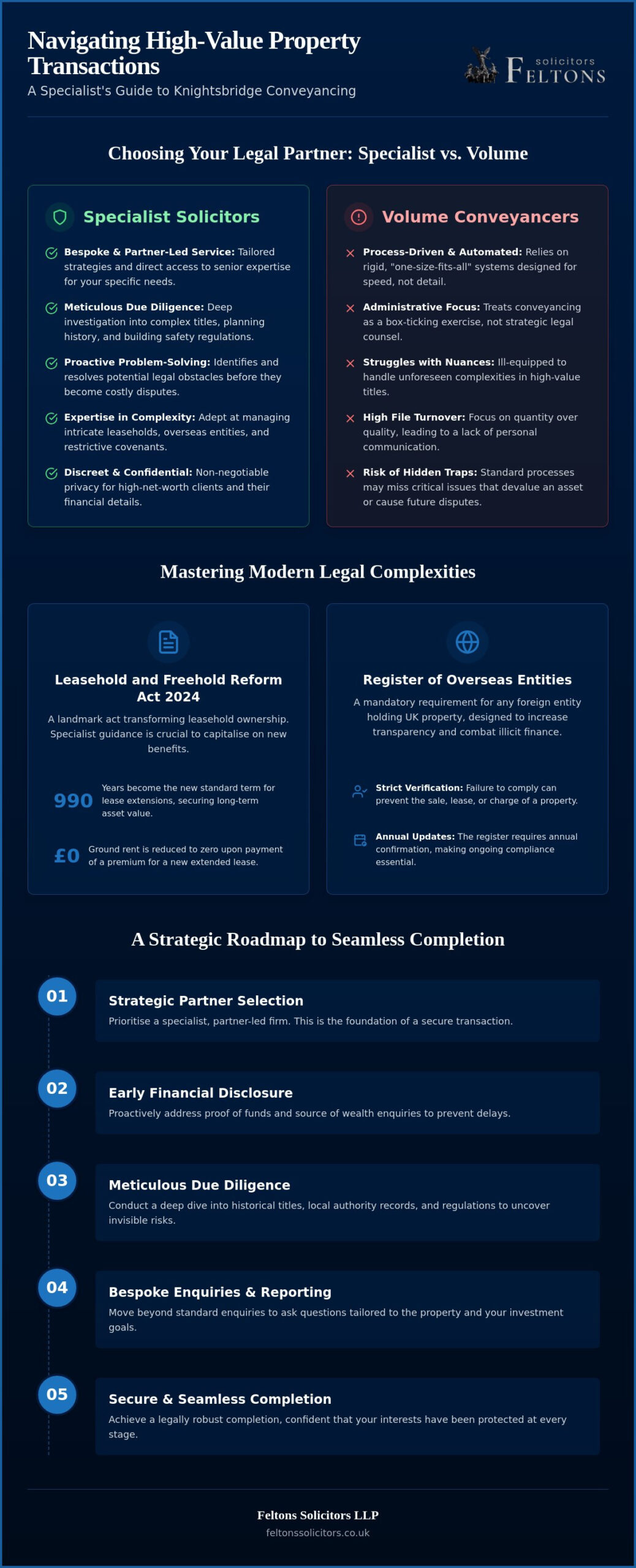
Could a single oversight in a leasehold title or a minor compliance error with the Register of Overseas Entities jeopardise your entire investment? In the high-stakes environment of Prime Central London, the difference between a successful acquisition and a costly delay often rests on the calibre of your legal representation. Finding the right conveyancing solicitors knightsbridge is about more than just processing paperwork; it’s about securing a partner who understands that high-value transactions require a bespoke, meticulous approach.

You likely recognise that securing a property in Knightsbridge involves layers of complexity that standard firms simply aren’t equipped to manage. It’s natural to feel concerned about the lack of personal communication or the potential for hidden legal traps within intricate leasehold structures. This article provides the clarity you need to move forward with confidence, promising a roadmap to a smooth and legally secure completion. We’ll examine the critical nuances of the Leasehold and Freehold Reform Act 2024, the stringent requirements for overseas entities, and how tailored legal support ensures your interests remain protected throughout the process.

Key Takeaways

  • Understand why standard volume conveyancing often fails to address the nuances of high-value property portfolios and complex legal titles.
  • Discover how specialist conveyancing solicitors knightsbridge manage the intricate requirements of leasehold extensions and the mandatory Register of Overseas Entities.
  • Learn why a partner-led, boutique approach ensures more transparent communication and robust legal protection than high-volume “factory” models.
  • Follow a strategic roadmap for 2026 that prioritises early financial disclosure and bespoke enquiries to ensure a seamless and secure property completion.

Understanding the Value of Specialist Conveyancing Solicitors for Complex Transactions

Specialist conveyancing is the expert management of intricate property titles and substantial capital transfers, requiring a level of scrutiny that standard transactions rarely demand. Standard “volume” conveyancing, often found in high-street chains or automated online platforms, relies on rigid systems designed for simplicity and speed. These models frequently fail when faced with the nuances of a Knightsbridge penthouse or a historic townhouse. When you engage conveyancing solicitors knightsbridge, you’re investing in a bespoke service that prioritises your specific financial and legal security over sheer file turnover. By choosing experienced conveyancing solicitors knightsbridge, you ensure that every detail of your transaction is handled with the precision it deserves.

Meticulous due diligence is the absolute bedrock of any successful high-value purchase. It’s about uncovering the invisible risks that could devalue an asset or hinder a future sale. A solicitor acts as your strategic advisor, guiding you through the entire life cycle of the transaction, from the initial offer to the final handshake. This involves a deep dive into:

  • Historical title deeds and complex ownership structures.
  • Specific local authority records and planning permissions.
  • Compliance with the latest environmental and building safety regulations.

This rigorous approach ensures your investment is sound and your legal position is unassailable.

The Distinction Between Administrative Conveyancing and Legal Counsel

Many firms treat the conveyancing process as a series of administrative boxes to tick. For complex titles, this process-driven approach is insufficient. You need a solicitor who understands the underlying property law, particularly when dealing with restrictive covenants or ancient easements that might restrict your plans for the property. Proactive problem-solving at this stage prevents post-completion disputes that are often expensive and stressful. A bespoke legal strategy ensures every potential obstacle is addressed before contracts are exchanged, providing a level of certainty that administrative firms cannot match.

Why High-Value Transactions Demand Discreet Expertise

Privacy is a non-negotiable requirement for high-net-worth clients. Discreet expertise ensures your personal information and financial details remain strictly confidential throughout the process. Managing a transaction in Knightsbridge also involves coordinating with various stakeholders, such as private banks, specialist surveyors, and estate agents. Your solicitor must act as the central point of contact, ensuring everyone is aligned whilst maintaining the highest standards of professional integrity. In 2026, the sophisticated advisor serves as a bridge between traditional legal heritage and the modern demands of global property compliance. This role requires a calm, steady hand and a commitment to personal rapport that high-volume firms simply cannot offer.

Knightsbridge property often involves intricate leasehold titles that demand more than just standard administrative oversight. For many owners, the legal landscape shifted significantly with the Leasehold and Freehold Reform Act 2024. This legislation has transformed how Leasehold extensions are handled, increasing standard terms to 990 years and reducing ground rent to zero upon payment of a premium. Expert conveyancing solicitors knightsbridge ensure these statutory rights are exercised correctly, protecting the long-term marketability of your asset. Without this specialist guidance, you risk missing critical windows or failing to capitalise on new legislative benefits.

Alongside domestic leasehold matters, international ownership structures introduce another layer of scrutiny. The overseas entity beneficial owner registration is now a mandatory requirement for any foreign entity holding UK property. This register, established to increase transparency, requires annual updates and strict verification. Failure to comply doesn’t just result in financial penalties; it can effectively freeze your ability to sell, lease, or even charge the property. Specialist solicitors act as the vital link between international jurisdictions and the Land Registry, ensuring your compliance is beyond reproach.

Navigating Leasehold Enfranchisement and Extensions

Securing your property rights often requires the intervention of leasehold enfranchisement experts. Since February 2025, the two-year ownership rule has been abolished, allowing new owners to begin extension proceedings immediately. You must decide whether to pursue the formal statutory process or engage in voluntary negotiations with the freeholder. Whilst voluntary routes can sometimes be faster, they lack the legal protections inherent in the statutory framework. A tailored approach ensures you pay a fair premium whilst securing the maximum possible term for your investment.

Compliance for International Property Investors

For clients based amongst various global financial centres, managing a UK portfolio requires a deep understanding of the Economic Crime (Transparency and Enforcement) Act 2022. Expert conveyancing solicitors knightsbridge provide the necessary verification services that Companies House demands. This process involves identifying every beneficial owner and ensuring all trust information is accurately disclosed where required. This methodical approach ensures that your international status remains an advantage rather than a bureaucratic hurdle. If you’re managing complex holdings, seeking advice on overseas entity registration is a prudent step toward maintaining a legally secure portfolio.

Selecting the right legal partner is perhaps the most critical decision you’ll make in the property acquisition process. Whilst volume conveyancing firms operate on a “factory” model, relying on high turnover and automated workflows, a boutique firm prioritises the depth of legal investigation required for multi-million pound assets. This distinction is vital when searching for conveyancing solicitors knightsbridge. Price-driven models often compromise on the time a qualified solicitor can dedicate to your file, potentially leaving complex title issues or restrictive covenants unexamined. In contrast, a partner-led approach ensures that your transaction receives the intellectual rigour it demands, rather than being processed by a junior paralegal in a remote call centre.

Communication frequency is the hallmark of a high-standard service. Direct access to your solicitor provides a sense of security that is often missing from larger firms. When you choose a residential property law firm with a diverse range of expertise, you benefit from a professional who can spot issues before they become delays. This proactive stance is essential for navigating the sophisticated property market in Knightsbridge, where transactions often involve international elements or unique historical titles.

The Risks of Undervalued Legal Advice

Opting for “cheap” conveyancing can lead to significant financial repercussions. If a solicitor fails to identify a defect in a title or an issue with planning permission, the cost to rectify these post-completion can be astronomical. When reviewing official government guidance on extending a lease, it’s clear that the administrative steps are only one part of a much larger strategic picture. A specialist firm understands that professional integrity and traditional values are the foundations of a secure transaction, even in a digital age where speed is often prioritised over accuracy. This is particularly true for properties that may have mixed residential and commercial aspects, requiring a solicitor with a broad legal perspective.

Evaluating Technical Competence and Practical Judgement

When interviewing conveyancing solicitors knightsbridge, ask about their specific experience with high-value estates and complex enfranchisement cases. Technical competence must be matched by practical judgement; you need a solicitor who offers pragmatic advice to overcome “deal-breaker” hurdles rather than simply identifying problems. Feltons Solicitors LLP balances modern delivery with traditional professional standards by ensuring every client has direct access to a senior legal expert who understands the human impact of their work. This “people-first” philosophy ensures that whilst the technical work is paramount, your personal peace of mind is never forgotten.

Conveyancing Solicitors Knightsbridge: Expert Legal Support for Complex Property Transactions

The Essential Roadmap to a Seamless Property Completion in 2026

Post-completion, the focus shifts to tax compliance and asset registration. As of July 2026, standard residential Stamp Duty Land Tax (SDLT) rates remain tiered, with the portion of the purchase price above £1.5 million attracting a 12% rate. Your solicitor ensures the SDLT return is filed accurately and that the Land Registry title is updated to reflect your ownership. This meticulous attention to detail ensures your investment is fully protected from day one.

Pre-Exchange Diligence and Contract Negotiation

The role of the solicitor during contract negotiation is to act as a robust shield for your interests. They review the draft contract and title pack with a focus on identifying any discrepancies in planning permissions or building regulation compliance. Managing complex funding is a core part of this diligence, particularly when dealing with offshore funds or gifted deposits from international relatives. Every document is scrutinised to ensure that your funding structure aligns perfectly with UK regulatory requirements, preventing any last-minute delays during the transfer of funds.

Post-Completion and Long-Term Asset Protection

A significant property purchase should always be the catalyst for a broader review of your legal standing. It is essential to update your estate planning to reflect your new asset and ensure your legacy remains secure. Similarly, if your personal circumstances change, a property transaction might prompt a necessary review of your divorce and financial arrangements to protect your capital. Secure document storage and the receipt of final registration confirmations from the Land Registry are the final steps in a process designed for long-term peace of mind. If you require a partner to guide you through these intricate stages, Feltons Solicitors LLP provides the steady, expert hand needed for such significant life events.

Feltons Solicitors LLP represents a departure from the impersonal nature of high-volume legal practices. Established in 2010 by Paula Felton, the firm has built its reputation on providing pragmatic, high-standard advice that prioritises the individual needs of each client. As specialised conveyancing solicitors knightsbridge, we understand that high-value property transactions are often just one part of a larger legal picture. Our team is uniquely positioned to handle not only the intricacies of property law but also complex litigation and dispute resolution. This dual expertise ensures that if a transaction encounters a legal hurdle, it’s managed with the same calm authority that defined the initial instruction.

Our approach is defined by the “sophisticated guide” persona. We recognise that legal transitions, particularly those involving significant capital, can be inherently stressful. Our role is to act as a steady presence, offering polished advice in plain English that avoids archaic legalese. We believe that clarity is the foundation of trust. We work tirelessly to ensure you feel informed at every stage of your journey, providing a level of care that prioritises personal connection over high-volume processing.

A People-First Philosophy in Property Law

At Feltons, we reject the factory model. Every client is treated as a priority, benefiting from a partner-led approach that ensures direct access to senior expertise. This is particularly valuable for international clients who may be managing assets amongst different jurisdictions and require a solicitor who understands the global context of their holdings. Our heritage is rooted in sound judgement and individualised attention. This ensures that the human impact of our work is never overshadowed by technical requirements. Whether you’re a first-time buyer in the luxury market or a seasoned investor, you’ll find our boutique approach offers a sense of security that larger firms often lack.

Connecting Property Expertise with Holistic Legal Care

A property purchase often serves as a catalyst for other legal considerations. By offering expertise in estate planning alongside divorce and financial arrangements, Feltons provides a comprehensive service for private clients. Having a single, trusted legal partner for all these matters ensures a cohesive strategy for your family’s future and your long-term assets. We invite you to experience a discreet, high-standard legal consultation where your privacy and personal rapport are our primary focus. Let us guide you through your next transaction with the quiet confidence and professional integrity your investment deserves.

Securing Your Knightsbridge Investment for the Future

High-value property transactions in Knightsbridge demand more than just administrative efficiency; they require a strategic legal partner who understands the intricacies of Prime Central London real estate. We have explored how the legal landscape necessitates a deep focus on leasehold enfranchisement and the strict verification requirements of the Register of Overseas Entities. Choosing the right conveyancing solicitors knightsbridge ensures that your capital is protected through a partner-led, boutique approach that prioritises your specific needs over high-volume turnover.

By following a methodical roadmap and ensuring early financial transparency, you can navigate the complexities of these transactions with quiet confidence. Feltons Solicitors LLP provides the steady guidance and professional integrity required to manage your property portfolio with precision. If you’re preparing for a significant acquisition or disposal, contact Feltons Solicitors for a discreet consultation on your property matter. With our specialist expertise in leasehold matters and international compliance, your completion remains in capable hands. We look forward to helping you secure your legacy with the care and attention it deserves.

Frequently Asked Questions

How long does the conveyancing process typically take for high-value properties?

High-value transactions typically take between 12 and 16 weeks to reach completion, although this timeline varies based on the complexity of the chain and the legal title. For properties in Prime Central London, additional time is often required for bespoke enquiries and the verification of international funding sources. Instructing experienced conveyancing solicitors knightsbridge early in the process helps identify potential bottlenecks, such as leasehold issues, before they cause significant delays.

What are the main differences between a conveyancer and a property solicitor?

A property solicitor is a fully qualified lawyer with broad training across multiple legal disciplines, whereas a licensed conveyancer is a specialist focused specifically on property transfers. This distinction is vital for complex transactions that may involve litigation, trust law, or estate planning. Solicitors offer a more comprehensive legal perspective, which is often essential when navigating the sophisticated requirements of high-end property acquisitions and diverse ownership structures.

Why is the Register of Overseas Entities important for my property purchase?

The Register of Overseas Entities is a mandatory requirement for any foreign entity owning or purchasing UK property to declare its beneficial owners to Companies House. Failing to comply with these regulations under the Economic Crime (Transparency and Enforcement) Act 2022 can effectively freeze your asset, making it impossible to sell, lease, or charge the property. Specialist solicitors ensure that all verification and registration requirements are met, preventing severe financial penalties and ensuring a legally secure transaction.

What is leasehold enfranchisement and do I need a specialist for it?

Leasehold enfranchisement is the legal right for leaseholders to extend their lease or collectively purchase the freehold of their building. Given the technical nature of valuation premiums and strict statutory deadlines, instructing a specialist is essential to protect your investment. A specialist solicitor ensures you benefit from the latest legislative changes, such as those in the Leasehold and Freehold Reform Act 2024, whilst managing negotiations with the freeholder to secure the best possible terms.

When should I instruct a conveyancing solicitor when buying a house?

You should instruct a solicitor as soon as you begin your property search or, at the latest, immediately after your offer is accepted. Early instruction allows your legal team to conduct preliminary identity and financial checks, which are increasingly rigorous for high-value transactions. By having conveyancing solicitors knightsbridge ready to receive the contract pack the moment a sale is agreed, you significantly reduce the risk of the transaction falling through due to initial administrative delays.

How does Feltons Solicitors handle complex property disputes?

Feltons Solicitors handles complex property disputes by combining deep property law expertise with robust litigation and dispute resolution services. Whether the issue involves a breach of contract, a boundary disagreement, or a contested leasehold extension, we provide calm and steady guidance to reach a pragmatic resolution. Our goal is always to protect your asset and financial interests whilst minimising the stress and cost often associated with formal legal proceedings.

What are the additional legal considerations for commercial property conveyancing?

Commercial conveyancing involves specific considerations such as VAT implications, planning use classes, and the intricacies of commercial lease terms. Unlike residential transactions, these often require a detailed analysis of environmental liabilities and complex service charge structures. A comprehensive legal review ensures that the property is fit for its intended business purpose and that all potential commercial risks are identified and mitigated before you commit to the purchase.

Do I need to update my will after buying a new property?

You should review and update your will following a significant property purchase to ensure your new asset is correctly accounted for in your estate planning. A property is often an individual’s most valuable asset, and failing to update your will can lead to complications for your beneficiaries or unintended inheritance tax consequences. Our team provides holistic legal care, ensuring that your property acquisition is seamlessly integrated into your broader long-term legacy plans.