

A declaration is only as useful as the facts it records. In England and Wales, making a statutory declaration in property law can support a claimed right of way where access has been used openly, without interruption or permission for at least 20 years, according to the UK legislation register. It records evidence of that use; the details and accuracy of the account matter.
If you’re trying to establish or explain access to land, you may want to know what to include in a statutory declaration in property law and how much weight it can carry. This article explains how a declaration can support right-of-way evidence, what to include in a factual account, and why a false statement can have serious consequences.
You’ll also learn how a declaration differs from other evidence used in property matters, and when legal support may help if access rights or land documents are disputed.
Key Takeaways
- A statutory declaration can set out personal knowledge of how a route has been used and help support evidence about access to land.
- Clear details about the route, the pattern of use and whether permission was given help make the account easier to understand.
- HM Land Registry can accept a statement of truth as an alternative form of evidence in relevant cases, with formal requirements for how it is made.
- Accuracy matters: a knowingly false statement can have serious legal consequences, so distinguish what you witnessed from what you have been told.
- Understanding the legal basis and purpose of a declaration can help you decide what evidence is relevant to a property access issue.
What is a Statutory Declaration for a Right of Way?
A statutory declaration records facts that a person declares to be true, including their own experience of using a route. It can help explain the history of access where no right has been granted.
Signing and witnessing the declaration
The declarant signs the document in front of an authorised witness, confirms its contents and makes the declaration using the required wording. The witness then completes and signs the jurat, the section recording that the declaration was made before them.
Signing in the witness’s presence matters. If you sign beforehand, you may need to sign again. The usual process includes the declarant confirming the contents after the solicitor or other authorised witness. The jurat uses “declared” rather than “sworn”, because this is a declaration, not an oath.
Who can witness a declaration
A statutory declaration may be witnessed by a solicitor, commissioner for oaths or notary public. These authorised witnesses can take the declaration and complete the jurat. A friend, neighbour or relative cannot witness it simply because they saw the declarant sign.
Choose an authorised witness before signing, and arrange an appointment with the solicitor or commissioner. Bring identification and the prepared declaration, but leave the signature blank until you are with the witness. Their details and signature form part of the completed document.
Choosing an independent witness
An independent witness has no personal stake in whether the route is recognised. For example, a solicitor who is not involved in the dispute can witness the declaration, provided they are authorised to do so.
Independence helps distinguish the witness’s formal role from the evidence itself. The declarant is responsible for the account, while the witness confirms the declaration was made in their presence. If a neighbour also has evidence about the path, keep their account separate from the declarant’s own experience.
In England and Wales, a statutory declaration may support a claimed right of way based on open, uninterrupted use without permission for at least 20 years, according to the UK legislation register. The declaration should explain the declarant’s own knowledge of the route and its use, rather than make broad claims without personal detail.
Useful context can include where the route begins and ends, how the declarant accessed the property, and whether the route was used openly or with permission. For example, describe a path from a public lane to a gate and explain what the declarant personally observed. Separate direct observations from information supplied by others.
Bring the exact fee in cash, along with identification and a copy of the declaration completed in advance where required. Arrange an appointment before attending, as the witness must be present when the declaration is made.
Using a statutory declaration for HM Land Registry evidence
A statutory declaration can support a land registration application, including by explaining how deeds were lost or destroyed. The account should identify the property, describe the relevant access and distinguish personal knowledge from information provided by others. What evidence should accompany a property statutory declaration? Include relevant deeds, plans, correspondence or other supporting records where available, and explain how they relate to the route or property.
For land registration purposes in England and Wales, rule 215A of the Land Registration Rules 2003 defines a statement of truth and requires it to be made in writing, signed, and to contain a declaration of truth, according to the UK legislation register. HM Land Registry adopted statements of truth as an alternative form of evidence in November 2008. A statutory declaration can still support an application unless its prescribed form incorporates a statement of truth.
Statements of truth and supporting documents
A statement of truth is written and signed, but it does not have to be sworn or witnessed. HM Land Registry recommends dating each statement to help avoid requisitions, although rule 215A does not require a date. Electronic signatures must follow the process in practice guide 82.
For example, if an original deed has been misplaced, a declaration can explain when it was last held, where it was kept and how the loss was discovered. Attach relevant records, such as correspondence referring to the deed, if they support the account. Do not present an assumption as something the declarant witnessed.
Form ST1 and other requirements
Form ST1 may be relevant when an application concerns evidence of a right of way. Use the form to give a clear, property-specific account, keeping the route and history consistent with any plans or documents submitted. Each piece of evidence should help explain the claim rather than merely add volume.
HM Land Registry requirements depend on the application and its prescribed form. A first registration application normally requires original documents; other applications require certified copies of deeds or documents submitted. Check which category applies before assembling the registration papers, because submitting the wrong form of document can delay consideration.
A mortgage company may also have evidence requirements relating to the property or lending decision. Keep its request separate from HM Land Registry’s application requirements, and make sure the declaration addresses the specific issue raised. For instance, evidence about a route may not answer a separate question about a missing title deed.
Solicitors can help organise property documents and explain how they relate to a registration application. Where land is held through an overseas entity, overseas entity registration may also be relevant to the ownership context.
Fraud consequences for false statements
A statutory declaration is a formal statement, so review every sentence before signing. In the United Kingdom, making a false statement in a statutory declaration is a criminal offence under the Perjury Act 1911. The risk is not limited to a property dispute: the declaration may be relied on as evidence by HM Land Registry or another decision-maker.
Fraud is a separate offence. According to the UK legislation register, the maximum penalty for fraud under section 1 of the Fraud Act 2006 is 10 years’ imprisonment, an unlimited fine, or both. That is the maximum penalty for fraud, not an automatic sentence for every error or disagreement in a declaration.
The distinction matters when an account of a right of way includes uncertainty. Someone might remember using a track but not know whether a gate was locked during a particular period. They should describe what they recall accurately, rather than state an uncertain detail as fact. Clearly separating personal knowledge from assumption helps prevent a misleading account.
Check each detail against available records before making the declaration. For example, compare the route description with a property plan and review correspondence about access. If a document gives a different account, address the discrepancy honestly. Do not change a date or omit relevant context to make the evidence appear stronger.
The declarant is responsible for the contents, even if a solicitor prepared the wording. A solicitor or commissioner witnesses the declaration in their presence, but that formal role does not make an inaccurate account true. Read the completed document carefully and raise any wording that does not reflect your knowledge before signing.
If you discover a mistake before signing, pause and have the wording corrected before making the declaration. For instance, if the draft says you used a route every day but you only remember using it regularly, that difference should be addressed. Do not sign a statement because someone expects a stronger or more definite version.
A disputed right of way can affect neighbouring owners, property access and later dealings with land. An unsupported claim may therefore have consequences beyond the registration application itself. Keep a copy of the signed declaration and the documents used to prepare it, so the account can be considered alongside its supporting evidence.
HM Land Registry may consider a declaration as part of a wider application, alongside plans, deeds or other relevant records. Consistency matters: a route described as running beside a boundary in the declaration should match the submitted plan. If the accounts differ, explain why rather than leaving the conflict unresolved.
Before signing, confirm that the declaration states only what you can honestly stand behind, including its description of the route, the nature of its use and any permission given. Accurate wording protects the value of genuine evidence. A statement made for property purposes must not turn a belief, assumption or another person’s account into a claimed personal fact.
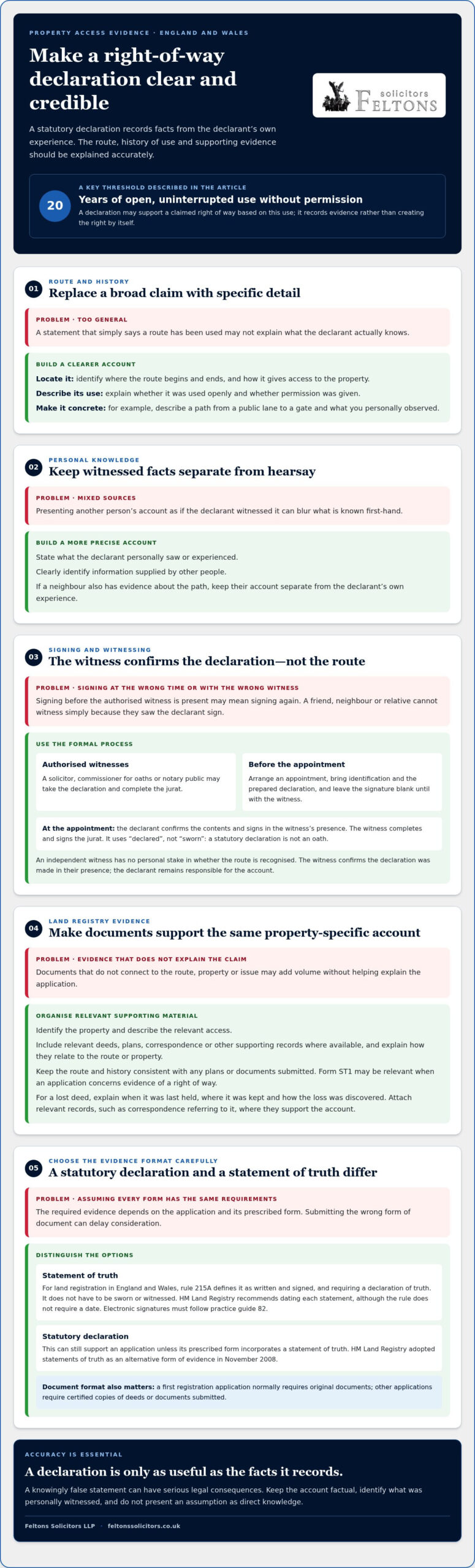
Information to include in a declaration
A useful declaration gives a clear, first-hand account of the route and the circumstances of its use. For a property access claim, organise the facts so another person can understand where the route runs, who used it and what the declarant personally observed.
Begin with your full name, address and connection to the property. Identify the land precisely, using its postal address and a plan or title reference where available. If the route crosses a neighbouring field before reaching a home, describe those points rather than relying on a general phrase such as “the back path”.
Set out the route in practical terms. Describe its starting point, direction, destination, surface and any gates or landmarks that help identify it. Explain how you know the route, such as by living at the property or regularly walking it. A sketch plan can help, but the written account should still make sense without unexplained markings.
- Pattern of use: explain who used the route, for what purpose and how regularly, using specific memories or events where possible.
- Permission: state whether permission was requested or given, and describe any conversation you personally remember.
- Changes or interruption: record an observed barrier, closure or alteration, and explain how it affected access.
- Supporting material: identify photographs, correspondence, plans or other documents, and say what each one helps to show.
Include details based on personal knowledge, not assumptions. For example, say you saw a neighbour pass through a gate only if you witnessed it; don’t present the neighbour’s account as your own observation. If a date is uncertain, explain the event that helps place it in time instead of inventing precision. Distinguish what you remember from what a document or another person tells you.
Keep the account focused on the reason for the declaration. If it supports a right-of-way claim, explain the history of access rather than adding unrelated details about ownership or a separate boundary disagreement. A formal statement is easier to assess when each paragraph relates to the route, the property or the evidence being explained.
Before attending to sign, read the complete document and compare its route description with any attached plan. Check names, addresses and dates, then mark any wording that does not match your recollection. A commissioner for oaths witnesses the declaration but cannot supply missing facts or correct the declarant’s personal account. Organising these details beforehand helps the witness understand which document is being declared.
Finish with a concise statement confirming that the contents are true to the best of your knowledge and belief. Keep a copy of the signed declaration with any referenced documents. That record can help explain the evidence later if HM Land Registry or another party asks how a detail was established.
Meaning and legal basis of statutory declarations
A statutory declaration is a formal statement of fact made by a person who declares its contents to be true. The framework described here applies across the United Kingdom, but the discussion of rights of way and HM Land Registry concerns England and Wales. Property procedures are not necessarily identical in Scotland or Northern Ireland.
Meaning of statutory declarations
A declarant sets out facts they believe to be true, based on personal knowledge. For example, someone describing a path may state when they first used it, where it runs and what they observed. This differs from offering a general opinion about who owns the route or what access should be allowed.
The declaration creates a formal record that can support an application or explain a matter where documentary evidence is limited. Its value depends on the detail and source of each fact. A declarant who personally saw a gate being opened can say so; a neighbour’s account should be identified as information from another person.
For someone making a statutory declaration in property law, this distinction clarifies what the evidence can establish. The declarant should separate what they remember from what they infer, and ensure the wording reflects the difference. An account of access, for instance, should not claim uninterrupted use if the declarant knows only about occasional visits.
Legal basis and regional rules
Statutory declarations in the United Kingdom are governed by the Statutory Declaration Act 1835, according to the UK legislation register. The Act is also cited in connection with the standard form of a declaration. That form gives the statement a recognised legal structure, while the declarant supplies the facts relevant to their particular application.
The statutory wording does not replace a complete account. A declaration about a right of way needs facts about the route and its use; one explaining a missing deed needs facts about the document and its loss. Making a statutory declaration in property law therefore involves both the formal declaration and a relevant, accurate account.
Schedule 1 of the Interpretation Act 1978 provides that an affidavit includes a declaration and that “sworn” means “declare”. This helps explain why statutory declarations use declaration wording rather than treating the declarant as taking an oath. A solicitor, commissioner for oaths or notary public can witness a declaration in the appropriate formal process.
For a property application, identify the relevant jurisdiction before relying on a form or procedure. The rules discussed here relate to England and Wales, including HM Land Registry evidence. If your land is in Scotland or Northern Ireland, the applicable property and registration framework needs separate consideration; do not assume that an England and Wales process applies.
Where a property issue also involves estate administration, discuss your legal options before preparing a declaration, so the statement fits the wider matter.
Feltons Solicitors LLP: Divorce and Financial Arrangements
Feltons Solicitors LLP assists with residential and commercial conveyancing when a right-of-way question affects a property transaction. Understanding the access evidence may be important when considering the property and its documents. If a property issue also forms part of a divorce or separation, Feltons Solicitors LLP can advise on divorce and financial arrangements in that context.
Consider legal support if the route is disputed, the declaration conflicts with other property records, or access concerns arise during a sale or purchase. Advice can help you understand how the property issue fits the wider matter and what information may be relevant to discuss.
To discuss your circumstances, contact Feltons Solicitors LLP.
Take the next step with confidence
Before relying on a declaration, consider how the access issue fits the property’s wider circumstances. A route may affect a sale, shared ownership or decisions about an estate, so the evidence should be understood in context. Making a statutory declaration in property law is one part of addressing the issue, not a substitute for considering its effect on the property and the people connected to it.
Feltons Solicitors LLP offers residential and commercial conveyancing, as well as wills, probate and estate planning. If a property matter also intersects with separation, the firm handles divorce and financial arrangements. The right legal support depends on the issue you need to resolve and how it connects with your wider plans.
For guidance on your circumstances, contact Feltons Solicitors LLP. A considered next step can help you move forward with greater clarity.
Frequently Asked Questions
When is this needed?
A statutory declaration may be useful when a property matter needs a formal account of facts that documents alone cannot establish. For example, it can explain how deeds were lost or provide evidence about access to a route. In England and Wales, a claimed right of way may rely on open, uninterrupted use without permission for at least 20 years, according to the UK legislation register.
Where do I swear the declaration?
Arrange to make the declaration before a solicitor, commissioner for oaths or notary public. The witness must be authorised and present when you sign. Contact the solicitor’s office to arrange an appointment, then take identification and the prepared document. Do not sign beforehand. The witness completes the jurat, recording that you made the declaration in their presence.
What is a statutory declaration in UK property law?
It is a formal written statement in which a person declares facts to be true to the best of their knowledge. In a property matter, it might explain a route’s history or the circumstances in which a deed disappeared. The declaration records the maker’s evidence; it does not, by itself, create a right of way or settle a disagreement about ownership.
When is a statutory declaration used in a property transaction?
It may be required to address a particular issue affecting a property transaction, such as missing title documents or a proposed commercial lease exclusion. For a lease contracted out of the Landlord and Tenant Act 1954, a tenant must make a statutory declaration before an independent solicitor if fewer than 14 days separate the warning notice and lease entry.
Who can make and witness a property statutory declaration in England and Wales?
The person making it should have personal knowledge of the facts they declare. For instance, someone who regularly used a path can describe their own experience, but should identify a neighbour’s account as information from that neighbour. A solicitor, commissioner for oaths or notary public may witness the declaration. The declarant gives the evidence; the witness formally takes the declaration.
What wording and information must a property statutory declaration contain?
Use the appropriate formal declaration wording and identify the person making it and the property concerned. For a route, describe its start, destination, location and the declarant’s experience of using it. A useful account separates remembered events from assumptions and refers clearly to any attached plan or document. The wording should match the facts the declarant is prepared to affirm.
How do you make and sign a statutory declaration for a property matter?
Prepare the statement and supporting documents, then arrange an appointment with an authorised witness. Take identification and leave the signature blank until you attend. Read the final wording and raise any errors, then sign in the witness’s presence and make the declaration as directed. The witness also signs and completes the jurat, recording the place and date.
What are the legal requirements for witnessing a statutory declaration in the UK?
The declaration must be made before an authorised witness, such as a solicitor, commissioner for oaths or notary public. The declarant signs in that person’s presence, and both sign the document. The jurat records the act of declaration, using “declared” instead of “sworn”. For solicitors and commissioners, the place and date must also be stated.