
Removing Overseas Entities: UK Land Registry Guide 2026

Removing Overseas Entities: UK Land Registry Guide 2026

A property sale doesn’t, by itself, remove an overseas entity from the relevant land register or from Companies House. If you’re searching for “removing overseas entity from land registry”, first identify which record needs changing: the property title records ownership, while Companies House maintains the Register of Overseas Entities.

It’s easy to assume one removal application will update both records. In practice, the order matters. The overseas entity must have disposed of its UK property, and the relevant land register must show the new ownership before the entity can apply to leave the Register of Overseas Entities. If a title update is still pending or the entity’s information is out of date, the application may be delayed or rejected.

This guide explains how the two processes fit together, which eligibility checks to complete and what information and verification may be needed before applying. It also covers common filing issues and how to prepare for them. Where ownership records or international details add complexity, legal support can help coordinate the property and Companies House requirements.

Key Takeaways

  • “Land Registry removal” can mean changing a property title or leaving the Register of Overseas Entities. Identify which record needs updating.
  • For removing overseas entity from land registry records, complete the disposal and ensure the relevant title shows the new ownership before applying to Companies House.
  • Check all relevant property titles and bring the entity’s Register of Overseas Entities information up to date before preparing the removal application.
  • Resolve outstanding title registrations, inconsistent details, incomplete updates and missing verification to help avoid preventable delays.
  • Coordinated legal advice can help align conveyancing and Companies House steps, particularly where multiple titles or jurisdictions are involved.

Removing an overseas entity from the Land Registry: which register do you mean?

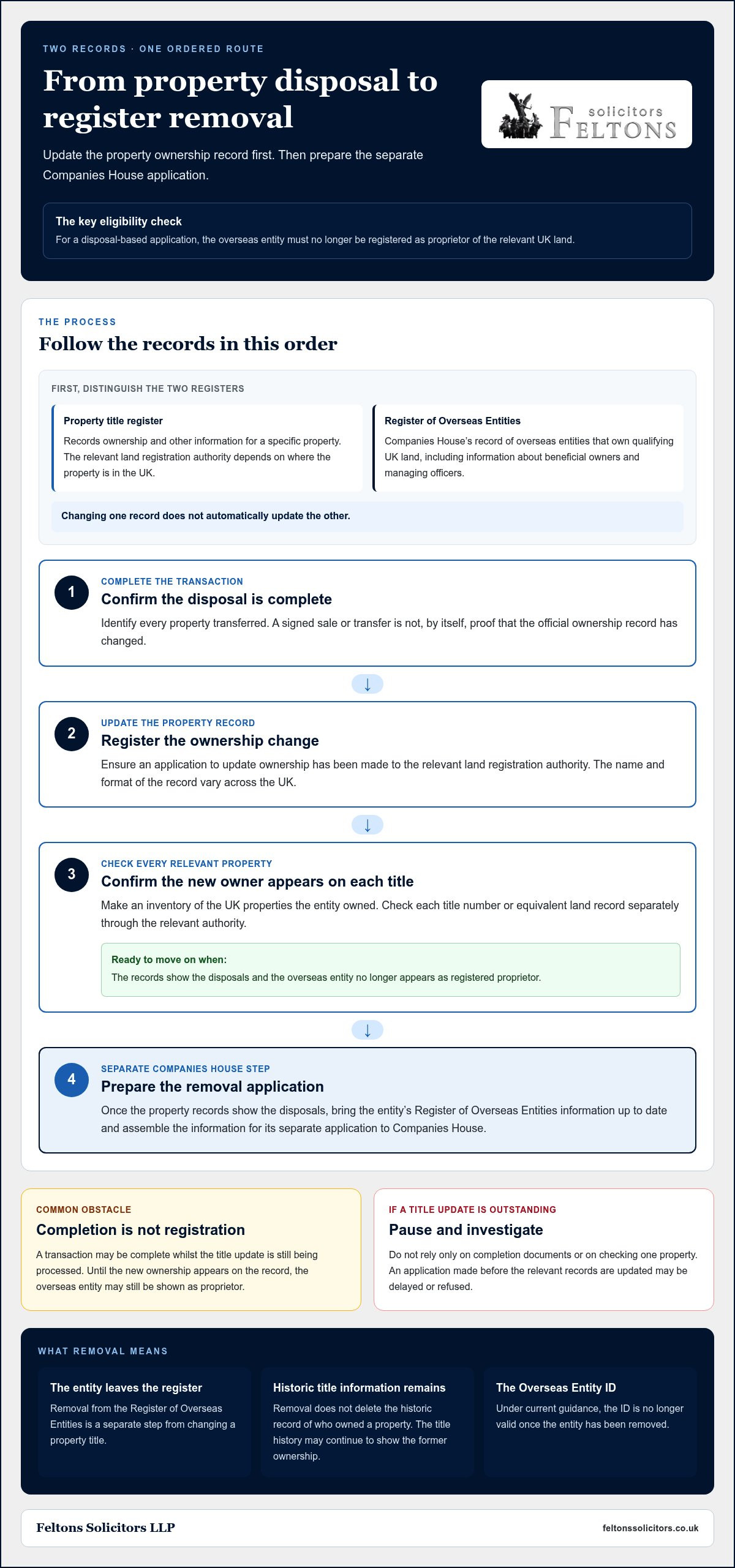
“Land Registry removal” can refer to two different processes: changing the ownership details recorded for a property, or removing an overseas entity from a Companies House register. The processes are connected, but changing one record doesn’t automatically update the other.

Two registers, two purposes

  • Property title register: records the registered ownership and other information for a specific property. The relevant land registration authority maintains it, and the responsible authority depends on where the property is in the UK.
  • Register of Overseas Entities: Companies House’s record of overseas entities that own qualifying UK land, including information about their beneficial owners and managing officers. Companies House is the UK’s registrar of companies; you can find further background on Companies House.

A completed transfer followed by an updated property title changes the ownership record for that property. It does not remove the former owner from the Register of Overseas Entities. That requires a separate application to Companies House, once the eligibility conditions are met. Keeping the two records distinct helps you complete the steps in the right order.

What does removing an overseas entity from the register mean?

Removal means taking the entity off the Register of Overseas Entities, not deleting the historic record of who owned a property. The title history may continue to show the entity’s previous ownership, and information on the public register may remain viewable after removal. Removal also affects the entity’s Overseas Entity ID: under current guidance, the ID is no longer valid once the entity has been removed. Don’t assume the entity can rely on that ID for a future UK land transaction.

When may an overseas entity apply for removal?

For a disposal-based application, the central eligibility test is that the entity is no longer registered as proprietor of relevant UK land. It isn’t enough for a sale or transfer to be signed, or for the parties to consider the transaction complete. The ownership records for the relevant land must reflect the disposal before the entity applies to leave the Companies House register.

This distinction matters when a transaction has completed but the title update is still being processed. Until the register shows the new owner, the public record may still identify the overseas entity as proprietor, creating an obstacle to removal. Check each relevant title rather than relying only on completion documents.

The entity’s registration history also helps explain its reporting obligations and the information held on the register. Feltons’ overseas entity registration guide explains the registration framework for UK property owners. Before preparing a separate Companies House removal application, confirm that each relevant title has been updated.

Before applying to remove an overseas entity, update the property title records

Start with the property records, not the Companies House removal form. Confirm that the completed disposal has been recorded for every relevant property where the overseas entity was registered as proprietor. A signed transfer or sale agreement is evidence of the transaction, but it doesn’t show, by itself, that the public ownership record has changed.

Use this sequence to prepare:

  1. Complete the disposal. Confirm that the transaction has completed and identify each property transferred.
  2. Register the ownership change. Ensure an application to update ownership has been made to the relevant land registration authority. The name and format of the record vary across the UK.
  3. Check every relevant title. Review each title or equivalent land record separately, including properties held under different title numbers.
  4. Prepare for removal. Once the records show the disposals, assemble the information for the separate Companies House application.

The order matters. If an overseas entity applies before the relevant ownership records have been updated, Companies House may be unable to confirm that it meets the removal conditions. The application could be delayed or refused. Resolve the title position first rather than relying on a signed transfer or the parties’ understanding that the sale has completed.

How do you confirm the new owner is recorded?

Make an inventory of the UK properties the entity owned, then identify the title number or equivalent land record for each one. Check the current record through the relevant land registration authority for the property’s jurisdiction. Confirm that the overseas entity no longer appears as the registered proprietor. Checking one property doesn’t confirm the position for the others.

Keep the stages distinct: conveyancing completion concerns the transaction between the parties, while registration updates the official ownership record. The application to register a transfer may still be outstanding after completion. Check the current record before moving to the next stage.

What if a property transfer has not appeared on the register?

Pause the removal application and investigate the outstanding registration. Review the transfer and completion documents, the registration application and any correspondence about requisitions or missing information. This can help establish whether the application is still being processed or whether something needs attention before the title can be updated.

For wider context on ownership records and conveyancing, Feltons’ residential property law guide explains key aspects of residential property transactions. Where several titles or jurisdictions are involved, Feltons’ conveyancing and overseas entity legal support can help coordinate the property records and Companies House steps.

Applying to Companies House After Title Updates

Once the relevant property records reflect the disposals, make the next application to Companies House, not to the land registration authority. These are separate stages: the title update records who owns the property, while Companies House considers whether the overseas entity can be removed from the Register of Overseas Entities.

Before filing, use current Companies House guidance to check the online application route, who is eligible to submit it and what authentication is required. Procedures can change, so don’t rely on an old form or instructions from an earlier filing. Confirm that the entity’s register information is accurate and up to date.

What information should be ready before filing?

Prepare the entity’s identifying details and Overseas Entity ID, then compare the information held by Companies House with the entity’s current records. Check the names and details of beneficial owners and managing officers, including whether any changes need to be reported. The current form and guidance specify what information to supply.

Where information has changed, verification is a key preparation step. Under current requirements, changes to an entity’s information, including new beneficial owners or managing officers, must be verified by a UK-regulated agent no more than three months before the removal application is made. Allow time to organise the evidence and confirm that it relates to the information being filed.

Establish who will submit the application and what evidence of authority to act is required under the current process. A clear file can bring together the entity’s details, relevant ownership information, verification evidence and confirmation that property records have been updated. This helps identify gaps between the conveyancing position and the Companies House filing before submission.

What happens after Companies House receives the application?

Companies House reviews the application against its requirements. It may seek clarification or further information if details are incomplete, inconsistent or need supporting evidence. Respond carefully to any request, and don’t assume that submitting the form means removal has already taken effect.

Removal doesn’t necessarily make information already available on the public register disappear. Treat the application as a change in the entity’s registration status, not as a request to erase its history. Consider what information remains accessible and make sure the entity understands the practical consequences before proceeding.

The Overseas Entity ID is no longer valid after removal. The entity should consider this consequence before applying, especially if it may need to undertake a later transaction involving UK land. For anyone removing overseas entity from land registry records, careful preparation means checking the title position, information and verification together, then following the current Companies House application guidance.
Removing Overseas Entities: UK Land Registry Guide 2026

Common delays when removing an overseas entity from property records

A removal application can be held up when the entity’s property records don’t align with the information filed with Companies House. Use this issue-and-response check to identify what needs attention before submitting.

  • A transfer is still awaiting registration. Check the application status and any correspondence about outstanding requirements. Resolve the registration issue and confirm the current title position before relying on the disposal for a removal application.
  • One property still shows the entity as proprietor. The eligibility test applies across the relevant UK land held by the entity, not just the property most recently sold. Review every property and title, including properties in different parts of the UK. A private sale agreement does not override a public record that still names the entity as registered proprietor.
  • Entity details do not match across records. Compare the entity’s name and identifying details in the property records with its Companies House information and supporting documents. Resolve discrepancies before filing so the application can be assessed against consistent information.
  • Beneficial owner or managing officer details are out of date. Compare the register information with current details and identify any required update. Check Companies House guidance for the applicable verification rules and deadlines. Under current requirements, changes to entity information must be verified by a UK-regulated agent no more than three months before a removal application.
  • An update statement or verification evidence is missing. Establish whether required updates are complete and gather the relevant evidence before applying. An incomplete compliance record or insufficient verification may mean more work is needed before the removal application is ready.

Can an overseas entity be removed if one property is still registered to it?

Generally, no. If a relevant UK property record still lists the entity as proprietor, the entity may not meet the removal eligibility test, even if it has sold its other properties. Resolve the remaining ownership position first, either by completing a disposal or addressing an outstanding title registration. The public proprietor record is central; a contract or private agreement alone does not change it.

What if the entity’s details or verification information have changed?

Check the information held for the entity and relevant people against current records before submission. Changes to beneficial owners or managing officers can affect what needs updating and verifying. Use the latest Companies House guidance to confirm the requirements at the time of filing, rather than relying on old verification documents or a previous application.

There is an additional coordination point if the entity owns or has owned land in more than one UK jurisdiction. England and Wales, Scotland, and Northern Ireland have distinct land registration systems, so the record and process for checking each title may differ. Keep a property-by-property schedule showing the jurisdiction, title reference and current registered proprietor. This helps prevent an overlooked title from undermining an otherwise complete application.

Where multiple titles, inconsistent records or international ownership details make the checks difficult to coordinate, Feltons can assist with overseas entity and property transaction advice to help clarify the next steps.

Coordinating a property disposal with a separate Companies House application can become more involved when the entity has several UK properties, multiple titles or land in different jurisdictions. Legal support can help bring the transaction documents, title position and entity information together, so unresolved issues can be identified before an application is submitted.

Feltons Solicitors advises on overseas entity registration, complex property transactions, and residential and commercial conveyancing. This combination is relevant when work involves both property records and the Register of Overseas Entities. Advice can be tailored to the ownership arrangements and records involved, including where the property history or jurisdiction adds complexity.

What can a solicitor help you coordinate?

A solicitor can review the disposal documents alongside the status of the related title registration, helping establish whether the public record reflects the transaction. They can also help organise entity information and identify inconsistencies or outstanding matters that may need resolution before filing. For multiple properties, this means considering the relevant titles together rather than treating one completed sale as the whole picture.

Where ownership arrangements or jurisdictional requirements are complex, tailored advice can clarify which records and transaction details need attention. This is practical coordination, not a promise that Companies House will accept an application or that a particular result or timescale can be achieved.

What should you prepare for an initial discussion?

A concise file helps make the circumstances easier to assess. Gather the core identification details and documents available, even if you’re unsure which items will be most relevant. The following information provides a useful starting point:

  • Entity details: the overseas entity’s registered name and Overseas Entity ID.
  • Property information: addresses and title references for relevant UK properties, with the jurisdiction of each property noted.
  • Disposal records: signed transfer or sale documents, completion information and correspondence about registration of the ownership change.
  • Title evidence: current title records, equivalent land records or correspondence showing the status of any outstanding registration.
  • Register changes: details of beneficial owners or managing officers who have changed since the entity’s latest filing, alongside any related update or verification information.

You don’t need to resolve every uncertainty before seeking advice. A clear account of what has been sold, what still appears in the property records and what information has changed can focus the discussion on the next steps. This is particularly useful where the entity’s portfolio spans England and Wales, Scotland or Northern Ireland, as each has its own land registration system.

If you’re considering removing overseas entity from land registry records and need to coordinate the property and Companies House aspects, discuss your property records and proposed application with Feltons. Bring the disposal history and available title information so the position can be considered in context.

Make your next step a coordinated one

The point where a disposal, a title update and a register filing meet is often where a tailored legal review can be useful. If you’re considering removing overseas entity from land registry records, bring the property history and the entity’s current position together before deciding how to proceed. A clear view of the matter can help identify outstanding questions and prepare for the next stage.

Feltons advises on overseas entity registration, complex property transactions, and residential and commercial conveyancing. The firm provides pragmatic guidance to domestic and international clients, shaped around the records and ownership arrangements involved.

For advice on your circumstances, discuss your overseas entity and property records with Feltons’ solicitors. A focused conversation can help you establish a practical way forward.

Frequently Asked Questions

Can I remove an overseas entity from the Land Registry after selling a UK property?

You may be able to apply for removal from the Register of Overseas Entities after a sale, once the entity is no longer registered as proprietor of any relevant UK land. A completed sale doesn’t necessarily mean the ownership record has changed. For example, if the buyer’s registration is still pending, the public title may continue to show the seller. Check the relevant records before making a separate Companies House application.

Is the Register of Overseas Entities the same as the Land Registry?

No. The Register of Overseas Entities is maintained by Companies House and records overseas entities that own qualifying UK land, along with relevant ownership information. A property title register records ownership and other details for an individual property. The registers serve different purposes and are updated through separate processes. Changing a property title does not itself change the entity’s status on the Companies House register.

How do I apply to remove an overseas entity from the register?

Apply to Companies House using its current removal process, once the entity meets the eligibility requirements. Before starting, gather its name and Overseas Entity ID, confirm the position of all relevant property records, and review entity and beneficial ownership details for accuracy. Check the latest Companies House instructions for the application route, who may submit it, authentication and any verification evidence required. Requirements should be checked at the time of filing.

What happens if an overseas entity applies before the property title is updated?

If the title still identifies the overseas entity as proprietor, Companies House may be unable to confirm that the entity is eligible for removal. The application could be delayed or refused, leaving the entity to resolve the registration issue and consider what further filing is needed. Check for outstanding correspondence about the title application, such as a request for additional information, before submitting the removal application.

Does removal from the Register of Overseas Entities erase the entity’s public information?

No. Removal changes the entity’s status on the register; it does not necessarily erase information already available about its registration or history. The entity should also consider the effect on its Overseas Entity ID: current guidance says the ID is no longer valid after removal. This matters if the entity may later be involved in a UK land transaction, so consider the consequences before applying.

Can an overseas entity apply for removal if it still owns another UK property?

Generally, no, if it remains registered as proprietor of relevant UK land. Selling one property does not meet the eligibility test if another qualifying property is still registered to the entity. This can be easy to overlook where property is held across different jurisdictions or under separate titles. Check the entity’s full UK property portfolio and resolve any remaining ownership position before applying to Companies House.

Do Scotland and Northern Ireland use the same property register as England and Wales?

No. The UK does not have one single property title register covering all four nations. England and Wales, Scotland, and Northern Ireland have distinct land registration systems, so the relevant authority, record and process depend on where each property is situated. If an entity has held land in more than one jurisdiction, identify and check the corresponding record for every property rather than relying on a search in one system.

Title Transfer Solicitors UK: A Complete Guide to Property Ownership Changes in 2026

Title Transfer Solicitors UK: A Complete Guide to Property Ownership Changes in 2026

Transferring a property title is rarely a simple administrative update; it’s a significant financial realignment that can trigger unforeseen tax liabilities or breach mortgage covenants if handled without precision. You likely want to ensure your family’s future or adjust your equity share without the process becoming a source of stress or legal uncertainty. It’s natural to feel concerned about the complexities of Stamp Duty Land Tax (SDLT) or the strict requirements of your mortgage lender during such a transition.

This guide provides the clarity you need to manage these changes effectively, ensuring your financial interests remain protected throughout. By engaging experienced title transfer solicitors uk, you can navigate the legal nuances of inheritance, relationship breakdowns, or gifting property with quiet confidence. We will explore the essential steps to satisfy the Land Registry whilst minimising tax exposure, ensuring professional oversight provides the indemnity protection your assets deserve in 2026.

Key Takeaways

  • Learn the critical legal difference between a full transfer of ownership and a transfer of equity to ensure your Land Registry records are accurately updated.
  • Discover how to manage title changes during major life events, such as marriage or relationship breakdowns, whilst protecting your long-term financial interests.
  • Understand why obtaining lender consent or arranging a remortgage is a non-negotiable step in the title transfer process for properties with existing debt.
  • Identify why instructing professional title transfer solicitors uk is essential for mitigating risks like identity fraud and ensuring your transaction satisfies rigorous anti-money laundering requirements.
  • Gain insights into managing “consideration” and Stamp Duty Land Tax (SDLT) liabilities to minimise tax exposure and prevent unexpected costs.

Understanding Title Transfer and Transfer of Equity in the UK

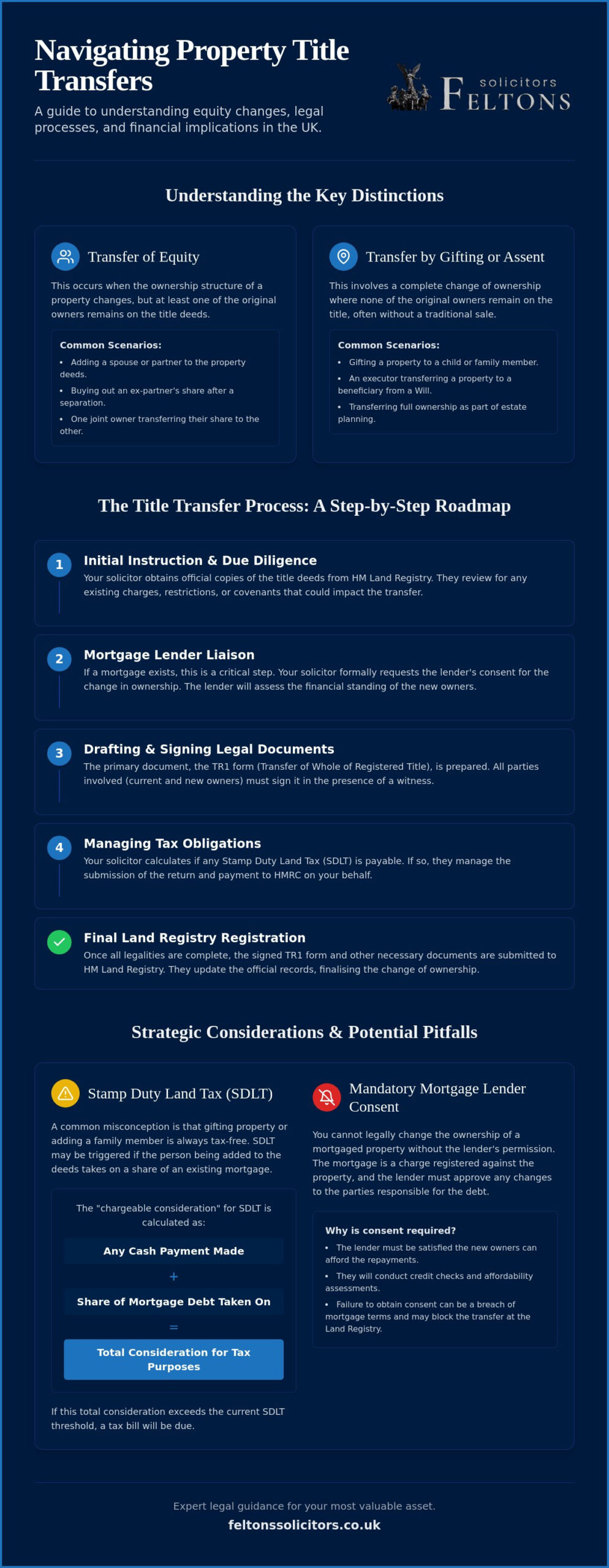
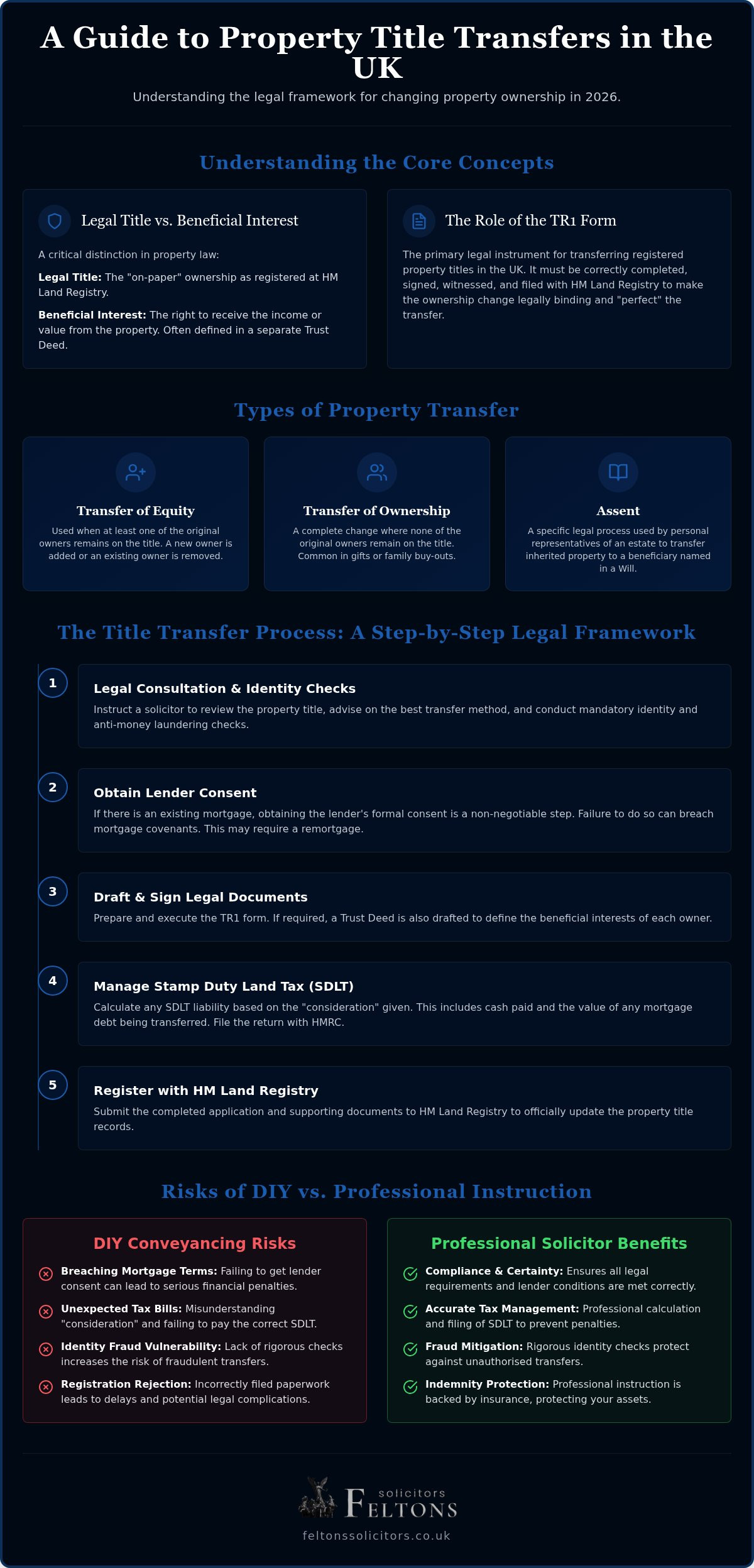
Changing the names on a property deed involves more than a simple clerical update at HM Land Registry; it’s a formal legal transition that requires precision to avoid future disputes. Title transfer is the overarching process of altering the official ownership records, but the specific path you take depends on your circumstances. For instance, a “Transfer of Equity” is used when at least one of the original owners stays on the title, such as when a partner is added after marriage. Conversely, a “Transfer of Ownership” involves a total change where none of the original owners remain, often seen in gifts or family buy-outs.

When dealing with inherited property, a distinct process known as an “Assent” is required. If you’ve been left a home in a Will, the personal representatives of the estate must use an Assent to formally vest the property in your name. This step is vital for making your ownership legally binding, yet it’s frequently misunderstood by those attempting to manage probate without professional guidance. Choosing the correct mechanism is paramount because it dictates your obligations for Stamp Duty Land Tax (SDLT) and your standing with mortgage lenders. Even in transfers where no money is exchanged, the value of a mortgage being transferred can be classed as “consideration”, which can trigger a tax liability.

Legal Title vs. Beneficial Interest

Legal ownership isn’t always as straightforward as the names on the Land Registry might suggest. There is a critical distinction between legal title, which represents the “on paper” ownership, and beneficial interest, which relates to the right to receive the value or income from the property. In many cases, a Trust Deed is drafted alongside the transfer to define these interests clearly. Instructing a residential property law firm ensures these layers of ownership are correctly documented, protecting your investment if circumstances change or relationship dynamics shift.

The Role of the TR1 Form and HM Land Registry

The primary instrument used to facilitate these changes for registered titles is the TR1 form. This document acts as the legal bridge between the current and new owners. Once signed and witnessed, it must be filed with HM Land Registry to make the transfer “perfect”. Without this official registration, the legal title doesn’t technically pass to the new owner. During Conveyancing, it’s also essential to verify that the property’s plan descriptions are accurate, particularly if the transfer involves dividing a plot or changing boundaries. Professional title transfer solicitors uk provide the necessary due diligence to ensure these technical details are handled flawlessly, preventing future boundary disputes or registration delays.

Common Reasons to Organise a Property Title Transfer

Life’s milestones frequently demand a shift in property ownership. Whether you’re blending households or settling an inheritance, the legal title must align with your current intentions. Many homeowners choose to add a spouse or partner to their deeds following marriage or cohabitation. This ensures that both parties have a recognised legal stake in their shared home. However, this isn’t a mere administrative tick-box. It requires formalising the transferring ownership process through the Land Registry to prevent future disputes and ensure clarity for any mortgage lender involved.

Title transfers also facilitate the “buying out” of a co-owner. This is a common scenario amongst siblings who have inherited a property together or joint tenants who have decided to part ways. One party pays a sum to the other to acquire their share, necessitating a formal update to the title deeds. Engaging professional title transfer solicitors uk is critical here to ensure the “consideration” is recorded correctly and that any existing mortgage lender consents to the change. Without this professional oversight, you risk breaching mortgage terms or facing complications when you eventually decide to sell.

Divorce and Financial Settlements

During a relationship breakdown, the home is often the most significant asset to be divided. A divorce and financial arrangements lawyer will structure the property transfer to comply with court orders or separation agreements, ensuring the legal title matches the agreed financial settlement. In some cases, a “Mesher Order” might be used. This defers the sale or transfer of the property until a specific event occurs, such as a child reaching adulthood or completing their education. We understand the emotional weight of these transitions; our role is to provide a calm, steady hand to ensure the legal process remains as smooth and discreet as possible.

Estate Planning and Gifting

Gifting a share of your home to children is a popular strategy for managing future liabilities, but it comes with strict regulatory hurdles that go far beyond simple paperwork. Under the “seven-year rule”, the gift may still be subject to Inheritance Tax if you pass away within seven years of the transfer. Additionally, if you continue to live in the property without paying market rent, HMRC may view it as a “gift with reservation of benefit”, potentially nullifying the tax advantages. You must also be aware of “deliberate deprivation of assets” rules; local authorities often scrutinise property transfers if you later require care funding. Integrating these changes into a wider estate planning strategy is the only way to ensure your legacy is protected. When navigating these complex scenarios, the guidance of title transfer solicitors uk ensures that every legal and tax implication is accounted for. If you are considering a property gift, speaking with a specialist can help clarify your tax position.

The journey begins with a detailed consultation to establish the “consideration” involved in the transaction. In legal terms, consideration isn’t limited to physical cash; it includes the value of any mortgage debt the new owner is taking on. Once this value is determined, the formal drafting of the Transfer Deed, or TR1 form, commences. If you’re sharing ownership in specific proportions, your title transfer solicitors uk will also prepare a Trust Deed to document these beneficial interests clearly. This ensures that the “on paper” ownership matches the financial reality of each party’s contribution.

Executing the deed requires a formal signing in the presence of an independent witness who is not a party to the transfer. Following this, the application is submitted to HM Land Registry along with the necessary filing fees. As of 2026, registration fees are tiered based on property value; for example, a property valued between £200,001 and £500,000 incurs a fee of £330. The process is only “perfected” once the Land Registry updates the digital register, a step that confirms the new ownership status to the world.

Navigating Mortgage Lender Requirements

Lenders maintain a significant interest in who holds the legal title, as any change affects the security of their loan. If a property is mortgaged, you must obtain formal consent before the transfer can proceed. For those leaving the title, a “Release of Covenant” is necessary to ensure they’re no longer liable for the debt. Lenders almost always require a solicitor to act for them during this process to ensure their interests remain protected. This dual representation streamlines the transition whilst satisfying the lender’s rigorous compliance and identity standards.

Stamp Duty Land Tax (SDLT) Implications

A common misconception is that tax only applies when money changes hands. However, SDLT is calculated based on the “chargeable consideration”. If you’re added to a title and take responsibility for a portion of an existing mortgage, that share of the debt is considered payment. In 2026, the standard SDLT threshold begins at £125,000. Even if the consideration falls below this level and no tax is due, you must still file an SDLT return with HMRC within 14 days of completion. Expert title transfer solicitors uk manage these filings on your behalf, preventing the risk of late payment penalties or inquiries from the tax authorities.

Title Transfer Solicitors UK: A Complete Guide to Property Ownership Changes in 2026

The Risks of DIY Conveyancing versus Professional Instruction

The assumption that a property title transfer is merely a matter of filling in forms is a frequent and costly mistake. In reality, the process involves complex legal obligations that, if mismanaged, can leave your most valuable asset vulnerable. Professional title transfer solicitors uk provide a critical layer of security through rigorous Anti-Money Laundering (AML) checks and identity verification. These protocols aren’t just bureaucratic hurdles; they’re essential defences against the rising threat of property fraud. By instructing a professional, you’re also benefiting from Professional Indemnity Insurance. This ensures that if a technical error occurs, your financial interests are fully protected, a safeguard that is entirely absent in a DIY approach.

Most mortgage lenders will simply refuse to engage with unrepresented individuals. They require the assurance that a qualified solicitor is overseeing the transaction to protect their security. Attempting to handle the transfer yourself often leads to a stalemate where the lender won’t release the necessary documents, causing significant delays and potential breaches of contract. These delays can be particularly damaging when a transfer is part of a time-sensitive financial settlement or inheritance plan.

Identity Verification (ID1 and ID3)

For those who choose to proceed without a solicitor, HM Land Registry mandates a strict identity verification process using forms ID1 or ID3. This requires you to find a professional, such as a solicitor or notary, to witness your signature and verify your credentials for a fee. This process is often cumbersome and time-consuming for DIYers, as many firms are reluctant to verify identity for non-clients due to the liability involved. Conversely, when you use a solicitor for the entire transaction, identity verification is integrated seamlessly into the process, providing a higher level of security for all parties involved.

Avoiding Future Litigation

Errors made during a DIY transfer often lie dormant for years, only surfacing during a future sale or upon the death of an owner. Poorly drafted deeds frequently lead to “Contentious Probate” or bitter ownership disputes amongst heirs, which are far more expensive to resolve than the initial legal fees. A solicitor acts as a discreet partner, ensuring that every detail, from the rights of way to the distribution of beneficial interest, is tied up correctly. In the context of property law, indemnity is a financial safeguard that protects you against losses arising from professional errors or omissions. To ensure your property interests are handled with the precision they deserve, you should instruct Feltons Solicitors for your title transfer.

How Feltons Solicitors Facilitates Seamless Title Transfers

Feltons Solicitors understands that property is more than a legal asset; it’s the foundation of your personal and financial security. As a boutique firm, we move away from the high-volume, impersonal processing common in the industry. Instead, we position ourselves as your sophisticated guide, handling the technical complexities of the law whilst maintaining a genuine human connection. Choosing the right title transfer solicitors uk means finding a partner who values your privacy and provides the discreet, high-standard service your situation demands. We don’t just process paperwork; we provide a calm, steady presence during what can often be a stressful period of transition.

Our expertise extends to the most intricate ownership structures. We regularly assist with overseas entity beneficial owner registration, ensuring that international property interests remain compliant with evolving UK regulations. When disputes arise amongst co-owners, we apply a pragmatic, resolution-focused approach to protect your equity and restore stability. This “people-first” philosophy ensures that while the technical legal work is paramount, the human impact of our work is never forgotten.

A Tailored Approach for Private Clients

We recognise that a title transfer is often a single piece of a much larger puzzle. Whether you’re navigating a relationship breakdown or finalising an inheritance, we integrate our property advice into your broader life changes. We’ve discarded archaic legalese in favour of a “plain English” methodology, ensuring you feel informed and empowered at every stage. This boutique level of care prioritises personal rapport, meaning you’ll deal directly with the expert managing your case rather than being passed between anonymous departments. It’s an approach that values modern efficiency without sacrificing traditional professional integrity.

Expertise in Complex and Leasehold Matters

Leasehold properties present unique challenges, particularly regarding extensions and management rights. As leasehold enfranchisement experts, we understand how these nuances impact the transfer of title and the long-term value of your investment. Our team possesses the worldly experience required to handle high-net-worth portfolios and complex international interests with absolute precision. As experienced title transfer solicitors uk, we invite you to a confidential consultation to discuss your specific circumstances and discover how we can facilitate a seamless transition for your property assets. Our goal is to provide the security and comprehensive care you need to move forward with confidence.

Securing Your Property Interests for the Years Ahead

Managing a property ownership change is a significant life event that requires more than just administrative accuracy; it’s about ensuring your legal title reflects your current life circumstances whilst protecting your equity from unforeseen tax or mortgage complications. By navigating the nuances of the TR1 form, satisfying SDLT requirements, and securing lender consent, you establish a solid foundation for your future. These steps are essential for maintaining the integrity of your investment and preventing contentious disputes in years to come.

Instructing expert title transfer solicitors uk provides the professional indemnity and identity security that DIY methods simply cannot offer. Feltons Solicitors, a boutique firm established in 2010, combines specialist expertise in residential and commercial conveyancing with pragmatic, people-first advice. We pride ourselves on being a steady, sophisticated guide through complex legal transitions, ensuring every detail is perfectly aligned with your long-term goals. Contact Feltons Solicitors for expert guidance on your property title transfer today. Taking this proactive step ensures your property remains a secure legacy for you and your family.

Frequently Asked Questions

Do I need a solicitor to transfer property title to my spouse?

While you can legally manage a transfer yourself if there’s no mortgage, instructing title transfer solicitors uk is strongly recommended to ensure the deed is “perfected” at the Land Registry. If a mortgage is involved, lenders almost always insist on professional representation to protect their security. Using a solicitor also provides professional indemnity insurance, which safeguards your home against technical errors that could lead to future ownership disputes or complications whilst you eventually sell.

How much does a title transfer solicitor cost in the UK?

Legal fees for a straightforward transfer of equity typically range between £400 and £900 plus VAT, depending on the complexity of the case. You must also account for disbursements, such as HM Land Registry fees, which are tiered based on the property’s value. For example, a property valued between £200,001 and £500,000 currently incurs a registration fee of £330. We provide transparent, fixed-fee quotes to ensure you have complete certainty over your costs.

Can I transfer property title if there is still a mortgage?

Yes, you can transfer the title, but you must obtain formal consent from your mortgage lender first. The lender will assess the financial stability of the remaining or new owners to ensure they can meet the repayment obligations. This process often involves a “Release of Covenant” for any departing owner. Your solicitor will act for both you and the lender to ensure all regulatory requirements are met and the mortgage deed is updated correctly.

How long does the title transfer process take at the Land Registry?

The legal preparation and signing of deeds usually take between four and eight weeks. Once the application is submitted to HM Land Registry, the time taken to update the digital register can vary significantly. While simple transfers are often processed within a few weeks, more complex cases or those requiring additional queries can take several months. Your solicitor will monitor the progress and provide updates until the new title deed is officially confirmed.

Do I have to pay Stamp Duty on a transfer of equity?

Stamp Duty Land Tax (SDLT) is payable if the “chargeable consideration” exceeds the current threshold of £125,000. Consideration includes any cash payment made for the share plus the proportion of the outstanding mortgage being taken over. If you’re added to a title and take on 50% of a £300,000 mortgage, your consideration is £150,000, which may trigger a tax liability. You must file an SDLT return even if no tax is actually due.

What is the difference between a Transfer of Equity and an Assent?

A Transfer of Equity is used when at least one of the current legal owners remains on the title, such as adding a partner. An Assent is a specific legal process used to transfer property from a deceased person’s estate to a beneficiary named in a Will. Whilst both result in a change at the Land Registry, an Assent requires the involvement of the estate’s personal representatives and follows distinct probate regulations to ensure the transfer is legally binding.

Can a property title be transferred as a gift?

You can transfer a property title as a gift, but this often triggers significant tax implications. If you don’t survive for seven years after the gift, it may be subject to Inheritance Tax. If the property isn’t your primary residence, Capital Gains Tax might also apply based on the market value at the time of the transfer. It’s essential to seek professional advice to understand how gifting impacts your broader estate planning and potential tax exposure.

What documents do I need to provide to my title transfer solicitor?

You’ll need to provide valid photo identification and recent proof of address to satisfy Anti-Money Laundering (AML) regulations. Additionally, your solicitor will require your latest mortgage statement, details of any money changing hands, and a copy of the existing title deeds if the property is unregistered. Providing these documents promptly allows your title transfer solicitors uk to conduct the necessary due diligence and prepare the TR1 form without unnecessary delays to your transaction.

Title Transfer Solicitors UK: Professional Guidance for Property Ownership Changes

Title Transfer Solicitors UK: Professional Guidance for Property Ownership Changes

Could a simple name change on your property deeds inadvertently trigger a five-figure tax bill from HMRC? Many homeowners view the process of adding a partner or gifting a share of a home as a minor administrative update, yet it’s a significant legal realignment with lasting financial consequences. It is understandable that the fear of unexpected Stamp Duty bills and the confusion of Land Registry forms can be daunting. Your property is likely your most valuable asset, and changing its ownership structure requires a delicate balance of technical precision and personal care.

By consulting with experienced title transfer solicitors uk, you can navigate these complexities with total confidence. Our role is to provide a steady hand, ensuring your interests are protected whilst meeting every regulatory obligation. This article explores the nuances of equity transfers, provides clarity on the latest 2026 tax implications, and outlines how to coordinate effectively with mortgage lenders for a seamless, compliant transition.

Key Takeaways

  • Learn the legal distinction between a Transfer of Equity and a Transfer of Ownership to ensure your application matches your specific circumstances.
  • Understand how title transfer solicitors uk manage the due diligence phase to identify existing charges or restrictions that could delay your ownership change.
  • Uncover common misconceptions regarding Stamp Duty Land Tax (SDLT) and why transfers between family members are not always tax-free.
  • Identify the critical role of mortgage lenders in approving title changes and how to liaise with them to avoid a blocked transfer.
  • Gain a step-by-step roadmap of the transfer process, from initial legal instruction through to the final Land Registry registration.

Understanding Title Transfer: Equity vs. Ownership Changes

At its core, a title transfer is the formal legal mechanism used to update the ownership records held by HM Land Registry. Whilst many homeowners use the term broadly, the specific legal path depends entirely on the circumstances of the change. Engaging title transfer solicitors uk ensures that these updates are not merely administrative entries but legally robust protections for your assets. The process formally records who holds the legal title to a property, which is a distinct concept from who might have a claim to its underlying financial value.

A deep understanding of English land law is essential for any successful transfer. In British property law, a distinction exists between “legal title” and “beneficial interest.” Legal title refers to the names appearing on the official register, whilst beneficial interest relates to the right to occupy the property or receive proceeds from its eventual sale. Most transfers are executed using a TR1 form. This document acts as the primary instrument to convey the estate from the current owners to the new ones, whether that involves adding a family member or removing an outgoing party.

Transfer of Equity Explained

A transfer of equity occurs when a property remains in the partial ownership of at least one of the original parties. You might encounter this when an owner gets married and wishes to add their spouse to the deeds, or following a relationship breakdown where one partner is bought out. For the process to be classified as a transfer of equity, at least one original owner must remain on the title. In these instances, the consideration is a vital factor. This is not always a cash payment; it often includes the value of the mortgage debt being assumed by the remaining owner. If a mortgage exists, the lender’s consent is mandatory, as they must be satisfied that the incoming or remaining owners can meet the repayments independently.

Transfer by Assent and Gifting

Ownership changes also occur through gifting or following the death of an owner. When a property owner passes away, the executors of the estate use a process called Assent to transfer the title to the beneficiaries named in the Will or determined by the rules of intestacy. This is a delicate time that requires a calm, methodical approach. Gifting property to children whilst retaining a right to reside is another common scenario, though it carries significant risks regarding tax and long-term security. Without professional guidance, such gifts can be challenged by authorities or lead to unintended liabilities. Expert advice helps you navigate these choices whilst ensuring your financial interests remain protected.

Key Scenarios Requiring Title Transfer Solicitors

Property ownership is rarely static; it evolves alongside your personal and professional life. A title transfer serves as the bridge between a significant life event and your long-term financial security. Expert title transfer solicitors uk act as steady guides through these transitions, ensuring that every legal detail is meticulously handled. Whether you are restructuring your estate for inheritance purposes or managing a commercial asset amongst business partners, the precision of the transfer is paramount. These changes are not mere formalities. They are strategic legal realignments that dictate your future rights and liabilities.

In sophisticated tax planning, transferring property title can be a strategic move to manage future liabilities. However, these changes must be executed with a clear understanding of the official transferring ownership (conveyancing) requirements to avoid unnecessary scrutiny from HMRC. For business owners, transferring title between partners often requires a more commercial perspective. It involves balancing corporate interests with individual property rights to maintain operational stability whilst protecting each party’s investment. If you are navigating these complexities, our team at Feltons Solicitors can provide the pragmatic, tailored advice you need to proceed with confidence.

Divorce and Relationship Breakdown

When a relationship ends, the property is often the most significant asset to be divided. A title transfer is the mechanism that executes a court-ordered financial settlement or a voluntary separation agreement. It’s not enough to simply sign over the deeds. You must synchronise the transfer with the formal removal of a party from the mortgage. Failure to do so can leave the departing partner financially liable for a debt on a home they no longer own. For those facing these challenges, consulting a divorce and financial arrangements lawyer provides the holistic support needed to protect your future during a stressful time.

Marriage, Cohabitation, and New Partnerships

Conversely, adding a partner to your property title is a significant gesture of commitment that requires careful legal structuring. You must choose between becoming “Joint Tenants” or “Tenants in Common.” Joint tenants own the property equally, and ownership passes automatically to the survivor. Tenants in common can own specific, unequal shares, which can be left to others in a Will. We often recommend using a Declaration of Trust in these scenarios. This document clearly defines each person’s financial contribution and share of the equity, preventing disputes if the partnership eventually ends. Professional guidance ensures that your existing assets remain protected whilst you build a future with a partner, and if you plan to enhance your home together, WillsByrne Construction & Landscaping LTD offers expert services to help you renovate and landscape your shared property.

The Title Transfer Process: A Step-by-Step Guide

Successfully updating a property title requires a methodical approach that balances legal precision with administrative efficiency. The journey begins with a formal instruction and concludes only when the Land Registry updates the digital register, a step that represents the finality of ownership in UK law. Throughout this progression, experienced title transfer solicitors uk act as the central point of coordination between the transferor, the transferee, and any third-party lenders. This ensures that every party’s interests are aligned and that the transition doesn’t inadvertently breach any existing mortgage covenants or legal restrictions.

Before any documents are signed, your solicitor conducts a rigorous due diligence phase. This involves examining the current Official Copies to identify any charges, cautions, or restrictions that might block the transfer. For instance, a restriction might require the consent of a management company or a former spouse before the register can be updated. Identifying these hurdles early prevents the stress of last-minute delays. It’s this proactive management that distinguishes a professional legal service from a purely administrative one.

Preparation and Form TR1

The TR1 form is the cornerstone of the transaction. It must be drafted with absolute accuracy to reflect the intentions of all parties involved. A common point of confusion is the “consideration” section, which must detail exactly what is being exchanged for the property share. This isn’t limited to cash payments; it includes the value of any mortgage debt being assumed. Getting this right is essential for HMRC compliance and ensures that any potential Stamp Duty liability is correctly calculated. Once drafted, the deed must be executed in the presence of independent witnesses to be legally binding.

Identity Verification and Compliance

Identity verification is often the most significant bottleneck for those attempting a DIY transfer. HM Land Registry imposes stringent requirements for unrepresented parties, typically requiring the completion of ID1 or ID3 forms. These forms often necessitate a physical appointment with a legal professional or magistrate, a hurdle that leads to frequent application rejections for the unwary. By contrast, solicitors verify identity internally using sophisticated digital tools to satisfy Anti-Money Laundering (AML) regulations. This seamless integration protects the integrity of the register and ensures your application moves forward without unnecessary queries.

Registration and Post-Completion

The final stage involves submitting the AP1 application to the Land Registry. This is more than a simple filing; it’s a request to update the legal record of the land. Occasionally, the Land Registry issues “requisitions”—specific questions or requests for clarification that can stall the process if not handled promptly. Your solicitor manages these queries directly, ensuring the application stays on track. Once the register is updated, you’ll receive the new Official Copies. These documents serve as your definitive proof of ownership, confirming that the transfer is complete and your financial interests are secure.

Title Transfer Solicitors UK: Professional Guidance for Property Ownership Changes

Strategic Considerations: SDLT, Mortgages, and Risks

A common fallacy amongst homeowners is that transferring a property title is a tax-neutral event if no cash changes hands. In reality, the legal and financial ramifications are often more complex than a standard sale. Professional title transfer solicitors uk provide the necessary oversight to ensure that a strategic move today doesn’t become a liability tomorrow. Beyond immediate taxes, one must consider the risks of “undervalue” transfers. If a property is gifted or sold significantly below market value, the transaction can be challenged or even set aside by a court if the original owner enters bankruptcy within a specific timeframe. This is why holistic estate planning is vital; it ensures the transfer structure aligns with your long-term legacy goals whilst remaining legally robust.

Stamp Duty Land Tax (SDLT) Pitfalls

HMRC calculates SDLT based on what is known as “chargeable consideration.” This isn’t merely the physical cash that changes hands. It includes the value of any mortgage debt that the person receiving the share takes on. For example, if you transfer half a property with a £400,000 mortgage to a partner, they are effectively “paying” £200,000 by assuming that debt. If this amount exceeds the current SDLT thresholds, a tax bill will be triggered. Whilst exemptions exist for transfers following a divorce or those made under the terms of a Will, navigating these rules requires precision. An inaccurate return can lead to significant penalties and interest charges being levied by HMRC years after the event.

Mortgage Lender Requirements

You cannot simply remove a name from a property title if a mortgage is in place. The lender is essentially a silent partner with a vested interest in who is responsible for the debt. To remove a party, the lender must formally release them from their financial obligations, which usually requires a full assessment of the remaining owner’s income and creditworthiness. Major UK banks have specific “Transfer of Equity” protocols that must be followed. In some cases, the remaining owner may need to remortgage with a different lender to facilitate a buyout of the departing party’s share. Managing these requirements alongside the legal transfer is essential for a seamless transition.

Protecting your property interests requires more than just filling in forms; it demands strategic legal foresight. If you are planning a change in ownership and want to ensure full compliance with HMRC and your lender, contact our expert team at Feltons Solicitors for a professional consultation.

Why Choose Feltons Solicitors for Your Title Transfer?

Selecting the right title transfer solicitors uk is a decision that impacts the long-term security of your most significant asset. At Feltons Solicitors, we believe that property law should be defined by pragmatic, tailored advice rather than rigid administrative scripts. Our firm positions itself as a calm, steady presence for homeowners navigating ownership changes, providing the sophisticated guidance expected of a premier residential property law firm. We understand that a transfer is often the result of a major life transition, and we treat every instruction with the discreet, high-standard care it deserves.

Our expertise is not limited to simple domestic updates. We possess the worldly experience necessary to handle complex commercial title transfers and multi-party realignments that require a methodical, orderly mindset. By choosing Feltons, you gain a partner who values your privacy and personal rapport. We ensure that every detail, from Land Registry compliance to mortgage lender coordination, is handled with absolute precision, protecting your financial interests at every stage of the process.

Boutique Service, National Expertise

We pride ourselves on a boutique service model that combines traditional professional values with modern, efficient delivery. This approach is particularly beneficial for our diverse client base, including international investors who require specialist support for overseas entity registration when managing UK property portfolios. You won’t find yourself trapped in an impersonal call centre or passed between junior clerks. Instead, we provide a single point of contact who understands the specific nuances of your case. Our commitment to transparent, steady communication ensures you remain informed and supported from the initial instruction through to the final registration.

A Holistic Approach to Property Law

Property ownership is often intertwined with other legal complexities, such as leasehold rights or estate planning. Feltons is uniquely placed to advise on transfers involving leasehold enfranchisement, ensuring your transfer doesn’t inadvertently compromise your ability to extend a lease or purchase a freehold later. We take the time to ensure your property transfer aligns with your broader family and financial goals, providing a level of foresight that volume-based firms simply cannot match. Feltons is a firm that prioritises personal connection over high-volume processing. This people-first philosophy ensures that whilst the technical legal work is paramount, the human impact of our work is never forgotten. Whether you are gifting a home to the next generation or restructuring a commercial partnership, we provide the steady hand you need to move forward with confidence.

Securing Your Property Interests for the Future

Changing the names on your property deeds involves balancing legal compliance with long-term financial strategy. We have explored the critical distinctions between transfers of equity and ownership by assent, the necessity of rigorous identity verification, and the often-overlooked Stamp Duty implications. Navigating these requirements doesn’t have to be overwhelming, but it does require a methodical approach to ensure your assets remain protected and your standing with HMRC and mortgage lenders remains secure.

Choosing the right title transfer solicitors uk ensures that these complexities are managed with professional poise and personal care. Established in 2010, Feltons Solicitors is a boutique firm with over 15 years of expertise in both residential and commercial conveyancing. It’s this partner-led focus that allows us to provide pragmatic advice tailored to your unique circumstances, ensuring every detail of your transfer is handled with absolute precision.

Contact Feltons Solicitors today for expert guidance on your property title transfer. We are here to guide you through every step of the process with clarity and confidence.

Frequently Asked Questions

Do I need a solicitor to transfer property to a family member?

You should engage a solicitor to ensure the transfer is legally binding and the deeds are correctly updated at HM Land Registry. Whilst a DIY approach is technically possible for properties without a mortgage, it carries significant risks regarding title defects and tax miscalculations. If a mortgage lender is involved, they will mandatory require professional representation to protect their financial interest in the asset.

How much does a transfer of equity cost in the UK?

The total cost depends on the complexity of your case and whether a mortgage lender’s consent is required. You’ll need to account for professional legal fees alongside third-party disbursements, such as Land Registry filing fees and potential search costs. Every transaction is unique, so it’s essential to obtain a detailed breakdown that includes any potential Stamp Duty Land Tax liabilities before you begin.

Will I have to pay Stamp Duty when transferring title?

Stamp Duty Land Tax (SDLT) is payable if the “chargeable consideration” exceeds the current HMRC thresholds. Consideration isn’t just cash; it includes the value of any mortgage debt that the person receiving the share takes on. Whilst transfers resulting from a divorce or a Will are often exempt, many family transfers do trigger a tax bill that must be settled within 14 days of completion.

Can I remove my ex-partner from the house deeds without their consent?

You cannot remove a co-owner from the property title without their express written consent or a formal court order. If an agreement cannot be reached following a relationship breakdown, you may need to apply for a court order as part of a financial settlement. Once the court grants this order, your title transfer solicitors uk can execute the transfer even if the other party refuses to cooperate.

How long does a title transfer take at Land Registry in 2026?

Straightforward electronic applications are typically processed within a few weeks, though complex cases involving leasehold restrictions or new charges can take longer. The Land Registry continues to prioritise digital submissions from title transfer solicitors uk to ensure efficiency. Your solicitor will manage the entire process, responding to any registry queries promptly to avoid the delays often associated with postal or DIY applications.

What happens to the mortgage during a transfer of title?

The mortgage must be addressed before the title can be updated, as the lender must formally release any outgoing party from their debt obligations. This usually involves a “Transfer of Equity” application where the lender assesses the remaining owner’s ability to maintain the loan alone. If the lender doesn’t consent, you may need to remortgage with a different provider to facilitate the change in ownership.

Is a TR1 form the only document needed for a transfer?

The TR1 form is the primary deed, but it’s only one part of a comprehensive application. You will also need to provide identity verification (ID1 or ID3 forms), an AP1 application for the Land Registry, and an SDLT1 return for HMRC. Leasehold properties often require additional documentation, such as a certificate of compliance or a formal deed of covenant with the freeholder.

What is the difference between a Transfer of Equity and an Assent?

A Transfer of Equity is used when at least one of the original owners remains on the title, such as adding a spouse or buying out a partner. An Assent is the specific legal process used by executors to transfer a property to beneficiaries after an owner has passed away. Both processes update the Land Registry, but they require different forms and legal authority to be successful.