
Boundary dispute mediation solicitors in the UK: finding your boundary

Boundary dispute mediation solicitors in the UK: finding your boundary

The line on your title plan may not be the legal boundary. Most registered properties in England and Wales are subject to the general boundaries rule, so the plan usually indicates the boundary’s general position rather than fixing it precisely. Boundary dispute mediation solicitors in the UK can help you assess deeds and other evidence, then explore mediation before court proceedings.

It’s understandable to expect a clear answer from the Land Registry plan, especially when a fence or wall appears to mark the divide. But the legal position may depend on how title documents, historic features and conditions on the ground fit together.

This article explains what title plans and deeds can show, what evidence may help establish a boundary, and how mediation works. It also covers when a surveyor’s input may be useful, how to record an agreement, and why court costs make litigation a route to consider carefully rather than an automatic first step.

Key Takeaways

  • Treat the title plan as a guide to the boundary’s general position, then compare it with deeds and evidence from the land itself.
  • Gather relevant documents and photographs before deciding whether expert input could help clarify the dispute.
  • Consider negotiation or mediation as a route to agreement before court proceedings, which can bring substantial costs.
  • Make any agreed boundary clear in the documents and plan, so uncertainty is less likely to arise again when a property is sold.
  • Where an expert is involved, their role is to assist the tribunal impartially, not simply to support the party paying for their report.

Court costs and unreasonable refusal to mediate

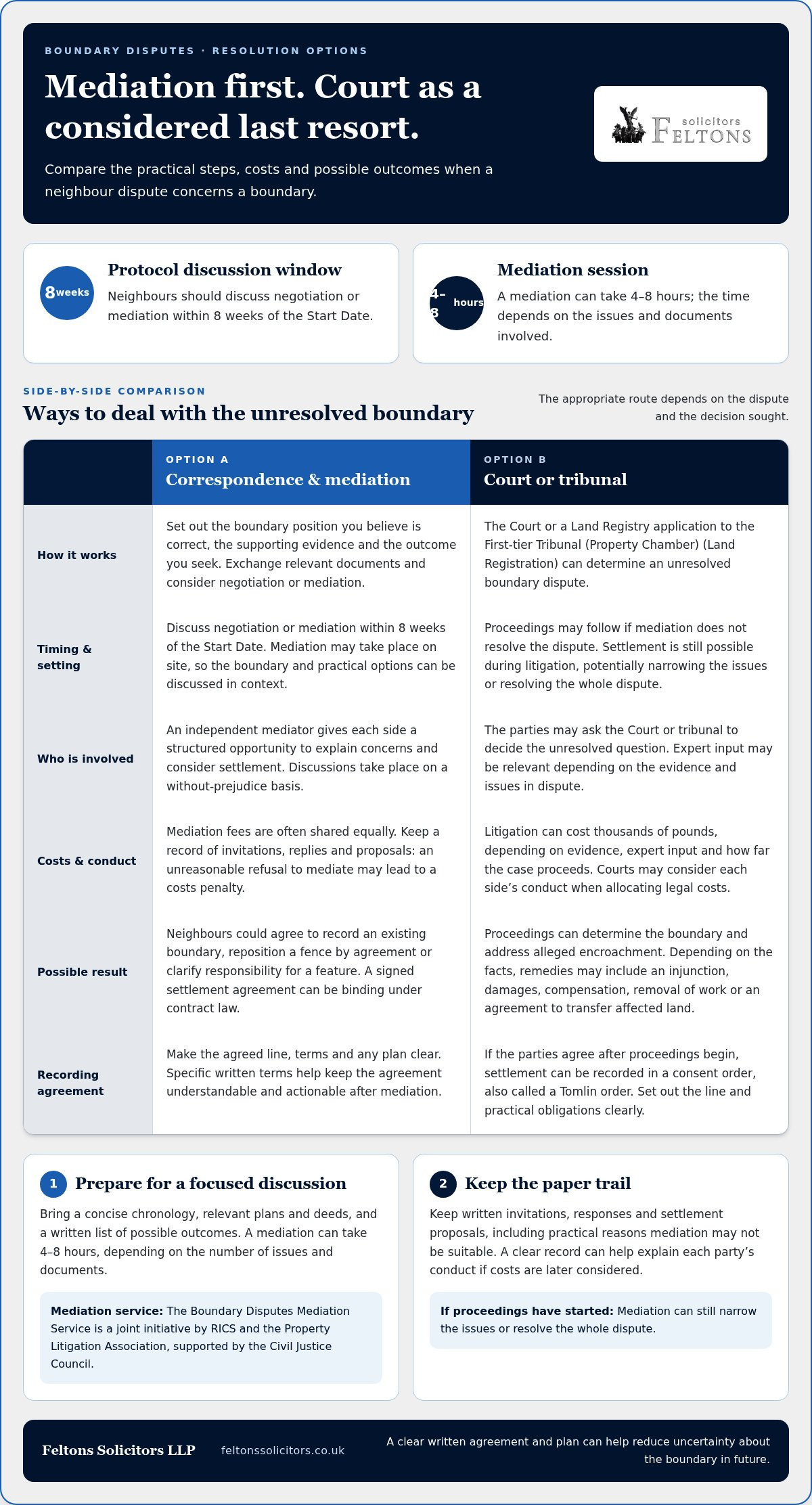
Mediation is recommended before court, and boundary proceedings should be a last resort after the parties have tried alternative dispute resolution. A party who unreasonably refuses mediation may face a costs penalty, even if they later succeed on the boundary question. Courts can consider each side’s conduct when deciding who should bear the legal costs, so a clear written invitation and a reasoned response matter.

In Huntley v Armes, cited by the Court of Appeal (Civil Division) as [2010] EWCA Civ 396, the dispute concerned a strip measuring 14 inches. The case is a reminder that a small area can still lead to formal proceedings and cost consequences. Keep records of proposals, replies and any practical reasons mediation may not be suitable; those details can help explain your conduct if a judge later considers costs.

The Boundary Disputes Protocol identifies the Court or a Land Registry application to the First-tier Tribunal (Property Chamber) (Land Registration) as routes for determining an unresolved boundary dispute. The appropriate route depends on the nature of the dispute and the decision sought. A solicitor can advise on the process, evidence and remedies relevant to your rights before you make an application.

Starting proceedings does not rule out settlement. The parties can mediate during litigation, potentially narrowing the issues or resolving the whole dispute. If they agree, the settlement can be recorded in a consent order, also called a Tomlin order, once proceedings have begun. Set out the agreed line and practical obligations clearly, rather than relying on an informal conversation or ambiguous sketch.

Where the dispute involves building work near a shared wall, distinguish boundary questions from party-wall issues. The Party Wall Act 1996 concerns building work affecting shared structures between two properties, according to UK Parliament. UK Parliament also identifies a 3 metre provision as a frequently misunderstood component of the Party Wall etc Act 1996. That provision should not be treated as deciding ownership of a disputed strip of land.

Court proceedings can determine the boundary and address alleged encroachment. Depending on the facts, possible remedies include an injunction, damages, compensation, removal of work or an agreement to transfer affected land. If construction is still under way, prompt advice may preserve more practical options. Planning permission or building regulations approval does not itself give a neighbour ownership of, or a right to build on, your land.

Before escalating, organise the title documents, photographs and a concise chronology of events. Identify the outcome you want, such as confirming the boundary, stopping work or recording an agreement. Then consider whether negotiation or mediation could achieve that outcome without a final hearing. If the other party declines, keep a record of their reasons and your response; the courts may consider that conduct when allocating costs.

Alternative dispute resolution

Mediation is one route to a practical agreement, alongside focused correspondence and expert discussions. If it fails, the parties can still pursue litigation, which can cost thousands of pounds depending on the evidence, expert input and issues in dispute. A solicitor handling boundary dispute mediation in the UK can help assess which route best fits the unresolved points.

Correspondence and mediation

Start with a clear letter setting out the boundary position you believe is correct, the evidence supporting it and the outcome you seek. Neighbours can then exchange relevant documents and consider whether negotiation or mediation could resolve the difficult points. Under the Boundary Disputes Protocol, they should discuss negotiation or mediation within 8 weeks of the Start Date.

Mediation gives each side a structured opportunity to explain its concerns and consider a settlement with an independent mediator. Discussions take place on a without-prejudice basis, and mediation fees are often shared equally. Boundary mediations can take place on site, helping everyone discuss the precise line and practical options in context.

The Boundary Disputes Mediation Service is a joint initiative by RICS and the Property Litigation Association, supported by the Civil Justice Council. A mediation can take 4-8 hours, though the time depends on the number of issues and documents involved. Prepare a concise chronology, relevant plans and deeds, and a written list of possible outcomes before the meeting. For neighbours considering boundary dispute mediation in the UK, this preparation helps keep discussion focused on achievable terms.

Keep proposals specific. Neighbours might, for example, agree to record an existing boundary, reposition a fence by agreement or clarify responsibility for a feature. A signed settlement agreement can be binding under contract law. Make its terms and any plan clear, so the agreement remains understandable and actionable after mediation ends.

Options after unsuccessful mediation

The Boundary Disputes Protocol identifies the Court or the First-tier Tribunal (Property Chamber) (Land Registration), by way of a Land Registry application, as routes for determining an unresolved boundary dispute. The next step depends on what remains disputed, the available evidence and the decision needed.

Litigation can cost thousands of pounds. The expense depends on how much evidence must be gathered, whether expert reports are needed and how far the case proceeds. Court proceedings may also result in a costs decision, so keep mediation invitations, responses and settlement proposals to show how each party approached dispute resolution.

When legal advisers are instructed after the initial 8-week period, the Protocol says they should consider whether further negotiation or mediation is appropriate and inform the other party within 2 weeks of appointment. For advice on the legal route and next steps, explore dispute resolution support.

A boundary solicitor reviews title documents and evidence, explains the issues and advises on practical next steps. To find a specialist near you, look for experience in property disputes and boundary evidence, rather than relying on distance alone.

Finding the legal boundary

Start by comparing the Land Registry title plan with the deeds and physical features on the ground. Most registered properties in England and Wales follow the general boundaries rule, so a title plan usually indicates a boundary’s general position rather than its precise measurement. A line on the plan may represent several metres on the ground, so it may not settle a disagreement by itself.

Check whether the official copies record a boundary agreement or formal boundary determination. These can be exceptions to the general guide shown by a title plan. Ordnance Survey maps physical features, not legal boundaries, and its mapping is not precise enough to establish ownership on its own.

Legal and surveying advice

An initial legal assessment brings the available documents together and identifies what remains disputed. A solicitor can compare the title plan, deeds, correspondence and neighbours’ accounts, then advise whether negotiation, a boundary agreement or further evidence may help. This also clarifies the outcome you are seeking, such as confirming the existing line or resolving a claim over land.

If comparing documents does not resolve the position, a specialist surveyor can interpret measurements, historic features and how plans relate to the ground. Consider carefully whether that expertise is needed before instructing an expert, since involving one too early can add considerable expense. The key question is whether a surveyor’s independent analysis would answer an unresolved point.

Risks of moving a fence or wall

Moving a fence does not automatically change the legal boundary or transfer ownership. If a neighbour’s new fence appears to cross the line, moving it back before establishing the boundary can escalate the dispute and complicate a later settlement. Record its location with dated photographs and preserve relevant correspondence before taking physical action.

A solicitor can assess the evidence and explain how a proposed change might affect the parties’ positions. If the dispute concerns building work, distinguish ownership from planning permission or building regulations approval. Those approvals do not themselves give someone ownership of, or a right to build on, neighbouring land.

Boundary litigation can become costly, particularly if the parties need expert reports or a court determination. The eventual expense depends on the issues, evidence and how far proceedings progress, so an early assessment can identify what needs clarification before litigation is considered. Record any settlement clearly, with an accurate plan, to reduce the risk of the same uncertainty returning when either property is sold.
Boundary dispute mediation solicitors in the UK: finding your boundary

Gathering evidence and interpreting title deeds

Build a clear record before discussing the boundary with the other owners. Comparing title documents with historic features and evidence from the ground can help identify where accounts differ.

Land Registry plans and boundary evidence

Use the Land Registry title plan as one part of the evidence, not as a precise survey. Most registered properties in England and Wales are subject to the general boundaries rule, so a plan usually shows the boundary’s general position. A line may represent several metres on the ground.

Compare the plan with the physical features it may relate to, such as a wall, hedge or old fence line. Ordnance Survey maps show physical features rather than legal boundaries, so they cannot settle ownership by themselves. Record any difference between the mapped line and what you see on site.

Evidence used to establish a boundary

Gather documents and observations that may explain how the boundary was created and treated over time. Useful material can include title plans, conveyance documents, dated photographs, correspondence between owners and details of historic features on the land. Keep each item in date order and note what it shows.

Boundary disputes can involve deeds 150 years old. Pre-registration deeds may contain a plan or a detailed written description, and those details can be compared with the present layout. A surveyor can help interpret measurements, historic features and the relationship between documents and conditions on the ground.

Make a short chronology of events, including when a fence was installed, repaired or moved, and when either party first objected. Label photographs with their dates and viewpoints. If a previous owner discussed the boundary, preserve letters or messages and identify anyone who witnessed the conversation.

The Boundary Disputes Protocol sets out practical steps for exchanging material. Neighbours should assemble and exchange relevant documents within 4 weeks of the Start Date. After identifying the First Conveyance, parties should exchange documentary evidence and identify proposed witnesses within 3 weeks.

These steps help both parties see which points are agreed and which remain disputed. For example, documents might establish the original line, while photographs show that a later fence was placed elsewhere. Discuss the difference before deciding whether further expert evidence is needed.

Keep the evidence organised in a shared schedule: list each document, its date, its source and the point it supports. Separate direct evidence, such as a deed plan, from interpretation, such as what a physical feature may indicate. This helps owners discuss the same material and consider whether a boundary agreement or further assessment could resolve the disagreement.

Boundary disputes

Boundary disputes can involve a fence, a wall, building work or long occupation of disputed land. Procedures differ across the UK: the Boundary Disputes Protocol and Land Registry routes discussed here concern England and Wales, not Scotland or Northern Ireland.

Start by defining the issue and the outcome you want. Is the disagreement about the boundary’s position, ownership of a strip, responsibility for a shared feature or construction crossing the line? These questions can overlap, but may require different evidence and remedies. For example, an extension built across a boundary raises questions about the land occupied and whether work should stop or be removed.

Long use of land can also complicate a claim. In England and Wales, a new-style adverse possession claim may rely on a condition in Schedule 6 paragraph 5 of the Land Registration Act 2002. That makes it important to distinguish a claim based on occupation from a disagreement about interpreting a deed. Gather evidence of how the land was used and who controlled it, then identify the specific basis of each party’s position.

A surveyor’s role is to provide independent evidence on physical features, measurements and how documents relate to conditions on the ground. The Boundary Disputes Protocol says expert instructions should follow CPR Part 35.3, according to the Civil Procedure Rule Committee. Under that rule, the expert’s duty to help the tribunal overrides obligations to the person instructing or paying them. Their opinion should address the issue, not advocate for either neighbour.

Before commissioning expert work, set out the question the surveyor must answer and the material they need. If the parties jointly appoint an expert, agree the instruction and provide relevant documents consistently. A concise report focused on the disputed line can help narrow complex disagreements. If litigation follows, a boundary surveyor may need to prepare a CPR-compliant expert report for the court.

Possible outcomes depend on the claim. They may include an agreed boundary, an injunction, damages, compensation, removal of encroaching work or a formal transfer of affected land. A boundary agreement can record where the existing legal boundary lies, but cannot be used to give or sell land to a neighbour. If ownership of land is changing, the parties may need a formal transfer instead.

Set out the unresolved issue, evidence and outcome you want before choosing the next step. Discuss your boundary dispute and the legal options available for resolving it.

Feltons Solicitors LLP: Divorce and Financial Arrangements

Feltons Solicitors LLP provides residential and commercial conveyancing when resolving a boundary issue involves a formal transfer of land. A boundary agreement records where the existing legal boundary lies; it cannot itself give or sell land to a neighbour. If a proposed settlement changes ownership, conveyancing support can help with the property transaction involved.

Before taking that step, establish whether the agreement confirms the existing line or transfers part of a title. Keeping that distinction clear helps ensure the paperwork reflects what both owners have agreed. For help with a property transaction arising from a boundary settlement, contact Feltons Solicitors LLP.

Take a considered next step

A boundary disagreement can affect more than the line on a plan. It may shape how neighbours use their gardens, maintain shared features and approach future property decisions. Before agreeing a way forward, set out the outcome you need and consider how the agreement will be recorded and understood by future owners.

Solicitors handling boundary dispute mediation in the UK can help you assess the legal issues and identify a practical route towards resolution. Feltons Solicitors LLP also advises on divorce and financial arrangements, wills, probate and estate planning, and residential and commercial conveyancing. Conveyancing may be relevant if resolving the dispute involves transferring part of a title.

If you’re ready to discuss your circumstances and possible next steps, contact Feltons Solicitors LLP. A clear starting point can help you approach the dispute with greater confidence.

Frequently Asked Questions

Establishing where the boundary actually is?

Compare the registered title, any filed deeds and the history of the disputed strip, rather than relying on a fence line alone. Note where fixed features sit and whether earlier photographs or conveyancing records show a different arrangement. A useful first step is to mark the disputed section on a copy of the plan, then list the documents or observations that support each neighbour’s position. This focuses discussions on evidence, not assumptions.

How long will it take to resolve a dispute?

There is no single timetable for a boundary dispute: the time depends on the issues, available documents and whether an agreement is reached. A mediation can sometimes resolve the dispute in 4-8 hours, but preparing for it and recording an agreement take additional time. If parties need expert reports or a court decision, the process will involve further steps. Set a practical aim for each stage, such as exchanging documents or narrowing disputed points.

Is the mediation outcome binding?

A settlement recorded in an agreement signed by both parties is binding, and a formal settlement agreement can be enforced under contract law. Before signing, make sure the written terms match the decision reached: identify the boundary clearly, describe any agreed work or responsibilities, and attach a plan both parties understand. If court proceedings have already begun, the settlement may be recorded in a consent order, also called a Tomlin order.

What happens if an agreement cannot be reached?

If mediation does not produce an agreement, the parties can continue negotiating or seek a formal decision through court proceedings or an application to the First-tier Tribunal (Property Chamber) (Land Registration). The next step depends on the unresolved issue and the decision needed. Before proceeding, list the points that are agreed, those still contested and the evidence supporting each position. This can help keep any later application focused.

What if the neighbour has used the land for years?

Long occupation can be relevant, but it does not by itself resolve a boundary disagreement. In England and Wales, a neighbour’s use of land may raise an adverse possession issue, even where the registered title appears to include that land. Record how the area has been occupied, maintained or enclosed, and whether permission was given. Dates, historic photographs and correspondence can help distinguish a long-standing arrangement from a later change in position.

Who can apply for mediation?

Either neighbour can propose mediation, and both parties need to participate for a jointly agreed settlement to emerge. A written proposal can identify the disputed area, the outcome sought and the documents each side should bring. The Boundary Disputes Protocol says neighbours should discuss whether to negotiate or mediate within 8 weeks of its Start Date. Legal advisers can also consider whether further mediation is appropriate when instructed later.

Who pays the fees?

Mediation fees are often shared equally between the parties, though they can agree another arrangement. Clarify who will pay which share before arranging the session, and establish how separate expenses, such as expert input, will be handled. Keep a written record of that agreement. If the dispute later reaches court, a judge may also consider whether either party unreasonably refused mediation when deciding costs.

How much do UK boundary dispute solicitors charge, and what are typical costs?

Solicitor fees depend on the case and are provided after a quote request; the main cost factors include the work required, the complexity of the dispute, the evidence and whether expert reports or court proceedings are involved. Boundary disputes can run into thousands of pounds to resolve legally, with litigation generally adding further stages and expense. Mediation may help contain costs, but its suitability depends on what remains disputed.

Commercial Property Acquisition by an Overseas Company: UK Legal Guide

Commercial Property Acquisition by an Overseas Company: UK Legal Guide

Could an overseas company agree terms for a UK commercial property, only to find that a registration gap prevents the transfer being registered? It’s a practical risk: an overseas entity generally needs to be registered with Companies House and hold a valid Overseas Entity ID, or the Land Registry may refuse to register the property transfer. A commercial property acquisition overseas company buyers plan therefore needs the legal and compliance steps considered together from the outset.

Registration, company records and property due diligence can all affect the transaction. Preparing early helps you identify the information needed and deal with key requirements before they become obstacles. This guide covers the main stages, including overseas-entity registration, due diligence, conveyancing and the filing duties that follow registration.

Feltons Solicitors LLP advises on commercial conveyancing and registration of overseas entities, helping national and international clients coordinate these connected matters. This guide explains what to prepare, when each step arises and how tailored legal advice can help you move the transaction forward.

Key Takeaways

  • Clarify which UK jurisdiction the property is in and whether the buyer is an overseas entity, as this shapes the legal steps involved.
  • Prepare beneficial-owner and managing-officer information early to address registration and disclosure requirements.
  • Tailor due diligence to the property’s title, occupational arrangements, condition and intended commercial use.
  • Plan the commercial property acquisition overseas company process as a connected sequence, coordinating entity checks, property enquiries and conveyancing from the outset.
  • Joined-up legal advice can help organise company information, assess contractual issues and progress registration and conveyancing together.

Commercial property acquisition by an overseas company: what the transaction involves

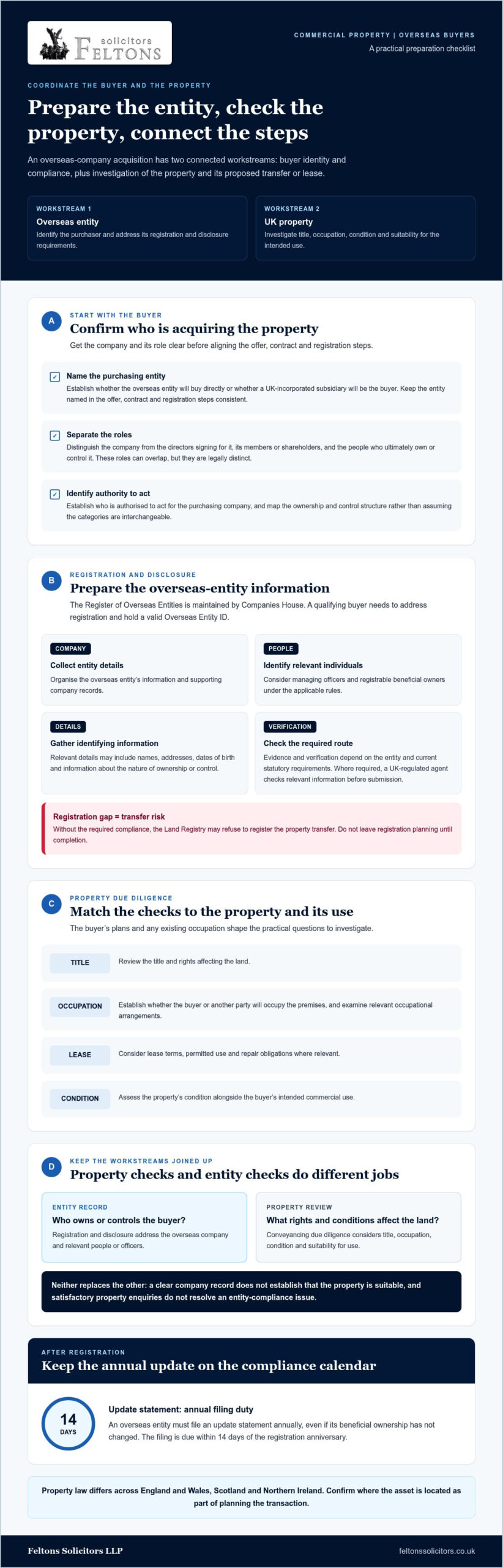
An overseas-company acquisition is a transaction in which an entity formed outside the UK buys or holds UK commercial land. The purchaser is the company, not the directors who sign documents on its behalf, its members or shareholders, or the people who ultimately own or control it. These roles can overlap, but they are legally distinct and may call for different information and checks.

This guide focuses on UK property. Land and property law differs across England and Wales, Scotland and Northern Ireland, so the location of the asset matters. For general background on the UK market, see the UK Real Estate Market Overview. A “commercial property acquisition overseas company” transaction involves two connected workstreams: checking the overseas buyer’s identity and compliance, and investigating the property while negotiating its transfer or lease.

Which overseas-company structure is buying the property?

An overseas entity may buy property directly in its own name. Alternatively, a group might use a UK-incorporated subsidiary as the buyer, creating a separate UK legal entity within the wider corporate structure. The choice can affect how ownership is organised and may have corporate, tax and financing consequences that depend on the buyer’s circumstances. There is no single structure that suits every purchaser. Identify the intended buyer early so the entity named in the offer, contract and registration steps is consistent.

What makes a commercial acquisition different?

Commercial due diligence depends on what the buyer plans to do with the premises and whether anyone already occupies them. An office bought for the buyer’s own business raises different practical questions from a warehouse acquired with an existing tenant, for example. The title, lease terms, permitted use, repair obligations and condition can all affect the buyer’s assessment of the property and the terms needed in the contract.

Keep these property questions separate from ownership disclosure. The property review concerns rights affecting the land, occupational arrangements and suitability for the intended use. Entity checks concern the overseas company and the people or officers relevant to its ownership and control. Neither replaces the other: a clear company record does not establish that the property is suitable, and satisfactory property enquiries do not resolve an entity-compliance issue.

  • Purchasing entity: establish which company will enter into the transaction and who is authorised to act for it.
  • Ownership and control: distinguish the company’s directors and members from the people who ultimately own or control it.
  • Property purpose: identify the planned use and whether the premises will be occupied by the buyer or another party.

Resolve these points together to give the transaction a clearer foundation. This helps align company information, property enquiries and contract arrangements before the buyer commits to a structure or timetable.

Overseas-entity registration and disclosure: the compliance questions to resolve

The Register of Overseas Entities (ROE), maintained by Companies House, records information about overseas entities that own or seek to acquire qualifying UK land. The regime was introduced by the Economic Crime (Transparency and Enforcement) Act 2022. For a qualifying buyer, registration and a valid Overseas Entity ID are important parts of the acquisition. Without compliance, the Land Registry may refuse to register the property transfer.

Registration is not a formality to leave until completion. The buyer needs to establish which overseas entity is acquiring the property, identify the people and officers whose details must be disclosed, and organise verification in line with the rules that apply to its ownership structure. These checks sit alongside, rather than replace, conveyancing due diligence. An entity’s registration record does not establish that the property title, lease arrangements or condition are satisfactory.

What information and verification may be required?

The application generally involves information about the overseas entity, its managing officers and any registrable beneficial owners. A beneficial owner is an individual or relevant legal entity that meets the statutory tests for owning or controlling the overseas entity. A managing officer is a person who manages the entity where the rules require their details. Directors, shareholders and beneficial owners are not automatically interchangeable categories, so examine the ownership structure rather than assume they are the same.

Relevant details may include names, addresses, dates of birth or other identifying information, as well as information about the nature of ownership or control. The evidence and verification route depend on the entity and the current statutory requirements. Where verification by a UK-regulated agent is required, that agent checks the relevant information before it is submitted. Different structures can involve several lines of ownership and control, so map the group structure and collect supporting company records early.

How can registration affect the acquisition timetable?

Check registration status as soon as the proposed buyer and transaction are identified. If the entity still needs to register, gathering information across a group with several ownership layers or overseas officers may require coordination. Running this work alongside offer negotiations and property enquiries can help avoid leaving a key compliance step until the parties are preparing to complete.

The practical link is clear: an overseas entity that must comply with the ROE needs the required registration status for the Land Registry to register the relevant property transaction. The precise restriction and how it applies depend on the circumstances and current rules, so review the buyer’s status and title requirements as part of the conveyancing process.

For a commercial property acquisition overseas company, aligning registration work with conveyancing helps keep entity information, verification and title registration on the same transaction plan. Feltons advises on overseas-entity registration and commercial conveyancing, coordinating these related steps and addressing the details of the ownership structure.

Commercial property due diligence for an overseas-company buyer

Property due diligence helps you understand what is being acquired, how it can be used and which obligations may continue after completion. Shape enquiries around the buyer’s plans: a property intended for its own operations may raise different priorities from an investment property with existing tenants. Keep this review separate from checks on the purchasing entity. Company registration does not establish that the property is suitable or that its title and occupation arrangements are acceptable.

Organise the work by linking each enquiry area to the decision it informs:

Enquiry area What to examine Decision it informs
Title and rights Ownership, title entries, access, restrictions and third-party interests Whether the buyer can obtain the rights and control it needs
Occupation Lease terms, rent position, tenant obligations and who occupies the premises Whether income, possession and continuing responsibilities fit the plan
Condition and environment Available building information and appropriate technical investigations Whether further assessment or contractual protection is needed
Intended use Planning history, permitted use and relevant building documents Whether the proposed activity appears compatible with the property information

Title, rights and occupational arrangements

Title review identifies the registered owner and the rights or restrictions recorded against the land. An access route, for example, may depend on rights benefiting the property, while a title restriction may affect how it can be dealt with. Third-party interests can also shape the buyer’s practical control. Conveyancing enquiries clarify what those entries mean for the proposed transaction and whether further information or contractual provisions should be considered.

If the property is let, examine the lease rather than relying only on a summary of the rental position. Relevant points include the term, rent, review provisions, repair and insurance obligations, permitted occupation and arrangements affecting the tenant’s use. The findings may inform negotiations, contractual protections or, if a concern cannot be resolved, a decision not to proceed.

Use, condition and transaction-specific risks

Start with the intended activity. A buyer planning to operate a particular business from the premises needs enquiries into whether the recorded planning position, permitted use and available building documents align with that plan. The precise enquiries depend on the site and proposed use. Legal review can identify issues in the available documents, but cannot replace specialist technical conclusions.

Condition and environmental investigations serve a different purpose from legal due diligence. Appropriate surveys and assessments can reveal matters that need specialist evaluation. A valuation considers the asset’s value for its purpose, while tax advice addresses the buyer’s particular structure and transaction. These workstreams should inform one another without being confused.

VAT also deserves early attention. If the seller has opted to tax the property, VAT may affect the purchase price and the SDLT calculation. The position depends on the transaction, so include it in tailored tax advice before finalising the commercial assumptions. A coordinated commercial property acquisition overseas company review connects title findings, occupation, intended use and tax questions to the buyer’s decision, rather than treating each enquiry in isolation.

Commercial Property Acquisition by an Overseas Company: UK Legal Guide

From offer to completion: a practical acquisition sequence

A clear sequence keeps company checks, property enquiries and contract decisions moving together. The steps below are a useful framework, not a fixed timetable. The transaction’s pace depends on the property, the buyer’s company information, the registration position and what due diligence reveals.

Before exchange: establish the buyer and investigate the asset

Before committing, confirm the exact entity that will buy the property and gather its constitutional documents, authority to act and relevant ownership information. At the same time, review the title and contract papers, arrange appropriate searches and consider the property’s commercial arrangements. Record issues that need negotiation, further investigation or specialist input so they can inform the decision to proceed.

  1. Identify the proposed buyer. Confirm the overseas entity’s legal name, place of incorporation and the people authorised to act for it. Make sure the proposed purchaser is consistent across the offer, company records and transaction documents.
  2. Review registration requirements early. Establish whether the entity needs to register with Companies House and whether it has the required Overseas Entity ID. If registration or verification is needed, coordinate that work with conveyancing rather than leaving it until the parties are ready to complete.
  3. Agree offer terms and obtain the papers. Clarify the proposed price, what is included in the sale, any occupation arrangements and the intended use. Request the contract pack and available property information so legal review can begin promptly.
  4. Investigate the property and the transaction. Review the title, searches, leases and other relevant documents, and arrange appropriate specialist enquiries. Compare the findings with the buyer’s plans, noting matters that may affect value, use, obligations or contract terms.
  5. Resolve key issues before exchange. Decide whether further information, contract changes or other protections are needed. Exchange is the point at which the parties enter into a binding contract on its terms, so address material concerns before making that commitment.

Exchange, completion and registration

Completion is when the transaction is carried out in accordance with the contract, including payment of the balance and transfer of the property. The conveyancer then deals with applicable post-completion filings and applies to register the transfer with the relevant land registry. Requirements depend on the property’s jurisdiction and the transaction. The sequence is straightforward in principle, but the supporting documents and compliance position must be in order.

  1. Prepare for completion. Confirm that contractual requirements, funds and documents are ready, and that the buyer’s registration position supports the intended transaction.
  2. Complete and register the transfer. Carry out the agreed completion steps, then submit the required application and supporting documents to the relevant land registry.

For more detail on ownership disclosures, the guide to overseas entity beneficial owner registration explains the information involved. Feltons coordinates registration and commercial conveyancing as part of a commercial property acquisition overseas company transaction. Speak to Feltons about your acquisition for tailored legal support with company information, property enquiries and contractual steps.

How Feltons can support an overseas-company commercial acquisition

A commercial purchase by an overseas entity brings together company information, property documents and contractual decisions. Feltons Solicitors LLP advises on commercial conveyancing and registration of overseas entities, including complex property transactions for national and international clients. Tailored legal advice can help you understand how these strands relate, identify the information to gather and focus on issues that may affect the proposed transaction.

The legal work can include considering the buyer’s entity details and registration position alongside the property papers, reviewing the contract and raising relevant conveyancing enquiries. This joined-up approach helps show where one issue may affect another. For example, proposed occupation arrangements may influence contract terms, while the identity of the purchasing entity informs registration work. The aim is pragmatic advice shaped around the transaction, not a promise of a particular outcome.

Coordinating registration and conveyancing advice

Clear responsibilities and organised documents can make a complex purchase easier to manage. The buyer’s team can identify who will provide company and ownership records, who can approve decisions, and how property enquiries and registration information will be gathered. Timely communication matters, particularly where information must come from people in different roles or jurisdictions.

The legal team can connect the entity review with the title, contract and occupational arrangements while keeping each workstream distinct. If the commercial decision involves weighing ownership against occupation under a lease, Feltons’ guide to commercial property law: buying versus leasing may help frame the issues for discussion. Tax, financing and technical questions may need input from the relevant specialists. Legal advice can identify where those questions intersect with the conveyancing process.

Preparing for an initial legal discussion

A focused first discussion is easier when the key facts are to hand. You do not need to resolve every issue in advance. A useful starting pack may include:

  • Entity details: the proposed buyer’s legal name, place of incorporation and available constitutional documents.
  • Ownership and authority information: a group structure or ownership chart, details of relevant officers and information about who can authorise the purchase.
  • Property particulars: the address, title information if available, sales particulars, draft contract papers and details of any existing lease or occupation.
  • Commercial objectives: the intended use, whether the buyer or a tenant will occupy the premises, and the key points the buyer wants the transaction to achieve.

These details help shape advice around the actual buyer and asset. They also make it easier to identify missing information, clarify priorities and organise next steps without assuming every acquisition follows the same route.

If you’re considering a commercial property acquisition overseas company structure, Feltons can advise on the proposed purchase. A discussion of the company, property and commercial objectives can help establish the appropriate conveyancing and overseas-entity registration work for your circumstances. Discuss your commercial property acquisition with Feltons.

Plan your next step with confidence

Turn your commercial objective into a clear legal plan. Consider what the property needs to achieve for your business or investment, which decisions are time-sensitive and who within your organisation can provide the required information. For a commercial property acquisition overseas company buyers pursue, this early alignment helps connect legal questions to the purpose of the purchase.

Feltons Solicitors LLP advises national and international clients on complex property matters, bringing commercial conveyancing and overseas-entity registration support together where the transaction calls for both. Advice can be tailored to the proposed buyer, property and contractual issues, while tax, finance or technical questions can be considered with the relevant specialists.

You do not need every detail resolved before seeking legal guidance. A discussion can help clarify priorities, identify useful documents and establish appropriate next steps for your circumstances. Discuss your commercial property acquisition with Feltons to understand the legal work involved.

Frequently Asked Questions

Can an overseas company obtain a UK commercial mortgage?

Does buying UK commercial property through an overseas company create UK tax obligations?

It can. The acquisition may involve property transaction taxes, and VAT can affect the price and tax calculation if the seller has opted to tax the property. Tax obligations can also arise during ownership or on disposal; non-resident companies pay UK Corporation Tax on gains from disposing of UK commercial property. The treatment depends on the transaction, structure and property location, so obtain tailored tax advice before relying on projected costs or returns.

Is beneficial ownership information on the Register of Overseas Entities publicly available?

Yes, the Register of Overseas Entities is publicly searchable and provides information about overseas entities and registrable beneficial owners. Not every personal detail is necessarily displayed: some information, such as residential addresses and full dates of birth, is treated differently from public-facing details, and protection arrangements may apply in defined circumstances. Buyers should distinguish the information that must be supplied to Companies House from what the public can view.

How often must an overseas entity update its information?

An overseas entity must file an update statement with Companies House annually, even if its beneficial ownership information has not changed. The filing is due within 14 days of the anniversary of its registration. The statement confirms or updates the relevant information for the entity. Keep a record of the registration anniversary and review ownership and officer details in good time so changes can be accurately reported through the applicable process.

Can an overseas company buy UK property through a UK subsidiary instead?

Yes. A group may choose to have a UK-incorporated subsidiary purchase the property rather than having the overseas parent acquire it directly. The subsidiary is a separate legal entity, so its authority, funding and contractual position need to be considered in their own right. Using a UK company does not automatically remove other disclosure or compliance obligations. The right structure depends on the group’s commercial, tax and financing circumstances.

Does an overseas company need a UK bank account to buy commercial property?

A UK bank account is not necessarily a legal prerequisite to owning commercial property, but the buyer needs a workable arrangement for paying the purchase funds and meeting any lender or transaction requirements. The conveyancer will need to understand the source and movement of funds as part of the transaction checks. If funds will arrive from an overseas account, agree the practical transfer arrangements early, particularly where currency conversion or several group entities are involved.

What happens if an overseas company’s ownership changes after it acquires property?

A change in ownership or control may affect the information the company must disclose to Companies House. The entity should assess whether the change makes someone a registrable beneficial owner or alters details already on the Register, then report it through the applicable update process. Keep supporting records and review the effect promptly rather than waiting for a future sale or refinancing. Changes can also have separate corporate, financing or tax implications.

Land Registry Overseas Entity ID Requirements: A 2026 Checklist

Land Registry Overseas Entity ID Requirements: A 2026 Checklist

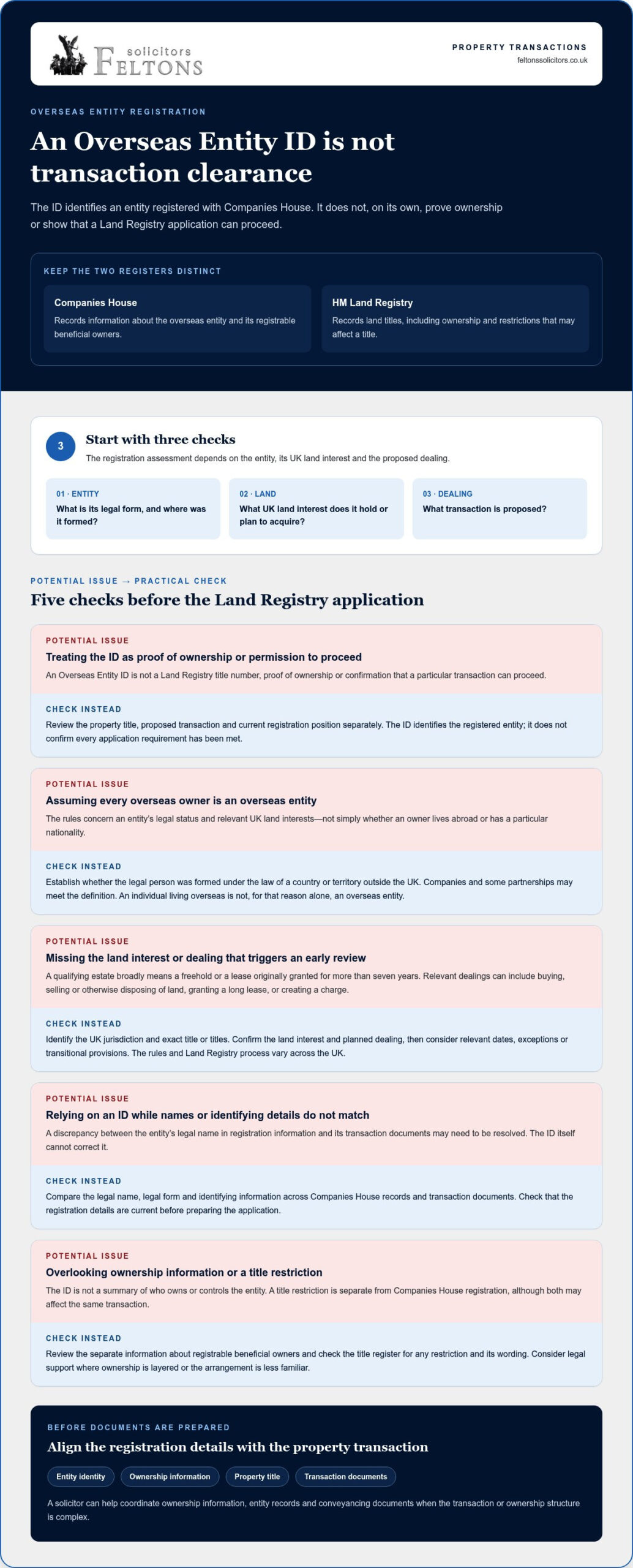
An Overseas Entity ID is a registration reference, not a green light for a UK property transaction. The land registry overseas entity ID requirements involve registering the entity with Companies House and checking that its details support the Land Registry application. An ID alone does not resolve inconsistencies or fill gaps in the information needed for a transaction.

To assess whether the rules apply, look at the entity’s legal status, its UK land interests and the activity proposed. Companies House registration and a Land Registry application are separate steps, so check that the relevant details align before documents are prepared. Doing this early can help identify issues before they affect an application.

This 2026 checklist explains when an Overseas Entity ID may be needed, what information to prepare and what to review before an application is made. It also covers how to check registration details and where legal support can help. Feltons Solicitors LLP advises on overseas entity registration and complex property transactions, helping clients coordinate registration information and conveyancing documents.

Key Takeaways

  • Start by reviewing the entity’s UK land interests and proposed transaction to establish which requirements may apply.
  • Use the land registry overseas entity ID requirements checklist to organise the registration and transaction details before applying.
  • Compare the entity’s legal name, form and identifying information across Companies House records and transaction documents.
  • Check that registration details are current, then review the property title restriction and transaction type before preparing the Land Registry application.
  • A solicitor can help coordinate ownership information, entity records and conveyancing documents when the transaction or ownership structure is complex.

What does a Land Registry overseas entity ID prove?

An Overseas Entity ID is the reference issued by Companies House when an overseas entity is entered on the Register of Overseas Entities. It identifies the registered entity. It is not a Land Registry title number, proof of ownership or confirmation that a particular property transaction can proceed.

The two registers serve different purposes. Companies House records information about the overseas entity and its registrable beneficial owners. HM Land Registry records land titles, including ownership and restrictions that may affect a title. An ID may be necessary for a property transaction, but it does not show that every registration or application requirement has been met. Check the title, proposed transaction and current registration position separately.

Which overseas entities are within the registration rules?

An overseas entity is a legal person formed under the law of a country or territory outside the UK. Companies and some partnerships may meet this definition. The rules concern the entity’s legal status and relevant UK land interests, not simply whether an owner lives abroad or has a particular nationality.

An individual who lives overseas is not, for that reason alone, an overseas entity. However, an individual may be a beneficial owner of an entity, which is a separate part of the registration analysis. The entity’s legal form and the law under which it was formed can affect whether the rules apply. Less familiar arrangements and layered ownership structures may need case-specific legal analysis before a transaction proceeds.

What is the difference between an entity ID and an owner’s details?

The ID is a reference for the registered entity. It is not a summary of the people who own or control it, and it does not replace the information required about registrable beneficial owners. Those details are assessed separately as part of the registration process.

Beneficial ownership analysis looks at relevant information about people or legal entities that own or exercise control over the overseas entity. The assessment depends on the structure and applicable rules. An ID alone does not establish that ownership information is complete, current or suitable for the transaction.

  • Entity identity: the overseas entity’s legal name and form.
  • Entity reference: the Overseas Entity ID issued after registration.
  • Ownership and control: the separate information required about registrable beneficial owners.

When checking the land registry overseas entity ID requirements, keep these elements distinct. A mismatch between the entity’s legal name in registration information and its transaction documents may need to be resolved. The ID itself cannot correct that discrepancy. Feltons Solicitors advises on overseas entity registration and complex property transactions, helping clients align ownership information with conveyancing documents.

Who needs an overseas entity ID for a UK property transaction?

Start with three questions: what kind of entity is involved, what interest in UK land does it hold or plan to acquire, and what transaction is proposed? Under the overseas entities regime, a legal entity governed by the law of a country or territory outside the UK may need to register if it owns or seeks to acquire a qualifying estate. Broadly, this means a freehold or a lease originally granted for more than seven years. The rules and Land Registry process vary across the UK, so identify the relevant jurisdiction before assessing the transaction.

This is a starting point, not a universal answer. The land registry overseas entity ID requirements can depend on the property interest, transaction date, title and applicable exemptions or transitional provisions. The regime also covers certain earlier acquisitions, with relevant dates varying across the UK. Review the transaction and title rather than relying on a general summary.

Which property dealings should prompt an early eligibility check?

Check the position early if an overseas entity is buying a qualifying estate, selling or otherwise disposing of relevant land, granting a long lease, or creating a charge over it. The effect of the rules depends on the dealing and circumstances. Having an ID does not automatically satisfy every Land Registry requirement.

Review the property title alongside the Companies House registration. A restriction on a title is a Land Registry entry that can limit registration of specified dispositions unless its stated condition is met. It is separate from registration on the Register of Overseas Entities, although both may affect the same transaction.

  • Identify the relevant UK jurisdiction and exact title or titles.
  • Confirm whether the entity owns or proposes to acquire a freehold or qualifying lease.
  • Describe the planned dealing, such as a transfer, lease or charge.
  • Review the title register for a restriction and note its wording.
  • Check relevant dates and whether an exception or transitional provision may apply.

How can ownership structures change the assessment?

Look beyond the name shown on the title. An overseas entity may be owned through several companies, or control may be exercised through arrangements that are not obvious from a simple ownership chart. Registration analysis must identify any registrable beneficial owners under the applicable tests. Shareholders and directors are not automatically decisive in every case.

Trust arrangements need particular care. Depending on the facts and rules, trustees and other people connected with a trust may be relevant to the ownership or control assessment. The treatment differs between structures. Record the chain of ownership and control, and flag trusts, intermediate entities or disputed control for legal analysis before preparing documents.

Where the structure or title raises questions, overseas entity registration and conveyancing support can help align the ownership analysis with the proposed property dealing and its Land Registry requirements.

What information should you check before relying on an overseas entity ID?

Review the details before relying on the ID in a property transaction. A valid-looking reference could be linked to the wrong entity, or the records may no longer reflect its legal name or ownership structure. The land registry overseas entity ID requirements are one part of the check: compare the Companies House record with the title and transaction documents.

Consistent records make it easier to show that the registered entity, property title and application documents refer to the same legal person. Differences in spelling, legal form or identifying details may need an explanation or correction. Deal with discrepancies early rather than waiting until the application is being prepared.

How should the entity’s registration details be checked?

Start with the Companies House Register of Overseas Entities. Find the entity and compare its record with the proposed transfer, lease or charge. Check the exact legal name and form, then confirm that the Overseas Entity ID belongs to that entity, not another group company with a similar name. Review the registration details for changes since the ID was issued.

Check the entity’s current position as well as its original registration. Overseas entities must file an annual update statement within 14 days of each registration anniversary, even if there have been no changes. Review the Companies House record for the latest filing and the next update date. Confirm the evidence and checking process required for the particular application against current Companies House and HM Land Registry guidance.

What owner and control information may need attention?

Compare the ownership and control information on the register with the entity’s current structure. Trace intermediate companies and consider whether changes in ownership, control or relevant personal details have been reflected in the required filings. Investigate missing or inconsistent entries rather than assuming they are immaterial. Trust arrangements may also require careful analysis. The people and information relevant to the disclosure depend on the circumstances and applicable rules.

  1. Match the entity: compare the exact legal name, legal form and identifying details across the Companies House record and transaction documents.
  2. Check the ID: confirm it is recorded against the entity that will be party to the transaction.
  3. Review current status: check registration details, the latest update statement and its next due date.
  4. Compare ownership: review beneficial owner and control information against the current structure, noting changes or uncertainties.
  5. Check the property records: examine the relevant HM Land Registry title information and ensure the application documents address any restriction.
  6. Organise supporting material: keep relevant records together and submit sensitive information only through the appropriate official process.

For complex structures, a solicitor can help reconcile entity records, beneficial ownership information and conveyancing documents before an application is lodged. This review can identify inconsistencies early and clarify which points need further attention under the current rules. In addition, individuals managing cross-border assets should keep abreast of broader statutory obligations, taking note of any recent hmrc tax warning regarding financial compliance and reporting.

Land Registry Overseas Entity ID Requirements: A 2026 Checklist

How do overseas entity ID requirements affect a Land Registry application?

Companies House registration and a Land Registry application are separate steps. Companies House records the overseas entity and issues its Overseas Entity ID. HM Land Registry deals with the property title and applications to register transactions. Having an ID does not, by itself, establish that an application meets the requirements for the title or the particular dealing.

The land registry overseas entity ID requirements need to be considered alongside the title register, transaction and supporting documents. A restriction on the title may specify conditions that must be satisfied before a disposition can be registered. Its wording matters. Do not assume that the same evidence or process applies to every sale, lease, charge or other dealing.

What should be checked on the title and application?

Begin with the current title information and identify any restriction referring to an overseas entity. Compare the registered proprietor and transaction parties with the Companies House details. A group may have several overseas companies with similar names, so confirm that the ID belongs to the legal entity named in the transaction and title records.

Next, establish which Land Registry application and evidence are appropriate for the transaction. Requirements can depend on the title, restriction and nature of the disposition. Check the current HM Land Registry guidance, forms and evidence standards rather than reusing documents from a different matter. The September 2026 version of Practice Guide 78 may require evidence that an overseas entity has existed continuously since it was first registered as proprietor. Assess whether that point is relevant to the title and application.

  • Read the restriction on the title and note the condition it sets.
  • Match the entity named on the title and in transaction documents to its Companies House record and ID.
  • Identify the transaction type and the application being made.
  • Check current Land Registry guidance for the applicable evidence and filing requirements.

What can happen if the ID or application details do not match?

An inconsistency may prompt HM Land Registry to raise questions or requisitions, or delay consideration of the application. The outcome depends on the issue and relevant rules. An administrative difference is not necessarily the same as a substantive eligibility or compliance problem, but it should be explained or corrected through the appropriate process.

For example, if a transfer names “Northstar Holdings Ltd” but the title or Companies House record uses a different legal name, the application may need clarification or supporting evidence. The mismatch could be a naming discrepancy, or it could indicate that the ID for a different entity has been supplied. These situations require different responses, so investigate the cause rather than making assumptions.

Where a restriction, ownership structure or supporting evidence raises questions, get legal support with your Land Registry application to coordinate registration details and conveyancing documents before submission.

A checklist helps organise the facts, but it cannot replace advice on the specific entity, title and transaction. The land registry overseas entity ID requirements involve separate Companies House and Land Registry processes. A solicitor can bring the records together, identify gaps in ownership information and assess how a title restriction applies to the proposed dealing.

Coordination is especially useful when registration details and conveyancing documents were prepared at different times or by different parties. For example, a change to an entity’s legal name or control structure may need to be reflected in relevant records and considered alongside the transaction documents. Legal review can identify what needs attention and which steps apply, without assuming a particular outcome or timetable.

When is tailored legal advice particularly useful?

Consider transaction-specific advice if ownership runs through several entities, a trust is involved, the entity’s details have changed, or the transaction is time-sensitive. These circumstances can raise questions that a general checklist cannot resolve by itself.

A solicitor can review the entity and ownership information alongside the title restriction and planned dealing. This joined-up assessment can help distinguish a record discrepancy from a wider eligibility or compliance issue, and clarify what to address before an application is prepared. Feltons Solicitors advises on overseas entity registration and complex property transactions, bringing registration and conveyancing considerations into the same discussion.

What should you have ready for an initial discussion?

You do not need to resolve every issue before seeking advice. A concise set of core details helps focus the discussion and identify what further information may be needed.

  • Entity details: the exact legal name, legal form and jurisdiction in which the entity is formed.
  • Registration reference: the Companies House Overseas Entity ID, if one has been issued, and any known update or record changes.
  • Property information: the relevant title number or title details, together with a copy of the title register if available.
  • Transaction outline: a short description of the proposed purchase, sale, lease, charge or other dealing, including any key dates.
  • Ownership and control: a simple outline of the ownership chain, any trusts, changes in control and unresolved questions.

Keep supporting documents organised, but avoid sending sensitive ownership material through informal or insecure channels. Appropriate handling depends on the information and why it is being provided.

For broader background on identifying the people connected with an overseas entity, the Overseas Entity Beneficial Owner Registration guide can help explain the ownership side of the checklist. For a UK property transaction, Feltons Solicitors can discuss how the registration position, title details and conveyancing documents fit together.

Put the next property step on a clear footing

Before the transaction moves further, turn your checklist into a working file. Record unanswered questions, identify who can provide the missing information and keep relevant documents together. This gives everyone involved a clearer basis for addressing registration and application issues as they arise.

The land registry overseas entity ID requirements can intersect with ownership structures and conveyancing documents in ways that call for a transaction-specific review. That assessment can help you identify what needs attention next, rather than relying on assumptions about how a previous matter was handled.

Feltons assists with overseas entity registration, residential and commercial conveyancing, and complex property transactions. Discuss your overseas entity and property registration requirements with Feltons to consider the appropriate next steps for your matter.

With the relevant details organised and issues identified, you can move forward with greater clarity about the registration and application requirements.

Frequently Asked Questions

What is a Land Registry overseas entity ID?

It is the reference Companies House issues after registering an overseas entity on its Register of Overseas Entities. The ID identifies the entity in that register. It is not a property title number or confirmation that every requirement for a particular transaction has been met. For example, an entity’s ID does not explain whether a restriction on a title affects a proposed transfer. Check the current rules and application requirements for the specific property and transaction.

Does an overseas entity need an ID to buy UK property?

An overseas entity may need to register and obtain an ID before a relevant property transaction can proceed, depending on its circumstances and the applicable rules. The land registry overseas entity ID requirements are not a single test that applies identically to every buyer. Establish the entity’s legal status, the property interest being acquired and whether an exception may be relevant. The title and current Companies House guidance can help identify the checks needed.

Can an overseas entity sell UK property without an ID?

That depends on the title, proposed sale and rules that apply to the entity. A restriction on the title may affect whether HM Land Registry can register a disposition, but its wording and any relevant exception need to be considered in context. Review the title register and current Land Registry guidance before progressing. A conveyancing solicitor can assess whether the entity’s registration position and sale documents address the relevant requirements.

What information is needed to apply for an overseas entity ID?

Registration generally requires information about the overseas entity and, where applicable, its registrable beneficial owners or managing officers. The details depend on the entity’s legal form and ownership arrangements. For example, a structure involving intermediate companies may require tracing ownership and control rather than considering only the immediate shareholder. Check the latest Companies House guidance before preparing the application, particularly if trusts or unusual control arrangements are involved.

Is an overseas entity ID the same as a Companies House number?

No. An Overseas Entity ID relates specifically to registration on the Register of Overseas Entities. It is distinct from other Companies House identifiers and from a Land Registry title number, which relates to a property title. For a transaction, use the precise reference requested and compare it with the entity’s official register entry. Similar names or numbers within a corporate group make this check particularly important. Do not assume one identifier can replace another.

What happens if the overseas entity ID is incorrect on a Land Registry application?

An incorrect or inconsistent ID may lead HM Land Registry to ask for clarification or raise a requisition, and could delay registration depending on the circumstances. Compare the application against the entity’s Companies House record to establish whether the error is a typing mistake or relates to a different entity. If the application has already been submitted, establish the appropriate correction process promptly. Where completion arrangements are time-sensitive, seek advice on the specific application.

Do beneficial owners need their own overseas entity ID?

No. The Overseas Entity ID identifies the registered entity, not each beneficial owner. However, registration may require information about registrable beneficial owners and other relevant people, depending on the ownership structure and applicable tests. For example, an individual who controls an entity through another organisation may need to be considered as part of the ownership analysis. Keep the entity’s reference separate from disclosure information and review complex arrangements carefully.

How long does it take to get an overseas entity ID?

There is no fixed timeframe that applies to every application. Processing can vary, and the completeness of the submission, verification requirements and complexity of the ownership structure may affect progress. Check current Companies House service information when planning, and allow time to address questions or correct information before a property transaction reaches a critical stage. If timing could affect contractual or completion arrangements, seek advice based on the transaction’s circumstances.